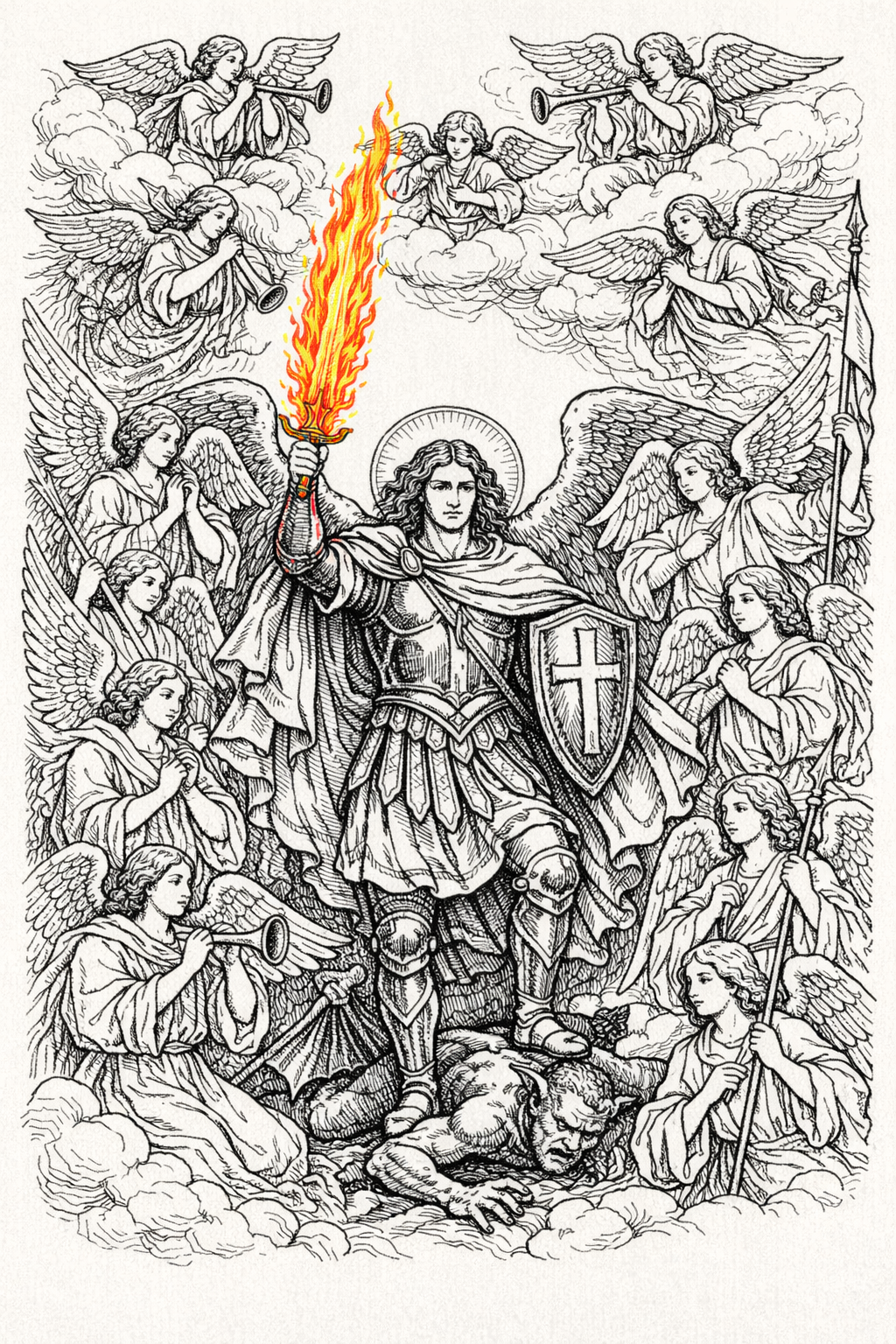
From Eden to the Apocalypse
The Complete Guide to Angels and Fallen Spirits
Thomas Veritas
Mater Press (mater.press)
January 2026
January 2026
From Eden to the Apocalypse
The Complete Guide to Angels and Fallen Spirits
Thomas Veritas
Mater Press (mater.press)
January 2026
Publisher’s Note
The author writes under the pen name Thomas Veritas for personal reasons. He is a layman, not an ordained priest. The theological content is offered in good faith and has been tested against Scripture and the perennial Magisterium.
Chapter 1
They are older than the stars. Before the first light broke across the void, before matter condensed into galaxies and planets, they existed—pure intellects, blazing with glory, standing in the presence of the Uncreated Light. Some of them fell. Most of them did not. And both groups have been intimately involved in human affairs since the Garden.
This is a book about angels.
Not the chubby cherubs of Renaissance art. Not the vague “spiritual beings” of New Age imagination. Not the greeting-card sentimentality that reduces the heavenly host to pleasant thoughts and warm feelings. This book is about the angels of Scripture and Tradition—the terrifying, glorious, powerful creatures who guard thrones, announce judgments, wage cosmic war, and occasionally appear to shepherds and virgins with messages that change history.
We live in an age of paradox. Surveys show that most people—including most who call themselves secular—believe in angels. Yet serious study of angelology has largely disappeared from popular religious education. The result is a strange situation: widespread belief combined with widespread ignorance.
This book aims to remedy that ignorance. Drawing on canonical Scripture, the deuterocanonical books, the pseudepigrapha, rabbinic literature, patristic sources, Islamic tradition, and the lived experience of the Church’s exorcists, we will construct the most comprehensive portrait of the angelic realm available in a single volume.
We make no apology for treating these sources with varying degrees of authority. The canonical Scriptures stand supreme. The deuterocanonical books (Tobit, Wisdom, Sirach) are authoritative for Catholics and Orthodox. The pseudepigrapha (1 Enoch, Jubilees, the Testaments) illuminate Jewish angelology without claiming canonical status. Rabbinic and patristic sources represent centuries of reflection. And the testimony of exorcists provides empirical data from the front lines of spiritual warfare.
The journey begins with Hierarchy—the ordered ranks of the heavenly host. The nine choirs of angels, systematized by Pseudo-Dionysius and affirmed by Thomas Aquinas, reveal that heaven is not a democracy but a kingdom, with distinct orders serving distinct functions. We will examine Seraphim, Cherubim, Thrones, Dominations, Virtues, Powers, Principalities, Archangels, and Angels—and ask where Satan stood before he fell.
From hierarchy we turn to Enoch—the man who walked with God and did not die. The Book of Enoch, canonical in Ethiopia and quoted in the New Testament, provides the most detailed account of the angelic realm in any ancient text. Here we encounter the Watchers, the heavenly scribes, and the mysterious figure who may have become the angel Metatron.
Then comes the Incursion—the catastrophe recorded in Genesis 6. “The sons of God saw the daughters of men that they were fair.” This cryptic passage has generated centuries of debate. Were these fallen angels who took human wives and fathered the Nephilim? The ancient sources say yes, and the implications are staggering. The corruption may have been so complete that it threatened the very possibility of the Incarnation.
The Flood follows as divine response. God did not merely punish human sin; He cleansed a corrupted creation. The fallen Watchers were bound until judgment. Their offspring were destroyed. And through Noah’s family—“perfect in his generations”—the untainted human lineage was preserved.
The Apocalypse reveals angels at the end of history. The Book of Revelation mentions angels over sixty times: the seven angels of the seven churches, the four living creatures around the throne, the trumpet angels unleashing judgment, the bowl angels pouring out wrath, Michael and his angels casting down the dragon. We will examine each and compare Christian eschatology with Jewish, Islamic, Zoroastrian, and Eastern traditions.
The heart of the book presents individual Angels and Demons by name. For each, we provide every scrap of information from every available source: canonical references, apocryphal accounts, rabbinic traditions, Islamic parallels, and—for the demons—the testimony of exorcists regarding their areas of attack.
You will meet Michael, the warrior who cast Satan from heaven. Gabriel, the herald who announced the Incarnation—and who, according to Ethiopian tradition, guarded the Ark of the Covenant. Raphael, who healed Tobit and bound the demon Asmodeus. Uriel, the angel of wisdom who guided Enoch. And Metatron, the mysterious figure whom some texts call “the Lesser YHWH.”
You will also meet the fallen. Lucifer, whose pride shattered heaven. Beelzebub, lord of the flies and prince of demons. Azazel, who taught humanity the arts of war and vanity. Asmodeus, destroyer of marriages. Lilith, terror of the night. And the 200 Watchers who swore an oath on Mount Hermon to take human wives.
A dedicated chapter explores Guardian Angels—the unnamed myriad assigned to each human soul from the moment of conception. When is a guardian angel assigned? Are they created for us or merely assigned? What happens to them when we die? We examine the theological questions, the testimony of saints who saw their guardians, and the prayers the Church offers for our angelic companions.
The book concludes with Our Lady—Mary, the woman placed above all angels. How did a human come to command the heavenly host? The answer lies in understanding her as the Ark of the New Covenant, guarded by the same Gabriel who guarded the Ark of the Old. The demons flee before her not because she is powerful in herself but because she bore the One who destroyed their power—and because God established absolute enmity between the Woman and the Serpent.
This book treats angels and demons as real. We do not approach them as myths, archetypes, or psychological projections. The Church has always taught that angels are personal beings—intellects without bodies, created by God, capable of choice. Some chose God; some chose themselves. The consequences of both choices continue to unfold in human history.
For the chapters on demons, particular caution is warranted. We present the information objectively and soberly. Our purpose is informational, not invocational. Knowledge of the enemy aids spiritual warfare; fascination with the enemy serves his purposes. Read with discernment. Pray for protection. And remember that greater is He who is in you than he who is in the world.
Throughout this book, we cite sources in footnotes. Biblical quotations are from the Revised Standard Version (RSV) unless otherwise noted. Quotations from the pseudepigrapha generally follow the translations in James H. Charlesworth’s Old Testament Pseudepigrapha. Rabbinic sources are cited by tractate. Patristic sources are cited by author and work.
We present multiple traditions—Jewish, Christian, Islamic—without forcing artificial harmonization. Where sources disagree, we note the disagreement. Where interpretations vary, we present the options. The goal is not to defend a single position but to provide the reader with the evidence needed to form an informed judgment.
The angels are watching. They have always been watching. They watched when God spoke light into existence. They watched when Adam named the animals. They watched when their brothers fell. They watch still—ministering spirits sent to serve those who will inherit salvation.
This book is an invitation to watch back. To see, as far as human minds can see, the invisible realm that surrounds us. To understand the allies who guard us and the enemies who assail us. To glimpse the glory that awaits and the horror that threatens.
The heavens are not empty. They never have been.
Turn the page, and meet those who dwell there.
Chapter 2
The heavens are not a democracy. From the earliest revelations, Scripture and Tradition have testified that God created the angelic hosts in distinct orders, ranks, and classes—each with particular duties, powers, and proximity to the Divine Throne. Understanding this hierarchy is essential to understanding both the angels who serve God and those who fell.
Scripture does not provide a systematic angelology, but it names several classes of celestial beings with distinct characteristics.
The Seraphim appear only once in Scripture, in Isaiah’s vision of the heavenly throne:
“In the year that King Uzziah died I saw the Lord sitting upon a throne, high and lifted up; and his train filled the temple. Above him stood the seraphim; each had six wings: with two he covered his face, and with two he covered his feet, and with two he flew. And one called to another and said: ‘Holy, holy, holy is the Lord of hosts; the whole earth is full of his glory.’ ” (Isaiah 6:1–3, RSV)
The Hebrew word seraphim (Hebrew: seraphim) derives from the root saraph, meaning “to burn.” These are the “burning ones,” consumed with love for God. Their six wings indicate their threefold ministry: two wings cover their faces in reverence before the Divine Majesty, two cover their feet in humility, and two enable them to fly in service.1
The Seraphim’s cry of “Holy, holy, holy” (Sanctus, Sanctus, Sanctus) has been incorporated into the liturgy of virtually every Christian tradition, recognizing that human worship joins the ceaseless praise of these highest angels.2
The Cherubim (Hebrew: keruvim) appear more frequently in Scripture than any other angelic order. Their first appearance is as guardians:
“He drove out the man; and at the east of the garden of Eden he placed the cherubim, and a flaming sword which turned every way, to guard the way to the tree of life.” (Genesis 3:24, RSV)
God commanded Moses to place golden Cherubim atop the Ark of the Covenant:
“And you shall make two cherubim of gold; of hammered work shall you make them, on the two ends of the mercy seat. Make one cherub on the one end, and one cherub on the other end... The cherubim shall spread out their wings above, overshadowing the mercy seat with their wings, their faces one to another... And there I will meet with you, and from above the mercy seat, from between the two cherubim that are upon the ark of the testimony, I will speak with you.” (Exodus 25:18–22, RSV)
Ezekiel provides the most detailed description of the Cherubim in his vision:
“As for the likeness of their faces, each had the face of a man in front; the four had the face of a lion on the right side, the four had the face of an ox on the left side, and the four had the face of an eagle at the back... And their whole body, and their backs, and their hands, and their wings, and the wheels, were full of eyes round about.” (Ezekiel 10:14, 12, RSV)
The four faces of the Cherubim—man, lion, ox, and eagle—have been interpreted by the Church Fathers as symbolizing the four Evangelists.3
The Thrones (Greek: thronoi) are mentioned by St. Paul:
“For in him all things were created, in heaven and on earth, visible and invisible, whether thrones or dominions or principalities or authorities—all things were created through him and for him.” (Colossians 1:16, RSV)
The name “Thrones” indicates their function: they bear the throne of God and serve as the seat of Divine justice. Pseudo-Dionysius describes them as “wholly lifted up above any groveling passion” and “perpetually and for ever raised aloft.”4
The Dominions (Greek: kyriotetes) regulate the duties of lower angels. St. Paul lists them in Colossians 1:16 and Ephesians 1:21:
“Far above all rule and authority and power and dominion, and above every name that is named, not only in this age but also in that which is to come.” (Ephesians 1:21, RSV)
Their name indicates lordship—they govern without being governed, except by God Himself.5
The Virtues (Greek: dynameis, also translated “Powers”) are associated with miracles and the governance of nature. They are the angels through whom God works signs and wonders:
“According to the working of his great might which he accomplished in Christ when he raised him from the dead and made him sit at his right hand in the heavenly places, far above all rule and authority and power and dominion.” (Ephesians 1:19–21, RSV)
St. Gregory the Great writes that the Virtues are “those through whom signs and miracles are frequently done.”6
The Powers (Greek: exousiai) are warriors against evil spirits. They guard the cosmic order and protect humans from demonic assault:
“For I am sure that neither death, nor life, nor angels, nor principalities, nor things present, nor things to come, nor powers, nor height, nor depth, nor anything else in all creation, will be able to separate us from the love of God in Christ Jesus our Lord.” (Romans 8:38–39, RSV)
St. Thomas Aquinas explains that the Powers “coerce the demons” and “prevent them from harming as much as they would wish.”7
The Principalities (Greek: archai) govern nations and large groups of people. Daniel’s vision reveals the reality of angelic princes assigned to nations:
“The prince of the kingdom of Persia withstood me twenty-one days; but Michael, one of the chief princes, came to help me, so I left him there with the prince of the kingdom of Persia.” (Daniel 10:13, RSV)
This passage reveals that nations have angelic princes—both good and fallen—who influence their affairs.
The term “archangel” (Greek: archangelos) appears only twice in Scripture:
“But when the archangel Michael, contending with the devil, disputed about the body of Moses, he did not presume to pronounce a reviling judgment upon him, but said, ‘The Lord rebuke you.’ ” (Jude 1:9, RSV)
“For the Lord himself will descend from heaven with a cry of command, with the archangel’s call, and with the sound of the trumpet of God.” (1 Thessalonians 4:16, RSV)
The term means “chief angel” or “ruling angel.” Despite its exalted sound, in the Dionysian hierarchy, Archangels rank second-to-last—they are “chief” among the angels who deal directly with humanity, not chief of all angels.
The lowest order shares its name with the entire heavenly host. These are the angels who most frequently appear to humans in Scripture:
“And the angel of the Lord appeared to him in a flame of fire out of the midst of a bush.” (Exodus 3:2, RSV)
“And the angel said to her, ‘Do not be afraid, Mary, for you have found favor with God.’ ” (Luke 1:30, RSV)
Guardian angels belong to this order. Christ Himself affirmed their existence:
“See that you do not despise one of these little ones; for I tell you that in heaven their angels always behold the face of my Father who is in heaven.” (Matthew 18:10, RSV)
The most influential systematization of the angelic hierarchy comes from The Celestial Hierarchy, written around 500 AD and attributed to Dionysius the Areopagite, the Athenian converted by St. Paul (Acts 17:34). Modern scholarship identifies the author as an anonymous Syrian monk, hence the designation “Pseudo-Dionysius.”8
Regardless of authorship, this work profoundly shaped Christian angelology. It was accepted as apostolic authority throughout the medieval period and influenced Thomas Aquinas, Dante, and countless others.
Pseudo-Dionysius arranges the nine orders into three triads:
Seraphim — The “burning ones” who surround God’s throne in ceaseless worship.
Cherubim — The “fullness of knowledge” who guard sacred things and contemplate Divine wisdom.
Thrones — The “seat of God” through whom Divine justice is administered.
This highest triad receives illumination directly from God and transmits it to the orders below. They are characterized by perfect contemplation and have no direct ministry to humans.9
Dominions — They regulate the duties of angels and govern without being governed.
Virtues — They work miracles and govern the elements and natural laws.
Powers — They maintain cosmic order and combat evil spirits.
This middle triad governs the created universe and receives illumination from the first triad.10
Principalities — They govern nations, cities, and large groups.
Archangels — They deliver important messages and lead the angels.
Angels — They serve as guardians and messengers to individuals.
This lowest triad deals directly with humans, receiving illumination through the higher orders.11
Pope Gregory I (540–604) proposed a slightly different arrangement in his Homily 34 on the Gospels:
Seraphim
Cherubim
Powers (moved up)
Principalities
Virtues
Dominions
Thrones
Archangels
Angels
Gregory’s arrangement differs from Pseudo-Dionysius primarily in placing Thrones lower and Powers higher.12
St. Ambrose (340–397) listed only seven orders, omitting Thrones and Virtues:
Seraphim
Cherubim
Dominions
Principalities
Powers
Archangels
Angels
Ambrose based his list on the Biblical texts available to him, particularly Colossians and Ephesians.13
The Book of Enoch (1 Enoch), though not canonical in most Christian traditions (it is canonical in the Ethiopian Orthodox Church), provides extensive angelology that influenced Jewish and early Christian thought. Jude 1:14–15 quotes directly from 1 Enoch.
Enoch identifies several classes not found in the Dionysian hierarchy:
The Watchers (Hebrew: Irin): Angels assigned to observe and guard humanity. The term appears in the canonical Book of Daniel:
“I saw in the visions of my head as I lay in bed, and behold, a watcher, a holy one, came down from heaven.” (Daniel 4:13, RSV)
In 1 Enoch, it was Watchers who fell by lusting after human women:
“And it came to pass when the children of men had multiplied that in those days were born unto them beautiful and comely daughters. And the angels, the children of the heaven, saw and lusted after them, and said to one another: ‘Come, let us choose us wives from among the children of men and beget us children.’ ” (1 Enoch 6:1–2)14
The Angels of the Presence: Those who stand before God’s face. In Jewish tradition, these include Michael, Gabriel, Raphael, and Uriel.15
The Angels of Sanctification: Angels created circumcised and observing the Sabbath from the day of their creation, according to the Book of Jubilees.16
The Kabbalah and related Jewish mystical traditions developed elaborate angelic hierarchies:
Maimonides’ Ten Ranks: The great medieval Jewish philosopher Moses Maimonides (1138–1204) listed ten ranks of angels in his Mishneh Torah:
Chayot Ha Kodesh (Holy Living Ones)
Ophanim (Wheels)
Erelim (Brave Ones)
Hashmallim (Glowing Ones)
Seraphim (Burning Ones)
Malakim (Messengers)
Elohim (Godly Beings)
Bene Elohim (Sons of God)
Cherubim (Strong Ones)
Ishim (Manlike Beings)
This hierarchy places Chayot (the “living creatures” of Ezekiel 1) above the Seraphim.17
The Qur’an affirms the existence of angels (malā’ika) and names several:
Jibril (Gabriel): The angel of revelation who delivered the Qur’an to Muhammad.18
Mikail (Michael): The angel of nature and providence.19
Israfil: The angel who will blow the trumpet on the Day of Judgment. Though not named in the Qur’an, he appears prominently in Islamic tradition.20
Azrael (Malak al-Mawt): The Angel of Death.21
Islamic tradition also identifies classes such as:
Hamalat al-’Arsh: The bearers of God’s throne, described as having four faces.22
Kiraman Katibin: The “honorable recorders” who write down every person’s deeds.23
Mu’aqqibat: Guardian angels who protect humans.24
One of the most debated questions in angelology concerns Lucifer’s original rank. Was he an archangel, like Michael and Gabriel? Or did he belong to a higher order?
The primary Scriptural text applied to Lucifer is Ezekiel 28:12–17, ostensibly addressed to the King of Tyre but traditionally interpreted as referring to Satan:
“You were the signet of perfection, full of wisdom and perfect in beauty. You were in Eden, the garden of God; every precious stone was your covering... You were the anointed cherub who covers; I placed you; you were on the holy mountain of God; in the midst of the stones of fire you walked. You were blameless in your ways from the day you were created, till iniquity was found in you... Your heart was proud because of your beauty; you corrupted your wisdom for the sake of your splendor.” (Ezekiel 28:12–17, RSV)
The phrase “anointed cherub who covers” (Hebrew: keruv mimshach hasokek) has led many theologians to conclude that Lucifer belonged to the Cherubim—the second-highest order in the Dionysian hierarchy.25
Isaiah 14:12–15 provides the name “Lucifer” (in the Vulgate) and describes his fall:
“How you are fallen from heaven, O Day Star, son of Dawn! How you are cut down to the ground, you who laid the nations low! You said in your heart, ‘I will ascend to heaven; above the stars of God I will set my throne on high... I will make myself like the Most High.’ But you are brought down to Sheol, to the depths of the Pit.” (Isaiah 14:12–15, RSV)
The Hebrew Helel ben Shachar (“shining one, son of the dawn”) was translated as Lucifer (“light-bearer”) in the Latin Vulgate.26
St. Thomas Aquinas argues that Lucifer was “the highest of all angels” who fell:
“The devil was not of the lowest order of angels, but of the highest. For it was befitting that he who was to sin through pride should be more excellent than others in his natural gifts.”27
However, Aquinas also notes that being “highest” does not necessarily mean Lucifer was the single greatest angel. He may have been the highest among those who fell, or the highest of a particular group.
The designation “cherub” in Ezekiel suggests Lucifer belonged to the second choir, not the first. If the Seraphim are higher than Cherubim, then Lucifer was not the absolute highest—unless he was the highest among the Cherubim, or unless “cherub” is used loosely to mean “angelic being of exalted rank.”
Probable conclusion: Lucifer was among the highest angels, likely a Cherub of supreme eminence, but not necessarily a Seraph. He was certainly not a mere Archangel in the Dionysian sense, as that rank ministers directly to humanity and occupies the eighth position.
The Watchers (Irin or Egregori) present a particular puzzle. Where do they fit in the hierarchy?
The canonical Book of Daniel uses the term “watcher” (Hebrew: ir):
“I saw in the visions of my head as I lay in bed, and behold, a watcher, a holy one, came down from heaven.” (Daniel 4:13, RSV)
Here the Watcher appears as a divine messenger, suggesting equivalence with the lower orders that interact with humanity.
In 1 Enoch, the Watchers are described as angels assigned to observe humanity:
“And Uriel said to me: ‘Here shall stand the angels who have connected themselves with women, and their spirits assuming many different forms are defiling mankind and shall lead them astray into sacrificing to demons.’ ” (1 Enoch 19:1)28
The leader of the fallen Watchers is named Semyaza (also spelled Shemihazah or Samyaza):
“And Semjâzâ, who was their leader, said unto them: ‘I fear ye will not indeed agree to do this deed, and I alone shall have to pay the penalty of a great sin.’ ” (1 Enoch 6:3)29
Two hundred Watchers descended on Mount Hermon and took human wives.30
The Watchers appear to be distinct from the nine Dionysian choirs. They may represent:
A subset of the Principalities or Angels—those assigned to govern or guard humanity who abused their position.
A distinct class not included in Pseudo-Dionysius’s scheme, which focused on the unfallen angels.
The Powers—those assigned to maintain order between realms, some of whom violated that order.
The Book of Jubilees suggests the Watchers were sent to teach humanity:
“For in his days the angels of the Lord descended on the earth, those who are named the Watchers, that they should instruct the children of men, and that they should do judgment and uprightness on the earth.” (Jubilees 4:15)31
This teaching function suggests a ministerial role consistent with the third triad.
Probable conclusion: The Watchers were angels of the lower orders—likely Principalities or Angels—assigned to govern and instruct humanity. Their sin was not primarily pride (like Lucifer’s) but lust and the violation of the boundary between spiritual and material creation.
When exorcists command demons to reveal their names, a fascinating question arises: do demons give the names God originally assigned them, or have they taken new names after the Fall?
In ancient Near Eastern thought, names possessed power. To know something’s name was to have power over it. God Himself named Adam, and Adam named the animals, establishing dominion (Genesis 2:19–20).
In exorcism, demanding a demon’s name follows Christ’s example:
“Then Jesus asked him, ‘What is your name?’ He replied, ‘My name is Legion; for we are many.’ ” (Mark 5:9, RSV)
Several considerations suggest demons retain their original angelic names:
Angels’ names reflect their nature: Gabriel means “strength of God”; Michael means “who is like God?”; Raphael means “God heals.” These names were given by God and define the angel’s essential being.
Names cannot be destroyed: St. Thomas Aquinas argues that angelic nature is not destroyed by sin—only perverted. The demon remains the same being, twisted.32
Scriptural demons retain angelic-sounding names: Names like Asmodeus (Aeshma Daeva), Abaddon, and Beelzebub, while corrupted in form, appear to be original designations.
Other considerations suggest demons have adopted new names:
Names reflecting fallen function: “Satan” means “adversary” or “accuser”—a role, not a personal name. “Devil” (Greek: diabolos) means “slanderer.” These describe what the demon does, not who he originally was.
Names of shame: Many demonic names in grimoires and medieval demonologies appear designed to mock or degrade: Beelzebub (“Lord of the Flies”) may be a Hebrew pun on Baal-Zebul (“Lord of the High Place”).33
Demonic deception: Demons are liars (John 8:44). They may give false names to mislead exorcists or to avoid the power that comes from knowing their true identity.
Fr. Gabriele Amorth (1925–2016), chief exorcist of the Vatican for nearly three decades, reported that demons often resist revealing their names and that the names given vary:
“Sometimes they give a name immediately; other times they resist for a long time before finally revealing it. Some names are clearly diabolical; others sound like ordinary human names.”34
The Rituale Romanum instructs the exorcist to demand the demon’s name, the time of entry, and other details—implying that the name has practical spiritual significance regardless of whether it is the original angelic name.35
Probable conclusion: Demons likely retain their original nature and essence, which their God-given names reflect. However, they may use titles, pseudonyms, or corrupted forms of their names. The name “Satan” appears to be a title rather than a personal name, suggesting that the being we call Satan has another name—possibly Lucifer, possibly something else—that he conceals. When exorcists successfully extract a name, it may be the original angelic name, a title, or a name the demon has adopted to reflect his fallen function.
How many angels exist? Scripture suggests their number is vast beyond human counting.
“The chariots of God are twice ten thousand, thousands upon thousands.” (Psalm 68:17, RSV)
“Then I looked, and I heard around the throne and the living creatures and the elders the voice of many angels, numbering myriads of myriads and thousands of thousands.” (Revelation 5:11, RSV)
Daniel’s vision:
“A thousand thousands served him, and ten thousand times ten thousand stood before him.” (Daniel 7:10, RSV)
St. Thomas Aquinas argues that the number of angels exceeds all material things:
“Hence it must be said that the angels, even inasmuch as they are immaterial substances, exist in exceeding great number, far beyond all material multitude.”36
Tradition holds that one-third of the angels fell with Lucifer, based on Revelation 12:4:
“His tail swept down a third of the stars of heaven, and cast them to the earth.” (Revelation 12:4, RSV)
If this “third” is taken literally and the total number of angels is effectively infinite, the number of demons is also vast beyond calculation—yet still outnumbered two to one by the faithful angels.
| Rank | Order | Function |
|---|---|---|
| 1 | Seraphim | Worship, burning love |
| 2 | Cherubim | Guardianship, wisdom |
| 3 | Thrones | Divine justice, God’s seat |
| 4 | Dominions | Regulate angelic duties |
| 5 | Virtues | Miracles, natural laws |
| 6 | Powers | Combat evil, cosmic order |
| 7 | Principalities | Govern nations, groups |
| 8 | Archangels | Major messages, leadership |
| 9 | Angels | Guardians, messengers |
This hierarchy, systematized by Pseudo-Dionysius and affirmed by St. Thomas Aquinas, remains the standard reference in Catholic theology. The Eastern Orthodox tradition accepts a similar structure. Protestant traditions vary, with some accepting the nine choirs and others limiting themselves to Biblical terminology alone.
What remains certain across all Christian traditions is that the heavenly host is organized, ranked, and ordered by Divine wisdom—and that this order extends even to the fallen angels, who retain their natures though they have perverted their wills. Understanding the hierarchy of angels is the first step toward understanding both the help available to us from above and the nature of the enemy we face from below.
Chapter 3
Among all the figures of the antediluvian world, none occupies a more mysterious position than Enoch. He was not an angel, yet he was given authority over angels. He did not die, yet he departed from this world. His writings, though excluded from most biblical canons, are quoted in the New Testament and preserved as Scripture by the Ethiopian Orthodox Church. To understand the angelic realm, we must understand the man who walked among them.
The canonical Bible provides only tantalizing glimpses of Enoch, yet what it reveals is extraordinary.
Genesis records Enoch in the genealogy from Adam to Noah:
“When Enoch had lived sixty-five years, he became the father of Methuselah. Enoch walked with God after the birth of Methuselah three hundred years, and had other sons and daughters. Thus all the days of Enoch were three hundred and sixty-five years. Enoch walked with God; and he was not, for God took him.” (Genesis 5:21–24, RSV)
The phrase “walked with God” appears only twice in Genesis—once for Enoch and once for Noah (Genesis 6:9). It indicates extraordinary intimacy with the Divine. But the truly remarkable statement is “he was not, for God took him.” Every other patriarch in Genesis 5 concludes with “and he died.” Enoch alone escapes this formula.
The Hebrew verb laqach (“took”) is the same used when Elijah was taken up to heaven in a whirlwind (2 Kings 2:3, 5, 9, 10). Jewish and Christian tradition has consistently understood this to mean that Enoch was translated bodily to heaven without experiencing death.37
The New Testament confirms the traditional understanding:
“By faith Enoch was taken up so that he should not see death; and he was not found, because God had taken him. Now before he was taken he was attested as having pleased God.” (Hebrews 11:5, RSV)
Enoch thus becomes one of only two humans in Scripture who departed earthly life without dying—the other being Elijah. Some traditions hold that these two will return as the “two witnesses” of Revelation 11, finally to die as martyrs before being resurrected.38
The Epistle of Jude contains a direct quotation from the Book of Enoch:
“It was of these also that Enoch in the seventh generation from Adam prophesied, saying, ‘Behold, the Lord came with his holy myriads, to execute judgment on all, and to convict all the ungodly of all their deeds of ungodliness which they have committed in such an ungodly way, and of all the harsh things which ungodly sinners have spoken against him.’ ” (Jude 1:14–15, RSV)
This passage corresponds almost exactly to 1 Enoch 1:9.39 The fact that a canonical New Testament book quotes 1 Enoch as prophecy has generated extensive debate about the status of the Enochic literature. At minimum, it confirms that the Book of Enoch was known and respected in first-century Jewish and Christian circles.
Three major texts bear Enoch’s name, each from a different period and cultural context.
The Book of Enoch, known as 1 Enoch or Ethiopic Enoch, is the oldest and most significant of the Enochic texts. It survives complete only in Ge’ez (Ethiopic), though fragments have been found in Aramaic among the Dead Sea Scrolls and in Greek.40
The book is composite, containing five major sections written at different times:
The Book of the Watchers (chapters 1–36) — The oldest section, dating perhaps to the 3rd century BC. It describes the fall of the Watchers, Enoch’s journeys through heaven and earth, and his intercession for the fallen angels.
The Book of Parables (chapters 37–71) — Also called the Similitudes of Enoch. Contains visions of the Son of Man, the Elect One, and the final judgment. Dated to the 1st century BC or AD.
The Astronomical Book (chapters 72–82) — A detailed treatise on the movements of the sun, moon, and stars, based on a 364-day solar calendar. Possibly the oldest section, perhaps 3rd century BC or earlier.
The Book of Dream Visions (chapters 83–90) — Contains two visions: a prediction of the Flood, and an allegorical history of Israel from Adam to the Maccabean period.
The Epistle of Enoch (chapters 91–108) — Exhortations and prophecies, including the “Apocalypse of Weeks” which divides history into ten periods.
Canonical Status: 1 Enoch is canonical Scripture in the Ethiopian Orthodox Tewahedo Church and the Eritrean Orthodox Tewahedo Church.41 It is not canonical in Catholic, Orthodox, or Protestant traditions, though it was widely read and respected in the early Church.
The Book of the Secrets of Enoch, or 2 Enoch, survives only in Old Church Slavonic manuscripts dating from the 14th century onward. The original composition is debated—some scholars date it to the 1st century AD, others to the medieval period.42
2 Enoch describes Enoch’s ascent through seven heavens (or ten, in some manuscripts), his transformation into an angelic being, and his return to earth to instruct his sons before his final translation.
Key passages for angelology include:
Description of angels in each of the seven heavens
The Watchers imprisoned in the second heaven
The fallen angels (Grigori) in the fifth heaven
Enoch’s transformation and investiture with angelic garments
3 Enoch, also called the Sefer Hekhalot (Book of Palaces), is a Hebrew text from the Jewish mystical tradition, dated to the 5th or 6th century AD.43
In this text, Rabbi Ishmael ascends to heaven and is guided by the angel Metatron, who reveals that he was once Enoch:
“I am Enoch, the son of Jared. When the generation of the Flood behaved corruptly... the Holy One, blessed be He, took me from their midst to be a witness against them in the heavenly height... He made me a throne like the throne of glory... He called me ‘the lesser YHWH’ in the presence of all His heavenly household.”44
This identification of Enoch with Metatron is significant—Metatron is described as the highest of all angels, seated on a throne, and bearing the Divine Name.
Multiple sources attest that Enoch was given extraordinary authority in the heavenly realm—authority over angels themselves.
In 1 Enoch, Enoch functions as a heavenly scribe, recording the deeds of angels and humans:
“And I, Enoch, was blessing the Lord of majesty and the King of the ages, and lo! the Watchers called me—Enoch the scribe—and said to me: ‘Enoch, thou scribe of righteousness, go, declare to the Watchers of the heaven who have left the high heaven, the holy eternal place, and have defiled themselves with women...’ ” (1 Enoch 12:3–4)45
God sends Enoch—a human—to pronounce judgment on the Watchers. This is extraordinary: angels are sent to Enoch, not Enoch to angels. He is their superior in this function.
The fallen Watchers, terrified by their impending judgment, ask Enoch to intercede for them:
“And they asked me to write a petition for them that they might find forgiveness, and to read their petition in the presence of the Lord of heaven... And I went off and sat down at the waters of Dan, in the land of Dan, to the south of the west of Hermon: I read their petition till I fell asleep.”46
Enoch’s petition is denied—the Watchers are told they should have interceded for humans, not humans for them. But the very fact that angels sought a human intercessor reveals Enoch’s unique status.
Throughout 1 Enoch, angels serve as Enoch’s guides, showing him the secrets of creation:
“And Uriel said to me: ‘Here shall stand the angels who have connected themselves with women... And I, Enoch, alone saw the vision, the ends of all things: and no man shall see as I have seen.’ ” (1 Enoch 19:1, 3)47
The archangels—Uriel, Raphael, Raguel, Michael, Saraqael, Gabriel, and Remiel—all serve as Enoch’s instructors.48 They reveal to him the places of punishment for the Watchers, the chambers of the dead, the storehouses of natural phenomena, and the movements of the celestial bodies.
In later Jewish mysticism, Enoch’s exaltation reaches its apex. 3 Enoch describes his transformation:
“When the Holy One, blessed be He, took me to serve the throne of glory, the wheels of the chariot and all the needs of the Shekhinah, at once my flesh turned to flame, my sinews to blazing fire, my bones to juniper coals, my eyelashes to lightning flashes, my eyeballs to fiery torches...”49
As Metatron, Enoch becomes:
The “Prince of the Divine Presence”
The “lesser YHWH” (a title that generated controversy in rabbinic circles)
The angel with 70 names
The one who sits on a throne in heaven (unique among angels)
The “Prince of Wisdom” and “Prince of Understanding”
This tradition was not universally accepted in Judaism. The Talmud records a debate about whether Metatron’s throne-sitting constitutes improper dualism.50 But the tradition persists in Kabbalistic literature.
The early Church Fathers held varying views on Enoch and his writings.
Several Church Fathers accepted 1 Enoch as authoritative or near-canonical:
Tertullian (c. 155–240) defended the Book of Enoch vigorously:
“I am aware that the Scripture of Enoch, which has assigned this order of action to angels, is not received by some, because it is not admitted into the Jewish canon... But since Enoch in the same Scripture has preached likewise concerning the Lord, nothing at all must be rejected by us which pertains to us.”51
Clement of Alexandria (c. 150–215) quoted from 1 Enoch approvingly in his Eclogae Propheticae.52
Irenaeus of Lyon (c. 130–202) referenced Enochic traditions about the Watchers in Against Heresies.53
By the 4th century, the Book of Enoch fell out of favor in the West:
Augustine of Hippo (354–430) acknowledged Enoch’s prophetic status but questioned whether the book bearing his name was authentic:
“Let us omit, then, the fables of those scriptures which are called apocryphal, because their obscure origin was unknown to the fathers...”54
Jerome (c. 342–420) excluded 1 Enoch from his Vulgate translation and expressed skepticism about its authenticity.55
The book survived in Ethiopia precisely because the Ethiopian Church was largely isolated from these later Western developments.
Enoch’s significance for the study of angels is threefold:
First, the Enochic literature provides the most detailed account of the fall of the Watchers—the angelic rebellion that preceded the Flood. Without 1 Enoch, we have only the cryptic reference in Genesis 6:1–4. With it, we have names, motivations, and consequences.
Second, Enoch demonstrates that the boundary between human and angel is not absolute. A human was taken into heaven, given angelic knowledge, granted authority over angels, and (in some traditions) transformed into the highest angel. This has profound implications for understanding human destiny.
Third, Enoch’s intercession for the Watchers—though denied—establishes a principle that will be fulfilled in Christ and, Catholic tradition holds, in Mary: humans can intercede in the spiritual realm, even for angelic beings.
The man who walked with God walked also among angels. And the angels called him “scribe of righteousness.”
Chapter 4
Genesis 6 contains one of the most enigmatic passages in all of Scripture—four verses that have generated centuries of debate, spawned multiple interpretive traditions, and may hold the key to understanding why God sent the Flood. Something happened in the antediluvian world that so corrupted creation that only total destruction could remedy it. The ancient sources call it an incursion.
The canonical text is brief but explosive:
“When men began to multiply on the face of the ground, and daughters were born to them, the sons of God saw that the daughters of men were fair; and they took to wife such of them as they chose. Then the Lord said, ‘My spirit shall not abide in man for ever, for he is flesh, but his days shall be a hundred and twenty years.’ The Nephilim were on the earth in those days, and also afterward, when the sons of God came in to the daughters of men, and they bore children to them. These were the mighty men that were of old, the men of renown.” (Genesis 6:1–4, RSV)
Immediately following this passage, Genesis records God’s decision to destroy humanity:
“The Lord saw that the wickedness of man was great in the earth, and that every imagination of the thoughts of his heart was only evil continually. And the Lord was sorry that he had made man on the earth, and it grieved him to his heart.” (Genesis 6:5–6, RSV)
The juxtaposition is significant. Whatever occurred in verses 1–4 appears directly connected to the corruption that necessitated the Flood.
The Hebrew phrase bene ha’elohim (“sons of God”) is the crux of the interpretive problem. Three major views have emerged.
The oldest interpretation holds that the “sons of God” were angels—specifically, the Watchers described in 1 Enoch.
Evidence for this view:
The term bene elohim elsewhere in the Hebrew Bible consistently refers to angels:
“Now there was a day when the sons of God came to present themselves before the Lord, and Satan also came among them.” (Job 1:6, RSV)
“When the morning stars sang together, and all the sons of God shouted for joy.” (Job 38:7, RSV)
In both Job passages, the context clearly indicates heavenly beings, not humans.
The Septuagint translates bene ha’elohim as angeloi tou theou (“angels of God”) in some manuscripts of Genesis 6:2.56
Second Temple Jewish literature unanimously adopted this interpretation:
1 Enoch 6–11 (3rd century BC)
Book of Jubilees 5:1 (2nd century BC)
Dead Sea Scrolls (Genesis Apocryphon, 1QapGen)
Philo of Alexandria, De Gigantibus
Josephus, Antiquities of the Jews I.3.1
Early Church Fathers accepted the angelic interpretation:
Justin Martyr, Second Apology, 5
Irenaeus, Against Heresies, IV.36.4
Clement of Alexandria, Stromata, V.1
Tertullian, On the Apparel of Women, I.2
Lactantius, Divine Institutes, II.15
Josephus (37–100 AD) wrote:
“For many angels of God accompanied with women, and begat sons that proved unjust, and despisers of all that was good, on account of the confidence they had in their own strength; for the tradition is, that these men did what resembled the acts of those whom the Grecians call giants.”57
By the 4th century AD, an alternative view emerged: the “sons of God” were the righteous descendants of Seth, while the “daughters of men” were the corrupt descendants of Cain.
Proponents:
Julius Africanus (c. 160–240 AD) — earliest known advocate
Augustine of Hippo, City of God, XV.23
John Chrysostom, Homilies on Genesis, 22
This became the dominant view in Western Christianity
Arguments for this view:
Angels are spirits and cannot physically procreate with humans
Jesus said angels “neither marry nor are given in marriage” (Matthew 22:30)
The term “sons of God” can refer to righteous humans (Deuteronomy 14:1; Hosea 1:10)
The context of Genesis 4–5 distinguishes Cain’s line from Seth’s line
Augustine wrote:
“By these two names [sons of God and daughters of men] the two cities are sufficiently distinguished. For though the former were by nature children of men, they had come into possession of another name by grace.”58
A third view, found in some rabbinic sources and revived by modern scholars, holds that the “sons of God” were powerful rulers or tyrants.
Arguments:
Ancient Near Eastern kings were often called “sons of” their patron deities
The Hebrew word elohim can refer to human judges (Exodus 21:6, 22:8–9)
The offspring being “mighty men” (gibborim) and “men of renown” fits a royal context
This view is found in Targum Onkelos and some later rabbinic commentaries.59
The Sethite and royalty interpretations arose partly to avoid theological difficulties with the angelic view. But the angelic interpretation has the strongest textual and historical support:
It is the oldest interpretation
It best fits the use of bene elohim elsewhere in Scripture
It explains the severity of God’s response
It accounts for the Nephilim as hybrid offspring
It was the universal view until the 4th century AD
The objection that angels cannot procreate assumes more than Scripture reveals about angelic nature. Angels in Scripture eat food (Genesis 18:8, 19:3), take physical form, and interact with the material world. The mechanism of angelic-human hybridization remains mysterious, but the testimony of the ancient sources is consistent.
The Book of Enoch provides the most detailed narrative of the incursion.
“And it came to pass when the children of men had multiplied that in those days were born unto them beautiful and comely daughters. And the angels, the children of the heaven, saw and lusted after them, and said to one another: ‘Come, let us choose us wives from among the children of men and beget us children.’ And Semjâzâ, who was their leader, said unto them: ‘I fear ye will not indeed agree to do this deed, and I alone shall have to pay the penalty of a great sin.’ And they all answered him and said: ‘Let us all swear an oath, and all bind ourselves by mutual imprecations not to abandon this plan but to do this thing.’ Then sware they all together and bound themselves by mutual imprecations upon it. And they were in all two hundred; who descended in the days of Jared on the summit of Mount Hermon, and they called it Mount Hermon, because they had sworn and bound themselves by mutual imprecations upon it.” (1 Enoch 6:1–6)60
Mount Hermon, on the border of modern Lebanon and Syria, rises 9,232 feet. Its name in Hebrew (Hermon) derives from the root herem, meaning “devoted to destruction” or “banned.” The mountain was associated with pagan worship throughout antiquity.61
1 Enoch names twenty leaders of the two hundred fallen Watchers:
“And these are the names of their leaders: Semjâzâ, their leader, Arâkîba, Râmêêl, Kôkabîêl, Tâmîêl, Râmîêl, Dânêl, Êzêqêêl, Barâqîjâl, Asâêl, Armârôs, Batârêl, Anânêl, Zaqîêl, Samsâpêêl, Satarêl, Tûrêl, Jômjâêl, Sarîêl. These are their chiefs of tens.” (1 Enoch 6:7–8)62
Two figures stand out:
Semjâzâ (also Shemihazah, Samyaza): The chief leader who organized the conspiracy. His name may mean “he sees the name” or “my name has seen.”
Asâêl (also Azazel): Though listed among the twenty, Azazel receives special condemnation and is sometimes portrayed as a rival leader. His name appears in the Levitical scapegoat ritual (Leviticus 16:8, 10, 26), where one goat is “for Azazel”—a passage that has generated extensive debate.63
The Watchers did not merely take human wives; they taught humanity forbidden arts:
“And Azâzêl taught men to make swords, and knives, and shields, and breastplates, and made known to them the metals of the earth and the art of working them, and bracelets, and ornaments, and the use of antimony, and the beautifying of the eyelids, and all kinds of costly stones, and all colouring tinctures. And there arose much godlessness, and they committed fornication, and they were led astray, and became corrupt in all their ways. Semjâzâ taught enchantments, and root-cuttings, Armârôs the resolving of enchantments, Barâqîjâl astrology, Kôkabêl the constellations, Êzêqêêl the knowledge of the clouds, Araqiêl the signs of the earth, Shamsiêl the signs of the sun, and Sariêl the course of the moon.” (1 Enoch 8:1–3)64
This passage suggests that human civilization’s rapid advancement in metallurgy, cosmetics, warfare, astrology, and sorcery was not natural development but illicit transfer of angelic knowledge.
The consequences of the incursion were catastrophic:
“And the women have borne giants, and the whole earth has thereby been filled with blood and unrighteousness... And now, behold, the souls of those who have died are crying and making their suit to the gates of heaven, and their lamentations have ascended: and cannot cease because of the lawless deeds which are wrought on the earth.” (1 Enoch 9:9, 10)65
The Hebrew word Nephilim appears only twice in the Hebrew Bible: Genesis 6:4 and Numbers 13:33. Its meaning is disputed.
Three main derivations have been proposed:
From naphal (“to fall”): The Nephilim are “fallen ones”—either because they fell from heaven or because they caused others to fall. This is the traditional interpretation.
From nephel (“miscarriage” or “untimely birth”): The Nephilim are monstrous or unnatural beings.
A proper name without clear etymology: Some scholars argue the term was borrowed from another language or tradition.
The Septuagint translates Nephilim as gigantes (“giants”), which influenced all subsequent interpretation.66
Numbers provides crucial data:
“And there we saw the Nephilim (the sons of Anak, who come from the Nephilim); and we seemed to ourselves like grasshoppers, and so we seemed to them.” (Numbers 13:33, RSV)
The spies sent to Canaan report seeing Nephilim—and they compare themselves to grasshoppers beside them. This confirms that the Nephilim were beings of extraordinary size.
1 Enoch describes the giants’ dimensions:
“And the women became pregnant, and they bare great giants, whose height was three thousand ells: Who consumed all the acquisitions of men. And when men could no longer sustain them, the giants turned against them and devoured mankind.” (1 Enoch 7:2–4)67
Three thousand ells would be approximately 4,500 feet—clearly hyperbolic. Other manuscripts give smaller figures. The Book of Jubilees states they ranged from “three hundred cubits” to “hundred and twenty cubits” (approximately 450 to 180 feet).68 Even these figures seem exaggerated, though they consistently indicate beings of immense stature.
Genesis 6:4 states the Nephilim were on earth “in those days, and also afterward.” Numbers 13:33 places them in Canaan centuries after the Flood. How did Nephilim survive the Flood?
Several explanations have been proposed:
A second incursion: Some Watchers repeated the sin after the Flood.
Nephilim bloodlines in Noah’s family: The wives of Noah’s sons may have carried Nephilim genetics. Genesis emphasizes that Noah was “perfect in his generations” (Genesis 6:9)—possibly indicating pure human lineage—but says nothing about his daughters-in-law.
The Numbers passage is hyperbole: The spies exaggerated to discourage the Israelites from entering Canaan.
“Nephilim” became a generic term: Over time, the word may have been applied to any giants, not only the original antediluvian hybrids.
Accounts of giants appear in virtually every ancient culture—a fact that either reflects shared imagination or shared memory.
The Greeks preserved extensive traditions of giants:
The Titans: The primordial race born of Uranus (Heaven) and Gaia (Earth). They warred against the Olympian gods in the Titanomachy and were cast into Tartarus.69
The Gigantes: A separate race of giants who also warred against the gods in the Gigantomachy.70
The offspring of gods and mortals: Figures like Hercules (son of Zeus and Alcmene) were called hemitheoi (“demigods”)—half-divine, half-human, and often of great stature and strength.
The parallels to Genesis 6 are striking. Heavenly beings unite with human women; their offspring are mighty warriors; the gods eventually destroy them.
The Sumerian King List records antediluvian kings who reigned for tens of thousands of years.71 After the flood, lifespans dramatically shortened.
The apkallu were seven sages sent by the gods to teach humanity civilization before the flood—a tradition that parallels the Watchers’ forbidden teachings.72
Gilgamesh, the hero of the famous epic, was said to be two-thirds divine and one-third human, of immense size and strength.73
Norse mythology: The Jötnar (giants) preceded and opposed the gods. The world was formed from the body of the giant Ymir.74
Hindu tradition: The Asuras were powerful beings who opposed the Devas (gods). The Daityas and Danavas were races of giants born from divine figures.75
Native American traditions: Numerous tribes preserved accounts of ancient giants. The Paiute spoke of the Si-Te-Cah, red-haired giants who were their enemies.76 The Delaware recalled the Allegewi, a race of giants east of the Mississippi.77
Irish mythology: The Fomorians were a race of giants who preceded the Tuatha Dé Danann.78
The global distribution of giant traditions raises a question: did multiple cultures independently invent similar myths, or do these traditions preserve fragmentary memories of actual events?
The greatest objection to the angelic interpretation is metaphysical: how can a spirit being procreate with a physical human?
Scripture repeatedly shows angels taking physical form and interacting with the material world:
The angels who visited Abraham ate the meal he prepared (Genesis 18:8)
The angels at Sodom were seized by the men of the city, implying physical bodies (Genesis 19:10)
Jacob wrestled with an angel through the night (Genesis 32:24–30)
The angel who struck Peter was physical enough to wake him (Acts 12:7)
If angels can eat, be touched, and physically interact with humans, the possibility of procreation cannot be dismissed on purely metaphysical grounds.
Some have proposed that the Watchers did not create bodies but possessed human men, using their bodies to procreate. This would explain the physical mechanism while preserving angelic incorporeality.
Others suggest the Watchers manifested temporary physical bodies capable of reproduction—a more direct reading of the texts but raising questions about the nature of angelic materialization.
A modern hypothesis suggests the Watchers may have employed what we would call genetic engineering—manipulating human and possibly animal DNA to create hybrid offspring.
This interpretation finds some support in 1 Enoch 7:5:
“And they began to sin against birds, and beasts, and reptiles, and fish, and to devour one another’s flesh, and drink the blood.”79
The phrase “sin against birds, and beasts” has been interpreted as either dietary violations or genetic experimentation that crossed species boundaries.80 This interpretation remains speculative but has gained attention in recent scholarship.
1 Enoch describes the punishment decreed for the fallen Watchers:
“And the Lord said unto Michael: ‘Go, bind Semjâzâ and his associates who have united themselves with women so as to have defiled themselves with them in all their uncleanness. And when their sons have slain one another, and they have seen the destruction of their beloved ones, bind them fast for seventy generations in the valleys of the earth, till the day of their judgement and of their consummation, till the judgement that is for ever and ever is consummated.’ ” (1 Enoch 10:11–12)81
The Watchers were imprisoned, but their giant offspring were destroyed—and their disembodied spirits became the demons that afflict humanity:
“And now, the giants, who are produced from the spirits and flesh, shall be called evil spirits upon the earth, and on the earth shall be their dwelling. Evil spirits have proceeded from their bodies; because they are born from men and from the holy Watchers is their beginning and primal origin; they shall be evil spirits on earth, and evil spirits shall they be called.” (1 Enoch 15:8–9)82
This Enochic tradition provides an origin for demons distinct from the fall of Lucifer: demons are the spirits of the Nephilim, forever homeless, seeking to inhabit physical bodies they can never truly possess.
Why did the Watchers do this? Several motivations have been proposed:
Lust: The simplest reading—the Watchers saw beautiful women and desired them. “The sons of God saw that the daughters of men were fair” (Genesis 6:2).
Cosmic rebellion: An attempt to corrupt the human bloodline and prevent the promised “seed of the woman” (Genesis 3:15) from being born.
Desire for embodiment: Angels, as pure spirits, may have envied human physicality and sought to experience it through hybrid offspring.
Teaching forbidden knowledge: The corruption of humanity through illicit wisdom may have been the primary goal, with the interbreeding as means or consequence.
The second interpretation—an attempt to corrupt the Messianic line—has gained considerable attention. If the “seed of the woman” promised in Genesis 3:15 required a fully human lineage, then corrupting human genetics would prevent the Redeemer’s birth. This would explain both the severity of the Flood and the emphasis on Noah being “perfect in his generations.”
The incursion was not merely sin. It was an assault on the plan of salvation.
Chapter 5
The Flood was not merely a natural disaster. According to the biblical and apocryphal sources, it was God’s response to the corruption of creation itself—a corruption so profound that only total destruction could remedy it. This chapter examines the Flood’s connection to the angelic incursion, the preservation of Noah’s line, and the questions that remain about what survived the deluge.
Genesis links the Flood directly to the events of Genesis 6:1–4:
“The Lord saw that the wickedness of man was great in the earth, and that every imagination of the thoughts of his heart was only evil continually. And the Lord was sorry that he had made man on the earth, and it grieved him to his heart. So the Lord said, ‘I will blot out man whom I have created from the face of the ground, man and beast and creeping things and birds of the air, for I am sorry that I have made them.’ ” (Genesis 6:5–7, RSV)
The phrase “man and beast and creeping things and birds of the air” is significant. Why would animals need to be destroyed because of human wickedness? Unless the corruption extended beyond humanity.
Genesis 6:11–12 provides a crucial detail:
“Now the earth was corrupt in God’s sight, and the earth was filled with violence. And God saw the earth, and behold, it was corrupt; for all flesh had corrupted their way upon the earth.” (Genesis 6:11–12, RSV)
The phrase “all flesh had corrupted their way” extends beyond human moral failure. The Hebrew kol-basar (“all flesh”) includes animals. Something had corrupted the entire biological order.
1 Enoch provides an explanation:
“And they began to sin against birds, and beasts, and reptiles, and fish, and to devour one another’s flesh, and drink the blood. Then the earth laid accusation against the lawless ones.” (1 Enoch 7:5–6)83
The Book of Jasher, referenced in Joshua 10:13 and 2 Samuel 1:18, elaborates:
“And the sons of men in those days took from the cattle of the earth, the beasts of the field and the fowls of the air, and taught the mixture of animals of one species with the other, in order therewith to provoke the Lord.”84
If the Watchers and their Nephilim offspring engaged in genetic manipulation—crossing species boundaries—then “all flesh” being corrupted takes on a concrete meaning. The Flood would have been necessary not merely to punish sin but to eliminate corrupted genetic lines and restore biological integrity to creation.
God’s choice of Noah is described in precise terms:
“These are the generations of Noah. Noah was a righteous man, blameless in his generation; Noah walked with God.” (Genesis 6:9, RSV)
The Hebrew phrase tamim hayah bedorotav is translated “blameless in his generation” or “perfect in his generations.” The word tamim means “complete,” “whole,” “without blemish”—the same word used for sacrificial animals that must be physically unblemished (Leviticus 1:3, 3:1, 4:3).
Two interpretations have been proposed:
Moral interpretation: Noah was ethically righteous in a corrupt generation. His “blamelessness” refers to his character.
Genetic interpretation: Noah’s lineage was physically uncorrupted—his family line had not intermarried with Nephilim. His “generations” (toledot) were genetically pure.85
The genetic interpretation gains support from the context. If the problem was merely moral wickedness, why destroy all animals? If the problem was genetic corruption of “all flesh,” then preserving an uncorrupted human line makes sense. Noah was chosen not only because he was righteous but because his bloodline remained uncontaminated.
God specified exact dimensions for the ark:
“Make yourself an ark of gopher wood; make rooms in the ark, and cover it inside and out with pitch. This is how you are to make it: the length of the ark three hundred cubits, its breadth fifty cubits, and its height thirty cubits. Make a roof for the ark, and finish it to a cubit above; and set the door of the ark in its side; make it with lower, second, and third decks.” (Genesis 6:14–16, RSV)
Using the standard cubit of approximately 18 inches:
Length: 300 cubits = 450 feet
Breadth: 50 cubits = 75 feet
Height: 30 cubits = 45 feet
This yields a vessel of approximately 1.5 million cubic feet—roughly the capacity of 522 standard railroad stock cars.86
Genesis specifies that the ark had one door, and that God Himself closed it:
“And they that entered, male and female of all flesh, went in as God had commanded him; and the Lord shut him in.” (Genesis 7:16, RSV)
The single door has been interpreted typologically as pointing to Christ (“I am the door; if any one enters by me, he will be saved”—John 10:9). But it also has practical implications: there was only one way into the ark, and God controlled access.
Genesis emphasizes that the animals aboard were of their proper kinds:
“Of every living thing of all flesh, you shall bring two of every sort into the ark, to keep them alive with you; they shall be male and female. Of the birds according to their kinds, and of the animals according to their kinds, of every creeping thing of the ground according to its kind, two of every sort shall come in to you, to keep them alive.” (Genesis 7:15–16, RSV)
The repeated phrase “according to their kinds” (leminehu) echoes the creation account (Genesis 1:11, 12, 21, 24, 25). God created distinct kinds; the Flood preserved distinct kinds. If the antediluvian world had seen the corruption and mixing of kinds (as 1 Enoch and Jasher suggest), the ark restored biological order.
Genesis provides detailed genealogical information about Noah and his sons but is silent about their wives:
“In the selfsame day entered Noah, and Shem, and Ham, and Japheth, the sons of Noah, and Noah’s wife, and the three wives of his sons with them, into the ark.” (Genesis 7:13, RSV)
Eight people survived the Flood: Noah, his wife, his three sons, and their three wives. Noah is described as “perfect in his generations,” but nothing similar is said of the wives.
This silence has generated speculation: could one or more of the wives have carried Nephilim genetics?
Arguments for this possibility:
Genesis 6:4 states the Nephilim were on earth “in those days, and also afterward.” If all Nephilim genetics were destroyed in the Flood, how did Nephilim appear in Canaan (Numbers 13:33)?
Genesis emphasizes Noah’s pure lineage but not his daughters-in-law’s.
Post-flood giants appear in Scripture: Og of Bashan (Deuteronomy 3:11), Goliath and his brothers (1 Samuel 17, 2 Samuel 21:15–22), the Anakim (Deuteronomy 2:10–11).
Arguments against:
God would presumably not allow corrupted genetics on the ark He designed to preserve uncorrupted creation.
Post-flood giants may result from a second angelic incursion (“and also afterward” may refer to post-flood events).
“Nephilim” in Numbers 13:33 may be hyperbole from frightened spies, or the term may have become generic for “giant.”
The Book of Jubilees suggests continued demonic activity after the Flood but does not explicitly address Nephilim genetics:
“And in the third week of this jubilee the unclean demons began to lead astray the children of the sons of Noah, and to make to err and destroy them.” (Jubilees 10:1)87
Accounts of a catastrophic global flood appear in cultures across the world—a distribution difficult to explain if the event never occurred.
The Mesopotamian flood narratives predate our earliest Hebrew manuscripts:
The Epic of Gilgamesh (c. 2100 BC): Utnapishtim recounts how the god Ea warned him of the coming flood, instructed him to build a boat, and told him to bring “the seed of all living creatures.”88
The Atrahasis Epic (c. 1700 BC): Atrahasis is warned by the god Enki and builds a boat to survive the flood sent by Enlil.89
The Eridu Genesis (c. 1600 BC): Ziusudra receives divine warning and survives the deluge.90
The similarities to Genesis are striking: divine warning, a boat, preservation of life, the flood destroying all outside the vessel. The differences (multiple gods, different dimensions, different duration) may reflect corrupted transmission of a common memory.
Greek mythology preserves the story of Deucalion and Pyrrha:
“Zeus... let loose a great flood on the earth that was meant to destroy mankind... But Deucalion... constructed an ark, and having stored it with provisions he embarked in it with Pyrrha. Zeus poured a great rain from the sky upon the earth... and the whole of Hellas was flooded.”91
Deucalion was the son of Prometheus and thus had Titan blood—an interesting parallel to the Nephilim.
The Matsya Purana recounts how Manu was warned by a fish (avatar of Vishnu) about a coming flood and instructed to build a boat:92
“O kind one, a dissolution of all beings of the three worlds is to occur. The time for purging has arrived... You should therefore cause to be built a large ship... and get into it with the seven sages.”93
Chinese traditions speak of a great flood during the reign of Emperor Yao (c. 2300 BC):
“In Yao’s time, the flood waters rose and surrounded the mountains and overtopped the hills. The people were overcome by the waters.”94
The hero Gun attempted to control the waters; his son Yu finally succeeded and founded the Xia dynasty.
Flood narratives appear across the Americas:
Ojibwe: Nanabozho survives a flood on a raft with animals and recreates the earth from mud brought up by a muskrat.95
Aztec: The Fourth Sun ended in a great flood; only one man and one woman survived in a hollowed-out log.96
Hopi: The Third World was destroyed by flood; the people escaped by climbing inside hollow reeds.97
Over 200 flood traditions have been documented worldwide.98 The standard explanations are:
Common memory: All these cultures preserve distorted memories of an actual global event.
Diffusion: The story originated in one place and spread through cultural contact.
Independent invention: Floods are universal experiences, so flood myths naturally arose everywhere.
Local floods: Each culture remembers its own regional catastrophe.
The sheer number of traditions, their geographic distribution, and their common elements (divine warning, a vessel, animal preservation, a single family surviving) make independent invention less plausible than shared memory.
The world after the Flood differed from the world before:
Pre-flood patriarchs lived 800–900 years. Post-flood lifespans declined rapidly:
Shem: 600 years (Genesis 11:10–11)
Arphaxad: 438 years (Genesis 11:12–13)
Shelah: 433 years (Genesis 11:14–15)
Eber: 464 years (Genesis 11:16–17)
Peleg: 239 years (Genesis 11:18–19)
Abraham: 175 years (Genesis 25:7)
Moses: 120 years (Deuteronomy 34:7)
Something changed. Whether atmospheric conditions, genetic factors, or divine decree, human biology was fundamentally altered.
Before the Flood, humans were apparently vegetarian (Genesis 1:29). After the Flood:
“Every moving thing that lives shall be food for you; and as I gave you the green plants, I give you everything. Only you shall not eat flesh with its life, that is, its blood.” (Genesis 9:3–4, RSV)
The prohibition against eating blood may relate to the antediluvian corruption: 1 Enoch describes the giants as drinking blood (1 Enoch 7:5). The post-flood command establishes a boundary.
God established a covenant never to destroy the earth by flood again:
“I set my bow in the cloud, and it shall be a sign of the covenant between me and the earth. When I bring clouds over the earth and the bow is seen in the clouds, I will remember my covenant.” (Genesis 9:13–15, RSV)
Some have noted that this implies rainbows did not exist before the Flood—consistent with the Genesis 2:5–6 description of a world without rain. The atmospheric changes that ended the antediluvian environment also created the conditions for rainbows.
Despite the Flood’s purpose of eliminating corrupted bloodlines, giants reappear in the biblical narrative:
The spies sent to Canaan reported:
“And there we saw the Nephilim (the sons of Anak, who come from the Nephilim); and we seemed to ourselves like grasshoppers, and so we seemed to them.” (Numbers 13:33, RSV)
The Anakim were later driven out by Joshua (Joshua 11:21–22), with remnants surviving in Gaza, Gath, and Ashdod—the Philistine cities.
King Og of Bashan possessed an enormous iron bed:
“For only Og the king of Bashan was left of the remnant of the Rephaim; behold, his bedstead was a bedstead of iron... nine cubits was its length, and four cubits its breadth, according to the common cubit.” (Deuteronomy 3:11, RSV)
Nine cubits by four cubits is approximately 13.5 feet by 6 feet—implying a being of extraordinary size.
Goliath of Gath was “six cubits and a span” tall (1 Samuel 17:4)—approximately 9 feet 9 inches. He had brothers of similar stature:
“And there was again war with the Philistines at Gob; and Elhanan the son of Jaare-oregim, the Bethlehemite, slew Goliath the Gittite, the shaft of whose spear was like a weaver’s beam. And there was again war at Gath, where there was a man of great stature, who had six fingers on each hand, and six toes on each foot, twenty-four in number; and he also was descended from the giants.” (2 Samuel 21:19–20, RSV)
The polydactyly (extra fingers and toes) suggests genetic abnormality consistent with hybrid origins.
The Flood was God’s response to the corruption of creation. Whether that corruption was purely moral, genetic, or both, the deluge aimed to reset humanity and preserve an uncorrupted line through which the “seed of the woman” could eventually come.
Yet the persistence of giants after the Flood raises questions that Scripture does not fully answer. Did Nephilim genetics survive through Noah’s daughters-in-law? Did a second angelic incursion occur? Did the term “Nephilim” simply become generic for any giant?
What is clear is this: the Flood was not the end of the spiritual war. The fallen Watchers were imprisoned, their Nephilim offspring destroyed, but the conflict between the seed of the woman and the seed of the serpent continued—and continues still.
The waters receded. The rainbow appeared. But the battle was not over.
Chapter 6
No study of angels would be complete without examining their role in the end of history. The Book of Revelation—the Apocalypse of St. John—presents the most detailed account of angelic activity in the eschatological drama. Here angels serve as heralds, executors of judgment, warriors, and guides through the mysteries of the last days.
Revelation mentions angels over sixty times—more than any other book of the New Testament. They appear in nearly every chapter, performing diverse functions.
The Apocalypse opens with letters to seven churches in Asia Minor, each addressed to “the angel” of that church:
“To the angel of the church in Ephesus write...” (Revelation 2:1, RSV)
The identity of these “angels” is debated:
Literal angels: Each local church has a guardian angel who represents it before God
Human messengers: The Greek angelos can mean “messenger”—perhaps the bishop or leader of each church
Personification: The “angel” represents the spiritual character or corporate identity of each congregation
The first interpretation aligns with Jewish belief in angels assigned to nations (Daniel 10:13, 20–21) and the concept of guardian angels.
Around God’s throne stand four living creatures (zoa):
“And round the throne, on each side of the throne, are four living creatures, full of eyes in front and behind: the first living creature like a lion, the second living creature like an ox, the third living creature with the face of a man, and the fourth living creature like a flying eagle. And the four living creatures, each of them with six wings, are full of eyes all around and within, and day and night they never cease to sing, ‘Holy, holy, holy, is the Lord God Almighty, who was and is and is to come!’ ” (Revelation 4:6–8, RSV)
These beings combine features of the Seraphim of Isaiah 6 (six wings, the Trisagion) and the Cherubim of Ezekiel 1 and 10 (four faces, full of eyes). Christian tradition has associated the four faces with the four Evangelists: Matthew (man), Mark (lion), Luke (ox), and John (eagle).99
Surrounding the throne are twenty-four elders on twenty-four thrones:
“Round the throne were twenty-four thrones, and seated on the thrones were twenty-four elders, clad in white garments, with golden crowns upon their heads.” (Revelation 4:4, RSV)
Whether these are angels or glorified humans is debated. They may represent:
The twelve patriarchs of Israel plus the twelve apostles
A heavenly council of angelic beings
The heads of the twenty-four priestly courses (1 Chronicles 24)
Seven angels stand before God, each given a trumpet (Revelation 8:2). As each sounds, catastrophe follows:
First trumpet: Hail and fire mixed with blood; a third of the earth burned (8:7)
Second trumpet: A great mountain burning with fire cast into the sea; a third of the sea becomes blood (8:8–9)
Third trumpet: A great star called Wormwood falls, poisoning a third of the waters (8:10–11)
Fourth trumpet: A third of the sun, moon, and stars struck dark (8:12)
Fifth trumpet: Locusts from the bottomless pit, led by Abaddon (9:1–11)
Sixth trumpet: Four angels bound at the Euphrates released to kill a third of humanity; an army of 200 million (9:13–21)
Seventh trumpet: The kingdom of the world becomes the kingdom of Christ (11:15–19)
The trumpet angels execute divine judgment on a cosmic scale, recalling the plagues of Egypt but expanded to affect the entire world.
A “mighty angel” descends from heaven:
“Then I saw another mighty angel coming down from heaven, wrapped in a cloud, with a rainbow over his head, and his face was like the sun, and his legs like pillars of fire. He had a little scroll open in his hand. And he set his right foot on the sea, and his left foot on the land.” (Revelation 10:1–2, RSV)
This angel’s description is so exalted that some interpreters identify him as Christ himself in angelic form. Others see him as a particularly glorious created angel. He commands John to eat the scroll, which is sweet in the mouth but bitter in the stomach—a symbol of prophetic mission.100
Seven angels pour out bowls of God’s wrath (Revelation 16):
First bowl: Sores on those with the mark of the beast (16:2)
Second bowl: The sea becomes blood; all marine life dies (16:3)
Third bowl: Rivers and springs become blood (16:4–7)
Fourth bowl: The sun scorches humanity with fire (16:8–9)
Fifth bowl: Darkness on the beast’s kingdom (16:10–11)
Sixth bowl: The Euphrates dries up; demonic spirits gather kings for Armageddon (16:12–16)
Seventh bowl: “It is done!”—earthquake, hail, Babylon falls (16:17–21)
These judgments intensify the trumpet judgments, moving from partial (one-third) to complete destruction.
Revelation 12 presents the cosmic battle:
“Now war arose in heaven, Michael and his angels fighting against the dragon; and the dragon and his angels fought, but they were defeated and there was no longer any place for them in heaven. And the great dragon was thrown down, that ancient serpent, who is called the Devil and Satan, the deceiver of the whole world—he was thrown down to the earth, and his angels were thrown down with him.” (Revelation 12:7–9, RSV)
This passage has been interpreted as:
The primordial fall of Satan before creation
Satan’s defeat at Christ’s death and resurrection
A future eschatological battle
All three, as the war plays out across time
Michael’s role as leader of the heavenly armies confirms his status as the chief warrior angel, consistent with Daniel 10–12 and Jewish tradition.
An angel proclaims the eternal gospel to all nations:
“Then I saw another angel flying in midheaven, with an eternal gospel to proclaim to those who dwell on earth, to every nation and tribe and tongue and people; and he said with a loud voice, ‘Fear God and give him glory, for the hour of his judgment has come; and worship him who made heaven and earth, the sea and the fountains of water.’ ” (Revelation 14:6–7, RSV)
This angel announces a final call to repentance before judgment falls. He is followed by two other angels announcing Babylon’s fall and the doom of those who worship the beast.
Angels execute the final harvest:
“And another angel came out of the temple, calling with a loud voice to him who sat upon the cloud, ‘Put in your sickle, and reap, for the hour to reap has come, for the harvest of the earth is fully ripe.’ ” (Revelation 14:15, RSV)
Two harvests occur: the grain harvest (possibly the gathering of the righteous) and the grape harvest (the judgment of the wicked, whose blood flows as high as horses’ bridles for 1,600 stadia).
Angels announce and execute judgment on Babylon (Revelation 17–18):
“After this I saw another angel coming down from heaven, having great authority; and the earth was made bright with his splendor. And he called out with a mighty voice, ‘Fallen, fallen is Babylon the great!’ ” (Revelation 18:1–2, RSV)
A “mighty angel” then casts a millstone into the sea, declaring that Babylon will be thrown down with violence.
An angel binds Satan for a thousand years:
“Then I saw an angel coming down from heaven, holding in his hand the key of the bottomless pit and a great chain. And he seized the dragon, that ancient serpent, who is the Devil and Satan, and bound him for a thousand years.” (Revelation 20:1–2, RSV)
This binding inaugurates the Millennium—interpreted variously as literal (premillennialism), spiritual/present (amillennialism), or the result of gospel progress (postmillennialism).
The Christian apocalypse shares themes with other religious traditions while maintaining distinctive elements.
Christian eschatology developed from Jewish sources:
Daniel: The “Ancient of Days,” the Son of Man, Michael as Israel’s prince, resurrection (Daniel 7, 12)
1 Enoch: The Elect One/Son of Man, judgment of the Watchers, Messianic kingdom
4 Ezra: Seven visions of the end, the Messiah’s reign, resurrection and judgment
2 Baruch: Destruction and restoration, the Messianic age, resurrection
Many Revelation images (beasts, thrones, books, trumpets) derive from these sources.
Islam shares significant eschatological elements with Christianity:
Israfil: The angel who blows the trumpet (Sur) to announce the Day of Judgment
Two blasts: First blast kills all living things; second blast resurrects all for judgment
The Dajjal: An antichrist figure who will deceive humanity
Return of Isa (Jesus): Jesus returns, defeats the Dajjal, and rules justly
Yajuj and Majuj: Gog and Magog, released before the final judgment
The Beast: Dabbat al-Ard, a beast that marks believers and unbelievers
The Islamic tradition of Israfil holding the trumpet to his lips, waiting for God’s command, parallels Revelation’s trumpet angels.101
The Persian tradition influenced Jewish and Christian apocalypticism:
Saoshyant: A future savior who will resurrect the dead and defeat evil
Frashokereti: The final renovation of the world, when evil is destroyed and creation restored
Yazatas: Angelic beings who assist Ahura Mazda in the cosmic battle
Chinvat Bridge: A bridge of judgment all souls must cross after death
Some scholars see Zoroastrian influence on the development of Jewish angelology and eschatology during the Persian period.102
Eastern traditions have distinct eschatological frameworks:
Hindu Yugas: Cyclical ages culminating in the Kali Yuga (current dark age), followed by dissolution and recreation
Kalki Avatar: The final avatar of Vishnu who will end the Kali Yuga and restore righteousness
Buddhist Maitreya: The future Buddha who will appear when the Dharma has been forgotten
Devas: Celestial beings who participate in cosmic cycles but are themselves subject to karma
These traditions differ fundamentally from Abrahamic eschatology in their cyclical rather than linear view of time.
Throughout Revelation, an angel guides John:
“Then one of the seven angels who had the seven bowls came and said to me, ‘Come, I will show you the judgment of the great harlot.’ ” (Revelation 17:1, RSV)
This interpreting angel explains visions, reveals mysteries, and at the end shows John the New Jerusalem. When John falls down to worship him, the angel refuses:
“You must not do that! I am a fellow servant with you and your brethren who hold the testimony of Jesus. Worship God.” (Revelation 19:10, RSV)
This refusal underscores that even the most glorious angel is a creature, not to be worshipped.
The Apocalypse concludes with angels at the gates of the eternal city:
“It had a great, high wall, with twelve gates, and at the gates twelve angels, and on the gates the names of the twelve tribes of the sons of Israel were inscribed.” (Revelation 21:12, RSV)
These guardian angels at the gates of the New Jerusalem recall the Cherubim who guarded Eden’s entrance (Genesis 3:24). What was lost is restored; what was closed is opened; and angels stand watch over the redeemed for eternity.
Chapter 7
This chapter presents the angels known to us by name. Scripture names only a few; the apocryphal and pseudepigraphal literature names many more. For each angel, we provide a standardized summary followed by a detailed account drawn from all available sources.
| Names: | Michael (Hebrew: Mikha’el, “Who is like God?”); |
| Mikail (Arabic); Taxiarch (Greek liturgical title) | |
| Rank: | Archangel; Prince of the Heavenly Host; |
| Leader of God’s armies | |
| References: | 5 canonical (Daniel 10, 12; Jude 9; Revelation 12); |
| Qur’an 2:98; extensive in 1 Enoch, rabbinic literature |
Michael is the most prominent angel in Scripture and tradition. His name is a rhetorical question—“Who is like God?”—which tradition holds was his battle cry against Lucifer’s rebellion.
Daniel 10:13, 21: Michael appears as “one of the chief princes” who assists an unnamed angel (possibly Gabriel) in spiritual warfare against “the prince of the kingdom of Persia”:
“The prince of the kingdom of Persia withstood me twenty-one days; but Michael, one of the chief princes, came to help me... But I will tell you what is inscribed in the book of truth: there is none who contends by my side against these except Michael, your prince.” (Daniel 10:13, 21, RSV)
Daniel 12:1: Michael is designated protector of Israel in the end times:
“At that time shall arise Michael, the great prince who has charge of your people. And there shall be a time of trouble, such as never has been since there was a nation till that time.” (Daniel 12:1, RSV)
Jude 9: Michael contends with Satan over the body of Moses:
“But when the archangel Michael, contending with the devil, disputed about the body of Moses, he did not presume to pronounce a reviling judgment upon him, but said, ‘The Lord rebuke you.’ ” (Jude 9, RSV)
This passage references a tradition preserved in the Assumption of Moses (also called Testament of Moses), a first-century Jewish work now partially lost.103
Revelation 12:7–9: Michael leads heaven’s armies against the dragon:
“Now war arose in heaven, Michael and his angels fighting against the dragon; and the dragon and his angels fought, but they were defeated and there was no longer any place for them in heaven. And the great dragon was thrown down, that ancient serpent, who is called the Devil and Satan.” (Revelation 12:7–9, RSV)
1 Enoch: Michael is one of the four (or seven) archangels who stand before God’s throne. He is assigned specific duties:
“And these are the names of the holy angels who watch. Uriel, one of the holy angels, who is over the world and over Tartarus. Raphael, one of the holy angels, who is over the spirits of men. Raguel, one of the holy angels who takes vengeance on the world of the luminaries. Michael, one of the holy angels, to wit, he that is set over the best part of mankind and over chaos.” (1 Enoch 20:1–5)104
Michael intercedes for humanity and pronounces judgment on the Watchers:
“And the Lord said unto Michael: ‘Go, bind Semjaza and his associates... bind them fast for seventy generations in the valleys of the earth, till the day of their judgment.’ ” (1 Enoch 10:11–12)
2 Enoch: Michael is the archistrategos (commander-in-chief) of heaven’s forces and stands at God’s left hand.105
3 Baruch: Michael holds the keys to the Kingdom of Heaven and presents human prayers and merits to God.106
Testament of Abraham: Michael is sent by God to announce Abraham’s death and escort his soul to paradise.107
Michael (Mikail) is one of four archangels in Islam:
“Whoever is an enemy to Allah and His angels and His messengers and Gabriel and Michael—then indeed, Allah is an enemy to the disbelievers.” (Qur’an 2:98)108
Islamic tradition assigns Michael responsibility for providing nourishment to bodies and souls, and for controlling nature and weather.109
The Talmud and Midrash extensively discuss Michael:
Michael is Israel’s advocate in the heavenly court (Yoma 77a).
Michael and Gabriel flanked God’s throne at Sinai (Shabbat 88b).
Michael rescued Abraham from Nimrod’s furnace (Genesis Rabbah 44:13).
Michael announced Sarah’s pregnancy (Bava Metzia 86b).
Michael is the “prince of water” as Gabriel is “prince of fire” (Berakhot 4b).
The Catholic and Orthodox churches venerate Michael as protector of the Church and leader of the faithful against Satan. The feast of St. Michael (Michaelmas) is celebrated September 29 in the West and November 8 in the East.
Pope Leo XIII composed the Prayer to St. Michael (1886) after reportedly receiving a vision of Satan’s assault on the Church.110
Michael is patron of soldiers, police, paramedics, and the dying.
| Names: | Gabriel (Hebrew: Gavri’el, “God is my strength” or |
| “Strong man of God”); Jibril (Arabic) | |
| Rank: | Archangel; Herald of God; Angel of Revelation |
| References: | 4 canonical (Daniel 8, 9; Luke 1); Qur’an (numerous); |
| 1 Enoch; extensive in rabbinic and Islamic literature |
Gabriel is the angel of announcement and revelation. In both Jewish and Christian tradition, Gabriel delivers the most important divine messages to humanity. In Islam, Gabriel (Jibril) is the angel who revealed the Qur’an to Muhammad.
Daniel 8:15–17: Gabriel interprets Daniel’s vision of the ram and goat:
“When I, Daniel, had seen the vision, I sought to understand it; and behold, there stood before me one having the appearance of a man. And I heard a man’s voice between the banks of the Ulai, and it called, ‘Gabriel, make this man understand the vision.’ ” (Daniel 8:15–16, RSV)
Daniel 9:21–23: Gabriel explains the prophecy of the Seventy Weeks:
“While I was speaking in prayer, the man Gabriel, whom I had seen in the vision at the first, came to me in swift flight at the time of the evening sacrifice. He came and he said to me, ‘O Daniel, I have now come out to give you wisdom and understanding.’ ” (Daniel 9:21–22, RSV)
Luke 1:11–20: Gabriel announces the birth of John the Baptist to Zechariah:
“And there appeared to him an angel of the Lord standing on the right side of the altar of incense... And the angel said to him, ‘I am Gabriel, who stand in the presence of God; and I was sent to speak to you, and to bring you this good news.’ ” (Luke 1:11, 19, RSV)
Luke 1:26–38: Gabriel announces the Incarnation to Mary—the Annunciation:
“In the sixth month the angel Gabriel was sent from God to a city of Galilee named Nazareth, to a virgin betrothed to a man whose name was Joseph, of the house of David; and the virgin’s name was Mary... And the angel said to her, ‘Do not be afraid, Mary, for you have found favor with God. And behold, you will conceive in your womb and bear a son, and you shall call his name Jesus.’ ” (Luke 1:26–27, 30–31, RSV)
This is Gabriel’s most significant role in Christian tradition—announcing the central event of salvation history.
1 Enoch: Gabriel is one of the four principal archangels:
“Gabriel, one of the holy angels, who is over Paradise and the serpents and the Cherubim.” (1 Enoch 20:7)111
Gabriel is commissioned to destroy the Nephilim:
“And to Gabriel said the Lord: ‘Proceed against the bastards and the reprobates, and against the children of fornication: and destroy the children of fornication and the children of the Watchers from amongst men.’ ” (1 Enoch 10:9)
2 Enoch: Gabriel stands at God’s left hand alongside Michael.112
Life of Adam and Eve: Gabriel teaches Adam to cultivate the earth after the expulsion from Eden.113
Gabriel (Jibril) holds supreme importance in Islam as the angel of revelation:
“Say, ‘Whoever is an enemy to Gabriel—it is he who has brought it [the Qur’an] down upon your heart, by permission of Allah.’ ” (Qur’an 2:97)
Gabriel appeared to Muhammad in his angelic form twice, described as having six hundred wings filling the horizon.114 Gabriel dictated the Qur’an to Muhammad over twenty-three years.
In Islamic tradition, Gabriel:
Brought Adam’s body to Paradise after his death
Taught Abraham the rituals of Hajj
Helped Moses against Pharaoh’s magicians
Brought revelations to all prophets
Will blow the trumpet on the Day of Judgment (in some traditions; others assign this to Israfil)
The Talmud and Midrash describe Gabriel:
Gabriel is the “prince of fire” and strength (Berakhot 4b, Pesachim 118a).
Gabriel destroyed Sodom and Gomorrah (Bava Metzia 86b).
Gabriel was one of three angels who visited Abraham (Bava Metzia 86b).
Gabriel taught Joseph the seventy languages overnight (Sotah 36b).
Gabriel marked the foreheads of the righteous in Jerusalem (Shabbat 55a).
Gabriel appeared to Moses in the burning bush (Exodus Rabbah 2:5—though other sources say it was Michael or an unnamed angel).
The Kebra Nagast (“Glory of the Kings”), the Ethiopian national epic composed in the 14th century from earlier traditions, presents Gabriel as the guardian of the Ark of the Covenant.115
When Menelik I, son of Solomon and the Queen of Sheba, travels to Jerusalem to meet his father, Gabriel orchestrates events so that Menelik’s companions can remove the Ark and bring it to Ethiopia:
“And the Angel of the Lord appeared again unto Azaryas and stood above him like a flame of fire, and he filled the house with his light. And he raised Azaryas upon his wings and brought him to where the Ark of God was... And the Angel of the Lord was there before them, and he opened the doors of the Temple.”
Gabriel does not merely permit the removal of the Ark—he actively facilitates it, opening doors, guiding the young men, and ensuring their safe passage. When Solomon pursues them, Gabriel confounds the pursuit. The text presents this not as theft but as divine will: God was transferring the Ark to Ethiopia because Israel had become unfaithful.
This tradition establishes Gabriel as the Guardian of the Ark—a role with profound typological significance. In Christian tradition, Mary is called the “Ark of the New Covenant,” for she bore within her womb not the stone tablets of the Law but the Lawgiver himself. And it was Gabriel who was sent to announce the Incarnation to Mary at the Annunciation.
The connection is striking: the same angel who guarded the physical Ark containing God’s presence is the angel who announced that Mary would become the living Ark containing God himself. We shall explore this typology more fully in the final chapter.
Gabriel is venerated as the patron of communications, postal workers, diplomats, and broadcasters—reflecting his role as divine messenger. The feast of St. Gabriel was formerly March 24 (the eve of the Annunciation) and is now celebrated with Michael and Raphael on September 29.
In Christian iconography, Gabriel is often depicted holding a lily (symbol of purity) and a scroll, typically in scenes of the Annunciation.
The Eastern Orthodox tradition calls Gabriel the “Bodiless Power” and emphasizes his role in preparing humanity for the Incarnation.
| Names: | Raphael (Hebrew: Rafa’el, “God has healed”); |
| Israfil (sometimes conflated in Islamic tradition) | |
| Rank: | Archangel; Angel of Healing |
| References: | Tobit (deuterocanonical); 1 Enoch; |
| not named in Protestant canon |
Raphael is the angel of healing. His name directly proclaims his function. He appears prominently in the Book of Tobit, which is canonical for Catholics and Orthodox but considered apocryphal by Protestants.
Tobit provides the most extensive account of any angel’s earthly mission. Raphael, disguised as a human named “Azarias” (“Yahweh helps”), accompanies young Tobias on a journey:
“I am Raphael, one of the seven holy angels who present the prayers of the saints and enter into the presence of the glory of the Holy One.” (Tobit 12:15, RSV)
During the journey, Raphael:
Instructs Tobias to catch a fish and preserve its heart, liver, and gall (Tobit 6:4–5)
Reveals that the fish organs can drive away demons and cure blindness (Tobit 6:7–8)
Binds the demon Asmodeus in Egypt (Tobit 8:3)
Enables Tobias to heal his father Tobit’s blindness (Tobit 11:11–13)
Reveals his true identity before ascending to heaven (Tobit 12:15–20)
Raphael’s parting instruction is significant:
“Bless God and give thanks to him... Do good, and evil will not overtake you. Prayer is good when accompanied by fasting, almsgiving, and righteousness... It is better to give alms than to treasure up gold.” (Tobit 12:6–8, RSV)
1 Enoch: Raphael is one of the four (or seven) archangels with specific duties:
“Raphael, one of the holy angels, who is over the spirits of men.” (1 Enoch 20:3)116
Raphael is tasked with binding Azazel:
“And again the Lord said to Raphael: ‘Bind Azazel hand and foot, and cast him into the darkness: and make an opening in the desert, which is in Dudael, and cast him therein. And place upon him rough and jagged rocks, and cover him with darkness.’ ” (1 Enoch 10:4–5)
Raphael also heals the earth after the Watchers’ corruption:
“And heal the earth which the angels have corrupted, and proclaim the healing of the earth, that they may heal the plague.” (1 Enoch 10:7)
3 Baruch: Raphael carries the prayers of the righteous to God.117
In rabbinic tradition, Raphael:
Was one of three angels who visited Abraham (Bava Metzia 86b)—Michael to announce Isaac’s birth, Gabriel to destroy Sodom, Raphael to heal Abraham after his circumcision
Healed Jacob’s hip after wrestling with the angel (Pirke de-Rabbi Eliezer 37)
Is associated with the west and the element of water
Raphael is venerated in Catholic and Orthodox churches as patron of travelers, the blind, medical workers, and matchmakers (the latter from his role in Tobit’s marriage to Sarah).
The healing pool at Bethesda (John 5:2–4) was traditionally associated with Raphael, though the angel is not named in the text. Some manuscripts include: “For an angel of the Lord went down at certain seasons into the pool, and stirred up the water.”
Raphael is often depicted carrying a staff (symbolizing pilgrimage), a fish (from Tobit), or a medicine container.
Raphael’s statement that he is “one of the seven holy angels who present the prayers of the saints” (Tobit 12:15) establishes the tradition of seven principal archangels. The identity of all seven varies by tradition:
Commonly accepted: Michael, Gabriel, Raphael
Often included: Uriel, Raguel, Sariel/Saraqael, Remiel/Jeremiel
Sometimes included: Phanuel, Zadkiel, Jophiel, Chamuel
The number seven likely connects to the seven spirits before God’s throne in Revelation 1:4 and 4:5.
| Names: | Uriel (Hebrew: Uri’el, “God is my light” or |
| “Fire of God”); Oriel; Auriel; Nuriel | |
| Rank: | Archangel; Angel of Wisdom and Light |
| References: | 2 Esdras (4 Ezra); 1 Enoch; 2 Enoch; |
| not in Protestant or Catholic canon |
Uriel is the angel of wisdom, light, and divine presence. Though not named in the Protestant or Catholic biblical canons, Uriel appears prominently in Jewish and Christian apocryphal literature and is venerated in Eastern Orthodox tradition.
Uriel’s most extensive canonical appearance (for Orthodox churches that accept 2 Esdras) is as Ezra’s angelic guide:
“The angel that had been sent to me, whose name was Uriel, answered and said to me, ‘Your understanding has utterly failed regarding this world, and do you think you can comprehend the way of the Most High?’ ” (2 Esdras 4:1–2)118
Throughout 2 Esdras, Uriel:
Poses wisdom challenges to Ezra (weighing fire, measuring wind)
Reveals apocalyptic visions of the end times
Explains the fate of souls after death
Guides Ezra through seven visions over forty days
1 Enoch: Uriel is one of the four principal archangels:
“Uriel, one of the holy angels, who is over the world and over Tartarus.” (1 Enoch 20:2)119
Uriel guides Enoch through the heavenly realms and explains cosmic phenomena:
“And I saw the chambers of the sun and moon, whence they proceed and whither they come again... And Uriel the angel who went with me showed me.” (1 Enoch 72:1, 75:3)
Uriel reveals the movements of stars, the calendar, and the luminaries—making him the angel of astronomical and cosmological knowledge.
2 Enoch: Uriel is placed over Tartarus (the place of punishment) and is responsible for the terrifying aspects of divine judgment.120
Sibylline Oracles: Uriel breaks the bars of Hades to release souls for the final judgment.121
Life of Adam and Eve: Uriel presides over repentance and is one of the angels who buries Adam and Abel.122
Jewish tradition associates Uriel with:
The south and the element of fire
The angel who wrestled with Jacob (Genesis 32)—though other traditions assign this to Michael, Gabriel, or Samael
The angel who warned Noah of the coming Flood (1 Enoch 10:1–3)
Standing at the left side of God’s throne (Targum Jonathan)
The name “Uriel” appears in 1 Chronicles 6:24 and 15:5, 11 as a human Levite, demonstrating that the name was used in ancient Israel.
The status of Uriel in Christian tradition is complicated:
Eastern Orthodoxy: Uriel is fully accepted as one of the seven archangels and is liturgically commemorated. Orthodox iconography depicts Uriel holding a flame in his open palm.
Anglicanism: Uriel appears in Milton’s Paradise Lost as “Regent of the Sun” and was included in some Anglican traditions.
Roman Catholicism: Pope Zachary’s 745 AD Council of Rome condemned the invocation of angels not named in canonical Scripture, specifically mentioning Uriel. However, Uriel continued to appear in Catholic art and literature, and the prohibition has been variously interpreted.
Uriel is traditionally associated with:
Wisdom and illumination
The flame guarding Eden (Genesis 3:24)—though Scripture does not name the angel
Interpreting prophecy and visions
Light that dispels darkness
In Miltonic tradition, Uriel is depicted as the sharpest-sighted of all angels, yet even he was deceived by Satan’s disguise—a lesson in the subtlety of evil.123
| Names: | Metatron (etymology disputed: possibly Greek |
| metathronos, “beside the throne”; or Latin | |
| metator, “guide”); also Yahoel, Little YHWH | |
| Rank: | Highest of angels; Chancellor of Heaven; |
| Prince of the Divine Presence | |
| References: | 3 Enoch; Talmud; Kabbalah; |
| not in any biblical canon |
Metatron is the supreme angel of Jewish mystical tradition—the angel closest to God’s throne, sometimes called “Little YHWH” or “Lesser YHWH.” He occupies a unique position: according to some traditions, he was once the human Enoch, transformed into an angel after being taken to heaven.
3 Enoch (also called Sefer Hekhalot, the “Book of Palaces”) provides the fullest account of Metatron’s identity:
“This Enoch, whose flesh was turned to flame, his veins to fire, his eye-lashes to flashes of lightning, his eye-balls to flaming torches, and whom God placed on a throne next to the throne of glory, received after this heavenly transformation the name Metatron.” (3 Enoch 15:1)124
The text describes Metatron receiving:
Seventy names corresponding to the seventy nations
A crown inscribed with the letters by which heaven and earth were created
A throne resembling God’s own throne
A robe of glory and a royal garment
Authority over all the princes of kingdoms
The Talmud contains a famous and controversial passage about Metatron:
“One passage says: ‘His throne was fiery flames’ (Daniel 7:9), and another passage says: ‘The Ancient of Days sat’ (Daniel 7:9). There is no contradiction: one throne for Him, and one throne for David [i.e., the Messiah]... Alternatively: one for justice and one for mercy... R. Akiva said: One for Him and one for Metatron.” (Hagigah 15a)
This passage provoked the question of whether Metatron might be mistaken for a second divine power—a concern addressed in the story of Elisha ben Abuya (Aher), who supposedly became a heretic after seeing Metatron seated in heaven and concluding there were “two powers in heaven.” God had Metatron struck with sixty fiery lashes to demonstrate his subordination.125
Metatron bears numerous titles:
Prince of the Presence (Hebrew: Sar ha-Panim): Stands in God’s immediate presence
Prince of the World (Sar ha-Olam): Governs the material world
Youth (Na’ar): Because he was the youngest of the angels after his transformation, or because he appears youthful
Scribe of God: Records the merits of Israel
Little YHWH: Bears God’s own Name
His functions include:
Recording all deeds in the heavenly books
Interceding for Israel
Serving as the heavenly high priest
Teaching Torah to the souls of the departed
Guiding mystics through the heavenly palaces
In the Zohar and later Kabbalah, Metatron becomes central to Jewish mysticism:
“Metatron is the angel who guides the visionary through the heavens, who stands at the boundary between the human and the divine, who transforms prayer into crowns for the Holy One.”126
The numerical value (gematria) of “Metatron” (314) equals that of “Shaddai” (one of God’s names), reinforcing the connection.
The exalted description of Metatron has always required careful theological framing:
Metatron is not divine—the Talmud emphasizes his punishment to show subordination
He is a created being (or transformed human), not eternal
His authority is entirely delegated, not inherent
The “two powers” interpretation was rejected as heresy
Some scholars have seen in Metatron a Jewish parallel to Logos theology or even a precursor to high Christology.127 The relationship remains debated.
Some Islamic traditions mention an angel called Matatrun or similar, though the identification is uncertain. The “recording angels” (Kiraman Katibin) of Islamic tradition share some functions with Metatron.128
| Names: | Raguel (Hebrew: Re’u’el, “Friend of God”); |
| Raguil; Rasul; Rufael; Akrasiel | |
| Rank: | Archangel; Angel of Justice and Harmony |
| References: | 1 Enoch; 2 Enoch; |
| not in any biblical canon |
Raguel is the angel of justice, fairness, and harmony. His primary role is overseeing other angels and ensuring they do not transgress their appointed duties.
Raguel appears in the list of archangels:
“Raguel, one of the holy angels, who takes vengeance on the world of the luminaries.” (1 Enoch 20:4)129
The phrase “vengeance on the world of the luminaries” has been interpreted as Raguel overseeing the stars and celestial bodies to ensure they follow their appointed courses—or metaphorically, overseeing angels (“luminaries”) to ensure they remain faithful.
In 1 Enoch 23, Raguel appears among those who accompany Enoch on his heavenly journey:
“And from there I went to another place, and he showed me in the west a great and high mountain... And Raguel, one of the holy angels who was with me, answered me and said...” (1 Enoch 23:1–4)
In 2 Enoch, Raguel (as Raguil or Pravuil) serves as a heavenly scribe and recorder:
“And the Lord summoned one of his archangels by name Pravuil, whose knowledge was quicker in wisdom than the other archangels, who wrote all the deeds of the Lord.” (2 Enoch 22:11)130
Some scholars identify Pravuil with Raguel, though others consider them distinct.
Later tradition emphasizes Raguel’s role as the angel who watches over other angels:
Ensures angels perform their duties faithfully
Brings vengeance upon angels who transgress
Maintains harmony in the heavenly host
May have played a role in the punishment of the Watchers
This function makes Raguel a kind of “internal affairs” angel—policing the heavenly ranks rather than interacting directly with humanity.
Like Uriel, Raguel was named in Pope Zachary’s 745 AD condemnation of angel invocation, which limited Catholic devotion to Michael, Gabriel, and Raphael. Raguel does not appear in canonical Scripture and remains outside official Catholic and Protestant veneration.
In the Ethiopian Orthodox tradition, which accepts 1 Enoch as canonical, Raguel maintains a more prominent role.
| Names: | Sariel (Hebrew: Sari’el, “Prince of God”); |
| Saraqael; Suriel; Suryal; Sarakiel; Zerachiel | |
| Rank: | Archangel; Angel of Guidance and the Moon |
| References: | 1 Enoch; 2 Enoch; War Scroll (Dead Sea Scrolls); |
| not in any biblical canon |
Sariel is one of the seven archangels in 1 Enoch, associated with guidance, the moon, and in some traditions, the fate of souls who sin.
Sariel (as Saraqael) appears in the list of archangels:
“Saraqael, one of the holy angels, who is set over the spirits, who sin in the spirit.” (1 Enoch 20:6)131
This assignment suggests Sariel has authority over spirits who transgress—possibly fallen angels or human souls who sin spiritually.
In 1 Enoch’s Astronomical Book, Sariel (as Suriel) is associated with the moon’s movements:
“And the leader of them is Uriel, and the leader of the others is Sariel.” (1 Enoch 82:10–20)
The War Scroll (1QM) from Qumran lists Sariel among the four principal angels:
“On the shields of the third tower they shall write ‘Michael,’ ‘Gabriel,’ ‘Sariel,’ and ‘Raphael.’ ” (1QM 9:15–16)132
This places Sariel among the top four angels in the Qumran community’s understanding—a position usually occupied by Uriel in other traditions.
In 2 Enoch, Sariel is mentioned among the angelic beings in the heavenly hierarchy.133
Sariel has been associated with:
Teaching Moses (some rabbinic traditions)
The angel of death in some sources
Knowledge of the moon and lunar calendar
The south wind
Protection and guidance
The variation in spelling (Sariel, Saraqael, Suriel, Zerachiel) may represent different traditions or simple scribal variation. Some scholars suggest these may originally have been distinct angels who became conflated.
| Names: | Remiel (Hebrew: Rami’el, “Thunder of God”); |
| Jeremiel; Ramiel; Eremiel | |
| Rank: | Archangel; Angel of Hope and Divine Visions |
| References: | 1 Enoch; 2 Baruch; 4 Ezra (2 Esdras); |
| not in any biblical canon |
Remiel (or Jeremiel) is the angel associated with divine visions, hope, and the resurrection. The name variants Remiel and Jeremiel likely derive from the same Hebrew root.
Remiel appears in the list of the seven archangels:
“Remiel, one of the holy angels, whom God set over those who rise.” (1 Enoch 20:8)134
The phrase “those who rise” has been interpreted as:
Souls rising from death—making Remiel an angel of resurrection
Righteous souls ascending to heaven
Those who rise in spiritual devotion
In the Syriac Apocalypse of Baruch, Remiel (as Ramiel) is one of the angels who presides over true visions:
“Ramiel, who presides over true visions.” (2 Baruch 55:3)135
In 2 Esdras, Jeremiel appears answering questions about the afterlife and the timing of the resurrection:
“Then the archangel Jeremiel answered and said, ‘When the number of those like yourselves is completed; for he has weighed the age in the balance, and measured the times by measure, and numbered the times by number; and he will not move or arouse them until that measure is fulfilled.’ ” (2 Esdras 4:36–37)136
Jeremiel explains that the souls of the righteous wait in “chambers” until the appointed time of resurrection.
Later tradition associates Remiel/Jeremiel with:
Imparting divine visions to prophets
Overseeing the resurrection of the dead
Giving hope to those in despair
Guiding souls after death
Some traditions identify Remiel as the angel who destroyed the Assyrian army of Sennacherib (2 Kings 19:35), though Scripture does not name the angel.
| Names: | Phanuel (Hebrew: Penu’el, “Face of God”); |
| Peniel; Paniel; Fanuel | |
| Rank: | Archangel; Angel of Repentance |
| References: | 1 Enoch; |
| not in any biblical canon |
Phanuel is the angel of repentance and hope for eternal life. His name means “Face of God,” connecting him to the divine presence.
Phanuel appears in the Similitudes (Parables) of Enoch as one of four principal archangels:
“And the fourth voice I heard expelling the Satans and forbidding them to come before the Lord of Spirits to accuse them who dwell on the earth. After this I asked the angel of peace who went with me... and he said to me: ‘These are the four voices which I heard... The fourth voice I heard is of Phanuel, who is set over the repentance unto hope of those who inherit eternal life.’ ” (1 Enoch 40:7–9)137
This passage assigns Phanuel three key functions:
Expelling Satan and demons from God’s presence
Forbidding demonic accusations against humanity
Overseeing repentance and the hope of eternal life
The role of blocking Satan’s accusations parallels Michael’s function in Jewish tradition and the “accuser” motif of Job 1–2 and Zechariah 3:1.
The name Phanuel derives from the Hebrew peniel, the name Jacob gave to the place where he wrestled with an angel:
“So Jacob called the name of the place Peniel, saying, ‘For I have seen God face to face, and yet my life is preserved.’ ” (Genesis 32:30, RSV)
This etymological connection suggests Phanuel may be the angel Jacob wrestled—though tradition also assigns this role to Michael, Gabriel, Uriel, or Samael.
Phanuel’s role over repentance makes him particularly significant for human salvation:
He oversees the process of turning from sin
He guards the hope of eternal life
He intercedes for those seeking forgiveness
He blocks demonic accusations that would condemn repentant sinners
This function makes Phanuel an advocate for humanity in the heavenly court—working alongside Michael to defend the faithful.
Unlike Michael, Gabriel, Raphael, and Uriel, Phanuel appears only in 1 Enoch’s Similitudes. He is not mentioned in the Book of Watchers or other sections of 1 Enoch, nor in other major pseudepigraphal texts. This has led some scholars to suggest Phanuel is a later addition to the angelic hierarchy or a regional tradition.
| Names: | Sandalphon (Greek derivation: possibly “co-brother”); |
| sometimes identified with Elijah | |
| Rank: | Archangel; Angel of Prayer |
| References: | Talmud; 3 Enoch; Kabbalah; |
| not in any biblical canon |
Sandalphon is the angel who weaves human prayers into crowns for God. In Jewish mystical tradition, he is sometimes identified as the prophet Elijah transformed into an angel—paralleling the Enoch-Metatron identification.
The Talmud describes Sandalphon’s immense stature:
“There is an angel who stands on the earth and his head reaches to the living creatures [of Ezekiel’s vision]. His name is Sandalphon. He is taller than his fellow by a distance of five hundred years’ journey. He stands behind the Chariot and weaves crowns for his Creator.” (Hagigah 13b)
The image of an angel so vast that his head reaches the highest heavens while his feet remain on earth emphasizes Sandalphon’s role as intermediary between the human and divine realms.
In 3 Enoch, Sandalphon is described in relation to Metatron:
“Why is he called Sandalphon? Because he is the brother of Metatron.” (3 Enoch 17:8)138
If Metatron is the transformed Enoch, then Sandalphon as his “brother” suggests Sandalphon is the transformed Elijah—the only other human taken to heaven without dying.
Sandalphon’s primary function is receiving and transforming human prayers:
He gathers the prayers of Israel
He weaves them into crowns (spiritual ornaments)
He presents these crowns to God
The crowns then rest upon God’s “head” (a mystical metaphor for divine reception)
This imagery suggests that human prayers become something beautiful and substantial in the heavenly realm—not merely words but spiritual creations.
In Kabbalah, Sandalphon is associated with:
The sefirah of Malkuth (Kingdom), the lowest on the Tree of Life
The Shekhinah (divine presence) dwelling on earth
The feminine aspect of divine presence
The element of earth
Sandalphon thus represents God’s presence reaching down to the material world, while Metatron represents the ascent toward the divine.
The identification of Sandalphon with Elijah rests on:
Both Enoch and Elijah were taken to heaven alive (Genesis 5:24; 2 Kings 2:11)
If Enoch became Metatron, symmetry suggests Elijah became Sandalphon
Both Metatron and Sandalphon function as intermediaries
The Talmud calls them “brothers,” which fits if both were transformed humans
This remains tradition rather than doctrine, and not all sources accept the identification.
| Names: | Raziel (Hebrew: Razi’el, “Secret of God”); |
| Gallizur; Akrasiel; Saraqael (sometimes) | |
| Rank: | Archangel; Keeper of Divine Secrets |
| References: | Sefer Raziel HaMalakh; Targum Ecclesiastes; |
| Kabbalah; not in any biblical canon |
Raziel is the angel of mysteries, the keeper of divine secrets. He is traditionally credited with authoring a book of esoteric wisdom given to Adam after the Fall.
The Sefer Raziel HaMalakh (“Book of Raziel the Angel”) is a medieval Jewish text claiming angelic origin:
“This is the book of the generations of Adam, which was given to him by the angel Raziel, in the year that he was expelled from the Garden of Eden.”139
According to legend:
Raziel gave Adam a book containing all knowledge
Other angels, jealous, stole the book and threw it in the sea
God commanded Rahab (the angel of the sea) to retrieve it
The book passed through generations to Enoch, Noah, Solomon
It contains the secrets of creation, astrology, and divine names
The Targum (Aramaic translation) of Ecclesiastes mentions Raziel:
“And I, Solomon, increased in wisdom beyond all who were before me in Jerusalem, for there was revealed to me the wisdom of Raziel.”140
This connects Raziel’s wisdom to Solomon’s legendary knowledge.
Raziel’s name defines his function—he knows and guards God’s secrets:
The mysteries of creation
The hidden meanings of Torah
The power of divine names
The movements of celestial bodies
The secrets of magic and theurgy
In Kabbalistic tradition, Raziel stands behind the curtain (pargod) separating the divine throne room from the rest of heaven, where he hears all that is decreed.
In Kabbalah, Raziel is associated with:
The sefirah of Chokmah (Wisdom)
The second highest position on the Tree of Life
Direct reception of divine wisdom
Transmission of esoteric knowledge
The Zohar describes Raziel as the angel who proclaims secrets from the divine throne to the lower realms.141
The Sefer Raziel HaMalakh circulated widely in medieval Jewish and Christian occult circles. Its content includes:
Angel names and their powers
Astrological tables
Magical formulas and amulets
Incantations for various purposes
Traditional Judaism and Christianity have viewed such magical texts with suspicion. While the angel Raziel appears in legitimate mystical sources, the book attributed to him belongs more to the history of magic than to religious devotion.
| Names: | Camael (Hebrew: possibly Qamu’el, |
| “One who sees God”); | |
| Chamuel; Kamael; Kemuel; Camiel | |
| Rank: | Archangel; Angel of Strength and Courage |
| References: | Late Jewish and Christian angelology; |
| not in any biblical canon |
Camael (or Chamuel) is the angel of strength, courage, and divine justice. The etymology and origin of this angel are uncertain, with some scholars suggesting a connection to severity and judgment.
The name Camael may derive from:
Hebrew qamah (“to rise up”) + El (“God”)—“Rising of God”
Hebrew qum (“to stand”) + El—“He who stands before God”
Alternatively connected to Kemuel in Genesis 22:21, a nephew of Abraham
The name appears in various medieval angelological texts but has no clear ancient attestation.
In some Kabbalistic systems, Camael is associated with:
The sefirah of Gevurah (Severity/Strength)
The left pillar of the Tree of Life
Divine judgment and discipline
The planet Mars (in astrological correspondences)
This association with Gevurah makes Camael an angel of strict justice—the counterbalance to mercy.
In some Christian angel lists (particularly those derived from Pseudo-Dionysian tradition and later elaborations), Chamuel appears as:
One of the seven archangels
The angel who wrestled with Jacob (a role assigned to many angels)
The angel who strengthened Jesus in Gethsemane (Luke 22:43)—though Scripture does not name this angel
The angel of peaceful relationships
Camael’s identity is particularly fluid:
Some traditions identify Camael with Samael (the angel of death), viewing them as variant spellings
Others sharply distinguish them, making Camael purely beneficent
The Steiner/Anthroposophical tradition gives Camael prominence not found in earlier sources
New Age systems often emphasize Chamuel as an angel of love and relationships
Given the lack of ancient attestation and the confusion with other angels, Camael should be approached with scholarly caution.
| Names: | Jophiel (Hebrew: Yofi’el, “Beauty of God”); |
| Iophiel; Iofiel; Zophiel; Zuriel | |
| Rank: | Archangel; Angel of Wisdom and Beauty |
| References: | Pseudo-Dionysian elaborations; |
| some Jewish mystical texts; not in any biblical canon |
Jophiel is the angel of beauty, wisdom, and illumination. The name suggests connection to the aesthetic dimension of the divine.
Jophiel appears in various traditions with the following roles:
Guardian of the Tree of Knowledge in Eden
The angel who expelled Adam and Eve from Paradise (Genesis 3:24)—though Scripture names only “Cherubim” and a flaming sword
Teacher of Shem, Ham, and Japheth (in some Jewish sources)
Angel of understanding and wisdom
One of the seven archangels in some lists
In elaborations on Pseudo-Dionysius’s angelic hierarchy, Jophiel sometimes appears as:
A leader of the Cherubim
Associated with divine wisdom and contemplation
The angel who illuminates the mind
However, Pseudo-Dionysius himself does not name Jophiel; these associations developed later.
Some Jewish mystical texts mention Iofiel or Yofiel:
As a prince (sar) of the Torah
As an angel who assists in understanding Scripture
As connected to the beauty and harmony of creation
Like Camael, Jophiel lacks clear ancient attestation. The name does not appear in 1 Enoch, the Dead Sea Scrolls, or other major pseudepigraphal texts. Most references come from medieval and later sources.
Modern angel devotion (particularly in New Age contexts) emphasizes Jophiel as patron of artists and those seeking beauty, but this has little grounding in traditional sources.
| Names: | Zadkiel (Hebrew: Tzadqi’el, “Righteousness of God”); |
| Sachiel; Zedekiel; Tzadkiel | |
| Rank: | Archangel; Angel of Mercy and Benevolence |
| References: | Rabbinic tradition; Kabbalah; |
| not in any biblical canon |
Zadkiel is the angel of mercy, benevolence, and forgiveness. His name proclaims God’s righteousness, and his function relates to divine compassion.
Jewish tradition identifies Zadkiel as the angel who stopped Abraham from sacrificing Isaac:
“And the angel of the Lord called to him from heaven, and said, ‘Abraham, Abraham!’ And he said, ‘Here am I.’ He said, ‘Do not lay your hand on the lad or do anything to him; for now I know that you fear God, seeing you have not withheld your son, your only son, from me.’ ” (Genesis 22:11–12, RSV)
Scripture does not name this angel, but Zadkiel is the traditional identification in some Jewish sources, emphasizing the mercy that spared Isaac.142
In Kabbalah, Zadkiel is associated with:
The sefirah of Chesed (Loving-kindness/Mercy)
The right pillar of the Tree of Life
Divine grace and generosity
The planet Jupiter (in astrological correspondences)
This places Zadkiel opposite to Camael (Gevurah/Severity), representing the balance between mercy and justice in divine governance.
Zadkiel’s functions include:
Interceding for mercy before the divine throne
Inspiring forgiveness and compassion
Assisting those seeking reconciliation
Reminding God of human frailty and need for grace
In some Christian angelologies, Zadkiel appears as:
One of the seven archangels
The angel of freedom and benevolence
Associated with the forgiveness of sins
The name Sachiel is sometimes used interchangeably with Zadkiel, though other sources distinguish them.
| Names: | Azrael (Hebrew: Azra’el, “Whom God helps” or |
| “Angel of God”); Izrail (Arabic); Malak al-Maut | |
| Rank: | Archangel; Angel of Death |
| References: | Islamic tradition (extensive); some Jewish sources; |
| not in any biblical canon |
Azrael is the angel of death—the one who separates souls from bodies at the appointed time. He appears most prominently in Islamic tradition, where he is one of four principal archangels.
In Islam, Azrael (Izrail or Malak al-Maut, “Angel of Death”) is explicitly named and described:
“Say: ‘The angel of death who is given charge of you shall cause you to die, then to your Lord you shall be brought back.’ ” (Qur’an 32:11)
Islamic tradition describes Azrael as:
Having four faces and four thousand wings
His body covered with eyes and tongues equal to the number of people on earth
Keeping a scroll with every human’s name; when the time comes, the name falls off and Azrael takes the soul
Of immense size—his feet in the seventh heaven, his head at the throne of God
The Prophet Muhammad is reported to have said that when God created death, He created it in the form of a hundred thousand angels.143
In Jewish tradition, the Angel of Death (Malakh ha-Mavet) is not always named Azrael. Various sources assign this role to:
Samael (most commonly in rabbinic literature)
Gabriel (in some contexts)
An unnamed destroying angel
Azrael (in some medieval Jewish texts, possibly influenced by Islamic sources)
The Talmud describes the Angel of Death as covered with eyes: “He is all full of eyes. At the time of a sick person’s death, he stands above the head with a drawn sword, and a drop of gall on its edge.” (Avodah Zarah 20b)
Azrael’s role is not to cause death arbitrarily but to execute God’s decree:
Every death is appointed by God
Azrael merely carries out the divine will
He treats the righteous gently and the wicked severely
He has no power over when death occurs—only how it is administered
In this understanding, Azrael is not evil but an angel fulfilling a necessary divine function.
It is important to distinguish Azrael from demonic figures:
Azrael serves God faithfully
Death itself is part of God’s created order
The fear of death is natural but Azrael is not malevolent
In Islamic tradition, Azrael is one of the four greatest angels, alongside Gabriel, Michael, and Israfil
Christian tradition generally does not name an angel of death, though “destroying angels” appear in Scripture (Exodus 12:23; 2 Samuel 24:16; 2 Kings 19:35).
| Names: | Israfil (Arabic); possibly related to Seraphim; |
| Israfel (variant spelling) | |
| Rank: | Archangel; Angel of the Trumpet |
| References: | Islamic tradition (extensive); |
| not in Jewish or Christian canonical sources |
Israfil is the angel who will blow the trumpet on the Day of Resurrection. He is one of the four principal archangels in Islam, alongside Gabriel (Jibril), Michael (Mikail), and Azrael (Izrail).
Israfil’s primary role is eschatological:
“And the Trumpet will be blown, and all who are in the heavens and all who are on the earth will swoon away, except him whom Allah wills. Then it will be blown a second time, and behold they will be standing, looking on.” (Qur’an 39:68)
Islamic tradition describes Israfil:
Standing with the trumpet at his lips since creation, awaiting God’s command
Of immense stature—one foot on the seventh heaven, one on earth
Having four wings: one covering his body, one shielding him from God’s light, and two for flying
Looking toward the Throne three times daily, weeping at the suffering to come on Judgment Day
The Prophet Muhammad is reported to have said: “How can I be comfortable when the one with the horn has put the horn to his mouth and bent his forehead, waiting to hear the command to blow?”144
According to Islamic eschatology, Israfil will blow the trumpet twice:
The First Blast (Nafkha al-Sa’q): All living things will die, except those God exempts.
The Second Blast (Nafkha al-Ba’th): All who ever lived will be resurrected for judgment.
Some traditions add a third blast that brings terror, but the two-blast interpretation predominates.
The name Israfil may derive from Hebrew Seraph (“burning one”), connecting him to the Seraphim of Isaiah 6. However:
Jewish sources do not name a specific trumpet angel
Christian tradition refers to “the trumpet of God” (1 Thessalonians 4:16) and “the last trumpet” (1 Corinthians 15:52) but does not name the angel who sounds it
The seven trumpets of Revelation (chapters 8–11) are sounded by seven unnamed angels
Israfil thus appears to be a distinctly Islamic development, possibly drawing on Jewish angelological traditions about the Seraphim but with a unique eschatological role.
Israfil’s function is:
To wait in perpetual readiness for God’s command
To announce the end of the present world
To herald the general resurrection
To mark the transition from temporal history to eternal judgment
He represents the imminence of the Last Day—a reminder that history is not endless and that judgment is coming.
Beyond the major figures discussed above, Jewish and Christian sources name numerous other angels. We provide brief entries for the most notable.
The Book of Watchers (1 Enoch 6–36) and related sections name additional angels:
Ananiel: “Rain of God.” One of the Watchers; in some versions, a holy angel associated with weather.145
Baraqiel: “Lightning of God.” Listed among the Watchers who descended; taught astrology.146
Kokabiel: “Star of God.” A Watcher who taught the constellations.147
Tamiel: “Perfection of God.” A Watcher; taught the striking of the embryo in the womb.148
Arakiel: “Earth of God.” Taught the signs of the earth.149
Shamsiel: “Sun of God.” Led 10,000 angels; taught the signs of the sun.150
Note: Many of these names appear in the list of fallen Watchers. Their original status as holy angels is debated.
3 Enoch (Sefer Hekhalot) names many angels in the heavenly hierarchy:
Rikbiel: Prince of the Chariot (Merkabah).151
Hayyliel: Prince of the Hayyot (living creatures).152
Kerubiel: Prince of the Cherubim.153
Ophaniel: Prince of the Ophanim (wheels).154
Seraphiel: Prince of the Seraphim.155
Radweriel: The angel who keeps the books containing all divine decrees.156
Galgalliel: Prince of the sun’s orb.157
The Talmud and Midrash name additional angels:
Lailah: Angel of the night; angel of conception who oversees pregnancy.158
Ridya: The angel who brings rain.159
Dumah: Angel of silence; prince of the dead in Gehinnom.160
Rahab: Angel of the sea; destroyed for refusing to swallow the waters at creation.161
Af and Hemah: Angels of wrath.162
Beyond the four major archangels, Islamic sources name:
Munkar and Nakir: The angels who question the dead in the grave.163
Raqib and Atid: The recording angels (Kiraman Katibin) who write down human deeds.164
Ridwan: The guardian of Paradise.165
Malik: The keeper of Hell.166
Harut and Marut: Two angels sent to Babylon to test humanity; taught magic.167
Both Jewish and Christian tradition affirm the existence of guardian angels assigned to individuals:
“See that you do not despise one of these little ones; for I tell you that in heaven their angels always behold the face of my Father who is in heaven.” (Matthew 18:10, RSV)
“For he will give his angels charge of you to guard you in all your ways.” (Psalm 91:11, RSV)
The Talmud states: “A man should never walk... alone at night... for Abaye said: At all times there are present six thousand demons.” But protection is provided: “Every man has thousands of angels to attend him.” (Berakhot 51a)
These guardian angels are generally unnamed, functioning as a class rather than as identified individuals. A fuller treatment of guardian angels follows in the next chapter.
Chapter 8
Every human soul, from the moment of conception, is entrusted to the care of a personal guardian angel. This doctrine, held by the Catholic Church, the Orthodox Churches, and many Protestant traditions, finds support in Scripture, the Church Fathers, and the lived experience of the faithful throughout history. This chapter explores what we know—and what remains mysterious—about these silent companions who accompany us from womb to eternity.
The Old Testament suggests angelic protection for individuals:
“For he will give his angels charge of you to guard you in all your ways. On their hands they will bear you up, lest you dash your foot against a stone.” (Psalm 91:11–12, RSV)
This passage, quoted by Satan during Christ’s temptation (Matthew 4:6), promises angelic guardianship to those who dwell in God’s protection.
“The angel of the Lord encamps around those who fear him, and delivers them.” (Psalm 34:7, RSV)
Jacob’s blessing over Joseph’s sons invokes the angel who protected him:
“The angel who has redeemed me from all evil, bless the lads.” (Genesis 48:16, RSV)
Jesus explicitly teaches that children have guardian angels:
“See that you do not despise one of these little ones; for I tell you that in heaven their angels always behold the face of my Father who is in heaven.” (Matthew 18:10, RSV)
The phrase “their angels” indicates personal assignment—each child has an angel. That these angels “always behold the face” of the Father suggests they are of high rank, with direct access to God’s presence.
In Acts, when Peter escapes from prison, the disciples assume it must be “his angel”:
“They said, ‘It is his angel!’ ” (Acts 12:15, RSV)
This casual reference reveals that belief in personal guardian angels was common in the early Church.
The Fathers consistently taught the doctrine of guardian angels:
St. Basil the Great (330–379):
“Beside each believer stands an angel as protector and shepherd leading him to life.”168
St. Jerome (347–420):
“The dignity of the soul is so great that each one has from birth an angel assigned for its protection.”169
St. Thomas Aquinas (1225–1274):
“Each man has an angel guardian appointed to him. This rests upon the fact that the guardianship of angels belongs to the execution of Divine providence concerning men.”170
Aquinas further taught that even the wicked have guardian angels, though they resist their guidance.
The traditional teaching is that a guardian angel is assigned at conception, not birth:
“From the moment of conception, the soul has a guardian angel.”171
St. Anselm of Canterbury wrote that the angel is assigned when the rational soul is infused—which occurs at conception.172
This has implications for the pro-life movement: if each conceived child has a guardian angel, then each abortion involves the loss of a soul that was already under angelic protection.
The traditional view is that guardian angels are assigned, not created anew for each person. The angels were all created at the beginning of time, before humanity. When a human soul comes into existence, an angel from the existing heavenly host is assigned to guard it.173
This raises the question: from which order of angels do guardians come? St. Thomas taught that guardian angels are from the lowest order (Angels proper), since guardianship of individuals is a lower ministry than guardianship of nations or cosmic duties. However, some theologians have speculated that higher-ranking angels may guard those with greater responsibilities.174
The mathematics are striking: if every human who has ever lived (estimated at over 100 billion) received a unique guardian angel, the number of angels must be immense. But are guardian angels reassigned after their charge dies?
The sources are largely silent on this question. Several possibilities exist:
Each angel guards only one soul, ever: This requires an enormous number of angels, but Scripture suggests the angelic host is indeed “innumerable” (Hebrews 12:22; Revelation 5:11).
Angels are reassigned after their charge enters heaven: The guardian’s mission would be complete once the soul is safely in glory.
Angels may guard multiple souls successively: After one charge dies, the angel receives another.
Angels may guard multiple souls simultaneously: Given angelic intellect and power, one angel could potentially guard many.
St. Thomas seemed to favor option (1), writing that guardian angels do not abandon their charges even after death, but accompany them to heaven or remain aware of them in purgatory.175 This suggests a permanent, non-transferable relationship.
The guardian angel accompanies the soul after death:
“May the angels lead you into paradise; may the martyrs come to welcome you and take you to the holy city, the new and eternal Jerusalem.”176
For souls entering purgatory, the guardian angel is believed to:
Comfort the soul during purification
Present the soul’s merits before God
Possibly carry prayers from the living to the suffering soul
Accompany the soul to heaven when purification is complete
The Catechism teaches that the guardian angel’s protection extends “from its beginning until death, and beyond.”177
Scripture records angels intervening to protect individuals:
Hagar (Genesis 16:7–12; 21:17–19): The Angel of the Lord finds Hagar in the wilderness and promises to multiply her descendants.
Lot (Genesis 19:1–22): Angels rescue Lot and his family from Sodom before its destruction.
Elijah (1 Kings 19:5–8): An angel provides food and water to sustain Elijah on his journey to Horeb.
Daniel (Daniel 6:22): “My God sent his angel and shut the lions’ mouths.”
Peter (Acts 12:6–11): An angel releases Peter from prison, leading him past guards and through locked gates.
Paul (Acts 27:23–24): During a storm at sea, an angel assures Paul that all aboard will survive.
The lives of the saints contain numerous accounts of guardian angel intervention:
St. Gemma Galgani (1878–1903): This Italian mystic had frequent visible encounters with her guardian angel, whom she called her “companion.” Her angel delivered messages, corrected her faults, and once physically prevented her from sending an imprudent letter.178
St. Padre Pio (1887–1968): Padre Pio regularly conversed with his guardian angel and encouraged others to send their angels to him with prayers. He reportedly could see others’ guardian angels and sometimes communicated with them.179
St. Frances of Rome (1384–1440): This saint saw her guardian angel continuously for the last twenty-three years of her life, appearing as a child of about nine years old, surrounded by light.180
St. John Bosco (1815–1888): Don Bosco was reportedly accompanied by a mysterious grey dog named “Grigio” who appeared at dangerous moments to protect him, then vanished. Some have speculated this was his guardian angel in animal form.181
The Church teaches caution regarding angel names:
“The practice of assigning names to the Holy Angels should be discouraged, except in the cases of Gabriel, Raphael, and Michael whose names are contained in Holy Scripture.”182
The reasoning is twofold:
Names not revealed by God may be fabrications or demonic deceptions
Seeking hidden names can lead to superstition or occult practices
However, some saints report that their guardian angels revealed their names privately. The Church neither confirms nor denies these private revelations but warns against spreading unverified angel names.
Private revelation of a guardian angel’s name is not prohibited; the prohibition is against spreading such names or treating them as authoritative.
The Feast of the Guardian Angels is celebrated on October 2 in the Roman Catholic Church. Originally celebrated in some localities, it was extended to the universal Church by Pope Clement X in 1670.183
The feast day was chosen to follow immediately after the Feast of St. Michael and All Angels (September 29), linking personal guardians to the entire angelic host.
The most familiar guardian angel prayer dates to the 17th century:
Angel of God, my guardian dear,
To whom God’s love commits me here,
Ever this day be at my side,
To light and guard, to rule and guide. Amen.
The Latin original:
Angele Dei, qui custos es mei,
me tibi commissum pietate superna,
hodie illumina, custodi, rege et guberna. Amen.
This prayer appears in the Raccolta (collection of indulgenced prayers) and has been taught to Catholic children for centuries.
For those seeking more developed prayers to their guardian angels:
Prayer of St. Gertrude the Great (13th century):
O most holy Angel of God, appointed by Him to be my guardian, I give you thanks for all the benefits which you have ever bestowed on me in body and in soul. I praise and glorify you that you condescended to assist me with such patient fidelity, and to defend me against all the assaults of my enemies. Blessed be the hour in which you were assigned to be my guardian, my defender, and my patron. In acknowledgment and return for all your loving ministries to me, I offer you the infinitely precious and noble heart of Jesus, and firmly purpose to obey you henceforward, and most faithfully to serve my God. Amen.184
Prayer from the Roman Ritual:
Obsecro te, Angele sancte, cui ego indignus commissus sum custodiendus, ut me hodie et semper custodias, regas, gubernes, illumines et protegas. Per Christum Dominum nostrum. Amen.
(I beseech you, holy Angel, to whom I, though unworthy, have been committed for protection, that today and always you may guard, rule, govern, enlighten, and protect me. Through Christ our Lord. Amen.)
Traditional devotional practices regarding guardian angels include:
Praying to another’s guardian angel: Before meeting someone—especially for a difficult conversation or in hopes of their conversion—one may pray to that person’s guardian angel to dispose them toward grace.
Sending one’s angel as messenger: St. Padre Pio encouraged this practice: “Send me your guardian angel” so that the angel could carry prayer intentions.
Morning acknowledgment: Beginning each day by greeting one’s guardian angel and asking for guidance.
Evening examination: Before sleep, thanking one’s guardian angel for protection during the day.
The empty chair: Some families set an empty place at table on the Feast of Guardian Angels to acknowledge these unseen guests.
The doctrine of guardian angels has apologetic and evangelical significance:
It demonstrates God’s personal care for each individual—no one is forgotten or unimportant.
It reveals the spiritual nature of reality—we are not alone in a purely material universe.
It provides comfort in suffering—an angelic companion walks with us through every trial.
It encourages moral vigilance—we have both a witness and a helper in the spiritual combat.
It connects us to the communion of saints—angels link heaven and earth, the visible and invisible.
As the Catechism teaches:
“From infancy to death human life is surrounded by their watchful care and intercession. ‘Beside each believer stands an angel as protector and shepherd leading him to life.’ Already here on earth the Christian life shares by faith in the blessed company of angels and men united in God.”185
The silent guardians accompany us still, waiting for us to acknowledge their presence and accept their help.
Chapter 9
This chapter presents the fallen angels and demons known to us by name. We approach this subject with caution: our purpose is informational, not invocational. Knowledge of the enemy aids spiritual warfare; fascination with the enemy serves his purposes. For each entity, we provide what the sources tell us, including—where known from exorcism accounts—the demon’s original intent or area of attack.
| Names: | Lucifer (Latin: “Light-bearer”); Satan (Hebrew: |
| ha-Satan, “the Adversary”); Devil (Greek: | |
| diabolos, “Slanderer”); Iblis (Arabic) | |
| Original Rank: | Highest of created beings; traditionally a Cherub |
| or Seraph; “the anointed cherub who covers” | |
| References: | Isaiah 14; Ezekiel 28; Job 1–2; Zechariah 3; |
| Matthew 4; Luke 10:18; Revelation 12, 20; Qur’an | |
| Area of Attack: | Pride; rebellion against God; temptation to |
| self-deification; despair |
Satan is the chief of the fallen angels—the enemy of God and humanity. Understanding his nature and tactics is essential for spiritual warfare, though we approach this subject with sobriety rather than fascination.
Two Old Testament passages have traditionally been interpreted as describing Satan’s original state and fall:
Isaiah 14:12–15:
“How you are fallen from heaven, O Day Star, son of Dawn! How you are cut down to the ground, you who laid the nations low! You said in your heart, ‘I will ascend to heaven; above the stars of God I will set my throne on high... I will make myself like the Most High.’ But you are brought down to Sheol, to the depths of the Pit.” (RSV)
The Latin Vulgate translated “Day Star” (helel ben shachar) as “Lucifer,” meaning “light-bearer”—hence the name.
Ezekiel 28:12–17:
“You were the signet of perfection, full of wisdom and perfect in beauty. You were in Eden, the garden of God... You were an anointed guardian cherub. I placed you; you were on the holy mountain of God... You were blameless in your ways from the day you were created, till iniquity was found in you... Your heart was proud because of your beauty; you corrupted your wisdom for the sake of your splendor.” (RSV)
These passages are addressed to human kings (Babylon and Tyre), but the Church Fathers and medieval tradition saw them as describing Satan’s primordial fall through pride.
Job 1–2: Satan appears as an accuser in God’s court, challenging Job’s righteousness and receiving permission to test him.
Zechariah 3:1–2: Satan accuses Joshua the high priest before God’s throne.
1 Chronicles 21:1: Satan incites David to take a census.
In these passages, Satan functions as an adversary and accuser, though still apparently operating within the divine court.
Luke 10:18: Jesus says, “I saw Satan fall like lightning from heaven.”
Matthew 4:1–11: Satan tempts Jesus in the wilderness with appeals to appetite, spectacle, and power.
John 8:44: Jesus calls Satan “a murderer from the beginning” and “the father of lies.”
2 Corinthians 11:14: Paul warns that “Satan disguises himself as an angel of light.”
Revelation 12:7–9: Satan (“the dragon,” “that ancient serpent”) is cast out of heaven by Michael.
Revelation 20:10: Satan’s final defeat and eternal punishment.
In the Qur’an, Satan is called Iblis (from Greek diabolos):
“And behold, We said to the angels: ‘Bow down to Adam.’ And they bowed down, except Iblis. He refused and was haughty; he was of those who reject faith.” (Qur’an 2:34)
The Qur’an presents Iblis’s sin as pride and refusal to honor Adam. Islamic tradition debates whether Iblis was an angel or a jinn (the Qur’an suggests the latter in 18:50).
Catholic exorcists have reported Satan’s tactics in demonic possession:
Primary attack: Pride—convincing humans they can be “like God” without God
Secondary tactics: Despair, hatred of self and others, blasphemy
Deception: Presenting himself as an “angel of light” or as nonexistent
Ultimate goal: The eternal damnation of souls
Fr. Gabriele Amorth, longtime chief exorcist of the Vatican, emphasized that Satan’s greatest victory in modern times is convincing people he does not exist.186
Satan was created good but fell through pride
His fall was irrevocable—angels choose once, eternally
He retains his angelic intelligence and power, now perverted
He is not God’s equal—he is a creature, defeated at the Cross
His final doom is certain (Revelation 20:10)
| Names: | Beelzebub (Hebrew: Ba’al Zevuv, “Lord of Flies”); |
| Beelzebul (“Lord of the Dwelling”); Baal-zebub | |
| Original Rank: | Uncertain; possibly a high-ranking fallen angel |
| References: | 2 Kings 1:2–3; Matthew 10:25, 12:24–27; |
| Mark 3:22; Luke 11:15–19 | |
| Area of Attack: | Idolatry; division; accusation |
Beelzebub is mentioned in both the Old and New Testaments. In the Gospels, the Pharisees accuse Jesus of casting out demons by Beelzebub’s power, indicating this was a well-known demonic name in first-century Judaism.
2 Kings 1:2–3: King Ahaziah of Israel, after falling through a lattice, sends messengers to inquire of “Baal-zebub, the god of Ekron” whether he will recover. The prophet Elijah intercepts them with a rebuke.
Baal-zebub was a Philistine deity. The name may be:
Original: “Lord of Flies”—a deity worshipped as controller of flies (which spread disease)
Polemical: A Hebrew mockery of “Baal-zebul” (“Lord of the Dwelling” or “Lord Prince”)
In the Gospels, Beelzebub/Beelzebul appears as a name for the prince of demons:
“But when the Pharisees heard it they said, ‘It is only by Beelzebul, the prince of demons, that this man casts out demons.’ ” (Matthew 12:24, RSV)
Jesus responds that a kingdom divided against itself cannot stand, and that He casts out demons by the Spirit of God.
Matthew 10:25: Jesus warns disciples that if the master of the house is called Beelzebul, how much more will they malign those of his household.
The New Testament uses Beelzebub as virtually synonymous with Satan—the ruler of the demonic realm.
The relationship between Beelzebub and Satan is interpreted variously:
Identification: Beelzebub is simply another name for Satan
Subordination: Beelzebub is Satan’s chief lieutenant, second in command
Distinction: Beelzebub is a separate high-ranking demon with his own domain
Medieval demonology often placed Beelzebub just below Satan in the infernal hierarchy.
In the Testament of Solomon (a pseudepigraphal work), Beelzebub appears as a major demon whom Solomon interrogates. He claims to have been the highest-ranking angel in heaven before his fall.187
In medieval grimoires and demonologies, Beelzebub is often listed among the chief demons, sometimes assigned to the sin of gluttony or pride.
| Names: | Azazel (Hebrew: possibly “Mighty One of God” |
| or “God Strengthens”); Azael; Azaziel | |
| Original Rank: | One of the leaders of the Watchers |
| References: | Leviticus 16:8–10, 26; 1 Enoch 8–10, 13; |
| Apocalypse of Abraham | |
| Area of Attack: | Teaching forbidden knowledge; weapons; |
| cosmetics; vanity |
Azazel is one of the most prominent fallen angels in Jewish tradition. He appears in the Torah in connection with the Day of Atonement ritual and in 1 Enoch as a leader of the rebellious Watchers.
On the Day of Atonement, the high priest was to take two goats:
“And Aaron shall cast lots upon the two goats, one lot for the Lord and the other lot for Azazel. And Aaron shall present the goat on which the lot fell for the Lord, and offer it as a sin offering; but the goat on which the lot fell for Azazel shall be presented alive before the Lord to make atonement over it, that it may be sent away into the wilderness to Azazel.” (Leviticus 16:8–10, RSV)
The meaning of “Azazel” here is debated:
A place name (a rocky precipice in the wilderness)
A description (“the goat that goes away”)
A demonic entity to whom sins are symbolically returned
The third interpretation connects the Levitical ritual to the Enochic tradition.
In 1 Enoch, Azazel is a primary villain—the Watcher who taught humanity forbidden knowledge:
“And Azazel taught men to make swords, and knives, and shields, and breastplates, and made known to them the metals of the earth and the art of working them, and bracelets, and ornaments, and the use of antimony, and the beautifying of the eyelids, and all kinds of costly stones, and all colouring tinctures.” (1 Enoch 8:1)188
Azazel is singled out for special punishment:
“And again the Lord said to Raphael: ‘Bind Azazel hand and foot, and cast him into the darkness: and make an opening in the desert, which is in Dudael, and cast him therein. And place upon him rough and jagged rocks, and cover him with darkness, and let him abide there for ever, and cover his face that he may not see light. And on the day of the great judgment he shall be cast into the fire.’ ” (1 Enoch 10:4–6)
The sins of humanity are attributed to Azazel’s teaching:
“And the whole earth has been corrupted through the works that were taught by Azazel: to him ascribe all sin.” (1 Enoch 10:8)
In the Apocalypse of Abraham (1st–2nd century AD), Azazel appears as a fallen angel who tempted Adam and Eve:
“This is disgrace—this is Azazel!” And he said to him, “Reproach is on you, Azazel! For Abraham’s lot is in heaven... whereas your lot is on earth.”189
Azazel is depicted as an unclean bird tempting Abraham during his sacrifice.
The Azazel tradition is significant for several reasons:
It provides an explanation for the origin of human violence and vanity
It connects the Day of Atonement to cosmic warfare against evil
It shows sin being “sent back” to its demonic source
It prefigures Christ bearing sin “outside the camp” (Hebrews 13:11–13)
| Names: | Semyaza (Hebrew: Shemihazah, |
| “My name has seen” or “He sees the name”); | |
| Shemyaza; Samyaza; Semjaza; Amezyarak | |
| Original Rank: | Leader of the 200 Watchers |
| References: | 1 Enoch 6–16; Book of Jubilees |
| Area of Attack: | Sexual immorality; oath-breaking; corruption of |
| the natural order |
Semyaza is the chief leader of the Watchers who descended to Mount Hermon and took human wives. While Azazel is emphasized as the teacher of forbidden arts, Semyaza led the conspiracy itself.
1 Enoch describes how Semyaza organized the descent:
“And Semjaza, who was their leader, said unto them: ‘I fear ye will not indeed agree to do this deed, and I alone shall have to pay the penalty of a great sin.’ And they all answered him and said: ‘Let us all swear an oath, and all bind ourselves by mutual imprecations not to abandon this plan but to do this thing.’ Then sware they all together and bound themselves by mutual imprecations upon it. And they were in all two hundred.” (1 Enoch 6:3–6)190
Semyaza’s fear that he alone would bear punishment, and his insistence on a binding oath, reveals both awareness of the sin and a perverse sense of solidarity.
The 200 Watchers descended on Mount Hermon (the name possibly connected to herem, “curse” or “ban”):
“And they descended in the days of Jared on the summit of Mount Hermon, and they called it Mount Hermon, because they had sworn and bound themselves by mutual imprecations upon it.” (1 Enoch 6:6)
They then:
Took human wives and fathered the Nephilim (1 Enoch 7:1–2)
Taught forbidden knowledge (1 Enoch 7:1, 8:1–3)
Corrupted the earth with violence and bloodshed (1 Enoch 7:3–5)
Michael was commanded to bind Semyaza and his associates:
“And the Lord said unto Michael: ‘Go, bind Semjaza and his associates who have united themselves with women so as to have defiled themselves with them in all their uncleanness. And when their sons have slain one another, and they have seen the destruction of their beloved ones, bind them fast for seventy generations in the valleys of the earth, till the day of their judgment and of their consummation.’ ” (1 Enoch 10:11–12)
Semyaza and the Watchers are imprisoned until the final judgment, while their offspring (the Nephilim) were destroyed in the Flood but their spirits remain as demons.
The Book of Jubilees provides a parallel account:
“And in the second week of the tenth jubilee Mahalalel took unto him to wife Dinah, the daughter of Barakiel, the daughter of his father’s brother... And in his days the angels of the Lord descended on the earth, those who are named the Watchers, that they should instruct the children of men.” (Jubilees 4:15)191
Jubilees emphasizes the Watchers’ original mission was instruction, which was perverted into corruption.
1 Enoch presents two somewhat parallel traditions:
Semyaza: Leader of the conspiracy; responsible for the sexual transgression
Azazel: Teacher of forbidden arts; “to him ascribe all sin”
Both are punished, but in different ways. Some scholars suggest these represent originally separate traditions that were combined in 1 Enoch.
| Names: | Asmodeus (Greek: Asmodaios; Hebrew: |
| Ashmedai; Persian: Aeshma-daeva) | |
| Original Rank: | Uncertain; possibly connected to Watcher spirits |
| References: | Tobit 3, 6, 8; Talmud (Gittin 68a–b); |
| Testament of Solomon | |
| Area of Attack: | Lust; destruction of marriages; jealousy |
Asmodeus is the demon of lust and marital discord. He appears in the deuterocanonical Book of Tobit as the killer of Sarah’s seven husbands and is prominent in Jewish demonology.
In Tobit, Asmodeus has killed Sarah’s seven husbands on their wedding nights:
“She had been given to seven husbands, and the evil demon Asmodeus had slain each of them before the marriage could be consummated.” (Tobit 3:8, RSV)
The angel Raphael instructs Tobias how to defeat Asmodeus:
“When you enter the bridal chamber, you shall take live ashes of incense and lay upon them some of the heart and liver of the fish so as to make a smoke. Then the demon will smell it and flee away.” (Tobit 6:16–17, RSV)
Tobias follows the instructions:
“The demon smelled the odor and fled to the remotest parts of Egypt, and the angel bound him.” (Tobit 8:3, RSV)
Raphael’s binding of Asmodeus in Egypt echoes the imprisonment of Azazel in the wilderness.
The name Asmodeus likely derives from Persian Aeshma-daeva (“demon of wrath”). This suggests:
Possible Persian influence on Jewish demonology during the Babylonian exile
Connection to anger as well as lust
A fusion of traditions from different cultures
The Talmud contains extensive stories about Ashmedai (Asmodeus):
Gittin 68a–b: King Solomon captures Ashmedai to help build the Temple (since no iron tools could be used). Ashmedai tricks Solomon and temporarily usurps his throne.
Key elements of the Talmudic account:
Ashmedai has regular habits—he can be trapped by appealing to his routines
He has knowledge Solomon needs but also dangerous cunning
He shows respect for certain things (Torah study, the dead)
He ultimately serves God’s purposes despite his nature
This portrayal is more complex than pure malevolence—Ashmedai is dangerous but not without certain boundaries.
In the Testament of Solomon, Asmodeus is interrogated by Solomon:
“My name is Asmodeus, and I am the destroyer of marriages. I bring madness upon women... I spread the jealousy of beauty.”192
He claims to be offspring of a human mother and an angel—connecting him to the Watcher tradition.
Based on the sources, Asmodeus’s domain includes:
Destruction of marriages before consummation
Sexual jealousy and possessiveness
Lust that prevents genuine love
Rage connected to romantic rejection
The Tobit account shows that prayer, fasting, and angelic assistance can defeat this demon.
| Names: | Belial (Hebrew: Beliya’al, “Worthlessness” |
| or “Without value”); Beliar (Greek variant) | |
| Original Rank: | Uncertain; a chief demon or personification of evil |
| References: | 2 Corinthians 6:15; Dead Sea Scrolls; |
| Testament of the Twelve Patriarchs; Jubilees | |
| Area of Attack: | Lawlessness; worthlessness; corruption of society |
Belial (or Beliar) appears throughout Jewish and Christian literature as a personification of wickedness and lawlessness. The name itself means “worthlessness” or “wickedness.”
In the Hebrew Bible, “sons of Belial” (bene beliya’al) is a phrase meaning “worthless men” or “wicked people”:
“But some worthless fellows [bene beliya’al] said, ‘How can this man save us?’ And they despised him.” (1 Samuel 10:27, RSV)
Similar usage appears in Deuteronomy 13:13, Judges 19:22, and 1 Kings 21:10, 13. In these passages, Belial functions as an abstract noun rather than a personal name.
Paul uses Beliar as a name for Satan:
“What accord has Christ with Belial? Or what has a believer in common with an unbeliever?” (2 Corinthians 6:15, RSV)
This is the only New Testament use of the name, but it shows that by Paul’s time, Belial had become personified as a demonic figure.
The Qumran community extensively developed Belial as a personal demonic entity:
War Scroll (1QM): Describes the cosmic battle between the “sons of light” and the “sons of darkness” led by Belial.
Community Rule (1QS): Assigns humanity to either the “lot of God” or the “lot of Belial.”
“And by the Angel of Darkness is the straying of all the sons of righteousness... and all the spirits of his lot try to cause the sons of light to stumble. But the God of Israel and His Angel of Truth help all the sons of light.”193
The “Angel of Darkness” here is identified with Belial.
This pseudepigraphal work presents Beliar as the spirit of evil opposing God:
“The spirit of Beliar will bind him, and he will lead him astray into every wicked deed.”194
Each patriarch warns his sons about Beliar’s specific attacks on their descendants.
Belial represents:
Lawlessness and rejection of divine order
Worthlessness—the devaluation of sacred things
Social corruption and breakdown of community
The opposite of all that is valuable to God
Unlike demons with specific domains (lust, violence, etc.), Belial represents the general spirit of wickedness and opposition to God.
| Names: | Abaddon (Hebrew: Avaddon, “Destruction”); |
| Apollyon (Greek: “Destroyer”) | |
| Original Rank: | Uncertain; angel of the abyss |
| References: | Revelation 9:11; Job 26:6, 28:22, 31:12; |
| Psalm 88:11; Proverbs 15:11, 27:20 | |
| Area of Attack: | Destruction; torment; death |
Abaddon appears in the Old Testament as a place (the realm of the dead) and in Revelation as the angel ruling the abyss. The transition from place to person is significant.
In the Hebrew Bible, Abaddon is parallel to Sheol—the realm of the dead:
“Sheol is naked before God, and Abaddon has no covering.” (Job 26:6, RSV)
“Sheol and Abaddon lie open before the Lord, how much more the hearts of men!” (Proverbs 15:11, RSV)
In these passages, Abaddon is a place of destruction, the grave, the realm where the dead go. It is personified only poetically.
In Revelation, Abaddon becomes a personal figure:
“They have as king over them the angel of the bottomless pit; his name in Hebrew is Abaddon, and in Greek he is called Apollyon.” (Revelation 9:11, RSV)
This angel commands the locusts from the abyss who torment humanity for five months. The identification is debated:
Demonic interpretation: Abaddon is a high-ranking demon, possibly Satan himself
Angelic interpretation: Abaddon is an angel executing God’s judgment (like the destroying angels of the Old Testament)
Symbolic interpretation: Abaddon represents the personification of destruction itself
The locusts under Abaddon’s command are described:
“In appearance the locusts were like horses arrayed for battle... they had scales like iron breastplates, and the noise of their wings was like the noise of many chariots with horses rushing into battle. They have tails like scorpions, and stings.” (Revelation 9:7–10, RSV)
These are clearly not natural locusts but demonic entities, and Abaddon rules over them.
The identity of Abaddon remains debated:
Some Church Fathers identified Abaddon with Satan
Others saw him as a distinct demon of destruction
Some modern interpreters view him as an angel of divine judgment, not evil but terrible
The text does not explicitly identify Abaddon as fallen or faithful
What is clear is that Abaddon represents destructive power—whether as God’s instrument of judgment or as a demonic force, he brings destruction.
| Names: | Legion (Latin: “a unit of soldiers,” typically |
| 3,000–6,000 men); not a personal name but a | |
| collective designation | |
| Original Rank: | Unknown; a collective of many demons |
| References: | Mark 5:1–20; Luke 8:26–39; (Matthew 8:28–34 |
| parallels but does not use the name) | |
| Area of Attack: | Possession; self-harm; isolation; madness |
Legion is the name given by demons possessing a man in the Gerasene region. The name indicates not a single demon but a vast collective—perhaps thousands.
Mark provides the most detailed account:
“And when he had come out of the boat, there met him out of the tombs a man with an unclean spirit, who lived among the tombs; and no one could bind him any more, even with a chain... Night and day among the tombs and on the mountains he was always crying out, and bruising himself with stones.” (Mark 5:2–5, RSV)
When Jesus asks the demon’s name:
“And Jesus asked him, ‘What is your name?’ He replied, ‘My name is Legion; for we are many.’ ” (Mark 5:9, RSV)
The demons beg not to be sent “out of the country” (Mark) or “into the abyss” (Luke), and request to enter a herd of pigs. Jesus permits this:
“So he gave them leave. And the unclean spirits came out, and entered the swine; and the herd, numbering about two thousand, rushed down the steep bank into the sea, and were drowned in the sea.” (Mark 5:13, RSV)
This exorcism reveals several important points:
Multiple possession: One person can be possessed by many demons simultaneously
Demonic knowledge: The demons recognize Jesus immediately (“Jesus, Son of the Most High God”—Mark 5:7)
Demonic fear: They beg not to be tormented or sent to the abyss
Christ’s authority: Jesus commands them with a word; they must obey
Destructive nature: Once in the pigs, the demons immediately cause death
After the exorcism, the man is found “sitting there, clothed and in his right mind” (Mark 5:15). Jesus commissions him:
“Go home to your friends, and tell them how much the Lord has done for you, and how he has had mercy on you.” (Mark 5:19, RSV)
The man becomes an evangelist in the Decapolis—a Gentile region. His testimony prepares the way for later Christian mission.
The Legion account provides pastoral insights for understanding possession:
Severe possession may involve multiple demons
Demons prefer embodiment to the abyss
Jesus’s authority is absolute and immediate
Complete restoration is possible
The healed person becomes a witness
| Names: | Lilith (Hebrew: Lilit, possibly from |
| Sumerian lil, “wind” or “spirit”) | |
| Original Rank: | Disputed; possibly a class of demons rather |
| than a single entity | |
| References: | Isaiah 34:14; Babylonian texts; Talmud; |
| Alphabet of Ben Sira (medieval) | |
| Area of Attack: | Attacks on infants and mothers; |
| nocturnal terrors; seduction |
Lilith is a female demon prominent in Jewish folklore. Her single biblical mention is obscure, but later tradition developed an extensive mythology around her.
The only biblical reference to Lilith appears in Isaiah’s oracle against Edom:
“And wild beasts shall meet with hyenas, the satyr shall cry to his fellow; yea, there shall the night hag [lilit] alight, and find for herself a resting place.” (Isaiah 34:14, RSV)
The Hebrew lilit is translated variously as “night creature,” “night hag,” “screech owl,” or simply transliterated as “Lilith.” The context describes a desolate wasteland inhabited by wild creatures and demons.
Lilith appears to derive from Mesopotamian demonology:
Sumerian lil demons (wind spirits)
Babylonian lilitu and ardat lili (female demons who attacked pregnant women and infants)
Assyrian protective incantations against these spirits
The Jewish tradition may have absorbed these beliefs during the Babylonian exile.
The Talmud mentions Lilith briefly:
“One should not sleep alone in a house, for whoever sleeps alone in a house will be seized by Lilith.” (Shabbat 151b)
“Lilith has long hair.” (Eruvin 100b)
These references assume readers know who Lilith is but do not elaborate her mythology.
The most developed Lilith tradition appears in the Alphabet of Ben Sira (8th–11th century AD), which presents Lilith as Adam’s first wife:
“When God created the first man Adam alone, He said: ‘It is not good for man to be alone.’ He created a woman for him, from the earth like him, and called her Lilith. They quarreled. She said: ‘I will not lie below.’ He said: ‘I will not lie below but above, for you are fit to be below and I above.’ She said: ‘We are both equal, because we both come from the earth.’ Neither listened to the other. When Lilith saw this, she pronounced the Ineffable Name and flew away into the air.”195
According to this text:
God sent three angels to bring Lilith back
She refused and was cursed—one hundred of her demon children would die daily
In revenge, she attacks human infants
Amulets bearing the angels’ names protect against her
The “first wife” tradition is late (medieval) and not found in earlier sources. It should be understood as folklore, not authoritative tradition. Nevertheless, the belief in Lilith as a threat to infants and mothers was widespread in Jewish communities and influenced protective practices.
Lilith represents fears about infant mortality, dangers of childbirth, and nocturnal terrors—real anxieties given concrete form.
| Names: | Samael (Hebrew: possibly “Poison of God” or |
| “Blind God”); sometimes conflated with Satan | |
| Original Rank: | Archangel; possibly a Seraph originally |
| References: | Ascension of Isaiah; 3 Baruch; Pirke de-Rabbi |
| Eliezer; Zohar; Talmud | |
| Area of Attack: | Death; accusation; temptation; |
| spiritual blindness |
Samael is the angel of death and accuser in Jewish tradition. His relationship to Satan is complex—sometimes they are identified, sometimes distinguished.
In rabbinic literature, Samael is frequently identified as the Angel of Death:
“Samael is the great prince in heaven. He is the accuser of Israel. He is called the Angel of Death.”196
The Talmud describes Samael descending to take Moses’s soul, but Moses defeats him through the power of the divine Name.197
Some traditions make Samael the leader of the fallen angels:
Ascension of Isaiah: “And I saw there Sammael and his hosts.”198
3 Baruch: Samael planted the vine that led to Adam’s fall.199
In some accounts, Samael is the serpent who tempted Eve, or the angel who rode the serpent.
In Kabbalistic tradition, Samael and Lilith form a demonic pair:
“Samael is the great serpent, and Lilith is his mate.”200
This pairing represents the dark counterpart to Adam and Eve—a demonic couple ruling the realm of evil.
The relationship between Samael and Satan is unclear:
Some texts use the names interchangeably
Others distinguish them as separate entities
Samael may be Satan’s “proper name” in some traditions
In other accounts, Samael is a distinct angel of death who serves God
The ambiguity reflects the complex development of Jewish demonology, where figures merged and separated over centuries.
Samael’s roles include:
Angel of death—separating souls from bodies
Accuser in the heavenly court
Tempter—especially associated with the Fall
Prince of demons in some traditions
Guardian of Esau/Rome (opposed to Michael, guardian of Israel)
Unlike purely evil demons, Samael sometimes functions as God’s agent of justice—executing divine decrees of death, even if unwillingly serving good.
| Names: | Mammon (Aramaic: mamona, “wealth” or |
| “riches”); personification of greed | |
| Original Rank: | Uncertain; possibly a personification rather |
| than a specific fallen angel | |
| References: | Matthew 6:24; Luke 16:9, 11, 13 |
| Area of Attack: | Greed; avarice; materialism; idolatry of wealth |
Mammon appears in Jesus’s teaching as a personification of wealth. Whether Mammon is a specific demon or simply a metaphor for the spiritual danger of riches is debated.
Jesus uses Mammon in his teaching about priorities:
“No one can serve two masters; for either he will hate the one and love the other, or he will be devoted to the one and despise the other. You cannot serve God and mammon.” (Matthew 6:24, RSV)
“And I tell you, make friends for yourselves by means of unrighteous mammon, so that when it fails they may receive you into the eternal habitations.” (Luke 16:9, RSV)
The personification is striking—mammon is treated grammatically as a master who can be served, in opposition to God.
The word mammon derives from Aramaic:
Mamona—wealth, riches, property
Possibly related to aman—to trust (wealth as that in which one trusts)
Used in the Targums and rabbinic literature simply to mean “money”
Jesus’s usage transforms an ordinary word for wealth into something approaching a divine title—a false god competing with the true God.
Medieval tradition personified Mammon as a specific demon:
Peter Lombard and other medieval theologians treated Mammon as a demon of avarice.
Milton’s Paradise Lost: Mammon is one of the fallen angels, described as the least elevated in heaven even before the fall—always looking downward at heaven’s golden pavement rather than upward at God.201
Binsfeld’s Classification: In Peter Binsfeld’s 1589 classification of demons by deadly sin, Mammon is assigned to greed (avaritia).
Whether or not Mammon is a specific demon, Jesus’s teaching is clear:
Wealth can become an object of worship
Service to wealth and service to God are mutually exclusive
The pursuit of riches can function as idolatry
Trust in money replaces trust in God
The demonic personification makes concrete what is spiritually true: the love of money is not merely a psychological weakness but a spiritual bondage.
| Names: | Leviathan (Hebrew: Livyatan, “twisted” |
| or “coiled”); possibly related to Lotan (Ugaritic) | |
| Original Rank: | Primordial sea monster; later demonized |
| References: | Job 3:8, 41; Psalm 74:14, 104:26; |
| Isaiah 27:1; 1 Enoch | |
| Area of Attack: | Chaos; pride; envy (in later tradition) |
Leviathan is the great sea monster of the Hebrew Bible—a creature of terrifying power that only God can control. In later tradition, Leviathan became associated with demonic chaos.
Job 41: The most extensive description presents Leviathan as a creature beyond human control:
“Can you draw out Leviathan with a fishhook, or press down his tongue with a cord?... Will he make many supplications to you? Will he speak to you soft words?... Upon earth there is not his like, a creature without fear. He beholds everything that is high; he is king over all the sons of pride.” (Job 41:1, 3, 33–34, RSV)
Psalm 74:14: God defeats Leviathan in the context of creation/exodus:
“Thou didst crush the heads of Leviathan, thou didst give him as food for the creatures of the wilderness.” (Psalm 74:14, RSV)
Isaiah 27:1: Leviathan will be slain eschatologically:
“In that day the Lord with his hard and great and strong sword will punish Leviathan the fleeing serpent, Leviathan the twisting serpent, and he will slay the dragon that is in the sea.” (Isaiah 27:1, RSV)
Leviathan parallels creatures from Canaanite mythology:
Lotan: The seven-headed sea serpent slain by Baal in Ugaritic texts
Tiamat: The Babylonian chaos monster defeated by Marduk
Rahab: Another biblical sea monster (Job 9:13, 26:12; Isaiah 51:9)
The biblical writers use this imagery to proclaim God’s sovereignty over chaos—He alone masters what terrifies humanity.
Rabbinic literature develops Leviathan traditions:
Leviathan and Behemoth will be served at the messianic banquet (Bava Batra 75a)
God plays with Leviathan daily (Avodah Zarah 3b, based on Psalm 104:26)
Leviathan was created on the fifth day (Genesis Rabbah 7:4)
God made male and female Leviathans but killed the female, lest they reproduce and destroy the world (Bava Batra 74b)
In medieval Christian demonology:
Leviathan was identified as a demon of envy (Peter Binsfeld’s classification)
He was sometimes equated with Satan or placed among the chief demons
The “Hellmouth” in medieval art—a gaping monster’s mouth as the entrance to hell—may derive from Leviathan imagery
Leviathan represents:
Primordial chaos that only God can master
The “proud”—those who oppose God (Job 41:34)
Forces of evil that will be destroyed at the eschaton
The terror of the sea and the unknown
| Names: | Belphegor (Hebrew: Ba’al Pe’or, “Lord of |
| the Opening” or “Lord of Mount Peor”) | |
| Original Rank: | Moabite deity; later demonized |
| References: | Numbers 25:1–9; Psalm 106:28; Hosea 9:10 |
| Area of Attack: | Sloth; seduction through ease; |
| sexual immorality (historically) |
Belphegor originated as Baal-Peor, a Moabite deity worshipped at Mount Peor. The Israelites’ worship of this god provoked severe divine judgment. In later demonology, Belphegor became a demon of sloth.
Numbers 25 records Israel’s apostasy:
“While Israel dwelt in Shittim the people began to play the harlot with the daughters of Moab. These invited the people to the sacrifices of their gods, and the people ate, and bowed down to their gods. So Israel yoked himself to Baal of Peor. And the anger of the Lord was kindled against Israel.” (Numbers 25:1–3, RSV)
The worship of Baal-Peor involved both idolatry and sexual immorality. God’s judgment killed 24,000 Israelites before Phinehas’s zealous action stopped the plague.
The Peor incident remained a paradigm of apostasy:
“They attached themselves to the Baal of Peor, and ate sacrifices offered to the dead.” (Psalm 106:28, RSV)
“Like grapes in the wilderness, I found Israel. Like the first fruit on the fig tree, in its first season, I saw your fathers. But they came to Baal-peor, and consecrated themselves to Baal, and became detestable like the thing they loved.” (Hosea 9:10, RSV)
The exact nature of Baal-Peor worship is debated:
Some sources suggest it involved ritual defecation (based on rabbinic interpretations of “opening”)
Others emphasize sexual rites connected to fertility worship
The “opening” may refer to a cave or cleft in the mountain used as a shrine
Rabbinic tradition particularly emphasized the degrading nature of the worship.202
In medieval Christian demonology, Belphegor underwent transformation:
Associated with the deadly sin of sloth (Peter Binsfeld’s classification)
Sometimes depicted as a demon who tempts through laziness and easy solutions
Represented as seducing people with inventions and discoveries that promise wealth without effort
Often depicted in a grotesque, seated posture
The shift from sexual sin to sloth may reflect changing cultural concerns, though both involve the path of least resistance.
1 Enoch 6:7 and 69:2 provide lists of the leaders among the 200 Watchers who descended on Mount Hermon. The lists vary slightly between manuscripts, but the following names appear with their attributed teachings or domains.
According to 1 Enoch 6:7, these were the chiefs of tens among the Watchers:203
Semyaza (Shemihazah)—Leader of the conspiracy
Azazel (Azazyel)—Taught metalworking, weapons, cosmetics
Armaros (Aramiel)—Taught the resolving of enchantments
Baraqiel (Baraqijal)—Taught astrology
Kokabiel (Kokabel)—Taught the constellations
Tamiel (Tamel)—Taught the striking of the embryo in the womb
Ramiel (Rameel)—One of the leaders
Daniel (Danel)—Not the biblical Daniel; taught the signs of the sun
Ezeqeel—Taught knowledge of the clouds
Sariel (Saraqael)—Taught the course of the moon
Asael (variant of Azazel in some texts)
Armen (Armers)—Taught sorcery
Batariel (Batriel)—One of the leaders
Ananel (Ananiel)—One of the leaders
Zaqiel (Zaqebe)—Taught alchemy
Samsapeel—Taught enchantments
Satariel—Taught astrology
Turiel—Taught reading of omens
Yomyael—One of the leaders
Arazyal—Taught the signs of the earth
1 Enoch 8:1–3 summarizes what the Watchers taught:
“And Azazel taught men to make swords, and knives, and shields, and breastplates, and made known to them the metals of the earth and the art of working them, and bracelets, and ornaments, and the use of antimony, and the beautifying of the eyelids, and all kinds of costly stones, and all colouring tinctures. And there arose much godlessness, and they committed fornication, and they were led astray, and became corrupt in all their ways. Semjaza taught enchantments, and root-cuttings, Armaros the resolving of enchantments, Baraqijal astrology, Kokabel the constellations, Ezeqeel the knowledge of the clouds, Araqiel the signs of the earth, Shamsiel the signs of the sun, and Sariel the course of the moon.”
The forbidden knowledge includes:
Metallurgy and weapons—arts of war
Cosmetics and jewelry—vanity and seduction
Astrology and divination—forbidden knowledge of the future
Sorcery and enchantments—manipulation of spiritual forces
Abortifacients—“the striking of the embryo”
The Watchers were bound by the archangels and imprisoned until the final judgment:
Azazel bound by Raphael in the desert of Dudael (1 Enoch 10:4–6)
Semyaza and associates bound by Michael for seventy generations (1 Enoch 10:11–12)
Their offspring (Nephilim) destroyed, but their spirits remain as demons (1 Enoch 15:8–12)
The imprisoned Watchers await final judgment at the eschaton.
Beyond the major figures discussed above, various sources name additional demons. We provide brief entries for the most notable.
The Testament of Solomon (1st–3rd century AD) contains an extensive catalog of demons whom Solomon interrogates and binds:204
Ornias: The first demon Solomon binds; attacks young boys.
Onoskelis: A female demon with a beautiful form but donkey legs; causes men to stumble.
Tephras: A demon of ashes who brings darkness and sets fires.
Lix Tetrax: A wind demon who divides and causes whirlwinds.
The Seven Sisters: Female demons who attack in groups.
Enepsigos: A female demon with multiple forms; thwarted by the angel Rathanael.
Ketev Meriri: The “bitter destruction” of Psalm 91:6; a demon active at noon.205
Shabriri: A demon of blindness, especially affecting those who drink uncovered water.206
Agrath bat Mahlat: A queen of demons who rides out on certain nights with 180,000 destroying angels.207
Ruach Ra’ah: The “evil spirit” that rests on unwashed hands.208
Medieval grimoires and theological works named many demons, often organized by hierarchies. While these texts are not authoritative Scripture, they influenced Christian imagination:
Mephistopheles: Associated with the Faust legend; not found in ancient sources.
Astaroth: Derived from the goddess Astarte/Ishtar; demonized as a male demon of sloth or vanity.
Baal: The Canaanite deity became a demon in later tradition, sometimes identified with Beelzebub.
Moloch: The deity to whom children were sacrificed (Leviticus 18:21, 20:2–5); later a demon of child sacrifice.
Dagon: The Philistine deity (Judges 16:23; 1 Samuel 5); demonized in later tradition.
Many demon names derive from:
Foreign deities demonized by Jewish and Christian writers
Medieval speculation without ancient attestation
Grimoires and occult texts of dubious origin
Confusion and conflation of different traditions
Not every named “demon” in historical literature represents an actual spiritual entity. Some are literary constructions, some are corruptions of other names, and some are products of overactive imagination.
The prudent approach is to focus on what Scripture and authoritative tradition teach about the reality of spiritual evil, rather than cataloging every name that appears in esoteric literature.
Chapter 10
A book on angels must end with Mary. Not because she is an angel—she is not—but because she stands at the center of the angelic drama. Gabriel announced her calling. Angels surrounded her Son’s birth. The heavenly host obeys her intercession. And the demons, those fallen angels who once stood in glory, flee before her in terror.
How did a human woman come to hold such power over the angelic realm? The answer lies in understanding who she is—and who she represents in the cosmic battle between the Woman and the Serpent.
The pivotal moment of salvation history occurred not on Calvary but in Nazareth, when Gabriel stood before a teenage girl and awaited her response:
“In the sixth month the angel Gabriel was sent from God to a city of Galilee named Nazareth, to a virgin betrothed to a man whose name was Joseph, of the house of David; and the virgin’s name was Mary. And he came to her and said, ‘Hail, full of grace, the Lord is with you!’ ” (Luke 1:26–28, RSV)
Consider the scene. Gabriel—the archangel who stands in God’s presence, who has appeared to prophets and priests, who guards the Ark of the Covenant—enters the humble dwelling of a young woman. And his first word is a greeting of profound reverence: Chaire, kecharitomene—“Rejoice, you who have been graced.”
The angel’s greeting troubled Mary—not because an angel appeared, but because of the extravagance of his words. What could such a greeting mean?
Gabriel’s mission was not merely to inform but to ask. The Incarnation required Mary’s consent:
“And Mary said, ‘Behold, I am the handmaid of the Lord; let it be to me according to your word.’ And the angel departed from her.” (Luke 1:38, RSV)
With these words, Mary undid Eve’s “No” with her own “Yes.” Where Eve disobeyed the divine command, Mary embraced it. Where Eve reached for forbidden fruit, Mary opened herself to receive the fruit of eternal life. The angel departed, and within her womb, the Word became flesh.
As we noted in discussing Gabriel, the Kebra Nagast presents this archangel as the guardian of the Ark of the Covenant. He opened the Temple doors, lifted the young men on his wings, and personally ensured the Ark’s safe passage from Jerusalem to Ethiopia.
But what was the Ark? It was the gold-covered wooden box containing three items:
The stone tablets of the Law (Exodus 25:16)
The rod of Aaron that budded (Numbers 17:10)
A golden urn of manna (Exodus 16:33–34; Hebrews 9:4)
Above the Ark, between the golden Cherubim, God’s presence dwelt—the Shekinah glory. The Ark was the holiest object in Israel, so sacred that touching it meant death (2 Samuel 6:6–7).
The Church Fathers recognized that Mary fulfilled the type of the Ark. The parallels are exact:
| Ark of the Old Covenant | Mary, Ark of the New Covenant |
|---|---|
| Contained the stone tablets of the Law | Bore the Lawgiver himself |
| Contained Aaron’s priestly rod | Bore the eternal High Priest |
| Contained the manna from heaven | Bore the Bread of Life |
| The Shekinah glory overshadowed it | “The power of the Most High will overshadow you” (Luke 1:35) |
| Carried to the hill country of Judah (2 Samuel 6:1–11) | Mary “went to the hill country of Judah” (Luke 1:39) |
| Stayed three months in Obed-edom’s house (2 Samuel 6:11) | Mary stayed three months with Elizabeth (Luke 1:56) |
| David danced before the Ark (2 Samuel 6:14) | John the Baptist “leaped” in Elizabeth’s womb (Luke 1:41) |
| David cried, “How can the Ark of the Lord come to me?” (2 Samuel 6:9) | Elizabeth cried, “Why is this granted me, that the mother of my Lord should come to me?” (Luke 1:43) |
St. Athanasius called Mary “the Ark of the New Covenant, clothed with purity instead of gold.”209 St. Ephrem the Syrian, St. Ambrose, and St. Gregory the Wonder-Worker all developed this typology.210
Now the connection becomes clear. Gabriel guarded the Ark—the dwelling place of God’s presence. And Gabriel announced the Incarnation to Mary—the living Ark who would contain God himself.
The same angel who opened the Temple doors for the Ark’s departure was sent to open Mary’s heart to receive the divine Word. His guardianship was not abandoned; it was fulfilled. The wooden box overlaid with gold gave way to a woman clothed with grace. The cherubim of beaten gold gave way to the angelic hosts who would announce Christ’s birth to shepherds.
Gabriel’s role as Guardian of the Ark explains why he, specifically, was chosen for the Annunciation. No other angel could have been sent. The guardian of the type became the herald of the fulfillment.
The Assumption of Mary—defined as dogma by Pope Pius XII in 1950—teaches that Mary was taken body and soul into heavenly glory at the end of her earthly life.211 This belief, held from the earliest centuries, means that Mary now exists in glorified bodily form in heaven.
The scriptural basis appears in Revelation 12:
“And a great portent appeared in heaven, a woman clothed with the sun, with the moon under her feet, and on her head a crown of twelve stars.” (Revelation 12:1, RSV)
While this woman represents multiple realities (Israel, the Church, Eve), the Fathers consistently saw her as Mary—the Mother of the Messiah who is pursued by the dragon.
Mary’s coronation as Queen of Heaven places her above all created beings, including the angels:
“The Blessed Virgin Mary... was exalted by the Lord as Queen over all things, so that she might be the more fully conformed to her Son, the Lord of lords and conqueror of sin and death.”212
This doctrine puzzles some: how can a human be placed above the angels, who are by nature superior to humans in intellect and power?
The answer lies in grace, not nature. Mary’s dignity comes not from her humanity as such but from her unique relationship to Christ:
She is the Mother of God (Theotokos)
She was preserved from original sin (Immaculate Conception)
She cooperated perfectly with grace throughout her life
She was assumed body and soul into glory
She reigns with Christ as Queen
No angel can claim any of these privileges. The highest Seraph never bore God in his womb. The mightiest Cherub never suckled the Infant who created him. Michael never heard God call him “Mother.”
St. Louis de Montfort wrote:
“Mary is the Queen of heaven and earth by grace as Jesus is King by nature and by conquest... All the angels in heaven unceasingly call her their Queen and obey her commands.”213
The conflict between Mary and the demons was announced in Eden:
“I will put enmity between you and the woman, and between your seed and her seed; he shall bruise your head, and you shall bruise his heel.” (Genesis 3:15, RSV)
This “first gospel” (protoevangelium) promises a woman whose offspring will crush the serpent’s head. While the “seed” is ultimately Christ, the “woman” is both Eve and Mary—and the enmity between her and Satan is absolute.
Note the unique phrase: “her seed.” In the ancient world, children were always called the seed of their father. Only here is the seed identified with the mother. This points to the Virgin Birth: Christ would be born of a woman without a human father.
The Vulgate translation rendered the verse: ipsa conteret caput tuum—“she shall crush your head.” Whether the pronoun refers to the woman or her seed, the meaning is clear: through Mary and her Son, Satan’s power is broken.
Revelation 12 depicts the Woman and the Dragon in eschatological terms:
“And the dragon stood before the woman who was about to bear a child, that he might devour her child when she brought it forth; she brought forth a male child, one who is to rule all the nations with a rod of iron, but her child was caught up to God and to his throne.” (Revelation 12:4–5, RSV)
The dragon pursues the woman, and she is given “the two wings of the great eagle that she might fly from the serpent into the wilderness” (12:14). The imagery recalls Israel’s exodus (“I bore you on eagles’ wings”—Exodus 19:4) but also suggests angelic protection.
The dragon, enraged, “went off to make war on the rest of her offspring” (12:17)—the Church, the children of Mary.
Those who engage in the ministry of exorcism consistently report that demons react with particular fury and terror to the name of Mary and her intercession:
Fr. Gabriele Amorth, who performed thousands of exorcisms as the chief exorcist of Rome, wrote:
“I have seen demons scream, writhe, and beg for the exorcism to stop when the name of Mary is invoked... One demon told me: ‘Every Hail Mary is like a blow on my head. If Christians knew how powerful the Rosary is, it would be my end.’ ”214
Fr. José Antonio Fortea, a Spanish exorcist, observed:
“The invocation of the Virgin Mary is especially powerful. Demons have a particular hatred for her because she is the purest creature, without the slightest stain of sin, and because through her came the One who destroyed their power.”215
Several factors explain the demons’ fear of Mary:
Her Immaculate Conception: Mary was preserved from original sin. She never, for a single moment, was under Satan’s dominion. This is a unique affront to him—a human who completely escaped his reach.
Her perfect obedience: Where Eve said yes to the serpent, Mary said yes to God. Her fiat was the undoing of the Fall. Every moment of her life was a rejection of demonic temptation.
Her motherhood of Christ: Through Mary, the Savior entered the world to destroy Satan’s works. She cooperated in bringing about the demons’ defeat.
Her humility: Pride is Satan’s defining sin. Mary’s profound humility—calling herself a “handmaid” when she was chosen to be the Mother of God—represents everything he hates.
Her queenship: Mary now reigns in heaven, exercising authority that the demons lost through their rebellion. A human woman holds power they forfeited.
The enmity of Genesis 3:15: God himself established absolute enmity between the woman and the serpent. This is not natural antipathy but divinely ordained opposition.
Throughout her life, Mary was attended by angels:
The Annunciation: Gabriel announces God’s plan (Luke 1:26–38).
Joseph’s Dream: An angel instructs Joseph to take Mary as his wife (Matthew 1:20–21).
The Nativity: Angels announce Christ’s birth to shepherds (Luke 2:8–14).
The Flight to Egypt: An angel warns Joseph to flee Herod (Matthew 2:13).
The Return: An angel directs the Holy Family back to Israel (Matthew 2:19–20).
The Agony: An angel strengthens Christ while Mary watched from afar (Luke 22:43).
The Resurrection: Angels announce Christ’s rising (Matthew 28:2–7).
The Assumption: Tradition holds that angels carried Mary to heaven.
Catholic and Orthodox tradition teach that Mary, as Queen of Angels, exercises authority over the heavenly host:
“The angels not only respect her as their Queen but also serve her and obey her commands.”216
This is not to say Mary is divine or replaces Christ’s authority. Rather, as Queen Mother (Gebirah), she shares in Christ’s royal authority as the mother shares in the son’s kingship.217
St. Bernard of Clairvaux addressed Mary:
“The angels call you their Lady, as they should, since you are Mother of the Lord they serve.”218
The Rosary emerged as one of the Church’s most powerful weapons against demonic influence. Attributed to St. Dominic (though developed over centuries), the Rosary combines vocal prayer, meditation on the mysteries of salvation, and invocation of Mary’s intercession.
Exorcists universally recommend the Rosary as protection:
“The Rosary is the most powerful weapon to put the demons to flight.”219
Our Lady of Fatima requested the daily Rosary, saying: “I am the Lady of the Rosary. Continue always to pray the Rosary every day.”220
The Scapular of Our Lady of Mount Carmel carries a promise attributed to Mary in her 1251 apparition to St. Simon Stock:
“Whoever dies clothed in this shall never suffer eternal fire.”221
While not a magical guarantee, the Scapular signifies consecration to Mary and the commitment to live under her protection.
Total consecration to Mary, developed especially by St. Louis de Montfort, places oneself entirely under Mary’s care:
“Having given ourselves entirely to Mary, we give her all our prayers and good works... She disposes of them according to her will for the greater glory of God.”222
This consecration is not worship but entrustment—placing oneself under the protection of the Queen of Angels.
The conflict that began in Eden will conclude with Mary’s complete victory. At Fatima, Our Lady promised: “In the end, my Immaculate Heart will triumph.”223
The book of Revelation shows the Woman crowned with twelve stars, her Son ruling the nations, the dragon cast down. The serpent who deceived Eve is crushed by the New Eve.
And the angels—those faithful spirits who chose God when Satan fell—serve the Woman who bore their King. The fallen angels who rebelled cower before the humble virgin who obeyed.
This is the final irony of salvation history: the demons who refused to serve God now flee from a creature who called herself a handmaid. The proud spirits who would not bow to the Incarnate Word are tormented by the woman who bore him. The rebellion that began with “I will not serve” is defeated by “Be it done unto me according to thy word.”
Mary is not an angel. She is something the angels never expected: a human raised above them all, clothed with the sun, crowned with stars, and standing forever on the head of the ancient serpent.
Thomas Aquinas, Summa Theologica, I, q. 108, a. 5.↩︎
Catechism of the Catholic Church, 335.↩︎
Irenaeus of Lyon, Against Heresies, III.11.8; Jerome, Commentary on Matthew, Prologue.↩︎
Pseudo-Dionysius, The Celestial Hierarchy, VII.1.↩︎
Pseudo-Dionysius, The Celestial Hierarchy, VIII.1.↩︎
Gregory the Great, Homily 34 on the Gospels.↩︎
Thomas Aquinas, Summa Theologica, I, q. 108, a. 6.↩︎
Ronald F. Hathaway, Hierarchy and the Definition of Order in the Letters of Pseudo-Dionysius (The Hague: Martinus Nijhoff, 1969), 31.↩︎
Pseudo-Dionysius, The Celestial Hierarchy, VII.↩︎
Pseudo-Dionysius, The Celestial Hierarchy, VIII.↩︎
Pseudo-Dionysius, The Celestial Hierarchy, IX.↩︎
Gregory the Great, Homily 34 on the Gospels.↩︎
Ambrose, Apologia Prophetae David, 5.↩︎
R.H. Charles, trans., The Book of Enoch (Oxford: Clarendon Press, 1912).↩︎
1 Enoch 9:1, 40:9.↩︎
Jubilees 2:18.↩︎
Maimonides, Mishneh Torah, Yesodei HaTorah 2:7.↩︎
Qur’an 2:97.↩︎
Qur’an 2:98.↩︎
Al-Tirmidhi, Jami’ al-Tirmidhi, Hadith 2431.↩︎
Qur’an 32:11.↩︎
Qur’an 69:17.↩︎
Qur’an 82:10–12.↩︎
Qur’an 13:11.↩︎
Thomas Aquinas, Summa Theologica, I, q. 63, a. 7.↩︎
Jerome, Vulgate, Isaiah 14:12.↩︎
Thomas Aquinas, Summa Theologica, I, q. 63, a. 7.↩︎
R.H. Charles, trans., The Book of Enoch.↩︎
R.H. Charles, trans., The Book of Enoch.↩︎
1 Enoch 6:6.↩︎
R.H. Charles, trans., The Book of Jubilees (London: SPCK, 1917).↩︎
Thomas Aquinas, Summa Theologica, I, q. 64, a. 1.↩︎
W. Herrmann, “Baal Zebub,” in Dictionary of Deities and Demons in the Bible, eds. K. van der Toorn, B. Becking, and P.W. van der Horst (Leiden: Brill, 1999), 154.↩︎
Gabriele Amorth, An Exorcist Tells His Story (San Francisco: Ignatius Press, 1999), 113.↩︎
Rituale Romanum, Title XII, Chapter 1.↩︎
Thomas Aquinas, Summa Theologica, I, q. 50, a. 3.↩︎
Hebrews 11:5 explicitly confirms this interpretation.↩︎
Hippolytus of Rome, Treatise on Christ and Antichrist, 43.↩︎
R.H. Charles, trans., The Book of Enoch (Oxford: Clarendon Press, 1912), 1:9.↩︎
J.T. Milik, The Books of Enoch: Aramaic Fragments of Qumrân Cave 4 (Oxford: Clarendon Press, 1976).↩︎
E. Isaac, “1 (Ethiopic Apocalypse of) Enoch,” in The Old Testament Pseudepigrapha, ed. J.H. Charlesworth (Garden City, NY: Doubleday, 1983), 1:5–12.↩︎
F.I. Andersen, “2 (Slavonic Apocalypse of) Enoch,” in The Old Testament Pseudepigrapha, ed. J.H. Charlesworth (Garden City, NY: Doubleday, 1983), 1:91–100.↩︎
P. Alexander, “3 (Hebrew Apocalypse of) Enoch,” in The Old Testament Pseudepigrapha, ed. J.H. Charlesworth (Garden City, NY: Doubleday, 1983), 1:223–254.↩︎
3 Enoch 4:2–5, trans. P. Alexander.↩︎
R.H. Charles, trans., The Book of Enoch.↩︎
1 Enoch 13:4–7, R.H. Charles trans.↩︎
R.H. Charles, trans., The Book of Enoch.↩︎
1 Enoch 20:1–8.↩︎
3 Enoch 15:1, trans. P. Alexander.↩︎
Babylonian Talmud, Hagigah 15a.↩︎
Tertullian, On the Apparel of Women, I.3.↩︎
Clement of Alexandria, Eclogae Propheticae, 2.1, 53.4.↩︎
Irenaeus, Against Heresies, IV.16.2.↩︎
Augustine, City of God, XV.23.↩︎
Jerome, De Viris Illustribus, 4.↩︎
Codex Alexandrinus reads angeloi; other manuscripts read huioi (sons).↩︎
Josephus, Antiquities of the Jews, I.3.1, trans. William Whiston.↩︎
Augustine, City of God, XV.23.↩︎
Targum Onkelos on Genesis 6:2, 4.↩︎
R.H. Charles, trans., The Book of Enoch.↩︎
Eusebius, Onomasticon, s.v. “Aermon.”↩︎
R.H. Charles, trans., The Book of Enoch.↩︎
Jacob Milgrom, Leviticus 1–16, Anchor Bible (New York: Doubleday, 1991), 1020–1021.↩︎
R.H. Charles, trans., The Book of Enoch.↩︎
R.H. Charles, trans., The Book of Enoch.↩︎
Septuagint, Genesis 6:4.↩︎
R.H. Charles, trans., The Book of Enoch.↩︎
Jubilees 7:22.↩︎
Hesiod, Theogony, 617–735.↩︎
Apollodorus, Bibliotheca, 1.6.1–2.↩︎
Thorkild Jacobsen, The Sumerian King List (Chicago: University of Chicago Press, 1939).↩︎
W.G. Lambert, “Ancestors, Authors, and Canonicity,” Journal of Cuneiform Studies 11 (1957): 1–14.↩︎
Epic of Gilgamesh, Tablet I.↩︎
Snorri Sturluson, Prose Edda, Gylfaginning 5–8.↩︎
Vishnu Purana, Book I.↩︎
Sarah Winnemucca Hopkins, Life Among the Piutes (Boston: Cupples, Upham, 1883), 73–75.↩︎
John Heckewelder, History, Manners, and Customs of the Indian Nations (Philadelphia: Historical Society of Pennsylvania, 1876), 47–49.↩︎
Lady Augusta Gregory, Gods and Fighting Men (London: John Murray, 1904), Part I.↩︎
R.H. Charles, trans., The Book of Enoch.↩︎
Michael S. Heiser, The Unseen Realm (Bellingham, WA: Lexham Press, 2015), 94–95.↩︎
R.H. Charles, trans., The Book of Enoch.↩︎
R.H. Charles, trans., The Book of Enoch.↩︎
R.H. Charles, trans., The Book of Enoch.↩︎
Book of Jasher 4:18, trans. J.H. Parry (Salt Lake City: J.H. Parry & Co., 1887).↩︎
This interpretation is advocated by scholars including Arnold Fruchtenbaum, The Book of Genesis (San Antonio: Ariel Ministries, 2009), 159–160, and Chuck Missler, Alien Encounters (Coeur d’Alene: Koinonia House, 1997), 205–210.↩︎
John C. Whitcomb and Henry M. Morris, The Genesis Flood (Philadelphia: Presbyterian and Reformed Publishing, 1961), 10.↩︎
R.H. Charles, trans., The Book of Jubilees.↩︎
Epic of Gilgamesh, Tablet XI, trans. Andrew George (London: Penguin, 1999).↩︎
W.G. Lambert and A.R. Millard, Atra-Hası̄s: The Babylonian Story of the Flood (Oxford: Clarendon Press, 1969).↩︎
Thorkild Jacobsen, “The Eridu Genesis,” Journal of Biblical Literature 100, no. 4 (1981): 513–529.↩︎
Apollodorus, Bibliotheca, 1.7.2, trans. James G. Frazer.↩︎
Matsya Purana, chapters 1–2.↩︎
W.J. Johnson, trans., The Sauptikaparvan of the Mahabharata (Oxford: Oxford University Press, 1998), appendix.↩︎
Shujing (Book of Documents), “Canon of Yao,” trans. James Legge.↩︎
Basil Johnston, Ojibway Heritage (Lincoln: University of Nebraska Press, 1976), 13–18.↩︎
Bernardino de Sahagún, Florentine Codex, Book VII.↩︎
Frank Waters, Book of the Hopi (New York: Viking Press, 1963), 15–18.↩︎
James George Frazer, Folk-Lore in the Old Testament, vol. 1 (London: Macmillan, 1918), 104–361.↩︎
St. Irenaeus, Against Heresies III.11.8; St. Jerome, Commentary on Ezekiel.↩︎
This echoes Ezekiel 3:1–3.↩︎
Sunan al-Tirmidhi; al-Tabari, Tarikh.↩︎
Mary Boyce, Zoroastrians: Their Religious Beliefs and Practices (London: Routledge, 1979).↩︎
R.H. Charles, The Assumption of Moses (London: Adam and Charles Black, 1897).↩︎
R.H. Charles, trans., The Book of Enoch (Oxford: Clarendon Press, 1912).↩︎
F.I. Andersen, “2 (Slavonic Apocalypse of) Enoch,” in The Old Testament Pseudepigrapha, ed. J.H. Charlesworth, vol. 1 (Garden City: Doubleday, 1983), 91–221.↩︎
H.E. Gaylord Jr., “3 (Greek Apocalypse of) Baruch,” in The Old Testament Pseudepigrapha, vol. 1, 653–679.↩︎
E.P. Sanders, “Testament of Abraham,” in The Old Testament Pseudepigrapha, vol. 1, 871–902.↩︎
Translation by Sahih International.↩︎
Al-Tha’labi, Ara’is al-Majalis (Stories of the Prophets), 11th century.↩︎
Kevin J. Symonds, Pope Leo XIII and the Prayer to St. Michael (Boonville: Preserving Christian Publications, 2015).↩︎
R.H. Charles, trans., The Book of Enoch.↩︎
Andersen, “2 Enoch,” in OTP 1:131.↩︎
M.D. Johnson, “Life of Adam and Eve,” in The Old Testament Pseudepigrapha, vol. 2 (Garden City: Doubleday, 1985), 249–295.↩︎
Sahih al-Bukhari, Book 59, Hadith 42.↩︎
E.A. Wallis Budge, trans., The Kebra Nagast (London: Oxford University Press, 1932).↩︎
R.H. Charles, trans., The Book of Enoch.↩︎
Gaylord, “3 Baruch,” in OTP 1:673.↩︎
Translation from NRSV with Apocrypha.↩︎
R.H. Charles, trans., The Book of Enoch.↩︎
Andersen, “2 Enoch,” in OTP 1:114.↩︎
J.J. Collins, “Sibylline Oracles,” in OTP 1:317–472.↩︎
Johnson, “Life of Adam and Eve,” in OTP 2:290.↩︎
John Milton, Paradise Lost, Book III, lines 690–735.↩︎
P. Alexander, “3 (Hebrew Apocalypse of) Enoch,” in The Old Testament Pseudepigrapha, ed. J.H. Charlesworth, vol. 1 (Garden City: Doubleday, 1983), 223–315.↩︎
Hagigah 15a; 3 Enoch 16.↩︎
Gershom Scholem, Major Trends in Jewish Mysticism (New York: Schocken Books, 1941), 67–70.↩︎
Daniel Boyarin, “Beyond Judaisms: Metatron and the Divine Polymorphy of Ancient Judaism,” Journal for the Study of Judaism 41 (2010): 323–365.↩︎
Brannon Wheeler, “Metatron,” in Encyclopedia of Islam and the Muslim World, ed. Richard C. Martin (New York: Macmillan, 2004).↩︎
R.H. Charles, trans., The Book of Enoch.↩︎
Andersen, “2 Enoch,” in OTP 1:140.↩︎
R.H. Charles, trans., The Book of Enoch.↩︎
Géza Vermès, The Complete Dead Sea Scrolls in English (London: Penguin, 2004).↩︎
Andersen, “2 Enoch,” in OTP 1:136.↩︎
R.H. Charles, trans., The Book of Enoch.↩︎
A.F.J. Klijn, “2 (Syriac Apocalypse of) Baruch,” in The Old Testament Pseudepigrapha, vol. 1 (Garden City: Doubleday, 1983), 615–652.↩︎
Translation from NRSV with Apocrypha.↩︎
R.H. Charles, trans., The Book of Enoch.↩︎
Alexander, “3 Enoch,” in OTP 1:271.↩︎
Sefer Raziel HaMalakh, prologue. Critical edition: Bill Rebiger and Peter Schäfer, eds., Sefer ha-Razim I und II (Tübingen: Mohr Siebeck, 2009).↩︎
Targum to Ecclesiastes 1:16.↩︎
Zohar I:55b.↩︎
Louis Ginzberg, The Legends of the Jews, vol. 1 (Philadelphia: Jewish Publication Society, 1909), 281.↩︎
Al-Tabari, Tarikh al-Rusul wa’l-Muluk (History of Prophets and Kings).↩︎
Hadith from Sunan al-Tirmidhi.↩︎
1 Enoch 6:7, 8:3.↩︎
1 Enoch 6:7, 8:3.↩︎
1 Enoch 6:7, 8:3.↩︎
1 Enoch 6:7, 69:12.↩︎
1 Enoch 6:7, 8:3.↩︎
1 Enoch 6:7, 8:3.↩︎
3 Enoch 22B.↩︎
3 Enoch 21.↩︎
3 Enoch 22.↩︎
3 Enoch 25.↩︎
3 Enoch 26.↩︎
3 Enoch 27.↩︎
3 Enoch 17.↩︎
Niddah 16b; Genesis Rabbah 10:6.↩︎
Ta’anit 25b.↩︎
Berakhot 18b; Shabbat 152b.↩︎
Bava Batra 74b.↩︎
Shabbat 55a.↩︎
Hadith; Sunan al-Tirmidhi.↩︎
Qur’an 50:17–18.↩︎
Hadith literature.↩︎
Qur’an 43:77.↩︎
Qur’an 2:102.↩︎
St. Basil, Adversus Eunomium III.1.↩︎
St. Jerome, Commentary on Matthew 18:10.↩︎
St. Thomas Aquinas, Summa Theologica I, q.113, a.2.↩︎
Catechism of the Catholic Church, citing St. Basil and St. Thomas.↩︎
St. Anselm, Eadmeri Monachi Cantuariensis Vita S. Anselmi.↩︎
St. Thomas Aquinas, Summa Theologica I, q.113, a.2.↩︎
Pseudo-Dionysius suggested that each order has functions appropriate to its rank.↩︎
Summa Theologica I, q.113, a.4.↩︎
Roman Rite, In Paradisum, sung at funerals.↩︎
Catechism of the Catholic Church, 336.↩︎
Fr. Germanus, Life of St. Gemma Galgani.↩︎
Renzo Allegri, Padre Pio: Man of Hope (Ann Arbor: Servant Publications, 2000).↩︎
Lady Georgiana Fullerton, Life of St. Frances of Rome (London: Burns and Oates, 1855).↩︎
Fr. Peter Lappin, The Grey Dog of Don Bosco.↩︎
Congregation for Divine Worship, Directory on Popular Piety and the Liturgy (2001), no. 217.↩︎
Pope Clement X, Cum felicis (1670).↩︎
St. Gertrude the Great, Exercises.↩︎
Catechism of the Catholic Church, 336.↩︎
Gabriele Amorth, An Exorcist Tells His Story (San Francisco: Ignatius Press, 1999), 31–35.↩︎
D.C. Duling, “Testament of Solomon,” in The Old Testament Pseudepigrapha, vol. 1 (Garden City: Doubleday, 1983), 935–987.↩︎
R.H. Charles, trans., The Book of Enoch.↩︎
R. Rubinkiewicz, “Apocalypse of Abraham,” in The Old Testament Pseudepigrapha, vol. 1 (Garden City: Doubleday, 1983), 681–705.↩︎
R.H. Charles, trans., The Book of Enoch.↩︎
R.H. Charles, trans., The Book of Jubilees.↩︎
D.C. Duling, “Testament of Solomon,” in OTP 1:970–972.↩︎
1QS 3:21–24, trans. Géza Vermès, The Complete Dead Sea Scrolls in English.↩︎
H.C. Kee, “Testaments of the Twelve Patriarchs,” in The Old Testament Pseudepigrapha, vol. 1 (Garden City: Doubleday, 1983), 775–828.↩︎
Alphabet of Ben Sira, text 5. See Eli Yassif, ed., The Tales of Ben Sira in the Middle Ages (Jerusalem: Magnes Press, 1984).↩︎
Pirke de-Rabbi Eliezer 13.↩︎
Deuteronomy Rabbah 11:10.↩︎
M.A. Knibb, “Martyrdom and Ascension of Isaiah,” in The Old Testament Pseudepigrapha, vol. 2, 143–176.↩︎
Gaylord, “3 Baruch,” in OTP 1:667–668.↩︎
Zohar I:148a–b.↩︎
John Milton, Paradise Lost, Book I, lines 678–688.↩︎
Sanhedrin 64a; Sifre Numbers 131.↩︎
R.H. Charles, trans., The Book of Enoch. Names and spellings vary by manuscript tradition.↩︎
D.C. Duling, “Testament of Solomon,” in OTP 1:935–987.↩︎
Pesachim 111b.↩︎
Pesachim 112a.↩︎
Pesachim 112b.↩︎
Shabbat 109a.↩︎
St. Athanasius, Homily of the Papyrus of Turin.↩︎
Luigi Gambero, Mary and the Fathers of the Church (San Francisco: Ignatius Press, 1999).↩︎
Pope Pius XII, Munificentissimus Deus (1950).↩︎
Pope Pius XII, Ad Caeli Reginam (1954).↩︎
St. Louis de Montfort, True Devotion to the Blessed Virgin Mary, no. 38.↩︎
Fr. Gabriele Amorth, An Exorcist Tells His Story (San Francisco: Ignatius Press, 1999).↩︎
Fr. José Antonio Fortea, Interview With an Exorcist (West Chester, PA: Ascension Press, 2006).↩︎
St. Alphonsus Liguori, The Glories of Mary.↩︎
See 1 Kings 2:19, where Bathsheba sits at Solomon’s right hand.↩︎
St. Bernard, Homilies on the Blessed Virgin Mary.↩︎
Fr. Gabriele Amorth, An Exorcist Tells His Story.↩︎
Apparition of October 13, 1917.↩︎
Tradition recorded by Carmelite sources.↩︎
St. Louis de Montfort, True Devotion, no. 121.↩︎
Apparition of July 13, 1917.↩︎