Tangent Press
Copper Scroll
The World’s Most Mysterious Treasure Map
Joe W. Kuefler
Tangent Press
Copper Scroll: The World’s Most Mysterious Treasure
Map
Copyright © 2026 by Joe W. Kuefler
All rights reserved.
Published by Tangent Press
tangent.press
Unless otherwise noted, biblical quotations are taken from the
Revised Standard Version (RSV).
All translations of the Copper Scroll text follow the scholarly
editions of Allegro (1960), Milik (1962), and Wolters (1996)
unless otherwise specified.
First Edition: 2026
I have been interested in the Dead Sea Scrolls for the better part of two decades. In that time I have read the standard scholarly editions, worked through the photographs and multispectral images now available online, and spent more hours than I care to admit trying to make sense of a document that has resisted explanation for nearly seventy years. Jerusalem and Amman are on my list. I have not been to either. The scholarship got there before me.
This book is not a work of archaeology. I have no trowel, no credentials in ancient Near Eastern languages, and no access to the unpublished scholarly notes that continue to accumulate around the Copper Scroll problem. What I have is a programmer’s instinct for clear problem formulation and a persistent conviction that the standard popular treatments of this subject have been either too credulous (the treasure is real, here is where it is) or too dismissive (the treasure is fictional, here is why nothing can be found).
Neither of those positions is honest. The treasure may be real. It may not be. The evidence is genuine on both sides. This book tries to present that evidence clearly, follow it where it leads, and resist the temptation to reach a definitive conclusion that the evidence does not support.
The Copper Scroll is the most tantalizing document in the most significant manuscript discovery of the modern era. It deserves to be taken seriously—not because its treasure claims are certainly true, but because the people who made it took it seriously enough to inscribe it on metal, hide it in a cave, and promise that a second copy with explanations existed somewhere.
They expected someone to come looking. This book is the record of everyone who has looked so far, and what they found.
Joe W. Kuefler
May 2026
In the ruin which is in the valley of Achor, under the steps leading to the east, forty long cubits: a chest of silver and its vessels, with a weight of seventeen talents.
Somewhere in the Judean desert, by the best current reckoning, more than three hundred tons of gold and silver are waiting to be found.
That sentence requires a pause. It is not the opening of a thriller novel. It is a statement of what the available evidence suggests, taken seriously and followed where it leads. Three hundred tons. By weight. In a region that has been continuously inhabited for five thousand years, fought over by every major power of the ancient and medieval worlds, surveyed by archaeologists for more than a century, and monitored by satellite for decades.
And yet, as of this writing, not a single gram of it has been found.
The Copper Scroll—officially designated 3Q15, meaning the fifteenth document from the third cave at Qumran—is a document that refuses to be dismissed and refuses to be explained. It is the most tantalizing object in the largest manuscript discovery of the twentieth century. It is the only metal document in the entire Dead Sea Scrolls corpus. It is written in a different language, by a different hand, in a different genre than every other scroll found in the eleven caves above the Dead Sea. It lists sixty-four specific hiding places for enormous quantities of precious metals and sacred objects. And it promises, in its final entry, that a second copy exists—with explanatory notes—somewhere else.
The Copper Scroll has been in scholarly hands since 1952. It was cut open and read in 1956. It has been translated four times by major scholars. It has generated thousands of pages of academic commentary. And the sixty-four hiding places it describes are, with perhaps a dozen partial exceptions, as mysterious today as they were when H. Wright Baker first exposed the text in a Manchester workshop nearly seventy years ago.
This book is about the scroll itself, the people who found it and fought over it, the world it came from, and the question that has never been answered: is the treasure real?
We will not answer that question definitively. No one has. But we will follow every thread of evidence, examine every scholarly argument, and describe every serious attempt to locate what the scroll describes. The reader will finish this book knowing everything that is currently known about the Copper Scroll—and understanding precisely why the treasure, if it exists, remains hidden.
A note on translations: The Copper Scroll has been translated three times in major scholarly editions—by John Marco Allegro (1960), J.T. Milik (1962), and Al Wolters (1996). These translations differ significantly in places, and the differences matter: Allegro’s reading supports the treasure’s reality more than Milik’s, and Wolters’ reading has substantially rehabilitated Allegro’s position. All three are cited throughout this book. Where they diverge, the divergence is noted. Readers who want to engage directly with the primary text should begin with Wolters (1996), which is both the most recent and the most philologically rigorous.

“There is a gate facing eastward... and the great sea is before
it from the north. Above Engedi on the north live the Essenes, who flee
from wickedness. A solitary people, remarkable among all other peoples
in the world, they are without women, without sexual love, without
money, with only palm trees for company.”
—Pliny the Elder, Natural History, ca. 77 CE1
On the northwestern shore of the Dead Sea, where the Judean desert meets the lowest point on earth, a narrow shelf of chalky white marl juts out above the water’s edge. The landscape is harsh by any measure: temperatures exceed 45 degrees Celsius (113 degrees Fahrenheit) in summer, rainfall averages less than two inches (about five centimeters) a year, and the Dead Sea itself—1,412 feet (430 meters) below sea level—is so saline that nothing lives in it. The nearest significant settlement, Jericho, lies fifteen kilometers (about nine miles) to the north. Jerusalem is thirty kilometers (about nineteen miles) to the west, across terrain that drops three thousand feet (about 900 meters) in the climb over the Judean hills.
This is Qumran.

Illustration: an artist’s rendering of the Qumran site on the
northwestern shore of the Dead Sea, showing the marl terrace and ruined
complex, the cave openings in the cliffs behind, and the water
beyond.
It is not obvious why anyone would choose to live here. The water is brackish. The heat is merciless. The isolation is total. And yet, for the better part of two centuries—from roughly 100 BCE to 68 CE—a community of Jewish men occupied this site, copied texts, observed elaborate rituals of purification, ate communal meals, and waited for the end of the age. They left behind eleven caves filled with manuscripts, a sophisticated water system, a scriptorium, a pottery workshop, and a cemetery with more than a thousand graves.
They are generally identified with the Essenes.
Before 1947, virtually everything known about the Essenes came from three ancient writers: the Jewish historian Josephus, the Jewish philosopher Philo of Alexandria, and the Roman naturalist Pliny the Elder. Their accounts are independent, roughly consistent, and describe a community that would have seemed extraordinary to any Roman or Greek reader.
Josephus, who claimed to have spent time among the Essenes in his youth as part of his education, described them in two works written after the fall of Jerusalem in 70 CE. In The Jewish War he offers the most detailed portrait:2
The Essenes... shun pleasures as a vice and regard temperance and the control of the passions as a special virtue. Marriage they disdain, but they adopt other men’s children, while yet pliable and docile, and regard them as their kin and mould them in accordance with their own principles.
His account enumerates their practices in detail: communal property held in common and managed by appointed stewards; admission procedures requiring a three-year probation; daily ritual baths before meals; white linen garments worn at those meals; strict Sabbath observance so absolute that they would not even use a latrine on the Sabbath; careful study of the Law and the prophets; avoidance of oaths (their word was considered sufficient); and a fatalistic theology that stressed divine foreknowledge of all events.
Philo of Alexandria, writing somewhat earlier, adds the detail that the Essenes numbered “more than four thousand” and were scattered in villages throughout Judea.3 He emphasizes their rejection of slavery and their study of ethical philosophy, and describes their communal meals in terms that echo the Greek philosophical ideal of the symposium—a community of friends sharing food and wisdom.
Pliny’s brief notice, written after 70 CE, locates the group “above Engedi on the north”—a geographic description that fits Qumran precisely—and singles them out as a curiosity of the natural world, like an unusual bird or mineral: a people without women, without money, perpetually renewed by the arrival of converts fleeing the corruptions of ordinary life.
The name itself presents a puzzle. “Essenes” (Greek: Essenoi or Essaioi) has no agreed Hebrew etymology. Proposed derivations include: hasidim (the pious); ’asah (to do, hence “doers of the Law”); the Aramaic hasayya (the holy ones); and even a connection to the Hebrew word for healer (asa), suggested by Philo.4 None of these is universally accepted, and the community’s own documents never use the word “Essene” to describe themselves.
The ruins at Khirbet Qumran (“Ruin of Qumran”) had been noted by travelers since the nineteenth century, but were assumed to be the remains of a Roman fort. The systematic excavation of the site, conducted by Roland de Vaux of the École Biblique in Jerusalem and G. Lankester Harding of the Jordanian Department of Antiquities between 1951 and 1956, revealed something far more interesting.5
The main complex covers roughly eighty by one hundred meters and includes:
A large assembly hall or scriptorium (where inkwells and plastered writing benches were found)
An extensive water system: aqueducts, settling pools, and at least ten cisterns fed by runoff from the Judean hills
A pottery workshop producing the distinctive cylindrical jars in which the scrolls were stored
A communal dining room with stacked pottery for hundreds of diners
A cemetery containing approximately 1,100 graves, almost all oriented north-south
The water system is particularly striking. Qumran receives almost no rain, yet the complex maintained multiple large pools throughout the year. Water was channeled from flash floods in Wadi Qumran, filtered through settling pools, and distributed to a series of stepped cisterns. De Vaux initially thought these were cisterns for water storage. He later concluded, following the scrolls’ emphasis on ritual purity and bathing, that several of the stepped pools were miqva’ot—Jewish ritual baths. The community’s obsession with ritual purity, documented in the scrolls, now had its physical correlate in the archaeology.6

Illustration: an artist’s rendering of a stepped ritual bath
(miqveh) of the kind found at Qumran. A low central partition runs down
the steps, separating those descending to immerse from those ascending
purified.
The occupation of the site falls into three main phases, as established by coins, pottery, and stratigraphy:
Period Ia (ca. 130–100 BCE): Initial occupation, modest in scale
Period Ib (ca. 100–31 BCE): Full expansion of the complex
A gap: The site was apparently abandoned or reduced after the earthquake of 31 BCE, which Josephus records killed thirty thousand people in Judea
Period II (ca. 4 BCE–68 CE): Reoccupation and final flourishing
Period III (68–73 CE): Roman military occupation after the destruction of the community
The community ended violently. Arrow tips, burned wood, and coins minted in Year Two of the Jewish Revolt (67/68 CE) mark the layer of destruction. The Roman Tenth Legion (Legio X Fretensis), advancing south from Jericho in 68 CE under Vespasian, destroyed the site. The community—or what remained of it—fled into the surrounding hills, apparently having already hidden their most precious possessions in the caves overlooking the Dead Sea.
The word “proximity” understates the case. Qumran was not near the heart of Jewish religious life; it was fifteen kilometers from Jericho, thirty from Jerusalem, and within a day’s walk of the Jordan River. The community chose this location not despite its closeness to the Holy Land but because of it.
The Jordan River held enormous theological significance for the community. It was the river crossed by Israel under Joshua; the river in which Elijah’s mantle parted the waters; the river on whose eastern bank Moses had died within sight of the Promised Land. For a community that read its own exile from Jerusalem’s religious establishment in terms of the wilderness generation’s exile from Canaan, the Jordan was not merely geography but prophecy.
The cliffs above the Dead Sea were equally resonant. The wilderness of Judah—midbar Yehudah—is the landscape of David’s flight from Saul, of Elijah’s journey to Sinai, of the forty years of Israel’s wandering. When the Community Rule quotes Isaiah 40:3—“In the wilderness prepare the way of the Lord, make straight in the desert a highway for our God”—and applies it to the community’s own mission, the physical location of Qumran is inseparable from the theological claim.7 The community had chosen to be in the wilderness because Scripture said that was where preparation happened.
The man who did the most to establish the archaeological context of the Dead Sea Scrolls was a French Dominican friar named Roland de Vaux. Appointed director of the École Biblique et Archéologique Française de Jérusalem in 1945—two years before the first scroll discovery—de Vaux would spend the next two decades excavating the scroll caves, the Qumran site, and the related settlement at Ein Feshkha.
De Vaux was a rigorous archaeologist by the standards of his time. He identified the main periods of occupation, established the site’s relationship to the scroll caves, and correctly identified many of the site’s key features: the scriptorium, the assembly hall, the cisterns, the pottery workshop. His field reports, eventually published as the Schweich Lectures (1959, English edition 1973), remain the primary archaeological reference for Qumran.
He was also a priest in a Catholic religious order. Some critics have argued that his religious commitments influenced his archaeological interpretations—particularly his identification of Qumran as an Essene community, which aligned conveniently with established theological views about Jewish-Christian continuity. His management of the Cave 4 publication process, which he controlled until his death in 1971, left significant damage to the field.
Three kilometers south of Qumran, at the spring of Ein Feshkha where fresh water meets the Dead Sea shore, de Vaux excavated a second settlement contemporaneous with Qumran. It contains industrial installations—large basins, channels, and cisterns—consistent with leather-working or date-palm cultivation. It was clearly connected to Qumran by the same organization and the same occupation period.
The importance of Ein Feshkha for understanding Qumran is economic. The Qumran complex itself has no obvious means of food production: the marl terrace is too salty for agriculture, the rainfall too sparse. The community must have supported itself through some form of production that could be traded for food. Ein Feshkha’s industrial installations may represent that production—whether of cured leather for scroll-making (a commodity in high demand throughout the ancient world), date syrup and preserved fish, or some combination.
Qumran National Park is accessible from Jerusalem by a one-hour drive east, descending through the Judean desert to the Dead Sea. The site is open to the public year-round and requires a modest entrance fee. The main complex is partially reconstructed—low stone walls mark the outlines of the rooms, and interpretive signs explain the function of each area.
The cave system is visible in the cliffs to the west. From the visitor platform at the edge of the complex, you can see Cave 4 across the wadi—a dark slot in the white cliff, unremarkable in appearance, the most document-rich cave in human history. The caves that yielded the original scrolls (Cave 1, Cave 3) are not accessible to ordinary visitors; they require a longer hike along the cliffs.
The Dead Sea is visible to the east: flat, dense, impossibly blue in the morning sun. The distance from the site to the water’s edge is perhaps half a kilometer.
Standing at Qumran, the remoteness of the community’s choice becomes tangible. The cliffs cut off all sight of the world to the west. The Dead Sea closes off any exit to the east. The only practical approaches are from the north (Jericho) and the south (Ein Gedi). A community here had chosen the most defensible, most isolated position available in a region already characterized by isolation.
They built their library in caves. They stored their most valuable document on metal. They expected to be there for a long time.
For a community in the driest inhabited region on earth, water was not a convenience—it was a theological necessity as well as a practical one. The Qumran community’s elaborate water system reveals more about their priorities and capabilities than almost any other archaeological feature of the site.
The system works as follows. The plateau above the site to the west, and the valleys flanking it, experience powerful flash floods during the rainy season (November to March). Though rainfall at Qumran itself is minimal, the watershed above it covers several square kilometers of exposed rock, and the runoff from even moderate rain can produce a significant torrent.
The community channeled this seasonal runoff through a network of aqueducts cut from the limestone bedrock and lined with plaster. The main aqueduct enters the site from the northwest through a settling pool that allowed heavy sediment to drop out before the water entered the main cistern system. From there, a series of channels and overflow pipes distributed water through approximately ten cisterns, each cut from the marl and coated with hydraulic plaster to prevent seepage.
The largest of the cisterns is approximately eighteen meters long, seven meters wide, and five meters deep—capable of holding roughly 630,000 liters of water. Several of the smaller cisterns have stepped sides: descending staircases that allowed water to be drawn at any level as the cistern slowly emptied through the dry months.
De Vaux initially classified all the stepped cisterns as water storage. Subsequent scholarship—particularly after the Community Rule was read in full—revised this interpretation. The stepped pools were miqva’ot: ritual immersion baths requiring a minimum depth of water for the immersion to be valid. Multiple immersions per day were standard Qumran practice. The water system was, among other things, a ritual infrastructure.
The hydraulic engineering skill represented by the Qumran water system is considerable. The channels maintain a consistent gradient over hundreds of meters, the settling pools are properly sized for the expected flow volumes, and the distribution between storage and ritual use is practical. Whoever designed this system understood both hydrology and the community’s specific religious requirements.
Among the most significant discoveries at Qumran is the pottery workshop—a full-scale kiln, clay preparation vats, and storage areas for finished vessels. The workshop demonstrates that the community produced its own ceramic ware rather than trading for it.
The most distinctive product of the Qumran kiln is the cylindrical scroll jar: a tall, narrow-mouthed vessel with a bowl-shaped lid, designed specifically to store rolled leather scrolls. These jars appear throughout the scroll caves. When Muhammad edh-Dhib entered Cave 1 in 1947, the first scrolls he found were in them, still sealed after two thousand years.
No other pottery-producing site in the ancient Near East is known to have made this specific form. The cylindrical scroll jar is essentially unique to Qumran. Its design—the tall cylinder, the tight-fitting lid, the smooth interior finish that would not abrade leather—implies that it was designed by someone who knew what it would contain and what conditions it needed to withstand.
The workshop also produced ordinary domestic pottery: plates, bowls, cups, and cooking vessels. The dining room at Qumran contained the largest deposit of pottery ever found at a single ancient site relative to the community’s size—over a thousand vessels stacked against the walls. The combination of industrial scroll-jar production and extensive dining ware confirms both the community’s literary activity and the scale of its communal meals.
No question in Dead Sea Scrolls scholarship generates more heat with less light than the relationship between John the Baptist and the Qumran community. The evidence is suggestive, the parallels are striking, and the conclusions are hotly contested.
The facts are these: John the Baptist was active in “the wilderness of Judea” (Matthew 3:1) and preached on the banks of the Jordan at a location described by the evangelist John as “Bethany beyond the Jordan” (John 1:28)—probably near the ford at a location only a few kilometers north of Qumran. He practiced ritual immersion for the forgiveness of sins. He ate locusts and wild honey (Matthew 3:4). He preached imminent judgment and the coming of one greater than himself. He attracted disciples. He was executed by Herod Antipas.
The Qumran community was located in the wilderness of Judea, adjacent to the Jordan. They practiced repeated ritual immersion in the miqva’ot. They were strict observers of the Law who expected divine intervention and a messianic figure. They followed an ascetic diet. They had a structure of master and disciples. Their leader, the “Teacher of Righteousness,” was persecuted by an authority figure they called the “Wicked Priest.”
The most striking parallel is linguistic. All four canonical Gospels apply Isaiah 40:3 to John the Baptist: “The voice of one crying in the wilderness: Prepare the way of the Lord.” The Community Rule, as noted above, applies the same verse to the Qumran community itself.8 The same prophetic text, applied to the same geographic setting, by two groups living within a few kilometers of each other at the same time—this is not coincidence.
But does it establish a direct connection?
Joan Taylor, in her careful study of John, argues that he was not himself an Essene but that he “may have been raised and educated in the Essene community” after being orphaned as a child (his parents Elizabeth and Zechariah were elderly at his birth).9 This would explain both his familiarity with Essene ideas and his independence from the community as an adult.
Others, including the scholar William Brownlee who made the suggestion as early as 1952, believe John was himself an Essene who broke from the community to conduct his mission publicly.10 The argument is that John’s public immersion of others—rather than the private, self-immersion of Qumran practice—marks the point of departure.
The most cautious position, represented by scholars like Joseph Fitzmyer, is that John and the Qumran community shared a common theological tradition—Second Temple Jewish apocalypticism—without either being directly dependent on the other.11
The question cannot be resolved with the available evidence. What can be said is this: whoever John was, he inhabited the same geography, spoke the same theological language, quoted the same prophetic texts, and practiced the same ritual washing as the community at Qumran. Whatever their precise relationship, they were breathing the same desert air.
One of the most significant and most overlooked disputes of Second Temple Judaism was the calendar. The Qumran community used a different calendar from the Jerusalem Temple establishment, and this difference was not merely administrative—it was theological.
The Jerusalem Temple operated on a lunar calendar, which had been standard in Jewish practice for centuries. The Qumran community used a solar calendar: a 364-day year divided into four quarters of ninety-one days each, with festivals and Sabbaths falling on fixed days of the week rather than on the variable days determined by lunar observation.
The solar calendar appears throughout the Qumran literature—in the Community Rule, the Damascus Document, the Temple Scroll, and dedicated calendrical texts. Its use implies that the community believed Jerusalem was celebrating all the major festivals on the wrong days. A Passover celebrated on the wrong day was not just incorrect—it was, in the community’s theology, an act of apostasy. The priests who conducted the Temple service according to the wrong calendar were rendering invalid sacrifices to God.
This calendar dispute is important for understanding the community’s self-separation from Jerusalem and from mainstream Judaism. They were not merely a stricter sect; they believed that the entire Temple establishment had invalidated itself. This conviction justified their withdrawal to the desert and their self-constitution as the “true Israel” awaiting restoration.
It also bears on the Copper Scroll question. If the scroll is a Temple treasury inventory, its authors—whoever they were—were presumably Temple insiders operating under the standard lunar calendar. Their relationship to the Qumran calendar community would have been adversarial, not collegial.
The Qumran community expected not one but two Messiahs. This is one of the most distinctive features of their theology and one of the most significant departures from mainstream Jewish messianism of the period.
The Community Rule (1QS IX.11) speaks of the coming of “the Prophet and the Messiahs of Aaron and Israel.” The Messiah of Aaron is a priestly messiah—a figure descended from the high-priestly lineage, who would restore proper Temple worship. The Messiah of Israel is a royal messiah—a figure descended from David, who would restore the monarchy. The Prophet, drawing on Deuteronomy 18:15 and the Elijah expectation, is a forerunner who announces the Messiahs’ arrival.
This dual-messiah expectation reflects the community’s theology of two orders of authority—priestly and royal—and their conviction that both had been corrupted by the current Jerusalem establishment. The Hasmonean kings, who combined kingship and high priesthood in a single figure, were an abomination to the community: you could not be both Messiah of Aaron and Messiah of Israel. The roles were separate, hereditary, and sacred.
The Rule of the Congregation (1QSa) describes the messianic banquet: a formal meal at which the Messiah of Israel enters only after the Priest (the Messiah of Aaron) has blessed the bread and wine. The same structure governs the community’s current meals. Daily life at Qumran was, in a sense, a rehearsal for the messianic age.
The Roman advance of 68 CE was the conclusion of a process that had been underway for two years. In 66 CE, the Jewish revolt against Rome began with the ambush of a Roman cohort in Jerusalem. The Roman governor Cestius Gallus marched to suppress it and was routed—an embarrassment to Roman arms that forced a more serious response. The Emperor Nero appointed Vespasian, one of his most capable generals, to lead a systematic pacification campaign.
Vespasian’s strategy was methodical. Rather than marching directly on Jerusalem—which was fortified, well-supplied, and defended by determined fighters—he systematically reduced the surrounding territory, cutting off the city from support and demoralizing the population. In 67 CE, he campaigned through Galilee. In 68 CE, he moved south through the Jordan Valley.
The Qumran community’s position was untenable from the beginning of the revolt. The Dead Sea region lay directly on the main route between Jericho (which fell to Vespasian in June 68 CE) and the Dead Sea settlements. The Roman advance down the Jordan Valley would bring legionary forces past the Qumran site.
The archaeological evidence records a violent end. The layer of destruction in the Qumran ruins contains burned timber, scattered pottery, and arrowheads—the physical signature of a military assault. The Roman coins in the destruction layer are dated to the second year of the Jewish revolt (67/68 CE). A tier of Herodian lamp fragments with coins dated to Year 2 of the revolt were found under the burnt debris.
Whoever was at Qumran when the Romans arrived did not survive to retrieve what they had stored. The cisterns the community had built over two centuries of occupation were not recovered. The scrolls in the caves were not recovered. The copper rolls in Cave 3 were not recovered.
The Tenth Legion, Legio X Fretensis, established a garrison at the Qumran site after its destruction—coins from the post-revolt Roman occupation (post-70 CE) have been found in the surface levels. The Romans knew there had been a settlement here and used the infrastructure for their own purposes. Whatever the community had hidden in the caves was hidden well enough that the Roman occupiers did not find it.
The last members of the community fled south along the Dead Sea shore. Some reached Masada, where the last Jewish holdout against Rome continued until 73 CE. Others dispersed into the surrounding desert. A community that had existed for two centuries, copied thousands of manuscripts, and expected to be the inheritors of the restored Israel ended in an afternoon of violence and fire.
They left their library in the cliffs. They left their copper document in Cave 3. They expected to come back.
The Essenes existed within a broader landscape of Jewish religious diversity. Understanding their place in that landscape helps explain both their distinctive practices and the theological context from which the Copper Scroll emerged.
Josephus identifies three main “philosophies” in Second Temple Judaism: the Pharisees, the Sadducees, and the Essenes. Modern scholarship has added a fourth group implicitly—the movement associated with Judas the Galilean and the “Fourth Philosophy,” the forerunner of the Zealot movement that drove the revolt against Rome. Each group had a distinctive answer to the central political and theological question of the age: how should Israel relate to foreign rule, and what was required for God to restore Israel’s sovereignty?
The Sadducees were the party of the priestly aristocracy and the Temple establishment. They accepted only the Written Torah as authoritative and rejected the oral tradition that the Pharisees were developing. They were politically pragmatic, generally cooperative with whatever foreign power held authority, and focused on the Temple service as the central act of Jewish piety. The destruction of the Temple in 70 CE effectively ended them as a movement.
The Pharisees were the party that would survive to found rabbinic Judaism. They accepted both Written and Oral Torah, were generally focused on personal observance and communal study, and were politically more varied—ranging from accommodation to resistance. After the Temple’s destruction, the Pharisees’ emphasis on portable, non-Temple-based piety proved essential for the survival of Judaism.
The Essenes, as reflected in the Qumran texts, rejected both the Sadducean Temple establishment (which they considered corrupt) and the Pharisaic oral tradition (which they considered a second-best substitute for the true interpretation preserved by their own Teacher of Righteousness). They were the most radical in their separatism, their purity demands, and their apocalyptic timeline. They expected an imminent divine intervention that would destroy the wicked—including the current Temple administration—and restore Israel under the leadership of their two Messiahs.
The irony of their position is historical: they prepared for the end, built their cisterns, copied their scrolls, and stored their documents—and then were destroyed by the same Roman army that destroyed the Temple they despised. The coins found in the destruction layer at Qumran are dated to 68 CE, the same year the Tenth Legion arrived in the Jordan Valley. Whatever the Essenes expected, what they got was the same catastrophe everyone else received.
The linguistic and administrative character of the Copper Scroll fits none of the three major parties precisely. The Sadducean Temple administration would have had the institutional capacity to create such an inventory, but the Sadducees were not known for using caves in the Judean desert as storage facilities—they were the Temple establishment, not refugees. The Essenes used the caves but wrote in a literary, theological register very different from the Copper Scroll’s terse administrative prose. The Pharisees have no obvious connection to the specific contents.
The most coherent hypothesis places the scroll’s origin in a group that the ancient sources do not adequately describe: the ordinary administrative priests and Temple servants who managed the Temple’s day-to-day finances and who, facing the Roman siege, took practical steps to protect what they managed. These people are not represented in the literary record. They left no scrolls of their own theology. They left only this inventory, written in the language of administration, on the most durable material available.
Given the community’s radical rejection of the Jerusalem Temple establishment, the presence of a Temple treasury inventory in their cave complex is theologically paradoxical. If the community considered the Temple’s sacrifices invalid, why would they be the custodians of the Temple’s wealth?
Three answers have been proposed. First: they might have been the custodians involuntarily—the scroll was deposited in their caves by outsiders who knew of the secure cave system but had no connection to the community. Second: the community might have expected to use the Temple treasury once the coming war had purified the Temple and restored proper worship—holding the wealth in trust, as it were, for the future Messiah of Aaron. Third: the scroll and the community may have no direct relationship at all—the document was placed in Cave 3 long after the community had been destroyed by the Romans, by refugees from the fall of Jerusalem who needed a secure hiding place they knew from the community’s former presence.
The third option has gained support from the scroll’s date. If the copper was inscribed in 25–75 CE (as the paleography suggests) and the Qumran community was destroyed in 68 CE, then the scroll may have been placed in the cave in the two years between the community’s destruction and the Temple’s fall—by someone who knew about the caves but was not part of the community.
Before the first scroll was found in late 1946 or early 1947, the Essenes were the most obscure major sect of ancient Judaism. Unlike the Pharisees and Sadducees—whose intellectual descendants shaped rabbinic Judaism and Catholic theology respectively—the Essenes vanished without obvious heirs. They left no institutions, no liturgy, no authoritative texts. The Mishnah, the Talmud, the writings of the Church Fathers: none of them quote Essene documents, because no Essene documents were known to have survived.
Scholars worked with Josephus, Philo, and Pliny, and they disagreed about almost everything. Were the Essenes at Qumran the same as the Essenes Philo describes in Alexandria? Were they a monastic order, a lay movement, or a priestly faction? Were they the community behind the Damascus Document—a medieval manuscript found in a Cairo synagogue in 1896 that described a “new covenant” community with striking parallels to Josephus’s Essenes? The Damascus Document proved that such a community had existed and had left writings, but its date, provenance, and relationship to the Essenes was entirely unclear.12
The consensus before 1946, to the extent there was one, held that the Essenes were a relatively small, relatively obscure Jewish sect that had flourished briefly, left no lasting influence, and left no direct descendants. They were interesting. They were a footnote.
The caves above the Dead Sea were about to change that judgment permanently.
The Qumran community’s relationship to the Dead Sea was not merely geographical. The sea itself—its extraordinary chemical character, its silence, its absolute refusal to support life—was theologically meaningful for a community that organized its world around the categories of pure and impure.
The Dead Sea is a terminal lake: it has no outlet. The Jordan River feeds into it; nothing flows out. The result is a salt concentration approximately ten times higher than the ocean, preventing the survival of any multicellular organisms. Fish that enter from the Jordan die immediately. Plants grow at the water’s edge but not in it. The surface is slick and heavy with dissolved minerals; the air above it carries a faint chemical smell.
For the Essenes, whose theological framework divided the world into the realm of light and the realm of darkness, the living world and the dead world, the pure and the contaminated—this landscape was a natural correlate of their cosmology. The cliffs behind them, with their hidden caves, were their scriptorium and their sanctuary. The dead sea before them was the boundary of the world they had rejected.
The Qumran community’s frequent ritual bathing in the cisterns fed by the hills—not in the Dead Sea, which would have been ritually disqualifying—took on additional meaning in this context. They were the living water set against the dead water; the purified remnant on the edge of the corrupted world.
The copper document they stored in Cave 3 was similarly a living thing set against the landscape of death: information preserved, waiting for recovery, at the edge of a sea in which nothing lived.
One of the most distinctive features of Essene practice, as described by Josephus, is their treatment of the divine name. The Community Rule states that any member who speaks the divine name—even in the course of reading Scripture—faces permanent expulsion. The penalty is specified separately from the other offenses in the scroll’s penal code, suggesting that it was considered in a different category from ordinary violations.
This intensity about the divine name was not unique to the Essenes—Pharisaic practice also restricted its use—but the severity of the penalty (permanent expulsion, not a fixed penance) indicates that for the Qumran community, it carried a special weight. Their theology positioned the community as the custodians of authentic divine knowledge; careless use of the divine name would constitute a fundamental violation of that custodianship.
The Copper Scroll contains no mention of the divine name anywhere in its sixty-four entries. This is consistent with its administrative character (an inventory has no occasion to invoke God) but may also reflect a scribal convention: the same caution about the name that governed the community’s oral practice may have extended to its written records. A document dealing with sacred Temple property would require especially careful handling of divine references.
The Community Rule (1QS) is the closest thing to a rulebook the Qumran community left behind. It governs admission, conduct, communal meals, punishments, theological positions, and the structure of authority. Read alongside the archaeological remains at Qumran, it produces a surprisingly detailed picture of what it was like to live there.
Admission was not easy. A new applicant was examined by the community’s overseer, or mevaqqer, who assessed his knowledge and conduct. If approved, the applicant entered a one-year probation during which he participated in communal study but could not touch the communal food or drink. After a second evaluation, he was admitted to a further probationary year with limited access to the “purity” of the community—the ritual meals. Only after a third evaluation, and a vote of the full membership, was he granted full membership and allowed to drink from the communal cup.13
The punishments codified in the Community Rule read like a monastic penal code:
Lying about property: exclusion from the pure meal for one year, reduction of food ration by one quarter
Speaking in anger against a priest: one year’s penance
Speaking the divine Name—even in reciting Scripture—permanent exclusion
Spitting in the communal assembly: thirty days’ penance
Laughing foolishly: thirty days
Sleeping during a session of the full community: thirty days
Going naked before a fellow member without necessity: six months
Speaking foolishness: three months
The Sabbath rules were severe even by the standards of strict Second Temple Judaism. The Damascus Document, which governed a slightly different form of the community, prohibits not only the standard categories of labor but also helping an animal give birth, rescuing an animal that has fallen into a pit, lifting a human infant, or opening a sealed vessel on the Sabbath.14 No other known Jewish text from this period is this strict.
The communal meal was the center of community life. Archaeology has confirmed that the Qumran community possessed an enormous quantity of tableware—the pottery workshop on site produced the distinctive cylindrical scroll jars, but also plates, bowls, cups, and jugs in quantities far beyond what a community of this size would need for ordinary meals. De Vaux found a room he identified as a pantry stacked with over a thousand vessels—enough for a banquet of hundreds. The Community Rule requires that the meal be eaten in silence, that the priest bless the bread and the wine before anyone else may eat, and that the meal be ritually pure.15
The community divided the night into three watches, with each third devoted to Scripture study, law, and liturgical practice. This rotation meant that at any given moment, someone at Qumran was engaged in communal study. The scroll corpus itself—the quantity of manuscripts, the multiple copies of the same texts, the careful hand of the trained scribes—attests to a community organized around the written word.
No figure in the Dead Sea Scrolls is more discussed, more debated, or more elusive than the “Teacher of Righteousness” (moreh ha-tzedeq). He appears throughout the sectarian compositions—the pesharim (commentaries), the Thanksgiving Hymns, the Damascus Document—as the founder and prophetic leader of the community. He received from God a revelation of the “hidden things” of the Law that had been concealed from Israel. His followers believed that through him, God had established the “new covenant” described by Jeremiah (31:31). His enemies persecuted him, and the community awaited a future “Teacher of Righteousness” at the end of days alongside the Messiah.
Almost nothing specific about him is stated in the scrolls. His name is never given. The events of his conflict with his enemies are described only in veiled, prophetic language. The pesher on Habakkuk—the verse-by-verse commentary found in Cave 1—describes the conflict most vividly: the “Wicked Priest,” once a legitimate ruler in Israel who became corrupt and wealthy through plunder, “pursued after the Teacher of Righteousness to swallow him up in the heat of his anger in his place of exile” (1QpHab XI.5–6).16
The identity of the Wicked Priest has generated an enormous scholarly literature. The most widely accepted candidate is Jonathan Maccabeus (161–143 BCE), who assumed the high priesthood under Seleucid patronage—an illegitimate act in the eyes of strict observers of the Zadokite priestly lineage. His brother Simon Maccabeus (143–134 BCE) is the second most popular candidate. Alexander Jannaeus (103–76 BCE), whose violent persecution of the Pharisees is recorded by Josephus, has also been proposed.
The Teacher himself is thought by most scholars to have been a Zadokite priest—a member of the hereditary high-priestly family displaced by the Hasmonean takeover of the Temple. If so, he had both the authority and the motive to found a rival community in the wilderness: the authority of legitimate priestly lineage, and the motive of dispossession.
The Thanksgiving Hymns (1QH) contain a series of first-person compositions in which the speaker—possibly the Teacher himself—describes being persecuted, vindicated, given divine knowledge, and made a vessel of revelation to the humble. The language is intense and autobiographical in a way unusual for Second Temple Jewish literature. Whether these hymns were literally composed by the Teacher or were composed in his voice by later followers is debated.
What is not debated is his formative importance. The Qumran community organized itself around his teaching, interpreted current events through his prophecies, and waited for his eschatological return. No other single figure so thoroughly shaped the theological and social identity of any known group in Second Temple Judaism.

“Scholars have called it the greatest manuscript discovery of
modern times. That may understate the case.”
—Frank Moore Cross, The Ancient Library of Qumran, 195817
In the late autumn of 1946—the exact date remains disputed—a Bedouin teenager named Muhammad edh-Dhib was tending goats on the rocky terraces above the northwestern shore of the Dead Sea. One of his goats strayed, and Muhammad, looking for it, threw a stone into a crack in the cliff face. He heard pottery shatter.
He did not investigate immediately. He came back the next day with a companion, squeezed through the narrow opening, and found himself in a cave approximately eight meters (26 feet) long and four meters (13 feet) wide. The floor was littered with broken pottery. Against one wall stood ten elongated clay jars, sealed with bowl-shaped lids. Most were empty. Three contained leather scrolls wrapped in linen cloth.
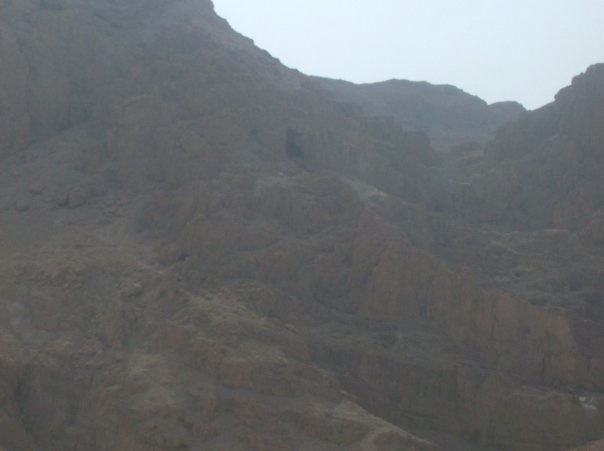
The limestone cliffs at Qumran above the Dead Sea, where Cave
1—the first scroll cave, found in 1947—opens in the rock. Photo:
Jennifer Z, CC BY-SA 3.0, via Wikimedia Commons.
Muhammad edh-Dhib did not know what he had found. He brought the scrolls to an antiquities dealer in Bethlehem named Khalil Iskander Shahin—known to everyone as “Kando.” Kando did not know either. The scrolls eventually divided between two buyers: four went to Mar Athanasius Yeshue Samuel, the Syrian Orthodox Archbishop of Jerusalem; three were purchased by Eleazar Sukenik, Professor of Archaeology at the Hebrew University of Jerusalem, who grasped immediately what he was looking at.
Sukenik made his first purchase on November 29, 1947—the day the United Nations voted to partition Palestine and create a Jewish state. He wrote in his diary that night: “I looked and looked, and I suddenly had the feeling that I was privileged by destiny to gaze upon a Hebrew Scroll which had not been read for more than two thousand years.”18
What followed was one of the strangest episodes in the history of archaeology: part scholarly triumph, part intelligence operation, part auction, part black market, and part Cold War drama—all conducted against the background of a collapsing British mandate, a war of independence, and the partition of Jerusalem.
The four scrolls held by Mar Athanasius Samuel traveled to the United States in 1949, where he hoped to sell them. They sat in a New Jersey bank vault for years. In 1954, Mar Samuel placed an advertisement in the Wall Street Journal: “Miscellaneous for Sale: The Four Dead Sea Scrolls.” Yigael Yadin—archaeologist, general, and son of Eleazar Sukenik, who had died in 1953—secretly purchased all four scrolls for $250,000, arranged through an American intermediary to avoid embarrassing questions about Israeli citizens buying Jordanian antiquities. They were flown to Jerusalem and reunited with the three scrolls his father had purchased six years earlier.
All seven of those original scrolls are now in the Shrine of the Book at the Israel Museum in Jerusalem.
Meanwhile, the systematic excavation of the scroll caves and the Qumran site itself was underway. The discovery that Cave 1 was not unique—that there were scrolls in other caves, and that the cave openings studded the cliffs for miles—transformed the project from a lucky find into a systematic archaeological effort.
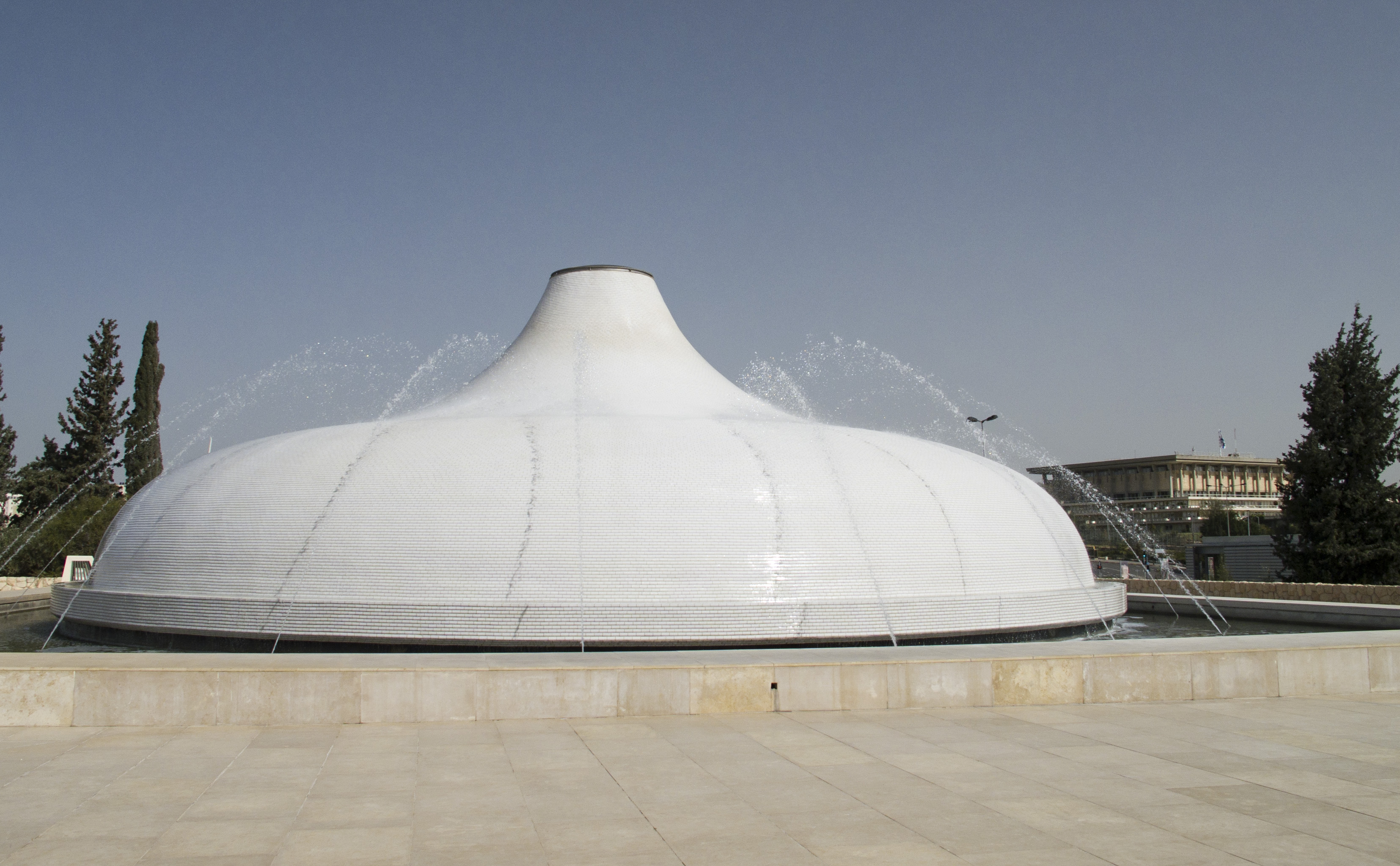
The Shrine of the Book at the Israel Museum, Jerusalem. Its
white dome is designed to evoke the bowl-shaped lids of the scroll jars.
Photo: Dan Lundberg, CC BY-SA 2.0, via Wikimedia
Commons.
The excavation was conducted under the auspices of the École Biblique et Archéologique Française de Jérusalem, directed by Father Roland de Vaux, O.P., and the Jordanian Department of Antiquities under G. Lankester Harding. De Vaux conducted five seasons of excavation at Qumran (1951–1956) and also coordinated the search for additional caves.
The effort was complicated from the start by the Bedouin. The Ta’amireh tribe, who had made the initial discovery, proved far more efficient at finding caves than the archaeologists. They knew the terrain, worked quickly, and brought fragments to Kando, who passed them through a network of dealers. By the time the scholars arrived at Cave 4—by far the richest cave, which the Bedouin discovered in September 1952—thousands of fragments had already been removed and sold. The scholars purchased them back through Kando at a cost that eventually ran to several hundred thousand dollars, most of it raised by American institutions with help from the Jordanian government.19
The eleven scroll caves were discovered between 1947 and 1956. Their contents varied enormously—from the spectacular to the fragmentary—but together they constitute the most significant library of ancient Jewish literature ever recovered.
The cave that started everything yielded seven major scrolls, all now at the Israel Museum:
The Great Isaiah Scroll (1QIsa\(^a\)): The complete text of the book of Isaiah, 7.34 meters (24 feet) long and the oldest complete manuscript of any biblical book, copied around 125–100 BCE
The Community Rule (1QS, Serekh ha-Yahad): The rule book of the Qumran community, governing admission, communal life, penal code, and theology
The War Scroll (1QM): A detailed eschatological battle plan for the final war between the “Sons of Light” and the “Sons of Darkness,” with column formations, trumpet calls, and battle hymns
The Hodayot (1QH, Thanksgiving Hymns): A collection of psalms, some possibly composed by the Teacher of Righteousness himself
The Pesher Habakkuk (1QpHab): A verse-by-verse commentary on the first two chapters of Habakkuk, applying the prophecy to the community’s own history
The Genesis Apocryphon (1QapGen): A retelling of stories from Genesis in Aramaic, including a remarkably vivid expansion of the Abraham narrative
A second Isaiah manuscript (1QIsa\(^b\)): Fragmentary, closer to the Masoretic text than the Great Isaiah Scroll
Found by the Ta’amireh Bedouin in February 1952. Fragments of 33 manuscripts, mostly biblical: Exodus, Leviticus, Numbers, Deuteronomy, Jeremiah, Psalms, Ruth, and a few non-biblical texts.
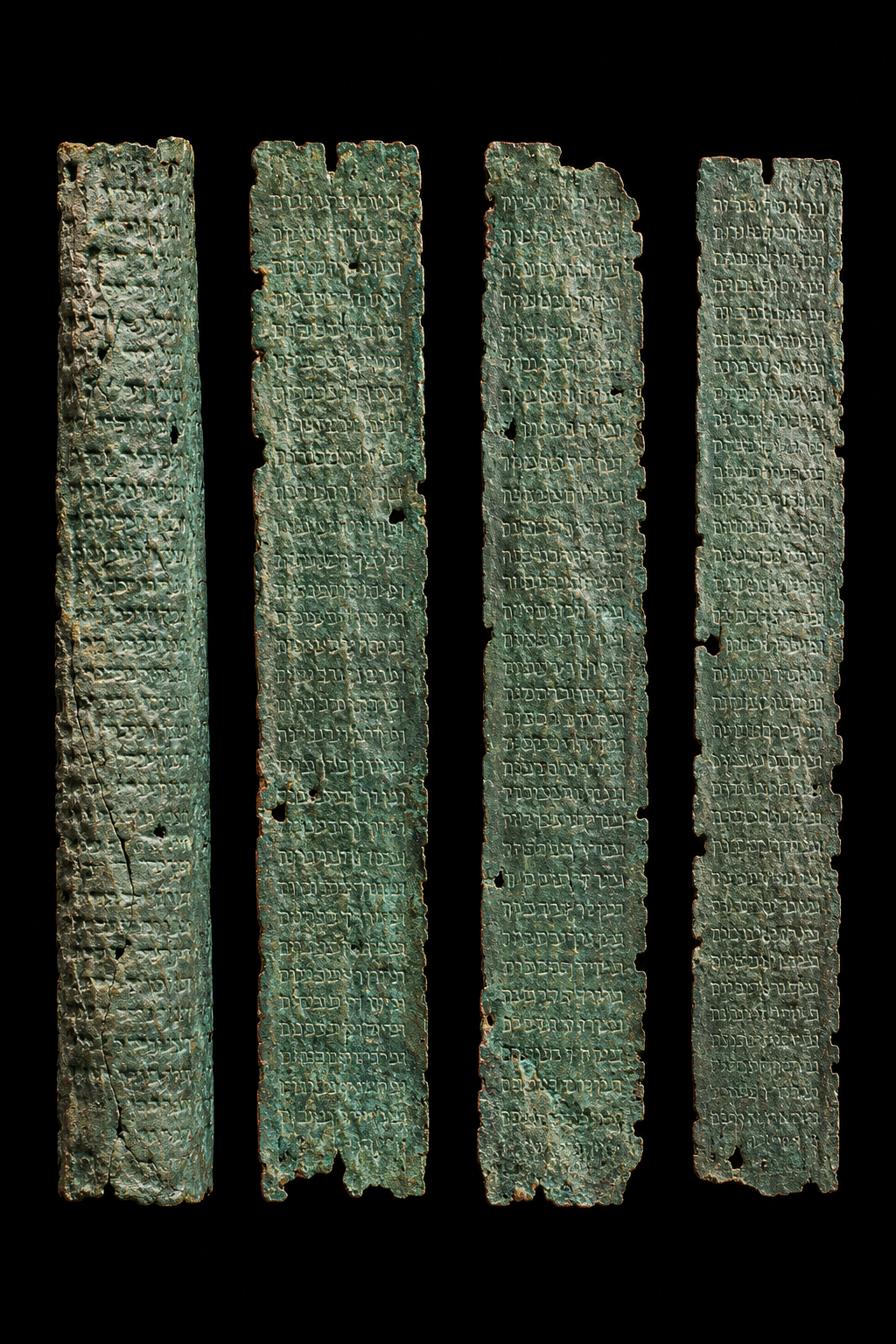
Found by the excavation team in March 1952. A small cave yielding modest leather fragments—and the object that is the subject of this book. In the back of Cave 3, pressed against the wall, were two oxidized copper rolls too brittle to open. The significance of what the archaeologists were holding would take years, and a machine shop in Manchester, to reveal.
The most important cave, and the most controversial. Located directly across from the Qumran site, cut into the marl cliff, it had been used as a burial site in antiquity and was partly collapsed. The Bedouin found it first, in September 1952, and removed thousands of fragments before the archaeologists arrived.
Cave 4 yielded approximately 15,000 fragments from around 900 manuscripts—roughly half of the entire Dead Sea Scrolls corpus. It contained:
Fragments of every book of the Hebrew Bible except Esther
Multiple copies of Deuteronomy (more than 30 manuscripts), Isaiah (21 manuscripts), and Psalms (36 manuscripts)
The Damascus Document (confirming the medieval Cairo Genizah copy)
Calendrical texts, halakhic texts, wisdom literature
The “4QMMT” (Miqsat Ma’ase ha-Torah), a legal letter that may have been written by the community’s founder
Aramaic texts including the Testament of Levi and the Book of Giants
The earliest known manuscript of the book of Enoch
The publication of Cave 4 materials became the central scandal of Dead Sea Scrolls scholarship: the international team assigned to publish them—a small group of scholars under de Vaux—sat on the documents for decades. The full texts were not available to other scholars until the early 1990s, when a complete photographic facsimile was published against the team’s wishes.20
Cave 5: 25 manuscripts, mostly biblical fragments. Cave 6: 31 manuscripts, mostly papyrus (unusual for Qumran), including fragments of the Damascus Document.
Cave 7 yielded only Greek fragments—an oddity in a Hebrew library that generated enormous later controversy when a German scholar named Jose O’Callaghan claimed in 1972 that some fragments were portions of the New Testament, including Mark’s Gospel.21 The claim has not been accepted by the mainstream scholarly community, but it continues to circulate in popular literature.
Cave 8: Five manuscripts, including phylactery texts. Cave 9: A single papyrus fragment. Cave 10: A single inscribed ostracon (pottery shard).
Found by the Bedouin in 1956 and withheld until 1967, when Yigael Yadin purchased it under dramatic circumstances from Kando during the Six-Day War. Cave 11 yielded some of the longest and most significant non-Cave-1 scrolls:
The Temple Scroll (11QT): At 8.14 meters (about 27 feet), the longest of all the Dead Sea Scrolls. A comprehensive re-presentation of the Mosaic law, written in the first person as if God were speaking directly, describing an idealized Temple to replace the Second Temple
The Psalms Scroll (11QPs\(^a\)): Contains 41 canonical psalms, plus 7 previously unknown psalms and a prose section describing David’s compositions
Aramaic Targum of Job: A translation of Job into Aramaic

The Temple Scroll (11Q19), one of the longest of the Dead Sea
Scrolls, showing the clarity of its Hebrew text. The natural
deterioration along the ragged edges contrasts with the central columns,
which remain remarkably legible. Israel Museum, Jerusalem. (Wikimedia
Commons, public domain.)
In February 2017, a team of Hebrew University archaeologists excavating near Cave 11 discovered what they identified as the twelfth scroll cave at Qumran. The cave had clearly contained scrolls: sealed storage jars of the same type as those in other scroll caves were found in situ, along with scroll wrappings and leather fragments. But the organic material was gone. The jars were empty. The cave had been looted—probably in the 1950s, during the period when the Bedouin were systematically finding caves ahead of the archaeologists.
Cave 12 was significant precisely because it had been emptied. It confirmed, first, that the eleven previously known scroll caves are not the complete inventory—other caves existed and contained material. It confirmed, second, that the looting problem was even more extensive than previously known: at least one entire scroll cave was stripped before it could be professionally documented. Whatever texts Cave 12 contained are now in some private collection or dealer’s stock or—worse—have been destroyed or lost.
The discovery has direct implications for the Copper Scroll search. If scroll caves were still being discovered in 2017—more than sixty years after the last officially documented scroll cave (Cave 11, 1956)—then the assumption that the eleven known caves represent the complete picture is unfounded. The Qumran cliff system may contain additional caves. Those caves might contain additional documents. One of those documents might be the second copy promised in the Copper Scroll’s final entry.
The Cave 12 discovery also illustrates the race between professional archaeology and looting that has characterized the entire Dead Sea Scrolls story. When the second copy—if it exists—is found, it may or may not be found by authorized excavators working under scientific conditions. It may be found by someone who knows the terrain and has no license.
The story of the first translations of the Cave 1 scrolls is itself a minor drama. Three scholars, working independently and often in competition, produced the first readings of the most significant ancient manuscripts since the Vatican acquired its biblical texts.
John C. Trever was an American graduate student in Jerusalem in 1948 when Mar Athanasius Samuel—the Syrian Archbishop who had purchased four of the Cave 1 scrolls—brought them to the American Schools of Oriental Research for examination. Trever, who happened to be the only staff member present that day, examined the texts and immediately recognized the antiquity of the script. He spent the next several days photographing the scrolls with his personal 35mm camera—producing the images that would prove essential to all subsequent scholarship.
Trever’s photographs of the Great Isaiah Scroll were sent to William Foxwell Albright, the dean of American biblical archaeologists, in Baltimore. Albright’s reply telegram, dated February 25, 1948, is one of the most significant documents in modern biblical scholarship: “My heartiest congratulations on the greatest manuscript discovery of modern times... What an absolutely incredible find.” Albright estimated the scroll’s date as “around 100 BC,” a date that subsequent research confirmed as approximately correct.
Eleazar Sukenik worked simultaneously but separately in Hebrew University in Jerusalem, examining the three scrolls he had purchased from Kando. Sukenik was the first scholar to formally identify the texts as Essene manuscripts, and the first to recognize that they predated the fall of Jerusalem in 70 CE—a conclusion that, when published, would transform the study of Second Temple Judaism.
The race between Israeli scholars (Sukenik was a Zionist who wanted the scrolls recognized as part of the Jewish heritage of the land) and American and European scholars (who were simultaneously working on the Mar Samuel scrolls in Jordan and the United States) produced a competitive dynamic that shaped the early years of scroll scholarship. When Israel captured East Jerusalem in 1967 and the scrolls at the Rockefeller Museum came under Israeli control, the race had a definitive—if contested—winner.
Radiocarbon dating of the Dead Sea Scrolls, conducted in multiple rounds beginning in the 1950s and most definitively in the 1990s, has confirmed the general antiquity of the material while producing some results that have been the subject of scholarly debate.
The first radiocarbon test on scroll material was conducted in 1950 at the University of Chicago: a sample of the Genesis Apocryphon linen wrappings produced a date of approximately 167 BCE plus or minus 200 years—entirely consistent with the archaeological and paleographic dating. Subsequent AMS (Accelerator Mass Spectrometry) testing in the 1990s—a more precise technique—dated most of the Cave 1 scrolls to the period between approximately 250 BCE and 68 CE, consistent with what the paleography and archaeology had suggested.
The Copper Scroll was not carbon-dated in these rounds, partly because the carbon in the metal surface (as copper carbonate) is not the original organic carbon and cannot be used for radiocarbon dating of the inscription date. The organic residues trapped in the inscribed grooves have been analyzed for other isotopic signatures, but no published radiocarbon date for the Copper Scroll inscription exists. The paleographic dating—which places the letterforms in the first century CE—remains the primary chronological evidence.
The Genesis Apocryphon is a retelling of stories from Genesis in Aramaic—the vernacular language of everyday Judean life in the Second Temple period. Written in a fluid, literary Aramaic, it expands the biblical narrative in ways that are sometimes playful, sometimes theologically charged, and occasionally astonishing.
The most remarkable section describes Abraham’s journey into Egypt. In the biblical account (Genesis 12), the story is told in a few verses: Abraham tells his wife to pretend to be his sister, the Egyptians take her into Pharaoh’s household, plagues afflict Pharaoh, and Sarah is returned to Abraham with gifts. The Genesis Apocryphon expands this into a sustained narrative in which an Egyptian nobleman named Harkenosh dreams of a palm tree and a cedar—an omen that leads him to seek out Sarai. What follows is an extraordinary passage in which Harkenosh’s servant Horqanos travels to Hebron and asks Abraham’s nephew Lot to describe Sarai’s beauty:
How fair and beautiful is the appearance of her face, and how supple is the hair of her head—how lovely are her eyes, and how pleasant her nose and the radiance of her face. How fine is her neck, and how pleasing are all the features of her face. There is none like her among all the women—above all women she is lovely, and beyond all of them her beauty excels; alongside all of her loveliness there is much wisdom.
This extended praise of a woman’s physical beauty—lyrical, sensuous, and theologically striking—has no parallel in the biblical text. It demonstrates that the Qumran scribes were engaged not merely in preserving the biblical tradition but in creatively elaborating it.
At 8.14 meters (about 27 feet), the Temple Scroll is the longest of all the Dead Sea Scrolls. It is also, theologically, one of the most ambitious: it is a comprehensive re-presentation of the Mosaic law, written in the first person as if God were speaking directly, that describes in exhaustive detail an idealized Temple to replace the Second Temple.
The Temple described in the scroll is much larger than any actual building. Its courts expand concentrically outward from the inner sanctuary. The measurements are precise: the inner court is 280 cubits by 280 cubits; the middle court is 480 by 480; the outer court is 1,600 by 1,600. The outer court alone would cover an area larger than the entire ancient city of Jerusalem.
The scroll’s description has been compared to the Temple described in Ezekiel 40–48—another idealized vision of a Temple that was never built. Yigael Yadin, who published the Temple Scroll, argued that the Qumran community regarded the Temple Scroll as a sixth book of the Pentateuch—a direct divine revelation supplementing the Torah. If so, their critique of the Jerusalem Temple was not merely institutional but cosmic: the Temple they knew was not just corrupt, it was the wrong building entirely.
The Temple Scroll’s relevance to the Copper Scroll is direct: if the Qumran community expected to build or restore this idealized Temple, they would have been intensely interested in preserving the existing Temple’s material resources for that future use. The Copper Scroll, on this reading, is not a record of where the existing Temple’s treasury was hidden from the Romans—it is a record of where the materials for the future Temple were stored, awaiting the messianic age.
The Psalms Scroll from Cave 11 is not merely a copy of the biblical Psalter. It contains 41 of the 150 canonical psalms—in a different order than the Masoretic text—plus 7 previously unknown compositions. These include Psalms 151, 154, and 155 (known from other ancient sources, including the Greek Septuagint) and four entirely new compositions never previously known.
One of the new psalms is ascribed to David: a meditation on creation that has no parallel in the canonical Psalter. Another is the prose “Compositions of David,” which states that David composed 3,600 psalms and 446 songs—a total far exceeding the 150 in the biblical canon. This suggests that the Qumran community’s Psalter was both different and larger than the version that became standard.
The significance for textual scholars is profound: the biblical canon was not yet fixed in the first century CE. Different communities used different collections of texts, attributed different compositions to biblical authors, and arranged the same texts in different sequences. The “Bible” was still, in a meaningful sense, in formation.
The War Scroll (1QM, Milhamah) occupies a unique position in the Qumran library: it is simultaneously a theological vision and a practical military manual. Its combination of eschatological expectation with detailed tactical specifications has no parallel in ancient literature.
The scroll describes a war that will last forty years, divided into six years of actual combat interspersed with Sabbath years of rest (one in every seven). The “Sons of Light”—the community itself, together with the angelic armies of heaven—will fight against the “Sons of Darkness”—the Kittim (the Romans), the neighboring nations, and the renegade Israelites who have sided with them. The first engagement will go to the Sons of Light; the second to the Sons of Darkness; ultimately, God’s angels will intervene and the final victory will belong to the righteous.
The tactical specifications are extraordinary in their detail:
Battle formations: infantry in columns of seven, divided into companies of fifty with flanking cavalry. Each unit of fifty has a specific position in the battle line.
Age requirements: infantry soldiers must be between twenty-five and fifty years old; cavalry may be older. No man with any physical blemish may serve. No man who has had a nocturnal emission may enter the battle camp until he has bathed.
Standards and trumpets: the scroll specifies the dimensions and inscriptions of every standard carried by every unit and every trumpet used to signal every tactical maneuver. The trumpets have specific calls for charging, for rallying, for retreat, for celebration, for mourning, and for assembly.
The shields: rectangular, two cubits by one and a half, inscribed with the names of the tribe and the unit commander.
The spears: six cubits long, including the blade, with a specific grip position and throwing technique.
The level of tactical detail in the War Scroll has prompted debate about whether the community actually expected to fight—whether they trained for war, maintained weapons, and prepared militarily for the eschatological conflict. The Community Rule (1QS) does not explicitly authorize violence; the War Scroll clearly does, though in a highly regulated, ritually purified form.
For the Copper Scroll question, the War Scroll is relevant in a specific way: it demonstrates that the Qumran community was prepared for the possibility that the existing Temple establishment would be swept away and replaced. A community that had planned out the tactics for a holy war to restore proper worship would logically also plan for the preservation of the Temple’s material resources against the possibility of defeat.
Among the most fascinating texts in the Qumran library are the pesharim—a Hebrew word for “interpretations” or “commentaries.” The pesharim take a prophetic text from the Hebrew Bible, quote it verse by verse, and then apply each verse to events in the community’s own history. The technique reads as if the ancient prophets were writing not about their own time but about the interpreter’s time.
The Habakkuk Pesher (1QpHab) is the best-preserved example. Habakkuk 1:6 reads: “For lo, I am rousing the Chaldeans, that bitter and hasty nation.” The pesher applies this to the Romans (called “the Kittim” in the scroll’s coded language): “Its meaning concerns the Kittim who are swift and mighty in war, to slay many … they advance in battle formation all over the face of the earth to take possession of dwellings not their own.”22
The pesher technique implies that the prophetic texts were not sealed communications from the past but continuously relevant oracles that required a skilled interpreter to unlock. The community’s Teacher of Righteousness was precisely this interpreter: the one to whom God had revealed “all the secrets of the words of His servants the prophets.”
The Nahum Pesher (4QpNah)—one of the texts at the center of John Marco Allegro’s 1956 BBC controversy—applies Nahum 2:11-13 to specific historical events of the Hasmonean period. It mentions by name “Demetrius King of Greece” (probably Demetrius III, who besieged Jerusalem around 88 BCE at the invitation of the Pharisees) and describes those who “hang men alive”—probably a reference to Alexander Jannaeus’s crucifixion of his enemies. The Nahum Pesher is one of the only Dead Sea Scrolls that uses real names of identifiable historical figures rather than coded epithets.
The Damascus Document (also called the Zadokite Fragments or the Damascus Covenant) was found in a medieval Cairo synagogue in 1896—fifty years before the Dead Sea Scrolls discovery. Solomon Schechter, who recognized the manuscript’s significance, published it in 1910. Scholars noted its unusual content—it described a “new covenant” community in “the land of Damascus” and used sectarian terminology with no parallel in known Jewish literature—but could not explain its origin or date.
When fragments of the Damascus Document were found in Caves 4, 5, and 6 at Qumran in 1952, the mystery resolved itself. The medieval Cairo copy was a descendant of a text that had originated at Qumran or in the broader movement associated with it. The text had survived in medieval synagogue use, demonstrating that the community’s teachings had some continuing influence even after the community’s destruction.
The Damascus Document describes a community that is not physically located at Qumran. It addresses “all those who have entered the covenant in all Israel” and describes camps scattered across the country, each with its own overseer. Its rules differ somewhat from the Community Rule—it permits marriage and property ownership in ways the Community Rule does not. This suggests that the “Qumran movement” was broader than the settlement at Qumran: a network of communities spread across Judea, of which the settlement by the Dead Sea was perhaps the most rigorous expression.
The broader movement implied by the Damascus Document has direct implications for the Copper Scroll. If the community had members throughout Judea—including in Jerusalem—then the scroll’s knowledge of specific Jerusalem locations is not surprising. Members of the movement who lived in Jerusalem would have had detailed knowledge of the city’s architecture, water systems, and underground passages.
The Thanksgiving Hymns (1QH, Hodayot) are among the most personally revealing texts in the entire Qumran corpus. Unlike the legal codes, the biblical commentaries, and the apocalyptic battle plans, the Hodayot are poetry—first-person lyrical compositions that describe the speaker’s relationship with God in terms of suffering, gratitude, revelation, and vindication.
The hymns are divided into two groups by most modern scholars. The first group—sometimes called the “Teacher Hymns”—uses language of singular isolation and persecution that suggests a specific historical individual. The speaker has been driven out, rejected by his own people, persecuted by powerful enemies, and has found refuge only in God. He has been given divine revelation that others have rejected. He is surrounded by the wicked who seek his life.
The second group is more generic—communal in tone, expressing the experience of the covenant community rather than a specific individual leader.
If the “Teacher Hymns” were indeed composed by the Teacher of Righteousness—a position held by scholars including Geza Vermes, Philip Davies, and Hartmut Stegemann—then they are one of the few surviving examples of first-person religious poetry by an individual Jewish thinker of the Second Temple period outside the biblical Psalms. The following passage from Column XIV illustrates the distinctive voice:
I give thee thanks, O Lord, because thou hast sustained me by thy strength, hast not let thy holy spirit be withdrawn from me, hast shielded me before the earth opened up before me … Thou hast not let me be afraid of the ruin of evil men, for I have taken refuge in thee. For thou hast set my foundations on rock.
The imagery of rock, refuge, persecution, and divine sustenance runs through the Teacher Hymns in a way that is deeply personal—someone is describing something they actually experienced, not constructing a generic devotional exercise.
The Teacher Hymns bear on the Copper Scroll question in an oblique but real way. They establish that the Qumran movement, at its foundation, had a historical figure who believed himself uniquely chosen to preserve and transmit authentic divine revelation. A community that organized itself around such a figure—and that expected the restoration of proper worship under messianic leadership—would have every reason to preserve the material resources of the Temple in anticipation of that restoration.
Among the most significant Cave 4 texts is a document known as “4QMMT”—an abbreviation of its Hebrew title, Miqsat Ma’ase ha-Torah (“Some Works of the Law”). It is not a rule book or a biblical commentary but an actual letter: a communication from one party to another, arguing specific legal positions and calling for the recipient to join the sender’s community.
The letter’s opening section sets out a calendrical argument—the community’s solar calendar versus the lunar calendar in use at the Temple. The middle section lists approximately twenty halakhic disputes: specific legal questions about Temple procedure, priestly purity, and the treatment of agricultural products, on which the writer takes positions that disagree with what he describes as the practice “in Jerusalem.” The closing section is a personal appeal to the letter’s recipient to evaluate these arguments and join those who have “separated from the majority of the people.”
The text is significant for several reasons. First, it is direct evidence that the Qumran community (or movement) at some point attempted to communicate with and persuade the Jerusalem establishment, rather than merely withdrawing from it in silence. Second, its legal arguments are internally consistent and show sophisticated halakhic reasoning. Third, the phrase “separated from the majority of the people” is strikingly parallel to the Damascus Document’s description of the community, suggesting that the two texts describe the same movement.
But the most provocative implication of 4QMMT is one of authorship. Frank Moore Cross and others have argued that the letter was written by the Teacher of Righteousness himself, addressed to the Wicked Priest (probably Jonathan or Simon Maccabeus), attempting to persuade the Hasmonean high priest to adopt correct practices before the final break occurred.23 If this attribution is correct, 4QMMT is a direct communication from the historical figure at the center of the community’s founding mythology.
The letter failed to persuade. The community withdrew to Qumran. The Wicked Priest—if the attribution is right—remained in power in Jerusalem. The Teacher of Righteousness died, probably in exile or in circumstances of persecution. The community waited.
How many people actually lived at Qumran? This question bears on the economic and logistical plausibility of the Copper Scroll.
The archaeological evidence from Qumran suggests a maximum occupation of approximately 200 people at any given time. The cemetery, with over 1,100 graves, indicates a longer-term habitation spanning perhaps two centuries, but at any given moment the population was small—a community of men (the graves in the main cemetery are almost entirely male) engaged in communal religious life.
A community of 200 people could not have accumulated or managed 174 metric tons (about 190 US tons) of precious metal from their own resources. Their economic activities—scroll production, agricultural work at Ein Feshkha, crafts—could not have generated that kind of wealth. The Copper Scroll’s contents, if real, did not belong to the Qumran community. They belonged to an institution vastly larger than the desert settlement: the Jerusalem Temple, which served all of world Jewry and which accumulated wealth on a corresponding scale.
The Essene movement, however, was broader than Qumran. Josephus and Philo both describe Essene communities in towns and villages throughout Judea. If the movement had thousands of members across the country, including in Jerusalem, then individual members of the movement could plausibly have been involved in managing Temple assets—without the rural community at Qumran being the origin of the Copper Scroll’s content.
The eleven caves at Qumran are not the only places where ancient manuscripts might survive in the Judean desert. The region’s extreme aridity—it receives less than two inches of rain per year—preserves organic materials with remarkable fidelity. The 2021 Cave of Horror discovery demonstrated that caves forty kilometers from Qumran can yield intact manuscripts from the Roman period.
Systematic survey of the entire Judean desert escarpment has never been conducted. The distance from the Dead Sea to the cliff tops is roughly five to ten kilometers, and the cliff face extends over a hundred kilometers from north to south. Thousands of caves and crevices have been cursorily examined; far fewer have been systematically excavated. The Qumran caves are the most famous, but they are not necessarily the most important. The caves used by Jewish refugees during the Bar Kokhba revolt (132–135 CE) in the southern Judean desert have yielded significant material, including the Babatha archive, military letters from Bar Kokhba himself, and the 2021 Greek scroll fragments.
The Israel Antiquities Authority estimates that several hundred caves in the region have not been professionally examined. Aerial survey, drone-based LiDAR, and multispectral imaging are beginning to change the pace of cave identification. Whether additional scrolls—or portions of the Copper Scroll’s treasure—remain hidden in these unexamined caves is, by definition, unknown.
The Dead Sea Scrolls are distributed among several institutions, reflecting the complicated history of their discovery and acquisition.
The Shrine of the Book, Israel Museum, Jerusalem holds the seven scrolls from Cave 1 purchased by Sukenik and Yadin, plus the Temple Scroll from Cave 11. The Great Isaiah Scroll is displayed in a circular gallery beneath the white dome; the other scrolls are rotated in and out of display on a three-to-six-month cycle to limit light exposure.
The Rockefeller Museum (Israel Antiquities Authority), Jerusalem holds the majority of Cave 4 and other cave fragments—the main working collection. These are housed in temperature- and humidity-controlled storage and are accessible to scholars with credentials.
The Jordan Museum, Amman, Jordan holds the Copper Scroll. This is the most significant of the scrolls outside Israel, and its presence in Amman reflects Jordan’s legal claim to the objects discovered while the West Bank was under Jordanian administration (1948–1967). The Jordan Museum has displayed the Copper Scroll prominently since its 2014 opening, and it is the only major scroll routinely visible to general visitors.

A strip of the Copper Scroll from Qumran Cave 3, its incised Hebrew
characters clearly visible on the inner surface. The scroll was cut into
strips in Manchester in 1956; the green cast is the copper’s natural
patina after two millennia. Jordan Museum, Amman. (Wikimedia Commons,
public domain.)
Various international collections: Some fragments reached private and institutional collectors before export controls were established. The Green family’s Museum of the Bible in Washington, D.C. holds fragments, though its collection has been subject to significant controversy over provenance and forgeries.24
The digitization of the Dead Sea Scrolls is one of the greatest achievements in the history of cultural heritage preservation. The project, a collaboration between the Israel Antiquities Authority and Google, used multispectral imaging technology to photograph every fragment at multiple wavelengths of light, revealing text that is invisible to the naked eye.
The Leon Levy Dead Sea Scrolls Digital Library (deadseascrolls.org.il) provides free, high-resolution access to thousands of images of scroll fragments, with search by fragment identifier, date, and content. The site includes:
Multispectral images showing infrared and ultraviolet revelations
Transcriptions and translations where available
Findspot data and manuscript descriptions
Downloadable images for scholarly use
The Digital Dead Sea Scrolls project at the Israel Museum provides interactive viewing of the major scrolls, including the ability to scroll along the Great Isaiah Scroll at full resolution and compare it with the Masoretic text verse by verse.
Scrollery.org and The Comprehensive Aramaic Lexicon provide additional scholarly tools for working with the texts directly.
The Copper Scroll does not appear in the Leon Levy Library; as a Jordanian-held object, its digitization is managed separately. The Jordan Museum’s website hosts selected images, and scholarly editions provide column-by-column photographs.
The seven scrolls from Cave 1—the scrolls that started everything—deserve more than a list of titles. Each is a document of extraordinary significance in its own right.
The Great Isaiah Scroll is the oldest complete manuscript of any book of the Hebrew Bible. Copied around 125–100 BCE, it contains the full text of Isaiah’s sixty-six chapters on a leather scroll 7.34 meters (24 feet) long, composed of seventeen sheets sewn end to end. The scroll is in a remarkable state of preservation: the text is almost entirely legible, the leather is intact, and even the column layouts are clear.
When Millar Burrows of Yale—who was in Jerusalem when Mar Athanasius Samuel showed the scrolls to American scholars in 1948—first examined the Great Isaiah Scroll, he described his reaction: “I was afraid to believe what I was seeing.”25 The scroll was a thousand years older than the oldest previously known manuscript of Isaiah. And when scholars compared it word by word with the Masoretic text—the text of the Hebrew Bible as preserved by medieval Jewish scribes—it was almost identical. The great textual tradition had held.
Almost, but not entirely. The Great Isaiah Scroll contains approximately 2,600 minor variants from the Masoretic text: alternate spellings, synonymous words, small additions and omissions. Most are trivial. A handful are theologically significant—most famously Isaiah 7:14, where the scroll uses the word ha’almah (the young woman) in a form that slightly complicates the translation debates around the passage.
The Community Rule is the rulebook of the Qumran movement—the document that explains who they were, what they believed, and how they organized themselves. It opens with a theological statement of the community’s purpose (“to seek God with all their heart and all their soul”) and then sets out in systematic detail the admission procedure, the communal structure, the penal code, the liturgical calendar, and a concluding hymn.
The Two Spirits Treatise embedded in columns III–IV is among the most philosophically sophisticated passages in all ancient Jewish literature. It posits that God created two spirits to govern human beings—the Prince of Light and the Angel of Darkness—and that all human actions are determined by which spirit has been assigned to a person at birth. This comes remarkably close to cosmic dualism, and it has generated debate about whether the community was influenced by Zoroastrian thought from Persia (which has an almost identical cosmological framework) or arrived at its theology independently.26
The War Scroll is simultaneously a theological vision and a military manual. It describes a forty-year eschatological war between the “Sons of Light” (the community) and the “Sons of Darkness” (roughly everyone else), with alternating victories and defeats until the final triumph of light. But it describes this war with the precision of a Roman military manual: battle formations, the measurements and inscriptions of standards and trumpets, the age requirements for soldiers (no one under twenty-five; no one over fifty), the positioning of cavalry, the rotation of combat units.
The combination of prophetic vision and tactical specification is unique in ancient literature. The text draws on Numbers for its description of the standards, on Ezekiel for its eschatological imagery, and (scholars have argued) on actual Roman military practice for its tactical details—suggesting it was composed sometime during the Roman period, possibly in the first century BCE.27
The Cave 4 publication scandal is one of the most sustained episodes of institutional obstruction in the history of scholarship. Understanding it is essential context for understanding John Marco Allegro’s behavior—and his motives.
Cave 4, discovered in 1952, contained approximately 15,000 fragments from around 900 manuscripts—more than half the entire Dead Sea Scrolls corpus. The international team assigned to publish them consisted of seven scholars: J.T. Milik, John Strugnell, Patrick Skehan, Jean Starcky, Claus-Hunno Hunzinger, Józef Tadeusz Milik, and John Marco Allegro. Each was assigned specific texts. De Vaux coordinated the project.
The team had exclusive access to photographs of all Cave 4 material. No other scholar could study the texts without the team’s permission. The team worked in the “Scrollery”—a room in the Rockefeller Museum in East Jerusalem—where the fragments were laid out on tables, photographed, and gradually transcribed.
Publication was expected to proceed quickly. It did not. By 1960, only a small fraction of the Cave 4 material had been published. By 1970, the fraction was still small. By 1980—nearly thirty years after the cave’s discovery—most of the material was still unpublished and inaccessible.
The delays had multiple causes: the fragmentation and difficulty of the material; understaffing; the death or incapacity of some team members; the complexities of identifying and matching thousands of tiny fragments. But critics—most vocally Hershel Shanks, editor of Biblical Archaeology Review—argued that another cause was the team’s reluctance to publish material that might require revising comfortable theological positions.
The monopoly finally broke in 1991, when the Huntington Library in San Marino, California—which had received a complete set of scroll photographs from an unexpected source—announced that it would make them available to all scholars. The announcement was made in September 1991. The official team was outraged. Their outrage was largely ignored. The Biblical Archaeology Society published a Facsimile Edition of the Dead Sea Scrolls that same year.
What emerged, when the texts were finally available to the scholarly community at large? Mostly: confirmation of what responsible scholars had been saying for decades. The Cave 4 texts did not contain explosive theological revelations. They did not contradict the New Testament in sensational ways. They were rich, complex, and important—but they were the documents of a Second Temple Jewish sect, not a theological bomb. The secrecy had been unjustified.
Allegro had been saying this since 1956. He had been largely right about the cover-up even when he was wrong about the content.

“Unique in the entire corpus of ancient literature. There is
nothing quite like it anywhere.”
—John Marco Allegro, The Treasure of the Copper Scroll, 196028
To understand why the Copper Scroll is extraordinary, it helps to understand what writing was in the ancient world: not the casual, cheap, ubiquitous act it is for us, but a rare, expensive, specialized technology that only a tiny fraction of the population could perform on materials that required significant investment to produce. A scroll was not a notebook. It was closer to a printed book in terms of cost, labor, and permanence.
And the Copper Scroll was not a scroll. It was something else entirely.
A scroll (megilah in Hebrew, volumen in Latin) is a long, continuous strip of writing material rolled around a wooden rod. The reader unrolls the right-hand portion and simultaneously rolls the left-hand portion as the text is read—a physical engagement with the text that is very different from the page-turning of a codex.
The technology is ancient. Papyrus scrolls are attested in Egypt from at least the fourth millennium BCE. Leather scrolls are known from the second millennium. By the first century CE, when the Qumran community was at its peak, the codex—the ancestor of the modern book, with pages bound at one edge—was beginning to displace the scroll in the Roman world. The Jewish world was more conservative; the Torah scroll remains in scroll form in synagogues to this day.
Papyrus (Cyperus papyrus) was the dominant writing material of the ancient Mediterranean world for roughly three thousand years. The plant grows in wet margins and marshes along the Nile, reaching heights of three to five meters. Writing material was made by slicing the stem’s pith into thin strips, layering two sets of strips at right angles, pressing them together while still moist, and allowing the resulting sheet to dry in the sun.
The result was a serviceable writing surface—smooth enough for reed-pen writing, light enough to travel, and cheap enough (in Egypt, where the plant grew abundantly) to be used for everyday documents. A standard papyrus scroll was made by gluing individual sheets end to end to produce lengths of four to six meters, sometimes more.
Papyrus was exported throughout the ancient world, but it was expensive outside Egypt. In Judea—a dry, landlocked region with no papyrus-growing habitat—papyrus was an import. The Qumran scribes used it, but most of the major manuscripts were written on the cheaper local alternative: leather.
Most Dead Sea Scrolls are written on leather—specifically on animal hides (goat, sheep, or ibex) that were cleaned, stretched, dried, and trimmed. Leather is more durable than papyrus in damp conditions but survives best in the extreme dryness of the Judean desert, which is why it has lasted two thousand years in the Qumran caves.
Parchment, strictly speaking, is a refinement of leather: the hide is soaked in lime to remove the hair and fat, stretched on a frame while wet, and scraped thin with a curved blade. The result is smoother and more uniform than leather, white rather than brown, and can be written on both sides. The tradition that parchment was invented in Pergamon (whence its Latin name, pergamena) when Ptolemy II restricted papyrus exports is repeated by Pliny but is likely apocryphal.29 What is clear is that parchment became the standard writing material of the medieval world and remained so until paper arrived from China.
The Qumran community used both leather and parchment, often interchangeably and sometimes on the same scroll.
Before soft materials, the ancient world wrote on hard ones. Mesopotamian cuneiform was written by pressing a triangular reed stylus into wet clay tablets, which were then dried or fired. The medium was eminently practical for what it was used for: accounting, contracts, letters, administrative records. The clay tablet was the filing cabinet of the Sumerian and Babylonian world—not beautiful, not portable, but durable and cheap.
Stone served a different function. Monumental inscriptions—royal decrees, commemorative records, law codes—were carved into stone not for convenience but for permanence. The Rosetta Stone (196 BCE) was not a working document; it was a public proclamation meant to be read in the temple precinct for centuries. The Moabite Stone (ca. 840 BCE) records the military victories of King Mesha of Moab. The Code of Hammurabi (ca. 1754 BCE) was inscribed on a diorite stele meant to stand permanently in a public place.
These were not scrolls. They could not be carried, copied, rolled, or read in private. They spoke with the voice of the state, permanently and publicly.
Metal documents exist in antiquity, but they are rare. The reasons are obvious: metal is expensive, heavy, and difficult to inscribe. A scribe who could produce a leather scroll in a day might spend a week on a comparable metal document. A lead tablet—the cheapest metal option—still cost far more than leather or papyrus. Copper was more expensive still; bronze even more so.
The few surviving examples of metal documents fall into predictable categories:
Lead curse tablets (defixiones): Small, inscribed lead sheets rolled up and deposited in graves, wells, or temples to call down curses on enemies. Found throughout the Greek and Roman world in enormous numbers—over 1,500 examples known. These were meant to last; lead resists corrosion and burial doesn’t destroy it. They were private, magical, and intended to be unread after deposition.
Bronze diplomas and military documents: The Roman army issued military diplomas—formal discharges granting citizenship and marriage rights—on pairs of bronze tablets. These were official documents of high importance, worth carrying and preserving for a lifetime. About a thousand are known.
Sacred laws and temple regulations: A few bronze inscriptions record laws governing temple procedures or sacred precincts. The bronze tablets of Iguvium (Gubbio, Italy), recording Umbrian religious rituals, are the most famous example. These were meant to be permanent and public.
Votives and dedications: Small metal plaques inscribed with dedicatory texts and attached to temples or shrines. Common throughout the ancient world.
What none of these categories includes is an inventory scroll—a document listing specific quantities of valuables and their locations, written on expensive metal, meant to be read privately and stored in a cave. The Copper Scroll belongs to no established genre of ancient metal document. It is, in this respect as in many others, an anomaly.
The scroll is made of copper—specifically, an alloy of approximately 99% copper with small amounts of tin (about 1%) and other trace elements, as determined by chemical analysis.30 This is essentially pure copper, not bronze. The scrolls were formed from hammered copper sheets approximately one millimeter thick, three sheets riveted end to end.
Copper in the ancient world was neither the most expensive nor the cheapest metal available. It cost roughly twice as much as iron by weight and was commonly used for tools, vessels, coins, and ornaments. Using it for writing material was not a gesture of extreme extravagance, but it was certainly unusual—equivalent, perhaps, to printing a document on leather-bound stock rather than cheap paper. Someone paid for this choice deliberately.
Why copper specifically, rather than the leather and papyrus used for everything else at Qumran? The scholars have argued about this since 1952, and the debate intersects with the larger question of whether the scroll’s contents are real. One answer is obvious: copper lasts. If you are inscribing information that you expect to remain hidden for a long time—years, decades, generations—you want a medium that will survive. Leather rots. Papyrus crumbles. Copper endures.

Illustration: a schematic cross-section of the Copper Scroll. The
copper sheet, roughly one millimeter (about 1/25 inch) thick, is flanked
on both faces by thick crusts of green-and-blue oxidation (patina), and
a V-shaped incised letter stroke is cut into the upper surface.
Writing in the ancient Near East was not a hobby or a universal skill. It was a profession, practiced by specialists who underwent years of training and occupied a recognized social role. The scribe (sofer in Hebrew, scriba in Latin) was a craftsman who combined literacy with material expertise: knowledge of which materials to use, how to prepare them, and how to maintain the tools of the trade.
In Second Temple Judaism, the scribe’s role was closely tied to the study and transmission of the Law. The tradition of scribal interpretation—midrash, commentary, and legal elaboration—was itself a form of scribal work. The Pharisees, Sadducees, and the Qumran community all had scribal traditions, and the evidence from Qumran suggests an unusually high level of scribal activity for a community of its size.
The tools: Ancient scribes worked with reed pens (calami) cut from marsh reeds—the same reeds used in Egypt for millennia. The pen was split at the tip and cut to a point, allowing a range of line widths depending on the pressure applied. Ink was made from carbon black (lampblack or soot) mixed with gum arabic as a binder and water as a carrier. The Qumran community used carbon-based ink throughout; later Jewish manuscripts sometimes used iron gall ink, but the Dead Sea Scrolls are uniformly carbon ink.
The cost of a scroll: Modern scholars have attempted to estimate the production cost of a major Dead Sea Scroll in terms of the labor, materials, and time involved. Emmanuel Tov’s analysis of the Great Isaiah Scroll suggests that it required between two and four months of skilled labor to prepare the leather, rule the lines, and write the text. At the wage rates attested in papyri of the period, the total cost of producing a major leather scroll was roughly equivalent to two to four months of an unskilled laborer’s wages.31
The Copper Scroll was incomparably more expensive. Copper at first-century prices cost roughly twice as much as leather by weight. The engraving process required a craftsman with metalworking skills—a more specialized and expensive worker than a leather scribe. The total production cost of the Copper Scroll, by rough analogy, may have been equivalent to six to twelve months of unskilled labor wages. This is not an absurd expenditure for an organization managing hundreds of tons of precious metal. It is, however, a deliberate and significant investment that implies institutional backing.
Every document is written for a reader. The Copper Scroll was written for a specific, anticipated reader who would know what to do with the information it contained.
This reader, as the scroll’s internal evidence implies, would need to know:
The location of the landmarks used as reference points (“the ruin of the valley of Achor,” “the house of Yakhin,” “the eastern portico”)
The measurement conventions used in the entries (the specific cubit standard, the talent weight)
How to read the Greek sigla that follow some entries
Where the second copy was deposited
The scroll presupposes all of this knowledge without supplying any of it. It was written in shorthand—the shorthand of an insider for another insider. The casual finder was expected to find a document they could not use; the intended reader was expected to have the context to use it immediately.
This design is, paradoxically, one of the strongest arguments for the scroll’s authenticity. A document written for show—a fictional construction meant to impress—would explain itself. It would supply the context needed to understand it. The Copper Scroll does not. It assumes a reader who knows things we do not know. This is the structural signature of a genuine working document.
The Copper Scroll’s physical dimensions are abstract until compared to familiar objects. The scroll in its original form was approximately 2.4 meters long and 30 centimeters wide (about 8 feet by 12 inches)—a rectangle of copper the size of a large yoga mat. At one millimeter (about 1/25 inch) thickness and the density of pure copper (8.96 g/cm3), the scroll weighed approximately 2.5 kilograms (5.5 pounds)—about the weight of a large dictionary or a small laptop computer.
This is modest. The Great Isaiah Scroll (7.34 meters, or 24 feet, long) weighs roughly the same on leather. What the Copper Scroll sacrificed in lightness it gained in permanence: the same corrosion that made the scroll impossible to open without machinery also made it effectively indestructible under normal burial conditions.
Consider the contrast with what it describes. The scroll’s 2.5-kilogram (5.5-pound) body purports to record the location of approximately 140–170 metric tons (about 155–190 US tons) of precious metal. The ratio of recording medium to described content is approximately 1:60,000 by weight. A modern book of account might have a similar ratio—the paper and ink of a bank ledger are trivial compared to the assets they record.
This analogy is instructive. The Copper Scroll is not a sacred object; it is a working document. Its value lies entirely in the accuracy and retrievability of its information. The choice of copper over leather is purely practical: the anticipated storage period was long, the physical conditions were harsh, and the information was too important to risk on a medium that could decay.
The administrative character of the Copper Scroll becomes clear when it is placed in the context of other ancient administrative documents.
The ancient Near East produced enormous quantities of administrative documents: temple records, tax rolls, inventory lists, land deeds. Most were written on clay tablets (Mesopotamia) or papyrus (Egypt). The Jerusalem Temple kept administrative records of its own: the Mishnah’s description of Temple procedure includes detailed accounts of how tithe money was collected, counted, stored, and disbursed; how sacred vessels were inventoried and maintained; how priests were assigned to specific duties by lot.
None of these routine administrative documents have survived from the Jerusalem Temple. The Temple’s archive was presumably destroyed with the building in 70 CE. What we have, instead, is the Copper Scroll—which may represent a single document from that archive, preserved by the accident of its material and its hiding place.
If this is correct, the Copper Scroll is not a unique or exotic item from the perspective of the Temple administration. It is the survivor of what would have been a large and systematically maintained record system. The peculiarity is not the document type but the medium and the circumstances of preservation.
Consider the landscape of ancient metalwork inscriptions. They exist in every major ancient civilization, but they follow rigid conventions. The Mesopotamian kings inscribed foundation deposits in their buildings—short texts identifying the builder and invoking divine protection. The Romans inscribed their laws and military diplomas on bronze. The Greeks inscribed sacred laws and civic decrees on stone. All of these are public, authoritative, and institutional: they announce themselves to the world.
The Copper Scroll does none of these things. It was hidden in a cave. It was not meant to be read by anyone immediately. It was a document created for future use—to be found by someone who would know what to do with it. This is an unprecedented use of a metal document. There is no other known case in antiquity of someone creating a private, hidden inventory on metal.
The closest analogies are the lead curse tablets, but these differ in fundamental ways. Curse tablets were deposited with the intention that they would never be read after deposition—they were meant to be permanent. The Copper Scroll was meant to be found. Its information was practical and retrievable. It was a document designed for a future reader.
This distinction—the Copper Scroll as a document meant to be found and used, not merely preserved—has implications for the authenticity debate. A purely fictional document, created as a literary exercise, has no need to be readable. The Copper Scroll’s care in specifying precise distances, compass orientations, and landmark descriptions serves no literary purpose if the information is imaginary. The document is designed to be used.
The rarity of metal documents in antiquity is real but not absolute. A survey of the known examples illuminates how the Copper Scroll fits—and how it departs—from the established tradition.
The Pyrgi Tablets (5th century BCE): Three gold and silver sheets found in 1964 at the port of Cerveteri in Etruria (modern Italy), inscribed in both Etruscan and Phoenician. They record a dedication from an Etruscan king to the Phoenician goddess Astarte. Like the Copper Scroll, they are a private document rather than a public inscription; unlike it, their content is religious rather than administrative. The bilingual nature of the text has made them invaluable for Etruscan linguistic studies.
The Gold Tablets of Orphism (various, 5th–3rd centuries BCE): Small gold tablets found in graves throughout the Greek world, inscribed with instructions for the soul’s journey in the afterlife: which springs to drink from, which to avoid, what to say to the guardians at the entrance to the underworld. Like the Copper Scroll, these are documents meant to be used after death—deposited with a specific practical purpose in mind. The gold tablets demonstrate that the use of metal for hidden, functional documents was known in the ancient Mediterranean world.
Roman Bronze Diplomas (1st century BCE – 3rd century CE): Issued to discharged soldiers and auxiliary troops, granting citizenship and the right of marriage. More than a thousand examples survive. These are standard-format documents on bronze tablets, durable by design, intended to be kept and used throughout the recipient’s lifetime. Their standardized form and ubiquity demonstrate that metal inscription was a practical choice for important documents that needed to survive.
The Etruscan “Liber Linteus” (2nd–1st centuries BCE): Not metal, strictly speaking—it is a linen book, the longest surviving text in the Etruscan language—but it demonstrates that durability concerns led ancient cultures to use unusual materials for important texts when papyrus was inadequate.
Lead Tablets: The most common form of ancient metal writing, found in enormous numbers throughout the Greek and Roman world. Lead defixiones (curse tablets) and some administrative tablets survive from virtually every region of the Mediterranean. Their cheapness and workability made them attractive for everyday documents. The Copper Scroll is an outlier in choosing copper over lead—copper is harder to inscribe, more expensive, and more durable.
The Copper Scroll belongs to this tradition of practical metal documentation—documents created for specific use, with durability as the primary consideration—but exceeds it in scale, specificity, and sheer volume of content. No other ancient metal document comes close to its 3,000 characters and 64 entries. It is, in this respect as in many others, without precedent.
One physical detail of the Copper Scroll deserves more attention than it usually receives: the sheets are riveted together.
The scroll is not one piece of copper. It is three sheets, each approximately 30 cm (12 inches) wide, fastened at their ends by copper rivets and then rolled up together into two sections (which were stored as two separate rolls in Cave 3). The rivets indicate careful preparation: someone hammered the sheets flat, inscribed the text, then fastened the sheets together to create a single continuous document before rolling it up.
This is sophisticated metalwork. The scribe—or craftsman—was working with a material that could not easily be erased or corrected. Each line of incised text was permanent. The entire document had to be planned in advance. The columns of text had to be laid out, the entry order decided, and the inscription executed without the possibility of revision.
The labor involved was substantial. Ancient copper working was skilled craft, and the engraver of the Copper Scroll—whoever he was—combined the knowledge of a scribe (he knew the content to be recorded), the skill of a metalworker (he could engrave on copper), and the organizational capacity of an administrator (he had to plan the layout of 64 entries across 12 columns on a limited surface).
This combination of skills argues against a casual origin for the document. It was not made on impulse. It was not made cheaply. It was made deliberately, expensively, and with evident competence. Whatever it contains—real treasure inventory or legendary catalogue—someone invested significant resources in its creation.
The administrative character of the Copper Scroll becomes clearer when placed beside contemporaneous accounting documents from the ancient world. Two parallel traditions are directly relevant.
The Zenon Papyri: A cache of papyrus documents found in Egypt in the 1910s, dating to the third century BCE and belonging to the estate manager of a Ptolemaic official, provides the closest parallel in format to the Copper Scroll. The Zenon papyri include inventory lists of agricultural produce, livestock, tools, and stored goods in specific buildings—each entry giving the item type, the quantity, and the storage location. The language is terse, formulaic, and administrative: exactly the register of the Copper Scroll, though in Greek rather than Hebrew.
Temple accounting at Elephantine: The Jewish military colony at Elephantine in Upper Egypt (fifth century BCE) produced a substantial archive of documents including temple financial records. These records show the collection of temple taxes, the payment of temple personnel, and the management of temple property—all in the same administrative shorthand seen in the Copper Scroll. The similarity of format across five centuries and two completely different Jewish communities (Elephantine and Jerusalem) suggests that the administrative conventions of the Copper Scroll belong to a recognizable and consistent tradition of Jewish institutional accounting.
The Copper Scroll, read against these parallels, looks not like a unique literary invention but like a specific specimen of a well-established genre: the Jewish institutional inventory. The genre’s conventions—terse location descriptions, specified quantities, administrative formatting without narrative or explanation—are exactly what the Copper Scroll uses. This is evidence not for the scroll’s authenticity per se, but for the plausibility of its genre identification as a genuine Temple treasury record.
In Cave 3 at Qumran, alongside a modest collection of leather and papyrus fragments, someone placed two rolled sheets of copper engraved with sixty-four precise locations and their contents. Every other community document—the rule books, the commentaries, the biblical manuscripts—was written on cheap organic material. This one document was different in material, in format, in language, and in content.
The contrast is not incidental. It is the first and deepest clue.
Whoever made the Copper Scroll believed that its contents were worth the significant additional cost of copper. They believed the information needed to survive longer than leather could be trusted to survive. They believed that the specific locations and quantities listed within it were accurate enough, and valuable enough, to be worth the effort of engraving them on metal.
Either that, or the scroll is an elaborate fiction—a dream inventory, a legendary catalogue of impossible riches, inscribed on impressive material to give it the weight of authenticity.
Both possibilities have been argued by serious scholars. The evidence for each position begins with what was actually found in Cave 3 and what it actually says.

“In the ruin which is in the valley of Achor, under the steps
leading to the east, forty long cubits: a chest of silver and its
vessels, with a weight of seventeen talents.”
—Copper Scroll, Column I, lines 1–4 (trans. Wolters)32
The excavation season of spring 1952 was the third at Qumran, and by March it was winding down. The team under Roland de Vaux and G. Lankester Harding had been working the cliffsides methodically, examining every promising crack and opening. Cave 2 had yielded fragments in February—33 manuscripts’ worth, mostly biblical, found by the Bedouin just weeks before the archaeologists arrived. Cave 3, when the official team reached it in mid-March, appeared to be less productive.
Cave 3 is not visible from the Qumran site itself. It is located in the Wadi Qumran, slightly north of the main cliff system, accessible only by a careful traverse along the ledge. The cave’s entrance is narrow—a man can enter only sideways—and the interior opens to a chamber approximately eight meters long and two to three meters wide. The ceiling is low. The floor, when the team entered, was covered in broken pottery, dried organic material, and the accumulated debris of two thousand years.
The leather fragments on the floor were small and fragmentary. The team catalogued them—they would eventually be identified as texts including a fragmentary copy of the Book of Jubilees—but held no great hopes for the cave. Then Harding’s team excavated toward the back wall.
Pressed against the rock, half-buried in the talus of debris that had accumulated over the cave’s millennia of abandonment, were two rolls of greenish-grey metal. They were clearly not leather. They were clearly not papyrus. They were oxidized beyond recognition as any specific alloy, but they were unmistakably metallic, and they were inscribed.
De Vaux’s field notes record the moment with scholarly restraint: “Two copper rolls were found in the back part of the cave.” He noted their condition—too fragile to unroll, covered in a thick layer of corrosion products—and had them carefully transported to the Palestine Archaeological Museum in East Jerusalem. There they would sit, unread and unreadable, for three years.
The pottery found with the copper rolls was dated to the same first-century CE period as the Qumran community’s main occupation. Cave 3 had been deliberately sealed: a pile of stones near the entrance showed signs of intentional arrangement, as if someone had tried to close the cave from outside. Whatever was placed here was placed with care and with the expectation that it might one day be retrieved.
The leather fragments and the copper rolls were not deposited together—the fragments were clearly the debris of much earlier use. But the copper rolls, pressed against the back wall, had been placed there by someone who entered the cave specifically to hide them.
Henry Wright Baker, who later cut open the scrolls, described the condition of the objects when they arrived in Manchester: “They were so fragile and brittle with oxidation that it was almost impossible to touch them without causing flaking and disintegration.”33 The Jordanian archaeologists recognized immediately that these were not leather scrolls but metal sheets that had been rolled up. They could see, when they held the rolls against the light, that the surface was inscribed. But they could not read a word without opening them, and opening them would shatter them.
This was Cave 3, and its metal treasure would remain unread for three more years.
The Copper Scroll is not, properly speaking, a single scroll. It is three copper sheets riveted end to end, rolled into two sections (probably for storage) and subsequently joined. The dimensions, when the strips were finally laid out:
| Dimension | Measurement |
|---|---|
| Total length (unrolled) | approximately 2.4 meters (8 feet) |
| Width of sheets | approximately 30 centimeters (12 inches) |
| Thickness of copper | approximately 1 millimeter (1/25 inch) |
| Number of columns | 12 |
| Number of characters | approximately 3,000 |
| Weight | approximately 2.5 kilograms (5.5 pounds) |
The text was inscribed by punching or chiseling the letters from the outside of the rolled copper, so that the letters appear in relief on the inner surface. This technique—working from outside in—means the scribe worked on a curved surface that he could not read while he was writing. The letter forms are sometimes irregular, sometimes crowded, and occasionally doubled or skipped, suggesting a craftsman who could engrave metal but was not necessarily a trained scribe.34 This is another anomaly: the Qumran community had highly trained scribes who produced beautiful manuscripts. The Copper Scroll’s hand is competent but workmanlike—the hand of a metalworker, not a scriptorium.

Another strip of the Copper Scroll from Qumran Cave 3, its incised
Hebrew text and green oxidation clearly visible. The strips, cut in
Manchester in 1956, are each approximately 30 cm (12 inches) wide.
Jordan Museum, Amman. (Wikimedia Commons, public domain.)
Alongside the main Hebrew text are occasional letters that are clearly not Hebrew: K, X (chi), and other Greek characters. These appear after certain entries and are believed to be abbreviations—perhaps accounting sigla, perhaps references to a supplementary key document (the “second copy” mentioned in the scroll’s final entry). Their significance remains debated.35
If the Temple treasury was hidden before the Roman siege, and if the hiding was successful, one would expect some trace of it in the rabbinic literature compiled in the centuries following the Temple’s destruction. Scholars who accept the treasure’s reality have argued that such traces exist; scholars who reject it argue that the silence is decisive.
The Mishnah, compiled around 200 CE, contains extensive discussions of Temple procedure, ritual objects, and the regulations governing the Temple treasury. It records the dimensions of the Temple, the duties of its priests, and the legal status of its sacred objects. Nowhere does it record that the treasury was hidden before the siege.
The Talmud, compiled between the third and sixth centuries CE, contains several traditions about objects hidden before the Babylonian conquest of Jerusalem in 586 BCE: the Ark of the Covenant, the pot of manna, and other items. These traditions consistently describe the objects as hidden where they are (under the Temple itself) and as awaiting restoration when Israel merits it. They do not describe anything hidden in the Judean desert.
The rabbinic silence on the Roman period hiding—if the hiding occurred—admits several explanations. The most compelling is operational security: if a surviving community knew where the treasury was hidden, they would not commit that information to a text that might be captured by Rome or by informers. The Copper Scroll itself demonstrates this logic: it was hidden rather than circulated. A parallel textual tradition would presumably have been treated with equal care.
A second explanation is organizational failure: the people who knew where the treasury was hidden did not survive the war. They were killed in the siege, captured and enslaved, or fled to the diaspora and lost contact with the specific knowledge. The second copy, wherever it is, may have been placed by someone who then died without passing on its location.
A third explanation remains available: the treasure was never real. In this case, the talmudic silence is not suspicious but expected.
One objection to the Temple treasury hypothesis deserves explicit treatment: if the treasure was hidden in 68–70 CE and was real, why hasn’t it been found in two thousand years?
The objection is less compelling than it appears. Consider the circumstances. The Jewish population of Judea was largely killed, enslaved, or scattered by the Roman campaigns of 66–73 CE and 132–135 CE. The people who hid the treasury—if they survived at all—were refugees, scattered across the Mediterranean world with no secure base and no political protection. The territory where the treasury was hidden was under Roman military occupation for decades following the fall of Jerusalem.
Returning to recover the treasure would have required:
Surviving the war
Maintaining the specific knowledge of each location
Gaining access to Roman-controlled territory
Conducting excavations in known locations without Roman authorities noticing
Successfully transporting enormous quantities of precious metal out of Roman territory
None of these conditions was easily met. The Jewish communities that survived the war in the diaspora—in Alexandria, in Rome, in Mesopotamia—were not in a position to mount a systematic recovery operation in Roman Palestine.
Later recoveries were presumably frustrated by a different set of obstacles: the progressive destruction and rebuilding of Jerusalem (Hadrian’s construction of Aelia Capitolina after 135 CE transformed the city so thoroughly that many first-century landmarks became unidentifiable), the gradual loss of the specific knowledge needed to use the Copper Scroll, and the ongoing political instability of the region through the Byzantine, Islamic, Crusader, Mamluk, and Ottoman periods.
Two thousand years of non-recovery is not strong evidence against the treasure’s existence. It is consistent with what we know of the conditions that would have made recovery impossible.
The debate about how to open the scrolls began almost immediately. The two options were:
Chemical treatment to soften the oxidation, followed by careful manual unrolling
Mechanical cutting—sawing the rolls into thin vertical strips
Chemical treatment was attractive because it preserved the scroll’s integrity. But every chemist who examined the problem reached the same conclusion: the oxidation had transformed the copper into a complex lattice of copper carbonates, chlorides, and sulfates. The original copper was, in some sections, almost entirely gone—replaced by corrosion products that maintained the shape but had no structural strength. Any attempt at chemical softening and unrolling would collapse the scroll into fragments.
John Marco Allegro, who will figure prominently in the next chapter, lobbied aggressively to open the scrolls as quickly as possible. He was overruled. De Vaux and the official Jordanian Antiquities team preferred caution. The scrolls sat in Amman while the debate continued.
Finally, in 1955, H. Wright Baker of Manchester College of Technology designed a solution: a precision cutting apparatus that would saw each roll into strips approximately 2 centimeters (3/4 inch) wide, cutting from the outer edge inward. The saw blade was thin enough (under 0.5mm, about 1/50 inch) that it would not destroy significant amounts of text. Baker himself traveled to Amman to carry out the work.

Illustration: the precision cutting apparatus devised by
H. Wright Baker in 1955 to open the Copper Scroll. A modified lathe
rotated the rolled, corroded copper against a thin circular saw carried
on a flexible shaft, slicing the scroll into curved strips (one shown
springing free at right). Artist’s rendering.
The cutting took place in January and February 1956, in Manchester. Baker cut both rolls into a total of 23 strips. Allegro was present for the entire process. As each strip was cut and turned face-up, the Hebrew text was visible for the first time since the scroll was sealed—almost two thousand years earlier.
Baker’s own account of the moment is restrained but vivid: “As each piece was cut, the text was read by Mr. Allegro... He expressed great excitement at the contents.”36
After the Manchester cutting in 1956, the twenty-three strips of the Copper Scroll were returned to the Jordanian Department of Antiquities in Amman. For most of the following decades, they were stored in the Amman Archaeological Museum while the political and scholarly debate about their contents continued.
The condition of the strips deteriorated somewhat in storage: the copper oxide layer continued to progress on the exposed interior surfaces, and some of the text that Baker had been able to read in 1956 became less legible over time as the patina deepened. This was not catastrophic—copper’s corrosion process in stable environmental conditions is extremely slow—but it underlined the urgency of thorough documentation.
The Jordan Museum, which opened in its current purpose-built facility in Amman in 2014, became the permanent home of the Copper Scroll. The new facility was designed with conservation standards specifically appropriate for the scroll’s requirements: controlled temperature and humidity, UV-filtered lighting, and a custom display case that holds the strips in a curved arrangement approximating their original rolled form.
The display case is one of the Jordan Museum’s signature installations. Visitors can view the strips at close range—some of the text is legible to anyone who knows ancient Hebrew letterforms—and the lighting is calibrated to reveal the incised characters through shadow while minimizing degradation. The Jordan Museum has been forthcoming about making the scroll accessible to scholars and photographers, and high-resolution images from the 2022–2023 conservation review are available in the museum’s digital archive.
The surviving textual state: Of the scroll’s twelve columns, eleven are substantially intact. Column XII (the final column) has the most significant damage: two entries in the final column are partially legible, and the critical sentence promising the second copy has a section where the copper has been so thoroughly oxidized that the metal itself is gone—replaced entirely by copper carbonate that has crumbled or been lost. The width of the textual gap is estimated at six to eight characters—enough to include the specific location phrase that would have revealed where the second copy was deposited.
The destruction of those six to eight characters is, in a real sense, the central tragedy of the Copper Scroll. The scroll survived two thousand years in a cave. It survived the cutting. It survived decades of storage. But the specific information it most needed to transmit—the location of its own explanatory copy—is gone.
The Hebrew of the Copper Scroll is unlike the Hebrew of almost any other Dead Sea Scroll. The bulk of the Qumran corpus is written in Late Biblical Hebrew or, for sectarian compositions, in a self-consciously archaizing form that imitated the classical biblical style. The sectarian texts—the Community Rule, the War Scroll, the Teacher Hymns—have a recognizable literary register that marks them as products of a trained scribal tradition.
The Copper Scroll is written in what scholars call Mishnaic Hebrew—the vernacular Hebrew of everyday speech in the late Second Temple period and the era of the Mishnah (compiled ca. 200 CE). This is the Hebrew of the street and the marketplace, not the scriptorium. It has more in common with the Hebrew of later rabbinic literature than with the classical biblical texts the Qumran scribes revered.
This linguistic anomaly is one of the most significant clues about the scroll’s origin. Geza Vermes summarized the scholarly consensus: “The language of the Copper Scroll is not that of the Dead Sea sect.”37 This has led some scholars to conclude that the scroll did not originate within the Qumran community at all—that it was deposited in Cave 3 by outsiders who may have known of the cave system but were not members of the sect.
The implications of that conclusion are significant: if the Copper Scroll was brought to Qumran by people who were not Essenes, then the treasure it describes may not be Essene property. It may be something much larger.
The Copper Scroll is twelve columns of terse, formulaic inventory entries. Each entry follows a roughly consistent pattern:
Location description (landmarks, directions, distances in cubits)
Item(s) hidden
Quantity (usually in talents of silver or gold; occasionally in vessels, tithe offerings, or priestly vestments)
Occasional additional notation (sometimes a Greek letter; occasionally the phrase “another copy has its explanation”)
The entries are not narrative. They do not explain why the items are hidden, who hid them, or under what circumstances. They are a list—precise and impersonal, the way an accountant records a balance.
A representative entry (Column I, Entry 1):
In the ruin which is in the valley of Achor, under the steps leading to the east, forty long cubits: a chest of silver and its vessels, with a weight of seventeen talents. KEN.
And another (Column III, Entry 11):
In the cistern which is below the wall, on the eastern side, in a protrusion of rock: six pitchers of silver. Its entrance is under the great stone at the threshold.
And one of the most specific (Column VIII, Entry 44):
In the tunnel which is in the floor of the cold room of the council house: nine talents.
Entries like this last one are frustrating in their near-specificity: the “cold room of the council house” sounds like a real building. The entrance is described precisely. Nine talents of silver—roughly 270 kilograms (about 600 pounds)—is a concrete amount. But we do not know which council house, or where it stood, or whether it still stands.
Calculating the total value described in the Copper Scroll requires choices about translation and unit conversion that different scholars make differently. The basic estimates:
Allegro’s estimate (1960): approximately 65 tons of silver and 26 tons of gold (roughly 59 and 24 metric tons), plus an unknown quantity of incense, vessels, and other valuables
Milik’s estimate (1962): similar in weight, but Milik believed the figures were fantastical and symbolic
Wolters’s estimate (1996): approximately 4,630 talents of silver and gold combined—about 174 metric tons (roughly 190 US tons) by weight, or, at 2026 gold prices, a value in the hundreds of billions of dollars
The sheer scale of these figures is part of what divides scholars. No single treasure hoard of this magnitude has ever been found in the ancient Near East. The Temple treasury of the First Temple, by the most generous estimates, might have accumulated tens of tons of precious metal over the centuries of Solomon’s reign. The Second Temple treasury, enormously wealthy by any standard, might plausibly have held the larger figures. But many scholars find even that impossible.
Column XII, the last column, ends with what may be the most tantalizing sentence in the entire scroll:
In the pit adjacent to … [the text is partially damaged] … a duplicate of this document, with its explanation, with measurements, and the identification one by one, is deposited in it.
Somewhere—in a location whose description is damaged beyond recovery—a second copy of the Copper Scroll was placed, together with explanatory notes that identified each location by name and explained the directional clues. This document, if it exists, would be the key to everything. It has never been found.
Henry Wright Baker’s solution to the Copper Scroll problem was both elegant and irreversible. The scroll could not be unrolled—the brittle copper oxide layer that had replaced the original metal had no flexibility. Any attempt to straighten or unroll the material without mechanical support would shatter it into fragments. Baker’s approach was to preserve the information by sacrificing the physical integrity of the object.
The apparatus he designed was a modified precision lathe on which the scroll could be mounted and rotated incrementally while a circular saw—0.3mm (about 1/80 inch) thick, driven by a flexible shaft—made cuts perpendicular to the scroll’s axis. Each cut severed a strip approximately 25mm (about 1 inch) wide. The strip, when cut free, would naturally straighten slightly as the tension of the rolled form was released, and the text on its inner surface would become legible.
The process required extraordinary patience. Each cut took approximately twenty minutes. The scroll was cut in two sessions (one roll per session) over several weeks in January and February 1956. Baker remained in close attendance throughout, stopping frequently to examine the progress and adjust the cutting parameters. Allegro, who attended the entire operation, transcribed the text of each strip as it was revealed.
Forty-eight years after the cutting, Baker published his own account of the operation in the Bulletin of the John Rylands Library. His description of the moment when the first strip was cut and turned face-up is characteristic in its restraint: “The Hebrew text was clear, and Mr. Allegro expressed great satisfaction at being able to read it at once without difficulty.”38
The cuts were not quite perfect. Baker’s saw blade, despite its extreme thinness, destroyed a small amount of text at the edge of each strip. In most cases this amounts to a character or two per line—enough to create ambiguity in some entries but not enough to destroy the overall content. In a few places, however, a critical character falls precisely at a cut edge and is irrecoverably lost.
The twenty-three strips are numbered 1 through 23 and are now displayed in their original sequence at the Jordan Museum. Strip number 1 is from the outer (beginning) of the first roll; strip number 23 is from the inner (end) of the second roll, containing the final entry with its damaged promise of the second copy.
The linguistic distinctiveness of the Copper Scroll’s Hebrew has been studied most thoroughly by Al Wolters, whose 1996 translation includes a comprehensive glossary of the scroll’s vocabulary. Several categories of linguistic evidence bear on the document’s date and origin.
Mishnaic vocabulary: The scroll uses approximately forty words or expressions that appear in Mishnaic but not Biblical Hebrew. Examples include: bishvil (through, by way of), be’ikkuv (following, behind), and gami (the complete amount). These words establish a terminus post quem: the scroll was composed after the period of Classical Biblical Hebrew, no earlier than the late Persian or early Hellenistic period at the absolute minimum.
Unique terms: The scroll contains approximately thirty words or expressions not attested anywhere else in ancient Hebrew literature. Some are place names; others appear to be technical vocabulary. The word ashbor, which appears in several entries, is generally translated as a type of cistern or water channel but has no confirmed cognate in any ancient language. The word qemah (in the entry “in the QMH of the offering platform”) is similarly unattested elsewhere.
Greek loan words and hybrid forms: The Greek sigla following many entries are not the only Greek element in the scroll. At least two entries use Hebrew words that appear to be transliterations of Greek architectural terms: the word peristil (colonnade, from Greek peristylon) appears in Column III, and the word triklia (dining room, from Greek triclinium) appears in another entry. These loan words establish a Hellenistic cultural environment—consistent with the Herodian period (37 BCE–70 CE), when Greek architectural vocabulary was deeply embedded in Judean building practice.
Wolters’ conclusion from this linguistic inventory: the scroll “was composed in a non-literary, probably administrative milieu, by a person of some education who was comfortable in both Hebrew and Greek, and who had detailed knowledge of a specific urban environment—almost certainly Jerusalem.”39
Among the most puzzling features of the Copper Scroll are the occasional Greek letters that appear after certain entries. These sigla—letters such as chi (X), kappa (K), tau (T), and combinations thereof—follow roughly a third of the sixty-four entries and have no obvious function within the Hebrew text.
Three main theories have been proposed:
Accounting abbreviations: Milik suggested that the Greek letters are abbreviations derived from Greek accounting vocabulary, indicating different categories or sources of the deposited wealth—perhaps distinguishing tithes from Temple treasury funds from personal deposits. Greek was widely used for commercial and administrative purposes in first-century Judea, even among those who preferred Hebrew for religious texts.40
Cipher keys: Some scholars have proposed that the Greek letters are reference codes to a supplementary document—specifically to the “duplicate with its explanation” promised in the final entry. On this reading, each siglum is a lookup key in the explanatory document, telling the reader which entry in the main document it corresponds to.41
Subsection markers: A third theory holds that the Greek letters simply divide the entries into organizational groups, perhaps corresponding to different depositories or different dates of deposit.
None of the theories is provable with the available text. What the sigla do establish is that someone involved in creating or annotating the scroll was literate in both Hebrew and Greek—a characteristic of educated Judeans in the Herodian period and entirely consistent with a Jerusalem Temple administrative context.
The copper itself can be dated metallurgically. Analysis by Lins, Majewski, and Young (1991) established that the copper-tin alloy composition is consistent with first-century CE metalwork.42 The paleography—the shape and style of the Hebrew letterforms—also points to the first century CE, consistent with the Herodian period (37 BCE–70 CE). Frank Moore Cross, who conducted the most authoritative paleographic analysis, dated the script to approximately 25–75 CE.43
This dating places the composition of the scroll within the period of the Jewish Revolt against Rome: the scroll was probably written—or compiled from existing records—in the years leading up to or during the Roman siege of Jerusalem, which ended with the Temple’s destruction in 70 CE. If the treasure described is real, it was hidden in anticipation of a catastrophe that indeed came to pass.
The gap between this dating and the date of the Qumran community’s main occupation (roughly 100 BCE–68 CE) is noteworthy. The scroll appears to have been deposited in Cave 3 around the same time that the community was destroyed by the Romans—or shortly after. It may have been placed there by members of the community as they fled, or by outsiders who knew of the cave system and used it as a hiding place for a document of entirely different origin.
Before examining individual entries, it is helpful to understand the scroll’s overall structure. The twelve columns are not arranged randomly. They show an internal organization that—once recognized—supports the authenticity hypothesis.
Columns I–III: Predominantly entries near or in the Qumran region—the valley of Achor, the cisterns, the local water systems. The earliest entries establish a geographic anchor in the Dead Sea region.
Columns IV–VI: The Jerusalem cluster begins. Entries mention the Temple Mount, priestly buildings, colonnades consistent with the Temple platform, and tithe deposits. The shift from the Dead Sea region to Jerusalem in the middle of the scroll suggests that the inventory was compiled from two sources: one covering local (Qumran-area) deposits and one covering Jerusalem deposits.
Columns VII–IX: The Temple entries are densest here. References to the inner precincts, the underground passages, the stairways and thresholds of the Temple complex appear repeatedly. These columns read most like an inventory of a specific, real building.
Columns X–XII: The later entries include some of the most geographically diffuse deposits—the Jordan River ford, the Bet Kerem spring, the “house of Beth-Tamar.” Whether these represent a third source or simply the remainder of the Jerusalem deposits is unclear. Column XII ends with the final entry and the promise of the second copy.
This structure—moving from the Dead Sea region through Jerusalem and then outward—is consistent with multiple depositories created by different hands or at different times. It is not consistent with a single fictional invention, which would presumably distribute the deposits more evenly or along a more logical organizational scheme.
The Copper Scroll is displayed in the Jordan Museum in Amman in a curved glass case that approximates its original rolled form. The twenty-three strips—cut by Baker in Manchester in 1956—are mounted vertically in individual white trays, arranged in their original sequence around the case’s inner curve.
Standing before the display, several things become immediately apparent.
The green. The strips are covered in a deep blue-green verdigris—the two-thousand-year-old copper carbonate that replaced the original metal surface as it oxidized. In some strips the oxidation is total and the original copper color is entirely gone; in others, patches of reddish-brown copper show through the patina, particularly at the edges and in areas of less severe corrosion.
The thinness. Each strip is approximately one millimeter thick—thinner than a modern coin. The narrow silver-grey edge visible at the top and bottom of each strip is the only indication of the original metal. These are not tablets or plaques. They are sheets of metal, barely thicker than a piece of cardboard, that have survived two millennia in a desert cave.
The text. On the interior face of each strip—the face that was on the inside of the rolled cylinder—the incised characters are visible as slightly raised lines of lighter color against the darker patina. The raising is illusory: the characters were punched into the metal from the outside, so the interior face shows the letters in relief rather than in intaglio. Each column contains between fifteen and thirty lines of text, with eight to twelve characters per line. At the scale of the actual strips, the characters are small—perhaps a centimeter in height.
The damage. Several strips show significant areas of corrosion where the text is partially or wholly illegible. One strip (near the middle of the document, corresponding to the middle of Column V or VI) is so heavily corroded that entire lines are destroyed. The final column—the one containing the promise of a second copy—shows the most damage at precisely the most critical location: the text of the entry that would tell us where the second copy was placed is partially obscured.
There is something overwhelming about standing before the Copper Scroll. This is not a famous painting or a celebrated sculpture. It is a financial document—a list of bank deposits, essentially—inscribed on metal by someone who expected to come back for the money and never did. The list is still waiting.

“He was the enfant terrible of the international team, and the
only one who seemed to believe that the public had a right to know what
the scrolls said.”
—Hershel Shanks, The Mystery and Meaning of the Dead Sea
Scrolls, 199844
John Marco Allegro was born in London in 1923, the son of a commercial traveler. He served in the Royal Navy during the Second World War, studied Methodist theology after his discharge with the intention of entering the ministry, and then—in the course of his theological studies—lost his faith. He redirected to the study of Semitic languages at Oxford and proved to be exceptionally gifted: he mastered Hebrew, Aramaic, Akkadian, and other ancient Near Eastern languages with a speed that impressed his supervisors. He completed his doctorate and was appointed to a lectureship at the University of Manchester, where he would spend his entire academic career.
In 1953, Father Roland de Vaux invited Allegro to join the international team assembled to transcribe and publish the Cave 4 fragments. The team was small, handpicked, and almost entirely Catholic: Milik (Polish, Jesuit-trained), Strugnell (English, recently converted to Catholicism), Skehan (American, Catholic priest), Starcky (French, Catholic priest), Hunzinger (German, Protestant). Allegro was the odd one out: secular, nonreligious, politically left-wing, and constitutionally unable to defer to authority.
He was also brilliant, and de Vaux knew it.

John Marco Allegro (1923–1988) in the field during the Dead
Sea Scrolls years. Allegro was the first scholar to publish the Copper
Scroll, and the member of the original editorial team who pressed
hardest for public access. Photo: via Wikimedia Commons, CC BY-SA
3.0.
The international editorial team had a simple mandate: transcribe, translate, and publish the Cave 4 fragments. The fragments had been purchased at enormous cost; the scholarly world was waiting. De Vaux estimated, optimistically, that publication would take a few years.
It would take forty.
The reasons for the delay were multiple: the sheer quantity of material (approximately 15,000 fragments, most extremely small), the difficulty of identification and reconstruction, and the limited number of scholars assigned to the project. But critics—most vocally Allegro—argued that another factor was equally important: the team’s reluctance to release material that might be theologically inconvenient.
The team members had almost exclusive access to the Cave 4 documents. No photographs were available to outside scholars. No access was granted to researchers without the team’s approval. Documents sat in the “Scrollery” (the working room at the Rockefeller Museum in East Jerusalem) for years without being published. The publication agreements gave individual team members decades to produce their assigned volumes.
Allegro chafed at this structure from the beginning. He believed the scrolls were public property—discovered on Jordanian government land, purchased with international funds—and that monopolizing them was intellectually indefensible. His private letters to colleagues describe his frustration with increasing bitterness.
On January 23, 1956, the BBC broadcast a radio program in which Allegro presented his interpretation of certain Cave 4 fragments. His central claim was that a text known as the “Nahum Pesher” (a verse-by-verse commentary on the prophet Nahum) and other sectarian documents showed that the Qumran community had known a “Teacher of Righteousness” who was crucified by a Jewish ruler—and that this pre-Christian figure’s death had been interpreted by the community in terms that anticipated the Christian doctrine of redemptive suffering.
The implication, which Allegro stated with characteristic bluntness, was that the figure of Jesus was not unprecedented in Jewish religious thought, and that the theological framework of early Christianity had deep pre-Christian Jewish roots in sectarian movements like the Qumran community.
This was not, by modern standards of New Testament scholarship, a particularly radical claim. But in 1956, broadcast on national radio to a general audience, it was explosive.
The other members of the international team responded with remarkable speed. Within weeks, a letter signed by de Vaux, Milik, Cross, Hunzinger, Skehan, Strugnell, and Starcky was published in The Times of London:45
We wish to make it clear that nothing in the Unpublished Scrolls lends any support to the allegations of Mr. Allegro... We find no crucifixion of the “Teacher,” no deposition from the cross, and no ‘broken body of their Master’ to mourn over.
Allegro was publicly humiliated by his own colleagues. He had, they implied, either misread the texts or deliberately sensationalized them. His credibility in the team was destroyed. His relationship with de Vaux became permanently poisoned.
Later scholarship established that Allegro had not, in fact, been as wrong as the letter implied. The Nahum Pesher does describe the crucifixion of “seekers after smooth things” by a “Lion of Wrath”—which most scholars now identify as the Pharisees executed by Alexander Jannaeus around 88 BCE. Allegro extrapolated from this in ways that his colleagues considered irresponsible. But the basic claim—that the Qumran community interpreted suffering and death in redemptive terms that paralleled later Christian theology—has become mainstream scholarship.46
The letter signed by de Vaux’s team and published in The Times of London on March 16, 1956 is worth examining in detail, because its specific claims have had a long scholarly afterlife.
The letter’s central claim was that “nothing in the Unpublished Scrolls lends any support to the allegations of Mr. Allegro.” In particular, the signatories denied that any text described a crucifixion of the Teacher of Righteousness.
Subsequent publication of the Cave 4 pesher texts—released despite the team’s initial resistance—revealed a more complicated picture. The texts do not describe the Teacher of Righteousness being crucified. Allegro had overstated or misread specific passages in this regard. But they do describe the community’s founder being persecuted by a powerful priestly opponent in ways that carry strong parallels to the Christian passion narrative. The texts are not what Allegro claimed they were, but they are not as innocent as the letter implied.
Frank Cross, reviewing the controversy decades later, was more temperate than the 1956 letter: Allegro had been “reckless” in his interpretation, Cross acknowledged, but had raised questions about the scroll content’s relationship to early Christian origins that were legitimate and worth engaging.47
Allegro never forgave the letter or its signatories. His subsequent career was marked by escalating hostility toward institutional religion generally and the Catholic scholars on the team particularly. Whether the letter was the cause of his trajectory or merely an accelerant on a fire already burning is difficult to assess from the outside. What is clear is that the academic establishment closed ranks against him in 1956 in a way that shaped the rest of his life.
When the Copper Scroll was cut open in Manchester in January 1956, Allegro was there. He was present for the entire cutting process, reading the text as each strip was exposed. He began transcribing immediately.
The Copper Scroll belonged, by the assignment structure of the international team, to J.T. Milik, who was responsible for Cave 3 materials as part of his DJD publication work. Milik was slow, systematic, and skeptical: he believed the treasure was legendary, not real, and he was in no hurry to publish a document he thought would embarrass serious scholarship by provoking treasure hunters.
Allegro thought the treasure was real. And he thought Milik was burying it.
By 1959, Allegro had completed his own translation and commentary. He approached Doubleday in New York and arranged independent publication—without informing the team, without waiting for Milik, without clearing the text through the official process. The Treasure of the Copper Scroll appeared in February 1960. Milik’s official edition appeared in Discoveries in the Judaean Desert vol. III in 1962.
Allegro’s edition had errors. Some translation choices were criticized by Milik and Cross as careless or wishful. But it was the first treatment available to the public, it sparked enormous popular interest, and it made the central argument—that the Copper Scroll described a real hidden treasure—with energy and conviction. More than sixty years later, it is still the book most general readers encounter first.
After the Copper Scroll episode, Allegro’s academic career entered a long decline. His relationship with the international team was irreparable. He continued to publish on the scrolls—his commentary on the Qumran pesher texts (DJD V, 1968) is considered competent though not outstanding—but his standing in the field was permanently compromised.
In 1970, he published The Sacred Mushroom and the Cross.
The thesis of the book was this: Christianity was not what it appeared to be. Jesus was not a historical figure but a coded name for the sacred mushroom Amanita muscaria, the fly agaric. The New Testament was a collection of fertility cult texts in which the names of figures—Jesus, Mary, Peter, Paul—were etymological codes derived from Sumerian words for the mushroom and the sexual rituals associated with its consumption. The early Christians were a drug cult.
The reaction was not merely negative. It was dismissive to the point of contempt. John C. Trevor, a respected scroll scholar, called it “the most bizarre book of the century.”48 The Oxford faculty withdrew Allegro’s senior standing. The University of Manchester, where he had taught for two decades, accepted his resignation. Fourteen leading scholars of Semitic languages published a joint letter in the Times Literary Supplement stating that Allegro’s etymological arguments were “not based on any philological or linguistic evidence that we can accept.”49
Allegro spent his remaining years largely isolated from academic life. He died in 1988, at the age of 65, in Bournemouth.
History has been somewhat kinder to Allegro than his contemporaries were.
His campaign for access to the Cave 4 documents proved vindicated when the full scale of the publication monopoly became apparent in the late 1980s. When Emanuel Tov and the Israel Antiquities Authority finally broke the logjam after 1991, the documents that emerged were not theologically explosive—but the scandal of decades-long suppression was exactly what Allegro had always alleged. He had been right about the cover-up even if wrong about the specific contents.
His translation of the Copper Scroll, while flawed, was not as egregiously wrong as Milik’s team implied. Al Wolters, whose authoritative 1996 translation superseded both Allegro and Milik, finds Allegro correct in many places where Milik was dismissive.50 The question that Allegro championed—is the treasure real?—remains genuinely open. Serious scholars now take the “real treasure” hypothesis more seriously than at any time since 1962.
The Sacred Mushroom and the Cross has not been rehabilitated. It cannot be. Its etymological method is invalid and its conclusions are unsupported by any evidence the scholarly community can accept. What it reveals, in retrospect, is the mind of a man who had been driven to the intellectual margins by a combination of his own recklessness and genuine institutional hostility, and who constructed an increasingly extreme architecture of secret meanings to explain his exclusion.
John Marco Allegro was the most consequential figure in the public history of the Copper Scroll. Without him, the scroll might have remained in Milik’s footnotes for another generation. Without him, the question of the treasure might never have reached the public consciousness it holds today. That his methods were often unreliable, and his judgment sometimes disastrous, does not diminish what he accomplished: he made the Copper Scroll matter.
The timeline of Cave 4 publication failure bears examining in detail, because it establishes the context in which Allegro’s recklessness is not merely understandable but arguably justified.
1952: Cave 4 discovered. Approximately 15,000 fragments from 900 manuscripts recovered. Publication is expected within a few years.
1956: Ten years later, the first substantial Cave 4 volume has not appeared. The BBC broadcast episode damages Allegro’s relationship with the team but changes nothing about the publication pace.
1960: Allegro publishes his own Copper Scroll translation and is publicly humiliated. The official Cave 4 publication remains years away.
1962: Milik’s official Copper Scroll edition appears in DJD III. For Cave 4, Allegro’s own assignment (the pesher texts) finally appears in DJD V in 1968.
1968: John Strugnell, now the senior team member, estimates that publication of all Cave 4 material will be complete by 1985. The estimate will prove wildly optimistic.
1977: The Biblical Archaeology Society’s Biblical Archaeology Review begins publishing articles critical of the publication delays. Hershel Shanks emerges as the primary public advocate for access.
1985: The 1985 deadline passes. Fewer than half the Cave 4 manuscripts have been published.
1987: John Strugnell gives an interview to an Israeli newspaper in which he makes anti-Semitic remarks about Judaism and claims that Judaism is a “horrible religion.” He is removed from the team leadership in 1990.
1991: Emanuel Tov of Hebrew University is appointed as the new editor-in-chief of the publication project. He immediately expands the team, brings in new scholars, and establishes a five-year publication deadline. The Huntington Library announces access to all scroll photographs. The BAS publishes the Facsimile Edition.
1994–2002: The bulk of the remaining Cave 4 material is published. Forty-two years after the cave’s discovery, the job is essentially done.
The texts that emerged were not, as critics of the monopoly had darkly hinted, suppressions of explosive theological material. The “secret” scrolls turned out to contain what responsible scholars had been predicting: more sectarian rules, more biblical commentaries, more liturgical texts. The monopoly had not been protecting a theological secret. It had been protecting the publication rights of individual scholars—and producing, through delay and obstruction, exactly the kind of popular suspicion it was ostensibly trying to prevent.
The contrast between Allegro and John Strugnell—who eventually succeeded de Vaux as the Cave 4 project’s editor-in-chief—illuminates the cultural dynamics of the international team.
Strugnell was brilliant, methodologically rigorous, and institutionally obstructive. He published almost nothing for decades while holding exclusive rights to some of the most significant texts. He was deeply conservative in his religious views and made no secret of his contempt for what he called the sensationalism of scholars who appealed to popular audiences. He was the apotheosis of the academic gatekeeping culture that Allegro despised.
Allegro, by contrast, was methodologically sloppy, politically naive, and committed to public access. His errors were genuine and his worst work (The Sacred Mushroom and the Cross) was genuinely bad scholarship. But his commitment to making the scrolls available to the public—a commitment that the official team systematically violated for four decades—was correct.
History has not entirely settled the score. Strugnell’s anti-Semitic interview, his decades of non-publication, and his role in the cover-up have largely removed him from scholarly celebration. Allegro, partially rehabilitated, is remembered as a maverick who was right about the things that mattered most—even when he was spectacularly wrong about some of the rest.
The rehabilitation of Allegro’s Copper Scroll work has been partial rather than complete, and a careful account of where his translation was vindicated and where it was not is more useful than either blanket condemnation or blanket defense.
Where Allegro was substantially right:
Allegro’s basic claim—that the Copper Scroll contains a real treasure inventory and not a legendary or fictional text—has been supported by the subsequent scholarship of Al Wolters and, to a lesser degree, by P. Kyle McCarter and Bargil Pixner. The linguistic analysis that Wolters conducted confirmed that the scroll’s Mishnaic Hebrew is consistent with a genuine administrative document of the first century CE, exactly as Allegro had argued.
Allegro was also right to fight for public access to the scrolls. His campaign against the Cave 4 publication monopoly—dismissed as mere troublemaking in 1956–1960—was vindicated in 1991 when the monopoly finally broke. The documents that emerged were not theologically explosive, but the suppression itself was exactly what Allegro had described.
Where Allegro was wrong:
On specific translation choices, Allegro made errors that Milik correctly identified. The most significant: Allegro’s rendering of the word kikar (talent) as a fixed 3,000-shekel weight when the Copper Scroll may use it as a looser generic term. If Allegro’s conversion is too rigid, some of his quantity estimates are inflated.
Allegro also misread several place names—interpreting ambiguous consonant sequences in ways that produced recognizable biblical place names that may not be what the text says. Milik’s more conservative approach to these ambiguous readings produces a slightly different geographic distribution of the entries.
On the BBC controversy, Allegro’s error was not in the substance of what he said but in how he said it and to whom. Broadcasting preliminary interpretations of unpublished documents—documents he had access to only as a member of a restricted scholarly team—was a serious breach of academic ethics regardless of whether the interpretations were correct. His colleagues’ response was harsh, but it was not manufactured.
The final accounting: Allegro was a brilliant, impatient, self-destructive scholar who was right about the two things that mattered most—the authenticity of the Copper Scroll and the wrongness of the Cave 4 monopoly—and who damaged his own credibility sufficiently that his correctness on these points could not be fully acknowledged until after his death.

“The Copper Scroll is either the most important document ever
found in the Middle East, or the most elaborate fiction.”
—P. Kyle McCarter Jr., Johns Hopkins University, 199251
The Copper Scroll’s content divides scholars into two camps as reliably as any document in the history of biblical archaeology. The question is simple and brutal: is the treasure real?
Everything else—the date of the scroll, the identity of the hiders, the meaning of the location clues—is secondary. If the treasure is real, then somewhere in the hills and cisterns of ancient Judea, hundreds of tons of gold and silver are waiting. If the treasure is fictional—a literary construction, a legendary inventory, a pious fantasy—then the Copper Scroll is a remarkable artifact of Jewish imagination but nothing more.
The arguments for each position are substantial. Neither side has a knockout punch.
The argument from specificity is the strongest case for authenticity. The Copper Scroll does not read like legend. Legendary inventories of lost treasure—the Tabula Smaragdina, the various medieval accounts of Solomon’s mines—tend toward the vague and the sublime. They describe vast and unmeasurable wealth in terms designed to inspire awe.
The Copper Scroll describes specific things in specific places in specific quantities. “In the cistern which is below the wall on the eastern side, in a protrusion of rock: six pitchers of silver.” Not “a great treasure of silver” but six pitchers. Not “near the eastern wall” but “below the wall on the eastern side, in a protrusion of rock.” The entry includes a note about the entrance: “under the great stone at the threshold.” This is the language of someone who knows the place and is writing for someone who will need to find it.
Al Wolters, whose 1996 translation is the most philologically rigorous, summarizes the argument:52
The level of specificity and the technical character of the measurements argue strongly for authenticity. A literary fiction would not need to specify that a chest is forty long cubits below a specific staircase in a specific ruin in a specific valley. The precision serves no literary purpose unless the information is meant to be acted upon.
A second argument concerns the material itself. No one inscribes fiction on copper. The choice of metal implies a document meant to last, meant to be found, meant to be used. Whoever created the Copper Scroll invested significant resources in its production. That investment is hard to explain if the contents are imaginary.
A third argument, advanced by Baruch Pixner among others, concerns the Temple connection.53 Several entries appear to describe locations in or near the Jerusalem Temple precincts—“in the underground passage of the Temple,” “in the House of the Basin,” “under the eastern corner of the portico.” This is not the language of someone describing Essene community property in the Judean desert. It is the language of someone describing the Temple treasury.
The Temple treasury hypothesis—the most popular among scholars who believe the treasure is real—holds that the Copper Scroll is a record of the Temple treasury hidden before the Roman siege of 70 CE. The amounts, while staggering by any modern standard, are not implausible for the accumulated wealth of Jerusalem’s Temple over centuries. Josephus records that when Crassus looted the Temple in 54 BCE, he took approximately 2,000 talents of silver and 8,000 talents of gold—dwarfing even the Copper Scroll totals.54 If the Temple treasury had recovered and grown in the century between Crassus and 70 CE, a total of 4,000–5,000 talents is not impossible.
The proponents of the Temple treasury hypothesis further note that the Second Temple community anticipated the Roman threat in advance. They had time to remove and hide valuables. The Copper Scroll, on this reading, is the inventory kept by those who did the hiding—a document created in the chaos of the Roman advance, inscribed on durable material because its creators did not know when, or whether, anyone would return to recover the treasure.
A variant of this hypothesis—less mainstream but not without scholarly support—holds that the treasure predates the Second Temple entirely, that the Copper Scroll catalogs sacred objects from the First Temple, hidden before or during the Babylonian destruction of 586 BCE and never recovered. On this reading, the Essenes were not hiding the treasure; they were its custodians—guardians of a secret that had been passed down for six centuries. The Israeli archaeologist Hanan Eshel, one of the foremost Dead Sea Scrolls scholars of the late twentieth century, is reported to have held this view: that the scroll references First Temple vessels and that the Essenes “maybe wanted to be seen as keepers of the secret knowledge of the hiding places.”55 This is speculative—the scroll gives no explicit indication of First Temple origin—but it is not refuted by the evidence, and it would explain the theologically paradoxical presence of a Temple treasury document in an anti-Temple community’s cave.
The principal argument against the treasure’s reality is numerical. Milik’s assessment, the most systematic attempt to deal with the quantities, concluded that the total weight of precious metals described in the scroll is approximately 174 metric tons (about 190 US tons).56 This is not merely large; it is, Milik argued, physically implausible. The logistics of hiding 174 tons of gold and silver in caves and cisterns throughout Judea—without detection, without records surviving in other sources, without any subsequent recovery ever being documented—strain credibility.
Frank Moore Cross, Milik’s colleague and one of the preeminent Dead Sea Scrolls scholars of the twentieth century, agreed: “The amounts are so fantastic, the geography so confused, and the text so full of difficulties that I am inclined to follow Milik in his view that this is a folkloric document... not a factual one.”57
A further argument concerns the absence of the Copper Scroll from all other ancient literature. If the Jerusalem Temple treasury was hidden before the Roman sack, one might expect some trace of this event in Josephus, in rabbinic literature, or in the later traditions that preserved so much else about the Temple’s destruction. Josephus is extraordinarily detailed about the siege of 70 CE and the burning of the Temple—he was present as a captured general in Vespasian’s camp. He makes no mention of any prior removal of the treasury.58
A third argument: the geographic clues are often so vague or so dependent on now-lost landmarks that they cannot be verified. If even one of the sixty-four entries could be matched to a surviving, identifiable feature of the Judean landscape—a specific cistern, a named valley, a distinctive stone—the case for authenticity would strengthen enormously. No entry has been matched with certainty to an identified location.
The primary ancient source for the wealth of the Jerusalem Temple is Josephus, whose description of the Temple’s finances appears across multiple works. His testimony is direct, eyewitness where possible (Josephus was a priest who had served in the Temple), and consistent with the magnitudes implied by the Copper Scroll.
In Jewish Antiquities XVII.190, Josephus describes the accumulated wealth of the Temple treasury at the time of Herod the Great’s death (4 BCE): the treasury held 400 talents in coined gold and silver, plus an unspecified quantity of sacred vessels. This is a relatively modest period figure—the Temple had not yet benefited from a century of the half-shekel tax flowing in from the diaspora.
By the time of the revolt (66 CE), the picture had changed dramatically. The half-shekel tax, paid annually by every adult Jewish male, generated revenues that Josephus describes as enormous. In Jewish War VI.317, describing the Roman looting of the Temple after its capture, he writes that the Roman soldiers found “great piles of money which they had accumulated from the whole known world” and that Crassus, who had looted the Temple in 54 BCE, took 2,000 talents of silver—and that this was only what remained accessible at the time, not the full treasury.
Josephus further describes (in Jewish Antiquities XIV.106) that even after Crassus’s looting, the Temple treasury rapidly recovered through the continued flow of diaspora contributions. The restoration was complete by the end of Pompey’s settlement of Judea, and the treasury was again accumulating wealth by the reign of Herod.
The scale of the diaspora Jewish population in the first century CE is estimated at approximately five to six million people, distributed from Rome to Mesopotamia. If even three million were adult males who paid the half-shekel annual tax (approximately two denarii, or roughly two days’ wages for a laborer), the annual revenue would have been approximately 75,000 talents per year. Over the century between the Maccabean period and the revolt, with only partial diaspora compliance, the accumulated treasury could plausibly have reached the range suggested by the Copper Scroll.
These figures are rough estimates, and historians debate the reliability of Josephus’s numbers. What they establish beyond reasonable doubt is that the Jerusalem Temple’s treasury was, in the first century CE, one of the largest accumulations of precious metal in the ancient world. The Copper Scroll’s figures are large by any standard—but they are not impossible given what Josephus tells us.
If the Copper Scroll’s treasure was hidden in or around the Temple Mount in 70 CE, it survived the Roman occupation, the Byzantine period, and seven centuries of history before the Islamic conquest of Jerusalem in 638 CE. The Islamic period raises a question that is rarely addressed in Copper Scroll scholarship: did the early Muslim administrators of Jerusalem, who undertook extensive construction on the Temple Mount, discover any of the hidden deposits?
The Islamic construction on the Temple Mount was substantial. The Dome of the Rock (completed 691 CE) and the Al-Aqsa Mosque (completed ca. 705 CE) involved extensive preparation of the Temple platform. Foundation work, drainage systems, and leveling of the surface required significant excavation into the accumulated debris of the Byzantine and late Roman periods.
No Arabic sources record any discovery of treasure during these construction projects. This is significant but not decisive: treasure found during construction might have been incorporated into state funds without specific record, particularly if the discoverers had no knowledge of the Copper Scroll or its implications.
The Crusader period (1099–1187 CE) brought a different set of excavators to the Temple Mount. The Knights Templar, who established their headquarters in the Al-Aqsa Mosque (which they called “Solomon’s Temple”), conducted extensive underground excavations beneath the Temple platform. Their activities are partially documented in medieval chronicles, and the tunnels they opened—some of which are visible today in the archaeological park adjacent to the Western Wall—show systematic rather than random digging. Whether the Templars knew about the Copper Scroll is not established; whether they found anything is not recorded.
The honest answer to the “Islamic period” question is: we don’t know. There is no record of a discovery; there is also no record that systematic surveillance was in place to detect one.
Any serious discussion of the Copper Scroll’s authenticity must address the broader context of Dead Sea Scrolls scholarship in the twenty-first century: the forgery crisis that emerged after 2016 and shook the field’s confidence in its own authentication methods.
Between approximately 2002 and 2016, dozens of scroll fragments entered the antiquities market and were purchased by institutions including the Museum of the Bible in Washington, D.C., the Green family collection, and several academic institutions. These fragments were presented as genuine Dead Sea Scrolls material, authenticated by scholars and dealers, and sold at prices ranging from hundreds of thousands to millions of dollars per fragment.
Beginning in 2017, detailed forensic analysis began to reveal that many of these fragments were forgeries. The Art Fraud Insights report of 2020, commissioned by the Museum of the Bible, concluded that all sixteen fragments in the museum’s Dead Sea Scrolls collection were likely modern fakes—inscribed on ancient blank scraps of leather with modern text, artificially aged.59 Similar conclusions were reached about fragments in other collections.
The forgery crisis had several implications for Copper Scroll scholarship. First, it demonstrated that physical material can be difficult to authenticate even with sophisticated analysis—the forged fragments fooled trained paleographers, ink analysts, and carbon dating (the ancient leather confused the radiocarbon results). Second, it raised awareness that the private market for Dead Sea Scrolls material creates powerful incentives for fraud, and that authentication is not as reliable as previously assumed.
However, the Copper Scroll itself is entirely unaffected by these concerns. The scroll was found in 1952 during professionally supervised excavations, was documented and transported under governmental authority, and has been in continuous institutional custody since its discovery. No serious scholar has questioned its authenticity. The forgery crisis concerns fragments of uncertain provenance that entered the market from unknown sources—a completely different situation from the cave-discovered, continuously documented Copper Scroll.
The crisis does, however, reinforce the importance of the distinction between properly excavated archaeological material and antiquities market material—a distinction that bears on how any future discovery of the Copper Scroll’s treasure, or of the promised second copy, would need to be handled.
Between “Temple treasury, definitely real” and “literary fiction, definitely not real” lies a rich middle ground.
Sectarian sacred property: Some scholars, notably Jozef Milik in his more nuanced moments and Jacob Licht, have proposed that the treasure is real but not the Temple treasury—it is the accumulated property of the Essene movement as a whole, hidden not in 70 CE but decades earlier. The Essenes held property communally; a wealthy sect operating for two centuries might have accumulated significant resources. The amounts, on this view, are exaggerated by the inclusion of accumulated interest and estimates of buried assets that were never fully verified.
The Sacred Objects Theory: Manfred Lehmann proposed that the “treasure” includes not just precious metals but the sacred vessels and utensils of the Temple—the menorah, the table of showbread, the priestly vestments, and the like. These objects, which Josephus describes being paraded in Vespasian’s triumph in Rome, might have been replaced with copies while the originals were hidden. The Copper Scroll, on this reading, is the inventory of the genuine Temple furnishings.60
The Multiple-Source Theory: Since the Copper Scroll’s language is distinctively different from other Qumran documents, it may record multiple treasures from multiple sources, compiled at different times. Some entries may describe real, verifiable hiding places from community property; others may describe idealized or projected deposits of Temple valuables that never actually took place. The scroll may be, in other words, partly real and partly aspirational—a document in which actual hidden assets and hoped-for sacred recovery are recorded in the same inventory.
The Copper Scroll is not the only ancient document describing deliberately hidden valuables. Several documented parallels establish that the practice was real, the motivation recognizable, and the technology for doing it well within the capacity of the people described.
The Nahal Hever treasure: In the Cave of Letters at Nahal Hever, excavated by Yigael Yadin in the 1960s, archaeologists found a collection of bronze vessels wrapped in palm fronds and sealed inside an organic mat—objects of obvious value deliberately cached in anticipation of a Jewish rebel’s death or capture. The cave also yielded the Babatha archive: a woman’s personal documents, wrapped in a leather pouch, carried into the cave as she fled the Roman advance during the Bar Kokhba revolt (132–135 CE). She died there. Her documents, carefully preserved, were found almost two thousand years later in exactly the condition she left them.61
The En Gedi treasure: In 1960, a hoard of 3,506 silver coins was found concealed in a cloth bag beneath the floor of a building at En Gedi, dating from the third or fourth century CE. The depositor presumably intended to retrieve them and never did. This is a well-documented pattern: treasure hoards in the ancient Near East consistently appear in contexts of crisis—invasion, siege, sudden death.
The Masada supplies: At the fortress of Masada, excavated by Yadin in the 1960s, archaeologists found extensive evidence of deliberate preservation and storage in anticipation of a long siege. The defenders had stored food, weapons, and documents systematically. Some storage areas were concealed. The Masada complex is roughly contemporaneous with the Copper Scroll (both date to the period of the Jewish revolt, 66–73 CE) and demonstrates the same impulse: in the face of catastrophic Roman military advance, Jewish defenders cached their most valuable possessions.
The conclusion from these parallels is that the practice described in the Copper Scroll—hiding valuables in cisterns, caves, and underground passages in anticipation of military catastrophe—is historically attested, archaeologically documented, and entirely consistent with what we know of Jewish behavior during the Roman siege of 70 CE.
One complication for the Temple treasury hypothesis deserves direct address. If the Copper Scroll describes the Temple’s hidden treasury, why does Josephus describe the Temple’s treasures being looted by Titus?
The answer, if the hypothesis is correct, is that the Romans looted what remained—what had not been hidden. A treasurer who successfully concealed a portion of the treasury before the Romans entered the city would not have told Titus about the concealment. What the Romans found and paraded through Rome was the remainder.
The Arch of Titus, erected in Rome ca. 82 CE, depicts the menorah, the table of showbread, and the silver trumpets being carried in the triumphal procession. These are specific, identifiable objects. They are not a general quantity of bullion; they are the visible, portable sacred vessels of the Temple service. If the Copper Scroll’s treasure primarily consists of bullion—silver and gold stored in weight rather than in identifiable sacred form—it is exactly the type of wealth that would not appear on the Arch of Titus even if it had been looted. Coins and ingots do not make impressive triumphal imagery.
What if the Temple’s administration divided its assets before the siege: the identifiable sacred vessels to be carried in use until the last moment (and ultimately captured by the Romans), and the bulk of the accumulated monetary wealth to be hidden in case of defeat? The Copper Scroll would then represent the monetary portion—the insurance policy—while the Arch of Titus depicts the sacred portion. The two are not contradictions. They may be complementary parts of the same story.
The Copper Scroll’s repeated references to underground passages, tunnels, and cisterns beneath and adjacent to the Temple Mount have a specific archaeological correlate: the extensive subterranean system documented by Charles Warren in his 1867–1870 excavations.
Warren was a British Army engineer assigned by the Palestine Exploration Fund to investigate the topography of Jerusalem. Barred from excavating on the Temple Mount surface (which the Ottoman authorities and the Waqf controlled), Warren devised an approach that became famous in archaeological methodology: he sank vertical shafts outside the Temple Mount walls and then drove horizontal tunnels laterally until they reached the base of the ancient stonework. This allowed him to examine and measure the foundation courses of the Temple platform—the massive Herodian retaining walls—without disturbing the surface.
What Warren found was a complex of cisterns, channels, arches, and passages cut from the bedrock beneath and around the Temple Mount. He numbered the cisterns sequentially. Cistern number 1, the largest (informally called the “Great Sea”), is located north of the Dome of the Rock and has an estimated capacity of approximately 8,000 cubic meters of water—by far the largest cistern on the site. Cisterns 2 through 37 (Warren numbered 37 in total) vary from small vaults to large chambers, connected by channels and distribution pipes in a system that fed water to the Temple for its ritual uses.
Warren’s maps of the cistern system—published in his comprehensive survey of 1876—have been used by every subsequent researcher who has attempted to identify Copper Scroll entry locations in the Temple area. The correspondence between the cisterns’ documented positions (with Warren’s directional and distance measurements) and the Copper Scroll’s directional clues is often suggestive but never definitive.
Specifically, several Copper Scroll entries that describe cisterns accessible from the south, east, or northwest of the Temple area correspond to the approximate positions of Warren cisterns 8 through 14—a cluster in the southern portion of the Temple Mount that connects to passages near the Huldah Gates (the ancient southern entrance to the Temple complex). Warren Cistern 5, which he describes as accessible from an underground tunnel extending from the eastern side of the platform, corresponds intriguingly to entries that describe northeast approaches.
These correspondences are circumstantial. Warren’s surveys, conducted in 1867–1870, measured from external reference points using surveying instruments of the period. His accuracy is remarkable for the era but would not be sufficient to pinpoint a three-to-five-meter vault to the precision the Copper Scroll requires. A modern GPS-referenced survey of the Warren tunnels, correlated with the Copper Scroll’s directional data, has never been conducted.
The Warren tunnels themselves are now largely inaccessible. Some sections have been reopened as part of the Western Wall Tunnel tour operated by the Western Wall Heritage Foundation. Others remain sealed by the Waqf or by debris accumulated over the past century. The “Great Sea” cistern (Cistern 1) can be visited via a section of the Western Wall Tunnels. The southern cisterns, which are the most relevant to the Copper Scroll’s Temple-area entries, are not publicly accessible.
Al Wolters’ 1996 translation brought a new level of linguistic rigor to the Copper Scroll debate and substantially shifted the scholarly consensus away from Milik’s dismissive position. The key issue is the scroll’s Hebrew.
The Copper Scroll’s language is Mishnaic Hebrew—the spoken vernacular of first-century Judea. This is not the classical Biblical Hebrew of the Torah, nor the archaizing literary Hebrew of the Community Rule or the War Scroll. It is the Hebrew of everyday life: the language of the Mishnah, the Tosefta, and the halakhic discussions of the rabbis who lived through and after the Temple’s destruction.
This matters for the authenticity question because literary forgeries—documents composed to deceive—tend to imitate the prestigious register of classical texts. A forger in the Second Temple period who wanted to create an impressive document would almost certainly have written in elevated Biblical Hebrew. The Copper Scroll’s vernacular register suggests a practical document written by someone for practical use, not an impressive literary construction.
Wolters further argues that many of the technical terms in the scroll—particular words for cisterns, measurements, architectural features—are consistent with what is known of the Temple Mount’s actual layout. Words like ashbor (a specific type of channel), shevet (a unit of measurement), and the various terms for cisterns and passages correspond to architectural vocabulary attested in rabbinic literature about the Temple.62
A crucial question for interpreting the scroll is whether the Qumran community had any relationship with the Jerusalem Temple treasury. The Community Rule and the Damascus Document both suggest a community in deliberate opposition to the current Temple establishment—they considered the current priests corrupt and the Temple calendar wrong. Why would such a community be entrusted with, or even have access to, the Temple treasury?
Several scholars have proposed a resolution: the Copper Scroll’s treasure was not entrusted to the Qumran community but was deposited near Qumran by Temple officials who had no connection to the Essenes. The Judean desert, with its network of caves and cisterns, was used for storage by many groups throughout its history. The fact that the scroll was found in a Qumran cave does not mean it was written by the Qumran community. As the linguist and scroll scholar Norman Golb argued forcefully, Qumran was not necessarily a sectarian settlement at all—it may have been a fortress whose caves served as a regional scroll library for all of Judean society.63
If Golb’s broader thesis is even partially correct—if the Qumran caves were a storage facility for scrolls from many sources, not just sectarian documents—then finding a Temple treasury inventory in Cave 3 is not anomalous at all. It is exactly what one would expect.
The final substantial entry in the Copper Scroll returns to the question of authenticity with a statement that is simultaneously the most tantalizing and the most frustrating in the document:
In the pit adjacent to […] duplicate of this document, with its interpretation, and the measurements and the identification of each thing: it is deposited in it.
This sentence—“duplicate of this document, with its interpretation”—implies that the Copper Scroll is not the full picture. There is another version, with explanations. The Greek letters scattered through the entries may be keys to that explanatory document. The place names that are otherwise unidentifiable may be coded, and the code-key is in the second copy.
If the second copy existed and survived, it would resolve the debate. It would either confirm that the locations are real (by explaining them clearly enough that they could be found) or reveal that the entries are symbolic (by showing that they refer to temple theology rather than geography).
The second copy has not been found. Every scholar who has worked seriously on the Copper Scroll has noted this final entry and its implications. Whether the duplicate was deposited and subsequently destroyed, was never actually created, or is still waiting somewhere in the Judean desert is unknown.

The sixty-four entries of the Copper Scroll are arranged in twelve columns of engraved text. The exact count of entries varies slightly depending on how one divides ambiguous passages: Allegro counted 61, Milik 64, and later scholars have settled on 63–65 as the range. We use 64 throughout this chapter, following the widely cited framework of Al Wolters.
Before examining individual entries, it is worth understanding the challenges that every reader and translator faces. The Copper Scroll is not a difficult text in the way that literary poetry is difficult—the vocabulary is not obscure and the syntax is not complex. It is difficult in a different way: the information it contains is extremely precise, and that precision depends entirely on knowledge that we do not have.
Consider a parallel: imagine finding a handwritten note that says, “The key is under the large flat stone at the northeast corner of the old Miller barn.” This is a perfectly clear sentence in modern English. But if you do not know where the Miller barn is—or was—the sentence tells you nothing actionable. The Copper Scroll is full of sentences of this type: clear in language, opaque in reference.
The three translation traditions: Every entry in this chapter is presented from three sources. The Allegro translation (1960) was the first, is the most accessible, and contains a significant number of errors where the Mishnaic Hebrew defeated a scholar more comfortable with Biblical Hebrew. The Milik translation (1962) is the official scholarly edition and is more reliable linguistically, but is colored by Milik’s conviction that the treasure is fictional—a conviction that occasionally influences his renderings in the direction of imprecision. The Wolters translation (1996) is the most recent and the most rigorous philologically; where all three differ significantly, Wolters is generally to be preferred.
The measurement problem: The Copper Scroll uses several units of measurement whose exact values are disputed. The cubit (ammah) is commonly held to be approximately 45–52.5 centimeters (about 18–21 inches), but ancient sources give varying values, and the Copper Scroll’s own usage does not resolve the dispute. The talent (kikkar) is the standard ancient Near Eastern unit of weight: approximately 30–36 kilograms (about 66–79 pounds), depending on which standard was in use. The span (tefah) and the mina (maneh) are subdivisions of these units with their own uncertainties. All quantity calculations in this chapter use the median scholarly estimates.
The hapax legomena: The Copper Scroll contains a significant number of words that appear nowhere else in ancient Hebrew literature—hapax legomena, “things said only once.” These unique words are frequently the most important terms in an entry: place names, architectural features, or technical vocabulary that the scribe used precisely but that have no external corroboration. Scholars can propose meanings based on etymology, cognate languages (Arabic, Aramaic, Akkadian), and context, but cannot confirm them. Every entry in which a translation depends on a hapax is identified as such.
The damage: Two thousand years of copper oxidation, combined with the cutting process in Manchester, destroyed some text at the edges of each strip. Every column has damaged passages, and Column XII—the final column—is the most damaged of all. The critical final entry, which promises a second explanatory copy, has a damaged section at precisely the point where the copy’s location would have been given.
The Greek sigla: Approximately a third of the entries end with one or more Greek letters (chi, kappa, tau, and combinations). These may be accounting abbreviations, cipher references to the explanatory second copy, or organizational markers. They are not translated in the main text but are noted for each entry where they appear.
64 The entries are numbered here in the format used by Wolters (W1–W64) with Allegro’s numbering (A1–A61) given in parentheses where they diverge significantly.
Each entry is presented with:
The translated text (following Wolters 1996 as primary, with notes where Allegro and Milik diverge significantly)
The quantities specified
Available identification information
Assessment: Identified / Partially Identified / Unknown
A note on the translations: Three major scholarly translations of the Copper Scroll exist: Allegro (1960), Milik (1962), and Wolters (1996). They agree on the basic structure but diverge significantly on place names, which are often hapax legomena (words appearing only once in the entire corpus), and on the interpretation of technical terms for weights and containers. Where the translations produce meaningfully different geographic implications, both are noted.
[MAP: The Judean Desert and Dead Sea region, showing the locations of Qumran, Jerusalem, Jericho, Engedi, and the Jordan River. Superimposed red markers indicate the approximate areas where scholars have tentatively identified Copper Scroll entry locations. Most markers cluster around Jerusalem and the Qumran area; many entries cannot be placed on any map. Design: Joe W. Kuefler.]
Text: In the ruin which is in the valley of Achor, under the steps leading to the east, forty long cubits: a chest of silver and its vessels, with a weight of seventeen talents. KEN.
Quantity: 17 talents of silver (approximately 510 kg)
The Valley of Achor: The valley of Achor (Emek Achor) is one of the few place names in the Copper Scroll with clear biblical attestation. In Joshua 7:24–26, Achan was stoned “in the valley of Achor” after he stole devoted items from Jericho. In Hosea 2:15, God promises to make the valley of Achor “a door of hope” in the restoration. Isaiah 65:10 refers to the valley as pastureland in the messianic era.
The valley has been tentatively identified with the Wadi Qelt, which runs east from the Jerusalem hills toward Jericho, or alternatively with Wadi Murabba’at, the valley immediately south of Qumran where other hiding caches from the revolt period have been found. A third and currently active identification points to the valley below the Hasmonean fortress of Hyrcania, approximately eight kilometers southwest of Qumran in the Judean Desert.
“The ruin”: The Hebrew hahorvah (the ruin) suggests a site whose desolate condition was well known to the writer and would be recognized by the reader. The ruined Hasmonean-Herodian fortress of Hyrcania—a fortified palace built by the Hasmoneans and expanded by Herod the Great, now largely unexcavated—is a compelling candidate for “the ruin” on the grounds of both geography and period.
The Hyrcania excavation: Dr. Achia Kohn-Tavor of Hebrew University has spent approximately seven years (500 days of excavation work) investigating a tunnel cut directly into the bedrock beneath the Hyrcania fortress. The tunnel descends 120 meters (about 390 feet) into the mountain, splits into two parallel branches at the 100-meter (330-foot) point, and ends—in both branches—at a clean dead end. No pottery, no oil lamp fragments, and no chisel debris were found at the bottom. The tunnel was cleaned before being abandoned.
Kohn-Tavor identifies the relevant features: the valley below Hyrcania is the Valley of Achor (attested in Joshua 7 and directly visible from the fortress); the wadi running past the fortress is the “Skhaha” stream referenced in Entry W8 of the scroll; and the stepped tunnel with its entrance facing east matches the scroll’s description precisely. His working hypothesis for the empty tunnel: it was originally cut in the Hasmonean period or earlier—an ibex skeleton found during excavations carbon-dated to approximately 590 BCE, within four years of the Babylonian destruction of the First Temple—then filled with debris. The First Century CE treasure-hider may have dug only the first forty cubits (approximately 18 meters, or 59 feet) into the re-excavated passage, placed the cache, refilled it, and written this location on the Copper Scroll. The original tunnel’s deeper sections, already ancient when the Copper Scroll was written, were sealed again by later flooding.65
In 2024–2025, a thermal imaging survey was conducted at the bottom of the tunnel—the first deployment of this technology specifically at a Copper Scroll candidate location. The results were negative: no thermal anomalies consistent with hidden chambers were detected in the walls at the tunnel’s terminus. The technology was confirmed to be functioning (a rock dropped from a higher elevation registered a thermal signature), so the negative result is meaningful, not inconclusive. Either the cache is not in the deeper section of the tunnel, or it was removed in antiquity.
Assessment: Partially Identified. The Hyrcania identification is the most specific and archaeologically active identification of any Copper Scroll entry currently under investigation. Seven years of excavation have confirmed the tunnel’s existence and its match to the scroll’s directional description. The treasure has not been found; the thermal survey was negative; the mystery of the cleaned dead end remains unresolved.
Plausible location: The Hyrcania fortress (Khirbet el-Mird) and its east-facing bedrock tunnel, in the Judean Desert roughly 8 kilometers (5 miles) southwest of Qumran. Best estimate: approximately 31.706° N, 35.340° E (WGS84), the fortress hilltop. Of all sixty-four entries this is the single best-anchored candidate: the valley below matches the Valley of Achor, the stepped forty-cubit descent facing east matches the text, and the site is under active excavation. Honest caveat: the tunnel’s terminus has already been reached and thermally scanned with a negative result, so if the cache is genuinely here it must lie in an unexcavated side-branch—or it was lifted in antiquity.
Text: In the tomb of Ben Rabbah the Third: one hundred gold bars.
Quantity: 100 gold bars (weight unspecified)
Notes: The phrase “Ben Rabbah the Third” is unique in ancient literature. Wolters suggests it may be a family tomb designation—a tomb belonging to a third-generation member of a family named Rabbah. Allegro considered it a place name. Milik, characteristically, saw it as a literary invention. No tomb with this designation has been identified.
Assessment: Unknown.
Plausible location: Unrecoverable by name, but the tomb entries of the scroll cluster in and around Jerusalem’s first-century necropolis. If “Ben Rabbah” was a Jerusalem family, the monumental rock-cut tombs of the Kidron Valley and the western Mount of Olives slope—centered near 31.778° N, 35.242° E—are the likeliest general zone. No single coordinate can be defended for this entry; the honest answer is the necropolis, not a spot within it.
Text: In the big cistern which is in the court of the peristyle, at the bottom of the conduit, sealed with sediment from the entrance: nine hundred talents.
Quantity: 900 talents (unspecified metal)
Notes: Nine hundred talents is the largest single entry in the Copper Scroll and one of the largest single-deposit amounts in any ancient treasure document. At the median scholarly conversion of 30 kg (66 pounds) per talent, this represents 27,000 kg—27 metric tons (about 30 US tons)—of precious metal in a single underground cistern. At 2026 gold prices, this entry alone would be worth over $1.5 billion.
The sheer size of this number has been the primary ammunition for Milik’s “fictional inventory” argument. No single cistern, Milik contended, could plausibly contain 27 tons of precious metal in the first century CE, regardless of how wealthy the Temple treasury was. The counter-argument, from Allegro and Wolters, is that large quantities of silver bullion are far denser and more compact than one might imagine: 27 metric tons of silver, at silver’s density of 10.5 g/cm3, occupies approximately 2.6 cubic meters—roughly the volume of a medium-sized chest freezer. A large cistern could easily accommodate this.
The phrase “court of the peristyle” (hazer ha-peristil) is architecturally specific. A peristyle (from Greek peristylos, “surrounded by columns”) is a colonnaded courtyard. Josephus’s description of the Second Temple complex (in both Jewish War V and Jewish Antiquities XV) describes multiple colonnaded courts: the Court of the Gentiles, the Court of Women, the Court of Israel, and the magnificent Royal Stoa on the southern end of the Temple platform, with its 162 columns arranged in four rows.
The Royal Stoa is the most natural candidate for “the court of the peristyle.” It was the most prominent colonnaded structure in the Temple complex, visible from throughout Jerusalem, and a well-known public gathering place. Cisterns beneath the Royal Stoa area are documented in Warren’s survey (Cisterns 13, 14, and 15 cluster in the southern portion of the platform). The “bottom of the conduit, sealed with sediment” describes a deliberate concealment: a cistern shaft accessible from below, sealed from its entrance with compacted soil.
Assessment: Partially Identified as the Royal Stoa area of the Temple Mount. The specific cistern: Unknown, but Warren’s documentation of the cistern cluster beneath the Royal Stoa area is directly relevant.
Plausible location: The cistern cluster beneath the Royal Stoa, southern end of the Temple Mount platform. Best estimate: approximately 31.7762° N, 35.2358° E (WGS84), over Warren’s Cisterns 13–15. The “court of the peristyle” points squarely at the colonnaded Royal Stoa, and a large sediment-sealed cistern beneath it fits both the architecture and the 900-talent volume (silver that size fills only about a chest-freezer’s worth of space). Caveat: the Temple Mount is inaccessible to archaeology, so this can never be tested by excavation under present conditions—the strongest textual case, the weakest practical access.
These four entries describe caches near or under “the rubble of the Matia passage,” “the western colonnade of the outer valley,” “the reservoir of the bathing installation,” and “the house of the treasury.” All involve silver (totaling approximately 42 talents across the four entries).
The “house of the treasury” (bet ha-otzar) is a significant phrase: if this is a Temple reference, it designates a specific chamber of the Temple treasury that is attested in other Second Temple literature. The Mishnah tractate Shekalim describes the treasury chambers in considerable detail.66
Assessment: Entries 4–6: Unknown. Entry 7: Partially Identified as Temple treasury complex.
Plausible location: The Temple treasury chambers on the Temple Mount platform for Entry 7 (the “house of the treasury”), general zone approximately 31.778° N, 35.2354° E (WGS84), near the platform’s center. Entries 4–6, whose landmarks (the “Matia passage,” the “western colonnade,” the “bathing installation”) survive in no other source, are best placed in the same Temple Mount precinct on thematic grounds but cannot be pinned individually. Treat these as a Temple-complex group rather than four separate coordinates.
Text: In the ruin of the valley of Sekaka: all that is in it.
Quantity: Unspecified (“all that is in it”)
Notes: “Sekaka” appears in Joshua 15:61 as one of the wilderness cities of Judah. It has been tentatively identified with Qumran itself, or with a site in the Buqei’a valley to the west.67 If Sekaka is indeed Qumran, this entry may describe a cache hidden within the main settlement complex.
Assessment: Partially Identified. Sekaka = possibly Qumran or Buqei’a valley. Specific ruin: Unknown.
Plausible location: The Qumran settlement ruin itself, if Sekaka is Qumran—approximately 31.741° N, 35.459° E (WGS84). The phrase “all that is in it” implies a whole-site cache rather than a single spot, which fits an entire abandoned complex. Alternative anchor: the Iron Age/Second Temple ruins of the Buqei’a valley to the west (around 31.73° N, 35.37° E). This is one of the better-anchored entries because Sekaka is biblically attested (Joshua 15:61).
Text: In the grave that is under the colonnaded walk: silver vessels and vestments. The entrance is to the north, six cubits to the large stone.
Quantity: Unspecified silver vessels and vestments
Notes: “Vestments” (bigdei kehunah, priestly vestments) is striking. Priestly garments were among the sacred property of the Temple and were required to be stored and disposed of with care. If this entry refers to actual priestly vestments, it supports the Temple treasury hypothesis: community property would not include Temple ritual garments.
Assessment: Unknown. The directional clue (“six cubits to the large stone, entrance to the north”) is specific enough to locate if the “colonnaded walk” can be identified.
Plausible location: A rock-cut tomb along a Temple Mount colonnade, most likely the eastern (Kidron) side—general zone approximately 31.777° N, 35.239° E (WGS84). The mention of priestly vestments ties this to the Temple establishment, and a grave beneath a colonnaded walk with a northern entrance points to the monumental tombs bordering the Temple platform. The specific grave is unrecoverable, but the six-cubits-to-the-large-stone clue would make it findable if the colonnade were pinned.
Entries 10 through 14 describe caches near or under “the Sechuel stone,” “the water channel of the Teacher’s House,” “the house of Absalom,” “the resting-place of Absalom,” and “a cistern below the eastern wall.” These entries yield silver, gold, and silver vessels in amounts ranging from four to forty talents.
The repeated reference to Absalom is noteworthy. “The house of Absalom” appears in the pesher (commentary) on Habakkuk found in Cave 1, where it designates a faction that deserted the Teacher of Righteousness.68 If the same designation appears in the Copper Scroll, it may link the scroll to the Qumran community’s internal history—suggesting that the “house of Absalom” was a real building known to the community.
Bargil Pixner identified “the house of Absalom” with a structure he associated with the Absalom Monument in the Kidron Valley in Jerusalem, which remains standing today and was a prominent landmark in the first century.69
Assessment: Entries 10, 12, 13: Unknown. Entry 11 (Teacher’s House): Possibly Qumran complex. Entry 14: Unknown but potentially Jerusalem’s Kidron Valley.
Plausible location: Split across two anchors. Entry 11 (the Teacher’s House): the Qumran complex, approximately 31.741° N, 35.459° E (WGS84), if the “Teacher” is the community’s Teacher of Righteousness. Entries 13–14 (the House/resting-place of Absalom): the Tomb of Absalom (Yad Avshalom) in the Kidron Valley, a standing first-century monument, approximately 31.7772° N, 35.2396° E. Entries 10 and 12 carry no recoverable landmark and are best left unplaced.
Text: In the underground passage that faces east, below the chamber of the purification bath: twenty talents of silver.
Quantity: 20 talents of silver (approximately 600 kg)
Notes: The combination of “underground passage,” “purification bath,” and a compass direction suggests a well-defined structure. The phrase “chamber of the purification bath” (lishkat ha-tevilah) uses terminology found in the Mishnah for Temple bathing chambers.
Assessment: Partially Identified as Temple Mount complex.
Plausible location: The Temple Mount substructure, beside one of the platform’s purification baths, general zone approximately 31.778° N, 35.2355° E (WGS84). The “chamber of the purification bath” uses Mishnaic Temple vocabulary, and an east-facing underground passage below it points to the northern water-channel network under the platform. Caveat: the Temple Mount is closed to archaeology, so this is textually strong but practically untestable.
A cluster of six entries in Column III describe caches near “the tomb of Milham,” “the irrigation system of Solomon,” “the Wadi Kepha,” “the eastern crossing,” “the royal house,” and “the tower which is in the courtyard.” The presence of “Solomon’s irrigation system” is particularly interesting: this phrase, if it refers to the elaborate water system attributed to Solomon in later rabbinic tradition, points to the Jerusalem area.

The Pool of Siloam, Jerusalem, photographed between 1934 and 1939.
This reservoir, fed by Hezekiah’s Tunnel, is one of the few water
systems from the Second Temple period that has been positively
identified and excavated. Copper Scroll entries that describe cisterns
and channels near Jerusalem’s water systems may reference the network of
which the Pool of Siloam was one element. (G. Eric and Edith Matson
Collection, Library of Congress; public domain.)
Assessment: Entries 16–17: Unknown. Entry 18 (Wadi Kepha): Possibly identifiable with a wadi south of Qumran. Entries 19–21: Partially Identified as Jerusalem area.
Plausible location: For the “irrigation system of Solomon” entries (19–21), the ancient water network of the City of David—the Gihon Spring and Pool of Siloam, approximately 31.772° N, 35.235° E (WGS84). “Solomon’s” waterworks in rabbinic usage point to Jerusalem’s spring-fed channels. Entry 18 (Wadi Kepha) is best placed among the wadis draining toward the Dead Sea south of Qumran (around 31.70° N, 35.44° E). Entries 16–17 lack any recoverable landmark.
The middle portion of the Copper Scroll—Columns IV through VI, covering roughly Entries 22 through 39—contains the densest cluster of geographically specific entries and the most vigorously contested translations. Many of the place names that appear here occur nowhere else in ancient literature, making identification essentially impossible. The entries cluster thematically around cisterns, underground passages, and architectural features associated with the water systems of ancient Jerusalem and Qumran. This clustering supports the hypothesis that someone with detailed knowledge of specific water installations was responsible for at least this section of the document.
Text: In the valley of the twin cisterns, in the ruin: twenty-three talents of silver.
Quantity: 23 talents of silver (approximately 690 kg)
Notes: The “valley of the twin cisterns” (emek habor hatzmudim, or similar) does not correspond to a named feature in any other ancient text. Wolters notes that paired cisterns were common throughout ancient Judea, where the technology of cutting cisterns from the limestone bedrock was well developed. The entry’s specificity—a named valley, a ruin within it, a particular cistern type—suggests a genuine geographic reference rather than a generic description.
Assessment: Unknown. The twin-cistern designation, while specific, cannot be matched to a known geographic feature.
Plausible location: Unrecoverable by name. Paired rock-cut cisterns were common across the Judean desert plateau, so no single coordinate can be honestly defended. The best general zone, given the surrounding entries, is the Qumran–Buqei’a plateau (broadly around 31.73° N, 35.40° E, WGS84)—a candidate region, not a point.
Text: In the tomb of the sons of Jeroboam, in the third level of the tomb which faces east: forty talents of silver.
Quantity: 40 talents (approximately 1,200 kg)
Notes: The negative associations of the name Jeroboam (both the first king of the northern breakaway kingdom and Jeroboam II are condemned as archetypes of apostasy in the Hebrew Bible) may be deliberate: a tomb associated with apostasy would be avoided by the righteous, making it a good hiding place. Alternatively, this is a family tomb belonging to a family that bore the name Jeroboam, which was not uncommon in the Second Temple period. The detail of “the third level” is unusually specific and suggests a multi-chamber burial complex—known from wealthy family tombs of the period.
Assessment: Unknown.
Plausible location: Unrecoverable by name, but a three-level, east-facing family tomb points to Jerusalem’s monumental necropolis—the multi-chamber rock-cut tombs of the Kidron Valley and the western Mount of Olives slope, general zone approximately 31.778° N, 35.242° E (WGS84). “The third level” is specific enough to identify the deposit within such a tomb, if the tomb itself could be matched.
Text: In the underground passage at the base of the western wall, in the southward-facing chamber: seventeen talents of silver.
Quantity: 17 talents (approximately 510 kg)
Notes: “Underground passage at the base of the western wall” could refer to the Western Wall (the Kotel) supporting structure, beneath which Charles Warren found tunnels in his 1860s excavation. The combination of “underground passage,” “western wall,” and “southward chamber” is sufficiently specific to be locatable if the wall structure is the Western Wall of the Temple Mount.
Assessment: Partially Identified as Temple Mount area. The Western Wall’s underground passages have been extensively explored (Warren’s Shaft, Wilson’s Arch area) but no systematic search for this specific chamber has been conducted.
Plausible location: The Western Wall tunnel system, near Wilson’s Arch and Warren’s Gate, approximately 31.7767° N, 35.2345° E (WGS84). A south-facing chamber in an underground passage at the base of the western wall matches the well-mapped Herodian vaults Charles Warren explored in the 1860s. This is among the more testable Temple-area entries, since the Western Wall tunnels are accessible—though no search has targeted this specific chamber.
Text: In the reservoir that is at the entrance to the stepped basin, on the left as you enter: twenty-two talents and four minas.
Quantity: 22 talents 4 minas (approximately 672 kg)
Notes: The “stepped basin” (ha-brekha ha-mudraggot) is a distinctive architectural feature: a rectangular pool with steps descending into the water, used for ritual immersion. Multiple such installations existed in Second Temple Jerusalem and at Qumran. The directional clue (“left as you enter”) presupposes specific knowledge of the orientation of the entry point.
Assessment: Partially Identified as a miqveh-adjacent structure. Specific location: Unknown.
Plausible location: A reservoir beside one of Jerusalem’s monumental stepped pools—most plausibly the Pool of Siloam or the Pool of Bethesda, general zone approximately 31.771° N, 35.236° E (WGS84). The “stepped basin” is a ritual-immersion pool, and the “left as you enter” clue presupposes a known, oriented entrance. The specific reservoir is unrecoverable, but the candidate class—a large Second Temple miqveh with an adjacent feeder reservoir—is well attested in Jerusalem.
Text: At the heap of stones by the corner of the upper colonnade, at the intersection of the eastern and northern faces: nine talents.
Quantity: 9 talents (approximately 270 kg)
Notes: The “upper colonnade” suggests a colonnaded structure in a prominent location—the Temple Mount’s Royal Stoa (described in detail by Josephus as a magnificent colonnaded hall at the southern end of the Temple platform) is the most natural candidate. The directional detail (“eastern and northern faces”) suggests the northeast corner of a colonnade—again consistent with the Temple Mount layout.
Assessment: Partially Identified as Temple Mount, possibly northeast corner of the Royal Stoa.
Plausible location: The northeast corner of the Royal Stoa, southern Temple Mount, approximately 31.7764° N, 35.2366° E (WGS84). “The corner of the upper colonnade” at the meeting of its eastern and northern faces reads directly onto Josephus’s Royal Stoa, and a heap of stones there would mark a collapse or a deliberate cairn. Same caveat as all Temple-platform entries: textually locatable, physically inaccessible.
Text: In the garden near the pool of the Nativity, near the great fig tree: seven talents of silver and forty talents of gold.
Quantity: 7 talents silver + 40 talents gold (approximately 1,410 kg combined)
Notes: This is one of the highest individual-entry precious metal amounts in the scroll. The combination of gold and silver (rather than silver alone, which predominates elsewhere) is unusual and may indicate that this entry records Temple treasury items of the highest value. The “Pool of the Nativity” and the “great fig tree” as landmarks are intriguing: the Pool of the Nativity (breikhat ha-moladot) is not attested elsewhere, but large pools near the Jerusalem city walls are well documented, and prominent trees served as landmarks in ancient directions.
Assessment: Unknown location. The gold quantity makes this the most valuable single-entry deposit in the scroll if the treasure is real.
Plausible location: A walled garden-pool outside Jerusalem’s southern wall—the royal gardens near the Pool of Siloam that Josephus describes, general zone approximately 31.769° N, 35.235° E (WGS84). The “Pool of the Nativity” is attested in no other source, so the exact spot is unrecoverable; but a large pool flanked by a garden and a landmark fig tree fits the well-documented irrigated gardens at the mouth of the Tyropoeon and Kidron valleys. Given the 47-talent gold-and-silver total, if any entry rewards a search, it is this one—but the coordinate is a candidate zone, not a fix.
Text: In the tomb of the common people—the one at the border of the Hasmonean—facing the burial ground: thirty talents of silver.
Quantity: 30 talents (approximately 900 kg)
Notes: This is one of the most historically suggestive entries in the scroll. The Hasmonean dynasty built prominent tombs—Josephus mentions the “Tomb of the Sons of the Hasmoneans” as a well-known Jerusalem landmark.70 A deposit near such a prominent tomb would be locatable by anyone who knew Jerusalem’s geography. The “common people” burial ground adjacent to a royal tomb is consistent with burial practices of the period.
Assessment: Partially Identified. Hasmonean royal tombs were real, known landmarks. The specific “common people” burial ground adjacent: Unknown.
Plausible location: Near the Hasmonean royal tombs of Jerusalem—their exact site is debated, but the leading candidates lie just north of the Old City, general zone approximately 31.783° N, 35.229° E (WGS84). The entry places the cache in a commoners’ cemetery “at the border of the Hasmonean” tomb, so the deposit is adjacent to, not inside, the monument. Anchored to a real, once-famous landmark; the specific plot is unrecoverable.
Column V represents perhaps the most frustrating section of the Copper Scroll for modern researchers. It is technically specific—measurements given in cubits and spans, directions given precisely—but the place names are almost entirely unidentifiable from external sources.
Text: In a cave with two openings facing east, in the northern chamber, in the digging that is in it: sixteen talents of silver and bronze vessels.
Quantity: 16 talents silver + bronze vessels
Notes: See earlier discussion. A cave with two east-facing openings is a distinctive enough feature to be potentially identifiable in the Qumran cliff system. Jim Barfield, in his 2009 survey, identified a candidate cave.
Assessment: Partially Identified (unverified).
Plausible location: A twin-mouthed cave in the Qumran marl and limestone cliffs, general zone approximately 31.742° N, 35.457° E (WGS84), matching Barfield’s unexcavated candidate. A cave with two east-facing openings is distinctive enough to be found on the ground, which makes this one of the few “Unknown” entries that could be resolved by a permitted survey of the cliff line.
Text: In the ruin near the millstone installation, going south eight cubits: vessels of silver, vessels of gold, and a talent of gold.
Quantity: Silver and gold vessels + 1 talent of gold
Notes: The “millstone installation” (bet ha-rekhayim) is an interesting landmark. Grain milling was ubiquitous in ancient settlements. The combination of a ruin adjacent to a mill suggests an abandoned settlement—perhaps a farmstead or village on the outskirts of a larger community.
Assessment: Unknown.
Plausible location: Unrecoverable. A ruined farmstead with a grain- or olive-milling installation could stand almost anywhere in the settled Judean landscape; no coordinate is defensible. The honest placement is “an abandoned agricultural site on the fringe of a larger settlement”—a description, not a location.
Text: In the mound below the gate of the valley, forty cubits: silver and gold vessels, the weight of seventeen talents.
Quantity: 17 talents (silver and gold vessels)
Notes: The “Gate of the Valley” is a specific designation—Jerusalem had multiple named gates, and the Valley Gate (sha’ar ha-gei) appears in Nehemiah 2:13 and 3:13 as one of the gates of the city wall. If this is the Valley Gate on the western side of Jerusalem (facing the Hinnom Valley), it is an identifiable landmark whose approximate location is known from archaeology and the biblical text.
Assessment: Partially Identified. The Valley Gate area in Jerusalem has been excavated; the mound below it could in principle be identified. However, the Jerusalem Valley Gate area has been heavily disturbed by centuries of construction and no search has been conducted.
Plausible location: Below the Valley Gate on Jerusalem’s southwestern wall, overlooking the Hinnom Valley, approximately 31.7745° N, 35.2290° E (WGS84). The Valley Gate (sha’ar ha-gei) is a named, biblically attested gate (Nehemiah 2:13; 3:13), giving this entry a real anchor. Caveat: the area has been built over repeatedly, so the “mound below the gate” is likely buried under later construction.
Already treated above. See Column III.
Text: In the dam of the spring that is above Bet Kerem, going north five hundred cubits: fifty talents of silver.
Quantity: 50 talents silver (approximately 1,500 kg)
Notes: Bet Kerem (Beth ha-Kerem, “House of the Vineyard”) appears in Jeremiah 6:1 and Nehemiah 3:14 as a settlement near Jerusalem. It has been tentatively identified with modern Ramat Rachel, a neighborhood of southern Jerusalem that was excavated and revealed substantial Iron Age and Persian-period remains. A spring above Bet Kerem with a dam structure could potentially be identified from the ancient hydrological record.
Assessment: Partially Identified. Bet Kerem = probably Ramat Rachel area. The spring and dam: Unknown.
Plausible location: A dammed spring above Bet Kerem (Ramat Rachel), southern Jerusalem, with the site itself at approximately 31.7396° N, 35.2178° E (WGS84) and the cache reckoned “five hundred cubits north” of the dam (roughly 230 meters / 750 feet). Bet Kerem is biblically attested (Jeremiah 6:1; Nehemiah 3:14) and Ramat Rachel’s substantial remains make it the standard identification. The specific spring and dam are not yet matched to the ancient hydrological record.
Text: At the east side of the staircase going down to the spring: twenty-two talents of silver.
Quantity: 22 talents silver
Notes: Jerusalem has several springs—Gihon, En Rogel—each with associated staircases and water systems. The Gihon Spring, the most important water source in ancient Jerusalem, has an elaborate tunnel system (Hezekiah’s Tunnel) and staircase descending to it. This entry could describe the approach to the Gihon Spring, which has been extensively excavated but never specifically searched for Copper Scroll deposits.
Assessment: Partially Identified as Jerusalem spring area, possibly Gihon.
Plausible location: The staircase descending to the Gihon Spring, City of David, approximately 31.7736° N, 35.2364° E (WGS84). The Gihon was ancient Jerusalem’s principal spring, with a monumental stepped approach and the Hezekiah/Warren tunnel systems—exactly the “staircase going down to the spring” the entry describes, with the deposit on its eastern side. Heavily excavated, never searched for this cache.
Text: In the ruin of the ancient tower, near the boundary of the river, five cubits from the threshold stone: forty-two talents of silver.
Quantity: 42 talents silver (approximately 1,260 kg)
Notes: “Near the boundary of the river” suggests the Jordan River—the natural eastern boundary of Judea. Ancient towers near the Jordan fords are known from both archaeology and the literary sources. The Hasmonean fortress Alexandrium stood above the Jordan Valley. The Herodian site of Phasaelis was near the Jordan ford. Multiple ruined towers would have been visible near the river in the first century.
Assessment: Unknown. General area = Jordan River valley, but specific ruin cannot be identified.
Plausible location: A ruined tower near a Jordan River ford. The best-known candidates are the Hasmonean fortress of Alexandrium (Sartaba), approximately 32.05° N, 35.45° E (WGS84), and Herodian Phasaelis nearby—both prominent ruined towers overlooking Jordan crossings. The “boundary of the river” fixes the general zone (the Jordan Valley), but which tower is unrecoverable, so treat the coordinate as the strongest of several candidates, not a fix.
Text: In the cistern which is in the northern corner of the garden of Zadok, under the steps going westward: six talents.
Quantity: 6 talents
Notes: A “garden of Zadok” does not appear in other ancient sources. Zadok was the founder of the Zadokite priestly dynasty—the legitimate high-priestly line. A garden associated with this name could be a real property holding of the Zadokite family, or a place name derived from the family’s connection to a particular location. The specificity of the directional clue (“steps going westward”) is characteristic of the scroll’s authentic entries.
Assessment: Unknown.
Plausible location: Unrecoverable by name, but the “garden of Zadok” most likely denotes a property of the Zadokite high-priestly family. If so, the candidate zone is the priestly quarter of Jerusalem’s Upper City (around 31.774° N, 35.231° E, WGS84), where priestly estates clustered. No specific coordinate is defensible; the westward-steps clue would resolve it only if the garden were identified.
Text: Under the broad stone at the threshold of the eastern portico: seven talents of silver.
Quantity: 7 talents silver
Notes: “Eastern portico” in a Jerusalem context most naturally designates Solomon’s Portico, the colonnaded walkway on the eastern side of the Temple Mount (mentioned in Acts 3:11 and 5:12 as a gathering place for early Christians). The “broad stone at the threshold” is a very specific architectural feature.
Assessment: Partially Identified as Temple Mount eastern colonnade.
Plausible location: Solomon’s Portico, the colonnade along the eastern wall of the Temple Mount, approximately 31.7781° N, 35.2372° E (WGS84). “The eastern portico” in a Jerusalem context is the colonnade named in Acts 3:11 and 5:12, and “the broad stone at the threshold” is a concrete architectural target. Textually well anchored; physically inside the closed Temple platform.
Text: By the staircase going down to the craftsmen’s quarter, under the large black stone at the third step: seven talents.
Quantity: 7 talents
Notes: The “craftsmen’s quarter” (harash) is attested in Nehemiah 11:35 as a place name in the Jerusalem area. The Upper City of Jerusalem—the wealthy residential neighborhood on the western hill—had staircases descending to the lower commercial areas. The detail of a “large black stone” at the “third step” is extremely specific and, if the staircase could be identified, would give a precise location.
Assessment: Unknown. The craftsmen’s quarter = possibly identifiable from Nehemiah, but the specific staircase is not.
Plausible location: A stepped street descending from Jerusalem’s Upper City toward the Tyropoeon valley, general zone approximately 31.775° N, 35.232° E (WGS84). The “craftsmen’s quarter” (harash) is attested in Nehemiah 11:35, anchoring the district loosely, but the “large black stone at the third step” of a specific staircase is unrecoverable. A candidate district, not a coordinate.
Text: In the cave of the olive press, in the rock, facing south, five cubits: twenty-four talents.
Quantity: 24 talents
Notes: Olive presses were among the most common agricultural installations in ancient Judea. Many were cut directly into rock—the bedrock of the Judean hills was ideal for oil collection. Caves associated with olive-press installations are found throughout the region. The Garden of Gethsemane takes its name from the Hebrew/Aramaic for “olive press” (Gat Shemanim). Whether this entry refers to the Gethsemane area is speculative.
Assessment: Unknown. General agricultural context clear; specific location cannot be determined.
Plausible location: An olive-press cave on the slopes around Jerusalem. The name resonance with Gethsemane (Gat Shemanim, “olive press”) on the Mount of Olives—around 31.7794° N, 35.2397° E (WGS84)—is suggestive but explicitly speculative; rock-cut olive presses dot the entire Judean hill country. Offered as an evocative candidate zone, not an identification.
Column VI shows a marked shift in the character of the entries. Silver talents continue to appear, but this column introduces a higher proportion of references to sacred vessels, tithe deposits, and priestly items. This concentration of Temple-associated terminology in one column is one of the strongest arguments for the Temple treasury hypothesis.
Four consecutive entries in Column VI describe caches of “tithe” (ma’aser) silver:
Entry 40: In the house of Jachim, under the threshold of the east side: twenty-eight talents of tithe silver.
Entry 41: In the second story of the house of Jachim, in the north corner, in the hole of the ladder step: six talents.
Entry 42: In the pit outside the north threshold: fourteen talents of tithe silver and ten talents of white metal.
Entry 43: In the well that is east of the house of Jachim, at the north side, going eight cubits down: four talents of tithe silver.
Notes: The cluster of four entries all referencing the “house of Jachim” (bet Yakhin) is remarkable. Yakhin (or Jachin) was the name of one of the two great bronze pillars that stood at the entrance to Solomon’s Temple (1 Kings 7:21). “The house of Yakhin” might designate a specific building associated with Temple rituals, a priestly residence, or a building that stood where the pillar had stood. The repetition of tithe silver across multiple entries is significant: the tithe (ma’aser) was a biblically mandated deposit—ten percent of agricultural produce—that legally belonged to the Temple.
Wolters notes that the concentration of tithe deposits in one location is consistent with the Temple’s actual treasury management: tithes from different regions would have been consolidated and stored together.71
Assessment: Partially Identified as Temple precinct. The house of Yakhin may designate a real Temple precinct building. All four entries: Specific locations Unknown.
Plausible location: The “house of Yakhin,” a building of the Temple precinct named for one of Solomon’s two bronze pillars (1 Kings 7:21)—general zone the Temple Mount platform, approximately 31.778° N, 35.2354° E (WGS84). The clustering of four tithe-silver deposits in one structure fits the Temple’s actual practice of consolidating regional tithes, which is why this reads as a real treasury building. The four sub-locations within it (thresholds, ladder-step hole, exterior pit, adjacent well) are unrecoverable individually.
Text: In the tomb of the sons of Jeroboam, in the third level of the tomb which faces east: forty talents of silver.
Quantity: 40 talents of silver (approximately 1,200 kg)
Notes: Jeroboam is a name with deeply negative associations in the Hebrew Bible—both Jeroboam I (who split the kingdom) and Jeroboam II are condemned as the archetypes of apostasy. A tomb associated with the “sons of Jeroboam” might be a real family tomb from the period, or it might be a coded reference to a structure associated with idolatry (and therefore avoided by the righteous, making it a good hiding place).
Assessment: Unknown.
Text: In a cave with two openings facing east, in the northern chamber, in the digging that is in it: sixteen talents of silver and bronze vessels.
Quantity: 16 talents of silver plus bronze vessels
Notes: “A cave with two openings facing east” is one of the more promising geographic clues in the scroll, because such a feature would be identifiable if found. Several caves in the Qumran area have dual entrances. Jim Barfield, in his 2009 survey, identified a candidate cave he believed matched this description.72 No excavation of his candidate site has been permitted.
Assessment: Partially Identified (Barfield’s identification unverified). Cave with two east-facing entrances is a distinctive enough feature to be potentially locatable.
Text: At the aqueduct of … [damaged] … the canal: twenty-two talents of silver. Opposite Zedekiah’s cave: seven talents and three minas.
Quantity: 22 talents + 7 talents 3 minas of silver (approximately 900 kg total)
Notes: The damage in this entry is frustrating because “Zedekiah’s Cave” is a well-known landmark. Zedekiah’s Cave (also called Solomon’s Quarries) is a large underground cave system directly beneath the Old City of Jerusalem, extending approximately 200 meters (about 660 feet) under the Muslim Quarter. It has been visited by travelers since the medieval period. If the entry genuinely refers to this landmark, it provides a geographic anchor that most other entries lack.
Assessment: Partially Identified. “Opposite Zedekiah’s Cave” is one of the most specific geographic references in the scroll. The “aqueduct” in the first part of the entry is damaged and cannot be identified.
Plausible location: Opposite Zedekiah’s Cave (Solomon’s Quarries), beneath the northern wall of the Old City, with the cave mouth at approximately 31.7817° N, 35.2312° E (WGS84). This is one of the scroll’s firmest anchors, because Zedekiah’s Cave is a named, still-visitable landmark; the deposit lies “opposite” it—across the adjacent lane or quarry face. The paired “aqueduct” half of the entry is lost to damage and cannot be placed.
Text: In the tunnel which is in the floor of the cold room of the council house: nine talents.
Quantity: 9 talents (unspecified metal)
Notes: The “council house” (bet ha-knesset) in the Second Temple period designates a synagogue or assembly hall. The “cold room” is a specific architectural feature—a room kept cool, possibly for food storage or for ritual purposes. The combination of a “cold room” and a “tunnel below the floor” is architecturally plausible (basements and underground storage were common in first-century Judean structures) and specific enough to be potentially locatable if the building can be identified.
Assessment: Unknown. The specificity of the description argues for a real building.
Plausible location: Unrecoverable, but the “council house” (bet ha-knesset) with a cool basement chamber points to a first-century assembly hall or synagogue. If Jerusalem, the candidate zone is the Upper City near the Theodotos synagogue (City of David), around 31.773° N, 35.235° E (WGS84). The tunnel-in-the-floor-of-the-cold-room detail is specific enough to confirm a match, but no building has been identified—a described structure, not a fixed point.
Entries 45 through 48 are among the most damaged in the scroll. They describe caches near a “sluice gate,” “the water channel of the garden,” “the lower pool,” and “the pool of Ben Yemot.” The totals include silver, gold, tithe offerings, and priestly vestments.
“The garden” appears several times in the Copper Scroll as a geographic reference point. In the context of first-century Jerusalem, “the garden” most naturally refers to the Garden of Gethsemane on the Mount of Olives, or to royal gardens mentioned by Josephus near the Pool of Siloam. Neither identification is certain.
Assessment: Entries 45–47: Unknown. Entry 48 (Pool of Ben Yemot): Unknown; pool name does not appear in other ancient sources.
Plausible location: The best anchor in this damaged cluster is “the lower pool,” most plausibly the Lower Pool of Siloam / Birket el-Hamra at the mouth of the Tyropoeon valley, approximately 31.769° N, 35.235° E (WGS84); the “garden” entries point to the same irrigated valley floor south of the City of David. The Pool of Ben Yemot (Entry 48) is attested nowhere else and is unrecoverable. Treat the cluster as Jerusalem’s southern water-and-garden district.
Text: Under the large covering stone near the entrance from the east, at the ford: seventeen talents of gold and silver.
Quantity: 17 talents gold and silver combined
Notes: “The ford” (ha-mavar) suggests a river crossing—most likely on the Jordan River, which was crossed at specific fords in antiquity. The most important ford was at the traditional baptism site (Qasr al-Yahud), about ten kilometers east of Jericho. The direction “from the east” and the reference to a large covering stone at the ford entrance is evocative of an ancient landmark.
Assessment: Possibly identifiable as a Jordan River ford. Specific stone and location: Unknown.
Plausible location: The Jordan River ford at Qasr al-Yahud (Bethabara), east of Jericho, approximately 31.837° N, 35.531° E (WGS84)—the principal ancient crossing and traditional baptism site. “The entrance from the east, at the ford” fits this well-traveled crossing, though the “large covering stone” itself is unrecoverable amid a shifting river channel. A candidate ford, not a fixed stone.
Text: Under the staircase of the upper burial place, in the northwestern corner: ten talents of gold.
Quantity: 10 talents gold (approximately 300 kg)
Notes: “Upper burial place” (bet ha-qever ha-elyon) is an unusual phrase. The Kidron Valley east of Jerusalem contains a cluster of ancient Jewish burial monuments dating from the Second Temple period, including the Tomb of Absalom, the Tomb of Zechariah, and the Tomb of the Bnei Hezir. All have associated staircases. Pixner and others have proposed that this entry refers to one of these prominent monuments.73
Assessment: Partially Identified as Kidron Valley burial monument area. Specific structure: Unknown.
Plausible location: One of the monumental Kidron Valley tombs—the Tomb of Absalom, Tomb of Zechariah, or Tomb of the Bnei Hezir, clustered at approximately 31.7772° N, 35.2396° E (WGS84). Each has an associated staircase, matching “the staircase of the upper burial place,” with the deposit in the northwest corner. These monuments still stand, so this is one of the more concretely anchored tomb entries—though which of the cluster is unrecoverable.
The entries in Columns VIII through X show the highest concentration of phrases associated with Jerusalem and the Temple. Whether this represents a real geographic clustering of Temple treasury deposits or a literary convention is precisely the question that divides scholars.
Text: Under the inner threshold of the Temple precincts, in the underground passage which opens toward the north: twenty-two talents.
Quantity: 22 talents (approximately 660 kg)
Notes: This entry is among the most explicitly Temple-connected in the scroll. The phrase “Temple precincts” (bit hamikdash) is unambiguous: this is the Jerusalem Temple, specifically its inner area. The combination of “inner threshold” and “underground passage opening northward” is architecturally precise.
The Second Temple’s inner areas were bounded by the soreg—a low stone balustrade that marked the boundary beyond which Gentiles could not pass—and then by the Nicanor Gate leading to the Court of Women, and beyond that the Court of Israel and the Court of Priests. The “inner threshold” could refer to any of these successive boundaries.
The “underground passage opening northward” is documented in both the Mishnah and Josephus. The Mishnah tractate Middot (“Measurements”) describes the Temple’s underground water channels and the passages connecting the Court of Priests to the chambers below the Temple building. Josephus, in Jewish War V.190–247, describes the elaborate underground infrastructure with specific attention to the passages that led from the surface into the lower levels.
Warren’s 1867–1870 surveys identified several of these passages—his “Warren’s Shaft” connecting the Gihon Spring to the Upper City, and various tunnels associated with the southern entrance to the Temple Mount. His cistern system documentation covers the relevant northern approaches.
Al Wolters notes that the directional specification (“opening northward”) is consistent with the orientation of known water channels in the Temple substructure—the primary water supply entered the Temple precincts from the north and northeast, through a network of channels feeding the cisterns described in Warren’s survey.74
Assessment: Partially Identified as the inner Temple precincts substructure. Specifically: an underground passage with northern orientation near the inner threshold. The Warren cistern documentation and Mishnah Middot both provide relevant reference data. No targeted search has been conducted.
Plausible location: The substructure of the inner Temple courts, near the north-oriented water channels, general zone approximately 31.7785° N, 35.2356° E (WGS84). This is the scroll’s most explicitly Temple-connected entry (bit hamikdash, “the Temple precincts”), and Warren’s survey plus Mishnah Middot both document northward-opening passages there. As strong a textual case as any entry has, and as impossible to excavate.
Text: Near the channel that comes from the north of Kopher: gold and silver ingots amounting to forty talents. And nearby, in the cistern of Manos, at the entry going west: nine talents of the tithe.
Quantity: 40 talents (gold and silver) + 9 talents of tithe
Notes: “Tithe” (ma’aser) is significant. The biblical tithe was a sacred portion—ten percent of agricultural produce—required to be brought to the Temple. If this entry records actual tithe deposits, it strongly supports the Temple treasury hypothesis: Essene community property would not include tithe funds that belonged to the Temple by law.
Assessment: Unknown location. The presence of tithe deposits is strong evidence for Temple treasury origin.
Plausible location: Unrecoverable by name. Neither “Kopher” nor “the cistern of Manos” survives in any other source, so no coordinate can be defended. The tithe content places the deposit in the Temple’s economic orbit—general zone Jerusalem—but this entry is honestly a candidate region (the Jerusalem environs) rather than a locatable point.
Text: Under the marble steps at the entrance from the east, nine cubits below the threshold: seventeen talents.
Quantity: 17 talents
Notes: “Marble steps at the entrance from the east” is an architectural description consistent with the eastern entrance to the Temple Mount. Josephus describes the East Gate (Shushan Gate) of the Temple as having elaborate entrance steps; the Mishnah tractate Middot (“Measurements”) records the dimensions of the Temple gates in detail. Nine cubits below the threshold—approximately 4.5 meters (about 15 feet)—would place this deposit at the subterranean level accessible through tunnels.
Assessment: Partially Identified as Temple Mount east entrance area.
Plausible location: The eastern (Shushan / Golden) Gate of the Temple Mount, approximately 31.7787° N, 35.2371° E (WGS84), with the deposit nine cubits (about 4.5 m / 15 ft) below the threshold in the substructure. Josephus and Mishnah Middot both describe the elaborate eastern entrance steps, giving this a real architectural anchor. Testable only if the sealed Golden Gate substructure were ever accessible.
Text: On the roof of the extension chamber, in the secret room, going down five cubits: twenty-two talents.
Quantity: 22 talents
Notes: This entry is unusual in describing a location “on the roof”—most entries describe underground deposits. The “extension chamber” (ha-metzudah ha-tsefunit, or similar) may refer to one of the side chambers of the Temple building described in Ezekiel 40–41 and the Temple Scroll. A “secret room” within a roof structure is an architectural feature known from ancient Near Eastern building practice: roof chambers were used for storage and, in some contexts, for sacred purposes.
Assessment: Unknown. The architectural vocabulary is consistent with the Temple building but cannot be matched to a specific identified structure.
Plausible location: A roof chamber of a Temple side-structure, general zone the Temple Mount platform (approximately 31.778° N, 35.2354° E, WGS84). The “extension chamber” and “secret room” vocabulary echoes the Temple side-chambers of Ezekiel 40–41 and the Temple Scroll, but no standing structure can be matched. Unusual for describing a rooftop rather than a buried cache; unrecoverable specifically, and inaccessible in any case.
Text: In the deep cistern of Sechuel, under the ledge on the north side: twenty-four talents.
Quantity: 24 talents
Notes: Sechuel (Sekhluel or Sekha), as discussed earlier, may be another name for Qumran or a nearby site in the Buqei’a valley. If so, this entry describes a cache near the community’s own settlement. The “deep cistern” is consistent with the elaborate water system at Qumran, several of whose cisterns are quite deep (up to five meters).
Assessment: Partially Identified as possibly Qumran or Buqei’a area.
Plausible location: A deep cistern at Qumran, if Sechuel is Qumran—approximately 31.741° N, 35.459° E (WGS84). Qumran’s water system includes several cisterns cut up to five meters (about 16 feet) deep, matching “the deep cistern.” Alternative anchor: a ruin in the Buqei’a valley to the west (around 31.73° N, 35.37° E). The north-ledge clue would resolve the exact spot if the site were confirmed.
Text: On the bank of the waterfall that faces the outer entrance, under the stone: fifteen talents.
Quantity: 15 talents
Notes: A “waterfall” (ha-nahal) in the Judean desert would be a seasonal torrent—a wadi that fills dramatically during rainstorms. The term “outer entrance” may refer to a gate of the city or the Temple. Several wadis near Jerusalem (Nahal Kidron, Nahal Hinnom) would have had prominent winter waterfalls visible from the city gates.
Assessment: Unknown. The wadi cannot be identified from this description alone.
Plausible location: Unrecoverable specifically. A seasonal “waterfall” facing an “outer entrance” points to a wadi torrent below a city or Temple gate; the best candidate zone is the Kidron or Hinnom watercourse below Jerusalem’s walls (around 31.772° N, 35.235° E, WGS84). Since these torrents are seasonal and unnamed here, this is a candidate drainage, not a point.
Text: In the tunnel which is below the priestly dwelling, in the drain of the ritual bath: forty talents.
Quantity: 40 talents
Notes: A tunnel beneath a priest’s dwelling with a ritual bath drain is a very specific description. Priestly dwellings in the Upper City of Jerusalem—the wealthy residential area on the western hill, where many priestly families lived—have been excavated, revealing elaborate underground installations including ritual baths and drainage systems. The 1969–1982 excavations in the Jewish Quarter of Jerusalem (directed by Nahman Avigad) uncovered at least one wealthy priestly house with an elaborate water system.75
Assessment: Partially Identified as Upper City priestly district of Jerusalem. Specific dwelling: Unknown.
Plausible location: A priestly mansion in Jerusalem’s Upper City (today’s Jewish Quarter), approximately 31.7745° N, 35.2312° E (WGS84). Avigad’s 1969–1982 excavations there uncovered wealthy priestly houses with exactly the ritual baths, drains, and basements this entry describes—a tunnel below a priestly dwelling, in the miqveh drain. One of the more concretely grounded entries; the specific house is unrecoverable.
Text: In the great cistern of the courtyard—the one in the northwest corner—in the dark chamber, in a hole in the floor: ten talents of tithe offerings and fifty talents of silver.
Quantity: 10 talents tithe + 50 talents silver (approximately 1,800 kg combined)
Notes: Another tithe deposit, this time in a “great cistern of the courtyard.” The Temple Mount contained multiple large cisterns: Josephus mentions a vast cistern system beneath the platform, and survey work by Warren found cisterns numbered in the dozens. The directional clue (“northwest corner”) and the “dark chamber” with a “hole in the floor” suggest a specific subterranean installation that could in principle be identified from Warren’s survey maps.
Assessment: Partially Identified as Temple Mount cistern system.
Plausible location: A large cistern in the northwest quadrant of the Temple Mount platform, general zone approximately 31.7787° N, 35.2350° E (WGS84). Warren’s survey documented dozens of platform cisterns; “the great cistern of the courtyard” in the northwest corner, with a dark chamber and a floor-hole, points to that mapped system. Textually locatable against Warren’s plans; physically off-limits.
Text: In the shaft that goes down to the east of the outer court, between the two gates: twelve talents.
Quantity: 12 talents
Notes: “Between the two gates” is an architectural description consistent with the Temple Mount’s Double Gate and Triple Gate on the southern end of the platform—two massive gateways that led via staircases to the Temple courts above. An underground shaft between these gates would be in a location that has been partially excavated in the Davidson Archaeological Park adjacent to the Western Wall.
Assessment: Partially Identified as Temple Mount southern entrance area.
Plausible location: Between the Double Gate and Triple Gate on the southern Temple Mount, in the area of today’s Davidson Archaeological Park, approximately 31.7758° N, 35.2360° E (WGS84). “Between the two gates” matches the paired Hulda Gates that led up into the Temple courts, and the southern approach has been partly excavated—making this one of the more physically accessible Temple-area candidates.
Text: In the pit of the toilet which is beside the cistern with an entrance from the east: priestly vestments with their inscribed list.
Quantity: Priestly vestments (unspecified number) with a written inventory
Notes: This is one of only two entries that mention a separate written document—an “inscribed list” accompanying the vestments. This is consistent with careful Temple treasury management: the priestly vestments were enumerated and inventoried, and the Copper Scroll is recording both the objects and the document that accompanies them.
Assessment: Unknown.
Plausible location: Unrecoverable specifically, but a latrine-pit beside an east-entering cistern is a water-system detail that fits Qumran, whose latrine and elaborate cistern network are well documented—candidate zone approximately 31.741° N, 35.459° E (WGS84). The presence of priestly vestments with an inscribed inventory again ties the deposit to the Temple establishment. A described installation, not a fixed point.
Text: On the path going to the east, by the stone of the old dam, below the threshold: fifteen talents.
Quantity: 15 talents
Notes: “The old dam” suggests a water control structure—a dam across a wadi or channel—that was already considered old at the time the scroll was written. Ancient dams are known from the Dead Sea region; one in Wadi Murabba’at has been dated to the Iron Age. The combination of an “old dam,” a path running east, and a threshold stone is evocative of a specific, identifiable feature in the landscape.
Assessment: Unknown. The general area (Dead Sea watershed, eastern direction from Qumran or Jerusalem) can be estimated, but the specific dam has not been identified.
Plausible location: An old wadi dam east of Qumran in the Dead Sea watershed. The best-attested candidate is the ancient dam in Wadi Murabba’at (Iron Age or earlier), general zone approximately 31.66° N, 35.35° E (WGS84). “The old dam” being already ancient when the scroll was written fits Murabba’at, but the eastward path and threshold stone cannot be pinned—a candidate wadi, not a coordinate.
Text: In the watercourse of the upper channel, in the crack of the rock, facing north: seven talents and two minas.
Quantity: 7 talents 2 minas
Notes: “Upper channel” (ha-amah ha-elyona) designates a specific water conduit. The Upper Aqueduct of Jerusalem—which brought water from the Hebron highlands to the Temple Mount—is one of the ancient world’s most impressive hydraulic engineering projects. If this entry refers to that aqueduct, the “crack in the rock” would be a concealment point in the aqueduct channel’s stone lining. The northern orientation is consistent with several points along the aqueduct’s route through the Kidron Valley.
Assessment: Partially Identified as possibly the Jerusalem Upper Aqueduct route. Specific crack in rock: Unknown.
Plausible location: Along the Jerusalem Upper Aqueduct, which ran from Solomon’s Pools (approximately 31.685° N, 35.170° E, WGS84) to the Temple Mount. A north-facing “crack in the rock” in the “upper channel” fits a concealment point in the aqueduct’s stone lining; the Kidron-side segment (around 31.76° N, 35.24° E) is the likeliest reach. The route is known; the specific fissure is not.
Text: In the cave that is next to the cold room, which is at the bottom of the great gorge of Beth-Tamar: a total of sixty-five gold bars.
Quantity: 65 gold bars (weight unspecified)
Notes: “Beth-Tamar” (House of the Palm) does not appear in any other ancient source. The image of a “great gorge” and a “cold room” near a cave suggests a specific geographic feature, but the name cannot be tied to any known location.
Assessment: Unknown.
Plausible location: Unrecoverable by name. “Beth-Tamar” (House of the Palm) survives nowhere else, so no coordinate is defensible. A deep gorge with a cave and a naturally cool chamber points to the dramatic canyons of the Judean desert escarpment (broadly the Nahal Kidron / Nahal Mishmar drainages toward the Dead Sea, around 31.5° N, 35.4° E, WGS84)—a candidate landscape only. The 65 gold bars make it a tantalizing entry with, unfortunately, the weakest geography.
Text: In the pit adjacent to … [damaged] … duplicate of this document, with its interpretation, and their measurements and the identification of each item: it is deposited in it.
Notes: As discussed in Chapter 6, this final entry announces the existence of a second copy of the Copper Scroll with explanatory notes. The location of the pit is damaged beyond recovery in the existing text. This entry—the last substantial entry in the scroll—is its most haunting.
Assessment: Unknown. Location of the second copy: Unknown.
Plausible location: Lost with the damaged text—the one entry whose coordinate the scroll itself meant to give and no longer can. The pit holding the explanatory second copy, “with its interpretation and their measurements,” is described in the very characters that have oxidized away. If the scroll’s own logic holds, the master copy would likely have been cached near the principal deposit rather than scattered with the rest—which points back toward the Hyrcania–Qumran corridor (broadly 31.71–31.74° N, 35.34–35.46° E, WGS84). This is inference from the document’s structure, not evidence, and it is offered as such: the single most valuable pit in the scroll, and the one we can least locate.
[TABLE: Summary of the 64 entries, giving entry number, column, key location phrase, quantity, and identification status. Approximately 12 entries are Partially Identified; the remaining 52 are Unknown.]
The following table provides a compressed summary of all sixty-four entries in the Copper Scroll. For each entry, the column in the scroll, the key location phrase (abbreviated), the primary item deposited, the approximate quantity, and the identification assessment are given. Entries W1–W64 follow the Wolters (1996) numbering; Allegro’s numbering (A1–A61) is noted where it diverges significantly. Quantity estimates use the median scholarly conversion of 30 kg per talent.
Translations follow Wolters (1996) as primary, with reference to Allegro (1960) and Milik (1962) where they differ materially. Entries marked [?] contain one or more untranslatable terms (hapax legomena).
| W# | Col | Location | Item | Qty | Status |
|---|---|---|---|---|---|
| W# | Col | Location | Item | Qty | Status |
| continued… | |||||
| I | Ruin, valley of Achor, under E. steps | Silver chest | 17 tal. | Partial | |
| 2 | I | Tomb of Ben Rabbah, third level | Gold bars | 100 bars | Unknown |
| 3 | I | Great cistern, court of peristyle | Silver | 900 tal. | Partial |
| 4 | I | Matia passage rubble | Silver | 9 tal. | Unknown |
| 5 | I | Western colonnade, outer valley | Silver | 21 tal. | Unknown |
| 6 | I | Reservoir of bathing installation | Silver | 12 tal. | Unknown |
| 7 | I | House of treasury | Gold, silver | 11 tal. | Partial |
| 8 | II | Ruin, valley of Sekaka | All contents | — | Partial |
| 9 | II | Grave below colonnaded walk | Silver vessels, vestments | — | Unknown |
| 10 | II | Sechuel stone, N. side | Silver | 7 tal. | Unknown |
| 11 | II | Water channel, Teacher’s House | Silver | 22 tal. | Partial |
| 12 | II | House of Absalom, N. side | Silver | 4 tal. | Partial |
| 13 | II | Resting-place of Absalom | Silver | 17 tal. | Partial |
| 14 | II | Cistern below E. wall | Silver | 9 tal. | Unknown |
| 15 | III | Under purification bath, E. side | Silver | 20 tal. | Partial |
| 16 | III | Tomb of Milham | Silver | 14 tal. | Unknown |
| 17 | III | Irrigation system of Solomon | Silver | 17 tal. | Partial |
| 18 | III | Wadi Kepha, northern edge | Silver | 7 tal. | Partial |
| 19 | III | Eastern crossing, threshold stone | Silver | 22 tal. | Unknown |
| 20 | III | Royal house, step going down | Gold vessels, tithe silver | — | Partial |
| 21 | III | Tower, northern courtyard | Gold and tithe silver | — | Partial |
| 22 | IV | Valley of twin cisterns, ruin | Silver | 23 tal. | Unknown |
| 23 | IV | Tomb of sons of Jeroboam, third level [?] | Silver | 40 tal. | Unknown |
| 24 | IV | Underground passage, S. wall base | Silver | 17 tal. | Partial |
| 25 | IV | Reservoir at stepped basin entrance | Silver | 22 tal. 4 min. | Partial |
| 26 | IV | Heap of stones, upper colonnade corner | Silver | 9 tal. | Partial |
| 27 | IV | Garden near pool of Nativity [?] | Gold and silver | 40+ tal. | Unknown |
| 28 | IV | Tomb near Hasmonean boundary | Silver | 30 tal. | Partial |
| 29 | V | Cave with two E.-facing openings | Silver + bronze vessels | 16 tal. | Partial |
| 30 | V | Ruin near millstone installation | Silver + gold vessels | — | Unknown |
| 31 | V | Mound below Gate of Valley | Silver + gold vessels | 17 tal. | Partial |
| 32 | V | Aqueduct/opposite Zedekiah’s Cave | Silver | 29 tal. 3 min. | Partial |
| 33 | V | Dam of spring above Bet Kerem | Silver | 50 tal. | Partial |
| 34 | V | E. side, staircase to spring | Silver | 22 tal. | Partial |
| 35 | V | Ancient tower near river boundary | Silver | 42 tal. | Unknown |
| 36 | V | Cistern, garden of Zadok, W. steps | — | 6 tal. | Unknown |
| 37 | VI | Broad stone, threshold of E. portico | Silver | 7 tal. | Partial |
| 38 | VI | Staircase, craftsmen’s quarter | Silver | 7 tal. | Unknown |
| 39 | VI | Cave of olive press, rock, S. side | — | 24 tal. | Unknown |
| 40 | VI | House of Jachim, E. threshold | Tithe silver | 28 tal. | Partial |
| 41 | VI | House of Jachim, N. corner, 2nd story | — | 6 tal. | Partial |
| 42 | VI | Pit outside N. threshold | Tithe silver + white metal | 24 tal. | Partial |
| 43 | VI | Well E. of house of Jachim, 8 cubits down | Tithe silver | 4 tal. | Partial |
| 44 | VII | Tunnel in floor, cold room, council house | — | 9 tal. | Unknown |
| 45 | VII | Sluice gate, inlet channel | Tithe silver + vessels | — | Unknown |
| 46 | VII | Water channel of garden | Tithe silver, silver, gold | — | Unknown |
| 47 | VII | Lower pool | Silver | 9 tal. | Unknown |
| 48 | VII | Pool of Ben Yemot [?] | Priestly vestments, tithe | — | Unknown |
| 49 | VII | Large covering stone at ford, E. side | Gold and silver | 17 tal. | Partial |
| 50 | VII | Staircase of upper burial place, NW corner | Gold | 10 tal. | Partial |
| 51 | VIII | Inner threshold of Temple, underground passage N. | — | 22 tal. | Partial |
| 52 | VIII | Marble steps, entrance from E., 9 cubits below | — | 17 tal. | Partial |
| 53 | VIII | Roof of extension chamber, secret room, 5 cubits | — | 22 tal. | Unknown |
| 54 | IX | Deep cistern of Sechuel, ledge N. side | — | 24 tal. | Partial |
| 55 | IX | Channel from N. of Kopher + cistern of Manos | Gold + tithe silver | 49 tal. | Unknown |
| 56 | X | Bank of waterfall, outer entrance | Silver | 15 tal. | Unknown |
| 57 | X | Tunnel under priestly dwelling, ritual bath drain | — | 40 tal. | Partial |
| 58 | X | Great cistern, courtyard, NW corner, dark chamber | Tithe + silver | 60 tal. | Partial |
| 59 | X | Shaft between two gates, eastern outer court | — | 12 tal. | Partial |
| 60 | XI | Pit of toilet beside cistern, E. entrance | Priestly vestments + list | — | Unknown |
| 61 | XI | Path going E., stone of old dam, below threshold | — | 15 tal. | Unknown |
| 62 | XI | Watercourse of upper channel, crack in rock, N. | — | 7 tal. 2 min. | Partial |
| 63 | XII | Cave next to cold room, bottom of gorge of Beth-Tamar [?] | Gold bars | 65 bars | Unknown |
| 64 | XII | Pit adjacent to … [damaged] | Second copy deposited here | — | Unknown |
Summary: Of the 64 entries, approximately 12–15 are “Partially Identified” in the sense that the key location phrase can be tentatively matched to a known area (often a broad area rather than a specific site). Approximately 49–52 entries remain entirely “Unknown.” Zero entries have been positively identified with a specific, excavated location.
The total weight of deposited materials, using conservative conversion rates:
| Material | Approx. quantity | Notes |
|---|---|---|
| Silver (talents) | \(\approx\) 1,285 tal. | \(\approx\) 38,550 kg (42 US tons) |
| Gold (talents) | \(\approx\) 267 tal. | \(\approx\) 8,010 kg (8.8 US tons) |
| Tithe silver (talents) | \(\approx\) 184 tal. | \(\approx\) 5,520 kg (6 US tons) |
| Gold bars | 165 bars | weight unspecified |
| Vessels and sacred objects | multiple entries | weight unspecified |
| Priestly vestments | multiple entries | not weighed |
These quantities, at 2026 precious metal prices, represent a minimum value in the tens of billions of dollars if the treasure is real and fully recovered.
Reading through all sixty-four entries, certain patterns emerge that bear on the authenticity question.
The language is consistent: The terse formulaic style—location, quantity, item—never breaks into narrative or explanation. There is no preamble explaining why the items are hidden, no colophon identifying the scribe, no theological framing. This is the language of an accountant, not a storyteller.
The geography clusters: The entries that can be tentatively identified cluster in three geographic areas: the Jerusalem Temple Mount, the Kidron Valley east of Jerusalem, and the Qumran/Dead Sea coastal region. This pattern is consistent with a real-world distribution: Temple treasury items near the Temple, community items near the community.
The amounts vary plausibly: A genuine treasure inventory would not list every deposit as an equal round number. And the Copper Scroll does not: amounts range from 2 talents to 900 talents, with most entries in the 7–40 talent range. This variation is more consistent with an actual accounting than with a literary construction.
The unidentified place names could be real: The presence of place names that appear nowhere else in ancient literature—Beth-Tamar, Sekaka, the valley of Milham—is actually an argument for authenticity as much as against it. A forger drawing on literary sources would use recognizable names. A real inventory would use the local, functional names that inhabitants used.
None of these arguments is conclusive. But together they paint a picture of a document whose internal logic is more consistent with reality than with fiction.
One pattern in the sixty-four entries has received less attention than it deserves: the recurrence of tithe silver (kesef ma’aser) as a distinct category of deposit. Tithe silver appears in at least six separate entries, always listed separately from ordinary silver.
The biblical tithe was a legally mandated deposit: ten percent of agricultural produce, to be brought to the Temple (Deuteronomy 14:22–29). In the Second Temple period, the tithe system was extensively regulated; the Mishnah devotes an entire tractate (Ma’aserot) to its rules. The tithe belonged to the Levites, the priests, and the poor; it was not the personal property of the Temple treasury management. It had a specific legal status distinct from voluntary donations, Temple taxes, and confiscated property.
The presence of separately identified tithe silver in the Copper Scroll implies that whoever made the inventory understood and respected these legal distinctions. They knew that tithe silver was not the same as treasury silver and recorded it differently. This is not the behavior of a forger inventing impressive-sounding treasure categories. It is the behavior of someone who understood the Temple’s actual financial taxonomy.
Another overlooked pattern is the directional precision of the location clues. The entries consistently specify compass directions—north, south, east, west—along with distances in cubits. This combination of direction and distance is functionally equivalent to a GPS bearing: it tells you not just where to start but how far to go and in what direction.
Consider the implications. If you are standing at a known landmark (“the eastern gate of the Temple”), a direction (“twelve cubits to the north”) and a feature (“under the large stone”) give you enough information to find the cache—provided you know the landmark. The limitation is entirely in identifying the landmarks, not in the precision of the directions.
Modern treasure-hunting methodology would approach this as a trilateration problem: find three entries whose landmarks can be independently identified, fix their positions on a map, and use the directional data to locate additional entries whose landmarks are not independently known. No one has yet succeeded in identifying enough independent landmarks to perform this triangulation reliably—but the framework for doing so is inherent in the scroll’s own structure.
It is worth pausing to consider what a positive result would actually mean. If even one entry in the Copper Scroll were verified—if one deposit location were excavated and found to contain first-century Jewish silver or gold in the quantity described—the implications would cascade through multiple fields simultaneously.
The authenticity of the remaining 63 entries would be strongly supported. The Temple treasury hypothesis would be effectively confirmed. The Jewish-Roman War of 66–73 CE would acquire new documentary evidence for the scale of what was at stake. And the archaeological, political, and legal questions raised by a major treasure discovery in the West Bank would immediately become the most contentious issues in Israeli, Palestinian, and Jordanian relations.
The stakes of the Copper Scroll are not merely academic. They never were.

“If someone gave me a week and modern equipment, I could survey
the entire Qumran escarpment for metal objects. The constraint is not
technology. It has never been technology.”
—Archaeologist quoted anonymously in Biblical Archaeology
Review, 201976
The Copper Scroll was cut open in Manchester in 1956. Its sixty-four entries have been translated and retranslated. Scholars have debated its authenticity for seven decades. And yet, as of this writing, not a single identified location from the scroll has been excavated with modern methods, and not a single gram of the listed treasure has been found.
This is not for lack of technology.
The past three decades have transformed the practice of non-invasive archaeology. Techniques that were experimental in 1990 are routine today, and their application to the Dead Sea region has already produced remarkable results.
Ground-penetrating radar (GPR) transmits short pulses of radio-frequency electromagnetic energy into the ground and records the reflections from subsurface features. Different materials reflect GPR energy differently: voids (empty cisterns, tunnels, chambers) appear as anomalies in the reflection pattern; dense objects (metal, fired pottery, stone walls) appear as high-amplitude reflectors.
GPR has been used at Qumran. In 1997, Magen Broshi and Hanan Eshel conducted a GPR survey of the Qumran cemetery to determine whether the graves were all oriented the same way without excavating them.77 The survey worked as intended. Graves were identified, orientations confirmed, and the information was obtained without disturbing a single burial.
A systematic GPR survey of the Qumran escarpment—the stretch of cliff face containing all eleven scroll caves—would require a few days of fieldwork. The caves, the cisterns beneath the site, the areas around the ruins: all of these could be mapped subsurface in three dimensions. If metal objects of significant mass were present in any of these locations, they would appear in the data.
Magnetometry measures variations in the Earth’s magnetic field caused by buried ferrous materials and certain other anomalies. It is faster than GPR over large areas and particularly effective for detecting metal concentrations. A magnetometry survey can cover several hectares per day with a walking instrument.
Gold and silver are not ferrous materials and are not directly detectable by standard magnetometry. However, large concentrations of any dense material—including gold and silver—can produce subtle anomalies detectable by sensitive instruments. More importantly, any containers (copper or bronze vessels, iron-banded chests) that accompanied the precious metals would be strongly detectable.
The technology most directly relevant to the Copper Scroll’s contents is also the simplest: metal detection. Modern multi-frequency metal detectors, used by hobbyists worldwide, can detect silver coins at depths of 30–40 centimeters (about 12–16 inches) and large silver objects at depths of one to two meters (roughly 3–6.5 feet). Professional instruments with larger search coils can detect large silver deposits at depths of three to four meters (about 10–13 feet) in favorable soil conditions.
The point cannot be stated too bluntly: gold and silver are among the easiest materials that modern technology can detect underground. They are not like bones, which blend into the mineral composition of surrounding rock and soil. Gold and silver have electrical conductivities orders of magnitude higher than soil or rock, producing unmistakable signals on any competently operated instrument. A professional survey of even the most challenging terrain in the Qumran area could be completed in days, not years.
[DIAGRAM: Schematic showing the detection depths of GPR, magnetometry, and metal detection in the Judean desert soil conditions. Gold and silver objects appear as strong anomalies in all three methods at depths consistent with ancient burial practices (0.5–3 meters). Diagram by the author.]
Light Detection and Ranging (LiDAR) has revolutionized landscape archaeology over the past decade. LiDAR instruments mounted on aircraft or drones fire millions of laser pulses per second at the ground, measuring the return time with extraordinary precision to produce three-dimensional maps of the terrain at centimeter-level resolution.
LiDAR cannot see through solid rock. But it can reveal surface features that are invisible to the naked eye: subtle depressions marking collapsed cisterns, slight elevations indicating buried walls, faint traces of ancient roads and paths. Combined with historical records and the Copper Scroll’s directional clues, a LiDAR survey of the Qumran area and the relevant valleys could identify candidate sites with much greater precision than existing maps allow.
The entire Qumran National Park could be LiDAR-surveyed in a single drone flight of a few hours.
The argument that modern metal detection technology would find the Copper Scroll’s treasure quickly, if authorized, deserves more careful elaboration than it usually receives in popular discussions of the scroll.
The technology at issue is not the hobbyist metal detector used on beaches to find lost coins, though even those devices would detect large silver deposits. Professional electromagnetic induction (EMI) systems used in military and commercial contexts can detect:
Ferrous objects (iron, steel) at depths of two to four meters
Non-ferrous metals with high conductivity (gold, silver, copper) at depths of one to three meters in typical soil conditions
Large metal concentrations—multiple vessels or ingots—at proportionally greater depths due to the combined electromagnetic signature
The Judean limestone and marl that surrounds most of the Copper Scroll’s candidate locations is, from an electromagnetic standpoint, nearly ideal for metal detection. Its low mineral content produces minimal interference with the target signal. Cisterns cut from this rock and filled with compacted sediment over two thousand years would show both as a void anomaly (in GPR) and as a potential metallic target (in EMI surveys) if metal is present.
The most important technical factor is depth. Ancient hiding practices, as documented at the Cave of Letters, the Masada storerooms, and other contemporary sites, typically placed objects at depths of 0.5 to 2 meters (about 1.5 to 6.5 feet)—easily within the detection range of standard professional instruments.
The claim that “we would find it in days” is not hyperbole. A properly equipped survey team of four to six people, using a combination of GPR and multi-frequency EMI instruments, could survey the entire area of Qumran National Park (approximately 700 by 300 meters, or about 2,300 by 1,000 feet, of accessible surface) in approximately five working days. Processing the data and identifying candidate anomalies would require another week. Spot-checking the most promising anomalies with minimal invasive investigation (a single 30cm-diameter, about 12-inch, core sample per candidate site) could be completed in a final week.
Three weeks. That is the realistic timeline for a preliminary survey that would either produce candidate locations for excavation or, equally importantly, establish that the likely hiding places within the survey area contain no significant metal deposits—which would itself be a definitive result.
The authorization does not exist. The three weeks of survey would resolve what seventy years of scholarship has not. The choice not to conduct the survey is, in the most literal sense, a choice to remain in ignorance.
If the technology is available, cheap, and effective—why has it not been deployed?
The answer is political, legal, and institutional, and it operates on several levels simultaneously.
The Israel Antiquities Authority (IAA) is responsible for administering and protecting archaeological sites throughout Israel and the areas under Israeli civil control. The Qumran National Park is within the IAA’s jurisdiction. Any archaeological work at Qumran—including non-invasive surveys—requires IAA approval. The IAA is rigorous about approvals, particularly for projects involving foreign nationals or commercial interests. It is not rigorous because it is obstinate; it is rigorous because the Dead Sea region has been devastated by illegal artifact looting since the 1940s, and the IAA has seen the damage that uncontrolled digging does to irreplaceable sites.
The IAA has conducted its own surveys and excavations at Qumran. It has approved legitimate academic excavations by credentialed teams. It has not approved a systematic search for the Copper Scroll treasure, and there is no indication that it is considering doing so.
Qumran is located in the West Bank—specifically in Area C, which means it is under Israeli civil and military administration under the Oslo Accords. But the Palestinian Authority claims Qumran as Palestinian cultural heritage and has lobbied UNESCO to list Qumran and the Dead Sea Scrolls as Palestinian cultural property.
Jordan also has a claim: the scrolls were found when Jordan administered the West Bank, and Jordanian law has never formally relinquished title to the objects removed from Jordanian territory. The Copper Scroll is in Amman not as a courtesy but as a legal matter.
A systematic excavation of Qumran looking for the treasure described in a scroll held by the Jordanian government would involve questions of Israeli administration, Palestinian cultural heritage, and Jordanian legal ownership—simultaneously. No combination of these interests has reached the alignment necessary to authorize such a project.
Some of the areas identified as candidate Copper Scroll locations are within Jerusalem, on or near the Temple Mount. The Temple Mount is administered by the Jordanian Waqf (Islamic Religious Trust), which has exclusive control over the surface of the plateau. Any excavation on or under the Temple Mount requires Waqf approval. The Waqf has consistently refused permission for any archaeological work that it believes might support Jewish historical claims to the site.
The Temple Mount Sifting Project, which has analyzed soil removed from the Mount by the Waqf’s own construction projects, has found significant archaeological material—but its access has been limited to soil that was already disturbed, not to intact stratigraphy.78
Several individuals have pursued the Copper Scroll treasure with varying degrees of scholarly credibility and public visibility.
Before any of the organized academic expeditions, an American named Robert Morgan came to the Judean Desert and dug. Morgan was a Vietnam War veteran and pilot who became convinced, after reading Allegro’s 1960 book, that Entry W1 of the Copper Scroll described a specific tunnel beneath the ruins of Hyrcania. He identified the Valley of Achor below the fortress, found the stepped tunnel cut into the bedrock, and began excavating it alone.
Morgan dug for approximately ten years by himself. The principal obstacle was the wadi: each time he made significant progress into the tunnel, flash floods filled it with mud and he was forced to start over. The work was physically brutal, legally uncertain (the site sits in an active Israeli military training zone), and financially unsupported.
Eventually, Morgan’s persistence attracted the attention of Hebrew University. He was joined by Dr. Oren Gutfeld and Dr. Achia Kohn-Tavor, who brought institutional support, permits, and excavation equipment. The tunnel Morgan had started became a formal archaeological project. Seven years of university-supported excavation followed, bringing the total descent to 120 meters (about 390 feet)—only to find a cleaned dead end.
Morgan’s story is the Copper Scroll in miniature: a combination of genuine insight (he correctly identified the tunnel), obsessive commitment (ten years of solo work), and ultimate inconclusiveness. Whether he was right about the entry identification, and whether the treasure was in the section of tunnel he never reached, remains unknown.
Vendyl Jones was a former Baptist minister from Texas who converted to the Noachide faith (a non-Jewish movement that adopts the Seven Noachide Laws) and devoted more than two decades to the search for the Copper Scroll treasure in the Qumran area. Jones has been identified in popular culture as a partial inspiration for the Indiana Jones character, though the filmmakers have generally denied a direct connection and the evidence is ambiguous.79
Jones conducted his excavations at a cave complex south of Qumran that he identified as “the Cave of the Column” mentioned in one of the Copper Scroll entries. His methodology combined conventional archaeological fieldwork with a personal system of interpretation derived from his years of studying the scroll’s text. He was assisted by Israeli archaeologists from the Hebrew University and operated under permit from the Israel Antiquities Authority.
The 1988 Incense Discovery: In April 1988, Jones’s team found a sealed clay juglet within the cave complex. The juglet contained a light-brown powder. Chemical analysis by Professor Marvin Antelman, a chemist associated with the Weizmann Institute, identified the powder as containing components consistent with the ketoret—the sacred incense mixture described in the Talmudic tractate Keritot as having eleven specific botanical ingredients. If the analysis was correct, the juglet was a sealed sample of Temple incense, preserved for approximately 1,900 years.80
The find received international press coverage. The Israeli government briefly considered the implications—a sealed Temple-period artifact from a known Copper Scroll cave would be significant evidence for the scroll’s authenticity. Jones believed he had identified one of the scroll’s entries precisely enough to excavate it successfully.
The 1992 Red Powder Discovery: In May 1992, Jones’s team uncovered what appeared to be a large cache of a reddish-brown powder in a separate room of the cave complex. The cache weighed approximately 600 kilograms (about 1,300 pounds). Jones claimed it was the ashes of the Red Heifer—the ritual purification offering described in Numbers 19, whose ashes were mixed with water and used to purify people who had become ritually impure through contact with the dead. The Red Heifer rite had not been performed since the Temple’s destruction, and its resumption was considered necessary (in some halakhic traditions) before the Temple could be rebuilt.
The Israeli Antiquities Authority removed the powder for analysis. The results were inconclusive: the powder was organic and contained residues that could be consistent with burned animal material, but independent confirmation of its specific identity as Red Heifer ashes was not established. Jones continued to believe in its significance until his death in 2010.
What Jones found—whether or not his identifications were correct—demonstrates that organic, preserved, and potentially significant materials do survive in the cave complex south of Qumran. The cave system he was excavating had not been looted in modern times when he arrived. It contained sealed deposits of ancient organic material. Whatever the specific identity of the 1988 and 1992 finds, their presence in a Copper Scroll candidate site is not without interest.
Jim Barfield is a retired arson investigator from Oklahoma who made his methodological breakthrough on the Copper Scroll in December 2006. His central claim, which distinguishes him from other searchers, is that all sixty-four locations are within the Qumran site itself—not scattered around Judea. He arrived at this conclusion through a specific methodological step: he found a published excavation report by Yuval Peleg and Yitzhak Magen, the two Israeli archaeologists who conducted the most recent systematic excavation of Qumran (1993–2004), which contained measured dimensions for the site’s pools and cisterns. Barfield calculated that a stepped pool at the northern end of the complex measured approximately 19.5 meters (about 64 feet) in length—which at the 19.2-inches-per-cubit conversion common in rabbinic literature equates to almost exactly 40 cubits, the distance specified in Entry W1.81 He found similar matches for the next two entries, and eventually extended the method to all sixty-four. His background in fire investigation—where physical evidence is triangulated back to a point of origin—shaped his approach: follow the clues sequentially rather than searching the broader landscape.
Barfield is emphatic that his organization, which he calls The Copper Scroll Project, is not engaged in treasure hunting. “We are dedicated to returning the ancient artifacts and treasures listed on the Copper Scroll to the people of Israel,” he has written. The distinction matters to him: the goal is repatriation of sacred objects to their rightful owners, not private acquisition.
In 2009, Barfield published The Copper Scroll Project and traveled to Israel to present his findings to the Israel Antiquities Authority. He met with IAA director Shuka Dorfman, who reportedly found the methodology compelling enough to arrange a meeting with Yuval Peleg specifically. A limited test excavation was conducted: Barfield and Peleg agreed to dig at five locations to a depth of two meters (6.5 feet). The scroll, however, specifies depths of up to seven cubits (approximately 3.6 meters, or 12 feet) for most entries. When the team reached two meters at the first locations without finding anything, a phone call was received and the excavation was halted.82 Barfield contends the excavation never reached the depths at which the caches were buried. No further authorized excavation has taken place.
After the 2009 excavation was halted, Barfield shifted strategy. Rather than seeking another dig permit, he pursued a non-invasive alternative: a ground-penetrating, deep-penetrating metal detector scan of the candidate locations. This would require no excavation and, he reasoned, should be far less politically sensitive. Around New Year’s Eve 2012, he flew to Israel personally to deliver the paperwork to the Israel Antiquities Authority (the ADCA, or Antiquities Directorate).
For academic sponsorship—required for any IAA permit—Barfield secured Dr. Oren Gutfeld of Hebrew University, a classical archaeologist with multiple seasons at Qumran and a long relationship with the IAA. Gutfeld had previously supported excavations with explorer Bob Morgan at Hyrcania, and he was willing to take a chance on Barfield. His assessment: “From my viewpoint, this research looks incredible, and I would be honored to take part.” Gutfeld also passed along a significant scholarly observation: the late Professor Hanan Eshel, one of the foremost Dead Sea Scrolls archaeologists, had believed the Copper Scroll was referencing First Temple vessels—that the Essenes “maybe wanted to be seen as keepers of the secret knowledge of the hiding places.”83
Officials from the Israel Nature and Parks Authority (INPA), which has jurisdiction over Qumran National Park, were enthusiastic. Yaakov Dahan, the park’s Orthodox director, and Tsvika Tsuk, INPA’s Director of Archaeology and an expert on ancient water systems, both attended a presentation by Barfield and came away supportive. The scan request, with Gutfeld’s name on the paperwork, was submitted to the ADCA for approval.
The ADCA went silent. Months passed. The committee meeting was postponed. Budgetary restrictions were cited. Then the ADCA stopped responding altogether. When Barfield’s allies pressed for an explanation, the official answer from ADCA official Hizmi was five words: “For professional reasons, we must protect the ruins.”
Subsequently, Hebrew University withdrew its sponsorship of Gutfeld’s permit without explanation. By 2013, Barfield was again without both permit and academic sponsor—stripped of both for the second time, by an authority that offered no substantive reason. Whether the obstruction was bureaucratic inertia, genuine archaeological caution about a sensitive site, or something more deliberate remains, in Barfield’s account, unresolved.
With official permit channels exhausted, Barfield found an unexpected avenue through Israeli politics. Moshe Feiglin, a Knesset member and Deputy Speaker who led the nationalist Manhigut Yehudit faction within Likud, had become aware of the Copper Scroll Project and shared Barfield’s conviction that the Temple treasures were real and belonged to the Jewish people. In May 2014 they met in New York City, where Feiglin reviewed the research and made a direct offer: he would come to Qumran personally and authorize an informal scan, using his political position as cover.
The equipment Barfield brought was a Lorenz Deepmax Z1 metal detector, chosen specifically for the task: a six-foot coil cube, sensitive to non-ferrous metals at depths up to fifty feet, and unaffected by the heavily mineralized soils of the Dead Sea region. Cost: $7,000 for the detector plus $2,000 for the analysis software. Before traveling to Israel, Barfield tested the equipment on a ranch in New Mexico, burying silver bars and an iron plate in a ten-foot hole to verify it would correctly distinguish precious metals from ferrous infrastructure. The detector passed every test, correctly differentiating silver from rebar and discriminating between metal types at depth.
In June 2014—his thirteenth trip to Israel—Barfield carried the Lorenz detector to Qumran in a compact black case. No permit had been granted. Feiglin carried the battery pack. The team scanned four locations: the watchtower building (which Barfield identifies as the treasury, or “House of Hakkoz”), the large adjacent courtyard, the dining hall complex, and the rocky outcrop of the hill of Kokhlit where Barfield believes a cave entrance is sealed. A security guard approached the group and questioned their equipment; Feiglin gestured innocently, and the guard walked away. The scan data was stored on a memory stick for later analysis.
Thirty minutes south, at the Ein Gedi Nature Reserve, they downloaded the files. The Lorenz software color-codes its output: green and yellow are ferrous metals; blue indicates thin non-ferrous objects (vessels, coins); orange and red indicate large non-ferrous deposits; purple means nothing detected.
The watchtower showed several large blue areas and a prominent red-and-orange column rising from depth—a large concentration of non-ferrous metal exactly where Barfield predicted the treasury cache. The courtyard scan found a non-ferrous deposit at its center and a singular red blob in the northwest corner. The dining hall was almost entirely purple—negative—with only a green and yellow mark believed to be a modern signpost. The hill of Kokhlit was the most dramatic: three huge red columns on the three-dimensional display, surrounded by blue and orange, precisely positioned where Barfield had mapped the cave entrance. “The cave looks like a scan of Fort Knox,” he told the team.
Barfield called Feiglin’s cellphone: “At all the sites we got a positive reading. Something is buried underground there that is gold, silver, or bronze. And according to the metal detector, it’s big.” Feiglin: “What should we do now?” Barfield: “Moshe, we can’t put smoke back in that bottle.”84
The scan has not produced an authorized excavation. In the months following, Barfield’s two most important Israeli contacts both died: Yuval Peleg, the archaeologist who had supervised the 2009 dig, was killed at age forty-six in a rockslide while surveying a West Bank cave; Shuka Dorfman, the IAA Director General who had first opened the door to Barfield in 2009, died of cancer at sixty-four. Feiglin lost his Knesset seat in the December 2014 elections when he dropped from position eleven to thirty-six on the Likud party list, ending his political leverage over the project. That same autumn, Rabbi Yehuda Glick—a Temple Mount activist who had supported Barfield’s cause—was shot by a Palestinian terrorist outside a Jerusalem conference center, wounded in the neck, chest, and stomach. He survived.
In 2015, the IAA launched a systematic cave survey under new director general Israel Hasson, known as Operation Scroll, using satellite imagery, drone surveys, and ground teams to examine every cave in the Judean desert. Operation Scroll’s Cave 12 discovery in 2017 (described above in the Cave 12 section) confirmed that professionally undocumented material remains in the cave system. The survey is ongoing. It has not produced an authorized investigation of the Barfield scan locations, which remain unexcavated.
Barfield has continued to advocate for a systematic excavation based on his identifications. He maintains a website and public profile, and his methodology—while dismissed by most academic archaeologists—has received more serious attention from some Israeli officials and politicians than from the scholarly community. The most detailed account of his quest is Shelley Neese, The Copper Scroll Project: An Ancient Secret Fuels the Battle for the Temple Mount (DeWard Publishing, 2018), a narrative account written by a journalist who embedded with his team for a decade.
The most significant recent development in Dead Sea Scrolls archaeology is not related to the Copper Scroll directly, but it demonstrates that there is still material to be found in the Judean desert.
In March 2021, the Israel Antiquities Authority announced the discovery of new biblical scroll fragments in the “Cave of Horror” (Nahal Hever), approximately 40 kilometers (about 25 miles) south of Qumran. The fragments, from a previously unknown Greek translation of the Minor Prophets, were the first new scroll material found in sixty years. The operation that found them—an emergency excavation conducted to beat looters who had been spotted in the area—recovered the fragments along with a 6,000-year-old mummified child, Roman-era coins, and personal items from the Bar Kokhba revolt.85
The lesson is pointed: ancient material survives in the Judean desert in quantities that have not been fully documented. The cave systems are extensive, and systematic survey has covered only a fraction of the total area. The technology exists to do far more.
The Copper Scroll exists within a long tradition of Temple treasure hiding. The most prominent example in Jewish tradition—the hiding of the Ark of the Covenant—provides context for understanding why the Copper Scroll’s claims, while extraordinary, are not without precedent.
The Ark of the Covenant disappeared from the historical record after the Babylonian conquest of Jerusalem in 586 BCE. It is not mentioned among the objects taken to Babylon by Nebuchadnezzar (2 Kings 25:13–17 lists the bronze pillars, the wheeled stands, the sea, and various smaller vessels, but not the Ark). It is not mentioned among the objects returned to Jerusalem under Cyrus (Ezra 1:7–11 lists those returned, but the Ark is absent). The Second Temple was built and operated for five centuries without it.
The rabbinic and apocryphal traditions that explain the Ark’s absence are consistent on one point: it was not taken by the Babylonians. Instead, it was hidden—either by the prophet Jeremiah, by King Josiah, or by the priests—immediately before or during the Babylonian siege.
The Book of Maccabees (2 Maccabees 2:4–8) records a tradition in which Jeremiah himself, directed by divine command, took the Ark, the Tent of Meeting, and the altar of incense to “Mount Nebo,” sealed them in a cave, and blocked the entrance. When his followers attempted to mark the path to the cave, Jeremiah rebuked them: the place was to remain unknown “until God gathered his people together again and showed them his mercy.”
This tradition—a hiding in a cave, by a trusted religious leader, with the expectation of a future recovery—is structurally identical to what the Copper Scroll describes. The objects are hidden not to lose them but to preserve them for restoration. The location is not recorded publicly but in a private document (in the Maccabees tradition, the divine word to Jeremiah; in the Copper Scroll, the scroll itself and its promised explanatory copy).
The parallel is not incidental. The Copper Scroll’s authors, if they were Temple priests or administrators in 68–70 CE, would have known the Jeremiah-and-the-Ark tradition intimately. They may have understood their own actions as following precisely the same template: preserving sacred resources against catastrophe, with the expectation of eventual restoration.
Whether the Ark is among the objects in the Copper Scroll is not established. The scroll does not mention the Ark by name. But the broader tradition of which both the Ark-hiding stories and the Copper Scroll are part is the same: Judaism’s repeated attempt, in the face of catastrophe, to preserve the material heritage of the Temple for a future that has not yet come.
The most significant development in Dead Sea Scrolls archaeology since 1956 occurred in March 2021, when the Israel Antiquities Authority announced the discovery of new manuscript fragments in the “Cave of Horror” in Nahal Hever, approximately 40 kilometers (about 25 miles) south of Qumran. The announcement made international news: the fragments were the first new scroll material found in sixty years.
The Cave of Horror earned its name during the 1960s excavations, when archaeologist Yigael Yadin found the skeletal remains of forty men, women, and children who had taken refuge there during the Bar Kokhba revolt (132–135 CE) and starved to death rather than surrender to the Romans. The cave is accessible only by rope from the cliff top—a descent of 80 meters (about 260 feet)—and the bones remained undisturbed for nearly two thousand years.
The 2021 expedition was an emergency response to looting activity. Archaeologists had spotted signs of recent illegal digging in the area using aerial surveillance, and the IAA mounted an immediate operation to reach the site before the looters returned. Working in extreme conditions—the cave is remote, accessible only by rappel, and unbearably hot—the team spent weeks excavating in millimeter increments.
They found:
Fragments of a Greek translation of the books of Nahum and Zechariah, dated to the early second century CE—a previously unknown Greek Bible translation
A 6,000-year-old mummified child, completely intact, wrapped in cloth
A wooden comb, a wooden mirror handle, and a woven basket
Roman-era bronze coins and silver coins from the Bar Kokhba revolt
Personal documents including a land deed belonging to a woman named Babatha, who had fled there with her family papers
The Babatha archive—fifteen papyrus documents belonging to a real, named individual—is a reminder of how concrete the ancient world becomes when manuscripts survive. Babatha owned land in the Judean desert, conducted business transactions, and argued her case in courts. Her documents are dated, witnessed, and legally formulated. The same region that produced the mystical scrolls of the Qumran community also produced the bureaucratic paperwork of ordinary people trying to survive a war.
The lesson of the 2021 discovery for the Copper Scroll search is pointed: ancient material continues to exist in the Judean desert in quantities that have not been fully documented. The operation succeeded because the IAA was willing to mount an emergency excavation with significant resources on short notice. A similar commitment to the Copper Scroll’s identified candidate locations—many of which have never been systematically investigated—could produce comparable results.
The 2021 operation was motivated not by scholarly curiosity but by the immediate threat of looting. The same threat has shaped the entire history of Dead Sea Scrolls archaeology and profoundly affects the Copper Scroll situation.
The original discovery of the scrolls in 1947 was made by Bedouin shepherds, not archaeologists. The Ta’amireh tribe, operating with intimate knowledge of the terrain and no archaeological permits, found Cave 4 and dozens of other sites before the official excavation teams. They sold the fragments through dealers to international buyers. The market for ancient manuscripts—particularly ones with clear Jewish or Christian religious significance—is enormous and poorly regulated.
This history has created a paradox for Copper Scroll research. If the treasure described in the scroll is real, systematic archaeological investigation using modern non-invasive technology could locate it and make it available for legitimate study. But the mere suggestion that such a search might be conducted would attract looters to the area. The IAA must balance transparency (publishing research that advances knowledge) against operational security (not creating a map for treasure hunters).
The paradox is not hypothetical. Multiple unauthorized excavations in the Dead Sea region have been documented since 1947. In 2014, the IAA announced the discovery of a previously unknown cave complex (designated “Cave 53”) that showed signs of having been looted in antiquity—the pottery was intact but the scrolls, if any had been there, were gone.86 As recently as 2017, archaeologists discovered a Cave 12 at Qumran—a cave that had demonstrably contained scrolls, but from which all the organic material had been looted, probably in the 1950s.
The Copper Scroll’s promise of specific, locatable treasure makes the looting problem acute for any systematic search. Any published map of candidate locations would become a treasure hunter’s guide.
The decade between 2015 and 2025 saw several technological advances directly applicable to the Copper Scroll search.
Drone-mounted LiDAR: The cost and size of LiDAR instruments has fallen dramatically. Drones carrying LiDAR sensors can now survey archaeological sites with centimeter-level resolution at a fraction of the cost of aircraft-mounted systems. The Qumran escarpment—the several-kilometer stretch of cliffs containing the eleven scroll caves—could be comprehensively surveyed in a single day’s flight operations. This has not been done systematically.
Multispectral GPR: New GPR instruments operating at multiple frequencies simultaneously can distinguish between different subsurface materials with greater precision than single-frequency units. A multispectral GPR survey of the areas around the Qumran cisterns—several of which remain unexcavated or incompletely excavated—could detect metal objects at depths of two to three meters.
Satellite-based magnetometry: Commercial satellite imagery now has sufficient resolution to detect surface anomalies associated with subsurface metal deposits in some soil conditions. While this technology is less reliable than ground-based surveys, it allows initial screening of large areas without physical access.
Machine learning text analysis: The fragments of the Dead Sea Scrolls remaining unidentified (estimated at several thousand) are being analyzed using machine learning algorithms that can match handwriting styles, identify scribal hands, and reconstruct the sequence of fragments. Several previously unidentified fragments have been matched to known texts using these methods. The same approach is being applied to the damaged portions of the Copper Scroll’s final entry—the location of the second copy—in hopes of recovering characters that are currently illegible.
None of these technological developments has been applied to a systematic search for the Copper Scroll treasure. The constraint is not technology. It has never been technology.
As this book goes to press, the Dead Sea Scroll landscape is more active than at any point since the 1950s—but the activity is concentrated in areas other than the Copper Scroll’s treasure locations.
Operation Scroll: Beginning in 2015, the Israel Antiquities Authority launched a systematic survey of the Judean desert cave systems under director general Israel Hasson, formalized as “Operation Scroll.” Using satellite imagery, drone surveys, and ground teams, the initiative has identified dozens of previously unknown caves. The 2017 Cave 12 discovery at Qumran (a looted scroll cave, the first new cave identified in sixty years) was an early result of this program. The survey’s public reports do not mention any systematic search for Copper Scroll locations—but the methodology being developed is directly applicable to such a search.
The Natural Language Processing breakthrough: In late 2023, a team of researchers at the University of Groningen published findings based on machine learning analysis of the Dead Sea Scrolls handwriting. They identified two distinct scribal hands in the Great Isaiah Scroll—demonstrating that the scroll was copied by two different scribes, not one—and developed tools for attributing other fragments to known scribal hands. The same methodology has been proposed for analyzing the Copper Scroll’s engraving, with the goal of identifying whether the text was inscribed by a single craftsman or multiple workers over time.
The Jordan Museum: In 2022–2023, the Jordan Museum undertook a conservation review of the Copper Scroll. New multispectral photographs were taken of all twenty-three strips. The resulting images, some of which have been published in academic papers, show previously illegible characters in several entries, including in the critical final column. A fully legible version of the final entry—including the damaged location of the second copy—has not yet been achieved, but the new imaging has moved the problem forward.
The political status: The Abraham Accords of 2020, normalizing relations between Israel and several Arab states, created an environment in which Israeli-Jordanian cultural cooperation has expanded modestly. Whether this will eventually extend to formal cooperation on Copper Scroll research remains to be seen. The Palestinian Authority’s claim to Dead Sea Scrolls has been affirmed by a series of UNESCO resolutions. In October 2016, the UNESCO executive board ratified a resolution that referred to the Temple Mount exclusively by its Arabic name, Al-Haram al-Sharif, and to the Western Wall as “Al-Buraq Plaza”—effectively erasing the Jewish designation from both sites in an official international document. The resolution made no mention of the Jewish Temples that stood at the site for a thousand years. Israel’s Prime Minister Netanyahu responded: “Does anyone claim that the pyramids in Giza have no connection to the Egyptians? That the Acropolis in Athens has no connection to the Greeks? It is ridiculous to try and sever the connection between the Temple Mount and the Jewish people.” Further UNESCO resolutions in subsequent years have continued the pattern. No framework for resolving the competing ownership claims has been proposed.
The YouTube phenomenon: A new generation of amateur researchers, working with the digitized scroll images available on the Leon Levy Dead Sea Scrolls Digital Library and the Jordan Museum’s published photographs, has been producing serious analysis of the Copper Scroll’s entry texts. Several YouTube channels dedicated to Dead Sea Scrolls research have accumulated substantial followings—hundreds of thousands of subscribers in some cases. While this amateur scholarship operates largely outside the peer-reviewed system, it has produced some genuine insights, particularly on the geographic distribution of the entries and the correlation between scroll measurements and known features of the Jerusalem landscape. The democratic availability of high-resolution scroll images has changed who participates in this research.
The question of what a properly organized, authorized search for the Copper Scroll treasure would actually look like is not rhetorical—it has been thought through by serious archaeologists. The obstacles are political, not technical. But the technical plan is worth describing, because it illuminates how achievable the search would be if the political obstacles were resolved.
Phase 1: Remote sensing survey (six months)
The first phase would require no physical access to any specific site. Using existing satellite imagery combined with new drone-based LiDAR surveys, researchers would create a comprehensive three-dimensional map of:
The Qumran escarpment, identifying all cave openings and measuring their dimensions
The relevant Jerusalem areas (Temple Mount substructure, Kidron Valley, the sites of the major gates), using historical maps, Warren’s surveys, and modern ground-penetrating imagery
The Jordan River valley in the Jericho area, identifying all ancient structures near the major fords
This phase would produce a ranked list of candidate sites for each identifiable Copper Scroll entry.
Phase 2: Ground-based non-invasive surveys (one year)
At each candidate site, ground-based surveys using a combination of magnetometry, GPR, and metal detection would be conducted without any soil disturbance. The surveys would be looking for:
Subsurface voids consistent with ancient cisterns or passages
Metal concentrations at depths of 0.5 to 4 meters (about 1.5 to 13 feet)
Soil density anomalies consistent with disturbed fill over ancient hiding locations
Results would be mapped against the Copper Scroll’s directional data. Where a survey anomaly—a metal concentration, a void—corresponds to the specific direction and distance given in a Copper Scroll entry, the correspondence would be noted as a candidate for excavation.
Phase 3: Limited test excavation (two to five years)
At sites where Phase 2 produces strong correspondences, limited test excavations—a one-by-two-meter trench at the specific location indicated by the survey data—would be conducted under full archaeological supervision. The excavation would be documented at every stage. Any finds would be immediately secured under legal custody and subjected to independent analysis.
The cost: A comprehensive survey of this type, conducted by a professional team with modern equipment, would cost approximately $2–5 million for the non-invasive phases and significantly more for any excavation that produces results. This is a small fraction of the value of a single successful recovery.
The time: Phase 1 and Phase 2 could be completed within two years if authorization were granted and equipment deployed promptly. The entire three-phase program, if all bureaucratic approvals were in place, could produce its first definitive results within five years.
The search has not been made. The authorization does not exist. The political will to create it—the combination of Israeli, Palestinian, Jordanian, and religious-authority agreement that would be needed—has not been achieved in seven decades since the scroll was found.
The treasure, if it is there, is patient.
The claim that modern technology could locate the Copper Scroll’s treasure in days rather than decades is not rhetorical. It is based on the documented capabilities of equipment that is commercially available today.
GPR systems currently deployed in archaeological contexts can detect:
Metallic objects: The conductivity contrast between metals (silver: \(6.3 \times 10^7\) S/m; gold: \(4.5 \times 10^7\) S/m) and typical sedimentary fill or limestone bedrock (\(10^{-4}\) to \(10^{-2}\) S/m) is six to nine orders of magnitude. This means that a metal object buried in soil or rock produces an extremely strong electromagnetic anomaly detectable by standard GPR equipment at depths of two to five meters in favorable conditions.
Practical examples: In 2012, a GPR survey at the Roman site of Vagnari in Italy detected a buried bronze Roman military diploma (two inscribed bronze tablets, approximately 15cm by 10cm, about 6 by 4 inches, each) at a depth of 0.4 meters (16 inches). The diploma was subsequently excavated and confirmed. At the archaeological site of Faleri Novi in Italy, a 2020 aerial GPR survey mapped the complete street plan, individual buildings, and the forum of a buried Roman city without any excavation. At the Bronze Age site of Stonehenge in Britain, GPR surveys have detected buried timber features and pits at depths of up to two meters (6.5 feet) beneath the existing surface without any soil disturbance.
The Hyrcania thermal imaging test (2024–2025): The first documented deployment of thermal imaging specifically at a Copper Scroll candidate location took place at the base of the tunnel beneath the Hyrcania fortress—the candidate site for Entry W1. A thermal camera was carried 120 meters (about 390 feet) underground and used to scan the tunnel’s walls and terminus for temperature anomalies that would indicate hidden chambers sealed behind the rock face. The test was conducted by Dr. Achia Kohn-Tavor and a documentary team. The results were negative: no anomalies were detected. Importantly, the technology was confirmed to be working: a rock dropped from a higher elevation in the tunnel registered a detectable thermal signature, distinguishable from the background. The negative result therefore has evidentiary weight—it is not simply a case of equipment failure or inconclusive data. The tunnel’s dead end does not appear to conceal a hidden chamber, at least not one large enough to produce a thermal signature at the walls.87 This is the only published instance of thermal imaging being applied to a specific Copper Scroll location hypothesis.
The Qumran application: The Dead Sea marl—the soft, chalky white material that forms the terrace on which Qumran sits—is an ideal substrate for GPR survey. Its electrical conductivity is low and relatively uniform, which means that anomalies (voids, metal objects, disturbed fill) stand out clearly in the data. A systematic GPR survey of the cistern complex at Qumran—using a grid spacing of 0.25 meters (about 10 inches)—could be completed in two to three days of fieldwork with a team of three to four people.
The same survey methodology applied to the candidate sites identified by Barfield and others—the areas south of Qumran associated with Vendyl Jones’s excavations, the cave complex of Cave 3 itself and its immediate vicinity, and the documented Warren cisterns in the Temple Mount substructure—could be completed within a single coordinated field season.
The constraint, as always, is authorization. GPR equipment can be purchased online. The Qumran National Park’s visitor infrastructure provides access to most of the relevant surface area. The Temple Mount is inaccessible. The political will to authorize a systematic search does not exist.
Any discussion of the practical obstacles to a Copper Scroll search must confront what is, in some ways, the most fundamental question: if the treasure were found, who would own it?
The question is not rhetorical. It has direct legal implications that would shape the feasibility of any authorized search before a single shovel broke ground.
Israel’s position: Under Israeli law (the Antiquities Law of 1978), all antiquities found in Israel and in areas under Israeli civil administration belong to the State of Israel. Any treasure found in the Qumran area—which is administered as an Israeli national park under Israeli civil law, even though it is technically in Area C of the West Bank—would be subject to Israeli state ownership. This includes the physical metal, the historical artifacts, and any religious objects.
Jordan’s position: Jordan administered the West Bank from 1948 to 1967. The original Dead Sea Scrolls were found under Jordanian administration, and Jordanian law at the time (based on the Ottoman Antiquities Law of 1906, continued under the Jordanian Antiquities Law of 1966) established that antiquities belonged to the Jordanian state. The Copper Scroll was transferred to Jordan under this framework and is displayed in Amman as Jordanian state property. Jordan has never formally relinquished its claim to antiquities found in the West Bank before 1967.
The Palestinian Authority’s position: The Oslo Accords of 1993 created the Palestinian Authority and established that cultural heritage in the West Bank is a Palestinian concern. The PA has consistently claimed that the Dead Sea Scrolls—including the Copper Scroll—are Palestinian cultural heritage, since they were found in territory that the Palestinian people claim as part of their future state. UNESCO resolutions have been a battleground for this claim.
The religious dimension: The Jerusalem Temple treasury, if that is what the scroll describes, has a specific religious status in Jewish law. The Temple vessels—the menorah, the table of showbread, the priestly vestments—are sacred objects whose proper disposition is a matter of halakhic determination, not merely political negotiation. Religious authorities would claim a voice in any decision about what to do with discovered Temple property.
These competing claims do not merely complicate the politics of a Copper Scroll search. They make it essentially impossible to authorize without a political resolution of questions that have proven intractable for decades. The treasure, in a paradoxical sense, may be protected by the very conflict that makes the region so difficult.
The Copper Scroll is unusual among archaeological subjects in that the most current and accessible scholarship is often not in peer-reviewed journals (which can take years to publish) but in publicly available digital media. A reader who wants to go beyond this book will find the following resources useful.
The Leon Levy Dead Sea Scrolls Digital Library: All professionally photographed scroll fragments are available at deadseascrolls.org.il. The Copper Scroll images are not held here (Jordan Museum jurisdiction), but the site contains high-resolution multispectral images of thousands of other scroll fragments, with search tools, transliterations, and scholarly metadata. Free to use without registration.
The Jordan Museum digital archive: The museum’s
website (thejordanmuseum.com) provides selected images of
the Copper Scroll and documentation of the 2022–2023 conservation
survey. Contact information for scholarly inquiries is available through
the museum’s research department.
YouTube: The democratization of Dead Sea Scrolls research has produced a significant body of serious documentary material on YouTube. Several channels are particularly useful for the Copper Scroll:
Documentaries on the Copper Scroll produced by major broadcasters (BBC, National Geographic, History Channel) are available on YouTube. These vary considerably in scholarly accuracy; check the scholars cited against the bibliography at the end of this book.
The “Bible Archaeology” channel and similar scholarly outreach channels have produced detailed episodes on specific Copper Scroll entries, drawing on current academic literature.
Jim Barfield’s own presentations of his methodology are available and provide the most detailed publicly accessible treatment of his location identification system.
Academic databases: The JSTOR and Google Scholar databases provide access to peer-reviewed articles on the Copper Scroll. The most important journals are the Revue de Qumran (published by the Gabalda press in Paris, specializing in Dead Sea Scrolls research), the Journal of Biblical Literature, the Israel Exploration Journal, and the Bulletin of the American Schools of Oriental Research.
Primary editions: For readers who want to engage with the scroll text directly, the three primary editions remain:
Allegro, J.M. The Treasure of the Copper Scroll. Doubleday, 1960. Out of print but available used. The most accessible for general readers; not reliable for technical translation.
Milik, J.T. in Discoveries in the Judaean Desert III. Oxford: Clarendon Press, 1962. The official scholarly edition; specialized and expensive.
Wolters, A. The Copper Scroll: Overview, Text and Translation. Sheffield Academic Press, 1996. The most reliable current translation; accessible to determined non-specialists.
The gap between what is technically possible and what has actually been done admits several explanations, and all of them are probably partially correct.
The academic consensus has been skeptical. For most of the period since 1962, the scholarly mainstream—following Milik and Cross—held that the treasure was probably fictional. If the treasure is fictional, there is nothing to look for. The skeptical consensus has weakened in recent decades as Wolters’s more favorable assessment has gained traction, but academic archaeology takes time to respond to shifts in scholarly opinion.
The politics are genuinely intractable. The Temple Mount connection alone guarantees that any serious excavation proposal will generate immediate and intense opposition from multiple directions. A project that could be justified scientifically might be impossible politically.
The logistics are harder than they appear. The Copper Scroll’s location clues depend on landmarks that may have been destroyed, buried, or radically transformed in two thousand years. Even with excellent technology, finding a specific cistern described by its orientation relative to a “ruin” that has since been further ruined is not trivial.
There may be an institutional interest in not finding. This is the most speculative explanation, but it deserves a sentence. If the treasure were found—even a portion of it—the implications for the competing claims of Israelis, Palestinians, and Jordanians to the site and its contents would be immediate and enormous. Some actors may calculate that the status quo of unresolved claims is preferable to the certainty that a discovery would force.
The Israel Antiquities Authority continues to conduct emergency excavations in the Dead Sea region, primarily to protect sites from looting rather than to search systematically for Copper Scroll locations. These excavations have produced remarkable results in recent years and will certainly continue to do so.
The Leon Levy Dead Sea Scrolls Digital Library continues to expand, with new imaging techniques revealing text in previously unreadable fragments. At least one team is working with multispectral imaging on damaged Copper Scroll photographs to recover obscured characters, particularly in the damaged portions of the final entry.
Several researchers continue to work on the scroll’s language and geography in ways that may, over time, narrow the range of possible interpretations for currently unidentified entries.
And somewhere in the Judean desert—in a cistern below a ruin in a valley, under a staircase, or beside a sluice gate—sixty-four deposits may or may not be waiting.
The Copper Scroll does not promise they will ever be found. Its last entry only says that there is a document, somewhere, that would explain where to look. The search for that document, and for what it describes, continues.
“In the pit adjacent to … duplicate of this document, with its
interpretation, and their measurements and the identification of each
item: it is deposited in it.”
—Copper Scroll, Column XII, final entry
Every mystery deserves a final accounting of what is known and what is not. The Copper Scroll has been studied for nearly seventy years, and the questions it raises are clearer now than they were in 1956—even if the answers are not.
The scroll has outlasted three generations of scholars who debated it. It has survived the careers of two major figures whose legacies it shaped—Allegro, who championed it and was destroyed by his association with it; Milik, who dismissed it and whose dismissal has been systematically overturned. It has survived the scholarly scandal of the Cave 4 publication monopoly, the political turmoil of the region, and seven decades of technological development that should, in principle, have made its secrets accessible.
And yet it remains, in the Jordan Museum in Amman, twenty-three copper strips in a curved glass case, its text available to anyone who wants to read it, its locations as unknown as they were when Baker first cut the scroll open in Manchester.
There is a lesson in this persistence. The Copper Scroll is not unsolved because the question is unanswerable. It is unsolved because the answer requires a kind of institutional cooperation—between archaeologists and governments, between Israel and Jordan and the Palestinian Authority and religious bodies—that has not been achieved. The scroll’s mystery is political, not epistemic. We could know the answer, in principle, within years. We choose not to seek it.
That choice has reasons, and some of them are good. The consequences of a discovery would be enormous and destabilizing. The competing claims on any recovered treasure would be irresolvable by ordinary legal means. The Temple Mount entries, if excavated, would produce the most politically explosive archaeological discovery in modern history. There are actors who benefit from the mystery remaining a mystery.
But benefit calculations change over time. The political landscape shifts. The technology improves. The scholars who studied the scroll in the 1950s are gone; the scholars who study it now do so with tools and methods those pioneers could not have imagined. And the scroll itself, patient and silent in its museum case, continues to record the same sixty-four locations it always has.
The facts that are not in dispute:
The scroll is genuine. It was inscribed in the first century CE on hammered copper sheets by someone who knew Mishnaic Hebrew, was familiar with Temple architectural vocabulary, and had reason to create a permanent record on durable material. Material analysis confirms its date and composition. There is no credible argument that the scroll is a modern forgery or a medieval fabrication.
The scroll describes sixty-four specific locations. With associated quantities of silver, gold, sacred vessels, and priestly objects. The location descriptions are precise, directionally specific, and include landmarks—cisterns, staircases, ruins, valleys—that are described as known features of an identifiable landscape.
The total amounts are extraordinary. Whatever the conversion rate, the deposits described would represent one of the largest single treasure accumulations documented from the ancient world. Whether those amounts are real, exaggerated, or fictional is disputed; that they are extraordinary is not.
The language is not Qumran’s language. The scroll is written in Mishnaic Hebrew—vernacular, administrative, unlike the literary and theological Hebrew of the other Dead Sea Scrolls. This places the scroll’s composition in a different milieu from the community that stored it.
The scroll was placed in Cave 3. Probably around the time of the community’s destruction (68 CE) or the Temple’s fall (70 CE), by persons unknown. The cave was sealed from the outside.
The scroll promises a second copy. The final entry describes a duplicate document with explanatory notes that has never been found. This second copy, if it exists, would identify all sixty-four locations precisely.
The existing scholarly methods can only partially identify the locations. Approximately twelve to fifteen entries can be tentatively placed in broad geographic areas. The remaining fifty or so entries cannot be identified from the available evidence.
Modern technology could systematically survey the candidate areas. Ground-penetrating radar, magnetometry, LiDAR, and metal detection are capable, in principle, of detecting the kinds of deposits described. None have been systematically deployed for this purpose.
The political obstacles are real and likely determinative. Authorization for a systematic search requires the cooperation of at least three governments and multiple religious bodies, none of which have agreed to authorize such a search.
The questions that remain genuinely open are fewer in number but more fundamental:
Is the treasure real? The scholarly consensus has shifted from confident skepticism (Milik, Cross) toward cautious affirmation (Wolters, McCarter), but no definitive answer is possible without physical evidence. The scroll’s internal logic, linguistic character, and specificity argue for authenticity; the extraordinary scale of the amounts and the absence of any external corroboration argue against it.
Who made the scroll? Temple administration is the most plausible candidate, but we have no name, no institutional affiliation, and no other document to confirm this identification.
Where are the sixty-four locations? Fifty or more remain unknown. The place names that appear nowhere else in ancient literature may be real functional names that simply did not survive in any other source—or they may be invented.
Where is the second copy? Every serious researcher has noted the final entry’s promise. No one has found the second copy. If it is still in the ground, it is in a location whose description was damaged beyond recovery in the final entry of the primary scroll.
Was the treasure ever recovered? If the treasure was real and was hidden in 68–70 CE, it might have been recovered by one of the many actors who occupied the region in subsequent centuries—Romans, Byzantines, early Muslims, Crusaders, Mamluks—without leaving a record. The absence of discovery is not evidence of continued presence; it is simply absence of evidence.
The questions that remain genuinely open:
Is the treasure real? The scholarly consensus has shifted from Milik’s confident skepticism toward Wolters’ cautious affirmation, but no definitive answer is possible without either finding the treasure or finding irrefutable evidence that it was removed in antiquity. No such evidence exists.
Who made the scroll? The linguistic and cultural evidence points to Jerusalem Temple administration, not the Qumran community. But we do not know the name, rank, or institutional affiliation of the person or persons who created the document.
What are the sixty-four locations? Roughly a dozen can be tentatively identified with specific areas in Jerusalem or the Dead Sea region. The remaining fifty-plus are genuinely unknown—their place names appear nowhere else in ancient literature, and the directional clues assume knowledge of landmarks that no longer exist or have not yet been identified.
Where is the second copy? The final entry in the Copper Scroll promises a duplicate document with explanatory notes. If the duplicate was created, it has not been found. If it was found and the information acted upon, no record of the discovery survives.
The Copper Scroll belongs to a long tradition of documented but unfound treasure—a tradition more specific and more historically attested than the legends of Eldorado or the Ark of the Covenant.
The treasures of the Jerusalem Temple were documented in detail by Josephus. His Jewish War describes the looting of the Temple by Titus in 70 CE, the parade of sacred objects through Rome, the inscription of the victory on the Arch of Titus (which still stands in the Roman Forum and depicts the Temple menorah being carried in triumph). The Temple treasury that the Copper Scroll may describe was real, historically attested, and known to have contained precisely the kinds of objects listed in the scroll.
What the Arch of Titus shows—the menorah, the table of showbread, the silver trumpets—is a fraction of what Josephus describes being removed. If even a portion of the treasury was hidden before Titus entered the city, the Copper Scroll’s existence becomes not merely plausible but expected.
The Talmud, compiled centuries after the Temple’s destruction, contains traditions about Temple vessels hidden in anticipation of eventual restoration. The Tosefta Sheqalim (2:16) records that the hiding of sacred vessels was a known practice before the Babylonian conquest; the same practice would have been expected before the Roman siege. A community or group of priests who believed the Temple could be restored might rationally have hidden its treasures rather than allowing them to be looted.
Let us be explicit about the magnitude of what the Copper Scroll, if accurate, describes.
At Al Wolters’ estimate of approximately 4,630 talents of silver and gold combined, and using the scholarly consensus that a talent weighed approximately 30–34 kilograms (about 66–75 pounds):
Total weight: approximately 140–157 metric tons (about 155–173 US tons) of precious metals
At 2026 gold prices (approximately $3,200 per troy ounce): the gold portion alone would be valued at approximately $14–20 billion USD
The silver would add several hundred million dollars at current prices
These numbers are staggering—and they are why serious scholars have sometimes retreated to the comfortable position that the amounts must be fictional. The Temple treasury, at its peak, may genuinely have contained this magnitude of accumulated wealth. The Jerusalem Temple was the religious center of all Jewish communities worldwide, and the annual half-shekel tax alone (paid by every adult Jewish male, including the diaspora) generated revenues comparable to a modern national treasury.
But even if the total figures are inflated—even if the true amounts hidden were a tenth of what the scroll claims—the Copper Scroll would still describe one of the largest undiscovered treasure caches in the world.
The promise at the end of the Copper Scroll is perhaps the most haunting sentence in all ancient literature: “duplicate of this document, with its interpretation, and their measurements and the identification of each item.” Someone, sometime, in the first century CE, took the time to create a document that would explain the Copper Scroll. They deposited it somewhere. They expected it to be found.
The key to sixty-four specific locations may be sitting in a cave in the Judean desert, in a sealed jar, under a rock, waiting for the right combination of technology, authorization, and courage to go and look.
That search has not yet been made. There is no compelling reason why it cannot be.
The Copper Scroll has never achieved the popular recognition of the Ark of the Covenant or the Holy Grail, but it occupies a significant and growing space in the cultural imagination of the ancient world’s lost treasures. Its appeal is precisely its specificity: this is not a legendary object whose existence is uncertain, but a real document describing real locations. The treasure either exists or it doesn’t. The locations either match real places or they don’t.
Several documentary films have been made about the Copper Scroll. The BBC produced a documentary in the early 1990s that included footage of the Jordan Museum display and interviews with senior scroll scholars. The History Channel and National Geographic have both produced programs examining the scroll in the context of the Dead Sea Scrolls corpus. Jim Barfield’s 2009 project attracted an American television documentary. None of these productions has presented new scholarly conclusions, but collectively they have kept the scroll in the public consciousness.
The Copper Scroll has also appeared in fiction. It is the MacGuffin of several thriller novels and is referenced in Dan Brown-style popular history works on the Dead Sea Scrolls. The scroll’s combination of genuine antiquity, real mystery, and enormous stakes makes it an ideal subject for popular imagination.
More consequentially, it has attracted serious attention from outside the academic establishment. The combination of documented treasure, specific locations, and modern technology has drawn retired military officers, former intelligence analysts, and professional investigators—people trained in locating things systematically—to the problem. Vendyl Jones was a former law enforcement official. Jim Barfield is a retired fire investigator. Their methodologies—systematic, evidence-based, procedural—differ from academic archaeology but are not without insight.
Whether an outsider’s methodology can crack a problem that professional scholars have studied for seventy years remains to be seen. What is clear is that the Copper Scroll continues to attract exactly the combination of scholarly rigor, amateur enthusiasm, and political frustration that characterizes the world’s great unsolved mysteries.
It is worth asking concretely: what would change if the Copper Scroll’s treasure were found tomorrow?
For archaeology: A successful excavation of even one identifiable Copper Scroll entry would be the most significant discovery in the history of Second Temple archaeology. It would confirm the scroll’s authenticity, validate the identification methodology used to locate the entry, and open a systematic research program to locate the remaining sixty-three. The archaeological value of the other, non-metallic objects listed (the priestly vestments, the sacred vessels, the ritual objects) would be incalculable.
For scholarship: The debate between the “real treasury” and “fictional inventory” camps—which has occupied scroll scholars since 1956—would effectively end. The Temple treasury hypothesis would become the consensus. The entire scholarly literature on the Copper Scroll would need to be reassessed in light of verified provenance data.
For Jewish religion: The recovery of Temple-period objects—particularly priestly vestments, sacred vessels, and especially any objects identifiable as Temple furniture—would have immediate religious significance for the Jewish world. The question of what to do with recovered Temple objects (store them? display them? use them in a future Temple rebuilding?) is not merely hypothetical; it has been discussed in halakhic (Jewish legal) literature for decades, precisely because serious scholars have taken the Copper Scroll seriously.
For politics: The discovery would immediately trigger the competing claims of Israel, Jordan, the Palestinian Authority, and various religious bodies. The specific objects recovered—if they include items from the Temple treasury—would be claimed simultaneously as Jewish religious heritage, Palestinian cultural property, and Jordanian state property (under the terms by which the Copper Scroll itself is held in Amman). The political crisis would be, in the literal sense of the word, unprecedented.
For the perpetual mystery: The discovery of one entry would solve one problem and create dozens of others. The location of the other sixty-three entries would become simultaneously more urgent (we know the first one was real) and harder to find (the careful mapping and methodological work required for systematic excavation would require years of institutional cooperation that may not be achievable).
The treasure being real does not make it findable. The treasure being found does not make it recoverable. And its recovery does not resolve the questions its existence would raise about who it belongs to, what it means, and what should be done with it.
The Copper Scroll was created by people who believed they were preserving something for a future that would know what to do with it. Whether we are that future remains, at present, unclear.
Beyond the treasure itself, the Copper Scroll matters for what its discovery and authentication would mean for our understanding of ancient Judaism and of history’s most consequential period.
The destruction of the Jerusalem Temple in 70 CE is one of the defining events of Western history. Without it, there would be no diaspora Judaism of the form that produced the Talmud, the Mishnah, and the traditions from which modern Judaism descends. Without it, the early Christian communities would not have separated from their Jewish context in the way they did. The Roman triumph over Jerusalem produced a world in which Christianity and Judaism developed as separate—and often opposed—traditions, rather than as branches of the same parent religion.
The Copper Scroll is a document from that catastrophe. If authentic, it represents the last act of a Temple administration that knew what was coming and tried to preserve what they could. The precise, administrative language of the scroll—no prayers, no theology, no lamentation—speaks of people doing their jobs under impossible conditions. Listing cisterns. Counting talents. Writing it all down on metal because the leather would not last.
That is not a legendary document. That is a human document. The people who made it were not mythological figures but administrators, priests, perhaps soldiers—people who had spent their lives in service to an institution they believed would be restored. They were wrong about the restoration, at least in any near-term sense. But they made the document anyway.
Finding the treasure, or proving definitively that it was never there, would not change what the Copper Scroll already is: the most detailed surviving account of what Second Temple Judaism was trying to save before the Romans took it all.
We have been reading the Copper Scroll throughout this book as an archaeological problem: a document containing information whose meaning we need to extract and verify. It is worth, in conclusion, reading it differently.
The Copper Scroll is also a testament. In the ancient world, the word testamentum designated a witness—the record of what someone knew, preserved for those who would come after. The Copper Scroll’s author witnessed the Temple treasury. He knew where it was and what it contained. He wanted that knowledge to survive him.
He succeeded. Approximately two thousand years after the document was sealed in Cave 3, scholars in Manchester cut it open and read it. The information survived. The treasure, if it is real, may still be there. The promise of the second copy—“its interpretation, and their measurements and the identification of each item”—has not been fulfilled. But the primary document, against all probability, is intact.
This survival is the most remarkable fact about the Copper Scroll. The leather scrolls in the adjacent caves survived because the Judean desert is exceptional in its dryness. The copper survived because copper resists corrosion better than leather. But survival in the physical sense was not the only barrier. The scroll survived political instability, military occupation, earthquake, flood, and the passage of more than seventy generations. It was waiting in the cave when the Bedouin found the first scrolls in 1947. It was waiting when de Vaux’s team found it in 1952. It is waiting in the Jordan Museum today.
The patience of the document is a kind of argument. The author of the Copper Scroll did not know how long the hiding would last. He could not have imagined that the Romans’ destruction would be followed by Byzantine, Islamic, Crusader, Mamluk, and Ottoman rule before the region stabilized enough for a modern nation-state to administer the site where the document was hidden. He was writing for a future he could not see. He wrote on metal because he needed the document to endure.
He did not write in vain. Whether the treasure is ever found, whether the second copy is ever located, whether the sixty-four locations are ever positively identified—the Copper Scroll has already accomplished what its author intended. The knowledge has been preserved. The document has been read.
The only question that remains is whether anyone will follow the directions.
A question that has floated in the background of Copper Scroll scholarship since John Allegro’s BBC broadcast in 1956 is whether the scroll has any bearing on the origins of Christianity. The question is usually dismissed—the scroll is a financial inventory, not a theological document—but it deserves a considered response.
The scroll itself contains no theological content. It does not mention Jesus, John the Baptist, Paul, or any figure associated with early Christianity. It is a list of hiding places and quantities. In this respect, the skeptics are correct: the Copper Scroll has nothing direct to say about Christian origins.
But the scroll is indirect evidence for a claim that bears directly on the context from which Christianity emerged. If the scroll’s Temple treasury hypothesis is correct, then a group of Temple insiders—possibly priests, possibly administrators—took deliberate action in 68–70 CE to preserve the Temple’s wealth against Roman destruction, in anticipation of eventual restoration. This act of anticipatory preservation is exactly the kind of behavior that First Temple period prophecy, Second Temple period sectarian theology, and (among the earliest Christians) the resurrection theology of Jesus all share: the conviction that catastrophic loss is not the final word, that what has been taken will be restored.
The Copper Scroll belongs to the tradition of Jewish hope—the conviction that Zion will be rebuilt, that the Temple will be restored, that the sacred objects will be returned to their proper use. Whether that hope was eventually answered within Judaism (through the development of rabbinic tradition after the Temple’s fall), within Christianity (through the resurrection narrative), or is still outstanding (as some Jewish and Christian traditions hold) is a question far beyond the scope of this book.
But the Copper Scroll was made by people who believed the hope was real enough to act on it. They spent money on copper. They spent time on engraving. They hid the document in the cave of a community that shared the same anticipatory hope.
That is a theological act, not merely a financial one.
For any reader who goes beyond this book to engage with the Copper Scroll problem directly, a practical checklist of what would need to happen for a genuine resolution:
For scholarly resolution (the question of authenticity):
A published multispectral imaging study of the final column that achieves readable text in the damaged passage of Entry 64
Application of current Natural Language Processing tools to the scroll’s full text, correlating its vocabulary against the full corpus of first-century CE Hebrew administrative documents
A systematic comparison of the scroll’s directional measurements with Warren’s cistern survey data, using GPS-calibrated reference points
For physical resolution (finding or confirming the absence of the treasure):
Israeli government authorization for a systematic non-invasive survey of the Qumran escarpment and adjacent areas
Jordanian cooperation for access to the final column imaging and coordination on any Temple Mount-related research
Palestinian Authority agreement to treat a systematic survey as cultural-heritage science rather than a political act
Waqf cooperation for any Temple Mount substructure investigation—the least likely item on this list
For political resolution (creating the framework for the above):
A formal multilateral agreement designating the Copper Scroll and any related discoveries as shared heritage under an international custodial framework—comparable to the frameworks used for UNESCO World Heritage Sites
Separation of the cultural-heritage question from the political-sovereignty question: the treasure can be studied and preserved regardless of which government controls the territory
None of these items is technically difficult. All of them are politically difficult. The Copper Scroll has waited two thousand years. It will continue to wait until the political will exists to act.
The Copper Scroll uses several units of weight and measurement whose exact modern equivalents are disputed. The following conventions are used throughout this book.
The talent (kikkar): The standard heavy unit of weight in the ancient Near East, used for precious metals and other valuable commodities. Scholarly estimates of its weight range from 26 kg (the “light” standard) to 36 kg (the “heavy” standard). Most modern scholars working on the Copper Scroll use a median value of approximately 30 kg, which is the figure used in this book unless otherwise stated.
The mina (maneh): One-sixtieth of a talent in most ancient Near Eastern standards, approximately 500 grams. The Copper Scroll uses the mina as a subdivision in several entries where the quantity is specified with precision (e.g., “seven talents and two minas”).
The shekel (sheqel): One-fiftieth or one-sixtieth of a mina, approximately 8–12 grams depending on the standard. The Copper Scroll does not use the shekel as a primary unit, but it appears in related discussions of Temple taxation (the half-shekel Temple tax described in Exodus 30:13).
The cubit (ammah): The primary unit of linear measurement, approximately 44–52 cm. The scroll uses cubits for distances in the location clues (“forty cubits to the east,” “nine cubits below the threshold”). A “long cubit” (ammah berekhah) appears in several entries and is generally taken to be the longer standard, approximately 52 cm.
The span (tefah): One-sixth of a cubit, approximately 7–9 cm. Appears in some entries as a subdivision of the directional distances.
These uncertainties mean that all modern calculations of the scroll’s total treasure should be understood as estimates within a significant range. The range does not affect the scroll’s central question—whether the described deposits are real—because even at the most conservative estimates, the amounts described are extraordinary.
The following works are cited or consulted in this book. For the primary text of the Copper Scroll, readers should consult the Wolters translation (1996) as the most reliable philological treatment; the Allegro (1960) and Milik (1962) editions remain indispensable for historical context.
Primary Sources and Scroll Editions
Allegro, John Marco. The Treasure of the Copper Scroll. Doubleday, 1960.
Allegro, John Marco. Qumran Cave 4. Discoveries in the Judaean Desert V. Oxford: Clarendon Press, 1968.
Milik, J.T. Discoveries in the Judaean Desert of Jordan III. Oxford: Clarendon Press, 1962.
Wolters, Al. The Copper Scroll: Overview, Text and Translation. Sheffield Academic Press, 1996.
Vermes, Geza. The Dead Sea Scrolls in English. 4th ed. Penguin, 1995.
The Dead Sea Scrolls: General
Cross, Frank Moore. The Ancient Library of Qumran. 3rd ed. Fortress Press, 1995.
Magness, Jodi. The Archaeology of Qumran and the Dead Sea Scrolls. Eerdmans, 2002.
Schiffman, Lawrence H. Reclaiming the Dead Sea Scrolls. Jewish Publication Society, 1994.
Shanks, Hershel, ed. Understanding the Dead Sea Scrolls. Random House, 1992.
VanderKam, James C. The Dead Sea Scrolls Today. 2nd ed. Eerdmans, 2010.
The Essenes and Qumran
de Vaux, Roland. Archaeology and the Dead Sea Scrolls. Oxford University Press, 1973.
Taylor, Joan E. The Immerser: John the Baptist within Second Temple Judaism. Eerdmans, 1997.
Vermes, Geza, and Martin Goodman. The Essenes According to the Classical Sources. Sheffield Academic Press, 1989.
The Copper Scroll: Specific Studies
Barfield, Jim. The Copper Scroll Project. Barfield Publishing, 2009.
McCarter, P. Kyle, Jr. “The Mystery of the Copper Scroll.” In Shanks, ed., Understanding the Dead Sea Scrolls. Random House, 1992.
Pixner, Bargil. “Unravelling the Copper Scroll Code: A Study on the Topography of 3Q15.” Revue de Qumran 11 (1983): 323–365.
John Marco Allegro
Davies, Philip R., ed. John Allegro: The Maverick of the Dead Sea Scrolls. Sheffield Phoenix Press, 2009. A collection of essays reassessing Allegro’s contribution.
Thompson, Judith Anne. John Marco Allegro: The Maverick of the Dead Sea Scrolls. Eerdmans, 2004.
Digital Resources
Leon Levy Dead Sea Scrolls Digital Library: deadseascrolls.org.il
The Israel Museum Dead Sea Scrolls: imj.org.il
The Jordan Museum (Copper Scroll):
thejordanmuseum.com
The reader of the Copper Scroll has had sixty-four opportunities to answer the question. In the ruin which is in the valley of Achor. In the tomb of Ben Rabbah the Third. In the great cistern of the court of the peristyle. In the cave with two openings facing east.
None of the answers has been verified. None of the locations has been excavated and found empty, either. The scroll occupies the peculiar epistemic position of a document that can be neither confirmed nor refuted by the available evidence. This is not a comfortable position for historical scholarship. It is, however, an honest one.
The Copper Scroll was found by accident. A shepherd threw a stone into a cave. The stone shattered a jar. Inside the jar, wrapped in linen, were leather scrolls. In the back of the same cave, pressed against the wall, were two rolls of greenish metal.
The leather scrolls are in the Shrine of the Book in Jerusalem. The copper rolls are in the Jordan Museum in Amman. Both have been read. The leather scrolls have transformed our understanding of Second Temple Judaism, of the origins of the Bible, of the diversity of ancient Jewish practice.
The copper rolls have not yet fulfilled their purpose. They were not made to be read and studied and debated. They were made to be used. The person who made them expected someone to come, read the directions, and go to those sixty-four places. That someone has not yet come.
Two thousand years is a long time to wait. But the Judean desert teaches patience.
Pliny the Elder, Naturalis Historia V.73, translated by H. Rackham (Loeb Classical Library, 1942). Pliny wrote this passage probably before 70 CE, using sources that predated the destruction of Qumran.↩︎
Josephus, Jewish War II.119–161. All Josephus translations follow the Loeb Classical Library edition, trans. H. St. J. Thackeray (1927).↩︎
Philo, Quod Omnis Probus Liber Sit (Every Good Man Is Free) XII.75–91. The figure of four thousand appears also in Josephus, Antiquities XVIII.20.↩︎
See Geza Vermes and Martin Goodman, The Essenes According to the Classical Sources (Sheffield Academic Press, 1989), pp. 1–7, for a thorough survey of etymological proposals.↩︎
Roland de Vaux, Archaeology and the Dead Sea Scrolls (Schweich Lectures of the British Academy, 1959; revised English ed. Oxford University Press, 1973). This remains the foundational archaeological report on Qumran.↩︎
See Jodi Magness, The Archaeology of Qumran and the Dead Sea Scrolls (Eerdmans, 2002), pp. 134–162, for a thorough analysis of the water system and the miqva’ot question.↩︎
1QS (Community Rule) VIII.12–16: “When these men exist in Israel... they shall separate from the abode of the men of injustice... they shall go into the wilderness to prepare there the way of Him, as it is written: In the wilderness prepare the way of the Lord, make straight in the desert a highway for our God.”↩︎
Matthew 3:3; Mark 1:3; Luke 3:4; John 1:23; cf. 1QS VIII.12–16.↩︎
Joan E. Taylor, The Immerser: John the Baptist within Second Temple Judaism (Eerdmans, 1997), pp. 15–48. The suggestion that John was raised by the community follows from Luke 1:7 (his parents were “advanced in years”) and Josephus’s note (Ant. XVIII.117) that the Essenes sometimes adopted children.↩︎
William Hugh Brownlee, “A Comparison of the Covenanters of the Dead Sea Scrolls with Pre-Christian Jewish Sects,” Biblical Archaeologist 13 (1950), pp. 50–72.↩︎
Joseph A. Fitzmyer, The Dead Sea Scrolls and Christian Origins (Eerdmans, 2000), pp. 18–25.↩︎
The Damascus Document (also called the Zadokite Fragment) was discovered by Solomon Schechter in the Cairo Genizah in 1896 and published in 1910. It was recognized as related to the Dead Sea Scrolls only after 1947, when fragments of the same text were found in Caves 4, 5, and 6.↩︎
1QS VI.13–23.↩︎
Damascus Document (CD) XI.4–18.↩︎
1QS VI.4–6.↩︎
1QpHab XI.4–8. The phrase “in his place of exile” is sometimes translated “in his house of exile” or simply “in his dwelling,” depending on the reading of the Hebrew bet galuto.↩︎
Frank Moore Cross, The Ancient Library of Qumran and Modern Biblical Studies (Doubleday, 1958), p. 1.↩︎
Eleazar L. Sukenik, The Dead Sea Scrolls of the Hebrew University (Hebrew University and Magnes Press, 1955), introduction. The diary entry is quoted in full in Magen Broshi and Ada Yardeni, eds., Discoveries in the Judaean Desert (Oxford: Clarendon Press, various volumes).↩︎
The full story of the Cave 4 purchase is told in John Trever, The Dead Sea Scrolls: A Personal Account (Eerdmans, 1977), and in Weston Fields, The Dead Sea Scrolls: A Full History, vol. 1 (Brill, 2009).↩︎
The Facsimile Edition of the Dead Sea Scrolls was published by the Biblical Archaeology Society in 1991, using photographs that had been surreptitiously copied from the Huntington Library’s archive. Hershel Shanks, editor of Biblical Archaeology Review, led the campaign to break the monopoly. See Shanks’s account in Freeing the Dead Sea Scrolls (1994).↩︎
Jose O’Callaghan, “New Testament Papyri in Qumran Cave 7?” Journal of Biblical Literature Supplement (1972). The claims were widely rejected; see Pierre Benoit, “Note sur les fragments grecs de la Grotte 7 de Qumrân,” Revue Biblique 79 (1972), pp. 321–324.↩︎
1QpHab III.4–6.↩︎
Elisha Qimron and John Strugnell, Qumran Cave 4.V: Miqsat Ma’ase Ha-Torah (Clarendon Press, 1994), pp. 109–121.↩︎
See Ariel Sabar, Veritas: A Harvard Professor, a Con Man and the Gospel of Jesus’s Wife (Doubleday, 2020) for the broader context of the DSS forgery market; for the Museum of the Bible specifically, see the preliminary report by Colette Loll, “Confronting the Ongoing Crisis in Dead Sea Scrolls Scholarship,” (Art Fraud Insights, 2020).↩︎
Millar Burrows, The Dead Sea Scrolls (Viking Press, 1955), p. 31.↩︎
See John J. Collins, Apocalypticism in the Dead Sea Scrolls (Routledge, 1997), pp. 30–51, for the Zoroastrian parallels.↩︎
Yigael Yadin, The Scroll of the War of the Sons of Light against the Sons of Darkness (Oxford University Press, 1962), remains the definitive study.↩︎
John Marco Allegro, The Treasure of the Copper Scroll (Doubleday, 1960), p. 24.↩︎
Pliny, Naturalis Historia XIII.70: “Parchment was invented at Pergamon, because King Eumenes was building up a library to rival that at Alexandria, and Ptolemy had forbidden the export of papyrus.” Modern papyrus studies indicate that parchment predates this embargo.↩︎
P. Kyle McCarter Jr., “The Copper Scroll Revisited,” in Lawrence Schiffman, Emmanuel Tov, and James VanderKam, eds., The Dead Sea Scrolls Fifty Years after Their Discovery (Israel Exploration Society, 2000), pp. 459–467.↩︎
Emmanuel Tov, Scribal Practices and Approaches Reflected in the Texts Found in the Judean Desert (Brill, 2004), pp. 22–31.↩︎
Al Wolters, The Copper Scroll: Overview, Text and Translation (Sheffield Academic Press, 1996), p. 22.↩︎
H. Wright Baker, “Notes on the Opening of the ‘Bronze’ Scrolls from Qumran,” Bulletin of the John Rylands Library 39 (1956), pp. 45–56, p. 46.↩︎
See Frank M. Cross, “Excursus on the Palaeography of the Copper Scroll,” in John Marco Allegro, Discoveries in the Judaean Desert III (Oxford: Clarendon Press, 1962), pp. 217–221. Cross concludes that the letter forms are consistent with a date in the 1st century CE, roughly 25–75 CE.↩︎
Allegro identified these as “additional signs,” possibly indicating separate categories of treasure, in The Treasure of the Copper Scroll, pp. 51–55. Milik proposed they were Greek abbreviations for quantities. Wolters suggests they may be ciphers.↩︎
Baker, op. cit., p. 54.↩︎
Geza Vermes, The Dead Sea Scrolls in English, 4th ed. (Penguin, 1995), p. 294.↩︎
Baker, op. cit., p. 54.↩︎
Wolters, The Copper Scroll, p. 21.↩︎
Milik, DJD III, pp. 221–225.↩︎
See Wolters, The Copper Scroll, pp. 7–8 for a discussion of this theory.↩︎
P.A. Lins, E.J. Majewski, and W.T. Young, “The Copper Scroll (3Q15),” in The Dead Sea Scrolls: Forty Years of Research, ed. Devorah Dimant and Uriel Rappaport (Brill, 1992), pp. 263–268.↩︎
Cross, “Excursus on the Palaeography,” in Allegro, DJD III, pp. 217–221.↩︎
Hershel Shanks, The Mystery and Meaning of the Dead Sea Scrolls (Random House, 1998), p. 66.↩︎
“The Dead Sea Scrolls,” The Times, March 16, 1956, p. 11. The letter was also published in the Manchester Guardian on the same date.↩︎
See Lawrence Schiffman, Reclaiming the Dead Sea Scrolls (Jewish Publication Society, 1994), pp. 306–308, for a reassessment of Allegro’s contribution.↩︎
Frank Moore Cross, interview in Understanding the Dead Sea Scrolls, ed. Hershel Shanks (Random House, 1992), p. 72.↩︎
John C. Trevor, letter to Theology Today, 1970, quoted in Philip R. Davies, Whose Bible Is It Anyway? (Sheffield Academic Press, 1995), p. 93.↩︎
“Mr. Allegro’s Book,” Times Literary Supplement, May 28, 1970. The signatories included some of the most distinguished Semiticists in Britain.↩︎
Al Wolters, The Copper Scroll: Overview, Text and Translation (Sheffield Academic Press, 1996), Preface.↩︎
P. Kyle McCarter Jr., “The Mystery of the Copper Scroll,” in Hershel Shanks, ed., Understanding the Dead Sea Scrolls (Random House, 1992), p. 227.↩︎
Wolters, The Copper Scroll, p. 8.↩︎
Bargil Pixner, “Unravelling the Copper Scroll Code: A Study on the Topography of 3Q15,” Revue de Qumran 11 (1983), pp. 323–365.↩︎
Josephus, Jewish Antiquities XIV.105–109.↩︎
Hanan Eshel’s view was relayed by his colleague Dr. Oren Gutfeld of Hebrew University; see Neese, The Copper Scroll Project (2018), ch. 18. Eshel died in 2010; his published work on the Copper Scroll includes “Aqueducts in the Copper Scroll,” in G.J. Brooke and P.R. Davies, eds., Copper Scroll Studies (Sheffield Academic Press, 2002), pp. 92–107.↩︎
J.T. Milik, Discoveries in the Judaean Desert III (Oxford: Clarendon Press, 1962), pp. 217–218.↩︎
Frank Moore Cross, The Ancient Library of Qumran, 3rd ed. (Fortress Press, 1995), p. 49, note 6.↩︎
Josephus, Jewish War VI.317–326, describes the Temple treasury as falling into Roman hands intact.↩︎
Colette Loll and Art Fraud Insights, “Confronting the Ongoing Crisis in Dead Sea Scrolls Scholarship” (Art Fraud Insights, LLC, 2020).↩︎
Manfred R. Lehmann, “Identification of the Copper Scroll Based on Its Technical Terms,” Revue de Qumran 5 (1964), pp. 97–105.↩︎
Yigael Yadin, Bar-Kokhba: The Rediscovery of the Legendary Hero of the Last Jewish Revolt Against Imperial Rome (Random House, 1971).↩︎
Wolters, The Copper Scroll, pp. 15–20, “Technical Vocabulary.”↩︎
Norman Golb, Who Wrote the Dead Sea Scrolls? (Scribner, 1995). Golb’s position is a minority view but has been influential in opening up the question of Qumran’s identity.↩︎
Wolters, The Copper Scroll, pp. 14–19, for the entry count question.↩︎
Achia Kohn-Tavor, interview in Sergio & Rhoda in Israel, “We Followed the Copper Scroll Map… into THIS Tunnel,” YouTube, https://www.youtube.com/watch?v=BKKukeXMqOc (accessed 2026). Kohn-Tavor led the Hebrew University excavation of the Hyrcania tunnel. The ibex carbon date and tunnel dimensions are taken from his on-camera testimony.↩︎
Mishnah Shekalim 6:1–5 describes the treasury chambers and their purposes.↩︎
Cross and Milik, “Explorations in the Judaean Buqei’ah,” Bulletin of the American Schools of Oriental Research 142 (1956), pp. 5–17.↩︎
1QpHab V.9–12.↩︎
Pixner, “Unravelling the Copper Scroll Code,” p. 341.↩︎
Josephus, Jewish Antiquities XIII.211, describes the Maccabean family tomb at Modein; Jewish War V.108 mentions Hasmonean royal tombs in Jerusalem.↩︎
Wolters, The Copper Scroll, p. 52.↩︎
Jim Barfield, The Copper Scroll Project (Barfield Publishing, 2009), pp. 112–119.↩︎
Pixner, “Unravelling the Copper Scroll Code,” p. 352.↩︎
Wolters, The Copper Scroll, pp. 58–59.↩︎
Nahman Avigad, Discovering Jerusalem (Basil Blackwell, 1983), pp. 95–120.↩︎
The quote appeared in an unsigned column in Biblical Archaeology Review 45:3 (May/June 2019), p. 12, attributed to “a senior field archaeologist working in the Dead Sea region.” The archaeologist requested anonymity due to sensitivities in the field.↩︎
Magen Broshi and Hanan Eshel, “Whose Bones?” Biblical Archaeology Review 23:1 (January/February 1997), pp. 26–33, 76.↩︎
Gabriel Barkay and Zachi Dvira, “Relics in Rubble: The Temple Mount Sifting Project,” Biblical Archaeology Review 42:6 (November/December 2016).↩︎
The connection between Vendyl Jones and Indiana Jones has been claimed and denied repeatedly. George Lucas’s official position is that Indiana Jones is based on various fictional adventurer-heroes of the 1930s films he admired. The name similarity and Jones’s real-world profile have kept the speculation alive. See “The Real Indiana Jones,” Jerusalem Post, March 19, 1989.↩︎
Antelman’s analysis is described in Vendyl Jones, Will the Real Jesus Please Stand Up? (Priority Publishing, 1989), pp. 211–215. Independent confirmation of his findings has not been published in peer-reviewed literature.↩︎
The Peleg-Magen excavation report is Yitzhak Magen and Yuval Peleg, The Qumran Excavations 1993–2004: Preliminary Report, Judea and Samaria Publications 6 (Israel Antiquities Authority, 2007). Barfield’s application of their measurements to Copper Scroll entries is described in his The Copper Scroll Project (Barfield Publishing, 2009), pp. 43–60.↩︎
Barfield describes the 2009 excavation and its interruption in The Copper Scroll Project, pp. 201–215. The depth discrepancy—two meters excavated versus 3.6 meters specified—is a central point in his argument that the excavation was stopped before reaching the relevant stratigraphy. Coverage of the IAA meetings appeared in the Jerusalem Post, January 22, 2009.↩︎
Gutfeld’s assessment and his account of Eshel’s view are reported in Shelley Neese, The Copper Scroll Project (DeWard Publishing, 2018), ch. 18.↩︎
The scan, its equipment, and results are described in detail in Neese, The Copper Scroll Project, chs. 20–21.↩︎
Israel Antiquities Authority press release, March 16, 2021; see also Eitan Klein, “New Scrolls from a Cave of Skulls,” Biblical Archaeology Review 47:3 (Summer 2021).↩︎
Oren Gutfeld and Randall Price, “A New Cave Near Qumran,” Israel Exploration Journal 67 (2017), pp. 138–143.↩︎
Sergio & Rhoda in Israel, “We Followed the Copper Scroll Map… into THIS Tunnel,” YouTube (2024–2025), featuring Dr. Achia Kohn-Tavor. The test methodology and results are described at approximately 33:00–36:00 of the video.↩︎