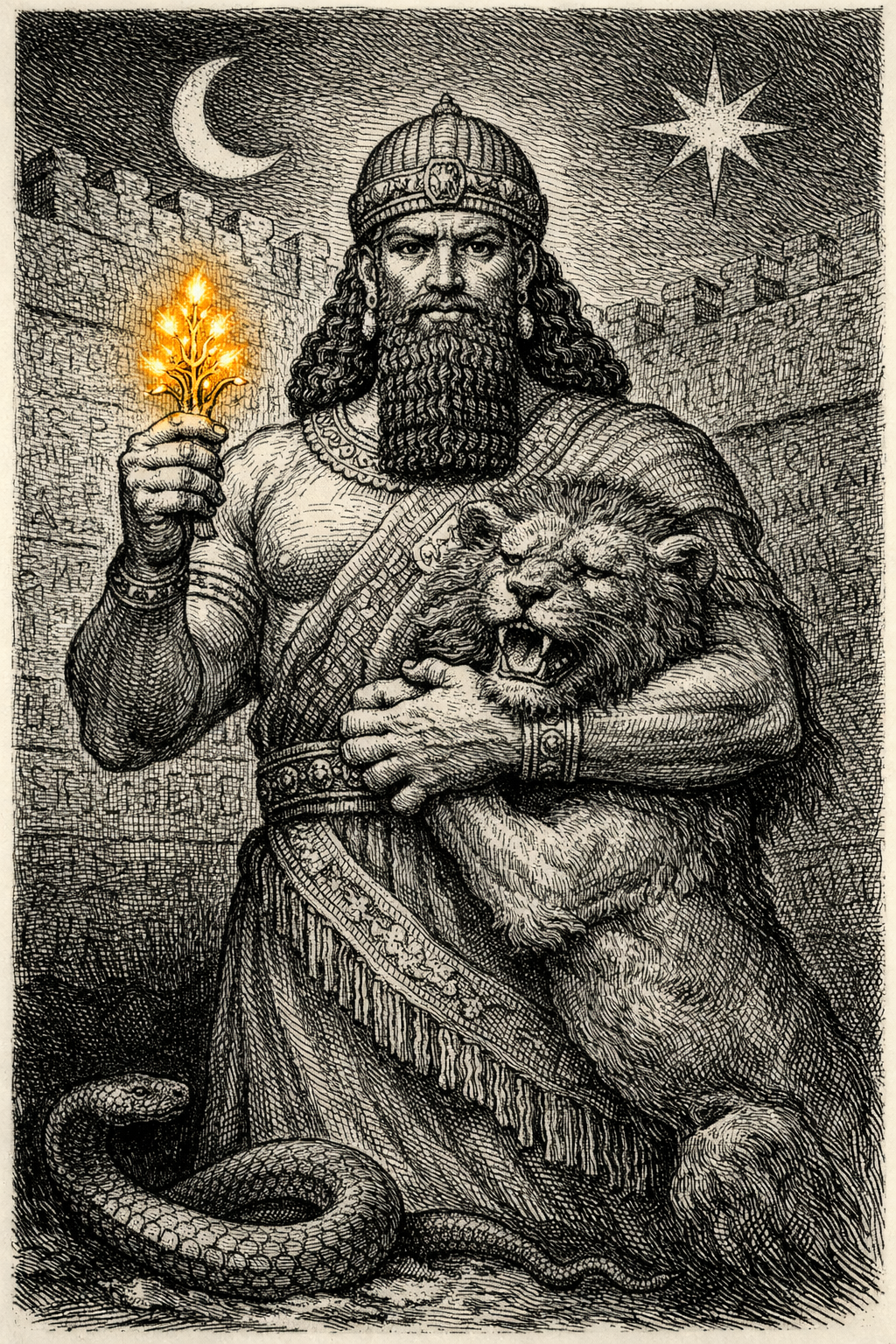
Gilgamesh
King, Giant, God
Mater Press
Mater Press (mater.press)
March 2026
March 2026
Gilgamesh
King, Giant, God
Mater Press
Mater Press (mater.press)
March 2026
Gilgamesh is the oldest named hero in human literature. His story was inscribed on clay tablets more than four thousand years ago, in a script that would not be deciphered until the nineteenth century, in a language that had been dead for two millennia before Christ was born. He ruled Uruk—the first great city on earth—at the dawn of recorded history, and his epic is the earliest surviving work of narrative literature in any language.
And yet, if you search for his name today, you will find it in places no Assyriologist would have predicted.
You will find it in a Freedom of Information Act request filed with the United States Department of State, asking for documents “pertaining to the resurrection chamber of Gilgamesh, the location of his body, and the location of the buried Nephilim.”1 You will find it in WikiLeaks intelligence databases, indexed alongside modern geopolitical keywords.2 You will find it in the fragmentary remains of the Dead Sea Scrolls, where the Book of Giants names Gilgamesh explicitly as one of the Nephilim.3 You will find it in the annals of German archaeology, where in 2003 a team led by Jörg Fassbinder used ground-penetrating radar to identify structures beneath the ancient city of Uruk that matched the Epic’s own description of Gilgamesh’s tomb—buried under the bed of the Euphrates River.4
You will find his name, in short, at the intersection of the oldest literature on earth and the most controversial questions of the present day.
The scholarly literature on Gilgamesh is vast, meticulous, and largely inaccessible. The standard critical editions—Andrew George’s magisterial two-volume The Babylonian Gilgamesh Epic: Introduction, Critical Edition and Cuneiform Texts (Oxford, 2003)5—are written for specialists who read Akkadian cuneiform. The popular translations—those by N.K. Sandars (Penguin, 1960),6 Stephanie Dalley (Oxford World’s Classics, 1989),7 Benjamin Foster (Norton, 2001),8 and Andrew George himself (Penguin Classics, 1999)9—are excellent but limit themselves to the Epic proper and do not attempt to compile every reference to Gilgamesh across all known traditions.
Meanwhile, the questions that most fascinate the general reader—Was Gilgamesh a real person? Was he a Nephilim? Is he the same figure as the biblical Nimrod? What is the “resurrection chamber”?—are either ignored by mainstream scholarship or addressed only in speculative works that lack rigorous sourcing.
This book attempts to bridge that gap.
In the pages that follow, we will:
Establish the historical evidence for Gilgamesh as a real king of Uruk, drawing on the Sumerian King List, archaeological excavations at Warka (ancient Uruk), and every cuneiform source that names him (Chapter 2).
Present every known Sumerian poem about Gilgamesh—the five compositions that predate the Epic by centuries—in transliteration with facing English translation (Chapter 3).
Present the complete Standard Babylonian Epic of Gilgamesh—all twelve tablets from the library of Ashurbanipal at Nineveh—in Akkadian transliteration with a modern English translation, accompanied by tablet-by-tablet commentary noting variant readings from Old Babylonian, Middle Babylonian, Hittite, and Hurrian fragments (Chapter 4).
Compile every other known reference to Gilgamesh across all cultures and all periods: Hittite and Hurrian versions, Elamite fragments, the Greek account preserved by Aelian, the Book of Giants from Qumran and the Manichean tradition, and any additional attestations however minor (Chapter 5).
Examine the Nephilim question: Was Gilgamesh one of the Nephilim of Genesis 6? The Epic describes him as “two-thirds god, one-third man.” The Book of Giants names him among the offspring of the Watchers. We examine all the evidence (Chapter 6).
Investigate the Nimrod identification: Are Nimrod (Genesis 10:8–12) and Gilgamesh the same historical figure? We examine the arguments of scholars from George Smith to David Rohl, and assess every textual and archaeological link (Chapter 7).
Analyze the Flood narrative: Tablet XI of the Epic contains the Utnapishtim flood story, the closest known parallel to the biblical account of Noah. We present a side-by-side comparison with Genesis 6–9, the Atrahasis Epic, and the Eridu Genesis, and address the question of dependence (Chapter 8).
Document the modern discovery of the tomb: Jörg Fassbinder’s 2003 magnetometry survey, the FOIA requests, the WikiLeaks intelligence trail, and the persistent theory that the 2003 Iraq invasion was connected to archaeological discoveries at Uruk (Chapter 9).
Explore the “return” narrative: The modern obsession with resurrecting Gilgamesh, its parallels in C.S. Lewis’s That Hideous Strength (where both good and evil factions race to awaken the sleeping Merlin), and what it means that humanity’s oldest story ends with a failed quest for immortality—yet modernity refuses to accept that verdict (Chapter 10).
This book is not a work of New Age speculation. It is not a conspiracy tract. It does not claim that the U.S. military invaded Iraq to seize Gilgamesh’s DNA, or that the resurrection chamber contains functioning alien technology, or that Hillary Clinton personally filed a FOIA request under a pseudonym.
What this book does claim is that the primary sources deserve to be taken seriously—all of them. The cuneiform tablets. The Sumerian King List. The Book of Giants. The biblical Nephilim passages. The archaeological surveys. And yes, the FOIA logs. We present the evidence. The reader draws the conclusions.
Every claim in this book is cited. Every translation is attributed. Where we present cuneiform texts, we provide the museum or collection number, the standard publication reference, and the translator. Where we discuss archaeological findings, we cite the excavation reports. Where we address the biblical text, we use the Revised Standard Version (RSV) unless otherwise noted, with reference to the Hebrew (Masoretic Text) or Greek (Septuagint) where relevant.
The following scholarly editions and reference works are cited throughout and deserve mention here:
Andrew R. George, The Babylonian Gilgamesh Epic: Introduction, Critical Edition and Cuneiform Texts, 2 vols. (Oxford: Oxford University Press, 2003). Abbreviated as George 2003.
Andrew R. George, The Epic of Gilgamesh: A New Translation (London: Penguin Books, 1999). Abbreviated as George 1999.
Samuel Noah Kramer, Sumerian Mythology: A Study of Spiritual and Literary Achievement in the Third Millennium B.C. (Philadelphia: University of Pennsylvania Press, 1944; revised edition 1961). Abbreviated as Kramer 1944.
Thorkild Jacobsen, The Sumerian King List (Chicago: University of Chicago Press, 1939). Abbreviated as Jacobsen 1939.
J.T. Milik, The Books of Enoch: Aramaic Fragments of Qumrân Cave 4 (Oxford: Clarendon Press, 1976). Abbreviated as Milik 1976.
Loren T. Stuckenbruck, The Book of Giants from Qumran: Texts, Translation, and Commentary (Tübingen: Mohr Siebeck, 1997). Abbreviated as Stuckenbruck 1997.
W.G. Lambert, Babylonian Creation Myths (Winona Lake, IN: Eisenbrauns, 2013). Abbreviated as Lambert 2013.
Benjamin R. Foster, Before the Muses: An Anthology of Akkadian Literature, 3rd ed. (Bethesda, MD: CDL Press, 2005). Abbreviated as Foster 2005.
Stephanie Dalley, Myths from Mesopotamia: Creation, The Flood, Gilgamesh, and Others (Oxford: Oxford University Press, 1989; revised edition 2000). Abbreviated as Dalley 2000.
A. Kirk Grayson, Assyrian and Babylonian Chronicles (Locust Valley, NY: J.J. Augustin, 1975). Abbreviated as Grayson 1975.
Douglas Frayne, The Royal Inscriptions of Mesopotamia, Early Periods, vol. 1: Presargonic Period (2700–2350 BC) (Toronto: University of Toronto Press, 2008). Abbreviated as RIME 1.
Jeremy Black, Graham Cunningham, Eleanor Robson, and Gábor Zólyomi, The Literature of Ancient Sumer (Oxford: Oxford University Press, 2004). Abbreviated as Black et al. 2004.
Throughout this book, key passages from the Sumerian poems and the Akkadian Epic are presented in transliteration alongside their English translations. This fulfills a dual purpose: it allows readers with some knowledge of the ancient languages to engage directly with the original text, and it gives all readers a sense of the sound and rhythm of the poetry that no translation alone can convey.
Sumerian transliteration follows the conventions of the Electronic Text Corpus of Sumerian Literature (ETCSL) and Black et al. 2004. Sumerian is written in cuneiform, a script that uses signs which can represent syllables, whole words (logograms), or semantic classifiers (determinatives). In transliteration:
Words are separated by hyphens connecting their component signs (e.g., bil-ga-meš).
Subscript numbers distinguish between homophonous signs (e.g., du\(_{8}\) vs. du\(_{10}\)).
Superscript determinatives indicate semantic categories: d marks a divine name, ki a place name, and g̃iš a wooden object.
The tilde (g̃) represents the velar nasal, a distinctive Sumerian phoneme with no English equivalent.
The character š represents the voiceless postalveolar fricative /š/, similar to English “sh.”
The character ḥ represents a pharyngeal or velar fricative not present in English.
Akkadian transliteration follows the conventions of George 2003 and the standard Assyriological practice established by the Chicago Assyrian Dictionary (CAD) and Wolfram von Soden’s Akkadisches Handwörterbuch (AHw). Akkadian is a Semitic language (related to Hebrew and Arabic) also written in cuneiform. In transliteration:
Macrons (ā, ē, ı̄, ū) indicate long vowels.
The character š represents /š/ (“sh”); ṣ represents an emphatic sibilant; ṭ an emphatic dental.
The character ḥ represents a pharyngeal fricative.
The determinative d before a name indicates divinity (e.g., \(^{d}\)GIŠ-gìm-maš = the god Gilgamesh).
Hyphens separate syllabic signs; periods or spaces separate logographic signs.
Readers unfamiliar with these conventions may simply read the transliterations as approximate phonetic guides. The English translations that follow each transliterated passage provide the full meaning.
Gilgamesh is not merely an academic curiosity. He is the first named individual in human literature to confront mortality and demand an answer. His story is the prototype for every hero’s journey that followed—from Odysseus to Beowulf, from Heracles to the Arthurian knights. His flood account is the closest known parallel to Genesis. His description as “two-thirds divine” places him squarely in the tradition of the Nephilim—the divine-human hybrids whose existence the Bible acknowledges but does not explain. And his tomb, if Fassbinder’s radar survey is correct, still lies beneath the Iraqi desert, unexcavated.
Four thousand years after his death, the world is still looking for Gilgamesh.
This book is a guide to the search.
Was Gilgamesh a real person?
For most of the twentieth century, the scholarly consensus treated him as a purely mythological figure—a literary creation onto whom Sumerian poets projected the ideals and anxieties of their civilization. This view began to shift as cuneiform scholarship advanced, and today the majority of Assyriologists accept that Gilgamesh was almost certainly a historical king of Uruk who ruled during the Early Dynastic II period, approximately 2700–2600 BCE.10
The evidence for a historical Gilgamesh is circumstantial but cumulative. No royal inscription bearing his name has yet been found. No contemporary document from his own reign survives. But the network of references to him in later Sumerian and Akkadian sources—king lists, royal hymns, literary compositions, offering lists, and administrative texts—is dense enough to convince most specialists that the literary tradition rests on a historical core.


The geography matters. Mesopotamia is flat—a vast alluvial plain built up over millennia by river sediment. There are no natural barriers, no defensible highlands, no reliable rainfall. Everything depends on the rivers. The Euphrates and Tigris are not stable watercourses; they meander, flood, shift their beds, and split into braided channels across the plain. A city built on the Euphrates in 2700 BCE might find itself kilometers from the river by 1000 CE. This fact is central to understanding both the rise and fall of Uruk and the remarkable claim, preserved in the Epic, that Gilgamesh was buried beneath the riverbed.
The single most important document for establishing the historicity of Gilgamesh is the Sumerian King List (abbreviated SKL), a composition surviving in multiple copies from the Old Babylonian period (c. 2000–1600 BCE) that purports to record every king who ruled Sumer from the time “when kingship descended from heaven” down to the compiler’s own day.11
The SKL lists Gilgamesh as the fifth king of the First Dynasty of Uruk. The relevant passage reads:

“The divine Gilgamesh—his father was a phantom (lilú), a high priest of Kullab—ruled 126 years. Ur-Nungal, son of Gilgamesh, ruled 30 years.”12
Several features of this entry are significant:
The determinative dingir (divine): Gilgamesh’s name is preceded by the cuneiform sign for “god” or “divine.” This is not typical of all kings on the list and suggests that Gilgamesh had already been deified by the time the SKL was compiled.
His father was a lilû: The SKL does not name Gilgamesh’s father as a human king. Instead, it uses a term associated with spirits or demons. This accords with the Epic’s claim that Gilgamesh was “two-thirds god, one-third man”—his mother was the goddess Ninsun and his father was a mortal (or, in this telling, a phantom). The precise meaning remains debated.13
His son Ur-Nungal succeeds him: The listing of a named son and successor implies a real dynastic sequence. Ur-Nungal (also read Ur-Lugal) is independently attested in other Sumerian literary texts.14
The reign length of 126 years: The antediluvian kings on the SKL reign for tens of thousands of years. The post-flood dynasties begin with long but gradually decreasing reign lengths. By the First Dynasty of Uruk, the numbers are still legendary (Meskiangasher: 324 years; Enmerkar: 420 years; Lugalbanda: 1,200 years; Dumuzi: 100 years; Gilgamesh: 126 years) but have been interpreted by some scholars as reflecting a transition from purely mythic chronology to something approaching historical record.15
The Tummal Inscription is a short Sumerian composition listing the kings who built and restored the Tummal, a shrine of the goddess Ninlil near Nippur. It provides an independent chronological sequence that overlaps with the SKL and names Gilgamesh:16
“For a second time, the Tummal fell into ruins. Gilgamesh built the Numunburra of the House of Enlil. Ur-Nungal, son of Gilgamesh, made the Tummal pre-eminent, brought Ninlil to the Tummal.”17
The Tummal Inscription places Gilgamesh in a sequence of rulers who are also named in the SKL—Enmebaragesi of Kish, Agga of Kish, Mesannepada of Ur—creating a network of cross-references that strengthens the case for historicity.
The historicity of Gilgamesh received its strongest indirect confirmation from archaeology in the early twentieth century. The SKL lists Enmebaragesi (also read Mebaragesi) as a king of Kish who ruled before Agga, the last king of the First Dynasty of Kish. In the Sumerian poem Gilgamesh and Agga, Agga of Kish besieges Uruk and Gilgamesh defends it—placing the two kings as contemporaries.18
In 1930, an inscribed alabaster vase fragment was discovered bearing the name Enmebaragesi, confirming that this king was a real historical figure.19 This was the earliest contemporary royal inscription then known from Mesopotamia (c. 2600 BCE). Since Enmebaragesi is a contemporary of Agga, and Agga is a contemporary of Gilgamesh in the literary tradition, the discovery anchored Gilgamesh to a datable archaeological horizon.
As Andrew George summarizes: “The historicity of Gilgameš is supported by the fact that he appears in the Sumerian King List in a plausible position relative to other kings whose existence is confirmed by contemporary inscriptions.”20
Whatever the historical Gilgamesh accomplished during his lifetime, he was elevated to divine status after his death. The evidence for his deification is extensive:
Gilgamesh appears in offering lists from the Third Dynasty of Ur (Ur III period, c. 2112–2004 BCE), where he receives cult offerings alongside other deified kings. At Ur, Girsu, and Nippur, the name \(^{d}\)Gilgameš (with the divine determinative) appears in administrative texts recording deliveries of animals for sacrifice.21
King Shulgi of Ur (r. c. 2094–2047 BCE), the most prolific self-propagandist of Sumerian history, claimed Gilgamesh as his personal ancestor and divine brother in several hymns. In Shulgi O, he states:22
“Gilgamesh, my brother and my friend—I will be his equal in the Netherworld.”23
Shulgi also claimed that his mother was the goddess Ninsun—the same goddess identified as Gilgamesh’s mother in the Epic—thereby establishing a mythological kinship.24
Several Sumerian texts assign Gilgamesh the role of judge of the dead in the Netherworld. The poem The Death of Gilgamesh describes the offerings made at his funeral and states that he will take his place among the gods of the underworld.25 A Sumerian incantation from Nippur invokes him:
“Gilgamesh, perfect king, judge of the Anunnaki, deliberative prince, the knot of the peoples, who surveys the regions of the world, administrator of the Netherworld, lord of the peoples below—you are a judge and you examine like a god.”26
This role persisted into later Babylonian religion. In the Neo-Assyrian period (first millennium BCE), Gilgamesh appears in ritual texts and prayers as a chthonic deity to whom one could appeal for justice in the afterlife.
The Epic of Gilgamesh itself draws attention to one tangible achievement: the city walls of Uruk. The opening and closing lines of the Standard Babylonian version form an inclusio (a literary bracket) that invites the reader to inspect the walls:
“Go up, pace out the walls of Uruk. Study the foundation terrace and examine the brickwork. Is not its brickwork of kiln-fired brick? Did not the Seven Sages lay its foundations?”27
Archaeological excavations at Warka (the modern name for ancient Uruk, in southern Iraq) have indeed revealed massive city walls dating to the Early Dynastic period. The German Archaeological Institute (Deutsches Archäologisches Institut) has been excavating Uruk since 1912, with major campaigns under Julius Jordan (1928–1939), Heinrich Lenzen (1954–1967), and subsequent directors.28
The walls enclose an area of approximately 5.5 square kilometers, making Uruk one of the largest cities in the ancient world by the mid-third millennium BCE. While the walls as currently excavated likely postdate Gilgamesh’s reign in their final form, the foundation layers are consistent with Early Dynastic II construction.29

Beyond the SKL, the Tummal Inscription, and the literary texts treated in Chapters 3–5, Gilgamesh appears in the following additional cuneiform sources:
The great Babylonian god list An = Anum (compiled in the Old Babylonian period and preserved in later copies) includes Gilgamesh among the deities of the Netherworld. He is listed with his wife Inanna-of-Uruk and his vizier Kulla.30
Gilgamesh appears in several Babylonian omen compendia, where historical events from his reign are used as precedents. For example, the Old Babylonian omen series Shumma ālu contains the entry: “If a city is surrounded by a siege ramp—omen of Agga, whom Gilgamesh captured.”31
These omen references are particularly significant because they treat Gilgamesh as a historical king whose reign produced datable events, not as a mythological figure.
The Neo-Sumerian king Utu-hegal of Uruk (r. c. 2119–2113 BCE), who liberated Sumer from Gutian rule, styled himself as a successor to Gilgamesh in a victory inscription.32 The Neo-Assyrian king Anam of Uruk (c. 1821–1817 BCE) claimed to have restored the walls of Uruk that Gilgamesh had originally built.33
The name itself has been the subject of extensive philological debate. It is written in Sumerian as \(^{d}\)Bilga.mes (or \(^{d}\)GIŠ.BIL.GA.MEŠ), and the precise reading and etymology remain contested:
Thorkild Jacobsen proposed “The Old Man (bilga) Is Still a Young Man (meš),” reflecting a paradox of aged wisdom and youthful vigor.34
W.G. Lambert suggested a connection to the Sumerian bilga (“ancestor”) and meš (“hero” or “young man”), yielding “The Ancestor Is a Hero.”35
Andrew George notes that the Akkadian form Gilgāmeš is a later adaptation and that the original Sumerian pronunciation was likely closer to Bilgames.36
The name appears in cuneiform with the divine determinative (\(^{d}\)) already in Early Dynastic texts, confirming that Gilgamesh was venerated as a deity from a very early period.
The most tantalizing question—whether physical evidence of Gilgamesh’s reign or burial will ever be found—remains open. The German-Iraqi magnetometry survey of 2001–2003, led by Jörg Fassbinder, revealed extensive subsurface structures at Uruk including what appeared to be a burial complex beneath the former bed of the Euphrates.37 Excavation was halted by the Iraq War and has not resumed as of this writing.
Until that tomb—if it is a tomb—is opened, the historical Gilgamesh remains attested only by later tradition. But that tradition is remarkably consistent, remarkably widespread, and remarkably persistent. Kings claimed descent from him. Priests offered sacrifices to him. Scribes copied his story for two thousand years. Omen scholars cited his military victories as historical precedent. And the city walls the Epic attributes to him are still visible in the Iraqi desert.
The real Gilgamesh may never have left a royal inscription of his own. But his contemporaries and successors left enough for us to conclude, with reasonable confidence, that behind the legend stands a king.
Before there was an Epic of Gilgamesh, there were poems.
Five independent Sumerian compositions about Gilgamesh survive from the Old Babylonian period (c. 2000–1600 BCE), though the traditions they preserve are certainly older—likely reaching back to the Ur III period (c. 2112–2004 BCE) or earlier. These poems are not chapters of a single narrative. They are separate works, each self-contained, each treating a different episode from the life of Gilgamesh. They were composed in Sumerian—the oldest written language in the world—and they represent the raw material from which the later Akkadian Epic would be crafted.38
The relationship between these Sumerian poems and the later Akkadian Epic is not one of simple translation. The author of the Standard Babylonian Epic—traditionally identified as Sîn-lēqi-unninni, a scholar-priest of Uruk39—selected, rearranged, expanded, and transformed these earlier traditions into a unified narrative with a coherent theological arc. Some episodes were incorporated almost wholesale. Others were drastically altered. At least one (Gilgamesh and Agga) was omitted entirely.
We present each poem below with an introduction, a summary, and extensive translated excerpts. For the full Sumerian transliterations, we refer the reader to the ETCSL and to the critical editions cited in the notes.

Gilgamesh and Agga is the shortest of the five poems (115 lines) and the most historically grounded. It describes a political and military confrontation between Gilgamesh, king of Uruk, and Agga, king of Kish—a conflict that likely reflects real Early Dynastic power struggles between Sumerian city-states.40
Uniquely among the Gilgamesh poems, this composition contains no supernatural elements. There are no gods, no monsters, no divine interventions. It reads like a political narrative: a city under siege, a council of elders debating surrender, a young king who refuses to submit, and a resolution that combines military bravado with diplomatic restraint.
This poem was not incorporated into the Standard Babylonian Epic, perhaps because its purely political subject matter did not fit the Epic’s grand themes of friendship, mortality, and the quest for immortality.
Agga, son of Enmebaragesi, king of Kish, sends envoys to Uruk demanding submission. Gilgamesh consults first the council of elders, who advise capitulation, then the assembly of fighting men, who urge resistance. Gilgamesh sides with the warriors. When Agga arrives with his army, Gilgamesh sends out a champion named Birhurturre, who is captured. Gilgamesh then appears on the city wall himself. His mere appearance causes Agga’s forces to falter. In the end, Gilgamesh addresses Agga directly, acknowledging a past favor Agga had done him, and the siege is lifted without a full battle.41
Sumerian Transliteration (ETCSL c.1.8.1.1, lines 44–49, 99–105):
\(^{d}\)bil-ga-meš en kul-aba\(_{4}^{ki}\)-ka
inim guruš-e-ne-ka šà-ni ḥúl-la ba-ni-in-dúg
ìr\(_{11}\)-a-ni en-ki-du\(_{10}\)-ra gù mu-na-dé-e
ud-bi-a me-é túkul-e ki-sè-ga-bi ḥa-ba-da-an-zì
g̃ištukul-e á-zù-ta ḥa-ba-da-an-gi\(_{4}\)
ni\(_{2}\) ḥúš-a ḥa-ba-da-an-ák
…
\(^{d}\)bil-ga-meš en kul-aba\(_{4}^{ki}\)-ka
inim ag-ga-ka igi-ni-šè mu-un-g̃ál\(_{2}\)
ag-ga ša\(_{3}\)-gu\(_{4}\)-mu ag-ga ugula-mu
ag-ga šagina-mu—
ag-ga ki-mu mu-un-gi\(_{4}\)
ag-ga ki-mu mu-un-gi\(_{4}\)
English Translation:
“Gilgamesh, the lord of Kullab,
at the word of the fighting men his heart rejoiced, his spirit brightened.
He said to his servant Enkidu:
‘Now the instruments of war shall be loosened from their bonds!
Let the weapons of battle return to your side!
Let them bring terror and dread!’
…
Then did Gilgamesh, the lord of Kullab,
at the word of Agga rise up before him.
He said: ‘O Agga, my lieutenant, O Agga, my captain,
O Agga, my army commander—
Agga has restored me to my place.
Agga has restored me to my place!’ ”42
The poem’s depiction of a bicameral assembly—a council of elders and an assembly of young warriors—has attracted enormous interest from historians of political institutions. Thorkild Jacobsen cited it as evidence for “primitive democracy” in early Mesopotamia, a thesis that has been influential though contested.43
The poem also provides a rare glimpse of interstate relations in Early Dynastic Sumer: the suzerainty claims of Kish over other cities, the mechanisms of diplomatic negotiation, and the role of personal loyalty between kings.
Gilgamesh and Huwawa (also known as Gilgamesh and the Land of the Living) survives in two versions, conventionally labeled Version A and Version B. It tells the story of Gilgamesh’s expedition to the Cedar Forest to confront and defeat its guardian, the monstrous Huwawa (Humbaba in the later Akkadian tradition).44
This poem supplied the raw material for Tablets III–V of the Standard Babylonian Epic, where the Cedar Forest expedition becomes one of the two great adventures of Gilgamesh and Enkidu. But the Sumerian version is significantly different in tone and detail.
Gilgamesh, brooding on mortality, resolves to “set up his name” by undertaking a great deed. He persuades his servant Enkidu (who is here a servant, not yet the wild man and equal companion of the later Epic) to accompany him to the Cedar Mountain. They travel through seven mountain ranges. Gilgamesh has a series of dreams, which Enkidu interprets. When they reach the Cedar Forest, they encounter Huwawa, whose terrifying “auras” (Sumerian me-lám) paralyze all who approach.45
Gilgamesh tricks Huwawa by offering his sisters as brides and giving him gifts, causing Huwawa to surrender his auras one by one. Once stripped of his power, Huwawa begs for mercy. Enkidu urges Gilgamesh to kill him. Gilgamesh hesitates but ultimately cuts off Huwawa’s head.46
Sumerian Transliteration (ETCSL c.1.8.1.5, Version A, lines 1–10):
\(^{d}\)bil-ga-meš en-ki-du\(_{10}\)-ra gù mu-na-dé-e
ga-nam lu\(_{2}\)-g̃e\(_{26}\) kur-še\(_{3}\) ga-an-g̃en
mu ḥé-g̃ál\(_{2}\) ga-àm\(_{3}\)-mi-ib-íl
en-ki-du\(_{10}\) ka-ni ba-an-dug\(_{4}\) \(^{d}\)bil-ga-meš-ra mu-na-ni-ib-gi\(_{4}\)
lugal-g̃u\(_{10}\) kur-še\(_{3}\) ga-e-re-g̃en-na-zu-dè\(_{3}\)
\(^{d}\)utu-ra ḥé-en-na-ab-bé
\(^{d}\)utu kur-bi lu\(_{2}\) nam-me-še\(_{3}\)
kur g̃išerin-na \(^{d}\)utu-kam
kur g̃išerin-na \(^{d}\)utu ḥé-en-na-ab-bé
English Translation:
“Gilgamesh spoke to Enkidu:
‘Come, my friend, let us go to the mountain of cedars,
let us set up our name!’
Enkidu opened his mouth and spoke to Gilgamesh:
‘My lord, if you would go to the mountain,
Utu, the god of the sun, should be informed.
The mountain of cedars—it is Utu’s concern.
The mountain of cedars—let Utu be informed!’ ”47
In the Sumerian version, Enkidu is a servant (ir\(_{11}\)); in the Epic, he is a friend and equal.
The Sumerian Huwawa is defeated through trickery; the Akkadian Humbaba is defeated in combat.
The sun god Utu (Shamash in Akkadian) plays a greater role in the Sumerian version, sending the “Thirteen Winds” to aid Gilgamesh.48
Huwawa’s auras (me-lám)—supernatural radiances that he wears like armor—are a distinctly Sumerian concept that is preserved but somewhat flattened in the Akkadian retelling.
Gilgamesh and the Bull of Heaven survives in fragmentary condition. The extant portions describe the goddess Inanna’s (Ishtar’s) demand that her father Anu release the Bull of Heaven to punish Gilgamesh, who has apparently rejected or insulted her. Gilgamesh and Enkidu fight and kill the Bull.49
This episode became Tablet VI of the Standard Babylonian Epic, where it is one of the pivotal events: the killing of the Bull of Heaven provokes the gods’ decision that one of the two heroes must die, leading to Enkidu’s death and Gilgamesh’s subsequent crisis.
The surviving portions show Inanna requesting the Bull from Anu, threatening dire consequences if he refuses (a motif parallel to her descent to the Netherworld). Anu releases the Bull. It descends to Uruk and causes devastating destruction—each of its snorts kills hundreds of men. Gilgamesh and Enkidu confront it. Enkidu grabs the Bull by the tail, and Gilgamesh strikes the killing blow.50
Sumerian Transliteration (ETCSL c.1.8.1.2, composite text):
gu\(_{4}\)-an-na pèš ba-an-pèš 1-kam-ma
ab-lál ba-an-šì guruš 1 šu-ši unug\(^{ki}\)-ga ba-an-šub
pèš ba-an-pèš 2-kam-ma
guruš 2 šu-ši unug\(^{ki}\)-ga ba-an-šub
pèš ba-an-pèš 3-kam-ma
en-ki-du\(_{10}\) murub\(_{4}\)-ba-na im-ma-an-šub
en-ki-du\(_{10}\) ba-da-ra-zì gu\(_{4}\)-an-na si-bi im-ma-an-dab\(_{5}\)
gu\(_{4}\)-an-na ka-bi-ta ù\(_{5}\) im-ma-an-dé
kun-bi-ta še-er-tab im-ma-an-dé
…
en-ki-du\(_{10}\) gu\(_{4}\)-an-na kun gal-la-bi-šè mu-un-dab\(_{5}\)
\(^{d}\)bil-ga-meš lu\(_{2}\) a-la-la-am\(_{3}\) kala-ga zu-a-am\(_{3}\)
murub\(_{4}\) si-bi ù gun\(_{3}\)-a-bi-šè g̃ištukul bi\(_{2}\)-in-gub
English Translation:
“The Bull of Heaven snorted once, and at its snort
a pit opened and one hundred young men of Uruk fell into it.
It snorted a second time, and two hundred young men of Uruk fell into it.
It snorted a third time,
and Enkidu fell into it up to his waist.
Enkidu leapt out. He seized the Bull of Heaven by its horns.
The Bull of Heaven cast foam from its mouth,
it threw dung from its tail.…
Enkidu seized the Bull of Heaven by its thick tail
and Gilgamesh, like a butcher, bold and skilful,
thrust his knife between the shoulders and the horns.”51
Gilgamesh, Enkidu, and the Netherworld is the longest and most complex of the Sumerian poems (c. 300 lines). It exists in two distinct sections: a cosmological prologue about the origins of the world and the halub-tree (possibly a willow or a huluppu-tree), and a main narrative in which Enkidu descends to the Netherworld and reports back to Gilgamesh on the conditions of the dead.52
The second half of this poem was translated almost verbatim into Akkadian as Tablet XII of the Standard Babylonian Epic—the most controversial tablet, which many scholars regard as an appendix awkwardly grafted onto the main narrative.53
The cosmological prologue describes how, in the beginning, heaven and earth were separated, and Enlil took the earth while An took heaven. A halub-tree grows on the bank of the Euphrates. The goddess Inanna finds it and plants it in her garden in Uruk, hoping to make a bed and a chair from its wood. But three unwanted inhabitants settle in the tree: a serpent at its roots, an Anzu-bird (a mythological eagle) in its crown, and a phantom maiden (ki-sikil-líl-lá) in its trunk.54
Inanna asks Gilgamesh for help. He kills the serpent, and the Anzu-bird and phantom maiden flee. He fells the tree and fashions from it a pukku and a mekkû (objects whose precise identification is debated—possibly a ball and stick, or a drum and drumstick) and gives them to Inanna.55
The pukku and mekkû then fall into the Netherworld through a hole in the ground. Gilgamesh laments their loss. Enkidu volunteers to descend and retrieve them. Gilgamesh gives him careful instructions on how to behave in the Netherworld—how not to attract the attention of the dead—but Enkidu violates every instruction and is seized by the Netherworld, unable to return.
Gilgamesh petitions the gods. Enlil refuses to help. Enki (Ea) intervenes by ordering Utu (Shamash) to open a hole in the ground so that the spirit (gidim) of Enkidu can rise up. Enkidu’s ghost appears, and Gilgamesh questions him about the conditions of the dead. Enkidu gives a grim catalog: those who had many sons fare better than those who had few; the unburied dead are worst off; the stillborn child is best off of all.56
Sumerian Transliteration (ETCSL c.1.8.1.4, lines 255–290):
\(^{d}\)bil-ga-meš mu-na-ni-ib-gi\(_{4}\)-gi\(_{4}\)
lu\(_{2}\) dumu 1-a-ni igi bi\(_{2}\)-in-du\(_{8}\)-am\(_{3}\)
igi im-mi-in-du\(_{8}\) a-na-še\(_{3}\)-àm\(_{3}\)
gag é-gar\(_{8}\)-ra-na-ka ér gig i-i
lu\(_{2}\) dumu 2-a-ni igi bi\(_{2}\)-in-du\(_{8}\)-am\(_{3}\)
igi im-mi-in-du\(_{8}\) a-na-še\(_{3}\)-àm\(_{3}\)
sig\(_{4}\) 2-a-na tuš-a ninda gu\(_{7}\)-e
lu\(_{2}\) dumu 3-a-ni igi bi\(_{2}\)-in-du\(_{8}\)-am\(_{3}\)
igi im-mi-in-du\(_{8}\) a-na-še\(_{3}\)-àm\(_{3}\)
a umbin\(_{3}\)-ta nag̃-a
…
lu\(_{2}\) dumu 7-a-ni igi bi\(_{2}\)-in-du\(_{8}\)-am\(_{3}\)
igi im-mi-in-du\(_{8}\) a-na-še\(_{3}\)-àm\(_{3}\)
an-zà-še\(_{3}\) di-ku\(_{5}\) dig̃ir-re-ne-ka g̃išgu-za-a tuš-a-àm\(_{3}\)
lu\(_{2}\) adda-ni edin-na šub-ba igi bi\(_{2}\)-in-du\(_{8}\)-am\(_{3}\)
igi im-mi-in-du\(_{8}\) a-na-še\(_{3}\)-àm\(_{3}\)
gidim-bi ki nu-ub-tuku
lu\(_{2}\) gidim ki-se\(_{3}\)-ga nu-tuku igi bi\(_{2}\)-in-du\(_{8}\)-am\(_{3}\)
igi im-mi-in-du\(_{8}\) a-na-še\(_{3}\)-àm\(_{3}\)
bur sila-a šub-ba ninda šub-ba sila-a gu\(_{7}\)-e
English Translation:
“Gilgamesh said to him, to Enkidu:
‘Did you see the man with one son?’
‘I saw him. He weeps bitterly at the peg driven into his wall.’
‘Did you see the man with two sons?’
‘I saw him. He sits on two bricks and eats bread.’
‘Did you see the man with three sons?’
‘I saw him. He drinks water from a saddle waterskin.’
…
‘Did you see the man with seven sons?’
‘I saw him. As a companion of the gods, he sits on a throne and listens to judgments.’
‘Did you see the man whose corpse was cast out on the steppe?’
‘I saw him. His ghost does not rest in the Netherworld.’
‘Did you see the man whose ghost has no one to tend it?’
‘I saw him. He eats the scrapings of the pot and crusts of bread thrown into the street.’ ”57
This poem contains the oldest surviving literary description of the afterlife in any language. Its vision is bleak: the Netherworld is not a place of punishment or reward in the moral sense, but a gray half-existence where one’s condition depends largely on how many descendants one has to maintain funerary offerings. This theology of the dead profoundly influenced the Standard Babylonian Epic, where Gilgamesh’s terror of death drives the entire second half of the narrative.
The poem also contains the earliest known reference to a figure identifiable with Lilith (the ki-sikil-líl-lá), predating the biblical and Talmudic traditions by over a millennium.
The Death of Gilgamesh survives in extremely fragmentary condition, with major gaps in the text. What remains describes the gods’ decree that Gilgamesh must die, his lamentation, the funeral preparations, and his installation as a judge in the Netherworld.58
This poem was not directly incorporated into the Standard Babylonian Epic, but its themes—the inevitability of death, the refusal to accept it, and the consolation of posthumous glory—permeate the entire second half of the Epic. The Epic’s resolution, in which Gilgamesh returns to Uruk and finds consolation in the enduring walls of his city, can be read as a transformation of this poem’s theology.
The text opens with Gilgamesh lying on his deathbed (or possibly in a dream vision of his own death). The gods—Enlil, Enki, and others—confirm that no mortal can escape death, not even one who is “two-thirds divine.” Gilgamesh laments. He is told that, though he cannot live forever, he will receive honors in the Netherworld. A grand funeral is prepared, with offerings to the gods of the dead. Gilgamesh’s wives, servants, musicians, and courtiers are described as accompanying him (possibly through human sacrifice, though this interpretation is debated).59
The poem concludes with Gilgamesh taking his place as a judge of the dead, with authority over the spirits of the Netherworld.
Sumerian Transliteration (ETCSL c.1.8.1.3, Segment A, lines 1–15):
am gal ba-an-nú\(_{2}\) ú nu-ku-ku
nam-šul-la dirig-ga ú nu-ku-ku
a\(_{2}\) ḥúš tuku en \(^{d}\)bil-ga-meš ú nu-ku-ku
lu\(_{2}\) ḥul gig-ga til-la ú nu-ku-ku
lu\(_{2}\) ki-nú-da gi\(_{6}\)-a nu-g̃ál\(_{2}\) ú nu-ku-ku
…
lu\(_{2}\) iri-na-ke\(_{4}\) mu-na-ab-bé
\(^{d}\)bil-ga-meš a-ab-ba diḥal-a dib-ba
a\(_{2}\)-bi ba-kúr
ḥur-sag̃ ki-ta ù ki-ta šu é-a dib-ba
a\(_{2}\)-bi ba-kúr
English Translation:
“The great wild bull has lain down and is sleeping,
he who excelled all in lordliness—he is sleeping.
He who was perfect in strength, the lord Gilgamesh—he is sleeping.
He who diminished the wicked—he is sleeping.
He who would not rest on the cushions of night—he is sleeping.
…
The people of his city said:
‘Gilgamesh, who crossed all the seas—
his strength has been brought low.
He who bound together the highlands and the mountains—
his strength has been brought low.’ ”60
This is the only Sumerian text that directly addresses the death of Gilgamesh and his transition from mortal king to netherworld deity. Its portrait of a lavish royal funeral, with its catalog of gifts for the gods of the underworld, provides our best literary evidence for Sumerian funerary ideology.
The poem also makes explicit what the other Sumerian compositions leave implicit: that Gilgamesh was two-thirds divine and yet could not escape death. The tension between superhuman status and mortal fate is already fully present in the Sumerian tradition, centuries before Sîn-lēqi-unninni would make it the central theme of his masterpiece.
Taken together, the five Sumerian Gilgamesh poems give us a composite portrait that differs in important ways from the Gilgamesh of the Standard Babylonian Epic:
Enkidu is a servant, not a friend. The great friendship—the emotional core of the Akkadian Epic—is an innovation of the later tradition.
The quest for immortality is present thematically (in The Death of Gilgamesh and Gilgamesh, Enkidu, and the Netherworld) but is not yet organized into a single narrative arc. The journey to Utnapishtim does not appear in any surviving Sumerian poem.
The supernatural elements are more localized: Huwawa’s auras, the Bull of Heaven’s destructive snorts, the Netherworld’s hole in the ground. The Sumerian poems are more episodic and less concerned with cosmic theology than the Epic.
Gilgamesh’s character is more one-dimensional: he is a powerful, sometimes reckless king. The psychological depth—the grief, the existential terror, the slow acceptance of mortality—belongs to the Akkadian tradition.
The political dimension (Gilgamesh and Agga) is present in the Sumerian tradition but absent from the Epic, which is entirely concerned with the personal and the cosmic.
The Sumerian poems are not inferior versions of the Epic. They are different works, reflecting a different literary tradition, a different theology, and a different understanding of what made Gilgamesh worth remembering. The Epic did not replace them; scribes continued to copy both traditions simultaneously for centuries. Understanding Gilgamesh requires reading both.
The Standard Babylonian Epic of Gilgamesh is the oldest great work of literature in the world. It was composed in Akkadian—the lingua franca of the ancient Near East—and organized into twelve tablets of approximately 300 lines each. The version that has come down to us derives principally from copies found in the library of Ashurbanipal (r. 668–627 BCE) at Nineveh, though fragments from other sites (Babylon, Uruk, Sultantepe, Ugarit, Megiddo, Emar, and Hattusa) attest to its wide distribution across the ancient world.61
The tradition attributes authorship to Sîn-lēqi-unninni, a scholar of Uruk, though whether he “composed” the Epic in the modern sense or compiled and edited earlier materials is debated.62 The Standard Babylonian version (abbreviated SB) was likely compiled in the late second millennium BCE (c. 1200–1100 BCE), drawing on earlier Old Babylonian (OB) versions dating to c. 1800–1600 BCE, which in turn drew on the Sumerian poems of Chapter 3.63
What follows is a tablet-by-tablet presentation of the Epic. For each tablet, we provide: (1) a summary of the content, (2) extensive translated passages following the SB text, and (3) commentary noting significant variant readings from OB, Middle Babylonian (MB), Hittite, and other recensions. All translations follow George 2003 and George 1999 unless otherwise noted. Line numbers refer to the SB composite text established by George 2003.
The Akkadian title of the Epic is its opening words: Sha naqba ı̄muru—“He who saw the deep.”

The Epic opens with a prologue that frames the entire narrative as a retrospective account. An unnamed narrator invites the reader to consider Gilgamesh’s achievements and wisdom, gained through suffering:
Akkadian Transliteration (SB I.1–21):
ša naqba ı̄muru išdı̄ māti
ša kulāti ı̄dē šı̄ kala-ma ḥası̄su
\(^{d}\)GIŠ-gìm-maš ša naqba ı̄muru išdı̄ māti
ša kulāti ı̄dē šı̄ kala-ma ḥası̄su
kal nagbi iḥı̄ṭa ša gim-ri nemeqi
niṣirti ı̄mur katimti iptu
ūbiá ṭēma ša lām abūbi
urha rūqta illik-ma anhu-ma šalēlu
ikṣur ši-pir-šu ina narê
dūra ša Uruk supuri ibni
ša Eanna elliti quddusi
amur dūra-šu ša kima qe erê
ṣı̄r bāniša ša lā išannānu
lēqē ṣippatu ša ul-la-nu-ú
qı̄truúb ana Eanna šubat \(^{d}\)Ištar
ša šarru arkû lā uštamhi-ma
ēli dūri ša Uruk itāllak
tēmenna ulṭahhhiṣ-ma libitta-šu amur
u ul libittu aga-rá-šu
u ul tēmenna-šu iškunu sibı̄ttu apkallı̄
English Translation:
“He who saw the deep, the foundation of the land,
who knew the ways, was wise in all things.
Gilgamesh, who saw the deep, the foundation of the land,
who knew the ways, was wise in all things.
He explored everywhere the seats of power,
he knew the totality of wisdom about all things.
He saw what was secret and revealed what was hidden,
he brought back a tale of the time before the Flood.
He came a far road, was weary, found peace,
and set all his labors on a tablet of stone.
He built the wall of Uruk-the-Sheepfold,
of holy Eanna, the sacred storehouse.
See its wall, which is like a copper band,
survey its battlements, which nobody can match!
Take the stairway of a bygone era,
draw near to Eanna, the seat of Ishtar the goddess,
that no later king could ever copy!
Go up on the wall of Uruk and walk around,
examine the foundation terrace and inspect the brickwork!
Is not its brickwork of kiln-fired brick?
Did not the Seven Sages lay its foundations?”64
This prologue is remarkable for several reasons. It establishes that Gilgamesh’s story is one of wisdom gained through suffering—not glory gained through conquest. It directs attention to the walls of Uruk as the tangible legacy of his reign. And it mentions that Gilgamesh “brought back a tale of the time before the Flood”—a reference to the flood narrative of Tablet XI, linking the story’s beginning to its climax.
The prologue gives way to a portrait of Gilgamesh as he was before his transformation: an oppressive tyrant. He is described as physically magnificent—“two-thirds god and one-third man”65—but his behavior is intolerable:
“Gilgamesh leaves no son to his father,
day and night his outrage continues unrestrained.
…
Gilgamesh leaves no girl to her mother!
The warrior’s daughter, the young man’s bride—
the gods heard their complaint,
the gods of heaven, the lords of shuruppak:
‘Was it not Aruru who created this wild bull?
No rival has arisen to face him.
His companions are kept on their feet by his contests.
Gilgamesh leaves no son to his father,
day and night his outrage continues unrestrained.’ ”66
The gods respond by commissioning the creation of a companion who will be Gilgamesh’s equal—someone to match his energy and redirect it.
The mother goddess Aruru creates Enkidu from clay:
Akkadian Transliteration (SB I.101–112):
\(^{d}\)Aruru imtasi qātı̄-ša
ik-ta-rṣ ṭiṭṭa iddima ina ṣēri
ina ṣēri ib-ta-ni Enkidu quradu
ilitti qu-ul-ti kiṣru ša \(^{d}\)Ninurta
kalu zu-mur-šu uḥḥuz šārtu
pēreta uštabbal kima sinništi
pirásū ša šārti-šu ki-ma \(^{d}\)Nisaba
ul ı̄di nišı̄ u māta
lubbuštu-šu kima \(^{d}\)Šumuqan
itti ṣabı̄tāti šamma ikkala
itti būli ištattı̄ mašqita
itti nammâšti lib-ba-šu i-ḥa-ad-du A-ma
English Translation:
“Aruru washed her hands, she took a pinch of clay,
she threw it down in the wild.
In the wild she created Enkidu, the hero,
offspring of silence, knit strong by Ninurta.
His whole body was hairy,
he was furnished with tresses like a woman,
his locks of hair grew luxuriant like grain.
He knew neither people nor inhabited land,
he was dressed as cattle are.
With the gazelles he feeds on grass,
with the wild beasts he drinks at the water-hole,
with the animals his heart delights in the water.”67
Enkidu is a wild man—fully human but raised among animals, innocent of civilization. He is the natural counterpart to Gilgamesh the urban tyrant. Where Gilgamesh abuses civilization, Enkidu has never known it.
A trapper discovers Enkidu at the watering hole and, frightened, reports to Gilgamesh. Gilgamesh sends Shamhat, a temple priestess (harimtu), to civilize Enkidu through sexual initiation.68 After seven days and six nights with Shamhat, Enkidu finds that the animals no longer accept him. He has crossed from nature to culture. Shamhat teaches him to eat bread, drink beer, wear clothes, and bathe—the markers of civilization.
“Shamhat pulled off her clothing,
with one piece she clothed him,
with the other she clothed herself.
She took hold of his hand
and led him like a god
to the shepherds’ camp, the place of the sheep-pen.
…
He rubbed down the matted hair of his body,
he anointed himself with oil, he became a man.
He put on a garment, he was like a groom.”69
Enkidu then hears of Gilgamesh’s tyrannical behavior and resolves to challenge him. He travels to Uruk. The two meet at the door of a wedding house, wrestle, and—after a mighty struggle—become inseparable friends.70
The friendship established, Gilgamesh proposes the expedition to the Cedar Forest to slay its guardian Humbaba and “establish forever a name eternal.”71 Enkidu, who knows the forest from his time in the wild, warns against it:
Akkadian Transliteration (SB II.157–170):
ibrı̄ ı̄dē anāku māta šuátu
itti nammâšti at-ta-na-al-la-ku
qištu 10 šār bēru mi-tḥur-ta šu-up-pu-uk
mannu ša i-ra-am-mu-u qereb-ša
\(^{d}\)Humbaba rigim-šu abūbu
pū-šu išātu napšat-su mūtu
ammı̄ni taraššâ epēš annê
tibut lā mahrāt ti-bu-ut \(^{d}\)Humbaba
English Translation:
“My friend, I knew that country
when I roamed with the wild beasts.
The forest stretches ten thousand leagues in every direction.
Who would go into its midst?
Humbaba—his voice is the Deluge,
his speech is fire, his breath is death!
Why do you want to do this?
An irresistible onslaught is the charge of Humbaba.”72
Gilgamesh is undeterred. They commission weapons from the smiths of Uruk. Gilgamesh’s mother, the goddess Ninsun, offers prayers to the sun god Shamash, asking him to protect her son. The elders of Uruk give parting advice. The heroes depart.
Tablet III contains Ninsun’s prayer to Shamash and the formal departure of the two heroes. Much of the tablet is fragmentary, but the key surviving passages show Ninsun ritually adopting Enkidu as a son and commending both heroes to Shamash’s protection:
Akkadian Transliteration (SB III.46–58):
\(^{d}\)Šamaš ammı̄ni tašku-un ana mārı̄-ya \(^{d}\)GIŠ-gìm-maš
libba lā sālilu ta-at-tu-uk-šu-ma
illik-ma urha rūqtu ša \(^{d}\)Humbaba
tāḥāza lā ı̄du panı̄-šu iṣṣabat
ḥarrāna lā ı̄du irakkab
adi u\(_{4}\)-mi ša illaku u itarra
adi iksuda qišti ereni
adi idūku \(^{d}\)Humbaba ezza
u ša ina māti tazerrû lemneti uhalliqū
u\(_{4}\)-ma attā tamahharā-šu
\(^{d}\)Aya kallatu li-za-kir-ka
English Translation:
“O Shamash, why did you give my son Gilgamesh a restless heart?
You have touched him and now he goes
on a far road to where Humbaba lives.
He faces a battle he does not understand,
he rides a road he does not know.
Until the day he goes and returns,
until he reaches the Cedar Forest,
until he has killed fierce Humbaba
and destroyed from the land the evil you hate—
on the day you face him, may Aya, your bride, remind you!”73
Tablets IV describes the journey to the Cedar Forest in a highly structured pattern: the heroes travel, make camp, Gilgamesh has a terrifying dream, Enkidu interprets it favorably. This sequence repeats five times. Only fragments of some dreams survive, but the pattern is clear.
Akkadian Transliteration (SB IV.1–11):
ina 20 bēri iksu-rū naptana
ina 30 bēri išku-nū ma-ya-al-ta
50 bēri illikū u\(_{4}\)-um ištēn
ḥarrān 11/2 ITU 3 u\(_{4}\)-mi illikū
ana šad Lab-na-na iṭ-ḥu-u
ina pa-an \(^{d}\)Šamaš ih-ru-ú ḥirrı̄ta
ı̄li \(^{d}\)GIŠ-gìm-maš eli šadê
niqê issuq qu-lē
šadû šutta šubriam ṭe\(_{4}\)-em \(^{d}\)Šamaš
English Translation:
“At twenty leagues they ate their ration,
at thirty leagues they stopped for the night.
Fifty leagues they walked in one day,
the journey of a month and a half in three days.
They drew near to Mount Lebanon.
They dug a well in front of Shamash,
Gilgamesh went up onto the mountain,
he poured out fine flour as an offering:
‘O mountain, bring me a dream, a favorable message from Shamash!’ ”74
In 2014, a previously unknown fragment of Tablet V was published, filling significant gaps in the narrative and providing the most detailed description yet of the Cedar Forest:75

Akkadian Transliteration (SB V.1–9):
izzizzū-ma ı̄taplasū qišta
ı̄tammarū šuqūr erēni
ı̄tammarū ı̄rib qišti
ašar \(^{d}\)Humbaba ittanallaku ubbulū kibsu
ḥarrānātu ištennattā ṭābu ḥarranu
ı̄murū šad ereni šubat ilāni
par-ak \(^{d}\)Ir-ni-ni
ina pān šadê erenu našû ḥišba-šu
ṭābu ṣillu-šu malû tul-tu
English Translation:
“They stood and gazed at the forest,
they were looking at the height of the cedars,
they were looking at the entrance of the forest.
Where Humbaba would walk, a path was made,
the roads were straight, the way was good.
They saw the Cedar Mountain, abode of the gods,
the throne-dais of Irnini [Ishtar].
Before the mountain the cedars raise their luxuriance,
their shade is good, full of delight.”76
The confrontation with Humbaba follows. The monster pleads for mercy, offering to be Gilgamesh’s servant and give him all the cedars he wants. Gilgamesh hesitates, but Enkidu urges him to strike:
“Enkidu opened his mouth and spoke,
he said to Gilgamesh:
‘My friend, do not listen to the words of Humbaba!’ ”77
The killing itself is narrated with brutal directness:
Akkadian Transliteration (SB V.243–260):
\(^{d}\)GIŠ-gìm-maš imhaṣ kippat nakiri-šu
\(^{d}\)Humbaba izakkara ana \(^{d}\)GIŠ-gìm-maš
attā \(^{d}\)GIŠ-gìm-maš amat \(^{d}\)Šamaš
\(^{d}\)Enkidu imhaṣ nāṣir qišti
ina ša-la-aš šaniš \(^{d}\)Humbaba imqut
qı̄ltu rabu ana 2 bēr šadê
itti-šu erenni imqutū
\(^{d}\)Enkidu ikkis rēša-šu
English Translation:
“Gilgamesh struck the neck of his enemy.
Humbaba spoke to Gilgamesh:
‘You, Gilgamesh—by the command of Shamash—’
Enkidu struck the guardian of the forest.
At the third blow Humbaba fell.
A great stillness spread for two leagues through the mountains.
With him the cedars fell.
Enkidu cut off his head.”78
They fell the great cedars. From the tallest cedar, Enkidu fashions a door for the temple of Enlil in Nippur.
This tablet marks the turning point of the Epic. Fresh from his triumph, Gilgamesh washes and dresses himself in royal splendor. The goddess Ishtar sees him and proposes marriage:
Akkadian Transliteration (SB VI.7–13):
alka \(^{d}\)GIŠ-gìm-maš lu-ú ḥāáirka
inbika yāši idnam-ma
attā lu mutija-ma anāku lu aššatka
lu-úṣṣabit-kum narkabta uqnê u ḥurāṣi
opannāša ḥurāṣu u qarnāša elmettu
tuštarakkas ūmē kūṣı̄ mūlē lugālē
English Translation:
“Come to me, Gilgamesh, and be my lover!
Give me the fruit of your body!
You shall be my husband and I shall be your wife.
I will have harnessed for you a chariot of lapis lazuli and gold,
its wheels of gold and its horns of amber.
You shall drive storm-demons as your mules!”79
Gilgamesh refuses—brutally. He delivers a devastating speech listing Ishtar’s previous lovers, each of whom she destroyed: Dumuzi (Tammuz), the allallu-bird, the lion, the horse, the shepherd, and Ishullanu her father’s gardener.80
Akkadian Transliteration (SB VI.42–50):
mannu-ú ḥāáiru-ki ša [tāramı̄] ana dārı̄
mannu-ú rēú-ki ša iṭābu ana dāriš
alsi-ma ana \(^{d}\)Dūzı̄ ḥāáiri ṣuhri-ki
taštakanı̄-šu bikita šatta ana šatti
tarāmı̄ iṣṣūra bur-mi-a
tamahḥaṣı̄-šu-ma kappi-šu tahtabı̄ri
izzaz-ma ina qišti i-ša-as-si kappi
English Translation:
“Which of your lovers did you love forever?
Which of your shepherds pleased you for all time?
…
For Dumuzi, the lover of your youth,
you decreed that he should keep weeping, year after year.
You loved the speckled allallu-bird,
then you struck him and broke his wing.
In the woods he sits and cries: ‘My wing!’ ”81
Enraged, Ishtar ascends to heaven and demands that her father Anu release the Bull of Heaven to destroy Gilgamesh. Anu warns that the Bull will cause seven years of famine. Ishtar threatens to smash the gates of the Netherworld and raise the dead if he refuses.82 Anu relents.
The Bull descends on Uruk. With each snort it opens chasms that swallow hundreds. Enkidu seizes it by the tail; Gilgamesh drives his sword into its neck. They butcher it and offer its heart to Shamash. When Ishtar appears on the city wall to mourn, Enkidu tears off the Bull’s haunch and throws it in her face:
“Had I caught you too, I should have done the same to you!
I should have draped its guts over your arms!”83
This act of hubris seals their fate. The gods convene and decree that one of the two heroes must die for killing Humbaba and the Bull of Heaven. The choice falls on Enkidu.
Enkidu falls ill with a sickness sent by the gods. He has a dream-vision of the Netherworld—a “House of Dust” where all the dead dwell together, kings and servants alike, dressed in feathers like birds:
Akkadian Transliteration (SB VII.171–178):
iṣbatanni-ma ana bı̄t eṭuti ušēridanni
šubat \(^{d}\)Irkalla
bı̄tu ša ēribu-šu lā aṣû
ḥarranu ša alak-ša lā tāyarat
bı̄tu ša āšbū-šu zummû nūra
ša epru bubuússu ṭiṭṭu akalu-šu
lubbušū kima iṣṣūri ṣubat kappı̄
nūra ul immarū ina eṭuti ašbū
English Translation:
“He seized me, he led me down to the House of Darkness,
the dwelling of Irkalla,
the house where those who enter do not come out,
along the road of no return,
to the house where those who dwell are deprived of light,
where dust is their sustenance and clay their food.
They are clothed like birds, with feathers for garments,
and see no light, dwelling in darkness.”84
Enkidu curses Shamhat for civilizing him, blaming her for leading him from the peaceful life of the wild to this end:
Akkadian Transliteration (SB VII.102–118):
alka ḥarimtu lu-uš-ši-im-ki šı̄mta
arrāt marušta lu-urriki a-na dārı̄š
ša ul-tu ṣēri tal-ki-ni-in-ni
ša ul-tu ṣēri tal-ki-ni-in-ni
al-ka ḥarimtu lu-uš-ši-im-ki šı̄mta
i-na-ad-di-ik-ki sulumma-a bı̄tu lā tēpu-šı̄
še-ni-ik bı̄ti lā tēli-šı̄
kišpı̄-ki lu burqu išātu lu-úkilanni
English Translation:
“Come, Shamhat, I will fix your fate,
a fate to last forever and ever!
I will curse you with a great curse!
You who took me from the wild,
you who took me from the wild—
Come, Shamhat, I will fix your fate!
No home shall you build to delight in!
The threshold of a house shall you not enjoy!
Your sorcery—may fire and lightning consume it!”85
Shamash rebukes him from heaven, reminding him of the blessings of civilization—fine food, fine clothing, and above all the friendship of Gilgamesh:
Akkadian Transliteration (SB VII.131–143):
\(^{d}\)Šamaš išmē-ma qābi pı̄-šu
ul-tu šamê issima-šu-ma
ammı̄ni Enkidu tarār ḥarimtu Šamhat
ša akla ušākilka akla sı̄mat ilūti
šikar ušaštika šikar šarrūti
ullı̄baska lubbušta rabı̄ta
u šumhurka \(^{d}\)GIŠ-gìm-maš ibra damqa
English Translation:
“Shamash heard the words of his mouth.
From heaven he called down to him:
‘Why, Enkidu, do you curse Shamhat the harlot,
who fed you food fit for the gods,
who gave you drink fit for kings,
who clothed you in a fine garment,
and gave you the handsome Gilgamesh as your companion?’ ”86
Enkidu relents and blesses Shamhat instead.87
After twelve days of illness, Enkidu dies.88
Gilgamesh’s lament for Enkidu is one of the most powerful passages of grief in ancient literature:
Akkadian Transliteration (SB VIII.41–59):
šimē-ninni sibūtı̄ Uruk rābı̄ti šimē-ninni
anāku ina muhhi Enkidu ibrı̄-ya abki
kima lalları̄ti ašašši damqiš
ḥaṣṣinnu idı̄-ya tuklat qātı̄-ya
nammušaru ša ṣibittı̄-ya arittu maharı̄-ya
lubbuštu rı̄šātı̄-ya
ut-tuk-ku lemnu itbam-ma iḥtabṭa-nni
ibrı̄ tallu ahi rādiḥ akanı̄ ša šadê
nim-ru ša ṣēri
Enkidu ibrı̄ tallu ahi rādiḥ akanı̄ ša šadê
nim-ru ša ṣēri
ša niqu kala-ma nı̄lû šadâ nı̄lu
ša nı̄ṣbatū nı̄dukū alâ ša šamê
ša nukālū Humbaba āšib qišti ereni
minu-ú šittu-ú ša iṣṣabatū-ka
ta-ad-lu-uḥ-ma ul tašammanni
English Translation:
“Hear me, O elders of Uruk, hear me, O men!
I mourn for Enkidu, my friend,
bitterly mourning like a wailing woman.
The axe at my side, my hand’s trust,
the dirk at my belt, the shield before me,
my festal garment, my greatest joy—
an evil demon rose up and robbed me!
My friend, my younger brother, who chased the wild ass of the hills,
the panther of the steppe—
Enkidu, my friend, my younger brother, who chased the wild ass of the hills,
the panther of the steppe—
we who conquered all things, climbed the mountain,
who seized the Bull of Heaven and killed it,
who overthrew Humbaba, who lived in the Cedar Forest—
now what is this sleep that has seized you?
You have turned dark and cannot hear me!”89
Gilgamesh refuses to allow Enkidu’s body to be buried until a maggot drops from its nose. He commissions a magnificent funerary statue and lays out offerings for the gods of the Netherworld. Then he strips off his royal garments and dons the skin of a lion—the garment of a wanderer.
Consumed by grief and terror of his own death, Gilgamesh sets out on a desperate journey to find Utnapishtim—the one mortal to whom the gods granted eternal life after the Flood. He crosses the wilderness, kills lions, and arrives at the twin peaks of Mount Mashu, which guard the path of the sun. The scorpion-beings (girtablı̄lū) who guard the gate warn him that no mortal has ever passed through:
Akkadian Transliteration (OB Meissner fragment / SB IX.i):
\(^{d}\)GIŠ-gìm-maš a-na mi-nim ta-ta-na-al-la-ak
balāṭam ša ta-sa-aḥ-ḥu-ru lā tu-ut-ta
i-nu-ma ilū ib-nu-ú a-wı̄-lu-tam
mūtam iš-ku-nu a-na a-wı̄-lu-tim
balāṭam ina qa-ti-šu-nu iṣ-ṣab-tu
English Translation:
“Gilgamesh, where are you wandering?
The life that you seek you will never find.
When the gods created mankind,
they established death for mankind
and retained life in their own keeping.”90
Gilgamesh passes through the mountain—twelve leagues of darkness beneath the earth—and emerges into a jeweled garden at the edge of the world.91
Gilgamesh meets Siduri, the ale-wife (tavern-keeper) who dwells at the edge of the sea. In the Old Babylonian version, she delivers one of the most famous speeches in ancient literature:
Akkadian Transliteration (OB Meissner tablet iii.1–14):
\(^{d}\)GIŠ-gìm-maš a-na mi-nim ta-ta-na-al-la-ak
balāṭam ša ta-sa-aḥ-ḥu-ru lā tu-ut-ta
ilū i-nu-ma ib-nu-ú a-wı̄-lu-ti
mūtam iš-ku-nu a-na a-wı̄-lu-ti
balāṭam i-na qa-ti-šu-nu iṣ-ṣab-tu
at-ta \(^{d}\)GIŠ-gìm-maš lu-ú ma-li ka-ra-aš-ka
ur-ri u mu-ši hi-ta-ad-du at-ta
u\(_{4}\)-mi-šam šu-ku-un hi-du-tam
ur-ri u mu-ši ṣu-ur u me-li-il
lubūšū-ka lu-ú me-su-ú
qa-qa-ad-ka lu-ú me-si ina mê ram-ka-ta
ṣu-ul še-er-ra ša qa-ti-ka ṣa-ab-tu
aššatum li-ih-ta-ad-du i-na su-un-ni-ka
ši-i-ma ši-ip-ir a-wı̄-lu-ti
English Translation:
“Gilgamesh, where are you wandering?
The life that you seek you will never find.
When the gods created mankind,
they established death for mankind
and retained life in their own keeping.
As for you, Gilgamesh, fill your belly,
day and night make merry,
let every day be full of joy,
dance and make music day and night.
Let your garments be sparkling fresh,
let your head be washed; bathe in water.
Pay heed to the little one who holds on to your hand,
let your wife delight in your embrace.
For this is the task of mankind.”92
Siduri directs Gilgamesh to Urshanabi, Utnapishtim’s boatman. After a confused encounter in which Gilgamesh smashes the “stone things” that enable the crossing (the text is damaged), they cross the Waters of Death by using punting poles, each discarded after one thrust to avoid contact with the lethal water.93
Gilgamesh reaches Utnapishtim at the far shore.
This tablet is treated in full in Chapter 8. In summary: Utnapishtim tells Gilgamesh the story of the Flood, explaining how the god Ea secretly warned him to build a boat, how he loaded it with his family and “the seed of all living things,” how the storm raged for seven days, and how the boat came to rest on Mount Nimush. After the Flood, the gods granted him eternal life—but this was a one-time dispensation, never to be repeated.94
Utnapishtim then challenges Gilgamesh to a test: stay awake for six days and seven nights. Gilgamesh immediately falls asleep. When he wakes, Utnapishtim proves his failure by showing him the loaves of bread that were baked each day—the first is dried and crusted, the last still fresh.
Gilgamesh despairs. As he departs, Utnapishtim’s wife persuades her husband to give Gilgamesh a parting gift: knowledge of a plant that grows at the bottom of the sea and restores youth. Gilgamesh dives to the sea floor, retrieves the plant, and begins the journey home—only to lose it when a serpent steals it while he bathes in a pool:
Akkadian Transliteration (SB XI.305–310):
ṣēru ı̄ṭen erêš šammi
ina qūlli ı̄li-ma ilqe šamma
ina tārı̄-šu išluh maška-šu
ina u\(_{4}\)-mi-šu \(^{d}\)GIŠ-gìm-maš ittasbam-ma ibakki
eli aḥı̄ illāk dimātu-šu
English Translation:
“A serpent smelled the fragrance of the plant,
silently it came up and carried off the plant.
As it turned away, it shed its skin.
Then Gilgamesh sat down and wept,
tears streaming down his cheeks.”95
Gilgamesh returns to Uruk empty-handed. The Epic closes by repeating the prologue’s invitation to admire the walls of Uruk—suggesting that the city itself, the enduring work of human hands, is the only immortality available to mortals.
Akkadian Transliteration (SB XI.316–328):
\(^{d}\)GIŠ-gìm-maš ana šāšu izakkara ana \(^{d}\)Ūr-šanabi
\(^{d}\)Ūr-šanabi ēli dūri ša Uruk itāllak
tēmenna ulṭahhhiṣ-ma libitta-šu amur
u ul libittu aga-rá-šu
u ul tēmenna-šu iškunu sibı̄ttu apkallı̄
ištēn šār ālu ištēn šār gannātu
ištēn šār kuppu
3 šārāt u kuppu tēmenna Eanna
English Translation:
“Gilgamesh spoke to him, to Urshanabi the boatman:
‘Urshanabi, go up on the wall of Uruk and walk around,
examine the foundation terrace and inspect the brickwork!
Is not its brickwork of kiln-fired brick?
Did not the Seven Sages lay its foundations?
One square mile of city, one square mile of gardens,
one square mile of clay pits,
three square miles and the clay pits comprise the area of Eanna.’ ”96
Tablet XII is an Akkadian translation of the second half of the Sumerian poem Gilgamesh, Enkidu, and the Netherworld (see Chapter 3). It describes Enkidu’s descent to the Netherworld, his entrapment, and the raising of his ghost by the god Ea, followed by the same grim catalog of the conditions of the dead.97
Many scholars have regarded Tablet XII as an awkward appendix that contradicts the preceding narrative (Enkidu is alive at its start, having died in Tablet VII). Andrew George argues that it was always part of the twelve-tablet series and provides a deliberate “second ending”—where Tablet XI ends with the consolation of Uruk’s walls, Tablet XII ends with the bleak reality of death.98
The Standard Babylonian text presented above is the most complete version, but it is not the only one. The Epic exists in multiple recensions:
Old Babylonian (OB) versions (c. 1800–1600 BCE): Three major tablets survive—the “Pennsylvania tablet,” the “Yale tablet,” and the “Meissner fragment”—preserving portions of what appears to be an earlier, shorter Epic. Key differences include a more prominent role for Siduri, a different account of the Cedar Forest expedition, and a less developed theology of death.99
Middle Babylonian (MB) fragments (c. 1400–1100 BCE): Fragments from Nippur, Babylon, and elsewhere represent transitional stages between the OB and SB versions.100
Peripheral versions: Fragments of the Epic have been found at Hattusa (the Hittite capital, in both Hittite and Akkadian), Emar (in Syria), Ugarit (on the Syrian coast, where a fragment preserves a unique version of the prologue), and Megiddo (in what is now Israel—the only fragment found in the southern Levant).101
The Hittite and Hurrian versions are treated in Chapter 5.
The modern recovery of the Epic of Gilgamesh is itself a remarkable story. In 1853, the Assyrian archaeologist Hormuzd Rassam (working under the direction of Sir Henry Rawlinson) excavated the library of Ashurbanipal at Nineveh and shipped thousands of cuneiform tablets to the British Museum.102 They sat in crates for nearly twenty years.
In 1872, George Smith, a self-taught Assyriologist working as a restorer at the British Museum, was sorting through the fragments when he discovered the Flood narrative on Tablet XI. He recognized its similarity to the biblical account of Noah. His excitement was such that, according to the famous (and possibly apocryphal) account, he “rushed about the room in a great state of excitement, and, to the astonishment of those present, began to undress himself.”103
Smith presented his discovery to the Society of Biblical Archaeology on December 3, 1872. The Daily Telegraph offered a thousand guineas for further excavation. Smith traveled to Nineveh himself and, in an extraordinary stroke of luck, found additional fragments of the same tablet.104


The decipherment of the complete Epic was a gradual process extending over the next century, with major contributions from Paul Haupt, Peter Jensen, R. Campbell Thompson, and eventually Andrew George, whose 2003 critical edition represents the current state of the art.105
The story of Gilgamesh did not remain in Mesopotamia. It traveled—on clay tablets, in the mouths of merchants and diplomats, through the trade networks and imperial administrations of the Bronze Age ancient Near East. Fragments of the Epic have been found from Anatolia to the Levant, and echoes of Gilgamesh appear in traditions as diverse as Greek mythology, Jewish apocalypticism, and Manichean religion.
This chapter compiles every known reference to Gilgamesh outside the Sumerian poems (Chapter 3) and the Standard Babylonian Epic (Chapter 4). Our goal is completeness: if Gilgamesh’s name appears in a text, we document it here.
The Hittites, who ruled Anatolia (modern Turkey) from c. 1650–1178 BCE, possessed their own versions of the Gilgamesh tradition. Fragments have been found at the Hittite capital Hattusa (modern Boğazköy) in three languages: Akkadian, Hittite, and Hurrian.106
Several fragments of the Akkadian Epic were found at Hattusa, demonstrating that Hittite scribes studied the Babylonian original. These include portions of Tablets I, IV, VI, and VII, with some variant readings not found in the Nineveh manuscripts.107
The most significant find is a Hittite-language version of the Epic, composed in the Hittite cuneiform script. This is not a word-for-word translation but an adaptation that modifies the story for a Hittite audience. Key differences include:108
The Hittite version adds a scene in which the elders of Uruk offer more elaborate advice to Gilgamesh before the Cedar Forest expedition.
Hittite divine names are sometimes substituted for Mesopotamian ones.
The style is less ornate than the Akkadian, reflecting Hittite literary conventions.
The existence of a Hittite translation demonstrates that the Epic was not merely copied by foreign scribes as a school exercise but was adapted for consumption by non-Mesopotamian cultures. It was, in the truest sense, international literature.
Several fragmentary tablets from Hattusa contain the Gilgamesh story in Hurrian, the language of the Hurrian people who exerted significant cultural influence on the Hittites. These fragments are extremely damaged but confirm that the Gilgamesh tradition passed through Hurrian intermediaries before reaching the Hittites.109
The Hurrian version likely reflects the cultural milieu of the Mitanni kingdom (c. 1500–1300 BCE), a Hurrian-speaking state in northern Mesopotamia and Syria that served as a bridge between Babylonian and Anatolian cultures.
At Emar (modern Tell Meskene, on the Euphrates in Syria), French excavations in the 1970s uncovered a scribal archive containing fragments of the Gilgamesh Epic in Akkadian. These Middle Babylonian fragments (c. 13th century BCE) represent a “provincial” version of the Epic—copied by local scribes who adapted the text to their own orthographic conventions.110
The Emar fragments include portions of Tablets I, VI, and VII, and provide important textual variants for establishing the critical text.
At Ugarit (modern Ras Shamra, on the Syrian coast), excavations beginning in 1929 recovered an extensive archive of cuneiform tablets. Among them are fragments of the Gilgamesh Epic in Akkadian, dating to the Late Bronze Age (c. 14th–13th centuries BCE).111
One Ugarit fragment preserves a variant of the prologue to the Epic that differs significantly from the Nineveh version, suggesting that the prologue underwent substantial revision between the Middle and Standard Babylonian recensions.112
Ugarit was a cosmopolitan port city with trade connections spanning the Mediterranean. The presence of Gilgamesh tablets there demonstrates that the Epic circulated in the commercial and diplomatic networks of the Late Bronze Age.
A single fragment of the Gilgamesh Epic was found at Megiddo (in modern Israel) in 1955, dating to the 14th century BCE. It preserves a portion of Tablet VII (the death of Enkidu).113
This is the southernmost known findspot of any Gilgamesh manuscript and demonstrates that the Epic was known in Canaan during the Late Bronze Age—the period immediately preceding the emergence of ancient Israel. The implications for possible biblical connections (particularly the Flood narrative) are discussed in Chapter 8.
The Roman-era Greek author Claudius Aelianus (c. 175–235 CE) preserves a remarkable account of Gilgamesh—rendered as Gilgamos—in his De Natura Animalium (“On the Nature of Animals”), Book XII, Chapter 21:114
“They say that Seuechoros, king of the Babylonians, was told by the Chaldaean astrologers that a grandson born to his daughter would deprive him of his kingdom. He therefore placed his daughter under strict guard. But fate prevailed: she conceived by an unknown man. The guards, in fear of the king, cast the infant from the citadel. But an eagle saw the child falling and, before it reached the ground, intercepted it on its back and carried it to a garden, where it set it down gently. The keeper of the garden saw the beautiful child and reared it. The boy was called Gilgamos and became king of the Babylonians.”115
This account bears no resemblance to the Epic itself but echoes a common ancient Near Eastern motif: the exposed infant who becomes king (cf. the legends of Sargon of Akkad, Moses, Romulus and Remus, and Perseus). The name “Seuechoros” may be a corruption of an Akkadian royal name. The “Chaldaean astrologers” place the tradition firmly in the Babylonian scholarly milieu that Aelian knew secondhand through Greek intermediaries.116
Aelian’s account is the only surviving Greek-language reference to Gilgamesh by name, demonstrating that some memory of the Mesopotamian hero persisted in the Greco-Roman world even after cuneiform literacy had died out.
The Book of Giants is an Aramaic Jewish text surviving in fragments among the Dead Sea Scrolls found at Qumran (Cave 4). It belongs to the Enochic literary tradition—the same tradition that produced 1 Enoch—and tells the story of the Nephilim, the giant offspring of the fallen angels (Watchers) who descended to earth and took human wives (cf. Genesis 6:1–4).117
The Book of Giants names Gilgamesh explicitly (glgmš in Aramaic) as one of the giants. The reading is secure and appears in at least two fragments: 4Q530 Col. ii, lines 1–3, and 4Q531 frag. 22.118 The Qumran manuscripts date paleographically to the 2nd–1st centuries BCE, but the composition itself is likely older—Milik argued for a 3rd-century BCE date.119
The full textual evidence, the relationship between Gilgamesh and the biblical Nephilim, and the theological implications of this identification are examined in detail in Chapter 6.
The Jewish Book of Giants was later adopted and adapted by Mani (216–274 CE), the founder of Manichaeism, who incorporated it into his own scriptural canon.120 The Manichean Book of Giants survives in fragments in multiple languages: Middle Persian, Sogdian, Uighur, and Coptic—reflecting the extraordinary geographic spread of Manichaeism from the Roman Empire to China.121
In the Manichean version, the giants Ohya (Sam) and Hahya (rendered variously) remain prominent. Gilgamesh is sometimes identified with a figure called Gilgamiš in the Middle Persian fragments.122
The Manichean adaptation demonstrates that the name and legend of Gilgamesh, transmitted through Jewish intermediaries, reached as far east as Central Asia and as far west as Roman North Africa. Manichean communities in Turfan (in what is now Xinjiang, China) possessed copies of the Book of Giants in Sogdian and Uighur translation—making Gilgamesh arguably the most widely traveled literary figure of the ancient world.123
No ancient source explicitly identifies Gilgamesh with the Greek hero Heracles (Hercules), but the structural parallels between them have been noted by scholars since the nineteenth century:124
Both are semi-divine: Gilgamesh is two-thirds god; Heracles is the son of Zeus and a mortal woman.
Both perform great feats of strength, including the killing of a lion (Gilgamesh kills lions in the wilderness; Heracles kills the Nemean Lion).
Both journey to the edge of the world: Gilgamesh crosses the Waters of Death; Heracles reaches the Pillars of Hercules and the garden of the Hesperides.
Both confront death: Gilgamesh’s entire quest is driven by mortality; Heracles descends to the underworld to capture Cerberus.
Both are associated with kingship and city-founding.
Both are ultimately deified after death.
Walter Burkert, in The Orientalizing Revolution, argued that the Heracles myth was directly influenced by the Gilgamesh tradition, transmitted to Greece through Phoenician intermediaries during the “Orientalizing period” (c. 750–650 BCE).125 M.L. West provided additional evidence for this thesis, arguing that specific episodes in the Heracles cycle (the lion-killing, the journey to the ends of the earth, the quest for immortality) derive from Mesopotamian prototypes.126
The parallel is not proof of direct borrowing in every case, but the cumulative weight of the similarities—combined with the documented presence of the Gilgamesh Epic at Megiddo, Ugarit, and other Levantine sites—makes some degree of transmission highly likely.
Several other possible connections to the Gilgamesh tradition have been proposed, though with less certainty:
The Alexander Romance (a fictionalized account of Alexander the Great’s life, composed in the Hellenistic period and widely circulated in late antiquity) contains an episode in which Alexander journeys to the Land of Darkness and seeks the Water of Life—a motif strikingly similar to Gilgamesh’s journey through the darkness of Mount Mashu and his quest for the plant of rejuvenation.127
Stephanie Dalley has argued that elements of the Gilgamesh story entered the Alexander Romance through oral traditions preserved in Mesopotamia and transmitted to Hellenistic authors.128
The Qur’anic figure Dhul-Qarnayn (“the Two-Horned One,” Surah 18:83–98) travels to the setting-place of the sun and the rising-place of the sun, and builds a wall against Gog and Magog. While traditionally identified with Alexander the Great, some scholars have noted parallels with Gilgamesh: the journey to the limits of the world, the passage through darkness, and the wall-building.129
Some scholars have proposed parallels between Gilgamesh and figures in Indian mythology, particularly Arjuna from the Mahabharata (the semi-divine warrior who confronts mortality and seeks divine knowledge) and elements of the Ramayana. These connections are speculative and may reflect common Indo-European or broader human mythological patterns rather than direct transmission.130
Gilgamesh appears—or is believed to appear—in numerous ancient Near Eastern cylinder seal impressions and sculptural reliefs. The identification is not always certain, as ancient seals rarely carry labels, but a recurring iconographic type is widely associated with him:
A bearded, muscular male figure, often nude or wearing a belt, grappling with animals (bulls, lions) or standing between rampant beasts.
The “Master of Animals” motif, showing a powerful figure controlling two beasts, has been linked to Gilgamesh since the early days of Assyriology.131
The famous “Gilgamesh” relief from Khorsabad (the palace of Sargon II at Dūr-Šarrukı̄n, 8th century BCE) shows a colossal figure subduing a lion and is traditionally identified as Gilgamesh, though this identification is disputed.132
Gilgamesh iconography spread widely: cylinder seals depicting the “Master of Animals” motif have been found from Iran to Syria to Cyprus, attesting to the visual dissemination of the Gilgamesh image even where the textual tradition may not have penetrated.
The following table summarizes every known attestation of Gilgamesh outside the Sumerian poems and the Standard Babylonian Epic:
| Source | Date / Location |
|---|---|
| Hittite translation | c. 14th–13th c. BCE, Hattusa |
| Hurrian fragments | c. 15th–14th c. BCE, Hattusa |
| Akkadian frags. at Hattusa | c. 14th–13th c. BCE |
| Emar fragments | c. 13th c. BCE, Syria |
| Ugarit fragments | c. 14th–13th c. BCE, Syria |
| Megiddo fragment | c. 14th c. BCE, Canaan |
| OB tablets (Penn., Yale, etc.) | c. 1800–1600 BCE, Babylonia |
| MB fragments (Nippur, etc.) | c. 1400–1100 BCE |
| Sumerian King List | c. 2000–1600 BCE (copies) |
| Tummal Inscription | c. 2000–1800 BCE |
| Ur III offering lists | c. 2112–2004 BCE |
| Shulgi hymns | c. 2094–2047 BCE |
| God list An = Anum | OB period onward |
| Omen texts | OB period onward |
| Neo-Assyrian ritual texts | 1st millennium BCE |
| Book of Giants (Qumran) | c. 3rd–1st c. BCE |
| Manichean Book of Giants | c. 3rd–10th c. CE |
| Aelian, De Nat. Anim. | c. 200 CE |
| Cylinder seals / reliefs | 3rd–1st millennium BCE |
If a credible reference to Gilgamesh exists that is not documented in this table, we have not found it. But cuneiform scholarship is a living field—new tablets are identified, new fragments are joined, and new archives are excavated every year. The record is never truly closed.
Was Gilgamesh a Nephilim?
The question sounds anachronistic—imposing a biblical category onto a Mesopotamian figure. But the evidence for the connection is older than most people realize. It does not come from modern conspiracy theorists or fringe websites. It comes from the Dead Sea Scrolls, from the Book of Giants found at Qumran, where Gilgamesh is named explicitly among the giant offspring of the fallen angels. And it comes from the Epic itself, which describes its hero in terms that map precisely onto the biblical definition of the Nephilim.
This chapter examines all the evidence.
The word “Nephilim” (nephilı̄m) appears only twice in the Hebrew Bible: Genesis 6:4 and Numbers 13:33. The Genesis passage is the more important:
“The Nephilim were on the earth in those days—and also afterward—when the sons of God went to the daughters of humans and had children by them. They were the heroes of old, men of renown.” (Genesis 6:4, RSV)
The passage is embedded in the prologue to the Flood narrative (Genesis 6:1–8), which describes a period of escalating corruption on earth. The “sons of God” (benē hā-’elōhı̄m) take human wives; their offspring are the Nephilim; and God, grieved by the wickedness of humanity, resolves to destroy the world with a flood.
The meaning of the word itself is debated:
The traditional derivation connects it to the Hebrew root n-p-l (“to fall”), yielding “fallen ones.” This is the basis for the common interpretation that the Nephilim are the offspring of fallen angels.133
An alternative derivation connects it to the Aramaic naphilā’ (“giant”), which is how the Septuagint (the ancient Greek translation of the Hebrew Bible) renders it: gigantes (“giants”).134
Some scholars propose a connection to the Mesopotamian apkallū (the antediluvian sages) or to the concept of divine-human hybrids more broadly.135
The identity of the “sons of God” (benē hā-’elōhı̄m) has been interpreted in three main ways:
The angelic interpretation: The “sons of God” are divine beings (angels) who descended to earth and mated with human women. This is the oldest known interpretation, found in 1 Enoch (2nd century BCE), the Book of Jubilees, and the writings of Josephus, Philo, and several Church Fathers.136
The Sethite interpretation: The “sons of God” are the descendants of Seth (the righteous line), and the “daughters of men” are the descendants of Cain (the wicked line). This interpretation emerged in the 2nd–3rd centuries CE with Julius Africanus and Augustine.137
The royal interpretation: The “sons of God” are human kings or rulers who claimed divine prerogatives. This reading has some support in ancient Near Eastern parallels, where kings were often called “sons” of their patron deities.138
For our purposes, the crucial point is this: regardless of which interpretation one adopts, Genesis 6:1–4 describes a category of beings who are the offspring of a union between the divine and the human—and who are characterized as “heroes of old, men of renown.”
The Epic of Gilgamesh describes its hero as:
“Two-thirds of him is god, one-third of him is human.”139
This is not a metaphor. The text means it literally. Gilgamesh’s mother is the goddess Ninsun (“Lady Wild Cow”), a minor deity of the Sumerian pantheon. His father, as the Sumerian King List records, was a lilû—a phantom or spirit, elsewhere described as Lugalbanda, a deified king of Uruk.140
The precise biology of “two-thirds god, one-third man” has puzzled commentators. Normally, one parent contributes half. Andrew George suggests it may reflect a theological rather than biological statement: Gilgamesh is “more divine than human” but still mortal.141 Others have noted that if both his mother (Ninsun, fully divine) and his father (Lugalbanda, a deified human) contributed divine essence, the fraction might be calculated as: mother = 1 (divine), father = \(\frac{1}{3}\) divine + \(\frac{2}{3}\) human, yielding Gilgamesh = \(\frac{2}{3}\) divine.142
Whatever the mathematics, the category is clear: Gilgamesh is a divine-human hybrid. He possesses superhuman strength, beauty, and stature. He is explicitly called a “wild bull” and compared to a god. And yet he is mortal—and the entire arc of the Epic turns on the agony of that contradiction.
As documented in Chapter 5, the Book of Giants from Qumran (4Q530, 4Q531, 4Q532) names Gilgamesh (glgmš) among the giants born of the union between the Watchers (fallen angels) and human women. The text places him in the same narrative as Ohya, Hahya, and other Nephilim who learn through dreams of the coming Flood.143
This is not a casual mention. The author of the Book of Giants clearly knew the Gilgamesh tradition well enough to incorporate the Mesopotamian hero by name into a Jewish apocalyptic framework. He recognized what modern readers are often slow to see: that the description of Gilgamesh in the Epic—divine mother, spirit father, superhuman strength, extraordinary stature, pre-Flood era—matches the biblical profile of the Nephilim precisely.
| Nephilim (Gen. 6) | Gilgamesh (Epic) |
|---|---|
| Offspring of “sons of God” and “daughters of men” | Son of goddess Ninsun and mortal/spirit father |
| “Heroes of old” | Greatest hero of Sumerian tradition |
| “Men of renown” | “He who saw the deep,” whose name was established forever |
| Giants (Septuagint: gigantes) | Described as enormously tall and powerful |
| Associated with pre-Flood era | The Epic’s prologue says he “brought back a tale of the time before the Flood” |
| Their wickedness provokes the Flood | Gilgamesh’s tyranny over Uruk provokes divine intervention |
The correspondence is not perfect—the Epic does not present Gilgamesh as wicked in the same way Genesis presents the Nephilim generation—but the structural parallels are striking.
The fuller context for understanding Gilgamesh as a Nephilim comes from the Enochic literature—the body of texts attributed to or associated with the patriarch Enoch (Genesis 5:24), particularly 1 Enoch (also called the Ethiopic Enoch).
The Book of the Watchers (1 Enoch 6–36, c. 3rd century BCE) expands dramatically on Genesis 6:1–4. Two hundred angels, led by Semjazā (or Shemhazai), descend to Mount Hermon and swear an oath to take human wives. They do so, and their offspring are the giants (gigantes/Nephilim), who:
“consumed all the acquisitions of men. And when men could no longer sustain them, the giants turned against them and devoured mankind. And they began to sin against birds, and beasts, and reptiles, and fish, and to devour one another’s flesh, and drink the blood.”144
Another group of Watchers, led by Azāzēl, teaches humanity forbidden knowledge: metalworking, cosmetics, astrology, and sorcery.145
God sends the Flood to destroy the giants and imprisons the Watchers in chains of darkness until the final judgment.146
The Enochic tradition and the Gilgamesh Epic share several key motifs:
Divine-human hybridization: Both traditions describe a generation of beings born from the union of divine and human parents, possessing superhuman abilities.
The Flood as divine punishment: In both traditions, the Flood is sent because of the corruption associated with these beings (though in the Epic, the gods’ reasons are more complex and less morally focused).
Forbidden knowledge: The Watchers teach forbidden arts; Gilgamesh “saw what was secret and revealed what was hidden” (SB I.7).
The pre-Flood world: Both traditions look back to a lost antediluvian civilization of extraordinary power and knowledge.
Amar Annus has argued that the entire Watcher tradition in 1 Enoch is a Jewish adaptation of the Mesopotamian apkallū (sage) tradition, in which the antediluvian sages—originally benevolent culture-heroes—were demonized by Jewish authors and recast as fallen angels.147 If Annus is correct, then the Nephilim tradition is not merely parallel to the Gilgamesh tradition—it is, in part, derived from it.
The Septuagint’s rendering of “Nephilim” as gigantes (“giants”) reflects an ancient interpretive tradition that understood the Nephilim as beings of extraordinary physical size. Numbers 13:33 reinforces this:
“And there we saw the Nephilim (the sons of Anak, who come from the Nephilim), and we seemed to ourselves like grasshoppers, and so we seemed to them.” (Numbers 13:33, RSV)
What of Gilgamesh? The Epic describes him as physically magnificent but does not give a specific height. However, later Mesopotamian tradition credited him with extraordinary stature. The Neo-Assyrian Verse Account of Nabonidus describes a statue of Gilgamesh as being of superhuman proportions.148 The Sumerian poems describe him as a “wild bull,” a “great wild bull,” and attribute to him physical feats (killing Huwawa, wrestling the Bull of Heaven) that imply size and strength far beyond normal human capacity.
The Book of Giants itself, by placing Gilgamesh among the Nephilim, implicitly attributes gigantic stature to him.
If Gilgamesh was a Nephilim—a divine-human hybrid of the kind described in Genesis 6—what are the theological implications?
The Epic’s central question—Why must Gilgamesh die?—takes on new resonance if he is understood as a Nephilim. He is not merely a man who happens to be strong. He is a being who ought to be immortal by virtue of his divine blood, but who has been condemned to mortality by the same gods who created him. The cruelty of his situation is not accidental; it is structural. He is too divine to accept death and too human to escape it.
If the Nephilim tradition preserved in Genesis 6 reflects real Mesopotamian memories of semi-divine kings like Gilgamesh, then the Genesis account may be understood as a theological commentary on the Gilgamesh tradition. Where the Epic presents Gilgamesh as a tragic hero, Genesis presents the entire Nephilim generation as an abomination—a violation of the boundary between heaven and earth that provoked divine judgment. The Flood, in the Genesis telling, is not the failure of the gods to manage their creation (as in the Epic) but the just response of a righteous God to a specific transgression.
The Book of Giants represents a Jewish attempt to synthesize both traditions. It takes the Nephilim framework from Genesis and 1 Enoch, names Gilgamesh as one of the giants, and incorporates elements of the Mesopotamian Flood tradition (the dream-warnings, the coming destruction). In doing so, it creates a composite figure: Gilgamesh the Nephilim, a being who is simultaneously the hero of humanity’s oldest story and one of the villains of its oldest moral tale.
The claim that Gilgamesh was a Nephilim is not a modern invention. It is attested in the Dead Sea Scrolls, in a text that dates to at least the 2nd century BCE and draws on traditions that may be considerably older. The description of Gilgamesh in the Epic—two-thirds divine, superhuman in strength and stature, associated with the pre-Flood world—fits the biblical profile of the Nephilim with remarkable precision. And the scholarly literature on the relationship between the Enochic Watcher tradition and Mesopotamian antediluvian mythology has only strengthened the connection.
Whether one reads this as evidence that Gilgamesh was “really” a Nephilim in the biblical sense, or as evidence that the Nephilim tradition was partly inspired by the Gilgamesh tradition, depends on one’s theological commitments. What cannot be denied is that the ancient world itself made the connection. The author of the Book of Giants looked at Gilgamesh and saw a Nephilim. He was not the first, and he will not be the last.
Are Nimrod and Gilgamesh the same person?
The question has been debated since the earliest days of Assyriology. When George Smith first deciphered the Gilgamesh tablets in the 1870s, he titled his landmark publication The Chaldean Account of Genesis and identified Gilgamesh with the biblical Nimrod.149 Paul Haupt, who published the first critical edition of the cuneiform text, titled it Das babylonische Nimrodepos—“The Babylonian Nimrod Epic.”150
The identification was eventually abandoned by mainstream Assyriology as the cuneiform texts became better understood. But the arguments for it have never been definitively refuted, and revisionist scholars—most notably David Rohl—have revived the case in recent decades.151
This chapter examines every piece of evidence, for and against.

Nimrod appears in a single passage in the Hebrew Bible, Genesis 10:8–12 (the “Table of Nations”):
“Cush became the father of Nimrod; he was the first on earth to be a mighty man. He was a mighty hunter before the LORD; therefore it is said, ‘Like Nimrod a mighty hunter before the LORD.’ The beginning of his kingdom was Babel, Erech, Accad, and Calneh, in the land of Shinar. From that land he went into Assyria, and built Nineveh, Rehoboth-Ir, Calah, and Resen between Nineveh and Calah; that is the great city.” (Genesis 10:8–12, RSV)
A parallel passage appears in 1 Chronicles 1:10: “Cush became the father of Nimrod; he began to be a mighty one in the earth.”
The prophet Micah refers to Assyria as “the land of Nimrod” (Micah 5:6), confirming his association with Mesopotamia in the prophetic tradition.
From the biblical text, we can extract the following profile:
Genealogy: Nimrod is a son of Cush, who is a son of Ham, who is a son of Noah. He is thus a post-Flood figure, a great-grandson of Noah.152
“Mighty one” (gibbōr): The Hebrew word gibbōr means “mighty man,” “hero,” or “warrior.” It is the same word used in Genesis 6:4 to describe the Nephilim: “They were the gibbōrı̄m of old, men of renown.” This lexical connection between Nimrod and the Nephilim is significant.153
“Mighty hunter before the LORD”: The phrase “before the LORD” (liphnē YHWH) is ambiguous. It may mean “in the presence of” (a positive sense, implying divine favor) or “in defiance of” (a negative sense, implying rebellion). Jewish and Christian tradition has overwhelmingly favored the latter reading.154
Kingdom: Nimrod’s kingdom begins in Shinar (Sumer/Babylonia) and includes Babel (Babylon), Erech (Uruk), Accad (Akkad), and Calneh. He then expands into Assyria and builds Nineveh.155
“First on earth to be a mighty man”: The Hebrew hū hēhēl lihyot gibbōr bā-’āreṣ literally means “he began to be a mighty one in the earth.” The verb hēhēl (from h-l-l, “to begin” or “to profane”) has a double meaning that some commentators exploit: Nimrod was either the first mighty man or the first to profane the earth through tyranny.156
The biblical portrait of Nimrod is brief, but Jewish tradition expanded it enormously. In the rabbinic and pseudepigraphic literature, Nimrod becomes the archetype of the godless tyrant:
Flavius Josephus (c. 37–100 CE) provides the fullest ancient Jewish account of Nimrod in Antiquities of the Jews I.4.2–3:
“Now it was Nimrod who excited them to such an affront and contempt of God. He was the grandson of Ham, the son of Noah, a bold man, and of great strength of hand. He persuaded them not to ascribe it to God, as if it were through his means they were happy, but to believe that it was their own courage which procured that happiness. He also gradually changed the government into tyranny, seeing no other way of turning men from the fear of God, but to bring them into a constant dependence on his power.
He also said he would be revenged on God, if He should have a mind to drown the world again; for that he would build a tower too high for the waters to reach. And that he would avenge himself on God for destroying their forefathers.”157
Josephus thus connects Nimrod directly to the Tower of Babel (Genesis 11:1–9) and characterizes him as a post-Flood rebel who sought to defy God and prevent any future destruction of humanity.
The Book of Jasher (Sefer ha-Yashar), a medieval Hebrew text claiming ancient origins, provides an extensive Nimrod narrative. It describes Nimrod as possessing the “garments of skin” that God made for Adam and Eve (Genesis 3:21), which gave him supernatural power over animals and men. He is portrayed as the founder of Babel, a mighty warrior, and the enemy of Abraham, whom he persecutes.158
The Aramaic Targum Pseudo-Jonathan on Genesis 10:9 renders:
“He was a mighty rebel before the LORD; therefore it is said: From the day the world was created there was none like Nimrod, mighty in hunting and in rebellion before the LORD.”159
The Babylonian Talmud (Eruvin 53a; Pesachim 94b; Hullin 89b) contains scattered references to Nimrod, generally portraying him as an idolater and tyrant. Hullin 89b attributes to him the statement: “Let us build a city and a tower and let us worship idols.”160
The argument that Nimrod and Gilgamesh are the same figure rests on the following points:
Nimrod’s kingdom includes Erech (Uruk)—the very city over which Gilgamesh ruled. Genesis 10:10 lists it as one of the first cities of Nimrod’s kingdom “in the land of Shinar.” The identification of biblical Erech with Sumerian Uruk is universally accepted by scholars.161
If Nimrod was the founder or ruler of Uruk, and Gilgamesh was the most famous king of Uruk, the identification is natural.
Nimrod is called a “mighty hunter” (gibbōr ṣayid). Gilgamesh is described throughout the Epic as a great warrior and hunter—he kills lions in the wilderness (Tablets IX–X), slays Humbaba in the Cedar Forest, and defeats the Bull of Heaven. The Khorsabad relief traditionally identified as Gilgamesh shows him subduing a lion.162
Both figures are characterized by the Hebrew/Akkadian concept of the gibbōr—the mighty man, the hero, the warrior-king.
Nimrod is a post-Flood figure (great-grandson of Noah). The Epic of Gilgamesh is set in a post-Flood world—Utnapishtim tells Gilgamesh the story of the Flood as something that happened in the past. The Sumerian King List places Gilgamesh in a post-Flood dynasty (the First Dynasty of Uruk follows the Flood in the SKL’s chronology).163
Jewish tradition consistently portrays Nimrod as a rebel against God—a tyrant who defied divine authority and built the Tower of Babel. The Epic presents Gilgamesh as a tyrant whose oppression provoked divine intervention (the creation of Enkidu), and whose later adventures involve repeated challenges to the divine order: killing a divinely appointed guardian (Humbaba), rejecting a goddess (Ishtar), killing the Bull of Heaven, and ultimately seeking to overturn the divine decree of mortality itself.164
If Nimrod is the builder of the Tower of Babel (as Josephus and the rabbinic tradition maintain), and if the Tower is identified with the great ziggurat of Babylon (as most scholars accept), then the connection to Gilgamesh gains an additional dimension. The Epic credits Gilgamesh with monumental building projects (the walls of Uruk), and later Mesopotamian tradition attributed various construction works to him.165
David Rohl has argued that the Tower of Babel should be identified not with Babylon but with the great temple complex at Eridu—the oldest city in Sumerian tradition—and that the “confusion of tongues” reflects the transition from Sumerian to Akkadian as the dominant language of Mesopotamia.166
George Smith, deciphering the tablets in the 1870s, noted that the name “Gilgamesh” was then read as “Izdubar” (the cuneiform signs were misinterpreted). He observed that the exploits of Izdubar/Gilgamesh—ruler of Erech, mighty warrior, hunter, defier of the gods—matched the biblical profile of Nimrod more closely than any other known Mesopotamian figure. Smith’s identification was not uninformed speculation; it was based on careful comparison of the cuneiform and biblical texts available to him.167
The arguments against the identification are also substantial:
“Nimrod” and “Gilgamesh” do not resemble each other linguistically. No known etymology connects the two names. If they were the same person, one would expect some trace of the original name in the other tradition.168
However, this argument is not conclusive. Ancient figures were frequently known by different names in different traditions (e.g., Utnapishtim = Ziusudra = Atrahasis; Inanna = Ishtar). The name “Nimrod” itself has no established Semitic etymology and may be a Hebrew adaptation of an unknown original.169
Nimrod is a descendant of Ham through Cush. The Table of Nations (Genesis 10) associates the Hamitic line with Africa and parts of the Near East. Gilgamesh, as a Sumerian king, belongs to a linguistic and cultural tradition that is not Hamitic (Sumerian is a language isolate). This creates a genealogical mismatch.170
Counter-argument: The Table of Nations is organized by political and geographic affiliation, not by modern linguistic classification. “Cush” may refer not only to Nubia/Ethiopia but also to the Kassites (Kaššı̄) of Mesopotamia, as several scholars have proposed.171
Several alternative identifications of Nimrod have been proposed over the centuries:
Tukulti-Ninurta I (r. c. 1243–1207 BCE), the Assyrian king who conquered Babylon. The name “Nimrod” has been connected to “Ninurta,” the Mesopotamian war god.172
Naram-Sin of Akkad (r. c. 2254–2218 BCE), the grandson of Sargon, who was deified during his lifetime and whose name contains the element N-R-M.173
Sargon of Akkad (r. c. 2334–2279 BCE), the founder of the Akkadian Empire, who ruled from Akkad over a territory that included Uruk, Babylon, and other cities mentioned in Genesis 10.174
Enmerkar of Uruk, Gilgamesh’s predecessor in the SKL, whose name has been connected to “Nimrod” through the proposed reading “Enmer-kar” \(\rightarrow\) “NMR-KR” \(\rightarrow\) “Nimrod.”175
None of these identifications has achieved scholarly consensus, but they demonstrate that the question “Who was Nimrod?” remains genuinely open.
If Nimrod is a great-grandson of Noah, and the Flood is placed at or near the boundary between the antediluvian and postdiluvian periods in the SKL, then Nimrod should belong to a very early postdiluvian generation. Gilgamesh, as the fifth king of the First Dynasty of Uruk, is separated from the Flood by several generations of kings. The chronological fit is imperfect.176
Some scholars and alternative historians have proposed a three-way identification between Nimrod, Gilgamesh, and the Egyptian god Osiris. The argument runs as follows:177
Nimrod was a mighty king who ruled the first post-Flood civilization and was deified after death.
Gilgamesh was a mighty king of Uruk who was deified after death and worshipped as a judge of the Netherworld.
Osiris was an Egyptian god-king who ruled, was killed, and became lord of the underworld.
All three share the pattern: mighty king \(\rightarrow\) death \(\rightarrow\) deification \(\rightarrow\) ruler of the dead.
The most influential version of this argument comes from Alexander Hislop’s The Two Babylons (1858), which proposed that all pagan religions derive from a single Babylonian original centered on Nimrod. Hislop’s methodology is deeply flawed—he relies on superficial resemblances and etymological speculation—but his thesis has been extraordinarily influential in certain Christian circles and continues to shape popular discussions of Nimrod.178
A more measured version of the argument would note that the pattern of the deified king who becomes a judge of the dead is indeed widespread in the ancient Near East and that Gilgamesh is the clearest Mesopotamian example. Whether this pattern reflects a single historical figure remembered differently in different cultures, or a common mythological archetype, cannot be determined from the available evidence.
The identification of Nimrod with Gilgamesh cannot be proven, but it cannot be dismissed either. The geographic overlap (both associated with Uruk), the shared characteristics (mighty warrior, hunter, builder, defier of divine limits), and the post-Flood chronological setting all create a circumstantial case. The fact that the earliest Assyriologists—working directly from the cuneiform tablets—made the identification spontaneously, before any conspiracy theory or popular agenda existed, deserves weight.
Against the identification stand the lack of linguistic connection between the names, the genealogical complexities of the Table of Nations, and the existence of other plausible candidates for the historical Nimrod.
What can be said with confidence is this: the type of figure that Nimrod represents in Genesis—the post-Flood mighty man, the builder of cities in Shinar, the founder of Uruk and Babylon—corresponds to the type of figure that Gilgamesh represents in the Sumerian and Akkadian traditions. Whether they are the same individual or two distinct figures cast in the same mold, the traditions are clearly drawing from the same cultural reservoir.
On December 3, 1872, George Smith stood before the Society of Biblical Archaeology in London and announced that he had found, inscribed on a clay tablet from Nineveh, an account of a great flood that bore unmistakable parallels to the story of Noah in Genesis. The tablet was Tablet XI of the Epic of Gilgamesh. The announcement caused a sensation. The Daily Telegraph funded an expedition to find more. The relationship between the Mesopotamian and biblical flood traditions has been debated ever since.179
This chapter presents the Gilgamesh flood narrative in full, compares it with the biblical account and other Mesopotamian flood traditions, and addresses the question of literary dependence.
In the Epic, Gilgamesh has traveled to the ends of the earth to find Utnapishtim (Sumerian: Ziusudra; also known as Atrahasis)—the one mortal who was granted eternal life. Gilgamesh asks him how he achieved immortality. Utnapishtim’s answer is the flood story.
Akkadian Transliteration (SB XI.9–27):
\(^{d}\)Ūta-napištim ana šāšu izakkara ana \(^{d}\)GIŠ-gìm-maš
lu-úkallamka \(^{d}\)GIŠ-gìm-maš amata niṣirta
u pirišti ilı̄ lu-úqabbika
Šuruppak ālu ša tı̄dē attā
ša ina aḥ ı̄dBuranuna šaknu
ālu šūú labı̄rū-ma ilū qereb-šu
ib-šû-ma libbi ilı̄ rabûti abūbi
šakāna it-mu a-bu-šu-nu \(^{d}\)A-num
mālik \(^{d}\)Enlil qar-ra-du
guzallu-šu-nu \(^{d}\)Ninurta
gug-gal-lu-šu-nu \(^{d}\)Ennugi
\(^{d}\)Nin-šiku \(^{d}\)Ea it-ti-šu-nu it-ma
u-ša-an-ni-ma a-mat-su-nu ana kik-kiš-ši
kikkiš kikkiš igāru igāru
kikkiš šimē igāru ḥasas
šu Šuruppak mār Ubar-dUTU
ḥussṣ bı̄ta ēpuš elippa
mi-iq-qe-e mūššir napišta būli
makkuru zeér napišta bullı̄
šu-li ana libbi elippi zēr napištı̄ kalu-šina
English Translation:
“Utnapishtim spoke to him, to Gilgamesh:
‘Let me reveal to you a secret of the gods,
let me tell you a mystery!
Shuruppak—a city that you know,
set on the bank of the Euphrates—
that city was old, and the gods within it,
when their hearts prompted the great gods to bring the Flood.
Their father Anu swore on oath,
the counselor, warrior Enlil,
their chamberlain Ninurta,
their canal-officer Ennugi.
Prince Ea [Enki] also swore with them,
but he repeated their words to the fence of reeds:
“Reed fence, reed fence! Wall, wall!
Reed fence, hear! Wall, understand!
Man of Shuruppak, son of Ubar-Tutu,
demolish the house, build a boat!
Leave possessions, seek life!
Belongings reject, life save!
Load the seed of every living thing into the boat!’ ’ ”180
Ea provides detailed specifications for the boat:
“The boat that you are going to build,
her dimensions shall be equal to each other:
her breadth and length shall be the same.
Roof her over like the Apsû [the subterranean waters].”181
Utnapishtim builds the boat in seven days. He loads it with his family, craftsmen, “the seed of all living things,” silver, gold, and provisions. He describes the construction in technical detail—six decks, waterproofing with bitumen, a launching ceremony.182
Akkadian Transliteration (SB XI.97–123):
itti namāri šēri
ı̄li-ma ištu išid šamê ūrpatu ṣalimtu
\(^{d}\)Adad ina libbi-ša irammum
\(^{d}\)Šullat u \(^{d}\)Ḥaniš illakū ina mahrija
illakū ēmugallu eli šadê u māti
\(^{d}\)Erragal inassah tarikāti
\(^{d}\)Ninurta illik-ma ušēṣṣi atāáti
ilānı̄ \(^{d}\)Anunnaki našû dipparāti
ina nam-ri-ir-ri-šu-nu uhhammatū mātu
qul-tu \(^{d}\)Adad ana šamê illik-ma
mimmuka namru ana eṭuti ittir
iksi-pu māta kima […]
ištēn u\(_{4}\)-mu im-ṭu izziq-ma
illik sapāniš šadâ ikkasus
ina tāhazim elê illik
ul immar ahhu ahu-šu
ul uttaáádū nišū ištu šamê
itūrū ilū abūba
iḥa-am-mu ēlū ana šamê ša \(^{d}\)Anim
kammu-šu ilū kima kalbi kunnū ina ṣupri
i-ša-as-si \(^{d}\)Ištar kima ālittı̄
tanambi ālat ilı̄ ṭābat rigma
u\(_{4}\)-mu-ú ullanu ana ṭiṭṭi lū tūr
aššum anāku ina puḥur ilı̄ aqbê lemutta
kı̄ ina puḥur ilı̄ aqbê lemutta
ana ḥul-luq nišı̄-ya qabla aqbê
u anāku-ma al-ta-da nišı̄-ya
ki-ma nūni umalli tamta
English Translation:
“With the first light of dawn,
a black cloud rose from the horizon.
Inside it Adad [the storm god] thundered.
Shullat and Hanish went in front,
moving as heralds over hill and plain.
Erragal tore out the mooring poles,
Ninurta went by, made the dikes overflow.
The Anunnaki raised their torches,
setting the land ablaze with their brightness.
The silence of the storm god passed over the sky,
and everything that was bright turned to darkness.
He broke the land like a pot.
For one day the south wind blew,
gathering speed, submerging the mountains,
overtaking the people like a battle.
No one could see his fellow,
nor could the people be recognized from heaven.
The gods were frightened by the Flood.
They retreated, went up to the heaven of Anu.
The gods cowered like dogs, crouching by the outer wall.
Ishtar cried out like a woman in travail,
the sweet-voiced Mistress of the Gods wailed:
‘The olden days have turned to clay
because I spoke evil in the assembly of the gods!
How could I speak evil in the assembly of the gods,
ordering battle for the destruction of my people,
when I myself gave birth to my people?
Like the spawn of fish they fill the sea!’ ”183
Akkadian Transliteration (SB XI.127–137):
6 u\(_{4}\)-mi u 7 mušı̄tı̄
illik šāru abūbu meḥû māta ikabbas
u\(_{4}\)-mu 7-kam-ma ina kašādi-šu
meḥû abūbu qābla inūḥ
ša im-ta-ḥa-ṣú kima ṣābi
inuh tamtu ištu-up šāru abūbu ikkila
at-tap-la-sa u\(_{4}\)-ma qu-ul-tu šak-na-at
u te-ne-še-tu kalu-šina ana ṭiṭṭi tūra
kima ūrı̄ uštemišši
ap-te-ma nappā-ša-am-ma i-bu-uk zu-mur-ya šāru
at-ta-na-ab-lak-ma aššib-ma abakki
eli aḥı̄ illakā dimātu-ú-a
ana ka-la a-ḥı̄ at-ta-nap-la-sa naqbı̄t mê
English Translation:
“For six days and seven nights
the wind blew, the flood and tempest overwhelmed the land.
When the seventh day arrived,
the tempest and flood ceased the battle
which they had fought like an army.
The sea grew quiet, the storm was stilled, the flood stopped.
I looked at the weather: stillness had set in.
And all of humanity had returned to clay.
The landscape was as level as a flat roof.
I opened a vent and fresh air fell upon my face.
I fell to my knees and sat weeping,
tears streaming down my face,
for on every side was the waste of water.”184
Akkadian Transliteration (SB XI.147–155):
u\(_{4}\)-mu 7-kam-ma ina kašādi-šu
ušēṣṣi-ma summata uštammšir
illik-ma summatu itturamma
ašru lā ı̄muru-ma istahram-ma tāra
ušēṣṣi-ma sinunta uštammšir
illik-ma sinuntu itturamma
ašru lā ı̄muru-ma istahram-ma tāra
ušēṣṣi-ma aribu uštammšir
illik-ma aribu ı̄mur nahšur mê
ikkala isahḥira išpuri-ma ul istahram
English Translation:
“When a seventh day arrived,
I sent forth a dove and released it.
The dove went off, but came back to me;
no perch was visible, so it circled back to me.
I sent forth a swallow and released it.
The swallow went off, but came back to me;
no perch was visible, so it circled back to me.
I sent forth a raven and released it.
The raven went off, and saw that the waters had retreated.
It ate, it scratched, it bobbed, but did not circle back to me.”185
Akkadian Transliteration (SB XI.155–161):
aqqı̄ niqâ
šukinna ašku-un ina muhhi ziqqurat šadê
7 u 7 adagurrē ušziz
ina šuplı̄-šina atbuk qanâ erena u murra
ilū iṣṣinū ı̄rēša
ilū iṣṣinū ı̄rēša ṭāba
ilū kima zumbı̄ eli bēl niqê ip-ḥurū
English Translation:
“I offered a sacrifice.
I set up an offering on the peak of the mountain.
Seven and seven cult vessels I arranged,
I heaped reeds, cedarwood, and myrtle into their bowls.
The gods smelled the savor,
the gods smelled the sweet savor.
The gods gathered like flies over the sacrifice.”186
Enlil arrives and is furious that anyone survived. Ea rebukes him:
Akkadian Transliteration (SB XI.179–196):
\(^{d}\)Ea pā-šu ı̄pušam-ma iqabbi
izakkara ana qar-ra-di \(^{d}\)Enlil
attā apkal ilı̄ quradu
kı̄ām lā ta-mi-il-ku-ma tabūba tašku-un
eli bēl arnı̄-šu arni-šu šu-uk-un
eli bēl gillatim gillatam šu-uk-un
…
\(^{d}\)Enlil ēli-ma ana libbi elippi
iṣbat qātı̄-ya ušēlanni yāši
ušēla-am-ma ušēšniq sinništı̄-ya ana idı̄-ya
ilput putas-sa izziz ina birı̄-ni ikarrabannnaši
ina pāna \(^{d}\)Ūta-napištim awı̄lut-ma
inanna-ma \(^{d}\)Ūta-napištim u sinništu-šu lū emu ilı̄ kima yāši
lu-ú ašib \(^{d}\)Ūta-napištim ina rūqi ina pı̄ nārāti
English Translation:
“Ea opened his mouth and spoke,
he said to the warrior Enlil:
‘You, the wisest of the gods, the hero,
how could you be so without counsel and bring about the Flood?
On the sinner lay his sin,
on the transgressor lay his transgression!’
…
Enlil went up into the boat.
He took my hand and brought me up,
he brought up my wife and had her kneel beside me.
He touched our foreheads, standing between us he blessed us:
‘Previously Utnapishtim was a human being.
But now Utnapishtim and his wife shall become like us, the gods.
Utnapishtim shall reside far away, at the mouth of the rivers.’ ”187
Utnapishtim then tells Gilgamesh that this was a one-time dispensation: “Who will convene the gods on your behalf, that you may find the life you seek?”188
The flood story in Gilgamesh Tablet XI is not the only Mesopotamian flood account. The Atrahasis Epic (Atrḥası̄s), dating to the Old Babylonian period (c. 1700 BCE), provides a fuller context for the Flood, embedding it within a creation-and-destruction narrative:189
The gods create humanity to do the work that the lesser gods refuse to perform.
Humanity multiplies and becomes noisy, disturbing Enlil’s sleep.
Enlil sends plague, drought, and famine to reduce the human population—three attempts, each thwarted by Ea/Enki’s intervention.
Finally, Enlil sends the Flood as a total solution.
Ea warns Atrahasis (“Exceedingly Wise”) to build a boat.
The Flood destroys all other humans. Atrahasis survives.
The gods, regretting the destruction, establish new limits on human reproduction (stillbirth, infant mortality, celibate priestesses) to prevent overpopulation.
The Atrahasis Epic’s reason for the Flood—human noise disturbing divine rest—is notably different from the biblical reason (human wickedness, Genesis 6:5–7). The Gilgamesh version, which borrows from Atrahasis, omits the reason almost entirely, presenting the Flood as an arbitrary divine decision.190
The oldest known flood narrative is the Eridu Genesis, a Sumerian composition surviving in a single fragmentary tablet from Nippur (CBS 10673, University of Pennsylvania Museum), dating to c. 1600 BCE. It tells of the flood hero Ziusudra (“Life of Long Days”), who is warned by a god, builds a boat, and survives. The text is extremely fragmentary but preserves enough to confirm the basic pattern.191
The three flood heroes—Ziusudra (Sumerian), Atrahasis (Akkadian), and Utnapishtim (Standard Babylonian)—are understood to be the same figure under different names.
Berossus (c. 290 BCE), a Babylonian priest who wrote a history of Babylonia in Greek, preserves a version of the flood story in which the hero is called Xisuthros (a Greek rendering of Ziusudra). Berossus’s account survives only in quotations by later Greek and Armenian historians (Josephus, Eusebius, Syncellus), but it confirms that the Mesopotamian flood tradition was still known in the Hellenistic period.192
The parallels between the Gilgamesh flood narrative and the Genesis flood narrative are too numerous and too specific to be coincidental. The following table presents a side-by-side comparison:
| Genesis 6–9 | Gilgamesh XI |
|---|---|
| God resolves to destroy humanity by flood | Gods resolve to send the Flood |
| God warns Noah | Ea warns Utnapishtim (indirectly) |
| Noah is to build an ark | Utnapishtim is to build a boat |
| Specific dimensions given | Specific dimensions given |
| Ark waterproofed with pitch | Boat waterproofed with bitumen |
| Noah loads family and animals | Utnapishtim loads family, craftsmen, “seed of all living things” |
| Rain/flood lasts 40 days (J) or 150 days (P) | Storm lasts 6 days and 7 nights |
| Ark rests on mountains of Ararat | Boat rests on Mount Nimush |
| Noah sends raven, then dove | Utnapishtim sends dove, swallow, then raven |
| Noah offers sacrifice | Utnapishtim offers sacrifice |
| God/gods smell the savor | Gods smell the sweet savor |
| God promises never to flood again | Gods establish new measures |
| Noah blessed, given dominion | Utnapishtim granted eternal life |
Three main positions have been argued:
Since the Mesopotamian flood traditions (Eridu Genesis, Atrahasis, Gilgamesh XI) are demonstrably older in their written form than any plausible date for the composition of Genesis, many scholars argue that the biblical account depends on the Mesopotamian tradition—either through direct literary borrowing (perhaps during the Babylonian exile, 6th century BCE) or through indirect transmission via Canaanite intermediaries.193
The presence of a Gilgamesh fragment at Megiddo (14th century BCE) demonstrates that the Epic was known in Canaan long before the Babylonian exile, making pre-exilic transmission plausible.194
Others argue that both the Mesopotamian and biblical traditions derive from a common source—an actual flood event (or a memory of catastrophic flooding) that was independently preserved and elaborated in different cultural contexts. The specific parallels between the accounts reflect shared material, not direct copying.195
A minority of scholars and many conservative biblical commentators argue that the Genesis account preserves the original tradition and that the Mesopotamian versions are later corruptions or independent witnesses to the same historical event. On this view, the “extra” elements in the Mesopotamian versions (polytheistic framework, the noise motif) represent theological distortions of a monotheistic original.196
Despite the extensive parallels, the two traditions differ in ways that reveal fundamentally different theologies:
Reason for the Flood: In Genesis, God sends the Flood because of human wickedness (a moral reason). In Atrahasis, Enlil sends the Flood because of human noise (an irritation). In Gilgamesh XI, the reason is barely mentioned—the Flood appears almost arbitrary.
Divine character: The God of Genesis acts with moral purpose and shows mercy through the covenant with Noah. The gods of the Mesopotamian accounts are capricious—they panic during the Flood, cower “like dogs,” and gather “like flies” over the sacrifice.
The aftermath: God establishes a covenant with Noah and promises never to flood the earth again (Genesis 9:11). The Mesopotamian gods impose population-control measures (stillbirth, celibacy). The theological visions are radically different.
The hero’s reward: Noah receives a blessing and dominion over the earth. Utnapishtim receives eternal life but is removed to the ends of the earth—a gift that isolates him from humanity forever.
Flood narratives are found in cultures around the world. While many of these may be independent responses to local flooding, the concentration of detailed parallels in the ancient Near East—and the documented literary connections between the Mesopotamian and biblical traditions—suggests that the Genesis and Gilgamesh accounts share a common historical or literary ancestor.
The Gilgamesh flood narrative remains the single most important comparative text for understanding Genesis 6–9. Whatever one’s position on the direction of dependence, the two texts must be read together.
In April 2003, as American and British forces swept through Iraq, a German archaeologist named Jörg Fassbinder quietly announced that he had found what appeared to be the tomb of Gilgamesh.
The announcement received a brief mention on the BBC’s “One Minute World News” segment and was then swallowed by the chaos of war.197 It has never been followed up. The site has never been excavated. And yet, of all the modern developments in the Gilgamesh story, this discovery—and the questions it raises about why it was never pursued—may be the most consequential.

Jörg W. Fassbinder is a geophysicist at the Bavarian State Department of Monuments and Sites (Bayerisches Landesamt für Denkmalpflege) in Munich. He is not a fringe figure. He is a respected specialist in archaeological prospection—the use of non-invasive technologies (magnetometry, ground-penetrating radar, satellite imaging) to map buried structures without excavation.198
Between 2001 and 2003, Fassbinder led a joint Iraqi-German geophysical survey of the ancient site of Uruk (modern Warka), in southern Iraq. Using caesium magnetometry—a technique that detects minute variations in the earth’s magnetic field caused by buried structures—his team mapped an area of approximately 5.5 square kilometers, revealing the outlines of the ancient city in extraordinary detail.199
The survey revealed:
The complete street plan of Uruk, including previously unknown residential quarters.
The outlines of gardens and canal systems.
The remains of monumental buildings, including temples and palace complexes.
And, most remarkably, what appeared to be a burial structure beneath the former bed of the Euphrates River.


The last finding is the critical one. The Epic of Gilgamesh describes how, at Gilgamesh’s death, the people of Uruk diverted the course of the Euphrates to create a burial chamber beneath the riverbed, then allowed the river to flow back over it:
“They dammed the flow of the Euphrates,
the river which flows from where the sun rises.
In the middle of it, Gilgamesh, the son of Ninsun,
they built his tomb.”200

Fassbinder’s magnetometry survey detected anomalous structures in an area that had once been the bed of the Euphrates. The river had shifted course over the millennia—a common phenomenon in alluvial Mesopotamia, as the map above makes dramatically clear. The ancient Euphrates once ran directly through Uruk; today the nearest major watercourse is kilometers away, leaving behind a dry channel visible in satellite imagery. Beneath this former riverbed, the magnetometry data showed what appeared to be a large, rectilinear structure consistent with a burial complex.201
The correspondence between the literary description and the geophysical data was, in Fassbinder’s own words, “striking.”202
The obvious question is: Why has the site never been excavated?
The answer is straightforward but unsatisfying. The Iraq War began in March 2003. Archaeological fieldwork at Uruk—which had been conducted under German auspices since 1912—was immediately suspended. The subsequent years of conflict, insurgency, and instability made any return to the site impossible. Even after conditions improved, the political and logistical challenges of resuming excavation at a remote desert site in southern Iraq have prevented systematic follow-up.203
Fassbinder’s magnetometry survey did eventually resume. In a 2020 article for The Ancient Near East Today, Fassbinder reported that the survey was “resumed after the Iraq war in 2016, and continued in 2018 and 2019.”204 The resumed survey focused on the southwestern city, the southern city wall, a floodgate, canal systems, and a large burial ground outside the walls. Fassbinder noted “vague traces of buried ships” near a harbor structure and revealed that the city wall complex was nearly 40 meters wide.
What the resumed survey has not done is excavate the anomalous structure beneath the former riverbed—the one that corresponds to the Epic’s description of Gilgamesh’s tomb. As of this writing (2026), that structure remains untouched.
The timing of Fassbinder’s announcement—weeks after the invasion of Iraq—has given rise to a persistent alternative theory: that the Iraq War was motivated, at least in part, by a desire to access archaeological sites in southern Mesopotamia.
The theory, in its various forms, argues:
German (and other international) archaeological teams had been mapping Uruk and other Sumerian sites for years using advanced geophysical techniques.
Their findings—including the possible tomb of Gilgamesh—were known to intelligence agencies.
The invasion provided an opportunity to secure these sites under military control.
The official justification for the war (weapons of mass destruction) has been thoroughly discredited, leaving the true motives open to speculation.
Several facts deserve mention:
American forces did secure certain archaeological sites during the occupation, while others (notably the Iraq Museum in Baghdad) were left unprotected and looted.205
The U.S. military established a major base at Tallil Air Base, near the ancient Sumerian city of Ur, approximately 200 kilometers southeast of Uruk.206
Significant looting of archaeological sites occurred throughout southern Iraq during and after the invasion, with satellite imagery showing thousands of illicit excavation pits at sites like Isin, Umma, and Adab.207
The looted artifacts fueled an international black market in Mesopotamian antiquities, with cuneiform tablets, cylinder seals, and other objects appearing in collections worldwide.208
The net effect of the Iraq War on Mesopotamian archaeology was catastrophic. Sites that had been carefully surveyed and partially excavated over decades were damaged, looted, or rendered inaccessible. Fassbinder’s Uruk survey, which represented the state of the art in non-invasive archaeological prospection, was cut short at the very moment it produced its most significant finding.
The looting of the Iraq Museum in Baghdad deserves particular attention, because it represents the single greatest loss of Mesopotamian cultural heritage in modern history.
Over approximately 36 hours in April 2003, while American forces occupied Baghdad but had not yet secured cultural institutions, an estimated 15,000 artifacts were stolen from the Iraq Museum.209 The looting was not random. Bogdanos’s investigation revealed that it occurred in three distinct waves:
Opportunistic theft by civilians who entered the museum through broken doors.
Targeted theft of display items, including some of the most famous artifacts in the collection.
Professional theft from underground storage vaults, where cuneiform tablets and cylinder seals were stored. Whoever executed this operation had advance knowledge of the vault layout and possessed keys or tools to open locked storage cabinets.
The professional theft of the vault contents is the most troubling. The underground storage rooms were not accessible to casual looters. The thieves knew exactly what they were looking for and where to find it. Bogdanos concluded that this element of the looting was “an inside job”—executed by individuals with prior knowledge of the museum’s internal layout.210

Among the artifacts later recovered—not from the museum looting, but from the broader wave of Iraqi antiquities entering the international market—was a Gilgamesh tablet.

In 2003, the same year as the invasion, an American antiquities dealer purchased a cuneiform tablet from the family of a London-based coin dealer. The tablet was shipped to the United States without customs declaration, caked in dirt and initially unreadable. Upon cleaning, experts realized it bore a portion of the Epic of Gilgamesh—specifically, a dream sequence from the Old Babylonian version.211
To be clear: the tablet itself is authentic—a genuine ancient artifact bearing a real portion of the Epic of Gilgamesh. What was fraudulent was the paperwork. The tablet changed hands several times, and in 2007 it was sold accompanied by a fabricated provenance letter—a document claiming that the tablet had been among “a box of miscellaneous ancient bronze fragments” purchased at a legitimate Butterfield & Butterfield auction in 1981. This letter was a forgery. Its purpose was to create a false chain of custody, making a looted artifact appear to have been legally acquired before Iraq’s 1990 antiquities law. In the antiquities trade, this process is known as provenance laundering: the object is real, but the paper trail is manufactured to conceal its true origin—in this case, almost certainly the looting of Iraq.
In 2014, the arts-and-crafts retailer Hobby Lobby purchased the tablet at auction for $1.6 million. It was destined for the Museum of the Bible in Washington, D.C., a privately funded institution backed by the Green family, Hobby Lobby’s owners. The tablet was placed on public display.
In 2019, federal agents with Homeland Security Investigations seized the tablet from the Museum of the Bible. The government’s case did not dispute the tablet’s authenticity—scholars confirmed it was genuine—but argued that the fraudulent provenance letter rendered the sale illegal and that the tablet was stolen Iraqi cultural property. In May 2020, the U.S. Attorney for the Eastern District of New York filed a civil complaint seeking forfeiture. In July 2021, Hobby Lobby consented to the forfeiture.212 In September 2021, the tablet was formally repatriated to Iraq in a ceremony held at the Smithsonian’s National Museum of the American Indian.
The Gilgamesh Dream Tablet was not an isolated case. Hobby Lobby had previously agreed to pay a $3 million fine in 2017 and surrender thousands of cuneiform tablets and other Iraqi artifacts that had been smuggled into the country bearing shipping labels describing them as “ceramic tiles.”213
A separate but related embarrassment: in 2020, the Museum of the Bible acknowledged that its entire collection of Dead Sea Scroll fragments—also acquired by Steve Green—consisted of modern forgeries.214 Unlike the Gilgamesh Dream Tablet, which was a real artifact with fake paperwork, the Dead Sea Scroll fragments were fake artifacts with real price tags. The two cases are distinct but illustrate the same vulnerability: when wealthy collectors enter the antiquities market without adequate scholarly oversight, they become targets for both looters and forgers.
The Gilgamesh Dream Tablet’s journey—from the dirt of Iraq to a London dealer to a forged provenance letter to a $1.6 million auction to the Museum of the Bible to federal seizure to repatriation—is a case study in how the black market in antiquities operates. It is also a reminder that Gilgamesh tablets are not merely academic curiosities. They are objects of monetary value, legal dispute, and geopolitical significance in the modern world.
As documented in Chapter 1, the U.S. Department of State’s FOIA logs contain at least three requests concerning Gilgamesh, filed over a four-year period. The FOIA logs record only the requester’s name, case number, date, and a brief description of the records sought—not the full text of the request letter. The descriptions as they appear in the published logs are reproduced below.
Request 1 — Denetra D. Senigar
Case No. F-2019-02110, filed December 13, 2018
“Documents pertaining to the resurrection chamber of Gilgamesh, the location of his body, and the location of the buried Nephilim.”215
Status: Closed.
Request 2 — Vincent Anderson
Case No. F-2021-00246, filed October 13, 2020
“Documents pertaining to the resurrection chamber of Gilgamesh, the location of his body, and the location of the buried Nephilim.”216
Status: Closed.
Request 3 — Steve Pereciszka
Case No. F-2022-09122, filed June 8, 2022
“Documents pertaining to the resurrection chamber of Gilgamesh, the location of his body, and the location of the buried Nephilim.”217
Status: Closed.
The language is identical across all three requests, word for word, suggesting a common template circulating in online communities.
The term “resurrection chamber” does not appear in any ancient text. It is not a scholarly designation. Its origin in the FOIA request context is unclear. All three requests were filed with the State Department—the agency that oversees U.S. diplomatic activities abroad—rather than with a military or intelligence agency, which is an odd choice if the requesters were seeking classified archaeological intelligence.
In online conspiracy communities, the first request—the 2018 Senigar filing—has been widely attributed to Hillary Clinton, with the claim that “Denetra D. Senigar” is a pseudonym or alias used by the former Secretary of State. This claim has gone viral on social media and alternative media platforms.
Fact-checkers have noted that the FOIA logs show the requester’s name as Denetra D. Senigar, not Hillary Clinton, and that FOIA logs are records of requests received, not of information possessed.218 The viral claim is not supported by the available evidence.
The claim also fails on its own logic. Hillary Clinton served as Secretary of State from January 2009 to February 2013. As the head of the State Department during that period, she would have had direct access to any documents in the Department’s possession—including anything relating to archaeological discoveries in Iraq, diplomatic cables about Uruk, or intelligence shared with the Department by other agencies. A sitting Secretary of State does not need to file a FOIA request with her own agency.
The Senigar request was filed in December 2018—nearly six years after Clinton left office. By that point she was a private citizen and would indeed have needed FOIA to obtain State Department records. But the claim requires believing that a former Secretary of State, who had unrestricted access to the Department’s files for four years, waited six years and then filed a public records request—using a pseudonym, in the same boilerplate language used by conspiracy hobbyists—for documents she could have read at any time during her tenure.
The second and third requests (Anderson in 2020, Pereciszka in 2022) have not been attributed to Clinton or any other public figure. Nothing is publicly known about any of the three requesters beyond their names.
What is noteworthy is that the requests exist at all. Three different people, over a period of four years, filed formal government requests about the burial location of a figure from a 4,000-year-old epic. All three were directed at the same agency, used the same language, and referenced the same specific claims: the “resurrection chamber,” the location of the body, and the “buried Nephilim.”
All three were marked “Closed.” The FOIA logs do not indicate whether the closure resulted from a “no records” determination, a denial under one of the nine statutory exemptions, a Glomar response, or simple administrative closure. The requesters have not publicly shared the government’s responses.
The requests indicate, at minimum, that a community of people believes the U.S. government possesses information about Gilgamesh’s tomb that it has not disclosed publicly. Whether that belief is justified is a question the FOIA process itself cannot answer, since all three requests were closed without public release of responsive documents. The FOIA process, the government’s standard responses, and the broader context of institutional secrecy are examined in detail in Chapter 10.
Searching the WikiLeaks database for “Gilgamesh” returns results across multiple datasets.219 The results fall into several categories.
The most significant result has nothing to do with archaeology. Documents provided by Edward Snowden and published by The Intercept in February 2014 revealed that GILGAMESH (GMESH) is the code name of an NSA/JSOC drone-mounted geolocation system used in the U.S. targeted killing program.220
The system works as follows: a specially constructed device is attached to the underside of a drone. As the drone circles a target area, the device functions as a fake cell phone tower (a “virtual base-tower transceiver”), forcing nearby mobile phones to connect to it. This allows the NSA to locate a specific SIM card or handset to within thirty feet.
The Intercept quoted a former JSOC drone operator describing the program:
“The NSA geolocation system used by JSOC is known by the code name GILGAMESH. Under the program, a specially constructed device is attached to the drone. As the drone circles, the device locates the SIM card or handset that the military believes is used by the target.”221
The same operator described the fundamental problem with the system:
“People get hung up that there’s a targeted list of people. It’s really like we’re targeting a cell phone. We’re not going after people—we’re going after their phones, in the hopes that the person on the other end of that missile is the bad guy.”222
Instructors who oversee GILGAMESH training reportedly emphasize: “This isn’t a science. This is an art”—a way of acknowledging that the system is imperfect. The CIA uses a parallel platform known by the code name SHENANIGANS.223
It is not known why the NSA chose the name “Gilgamesh” for a drone geolocation system. The intelligence community has a long history of assigning seemingly random code names to programs (other Snowden-era examples include PRISM, XKEYSCORE, and BOUNDLESSINFORMANT). But the choice is at least notable: the oldest literary hero in human history, a king who sought immortality and failed, now lends his name to a system that decides who lives and who dies from the sky.
WikiLeaks’ ICWatch database—an index of intelligence community professionals’ LinkedIn profiles—returns multiple results for “Gilgamesh.” These are individuals who listed GILGAMESH (GMESH) as a tool, skill, or program on their professional profiles.224 The profiles are indexed across three pages of results.
The profiles belong to military and intelligence personnel whose work involved the GILGAMESH drone tracking system described above. Their inclusion in a publicly searchable database is a consequence of the fact that intelligence professionals, like everyone else, maintain LinkedIn profiles—and some listed their classified program experience in vague but searchable terms.
The WikiLeaks Public Library of US Diplomacy (PlusD)—which holds over two million U.S. diplomatic cables—returns at least one result for “Gilgamesh.” A 1976 State Department cable (Cable ID: 1976STATE256365_b), classified UNCLASSIFIED, concerns conference arrangements for an OPIC (Overseas Private Investment Corporation) official named Hilliard A. Zola traveling to Bahrain. The cable references a “Gilgamesh Ballroom”—evidently a conference venue at a Bahraini hotel.225
“CONFERENCE INFO DESK LOCATED IN FOYER OF GILGAMESH BALLROOM.”226
The reference is mundane—a hotel ballroom named after a famous figure from the region’s ancient history. But it demonstrates that the name “Gilgamesh” appears in the U.S. diplomatic cable archive, and that searches for “Gilgamesh” in the WikiLeaks system will surface it alongside more consequential results.
WikiLeaks hosts a searchable archive of 30,322 emails from Hillary Clinton’s private email server, released by the U.S. State Department under FOIA.227 The archive is keyword-searchable.
The existence of this archive on the same platform where “Gilgamesh” returns intelligence-related results has contributed to the online conflation of Clinton, Gilgamesh, and the FOIA requests discussed above. The proximity of these datasets within WikiLeaks’ search ecosystem—the GILGAMESH drone program, the Clinton emails, the diplomatic cables—creates an appearance of connection that the underlying documents do not necessarily support. The reader may search the archives independently and draw their own conclusions.
The name “Gilgamesh” appears in the digital footprint of the modern intelligence and diplomatic apparatus in at least three distinct contexts: as the code name of an NSA drone surveillance program, as a hotel ballroom in a 1976 diplomatic cable, and as a searchable term across WikiLeaks’ indexed datasets including the Clinton email archive. The ICWatch database records intelligence professionals who worked with the GILGAMESH program by name.
The connection between the NSA’s GILGAMESH program and the historical Gilgamesh is, as far as the public record shows, a code name and nothing more. The connection between the FOIA requests about Gilgamesh’s tomb and the WikiLeaks results is a shared keyword, not a documented relationship. But the convergence of these threads—the ancient king, the drone program, the FOIA requests, the Clinton emails, the Iraq War—within a single searchable ecosystem explains why the topic has proven so durable online.
Setting aside the conspiracy theories, the purely archaeological question remains: What is buried beneath the former bed of the Euphrates at Uruk?
If Fassbinder’s magnetometry data are accurate, the subsurface structure is real. It may be:
A royal tomb from the Early Dynastic period, consistent with the literary tradition of Gilgamesh’s burial.
A temple or administrative building unrelated to Gilgamesh.
A natural geological formation that mimics architectural features in the magnetometry data.
Only excavation can resolve the question. And excavation has not occurred.
The situation is not unprecedented in archaeology. Many significant geophysical anomalies have been detected at ancient sites around the world and remain unexcavated due to political instability, funding constraints, or bureaucratic obstacles. But the Uruk anomaly is unique in one respect: it corresponds, with remarkable specificity, to a literary description in the oldest narrative poem in the world.
The Epic says Gilgamesh was buried under the Euphrates. The magnetometry says there is a structure under where the Euphrates used to flow. The war prevented anyone from looking.
That is where the matter stands. But the matter does not stand still. The search for Gilgamesh—his tomb, his body, his legacy—continues, driven by impulses that are older than archaeology and deeper than conspiracy. The final chapter examines what that search reveals about the searchers.
The previous chapter documented the modern evidence trail: the magnetometry survey, the FOIA requests, the WikiLeaks databases, the looted tablets. The facts are what they are. But the pattern behind the facts—the obsession with finding, recovering, and even resurrecting the ancient powerful figure—is itself a story, and one with a literary precedent that illuminates the whole enterprise.
In C.S. Lewis’s 1945 novel That Hideous Strength, the third volume of his Space Trilogy, the central plot turns on a single question: Who will find Merlin first?
The ancient wizard Merlinus Ambrosius lies sleeping beneath Bragdon Wood, on the grounds of a fictional English university. He has been there for fifteen hundred years, neither alive nor dead, preserved by an art older than Christendom. Both factions in the novel’s cosmic war—the technocratic N.I.C.E. (National Institute of Co-ordinated Experiments) and the small faithful community gathered around Elwin Ransom at St. Anne’s-on-the-Hill—believe that whoever awakens Merlin and recruits him to their side will tip the balance in the struggle for Britain’s soul.228
The N.I.C.E. wants Merlin for his power. They assume that a figure from the ancient world, steeped in pre-Christian magic, will naturally serve their agenda of total human control through science and occultism. Ransom’s company also seeks Merlin, but for a different reason: they believe that his ancient Art—which predates the corruption of the modern world—can be a vessel for divine power, if he submits to the authority of the Oyarsa (the planetary intelligences who serve the Creator).
The genius of Lewis’s plot is that both sides are wrong about what they will find. Merlin, when he awakes, is not a weapon to be wielded. He is a man with his own will, his own history, and his own allegiance. He does not serve N.I.C.E. because he recognizes their project as demonic. He does not serve Ransom’s company as a subordinate but as a fellow servant of a higher authority. In the climactic scene, the planetary intelligences descend through Merlin as a living conduit, and the power that destroys N.I.C.E. is not Merlin’s power at all—it is the power of the heavens, channeled through a man who was willing to be used.
The parallel to Gilgamesh is not incidental. It is structural.
Lewis’s novel dramatizes a pattern that recurs throughout human history: the obsession with resurrecting the ancient powerful figure.
The pattern has three elements:
The sleeping giant: An ancient figure of extraordinary power lies dormant—buried, entombed, preserved, or otherwise suspended between life and death. His power is remembered in legend. His location is known (or believed to be known).
The competing seekers: Multiple factions seek to find and awaken the figure, each believing that his power can be harnessed to their cause. The seekers project their own agendas onto the ancient figure, assuming he will serve them.
The figure’s own allegiance: The ancient figure, when found, proves to have his own will and his own loyalties. He cannot be controlled. The power he carries is not his to give—it belongs to a higher order.
In Lewis’s novel, the sleeping giant is Merlin. In the modern world, the sleeping giant is Gilgamesh.
Consider the parties who have shown interest in the tomb and remains of Gilgamesh in the modern era:
Academic archaeologists: Jörg Fassbinder and the German Archaeological Institute, who mapped the subsurface structures at Uruk using state-of-the-art geophysics. Their interest is scientific: to excavate, document, and publish.
Military and intelligence actors: The U.S. and coalition forces who occupied Iraq and operated in proximity to major Sumerian archaeological sites. Their interest, whatever it was, has never been publicly articulated.
FOIA requesters: The three citizens who filed State Department requests for documents about Gilgamesh’s “resurrection chamber” and the “buried Nephilim” (Chapter 9). Their interest appears to be rooted in alternative history, biblical prophecy, or conspiracy research.
Popular culture: A vast online community that discusses the Gilgamesh tomb, the Nephilim, and the Iraq War connection across social media platforms, podcasts, and alternative media. Their interest ranges from serious inquiry to unhinged speculation.
Each of these parties approaches Gilgamesh with its own assumptions about what he represents and what his remains (or tomb, or “resurrection chamber”) might yield. The archaeologist expects pottery, bones, and inscriptions. The conspiracy theorist expects alien technology or Nephilim DNA. The intelligence analyst expects… we do not know what the intelligence analyst expects, because no intelligence agency has ever publicly acknowledged an interest in Gilgamesh.
But they are all, in Lewis’s terms, looking for Merlin. They are all projecting their own needs onto an ancient figure, assuming that whatever they find will serve their purposes.
Chapter 9 presented the three FOIA requests, the Hillary Clinton claim, and the WikiLeaks trail. But the FOIA process itself—the machinery through which citizens demand information from their government—is poorly understood by most people. Understanding how it works changes how one reads the Gilgamesh requests.
The Freedom of Information Act (FOIA), codified at 5 U.S.C. § 552, was enacted in 1966. It grants any person—citizen or not—the right to request access to records held by federal executive branch agencies. The principle is simple: government information belongs to the public, and secrecy is the exception.229
The process:
A person submits a written request to a federal agency, describing the records sought.
The agency has 20 business days to respond.
The agency searches its records and issues one of several responses: full grant (all records released), partial grant (records released with redactions), denial (withheld under one or more of nine statutory exemptions), or “no records” (no responsive documents found).
If dissatisfied, the requester may file an administrative appeal within 90 days and ultimately sue in federal court.
The nine exemptions cover classified national security information (Exemption 1), information protected by other statutes such as the CIA Act of 1949 (Exemption 3), internal deliberations (Exemption 5), personal privacy (Exemption 6), and law enforcement records (Exemption 7), among others.230
There is also the Glomar response, named after the CIA’s refusal to confirm or deny its connection to the submarine retrieval vessel Glomar Explorer in Phillippi v. CIA (1976).231 In a Glomar response, the agency refuses to confirm or deny the existence of responsive records. This is the most opaque form of denial—the requester learns nothing at all, not even whether the government possesses relevant documents. Courts have held that Glomar responses should be reserved for rare circumstances, but agencies use them routinely.
The full text and circumstances of the three Gilgamesh FOIA requests—filed by Denetra D. Senigar (2018), Vincent Anderson (2020), and Steve Pereciszka (2022)—are presented in Chapter 9. Here, the question is what those requests look like when placed inside the FOIA system as a whole.
The scale of the system is staggering. In fiscal year 2024, federal agencies received approximately 1.5 million FOIA requests—a 25% increase over the previous year. Of those processed, only 12% were fully granted, an all-time low (down from 38% in 2010). The backlog stood at 267,056 requests. Average response time for simple requests was 44 days—more than double the statutory 20-day deadline. The estimated cost of the entire FOIA apparatus was $723 million, with an additional $54 million spent defending FOIA lawsuits. Federal agencies employed 5,638 full-time FOIA staff.232
Nearly nine out of ten FOIA requests do not result in full release of the requested records. The three Gilgamesh requests were all marked “Closed”—but in a system where 88% of requests are not fully granted, closure is the norm, not the exception. A “Closed” status could mean “no records found,” a denial under exemption, a Glomar response, or simple administrative closure because the requester failed to pay fees or respond to a clarification letter. Without seeing the actual response letters—which the requesters have not made public—it is impossible to know which outcome applied.
For context: a FOIA request for “documents pertaining to alien spacecraft at Area 51” would appear in the same logs, in the same format, and would receive the same type of closure. The FOIA system records what people ask for, not what the government has. The logs are a census of public curiosity, not a catalog of government secrets.
What makes the Gilgamesh requests notable is not their content but their persistence. Three different people, over four years, filed essentially identical requests—suggesting a template circulating in online communities. A figure from a 4,000-year-old Sumerian poem continues to generate formal government information requests in the twenty-first century. Whatever the government’s responses were, they remain behind the opacity of a system that fully grants only one request in eight.
No discussion of institutional gatekeeping and ancient history is complete without addressing the Smithsonian Institution—the world’s largest museum and research complex, and a recurring figure in allegations that powerful institutions suppress archaeological discoveries that challenge conventional narratives.
In the nineteenth century, European settlers across the American Midwest encountered thousands of earthen mounds—some enormous, some elaborately shaped—built by peoples who had vanished before European contact. The question of who built the mounds became one of the most heated debates in American archaeology.
The popular answer, widely believed from the early 1800s through the end of the century, was that the mounds were built by a lost race—variously identified as Toltecs, Phoenicians, Israelites, or giants. This “Mound Builder myth” held that the ancestors of Native Americans could not have constructed such sophisticated earthworks, and that a prior, more advanced civilization had been exterminated by the Indians.233
The belief was so mainstream that Abraham Lincoln referenced it in an 1848 lecture on Niagara Falls:
“The eyes of that species of extinct giants, whose bones fill the mounds of America, have gazed on Niagara, as ours do now.”234
Hundreds of nineteenth-century newspaper articles reported the discovery of giant skeletons in mounds across the eastern United States. The stories frequently claimed that bones had been “sent to the Smithsonian.” Some reports described skeletons seven, eight, or nine feet tall, with anatomical peculiarities attributed to the Nephilim.235
In 1879, the U.S. government created the Bureau of American Ethnology (BAE) within the Smithsonian Institution, under the direction of John Wesley Powell. The BAE dispatched ethnologist Cyrus Thomas to conduct a systematic investigation of the mounds. Thomas spent years compiling evidence, and in 1894 published his Report on the Mound Explorations of the Bureau of Ethnology—over seven hundred pages of documentation conclusively demonstrating that the mounds were built by the ancestors of Native Americans, not by a lost race or giants.236
Thomas’s report shifted academic consensus permanently. The lost race theory was abandoned by mainstream scholarship.
But the newspaper reports of giant skeletons continued for decades afterward. And the Smithsonian’s BAE had indeed encouraged people excavating mounds to send bones to the Institution. Prior to the passage of the Native American Graves Protection and Repatriation Act (NAGPRA) in 1990, the Smithsonian had collected over 18,000 Native American skeletal remains.237
In 1934, Aleš Hrdlička, curator of anthropology at the Smithsonian, publicly rejected claims of a race of giants. He attributed the persistent reports to amateur anthropologists misidentifying bones—particularly the femur, whose length often surprises those unfamiliar with human anatomy. He noted that reports of giant skeletons arrived at the Smithsonian “two or three times per month.”238
What emerges from this history is not a simple story of conspiracy or cover-up. It is a pattern of institutional authority displacing popular observation.
The nineteenth-century newspaper reports were, in many cases, credulous, exaggerated, or outright fabricated. Con artists exploited the public appetite for giants—the Cardiff Giant hoax of 1869 being the most famous example.239 Mastodon bones were misidentified as human. Measurements were exaggerated. The Smithsonian’s name was invoked to lend credibility to stories the Institution had never verified.
At the same time, the Smithsonian did collect thousands of skeletal remains. It did serve as the institutional authority that determined which interpretations of the archaeological record were acceptable. And its determinations—however scientifically sound—were made by a small number of specialists whose conclusions were not open to public challenge.
In 2014, a satirical website called World News Daily Report published a fabricated article claiming that the “Smithsonian Admits to Destruction of Thousands of Giant Human Skeletons in Early 1900’s.” The article was fiction—the website identifies its content as satirical—but it went viral and is still cited as fact in alternative history communities.240
The satire succeeded because it exploited a real tension: between institutional authority and popular suspicion, between the Smithsonian’s role as the arbiter of American prehistory and the public’s sense that the official narrative is incomplete.
The Smithsonian pattern is relevant to the Gilgamesh story for a specific reason: the Nephilim.
If the biblical Nephilim were real—if the “giants” of Genesis 6:4 and Numbers 13:33 had physical existence—then evidence of their remains would be among the most consequential archaeological discoveries in human history. It would validate a biblical claim that mainstream scholarship has treated as mythological. It would connect the ancient Near Eastern tradition (Gilgamesh as “two-thirds divine,” named in the Book of Giants) to the American mound builder tradition (giant skeletons in ancient earthworks) through a single biblical framework.
The Smithsonian sits at the intersection of these questions. It is the institution that determined the mound builders were not giants. It is the institution that collected eighteen thousand skeletal remains and controlled access to them for over a century. And it is the institution where, in September 2021, the Gilgamesh Dream Tablet was formally repatriated to Iraq—at the National Museum of the American Indian, a Smithsonian facility.241
The convergence is coincidental. But for those who see a pattern in institutional control of ancient history, the Smithsonian’s role in both the giant skeleton controversy and the Gilgamesh tablet repatriation reinforces the suspicion that the full story has not been told.
The Epic of Gilgamesh itself provides the definitive commentary on this pattern. Its entire narrative arc—from the prologue’s promise of wisdom to the final loss of the plant of rejuvenation—is a sustained meditation on the impossibility of conquering death through human effort.
Gilgamesh tries everything:
He seeks fame (the Cedar Forest expedition)—and his companion dies because of it.
He seeks immortality through knowledge (the journey to Utnapishtim)—and is told that immortality was a one-time dispensation, never to be repeated.
He seeks physical rejuvenation (the plant from the sea floor)—and a serpent steals it while he bathes.
At every turn, the universe refuses to grant Gilgamesh what he seeks. Not because he is unworthy—he is the greatest hero who ever lived, two-thirds divine, the builder of Uruk’s walls—but because mortality is not a problem to be solved. It is the condition of human existence. The gods decreed it. Even the greatest gibbōr cannot overturn their decree.
The Epic ends not with triumph but with acceptance. Gilgamesh returns to Uruk and gazes at its walls—the same walls the prologue invited the reader to admire. He has gained wisdom, not immortality. He has learned what the ale-wife Siduri told him at the edge of the world: that the task of mankind is to fill one’s belly, dance and make music, let one’s garments be fresh, and cherish the child who holds one’s hand.
The modern obsession with Gilgamesh’s tomb inverts the lesson of the Epic.
The Epic says: You cannot bring Gilgamesh back. He is dead. He accepted death. His immortality is the story itself—the tablet of stone on which he set all his labors.
The modern seekers say: But what if we could? What if the tomb contains something—DNA, technology, knowledge—that could reverse the verdict? What if the “resurrection chamber” is real?
This is precisely the error of N.I.C.E. in Lewis’s novel. The technocrats of Belbury believed they could harness Merlin’s ancient power to serve their modern agenda. They could not. Merlin had his own allegiance. And the power that flowed through him in the end—the descent of the planetary intelligences—was not a power that any human institution could control.
If Gilgamesh’s tomb is ever opened, those who open it will find what archaeology always finds: the material remains of a dead man. Bones, perhaps. Grave goods. Inscriptions, if we are extraordinarily lucky. What they will not find is a “resurrection chamber,” because the Epic itself is the story of why resurrection chambers do not exist.
The serpent took the plant. Gilgamesh sat down and wept. And then he went home.
And yet, the search continues. It has continued for four thousand years, and it shows no sign of stopping.
Why?
Because the question Gilgamesh asked—Must I die?—is the question every human being asks. The Epic does not answer it with comfort. It answers it with the bleak honesty of the Netherworld catalog: those with many sons fare better than those with few; the unburied dead are worst off of all; and even the greatest king ends as dust and clay.
This honesty is what makes the Epic endure. It does not offer false hope. It does not promise resurrection. It does not even promise meaning. It promises only this: that the walls you build will outlast you, that the story you inscribe on stone will be read after you are gone, and that the search for immortality—though it will always fail—is itself the most human thing there is.
Gilgamesh was the first to go looking. He will not be the last.
Sha naqba ı̄muru—He who saw the deep.
— END —
The following table lists every known attestation of Gilgamesh in approximate chronological order, from the earliest archaeological evidence to the most recent modern references. Dates are approximate and follow the Middle Chronology unless otherwise noted.
| Date | Attestation |
|---|---|
| c. 2700–2600 BCE | Historical reign of Gilgamesh, fifth king of the First Dynasty of Uruk (Early Dynastic II period). No contemporary inscription survives. |
| c. 2600 BCE | Enmebaragesi inscription (alabaster vase fragment). Confirms the historicity of Agga’s father, anchoring Gilgamesh’s contemporary to the archaeological record. |
| c. 2112–2004 BCE | Ur III offering lists. Gilgamesh (\(^{d}\)Gilgameš) receives cult offerings at Ur, Girsu, and Nippur alongside other deified kings. |
| c. 2094–2047 BCE | Shulgi hymns. King Shulgi of Ur claims Gilgamesh as ancestor and divine brother; claims Ninsun as his own mother. |
| c. 2119–2113 BCE | Utu-hegal victory inscription. The king of Uruk styles himself as a successor to Gilgamesh. |
| c. 2000–1600 BCE | Sumerian King List (multiple copies). Lists Gilgamesh as fifth king of the First Dynasty of Uruk with the divine determinative. |
| c. 2000–1800 BCE | Tummal Inscription. Names Gilgamesh as builder of the Numunburra of the House of Enlil. |
| c. 2000–1600 BCE | Five Sumerian Gilgamesh poems composed/copied: Gilgamesh and Agga, Gilgamesh and Huwawa (Versions A and B), Gilgamesh and the Bull of Heaven, Gilgamesh, Enkidu, and the Netherworld, The Death of Gilgamesh. |
| c. 1800–1600 BCE | Old Babylonian Epic versions: Pennsylvania tablet, Yale tablet, Meissner fragment. |
| c. 1821–1817 BCE | Anam of Uruk inscription. Claims to have restored the walls of Uruk that Gilgamesh originally built. |
| c. 1600 BCE | Eridu Genesis (Sumerian Flood Story), CBS 10673. Oldest known flood narrative; Ziusudra as flood hero. |
| c. 1500–1300 BCE | Hurrian fragments of Gilgamesh at Hattusa. Reflect the cultural milieu of the Mitanni kingdom. |
| c. 1400–1100 BCE | Middle Babylonian fragments from Nippur, Babylon, and elsewhere. |
| c. 14th–13th c. BCE | Akkadian and Hittite fragments at Hattusa. Hittite-language adaptation for Anatolian audience. |
| c. 14th–13th c. BCE | Ugarit fragments (Akkadian). Include variant prologue. |
| c. 14th c. BCE | Megiddo fragment (Tablet VII). Southernmost known findspot of any Gilgamesh manuscript. |
| c. 13th c. BCE | Emar fragments (Akkadian). Provincial copies from Syrian scribal archive. |
| c. 1200–1100 BCE | Standard Babylonian Epic compiled, attributed to Sîn-lēqi-unninni of Uruk. |
| c. 668–627 BCE | Library of Ashurbanipal at Nineveh. Principal source of the twelve-tablet Standard Babylonian text. |
| c. 3rd–1st c. BCE | Book of Giants (Qumran, Cave 4). Names Gilgamesh (glgmš) as one of the Nephilim. |
| c. 290 BCE | Berossus, Babyloniaca. Preserves flood story with hero Xisuthros (= Ziusudra). |
| c. 200 CE | Aelian, De Natura Animalium XII.21. Only surviving Greek reference to Gilgamesh by name (as “Gilgamos”). |
| 3rd–10th c. CE | Manichean Book of Giants. Fragments in Middle Persian, Sogdian, Uighur, and Coptic name Gilgamiš. |
| 1853 | Hormuzd Rassam excavates the library of Ashurbanipal at Nineveh; thousands of tablets shipped to British Museum. |
| 1872 | George Smith identifies the Flood narrative on Tablet XI at the British Museum. Announces discovery December 3. |
| 1876 | George Smith publishes The Chaldean Account of Genesis, identifying Gilgamesh (then read “Izdubar”) with Nimrod. |
| 1930 | Enmebaragesi inscription discovered, confirming the SKL’s historicity for Gilgamesh’s era. |
| 2001–2003 | Jörg Fassbinder’s caesium magnetometry survey at Uruk. Detects anomalous structure beneath former Euphrates bed. |
| 2003 | Iraq War begins. Archaeological fieldwork at Uruk suspended. Iraq Museum looted. |
| 2003 | BBC reports Fassbinder’s finding: “Gilgamesh Tomb Believed Found” (April 29). |
| 2014 | New Tablet V fragment published by Al-Rawi and George from Sulaymaniyah Museum. |
| 2014 | The Intercept reveals NSA’s GILGAMESH (GMESH) drone geolocation program (Snowden documents). |
| 2017 | Hobby Lobby pays $3 million fine, surrenders 5,500 smuggled Iraqi artifacts. |
| 2018–2022 | Three FOIA requests filed with U.S. State Department regarding “resurrection chamber of Gilgamesh.” |
| 2021 | Gilgamesh Dream Tablet forfeited by Hobby Lobby; repatriated to Iraq at Smithsonian ceremony (September). |
(Akkadian) The Flood; the Deluge. Used in the Epic to refer to the catastrophic flood narrated in Tablet XI.
The sky god; supreme deity of the Sumerian and Akkadian pantheons. Father of Ishtar/Inanna.
A group of Mesopotamian deities, sometimes associated with the underworld. In the Epic, they raise their torches during the Flood.
(Akkadian) The Seven Sages; antediluvian wise men credited with bringing civilization to humanity. Mentioned in the Prologue (SB I.21).
(Akkadian) The subterranean freshwater ocean; the cosmic deep. Utnapishtim’s boat is to be “roofed over like the Apsû.”
(Akkadian, “Exceedingly Wise”) Name of the flood hero in the Old Babylonian Atrahasis Epic. Equivalent to Utnapishtim (Standard Babylonian) and Ziusudra (Sumerian).
(Akkadian) “House of Darkness”; the Netherworld as described in Enkidu’s dream-vision (Tablet VII).
(Sumerian) Cuneiform determinative sign indicating divinity. Written as a superscript d before divine names (e.g., \(^{d}\)Gilgameš).
God of wisdom, freshwater, and cunning. In the Flood narrative, Ea circumvents the divine oath of secrecy to warn Utnapishtim.
(Sumerian, “House of Heaven”) The great temple precinct of Uruk, sacred to Inanna/Ishtar. Mentioned in the Prologue and throughout the Epic.
Gilgamesh’s companion. Created from clay by the goddess Aruru as a wild man, civilized by the priestess Shamhat, and bonded to Gilgamesh through friendship. His death precipitates Gilgamesh’s quest for immortality.
God of wind, earth, and storms; head of the active pantheon. Sends the Flood in the Atrahasis tradition. Rebuked by Ea for the Flood’s indiscriminate destruction.
(Hebrew) “Mighty man,” “hero,” “warrior.” Used of both Nimrod (Genesis 10:8) and the Nephilim (Genesis 6:4).
(Sumerian) A ghost; the spirit of a dead person. Enkidu’s gidim rises from the Netherworld to speak with Gilgamesh.
(Akkadian) Scorpion-beings; the guardians of Mount Mashu and the path of the sun (Tablet IX).
(Akkadian) A category of woman associated with the temple; sometimes translated “priestess” or “harlot.” Shamhat’s designation.
The monstrous guardian of the Cedar Forest. Called Huwawa in the Sumerian poems and Humbaba in the Akkadian Epic. Killed by Gilgamesh and Enkidu.
Another name for the Netherworld, or its queen (also called Ereškigal).
Goddess of love, war, and fertility. Proposes marriage to Gilgamesh in Tablet VI; her rejection triggers the Bull of Heaven episode.
(Sumerian) “Phantom maiden”; a spirit inhabiting the halub-tree in Gilgamesh, Enkidu, and the Netherworld. Connected to the later Lilith tradition.
A district of ancient Uruk. Gilgamesh is frequently titled “lord of Kullab” in the Sumerian poems.
(Akkadian) “Phantom,” “wind-demon,” or “fool.” The Sumerian King List describes Gilgamesh’s father as a lilû.
(Sumerian) “Terrifying radiance” or “supernatural aura.” Huwawa’s me-lám paralyzes all who approach him.
(Akkadian/Sumerian) Two objects fashioned from the halub-tree and given to Inanna; their loss into the Netherworld precipitates the action of Gilgamesh, Enkidu, and the Netherworld. Identification debated: possibly a drum and drumstick, or a ball and mallet.
(Hebrew, nephilı̄m) The divine-human hybrids of Genesis 6:4. The Book of Giants names Gilgamesh as one of the Nephilim.
(Sumerian, “Lady Wild Cow”) Gilgamesh’s divine mother. A minor goddess of the Sumerian pantheon.
The sun god. Patron deity of Gilgamesh’s Cedar Forest expedition. Rebukes Enkidu for cursing Shamhat.
The temple priestess sent to civilize Enkidu. After seven days with her, Enkidu crosses from nature to culture.
(Akkadian, “He who saw the deep”) The opening words and Akkadian title of the Standard Babylonian Epic.
Biblical name for the land of Sumer/Babylonia. Nimrod’s kingdom begins in Shinar (Genesis 10:10).
The ale-wife (tavern-keeper) at the edge of the world. In the OB version, delivers the famous speech urging Gilgamesh to accept mortal joys.
Sumerian King List. The primary document for establishing Gilgamesh’s place in Mesopotamian dynastic chronology.
(Akkadian, “He Found Life”) The flood hero of the Standard Babylonian Epic. Equivalent to Ziusudra (Sumerian) and Atrahasis (Old Babylonian). Granted eternal life by the gods after the Flood.
Modern Arabic name for the archaeological site of ancient Uruk, in southern Iraq.
(Sumerian, “Life of Long Days”) The flood hero of the Eridu Genesis (Sumerian Flood Story). Equivalent to Atrahasis and Utnapishtim.
Arnaud, Daniel. “La bibliothèque d’un devin syrien à Emar (fouilles 1972–1973, 1975).” Comptes rendus de l’Académie des Inscriptions et Belles-Lettres 124.2 (1980): 375–387.
Black, Jeremy, Graham Cunningham, Eleanor Robson, and Gábor Zólyomi. The Literature of Ancient Sumer. Oxford: Oxford University Press, 2004.
Cavigneaux, Antoine, and Farouk N.H. Al-Rawi. “Gilgameš et Taureau de Ciel (sul-mè-kam) (textes de Tell Haddad IV).” Revue d’Assyriologie 87 (1993): 97–129.
Cavigneaux, Antoine, and Farouk N.H. Al-Rawi. Gilgameš et la mort. Cuneiform Monographs 19. Groningen: Styx, 2000.
Dalley, Stephanie. Myths from Mesopotamia: Creation, The Flood, Gilgamesh, and Others. Oxford: Oxford University Press, 1989; revised edition 2000.
Electronic Text Corpus of Sumerian Literature (ETCSL). University
of Oxford. etcsl.orinst.ox.ac.uk.
Foster, Benjamin R. The Epic of Gilgamesh: A Norton Critical Edition. New York: W.W. Norton, 2001.
Foster, Benjamin R. Before the Muses: An Anthology of Akkadian Literature. 3rd ed. Bethesda, MD: CDL Press, 2005.
Frayne, Douglas. The Royal Inscriptions of Mesopotamia, Early Periods, vol. 1: Presargonic Period (2700–2350 BC). Toronto: University of Toronto Press, 2008.
Frayne, Douglas. Old Babylonian Period (2003–1595 BC). RIME 4. Toronto: University of Toronto Press, 1990.
George, Andrew R. The Epic of Gilgamesh: A New Translation. London: Penguin Books, 1999.
George, Andrew R. The Babylonian Gilgamesh Epic: Introduction, Critical Edition and Cuneiform Texts. 2 vols. Oxford: Oxford University Press, 2003.
George, Andrew R. “The Gilgamesh Epic at Ugarit.” Aula Orientalis 25 (2007): 237–254.
Goetze, A., and S. Levy. “Fragment of the Gilgamesh Epic from Megiddo.” Atiqot 2 (1959): 121–128.
Grayson, A. Kirk. Assyrian and Babylonian Chronicles. Locust Valley, NY: J.J. Augustin, 1975.
Haupt, Paul. Das babylonische Nimrodepos. Leipzig: J.C. Hinrichs, 1884–1891.
Jacobsen, Thorkild. The Sumerian King List. Chicago: University of Chicago Press, 1939.
Kramer, Samuel Noah. Sumerian Mythology: A Study of Spiritual and Literary Achievement in the Third Millennium B.C. Philadelphia: University of Pennsylvania Press, 1944; revised edition 1961.
Lambert, W.G. Babylonian Creation Myths. Winona Lake, IN: Eisenbrauns, 2013.
Lambert, W.G., and A.R. Millard. Atra-hası̄s: The Babylonian Story of the Flood. Oxford: Clarendon Press, 1969.
Litke, Richard L. A Reconstruction of the Assyro-Babylonian God-Lists, An: \(^{d}\)A-nu-um and An: Anu ša amēli. New Haven: Yale Babylonian Collection, 1998.
Milik, J.T. The Books of Enoch: Aramaic Fragments of Qumrân Cave 4. Oxford: Clarendon Press, 1976.
Al-Rawi, Farouk N.H., and Andrew R. George. “Back to the Cedar Forest: The Beginning and End of Tablet V of the Standard Babylonian Epic of Gilgameš.” Journal of Cuneiform Studies 66 (2014): 69–90.
Sandars, N.K. The Epic of Gilgamesh. Harmondsworth: Penguin Books, 1960; revised editions 1964, 1972.
Smith, George. The Chaldean Account of Genesis. London: Sampson Low, Marston, Searle, and Rivington, 1876.
Stuckenbruck, Loren T. The Book of Giants from Qumran: Texts, Translation, and Commentary. Tübingen: Mohr Siebeck, 1997.
Thompson, R. Campbell. The Epic of Gilgamish. Oxford: Clarendon Press, 1930.
Abusch, Tzvi. “The Development and Meaning of the Epic of Gilgamesh: An Interpretive Essay.” Journal of the American Oriental Society 121 (2001): 614–622.
Annus, Amar. “On the Origin of Watchers: A Comparative Study of the Antediluvian Wisdom in Mesopotamian and Jewish Traditions.” Journal of Semitic Studies 55.2 (2010): 277–320.
Beckman, Gary. “The Hittite Gilgamesh.” In George and Finkel, eds., Wisdom, Gods and Literature: Studies in Assyriology in Honour of W.G. Lambert, 37–57. Winona Lake, IN: Eisenbrauns, 2000.
Burkert, Walter. The Orientalizing Revolution: Near Eastern Influence on Greek Culture in the Early Archaic Age. Cambridge, MA: Harvard University Press, 1992.
Damrosch, David. The Buried Book: The Loss and Rediscovery of the Great Epic of Gilgamesh. New York: Henry Holt, 2007.
Finkel, Irving. The Ark Before Noah: Decoding the Story of the Flood. London: Hodder & Stoughton, 2014.
Heidel, Alexander. The Gilgamesh Epic and Old Testament Parallels. Chicago: University of Chicago Press, 1946; 2nd ed. 1949.
Hendel, Ronald S. “Of Demigods and the Deluge: Toward an Interpretation of Genesis 6:1–4.” Journal of Biblical Literature 106.1 (1987): 13–26.
Henning, W.B. “The Book of the Giants.” Bulletin of the School of Oriental and African Studies 11.1 (1943): 52–74.
Jacobsen, Thorkild. “Primitive Democracy in Ancient Mesopotamia.” Journal of Near Eastern Studies 2 (1943): 159–172.
Jacobsen, Thorkild. The Treasures of Darkness: A History of Mesopotamian Religion. New Haven: Yale University Press, 1976.
Kitchen, Kenneth A. On the Reliability of the Old Testament. Grand Rapids: Eerdmans, 2003.
Klein, Jacob. Three Šulgi Hymns: Sumerian Royal Hymns Glorifying King Šulgi of Ur. Ramat-Gan: Bar-Ilan University Press, 1981.
Lambert, W.G. “Gilgameš in Religious, Historical and Omen Texts and the Historicity of Gilgameš.” In P. Garelli, ed., Gilgameš et sa légende, 39–56. Paris: Klincksieck, 1960.
Lambert, W.G. “A Catalogue of Texts and Authors.” Journal of Cuneiform Studies 16 (1962): 59–77.
Lewis, C.S. That Hideous Strength: A Modern Fairy-Tale for Grown-Ups. London: John Lane/The Bodley Head, 1945.
Pollock, Susan. Ancient Mesopotamia: The Eden That Never Was. Cambridge: Cambridge University Press, 1999.
Reeves, John C. Jewish Lore in Manichaean Cosmogony: Studies in the Book of Giants Traditions. Cincinnati: Hebrew Union College Press, 1992.
Rohl, David M. Legend: The Genesis of Civilisation. London: Century, 1998.
Speiser, E.A. Genesis: Introduction, Translation, and Notes. Anchor Bible 1. Garden City, NY: Doubleday, 1964.
Tigay, Jeffrey H. The Evolution of the Gilgamesh Epic. Philadelphia: University of Pennsylvania Press, 1982.
van Ess, Margarete. “Uruk: The World’s First City.” In Uruk: 5000 Jahre Megacity, ed. Nicola Crüsemann et al., 10–25. Petersberg: Michael Imhof Verlag, 2013.
West, M.L. The East Face of Helicon: West Asiatic Elements in Greek Poetry and Myth. Oxford: Clarendon Press, 1997.
Westermann, Claus. Genesis 1–11: A Commentary. Trans. John J. Scullion. Minneapolis: Augsburg, 1984.
Bogdanos, Matthew. Thieves of Baghdad: One Marine’s Passion to Recover the World’s Greatest Stolen Treasures. New York: Bloomsbury, 2005.
Colavito, Jason. The Mound Builder Myth: Fake History and the Hunt for a “Lost White Race”. Norman: University of Oklahoma Press, 2020.
Fassbinder, Jörg W.E. “Beneath the Euphrates Sediments: Magnetic Traces of the Mesopotamian Megacity Uruk-Warka.” The Ancient Near East Today 8.6 (June 2020).
Scahill, Jeremy, and Glenn Greenwald. “The NSA’s Secret Role in the U.S. Assassination Program.” The Intercept, February 10, 2014.
Stone, Elizabeth C. “Patterns of Looting in Southern Iraq.” Antiquity 82 (2008): 125–138.
U.S. Department of Justice. “Rare Cuneiform Tablet Bearing Portion of the Epic of Gilgamesh Forfeited to the United States.” Press Release, July 27, 2021.
U.S. Department of Justice. “Hobby Lobby Agrees to Forfeit 5,500 Artifacts Smuggled Out of Iraq.” Press Release, July 5, 2017.
U.S. Department of Justice, Office of Information Policy. Annual FOIA Report, Fiscal Year 2024. Released April 28, 2025.
The following table lists every passage presented in transliteration in this book, organized by source text and tablet/line number.
| Text | Lines | Location |
|---|---|---|
| Gilgamesh and Agga (ETCSL c.1.8.1.1) | 44–49, 99–105 | Ch. 3 |
| Gilgamesh and Huwawa (ETCSL c.1.8.1.5, Version A) | 1–10 | Ch. 3 |
| Gilgamesh and the Bull of Heaven (ETCSL c.1.8.1.2) | 107–124 | Ch. 3 |
| Gilgamesh, Enkidu, and the Netherworld (ETCSL c.1.8.1.4) | 255–290 | Ch. 3 |
| The Death of Gilgamesh (ETCSL c.1.8.1.3) | A 1–6, B 1–4 | Ch. 3 |
| Tablet | Lines | Location |
|---|---|---|
| Tablet I: Prologue | I.1–28 | Ch. 4 |
| Tablet I: Creation of Enkidu | I.101–112 | Ch. 4 |
| Tablet II: Enkidu’s Warning | II.157–170 | Ch. 4 |
| Tablet III: Ninsun’s Prayer | III.46–58 | Ch. 4 |
| Tablet IV: Journey and Dreams | IV.1–11 | Ch. 4 |
| Tablet V: The Cedar Forest | V.1–9 | Ch. 4 |
| Tablet VI: Ishtar’s Proposal | VI.7–13 | Ch. 4 |
| Tablet VI: Catalog of Lovers | VI.42–50 | Ch. 4 |
| Tablet VII: House of Dust | VII.184–196 | Ch. 4 |
| Tablet VII: Enkidu’s Curse | VII.102–118 | Ch. 4 |
| Tablet VII: Shamash’s Rebuke | VII.131–143 | Ch. 4 |
| Tablet VIII: Lament for Enkidu | VIII.41–59 | Ch. 4 |
| Tablet IX: The Wandering | OB/SB IX.i | Ch. 4 |
| Tablet X: Siduri’s Speech | OB iii.1–14 | Ch. 4 |
| Tablet XI: Secret Council | XI.9–27 | Ch. 8 |
| Tablet XI: The Storm | XI.97–123 | Ch. 8 |
| Tablet XI: Subsiding of Waters | XI.127–137 | Ch. 8 |
| Tablet XI: The Birds | XI.147–155 | Ch. 8 |
| Tablet XI: The Sacrifice | XI.155–161 | Ch. 8 |
| Tablet XI: Ea’s Rebuke | XI.179–196 | Ch. 8 |
| Tablet XI: The Serpent | XI.305–310 | Ch. 4 |
| Tablet XI: Return to Uruk | XI.316–328 | Ch. 4 |
This index covers the 27 transliterated passages presented in this
volume. For the complete Akkadian text, the reader is referred to Andrew
George’s critical edition (George 2003). For the complete Sumerian
texts, the reader is referred to the Electronic Text Corpus of Sumerian
Literature (ETCSL), available online at
etcsl.orinst.ox.ac.uk, and to Black et al. 2004.
A Note on the Selection of Passages
The passages transliterated in this volume were chosen according to three criteria. First, they represent the most iconic and frequently cited moments of the Epic: the prologue, the creation of Enkidu, the lament, the flood, the serpent, and the return to Uruk. These are the passages that any serious reader of Gilgamesh should encounter in something closer to their original form. Second, they illustrate the range of Akkadian poetic technique—parallelism, formulaic repetition, ring composition, and the interplay of Sumerian logograms with Akkadian phonetic writing. Third, they correspond to the passages most frequently compared with biblical and other ancient Near Eastern texts, allowing the reader to judge the parallels for themselves rather than relying solely on English translations that may obscure or exaggerate similarities.
No transliteration can substitute for reading cuneiform. The signs on the original tablets carry semantic, phonetic, and visual information that no romanization can fully capture. But transliteration is the next best thing—and for a text as important as the Epic of Gilgamesh, the next best thing is well worth having.
U.S. Department of State, FOIA Log 2018, Case
No. F-2019-02110, filed by Denetra D. Senigar, December 13, 2018. The
log is publicly available at foia.state.gov. Subsequent
identical requests were filed by Vincent Anderson (F-2021-00246, October
13, 2020) and Steve Pereciszka (F-2022-09122, June 8, 2022).↩︎
See search.wikileaks.org/?query=gilgamesh
and the ICWatch database at
icwatch.wikileaks.org/search/?q=gilgamesh.↩︎
4Q530, 4Q531, 4Q532 (Qumran Cave 4). See J.T. Milik, The Books of Enoch: Aramaic Fragments of Qumrân Cave 4 (Oxford: Clarendon Press, 1976), pp. 304–317; and Loren T. Stuckenbruck, The Book of Giants from Qumran (Tübingen: Mohr Siebeck, 1997).↩︎
Jörg Fassbinder, Bavarian State Department of Monuments and Sites. Reported by BBC News, “Gilgamesh Tomb Believed Found,” April 29, 2003. The discovery was made using caesium magnetometry and ground-penetrating radar during a joint Iraqi-German survey of the Uruk site.↩︎
Andrew R. George, The Babylonian Gilgamesh Epic: Introduction, Critical Edition and Cuneiform Texts, 2 vols. (Oxford: Oxford University Press, 2003). This remains the definitive critical edition.↩︎
N.K. Sandars, The Epic of Gilgamesh (Harmondsworth: Penguin Books, 1960; revised editions 1964, 1972).↩︎
Stephanie Dalley, Myths from Mesopotamia: Creation, The Flood, Gilgamesh, and Others (Oxford: Oxford University Press, 1989; revised edition 2000).↩︎
Benjamin R. Foster, The Epic of Gilgamesh: A Norton Critical Edition (New York: W.W. Norton, 2001).↩︎
Andrew R. George, The Epic of Gilgamesh: A New Translation (London: Penguin Books, 1999).↩︎
See the summary in George 2003, vol. 1, pp. 1–70, and Thorkild Jacobsen, “The Historical Tradition and Its Literary Elaboration,” in The Treasures of Darkness (New Haven: Yale University Press, 1976), pp. 195–219.↩︎
Jacobsen 1939 remains the foundational study. See also Vincente, Claudia E., “The Tall Lailān Recension of the Sumerian King List,” Zeitschrift für Assyriologie 85 (1995), pp. 234–270. The best-preserved exemplar is the Weld-Blundell Prism (WB 444), now in the Ashmolean Museum, Oxford.↩︎
Jacobsen 1939, p. 88. The term lilû (Sumerian líl-lá) has been variously translated as “phantom,” “fool,” or “wind-demon.” Some scholars connect it to the Akkadian lilû meaning an incubus or spirit, which would make Gilgamesh’s father a supernatural being. See George 2003, vol. 1, p. 70.↩︎
W.G. Lambert, “Gilgameš in Religious, Historical and Omen Texts and the Historicity of Gilgameš,” in P. Garelli, ed., Gilgameš et sa légende (Paris: Klincksieck, 1960), pp. 39–56.↩︎
See RIME 1, pp. 442–443.↩︎
Jacobsen 1939, pp. 71–91; and Hallo, William W., “Beginning and End of the Sumerian King List in the Nippur Recension,” Journal of Cuneiform Studies 17 (1963), pp. 52–57.↩︎
Edmund I. Gordon, “The Sumerian Proverb Collections: A Preliminary Report,” Journal of the American Oriental Society 74 (1954), p. 82. Critical edition in Samuel Noah Kramer, “The Tummal Inscription,” in Enki and the World Order (Philadelphia: University of Pennsylvania Press, 1952).↩︎
Translation after Jacobsen 1939 and RIME 1.↩︎
“Gilgamesh and Agga of Kish,” translated in Black et al. 2004, pp. 20–23.↩︎
Edmond Sollberger, “The Tummal Inscription,” Journal of Cuneiform Studies 16 (1962), pp. 40–47; and Thorkild Jacobsen, “Early Political Development in Mesopotamia,” Zeitschrift für Assyriologie 52 (1957), pp. 91–140. The inscription reads simply “Mebarage-si, king of Kish.”↩︎
George 2003, vol. 1, p. 70.↩︎
See Marcel Sigrist, Drehem (Bethesda, MD: CDL Press, 1992), and Piotr Steinkeller, “More on the Ur III Royal Wives,” Acta Sumerologica 3 (1981), pp. 77–92.↩︎
Jacob Klein, Three Šulgi Hymns: Sumerian Royal Hymns Glorifying King Šulgi of Ur (Ramat-Gan: Bar-Ilan University Press, 1981), pp. 124–167.↩︎
Translation adapted from Klein 1981 and Black et al. 2004.↩︎
See Piotr Michalowski, “The Mortal Kings of Ur: A Short Century of Divine Rule in Ancient Mesopotamia,” in Nicole Brisch, ed., Religion and Power: Divine Kingship in the Ancient World and Beyond (Chicago: Oriental Institute, 2008), pp. 33–45.↩︎
Antoine Cavigneaux and Farouk N.H. Al-Rawi, “Gilgameš et la mort,” Cuneiform Monographs 19 (Groningen: Styx, 2000).↩︎
A. R. George, “The Poem of Erra,” in Foster 2005, p. 901 n. The incantation text is CBS 15201 (University of Pennsylvania Museum). See also George 2003, vol. 1, pp. 124–131.↩︎
Tablet I, lines 18–21 (George 2003, vol. 1).↩︎
See the comprehensive survey in Margarete van Ess, “Uruk: The World’s First City,” in Uruk: 5000 Jahre Megacity, ed. Nicola Crüsemann et al. (Petersberg: Michael Imhof Verlag, 2013), pp. 10–25.↩︎
Susan Pollock, Ancient Mesopotamia: The Eden That Never Was (Cambridge: Cambridge University Press, 1999), pp. 182–191.↩︎
Richard L. Litke, A Reconstruction of the Assyro-Babylonian God-Lists, An: \(^{d}\)A-nu-um and An: Anu ša amēli (New Haven: Yale Babylonian Collection, 1998), tablet V, line 219.↩︎
Lambert 1960, pp. 39–56 (“Gilgameš in Religious, Historical and Omen Texts”).↩︎
RIME 2, pp. 283–293.↩︎
Douglas Frayne, Old Babylonian Period (2003–1595 BC), RIME 4 (Toronto: University of Toronto Press, 1990), pp. 472–480.↩︎
Jacobsen 1939, p. 88 n. 166.↩︎
Lambert 1960, p. 41.↩︎
George 2003, vol. 1, pp. 71–73.↩︎
Fassbinder’s preliminary reports were presented at the European Geosciences Union General Assembly, 2003. See also the BBC report cited in Chapter 1, note 4.↩︎
For a comprehensive treatment of all five poems, see
Black et al. 2004, pp. 5–44; and Douglas R. Frayne, “The Sumerian
Gilgamesh Poems,” in George 2003, vol. 1, pp. 3–70. The Electronic Text
Corpus of Sumerian Literature (ETCSL), maintained by the University of
Oxford, provides composite transliterations and translations of all five
poems at etcsl.orinst.ox.ac.uk.↩︎
The colophon tradition attributes the “series” of Gilgamesh to Sîn-lēqi-unninni. See W.G. Lambert, “A Catalogue of Texts and Authors,” Journal of Cuneiform Studies 16 (1962), pp. 59–77.↩︎
The standard edition is Dina Katz, “Gilgamesh and Akka: Was Uruk Ruled by Two Assemblies?” Revue d’Assyriologie 81 (1987), pp. 105–114. See also Black et al. 2004, pp. 20–23.↩︎
Black et al. 2004, pp. 20–23; and Samuel Noah Kramer, “Gilgamesh and Agga,” American Journal of Archaeology 53 (1949), pp. 1–18.↩︎
Composite text, ETCSL c.1.8.1.1, lines 44–49, 99–105. Translation adapted from Black et al. 2004 and Kramer 1949.↩︎
Thorkild Jacobsen, “Primitive Democracy in Ancient Mesopotamia,” Journal of Near Eastern Studies 2 (1943), pp. 159–172.↩︎
Version A: critical edition in Edzard, Dietz Otto, “Gilgameš und Huwawa A,” Zeitschrift für Assyriologie 80 (1990), pp. 165–203; and 81 (1991), pp. 165–233. Version B: see ETCSL c.1.8.1.5.1. General treatment in Black et al. 2004, pp. 24–30.↩︎
The me-lám or “terrifying radiance” is a key concept in Sumerian theology. See A. Leo Oppenheim, “Akkadian pulḥu(m) and melammu,” Journal of the American Oriental Society 63 (1943), pp. 31–34.↩︎
Black et al. 2004, pp. 24–30.↩︎
ETCSL c.1.8.1.5, Version A, lines 1–10. Translation adapted from Black et al. 2004.↩︎
ETCSL c.1.8.1.5, Version A, lines 111–125.↩︎
Critical edition: Antoine Cavigneaux and Farouk N.H. Al-Rawi, “Gilgameš et Taureau de Ciel (sul-mè-kam) (textes de Tell Haddad IV),” Revue d’Assyriologie 87 (1993), pp. 97–129. See also ETCSL c.1.8.1.2.↩︎
Cavigneaux and Al-Rawi 1993; Black et al. 2004, pp. 31–32.↩︎
ETCSL c.1.8.1.2, composite text. Translation adapted from Cavigneaux and Al-Rawi 1993 and Black et al. 2004.↩︎
Critical edition: Aaron Shaffer, “Sumerian Sources of Tablet XII of the Epic of Gilgameš,” Ph.D. dissertation, University of Pennsylvania, 1963. See also ETCSL c.1.8.1.4; and George 2003, vol. 1, pp. 175–195.↩︎
George 2003, vol. 1, pp. 47–54, argues that Tablet XII was always part of the twelve-tablet series but acknowledges the “uneasy fit” with the preceding narrative.↩︎
The ki-sikil-líl-lá has been connected to the later Lilith tradition. See Raphael Patai, “Lilith,” The Journal of American Folklore 77 (1964), pp. 295–314.↩︎
See the discussion in Bendt Alster, “The Paradigmatic Character of Mesopotamian Heroes,” Revue d’Assyriologie 68 (1974), pp. 49–60.↩︎
ETCSL c.1.8.1.4, lines 230–303.↩︎
ETCSL c.1.8.1.4, lines 255–290. Translation adapted from Black et al. 2004 and George 2003.↩︎
Critical edition: Antoine Cavigneaux and Farouk N.H. Al-Rawi, Gilgameš et la mort (Cuneiform Monographs 19; Groningen: Styx, 2000). See also ETCSL c.1.8.1.3; and Andrew R. George, “The Death of Gilgamesh,” in The Babylonian World, ed. Gwendolyn Leick (London: Routledge, 2007), pp. 179–187.↩︎
Cavigneaux and Al-Rawi 2000, pp. 1–36. The question of human sacrifice is discussed by Piotr Steinkeller, “New Light on the Hydrology and Topography of Southern Babylonia in the Third Millennium,” Zeitschrift für Assyriologie 91 (2001), pp. 22–84.↩︎
ETCSL c.1.8.1.3, Segment A, lines 1–15. Translation adapted from Cavigneaux and Al-Rawi 2000 and Black et al. 2004.↩︎
George 2003, vol. 1, pp. 3–70, provides a complete catalog of all known manuscripts. The Nineveh tablets are held primarily in the British Museum (K-series and Sm-series numbers). Additional fragments continue to be identified; see Al-Rawi and George, “Back to the Cedar Forest: The Beginning and End of Tablet V of the Standard Babylonian Epic of Gilgameš,” Journal of Cuneiform Studies 66 (2014), pp. 69–90.↩︎
Lambert, “A Catalogue of Texts and Authors,” JCS 16 (1962), pp. 59–77. The colophon tradition calls the Epic iškar Gilgāmeš (“the series of Gilgamesh”) and credits it to Sîn-lēqi-unninni.↩︎
George 2003, vol. 1, pp. 24–33.↩︎
SB I.1–21 (George 2003, vol. 1). The “Seven Sages” (apkallū) are the antediluvian wise men whom Mesopotamian tradition credited with bringing civilization to humanity. See Erica Reiner, “The Etiological Myth of the ‘Seven Sages,’ ” Orientalia 30 (1961), pp. 1–11.↩︎
SB I.48. The precise meaning of this fraction has been much discussed. See Chapter 6.↩︎
SB I.62–75 (George 2003). The nature of Gilgamesh’s oppression is debated. The traditional interpretation is ius primae noctis—the right to sleep with brides on their wedding night. Others read it as forced labor or conscription for building projects. See Tzvi Abusch, “The Development and Meaning of the Epic of Gilgamesh: An Interpretive Essay,” Journal of the American Oriental Society 121 (2001), pp. 614–622.↩︎
SB I.101–112 (George 2003).↩︎
The role of Shamhat has been extensively discussed in the context of Mesopotamian sacred sexuality. See Julia Assante, “The kar.kid/harimtu, Prostitute or Single Woman? A Reconsideration of the Evidence,” Ugarit-Forschungen 30 (1998), pp. 5–96.↩︎
SB I.197–204, 228–230 (George 2003).↩︎
SB I.254–300. The OB version (Pennsylvania tablet) describes the wrestling scene more fully; see George 2003, vol. 1, pp. 174–177.↩︎
SB II.158 (George 2003).↩︎
SB II.157–170 (George 2003).↩︎
SB III.46–58 (George 2003). Aya is the wife of Shamash. The prayer is modeled on Mesopotamian ritual incantations addressed to the sun god.↩︎
SB IV.1–11 (George 2003). The distances are formulaic and should not be taken literally. “Mount Lebanon” reflects the identification of the Cedar Forest with the Lebanese cedar forests.↩︎
Al-Rawi and George, “Back to the Cedar Forest,” JCS 66 (2014), pp. 69–90. The fragment is from the Sulaymaniyah Museum in Iraqi Kurdistan.↩︎
SB V.1–9 (Al-Rawi and George 2014).↩︎
SB V.175–177 (George 2003).↩︎
SB V.243–260 (George 2003). The killing of Humbaba has been read as a paradigm for the human destruction of wilderness. The “great stillness” that follows is one of the Epic’s most haunting images.↩︎
SB VI.7–13 (George 2003).↩︎
SB VI.22–79 (George 2003). The catalog of Ishtar’s lovers parallels the Sumerian tradition of Inanna’s cruelty and is echoed in the Descent of Ishtar.↩︎
SB VI.42–50 (George 2003).↩︎
SB VI.94–100 (George 2003). The same threat appears in The Descent of Ishtar to the Netherworld.↩︎
SB VI.155–157 (George 2003).↩︎
SB VII.171–178 (George 2003). Compare the Greek Nekuia (Homer, Odyssey XI) and the biblical Sheol.↩︎
SB VII.102–118 (George 2003).↩︎
SB VII.131–143 (George 2003).↩︎
SB VII.144–161 (George 2003).↩︎
SB VII.262–267.↩︎
SB VIII.41–59 (George 2003).↩︎
SB IX.i (OB Meissner fragment, sometimes placed here in composite editions; see George 2003, vol. 1, pp. 278–279). Similar words are spoken by the ale-wife Siduri in the OB version.↩︎
SB IX.135–196 (George 2003).↩︎
OB Meissner tablet iii.1–14 (George 2003, vol. 1, pp. 278–279). This passage is significantly shortened in the SB version, leading some scholars to argue that Sîn-lēqi-unninni deliberately subordinated its hedonistic message to the Epic’s larger theological arc. Compare Ecclesiastes 9:7–9.↩︎
SB X.155–189 (George 2003).↩︎
SB XI.1–196 (George 2003). See Chapter 8 for the full text and comparison with Genesis 6–9.↩︎
SB XI.305–310 (George 2003). The serpent’s shedding of its skin is the etiological point: serpents renew themselves; humans cannot.↩︎
SB XI.316–328 (George 2003). The repetition of the prologue’s words creates a ring composition: the Epic ends where it began, at the walls of Uruk.↩︎
SB XII.1–155 (George 2003). See the full discussion of the Sumerian original in Chapter 3.↩︎
George 2003, vol. 1, pp. 47–54. For the opposing view, see Jeffrey H. Tigay, The Evolution of the Gilgamesh Epic (Philadelphia: University of Pennsylvania Press, 1982), pp. 105–109.↩︎
George 2003, vol. 1, pp. 159–277.↩︎
George 2003, vol. 1, pp. 312–355.↩︎
Gary Beckman, “The Hittite Gilgamesh,” in George and Finkel, eds., Wisdom, Gods and Literature: Studies in Assyriology in Honour of W.G. Lambert (Winona Lake, IN: Eisenbrauns, 2000), pp. 37–57; Daniel Arnaud, “La bibliothèque d’un devin syrien à Emar,” Comptes rendus de l’Académie des Inscriptions et Belles-Lettres (1980), pp. 375–387; A. Goetze and S. Levy, “Fragment of the Gilgamesh Epic from Megiddo,” Atiqot 2 (1959), pp. 121–128.↩︎
Julian E. Reade, “Hormuzd Rassam and His Discoveries,” Iraq 55 (1993), pp. 39–62.↩︎
E.A.W. Budge, The Rise and Progress of Assyriology (London: Martin Hopkinson, 1925), p. 153.↩︎
George Smith, The Chaldean Account of Genesis (London: Sampson Low, Marston, Searle, and Rivington, 1876).↩︎
Paul Haupt, Das babylonische Nimrodepos (Leipzig: J.C. Hinrichs, 1884–1891); Peter Jensen, Assyrisch-babylonische Mythen und Epen (Berlin: Reuther und Reichard, 1900); R. Campbell Thompson, The Epic of Gilgamish (Oxford: Clarendon Press, 1930).↩︎
Gary Beckman, “The Hittite Gilgamesh,” in George and Finkel, eds., Wisdom, Gods and Literature: Studies in Assyriology in Honour of W.G. Lambert (Winona Lake, IN: Eisenbrauns, 2000), pp. 37–57. See also the catalog in George 2003, vol. 1, pp. 318–331.↩︎
George 2003, vol. 1, pp. 318–325. The tablets are cataloged under the Boğazköy excavation numbers (Bo-series) and housed in the Museum of Anatolian Civilizations, Ankara, and the Vorderasiatisches Museum, Berlin.↩︎
Beckman 2000, pp. 37–57.↩︎
Emmanuel Laroche, Catalogue des textes hittites (Paris: Klincksieck, 1971), nos. 341.III.1–4. See also Gernot Wilhelm, “The Hurrian Gilgamesh,” in George 2003, vol. 1, pp. 326–331.↩︎
Daniel Arnaud, “La bibliothèque d’un devin syrien à Emar (fouilles 1972–1973, 1975),” Comptes rendus de l’Académie des Inscriptions et Belles-Lettres 124.2 (1980), pp. 375–387; and George 2003, vol. 1, pp. 338–345.↩︎
Andrew R. George, “The Gilgamesh Epic at Ugarit,” Aula Orientalis 25 (2007), pp. 237–254.↩︎
George 2007, p. 243.↩︎
A. Goetze and S. Levy, “Fragment of the Gilgamesh Epic from Megiddo,” Atiqot 2 (1959), pp. 121–128.↩︎
Claudius Aelianus, De Natura Animalium XII.21. See also Stephanie Dalley, “Gilgamesh in the Arabian Nights,” Journal of the Royal Asiatic Society, Third Series, 1.1 (1991), pp. 1–17.↩︎
Aelian, De Natura Animalium XII.21. Translation adapted from A.F. Scholfield, Aelian: On the Characteristics of Animals, Loeb Classical Library (Cambridge, MA: Harvard University Press, 1959), vol. 3.↩︎
Dalley 1991, pp. 1–17. Dalley argues that the Gilgamos story represents a late, folklorized version of the Gilgamesh tradition that circulated independently of the cuneiform Epic.↩︎
Milik 1976, pp. 298–339. The principal Qumran fragments are 4Q203, 4Q530, 4Q531, 4Q532, 4Q533, and 4Q206. See also Stuckenbruck 1997 and John C. Reeves, Jewish Lore in Manichaean Cosmogony: Studies in the Book of Giants Traditions (Cincinnati: Hebrew Union College Press, 1992).↩︎
4Q530 Col. ii, lines 1–3 (Milik 1976, p. 305; Stuckenbruck 1997, p. 88); 4Q531 frag. 22 (Stuckenbruck 1997, p. 113).↩︎
Milik 1976, pp. 57–58.↩︎
W.B. Henning, “The Book of the Giants,” Bulletin of the School of Oriental and African Studies 11.1 (1943), pp. 52–74. This remains the fundamental study of the Manichean version.↩︎
Reeves 1992, pp. 1–30.↩︎
Henning 1943, pp. 64–66; Reeves 1992, pp. 112–140.↩︎
Werner Sundermann, “Ein weiteres Fragment aus Manis Gigantenbuch,” in Orientalia J. Duchesne-Guillemin emerito oblata (Leiden: Brill, 1984), pp. 491–505.↩︎
Walter Burkert, The Orientalizing Revolution: Near Eastern Influence on Greek Culture in the Early Archaic Age (Cambridge, MA: Harvard University Press, 1992), pp. 33–40.↩︎
Burkert 1992, pp. 33–40. See also M.L. West, The East Face of Helicon: West Asiatic Elements in Greek Poetry and Myth (Oxford: Clarendon Press, 1997), pp. 458–473.↩︎
West 1997, pp. 458–473.↩︎
Richard Stoneman, Alexander the Great: A Life in Legend (New Haven: Yale University Press, 2008), pp. 114–142. See also Dalley 1991, who traces the motif through Arabic and Persian literary traditions.↩︎
Dalley 1991.↩︎
Kevin van Bladel, “The Alexander Legend in the Qur’ān 18:83–102,” in The Qur’ān in Its Historical Context, ed. Gabriel Said Reynolds (London: Routledge, 2008), pp. 175–203.↩︎
See the cautious assessment in Edwin F. Bryant, The Quest for the Origins of Vedic Culture: The Indo-Aryan Migration Debate (Oxford: Oxford University Press, 2001), pp. 224–226.↩︎
Dominique Collon, First Impressions: Cylinder Seals in the Ancient Near East (London: British Museum Publications, 1987), pp. 175–182.↩︎
The relief is now in the Louvre (AO 19862). See Julian E. Reade, “Was Sennacherib a Feminist?” in A.R. George, ed., La Femme dans le Proche-Orient Antique (Paris: Editions Recherche sur les Civilisations, 1987), pp. 139–146.↩︎
See the discussion in Ronald S. Hendel, “Of Demigods and the Deluge: Toward an Interpretation of Genesis 6:1–4,” Journal of Biblical Literature 106.1 (1987), pp. 13–26.↩︎
Septuagint, Genesis 6:4. The Vulgate follows the Hebrew more closely with gigantes.↩︎
Amar Annus, “On the Origin of Watchers: A Comparative Study of the Antediluvian Wisdom in Mesopotamian and Jewish Traditions,” Journal of Semitic Studies 55.2 (2010), pp. 277–320.↩︎
1 Enoch 6–11; Book of Jubilees 5:1–11; Josephus, Antiquities I.3.1; Philo, De Gigantibus 6–18.↩︎
Julius Africanus, Chronographiae frag. 2; Augustine, City of God XV.23.↩︎
Meredith G. Kline, “Divine Kingship and Genesis 6:1–4,” Westminster Theological Journal 24 (1962), pp. 187–204.↩︎
SB I.48 (George 2003). The Akkadian is: šitta šarā ilūtūsu šalša amēlūtūsu (“two-thirds of him is his divinity, one-third of him is his humanity”).↩︎
The SKL says his father was “a phantom (lilû), a high priest of Kullab.” Later tradition identifies his father as Lugalbanda. See George 2003, vol. 1, p. 70.↩︎
George 1999, p. xxii.↩︎
This calculation assumes Lugalbanda was himself partly divine, which some traditions support. See Wilfred G. Lambert, “Ancestors, Authors, and Canonicity,” Journal of Cuneiform Studies 11 (1957), pp. 1–14.↩︎
See Chapter 5 for the full textual evidence and citations.↩︎
1 Enoch 7:3–5. Translation from R.H. Charles, The Book of Enoch (Oxford: Clarendon Press, 1912).↩︎
1 Enoch 8:1–3.↩︎
1 Enoch 10:1–16.↩︎
Annus 2010, pp. 277–320. This thesis has been influential though not universally accepted.↩︎
See Paul-Alain Beaulieu, The Reign of Nabonidus, King of Babylon, 556–539 B.C. (New Haven: Yale University Press, 1989), pp. 128–132.↩︎
George Smith, The Chaldean Account of Genesis (London: Sampson Low, Marston, Searle, and Rivington, 1876), pp. 175–197. Smith wrote: “Izdubar [the early reading of Gilgamesh’s name] I think to be the Nimrod of the Bible.”↩︎
Paul Haupt, Das babylonische Nimrodepos (Leipzig: J.C. Hinrichs, 1884–1891).↩︎
David M. Rohl, Legend: The Genesis of Civilisation (London: Century, 1998), pp. 213–240.↩︎
Genesis 10:6–8.↩︎
See the discussion in Claus Westermann, Genesis 1–11: A Commentary, trans. John J. Scullion (Minneapolis: Augsburg, 1984), pp. 498–503.↩︎
Targum Pseudo-Jonathan on Genesis 10:9 renders it: “He was a mighty rebel before the LORD.” Josephus (Antiquities I.4.2) describes Nimrod as a tyrant who led humanity to rebel against God.↩︎
The identification of “Erech” with Uruk is universally accepted. See E.A. Speiser, Genesis: Introduction, Translation, and Notes, Anchor Bible 1 (Garden City, NY: Doubleday, 1964), pp. 67–73.↩︎
Westermann 1984, pp. 498–503.↩︎
Josephus, Antiquities of the Jews I.4.2–3. Translation from William Whiston, The Works of Josephus (Peabody, MA: Hendrickson, 1987).↩︎
Sefer ha-Yashar (Book of Jasher), chapters 7–12. The text is available in the 1840 English translation by Moses Samuel (repr. Salt Lake City: J.H. Parry, 1887). Its dating and authenticity are disputed; it is generally regarded as a medieval composition drawing on older midrashic traditions.↩︎
Targum Pseudo-Jonathan, Genesis 10:9. See Martin McNamara, Targum Neofiti 1: Genesis (Collegeville, MN: Liturgical Press, 1992).↩︎
Babylonian Talmud, Hullin 89b.↩︎
Speiser 1964, pp. 67–73.↩︎
See Chapter 5, section on iconography.↩︎
Jacobsen 1939, pp. 71–91.↩︎
Abusch 2001, pp. 614–622.↩︎
See the discussion of Anam’s inscription in Chapter 2.↩︎
Rohl 1998, pp. 213–240. This identification is not accepted by mainstream scholarship but illustrates the ongoing debate.↩︎
Smith 1876, pp. 175–197.↩︎
E.A. Speiser, “In Search of Nimrod,” Eretz-Israel 5 (1958), pp. 32–36.↩︎
Westermann 1984, p. 500.↩︎
Speiser 1958, pp. 32–36.↩︎
Ephraim A. Speiser, “The Ethnic Divisions of Man,” in Genesis, Anchor Bible 1 (1964), pp. 64–67. The Kassite identification of “Cush” is debated.↩︎
Yigael Yadin, “The Historical Background of the Nimrod Tradition,” in The Early Biblical Period: Historical Studies (Jerusalem: Israel Exploration Society, 1964), pp. 17–20.↩︎
J. van Dijk, “Le motif cosmique dans la pensée sumérienne,” Acta Orientalia 28 (1964), pp. 1–59.↩︎
See the summary in Brian Lewis, The Sargon Legend: A Study of the Akkadian Text and the Tale of the Hero Who Was Exposed at Birth (Cambridge, MA: ASOR, 1980).↩︎
David Rohl, Legend (1998), pp. 220–225. This etymology is highly speculative.↩︎
This assumes the SKL’s chronology can be correlated with the biblical chronology, which is itself a major assumption. See Jeremy Hughes, Secrets of the Times: Myth and History in Biblical Chronology (Sheffield: Sheffield Academic Press, 1990).↩︎
Alexander Hislop, The Two Babylons (Edinburgh: James Wood, 1858; many subsequent editions). Hislop’s work is widely cited in popular literature but is not regarded as reliable by mainstream scholarship. See Ralph Woodrow, The Babylon Connection? (Palm Springs, CA: Ralph Woodrow Evangelistic Association, 1997), for a critique.↩︎
Woodrow 1997 provides a thorough demolition of Hislop’s arguments.↩︎
Smith 1876. See also the account in David Damrosch, The Buried Book: The Loss and Rediscovery of the Great Epic of Gilgamesh (New York: Henry Holt, 2007), pp. 1–30.↩︎
SB XI.9–27 (George 2003). Ea (Enki) is bound by the oath of secrecy but circumvents it by speaking to the wall of Utnapishtim’s reed house rather than to Utnapishtim directly—a legal fiction that recurs in Mesopotamian literature.↩︎
SB XI.28–31 (George 2003). The specification that the boat’s dimensions “shall be equal to each other” has been interpreted as describing a cube or a coracle. Irving Finkel has argued for a round, coracle-shaped vessel; see Irving Finkel, The Ark Before Noah: Decoding the Story of the Flood (London: Hodder & Stoughton, 2014).↩︎
SB XI.48–85 (George 2003).↩︎
SB XI.97–123 (George 2003).↩︎
SB XI.127–137 (George 2003).↩︎
SB XI.147–155 (George 2003). Compare Genesis 8:6–12, where Noah sends a raven and then a dove.↩︎
SB XI.155–161 (George 2003). Compare Genesis 8:20–21: “Noah built an altar to the LORD… and the LORD smelled the pleasing odor.” The parallel is remarkably close.↩︎
SB XI.179–196 (George 2003).↩︎
SB XI.197–198 (George 2003).↩︎
W.G. Lambert and A.R. Millard, Atra-hası̄s: The Babylonian Story of the Flood (Oxford: Clarendon Press, 1969). This remains the standard edition.↩︎
Lambert and Millard 1969, pp. 1–30.↩︎
Thorkild Jacobsen, “The Eridu Genesis,” Journal of Biblical Literature 100 (1981), pp. 513–529. See also Miguel Civil, “The Sumerian Flood Story,” in W.G. Lambert and A.R. Millard, Atra-hası̄s (1969), pp. 138–145.↩︎
S.M. Burstein, The Babyloniaca of Berossus (Malibu: Undena, 1978), frag. 4.↩︎
Alexander Heidel, The Gilgamesh Epic and Old Testament Parallels (Chicago: University of Chicago Press, 1946; 2nd ed. 1949), pp. 224–269. Heidel was cautious but acknowledged the similarities.↩︎
Goetze and Levy 1959. See Chapter 5.↩︎
Kenneth A. Kitchen, On the Reliability of the Old Testament (Grand Rapids: Eerdmans, 2003), pp. 425–427. Kitchen argues for a common Mesopotamian milieu shared by the patriarchal ancestors of Israel.↩︎
See the discussion in John H. Walton, “The Mesopotamian Background of the Tower of Babel Account and Its Implications,” Bulletin for Biblical Research 5 (1995), pp. 155–175.↩︎
BBC News, “Gilgamesh Tomb Believed Found,” April 29, 2003. The timing—the announcement came just weeks after the fall of Baghdad on April 9—ensured minimal media attention.↩︎
For Fassbinder’s professional profile and publications, see the Bavarian State Department of Monuments and Sites website and his publications in Archaeological Prospection and the Proceedings of the European Geosciences Union.↩︎
Fassbinder’s preliminary results were presented at the European Geosciences Union General Assembly, Nice, France, April 2003. A summary appeared in Helmut Becker and Jörg W. Fassbinder, “Magnetic Prospecting in Archaeological Sites,” ICOMOS Heritage at Risk (2004), pp. 226–228.↩︎
From the Sumerian poem The Death of Gilgamesh, Segment B. Translation adapted from Cavigneaux and Al-Rawi 2000. The text is fragmentary but the key elements—the damming of the Euphrates and the construction of a tomb beneath the river—are clear.↩︎
BBC News, April 29, 2003.↩︎
Fassbinder, quoted in the BBC report, April 29, 2003.↩︎
See Margarete van Ess, “Iraq’s Heritage in Danger: The Iraqi-German Excavations at Uruk-Warka,” in Cultural Heritage and the Challenge of Sustainability, ed. Sophia Labadi and Colin Long (London: Routledge, 2010), pp. 157–172.↩︎
Jörg W.E. Fassbinder, “Beneath the Euphrates Sediments: Magnetic Traces of the Mesopotamian Megacity Uruk-Warka,” The Ancient Near East Today 8.6 (June 2020).↩︎
Matthew Bogdanos, Thieves of Baghdad: One Marine’s Passion to Recover the World’s Greatest Stolen Treasures (New York: Bloomsbury, 2005).↩︎
See the reporting in Micah Garen and Marie-Hélène Carleton, American Hostage: A Memoir of a Journalist Kidnapped in Iraq and the Remarkable Battle to Win His Release (New York: Simon & Schuster, 2005).↩︎
Elizabeth C. Stone, “Patterns of Looting in Southern Iraq,” Antiquity 82 (2008), pp. 125–138.↩︎
Neil Brodie, Jenny Doole, and Colin Renfrew, eds., Trade in Illicit Antiquities: The Destruction of the World’s Archaeological Heritage (Cambridge: McDonald Institute, 2001).↩︎
Matthew Bogdanos, Thieves of Baghdad (2005), provides the definitive account. Bogdanos, a U.S. Marine colonel and assistant district attorney, led the investigation into the looting. The 15,000 figure is his estimate.↩︎
Bogdanos 2005, pp. 211–235.↩︎
U.S. Department of Justice, “Rare Cuneiform Tablet Bearing Portion of the Epic of Gilgamesh Forfeited to the United States,” Press Release, July 27, 2021.↩︎
“Hobby Lobby Forfeits Ancient Tablet with the ‘Epic of Gilgamesh,’ ” CBS News, July 27, 2021.↩︎
U.S. Department of Justice, “Hobby Lobby Agrees to Forfeit 5,500 Artifacts Smuggled Out of Iraq,” Press Release, July 5, 2017.↩︎
“Museum of the Bible Says 5 of Its Dead Sea Scrolls Are Fake,” National Geographic, October 22, 2018; Museum of the Bible commissioned an independent study by Art Fraud Insights, which concluded in March 2020 that all 16 fragments were forgeries.↩︎
U.S. Department of State, FOIA Log 2018, p. 470 of 483.↩︎
U.S. Department of State FOIA Log, 2020.↩︎
U.S. Department of State FOIA Log, 2022.↩︎
Lead Stories, “Fact Check: Public FOIA Log Does NOT Show Hillary Clinton Requesting ‘Gilgamesh’ And ‘Nephilim’ Documents,” August 2025.↩︎
See search.wikileaks.org/?query=gilgamesh
and icwatch.wikileaks.org/search/?q=gilgamesh. Searches
conducted February 2026.↩︎
Jeremy Scahill and Glenn Greenwald, “The NSA’s Secret Role in the U.S. Assassination Program,” The Intercept, February 10, 2014.↩︎
Scahill and Greenwald, The Intercept, February 10, 2014.↩︎
Scahill and Greenwald, The Intercept, February 10, 2014.↩︎
Scahill and Greenwald, The Intercept, February 10, 2014.↩︎
See
icwatch.wikileaks.org/search/?q=gilgamesh&
tools_mentioned_facet=GILGAMESH+(GMESH). ICWatch was
originally created by Transparency Toolkit and later hosted by
WikiLeaks.↩︎
WikiLeaks, PlusD, Cable 1976STATE256365_b, dated
October 15, 1976, released April 7, 2013. Tags: BA (Bahrain), EINV,
ZOLA. Full text available at
wikileaks.org/plusd/cables/1976STATE256365_b.html.↩︎
Cable 1976STATE256365_b, 1976.↩︎
WikiLeaks, “Hillary Clinton Email Archive,” available
at wikileaks.org/clinton-emails/. The emails were released
by the State Department between 2015 and 2016 in response to FOIA
litigation.↩︎
C.S. Lewis, That Hideous Strength: A Modern Fairy-Tale for Grown-Ups (London: John Lane/The Bodley Head, 1945). All references are to the standard edition.↩︎
The statute is at
www.law.cornell.edu/uscode/text/5/552. See also CRS Report
R46238, “The Freedom of Information Act (FOIA): A Legal Overview.”↩︎
5 U.S.C. § 552(b)(1)–(9).↩︎
Phillippi v. CIA, 546 F.2d 1009 (D.C. Cir. 1976).↩︎
U.S. Department of Justice, Office of Information Policy, Annual FOIA Report, Fiscal Year 2024, released April 28, 2025. Analysis by the Brechner Center for Freedom of Information, University of Florida.↩︎
For the definitive history of the Mound Builder myth, see Jason Colavito, The Mound Builder Myth: Fake History and the Hunt for a “Lost White Race” (Norman: University of Oklahoma Press, 2020). See also the Wikipedia article “Giant human skeletons” and its extensive bibliography.↩︎
Abraham Lincoln, “Niagara Falls” (fragment), c. September 1848. In Roy P. Basler, ed., Collected Works of Abraham Lincoln, vol. 2 (New Brunswick: Rutgers University Press, 1953).↩︎
See the catalog compiled by archaeologist Donald Ball, discussed in “Report of Giant Skeletons,” The Columbus Dispatch, 2020. Ball collected newspaper articles about purported giant skeletons dating as far back as 1845.↩︎
Cyrus Thomas, “Report on the Mound Explorations of the Bureau of Ethnology,” in Twelfth Annual Report of the Bureau of Ethnology, 1890–1891 (Washington: Smithsonian Institution Press, 1894), pp. 3–730.↩︎
See the Smithsonian Institution’s NAGPRA compliance records and the National Museum of the American Indian Act of 1989, which required repatriation of remains to affiliated tribes.↩︎
“Giant Skeletons Exposed as Myth,” Associated Press, reporting on Hrdlička’s statements, 1934. See also the discussion in the Wikipedia article “Giant human skeletons.”↩︎
The Cardiff Giant was created by George Hull after an argument with a preacher who insisted the biblical giants had literally walked the earth. Hull hired sculptors to carve a ten-foot gypsum figure, buried it on a farm, and “discovered” it. P.T. Barnum commissioned a copy after failing to purchase the original.↩︎
“Smithsonian Admits to Destruction of Thousands of Giant Human Skeletons in Early 1900’s,” World News Daily Report, December 3, 2014. Debunked by Snopes, Reuters, and the Associated Press. The Smithsonian’s chief spokesperson, Linda St. Thomas, confirmed the claim is “baseless.”↩︎
“Smuggled Gilgamesh Dream Tablet Returns to Iraq,” Smithsonian Magazine, September 23, 2021.↩︎