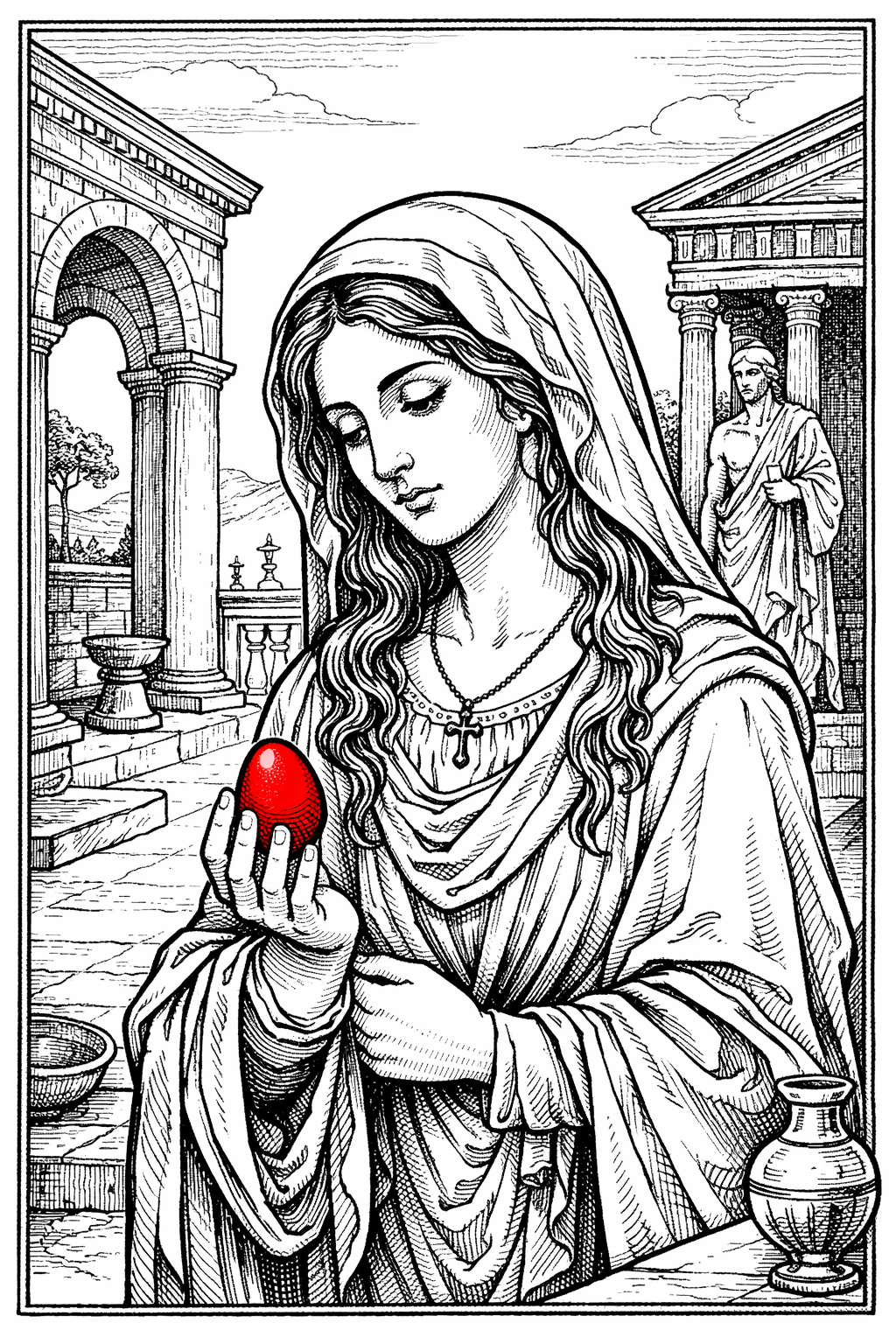
Apostle to the Apostles
Reclaiming Mary Magdalene from Myth and Fiction
by Thomas Veritas
Mater Press (mater.press)
January 2026
January 2026
Apostle to the Apostles
Reclaiming Mary Magdalene from Myth and Fiction
by Thomas Veritas
Mater Press (mater.press)
January 2026
Publisher’s Note
The author writes under the pen name Thomas Veritas for personal reasons. He is a layman, not an ordained priest. The theological content is offered in good faith and has been tested against Scripture and the perennial Magisterium.
Chapter 1
Why This Book?
Mary Magdalene deserves better.
She was there at the Cross when the Apostles fled. She was there at the tomb before the sun rose. She was the first to see the Risen Lord, the first to hear His voice, the first to be sent with the greatest news in human history. The early Church called her Apostola Apostolorum—the Apostle to the Apostles. In 2016, Pope Francis elevated her feast day to the same rank as the male apostles, formally recognizing what the Church has always known: this woman holds a singular place in salvation history.
And yet, if you walk into a bookstore today—or search online—you will find her name attached to an astonishing amount of nonsense.
Type “Mary Magdalene” into any book retailer and see what appears. You will find claims that she was Jesus’s secret wife. That she bore His children. That she founded a royal bloodline still walking among us. That the Church has suppressed the truth about her for two thousand years. That Leonardo da Vinci encoded hidden messages about her in his paintings. That ancient “gospels” reveal what the Bible conceals.
None of this is true. Most of it is based on admitted forgeries. Some of it was invented by a French con man in the 1960s. Yet these fabrications have sold tens of millions of books, spawned blockbuster films, and shaped how an entire generation thinks about one of the most important women in Christian history.
The real Mary Magdalene—the woman who actually appears in the Gospels—has been lost in the noise.
This matters because Mary Magdalene is worthy of genuine devotion. The Church has venerated her for two millennia. Saints and mystics have found in her story a model of converted love, of faithfulness unto death, of the grace that transforms sinners into saints. She is not a footnote to the Gospel narrative; she is central to its climax. Without her witness, we would not have the Resurrection account as we have it.
But how can devotion flourish when her name has become synonymous with conspiracy theories and bestselling fiction? How can the faithful draw close to the real Mary Magdalene when they must first wade through mountains of invented scandal?
This book is an attempt to clear away the debris.
In the pages that follow, we will examine what the canonical Gospels actually say about Mary Magdalene—no more, no less. We will trace how her image was distorted over the centuries, from Pope Gregory’s well-meaning but mistaken conflation to the outright fabrications of modern conspiracy theorists. We will look at the Gnostic texts that some claim reveal “hidden truths” and explain why they deserve skepticism rather than credulity. We will consider the medieval legends and the private revelations, distinguishing what contradicts Scripture from what merely adds to it.
Our goal is simple: to recover the real Mary Magdalene so that true devotion to her can flourish once again.
She has waited long enough.
Chapter 2
The Canonical Gospels
Before examining the various legends, heresies, and fictions that have attached themselves to Mary Magdalene over the centuries, we must first establish what the canonical Gospels—Matthew, Mark, Luke, and John—actually say about her. These are the earliest and most authoritative sources. Everything else is later addition.
The name “Magdalene” is not a surname in the modern sense but a geographic identifier. Mary was from Magdala (Hebrew: Migdal, meaning “Tower”), a prosperous fishing town on the western shore of the Sea of Galilee. The town was known for its fishing industry and its trade in salted fish. Archaeological excavations have revealed it to have been a substantial settlement in the first century.
The Gospels consistently identify her as “Mary Magdalene” or “Mary, called Magdalene” to distinguish her from the many other Marys who appear in the narrative: Mary the mother of Jesus, Mary of Bethany, Mary the mother of James, Mary the wife of Clopas. In an age when “Mary” (Miriam) was among the most common names for Jewish women, the geographic identifier was essential.
Luke introduces Mary Magdalene in the context of Jesus’s itinerant ministry through Galilee:
“Soon afterward he went on through cities and villages, preaching and bringing the good news of the kingdom of God. And the twelve were with him, and also some women who had been healed of evil spirits and infirmities: Mary, called Magdalene, from whom seven demons had gone out, and Joanna, the wife of Chuza, Herod’s steward, and Susanna, and many others, who provided for them out of their means.” (Luke 8:1–3, RSV)
Three facts emerge from this brief passage. First, Jesus had delivered Mary from a severe spiritual affliction—seven demons. Second, she became one of His followers, traveling with Him and the Twelve as He preached throughout Galilee. Third, she was among the women who financially supported Jesus’s ministry “out of their means.” This last detail suggests that Mary possessed resources of her own, whether inherited wealth or personal earnings.
The Gospels next mention Mary Magdalene at the most terrible moment of the narrative: the Crucifixion. All four Evangelists place her at Calvary.
Matthew records: “There were also many women there, looking on from afar, who had followed Jesus from Galilee, ministering to him; among whom were Mary Magdalene, and Mary the mother of James and Joseph, and the mother of the sons of Zebedee” (Matthew 27:55–56, RSV).
Mark confirms: “There were also women looking on from afar, among whom were Mary Magdalene, and Mary the mother of James the younger and of Joses, and Salome, who, when he was in Galilee, followed him, and ministered to him” (Mark 15:40–41, RSV).
John places her even closer: “Standing by the cross of Jesus were his mother, and his mother’s sister, Mary the wife of Clopas, and Mary Magdalene” (John 19:25, RSV).
The significance of her presence cannot be overstated. When Jesus was arrested, “all the disciples forsook him and fled” (Matthew 26:56). Peter followed at a distance but denied knowing Jesus three times. Of the Twelve, only John is recorded as present at the Cross. But Mary Magdalene was there. She did not flee. She watched her Lord die.
After Jesus died, Mary Magdalene remained. She watched as Joseph of Arimathea took the body down from the Cross. She saw where He was buried.
“Mary Magdalene and Mary the mother of Joses saw where he was laid” (Mark 15:47, RSV).
“Mary Magdalene and the other Mary were there, sitting opposite the sepulchre” (Matthew 27:61, RSV).
She stayed until the end. She knew exactly where to return.
When the Sabbath had passed, Mary Magdalene was among the first—or the very first—to return to the tomb. The Gospels vary slightly in their accounts of who accompanied her, but all agree that she was there.
“Now after the sabbath, toward the dawn of the first day of the week, Mary Magdalene and the other Mary went to see the sepulchre” (Matthew 28:1, RSV).
“And when the sabbath was past, Mary Magdalene, and Mary the mother of James, and Salome, bought spices, so that they might go and anoint him” (Mark 16:1, RSV).
“Now it was Mary Magdalene and Joanna and Mary the mother of James and the other women with them who told this to the apostles” (Luke 24:10, RSV).
John’s account focuses on Mary Magdalene alone: “Now on the first day of the week Mary Magdalene came to the tomb early, while it was still dark, and saw that the stone had been taken away from the tomb” (John 20:1, RSV).
She came while it was still dark. She could not wait for the sun.
Mark states it plainly: “Now when he rose early on the first day of the week, he appeared first to Mary Magdalene, from whom he had cast out seven demons” (Mark 16:9, RSV).
John provides the fullest account of this encounter, one of the most moving scenes in all of Scripture:
“But Mary stood weeping outside the tomb, and as she wept she stooped to look into the tomb; and she saw two angels in white, sitting where the body of Jesus had lain, one at the head and one at the feet. They said to her, ‘Woman, why are you weeping?’ She said to them, ‘Because they have taken away my Lord, and I do not know where they have laid him.’ Saying this, she turned round and saw Jesus standing, but she did not know that it was Jesus. Jesus said to her, ‘Woman, why are you weeping? Whom do you seek?’ Supposing him to be the gardener, she said to him, ‘Sir, if you have carried him away, tell me where you have laid him, and I will take him away.’ Jesus said to her, ‘Mary.’ She turned and said to him in Hebrew, ‘Rabboni!’ (which means Teacher). Jesus said to her, ‘Do not hold me, for I have not yet ascended to the Father; but go to my brethren and say to them, I am ascending to my Father and your Father, to my God and your God.’ Mary Magdalene went and said to the disciples, ‘I have seen the Lord’; and she told them that he had said these things to her.” (John 20:11–18, RSV)
She did not recognize Him at first—perhaps because of her tears, perhaps because His risen body was transformed, perhaps because she was not expecting to see Him alive. But when He spoke her name, she knew Him instantly. One word: “Mary.” And her response: “Rabboni!”—my Teacher, my Master.
Luke tells us that Jesus cast seven demons from Mary Magdalene. What does this mean?
In the ancient Jewish and Christian understanding, demonic affliction was not the same as moral sin. Possession or oppression by evil spirits was understood as an affliction that befell a person, not as a consequence of personal wickedness. The afflicted person was a victim, not a perpetrator.
The number “seven” in Scripture often indicates completeness or fullness. Mary’s affliction may have been particularly severe—a complete bondage from which Jesus completely delivered her. But there is no biblical basis for interpreting the seven demons as representing the seven deadly sins or as evidence of sexual immorality. That interpretation came later, and it came from Pope Gregory I, not from Scripture. We will examine his influential error in the next chapter.
Despite the brevity of her appearances in the Gospel narrative, Mary Magdalene holds a unique position. She is named in all four Gospels at the Crucifixion and Resurrection. She is typically listed first among the women disciples. She was the first witness to the Risen Christ. And she was commissioned by Jesus Himself to announce the Resurrection to the Apostles.
This last point earned her a remarkable title from the early Church Fathers. Hippolytus of Rome (c. 170–235) and Augustine of Hippo (354–430) called her Apostola Apostolorum—the Apostle to the Apostles. The word “apostle” comes from the Greek apostolos, meaning “one who is sent.” Mary Magdalene was sent by Christ to proclaim the Good News to the Twelve. She was an apostle before the Apostles knew there was good news to proclaim.
On June 10, 2016, Pope Francis formally recognized this singular role by elevating the liturgical celebration of Mary Magdalene (July 22) from a memorial to a feast—the same rank given to the male apostles. The Vatican’s decree explicitly cited her role as “Apostle to the Apostles” as the reason for this elevation.
Chapter 3
Pope Gregory’s Conflation (591 AD)
On September 14, 591 AD, Pope Gregory I (Gregory the Great) delivered a homily in Rome that would fundamentally alter the Western understanding of Mary Magdalene for nearly 1,400 years. In this Easter sermon, Gregory conflated three distinct women from the Gospels into a single figure: Mary Magdalene.
Mary Magdalene (Luke 8:2) — A woman from whom Jesus cast out seven demons, who became one of his most devoted followers and the first witness to the Resurrection.
Mary of Bethany (Luke 10:39, John 12:1–8) — The sister of Martha and Lazarus, who sat at Jesus’s feet and anointed him with expensive oil.
The Unnamed “Sinful Woman” (Luke 7:36–50) — An anonymous woman who washed Jesus’s feet with her tears and anointed them with oil at the house of Simon the Pharisee.
From his Homily 33:
“She whom Luke calls the sinful woman, whom John calls Mary, we believe to be that Mary from whom seven demons were cast out, according to Mark. And what did these seven demons signify, if not all the vices?”
Gregory interpreted the “seven demons” cast out of Mary Magdalene as representing the seven deadly sins, thereby transforming her into a repentant prostitute or promiscuous woman.
Gregory delivered this sermon during a time of plague in Rome
The conflation served a pastoral purpose: presenting a powerful model of repentance and redemption
The image of the penitent sinner who becomes a devoted follower had strong homiletic appeal
This interpretation became the dominant view in Western Christianity for centuries
Modern scholars note:
No canonical Gospel describes Mary Magdalene as a prostitute or sinful woman
The conflation appears to be Gregory’s interpretation, not established tradition
The Eastern Orthodox Church never accepted this conflation, maintaining the women as separate figures
French scholar Victor Saxer documented this homily as the origin of the “prostitute” identification
Pope Paul VI’s liturgical reform (Mysterii Paschalis, 1969) officially removed the identification of Mary Magdalene with Mary of Bethany and the sinful woman from the General Roman Calendar. The Vatican stated:
“No change has been made in the title of today’s memorial, but it concerns only Saint Mary Magdalene, to whom Christ appeared after his resurrection. It is not about the sister of Saint Martha, nor about the sinful woman whose sins the Lord forgave.”
Gregory’s conflation:
Transformed Mary from “Apostle to the Apostles” to “repentant prostitute”
Overshadowed her role as first witness to the Resurrection
Influenced centuries of Western art depicting her as a weeping penitent
Created a powerful but historically unfounded archetype
Persists in popular culture despite the official 1969 correction
Chapter 4
The Gospel of Mary (Discovered 1896)
Any serious study of Mary Magdalene will encounter references to the so-called “Gospel of Mary.” Rather than ignore it, we examine it here—and explain why it should be treated with extreme skepticism.
This text directly contradicts the canonical Gospels on fundamental matters of Christian doctrine. Its late discovery, Gnostic content, and suspicious provenance raise serious questions about its reliability as a witness to the historical Mary Magdalene.
In January 1896, German scholar Carl Reinhardt purchased a papyrus codex from a dealer in Cairo, Egypt. This became known as the Berlin Codex (Papyrus Berolinensis 8502). The manuscript was not published until 1955—a 59-year delay attributed to two World Wars, though this convenient explanation leaves the text unverifiable for over half a century.
Language: Coptic (translated from Greek original)
Date of Manuscript: 5th century CE
Date of Composition: Scholars estimate the original was written in the 2nd century CE
Condition: Roughly half the text is missing—the first six pages and four pages from the middle are lost
Two brief Greek fragments have also been discovered:
P. Rylands 463 (published 1938)
P. Oxyrhynchus 3525 (published 1983)
These fragments are cited as confirming the text’s antiquity, though dating ancient manuscripts remains an imprecise science subject to scholarly assumptions.
The Gospel of Mary is the only surviving apocryphal text named after a woman. It is divided into two main sections:
The text presents “Jesus” delivering post-resurrection teachings about the nature of matter, sin, and spiritual ascent—a Gnostic cosmology completely absent from the canonical Gospels.
After Jesus departs, Mary Magdalene comforts the fearful disciples:
“Do not weep or grieve or be in doubt, for his grace will be with you all and will protect you. Rather, let us praise his greatness, for he has prepared us and made us truly human.”
Peter then asks Mary to share teachings the Savior gave her privately:
“Sister, we know that the Saviour loved you more than the rest of women. Tell us the words of the Saviour which you remember which you know, but we do not, nor have we heard them.”
Mary then describes a complex Gnostic cosmology involving archons and spiritual ascent—teachings that appear nowhere in Matthew, Mark, Luke, or John, and which the text claims only she understood.
The text depicts tension between Mary and the male apostles:
Andrew’s Objection: “Say what you think about what she said, but I do not believe the savior said this. These teachings are strange ideas.”
Peter’s Objection: “Did he really speak with a woman in private, without our knowledge? Should we all listen to her? Did he prefer her to us?”
Matthew’s Defense of Mary: “Peter, you are always angry. Now I see you arguing against this woman like an adversary. If the savior made her worthy, who are you to reject her? Surely the savior knows her well. That is why he loved her more than us.”
The Gospel of Mary contradicts Christian Scripture on fundamental doctrines:
| Gospel of Mary | Canonical Gospels |
|---|---|
| Rejects suffering and death as the path to salvation | Jesus explicitly teaches He must suffer and die (Mark 8:31, Matt 16:21); salvation through the Cross |
| Gnostic cosmology (archons, spiritual ascent, matter as problematic) | No Gnostic framework; physical resurrection affirmed (Luke 24:39) |
| Secret private teachings only Mary understood | Jesus taught openly (John 18:20); apostles received the same teachings together |
| Peter portrayed as jealous, angry adversary | Peter is “the rock,” given the keys of the kingdom (Matt 16:18–19) |
| Salvation through knowledge (gnosis) | Salvation through faith in Christ’s death and resurrection (Rom 10:9) |
These are not minor discrepancies. The text presents a fundamentally different religion than Christianity.
Harvard professor Karen L. King wrote the primary scholarly work on this text: The Gospel of Mary of Magdala: Jesus and the First Woman Apostle (2003). King argues the text presents Mary as a visionary leader and provides evidence of early debates about women’s authority.
However, King’s credibility on ancient manuscripts suffered a significant blow in 2012 when she promoted the “Gospel of Jesus’s Wife”—a fragment she claimed proved Jesus was married. The fragment was later proven to be a modern forgery.
The text was rejected by the early Church as incompatible with apostolic teaching
It was found alongside clearly Gnostic texts (Apocryphon of John) in the Berlin Codex
The “2nd century” dating is a scholarly estimate, not a proven fact
Even if authentic to the 2nd century, the author never knew the historical Mary—writing 100+ years after her death
Its discovery in 1896 places it well after the rise of esoteric movements in Europe with interest in “alternative” Christianities
Bottom line: The Gospel of Mary is a Gnostic theological text that contradicts the canonical Gospels. It tells us nothing reliable about the historical Mary Magdalene. We include it here only because readers will inevitably encounter references to it and deserve to understand why it should not be taken seriously as a historical source.
Chapter 5
The Nag Hammadi Discovery (1945)
In December 1945, near the Upper Egyptian town of Nag Hammadi, a local farmer named Muhammad Ali al-Samman discovered a sealed earthenware jar while digging for fertilizer. Inside were 12 leather-bound papyrus codices (plus fragments of a 13th), containing 52 texts that had been buried for over 1,600 years.
This discovery ranks among the most significant archaeological and religious finds of the 20th century.
The collection includes:
Gospel of Thomas — Sayings of Jesus
Gospel of Philip — Sacramental and theological teachings
Gospel of Truth — Valentinian meditation
Apocryphon of John — Gnostic creation myth
And dozens more texts representing diverse early Christian movements
Manuscripts: 4th century CE (bound codices)
Original compositions: 2nd–3rd centuries CE
Burial: Likely around 367 CE, possibly in response to Bishop Athanasius’s decree against heretical books
The Gospel of Philip is the text most frequently cited regarding Mary Magdalene’s relationship with Jesus. It is a non-canonical Gnostic text dated to the 3rd century CE.
“There were three who always walked with the Lord: Mary, his mother, and her sister, and Magdalene, who was called his companion. His sister, his mother and his companion were each a Mary.”
The Greek word translated as “companion” is koinōnos (koinonos).
“As for Wisdom who is called ‘the barren’, she is the mother [of the] angels. And the companion of the [...] Mary Magdalene. [Christ loved] her more than [all] the disciples, [and used to] kiss her [often] on her [...].”
Critical Note: The manuscript is physically damaged at this point. The word after “kiss her on her” is missing. Scholars have suggested: mouth, cheek, forehead, hand, or feet.
“The rest of the disciples were offended by it and expressed disapproval. They said to him, ‘Why do you love her more than all of us?’ The Saviour answered and said to them, ‘Why do I not love you like her? When a blind man and one who sees are both together in darkness, they are no different from one another. When the light comes, then he who sees will see the light, and he who is blind will remain in darkness.’ ”
The term koinōnos is central to debates about this text:
Root meaning: “Person engaged in fellowship or sharing”
In the Bible: Used for spouse (Malachi 2:14), companion in faith (Philemon 17), co-worker (2 Cor 8:23), business associate (Luke 5:10)
In Gospel of Philip: Used for both spiritual partnership AND literal marriage in different passages
Important: When the Gospel of Philip wants to clearly indicate “wife,” it uses the regular Coptic word for wife directly. This suggests koinōnos may be “reserved for a more specific usage”—possibly spiritual partnership rather than marriage.
Scholar Bart Ehrman and others note:
Kissing was a common greeting among early Christians (the “kiss of peace”)
It did not have romantic connotation in this context
In the Gospel of Philip specifically, the kiss symbolizes the passage of truth from one person to another
The text is about spiritual enlightenment, not “divine foreplay”
Mainstream scholars agree:
Not historical documentation — These texts were written 100+ years after Jesus and Mary Magdalene lived
Not “suppressed truth” — They represent minority theological movements, not hidden facts
Theological, not biographical — Mary Magdalene functions as a literary/theological figure
Does not prove marriage — The “companion” language is ambiguous and likely spiritual
Does show diversity — Early Christianity was more varied than later orthodoxy suggests
Chapter 6
The Provençal Tradition
According to Provençal tradition, shortly after the Crucifixion and Resurrection of Jesus (traditionally dated around 45 AD), Mary Magdalene and several other early Christians were set adrift in the Mediterranean Sea by persecutors in Jerusalem. The medieval sources describe how their enemies placed them in a small boat without oars, sails, or provisions, expecting them to perish at sea. Instead, through divine providence, the boat crossed the Mediterranean and landed safely on the shores of what is now southern France.
The story, as recorded in medieval sources:
Following persecution of Christians in Jerusalem, a group of Jesus’s followers was placed in a rudderless boat and set adrift
Through divine providence, the boat crossed the Mediterranean
They landed at a place now called Saintes-Maries-de-la-Mer in the Camargue region
Different versions include various combinations of:
Mary Magdalene
Mary of Bethany (sometimes conflated with Magdalene)
Martha (sister of Mary and Lazarus)
Lazarus (whom Jesus raised from the dead)
Mary Jacobi (Mary, mother of James)
Mary Salome (mother of the apostles James and John)
Maximinus (one of the 72 disciples)
Sara (a servant, venerated by the Roma people as their patron saint)
According to the legend:
The group dispersed to evangelize Gaul (ancient France)
Mary Magdalene preached in Marseille
She eventually retreated to a cave at La Sainte-Baume for 30 years of solitary contemplation
She was fed daily by angels
She died at Saint-Maximin-la-Sainte-Baume
| Century | Development |
|---|---|
| 1st | No mention of Mary Magdalene in France in any source |
| 2nd–8th | No evidence of this tradition |
| 9th | First hints of Magdalene veneration in Provence |
| 11th | Vézelay Abbey claims to possess her relics |
| 1260s | The Golden Legend records the full narrative |
| 1279 | “Discovery” of relics at Saint-Maximin |
| 14th+ | Pilgrimage and veneration flourish |
The most influential source for this legend is the Legenda Aurea (Golden Legend), compiled around 1260 by Jacobus de Voragine, Archbishop of Genoa. This collection of saints’ lives was one of the most widely read books of the medieval period.
Jacobus presented the Provençal journey as established tradition, though he was writing over 1,200 years after the supposed events.
Unlike the Gnostic texts we examined earlier, the Provençal tradition does not contradict the canonical Gospels. Scripture tells us nothing about where Mary Magdalene went after Pentecost or where she died. The French tradition fills this silence with a story of apostolic evangelization—a story that, however unlikely on natural grounds, is not theologically impossible.
Could it be true? The honest answer is: we do not know. No first-century source mentions this journey. The tradition appears only in medieval texts, over a thousand years after the events it describes. A rudderless boat crossing the Mediterranean would require divine intervention. Multiple locations (Ephesus and France) claim to possess her relics.
But absence of early evidence is not the same as evidence of absence. Many true things were not recorded. And if God wished to bring Mary Magdalene to Gaul, a rudderless boat would present no obstacle.
The Church has taken a balanced approach to this tradition:
It is not defined dogma—Catholics are not required to believe it
It is considered pious legend—neither confirmed nor condemned
It is permitted as local devotion—the faithful may venerate the tradition without error
The relics at Saint-Maximin are treated with respect, even if their authenticity cannot be proven
For our purposes, what matters most is this: unlike the conspiracy theories and Gnostic texts that distort Mary Magdalene’s image, the Provençal tradition honors her. It presents her as an apostle and evangelist, a woman of prayer and contemplation, a saint worthy of veneration. Whether historically accurate or not, it does not diminish her—it elevates her.
On December 12, 1279, in the crypt of the church at Saint-Maximin in Provence, a sarcophagus was discovered that was proclaimed to be the tomb of Mary Magdalene. This discovery transformed the small town and established it as one of Christianity’s most important pilgrimage sites.
The most famous relic is a blackened skull displayed in a golden reliquary at the Basilica of Saint-Maximin-la-Sainte-Baume. It has been described as:
“One of the most precious relics in all Christendom”
“One of the world’s most famous sets of human remains”
A piece of forehead flesh and skin said to be from the spot where Jesus touched Mary Magdalene when he said “Do not touch me” (Noli me tangere) after the Resurrection (John 20:17).
A tibia (leg bone), the object of an annual procession
Various bone fragments
Hair samples
Other purported relics of Mary Magdalene are venerated at:
Simonopetra Monastery, Mount Athos (Greece) — Left hand
San Giovanni dei Fiorentini, Rome (Italy) — Left foot, in a reliquary made by Benvenuto Cellini
Vézelay Abbey, France — Rib bone
Metropolitan Museum of Art, New York — Tooth (displayed as medieval art object)
After the 1279 discovery, Charles II of Anjou (later King of Naples) ordered construction of a grand basilica. Work began in 1295 based on plans by architect Pierre Le Français.
Gothic style, the largest Gothic building in Provence
Construction continued for nearly 300 years
Work was definitively interrupted in 1592 (never completed)
The basilica lacks the intended grand façade
The basilica is called “Christianity’s third most important tomb” (after the Holy Sepulchre in Jerusalem and St. Peter’s in Rome) by its promoters.
The skull was analyzed in 1974 and has remained sealed inside a glass case since then.
Analysis of the skull and photographs of hair found on it indicate:
The skull belonged to a woman
Age at death: approximately 50 years old
Ethnicity: Mediterranean descent
The Catholic Church has not allowed removal of any portion of the skull for radiocarbon dating
Therefore, the year of the woman’s death has not been determined
Without dating, there is no scientific way to connect the skull to the historical Mary Magdalene
The 1279 “discovery” occurred in the context of medieval competition for relics:
| Date | Event |
|---|---|
| 1058 | Vézelay Abbey claims to have Mary Magdalene’s body |
| 1265 | Pope Clement IV confirms Vézelay’s claim |
| 1279 | Saint-Maximin announces rival discovery |
| 1295 | Charles II begins building basilica at Saint-Maximin |
| 1343 | Papal recognition of Saintes-Maries-de-la-Mer pilgrimage |
Relics attracted pilgrims and revenue
Royal and ecclesiastical prestige was at stake
Charles II had political reasons to promote Provençal claims
The “discovery” conveniently occurred just when Vézelay’s claim was dominant
Chapter 7
The Eastern Orthodox Tradition
While the West developed the Provençal tradition of Mary Magdalene’s journey to France, the Christian East preserved a different—and in some ways older—set of traditions. The Eastern Orthodox Churches have always venerated Mary Magdalene with particular devotion, and their traditions offer a complementary portrait of her life after Pentecost.
The Orthodox Church bestows upon Mary Magdalene titles that underscore her unique role in salvation history.
The Eastern Church calls Mary Magdalene Isapostolos (Greek: Isapostolos)—“Equal to the Apostles.” This is among the highest honors the Orthodox Church can bestow, reserved for those whose missionary work and witness to Christ rivaled that of the Twelve themselves. Only a handful of saints bear this title: Saint Constantine the Great, Saint Helena, Saint Nina of Georgia, Saints Cyril and Methodius, and Saint Mary Magdalene.1
The title reflects not merely her witness at the Resurrection, but the tradition that she continued to preach the Gospel for decades afterward—in Jerusalem, in Rome, and in Ephesus.
Mary Magdalene is also honored as a Myrrhbearer (Greek: Myrophoros)—one of the women who brought myrrh and spices to anoint Christ’s body on the third day. The Myrrhbearers are commemorated together on the second Sunday after Pascha (Easter), and Mary Magdalene holds the chief place among them.
The Orthodox Church has never confused Mary Magdalene with the sinful woman of Luke 7 or with Mary of Bethany. Pope Gregory I’s conflation was a Western development that the East did not follow. In Orthodox tradition, Mary Magdalene has always been venerated simply as the faithful disciple whom Christ healed of seven demons and who became His most devoted follower.
One of the most beloved traditions about Mary Magdalene in the Eastern Church explains the origin of the Paschal egg—the red eggs exchanged by Orthodox Christians at Easter.
According to this tradition, after the Ascension of Christ, Mary Magdalene traveled to Rome to proclaim the Gospel. She obtained an audience with Emperor Tiberius himself (who reigned 14–37 AD). Standing before the emperor, she held out an egg—a symbol of new life—and declared: “Christ is Risen!”
Tiberius scoffed at her claim. A man could no more rise from the dead, he said, than the egg in her hand could turn red.
Immediately, the egg turned bright red.
This miracle, according to tradition, converted many in the imperial household and established the custom of presenting red eggs at Pascha. An ancient Greek manuscript preserved at the monastery of Saint Athanasius near Thessalonica contains a prayer for the blessing of eggs at Pascha, noting that “the holy Equal of the Apostles Mary Magdalene first showed believers the example of this joyful offering.”2
To this day, Orthodox Christians exchange red eggs on Pascha with the greeting “Christ is Risen!” and the response “Truly He is Risen!”—continuing a tradition that traces back to Mary Magdalene herself.
The Eastern tradition holds that Mary Magdalene was not merely a passive witness but an active evangelist. After the events of the red egg, she continued preaching throughout Italy and in Rome itself.
Some Orthodox scholars identify her with the “Mary” mentioned by Saint Paul in his Epistle to the Romans: “Greet Mary, who has worked hard for you” (Romans 16:6).3 If this identification is correct, it would place Mary Magdalene among the founding generation of Roman Christians and confirm her role as an apostolic preacher.
According to tradition, she remained in Rome until the arrival of Saint Paul, and for two years afterward, sharing in the labors and dangers of the early Church.
Where did Mary Magdalene spend her final years? The West says France. The East says Ephesus.
According to Orthodox tradition, when Mary Magdalene was advanced in age, she departed from Rome and traveled to Ephesus, where the Apostle and Evangelist Saint John the Theologian was laboring. There she assisted him in his evangelical work—a fitting partnership, since John had stood with her at the foot of the Cross and had been entrusted by Christ with the care of His Mother.
Mary Magdalene remained in Ephesus until her peaceful death. She was buried in that city, and her tomb became a place of pilgrimage.4
In the ninth century, according to Eastern tradition, the relics of Mary Magdalene were transferred from Ephesus to Constantinople by Emperor Leo VI the Wise. They were placed in the monastery church of Saint Lazarus—an appropriate resting place, since Lazarus was her brother according to the tradition that identifies Mary Magdalene with Mary of Bethany.
During the era of the Crusades, the relics were reportedly transferred again, this time to the West. The Lateran Basilica in Rome claims to possess her relics under its high altar, while the French claim the relics at Saint-Maximin.
Mary Magdalene is the patron saint of the monasteries of Mount Athos, the famous monastic republic in Greece that has been a center of Orthodox spirituality for over a thousand years. Her feast day, July 22, is celebrated with great solemnity throughout the Orthodox world.
The Orthodox Church commemorates her twice each year:
July 22 (August 4 on the civil calendar for churches using the Julian calendar): Her principal feast day
The Sunday of the Myrrhbearers: The second Sunday after Pascha, when she is honored together with the other women who came to anoint Christ’s body
The Western Provençal tradition and the Eastern Ephesus tradition cannot both be literally true. Mary Magdalene did not die in both France and Ephesus. Yet both traditions share essential truths:
Both honor her as an apostolic preacher who continued to proclaim the Gospel after Pentecost
Both present her as a woman of prayer and contemplation in her later years
Both venerate her as one of the greatest saints of the early Church
Neither tradition contradicts Scripture—the Gospels are silent about her later life
What matters is not which geographic tradition is historically accurate, but what both traditions testify: that Mary Magdalene was remembered by the early Church as far more than a passive bystander. She was Apostola Apostolorum in the West, Isapostolos in the East—the Apostle to the Apostles, Equal to the Apostles, a woman whose witness and preaching helped spread the faith across the Roman world.
Chapter 8
The Mystical City of God (1660)
Unlike the Gnostic texts examined in the previous section, which contradict Scripture and present a fundamentally different religion, the Mystical City of God stands in a category apart. This seventeenth-century work of private revelation offers a detailed account of Mary Magdalene that harmonizes completely with the canonical Gospels while providing additional detail that fills gaps in the scriptural record. It neither conflicts with the Gospel accounts nor with the venerable French tradition of Mary Magdalene’s later life. For these reasons, it deserves careful and respectful consideration.
Venerable María de Jesús de Ágreda (1602–1665) was a Spanish Franciscan nun of the Conceptionist order who spent most of her life in a convent in the remote town of Ágreda in Castile. She was not a scholar or theologian by training, yet she produced one of the most comprehensive and detailed accounts of the life of the Blessed Virgin Mary ever written—a work spanning over 2,600 pages across eight books.
The Mystical City of God (La Mística Ciudad de Dios) claims an extraordinary origin. According to Ágreda, the work was dictated to her by the Blessed Virgin Mary herself during mystical visions. She first wrote the account between 1637 and 1643 under the direction of her confessor, the Franciscan Francisco Andrés de la Torre. A subsequent confessor, however, ordered her to destroy it—and she obeyed, burning the manuscript. Later, under the guidance of a new confessor, Andrés de Fuenmayor, she rewrote the entire work from memory between 1655 and 1660. It was published posthumously in 1670 and has remained continuously in print for over 350 years, translated into dozens of languages.
The Church has examined this work with care. María de Ágreda was declared Venerable in 1673—the first formal step toward canonization, indicating that her life was one of heroic virtue. The work itself was briefly placed on the Index of Forbidden Books in 1681 under Pope Innocent XI, but this prohibition was later removed. Today it is classified as private revelation: Catholics are not obliged to believe its contents, but may piously accept them. Importantly, the work has never been condemned as containing doctrinal error.
One of the most significant contributions of the Mystical City of God to Magdalene studies is its detailed resolution of the identity question that has divided East and West for centuries.
Ágreda presents Mary Magdalene as the same person as Mary of Bethany, the sister of Martha and Lazarus. According to her account, Mary was born to wealthy and devout Jewish parents named Syrus and Eucharia. The family possessed considerable property, including estates in Bethany (near Jerusalem), in Magdala (on the Sea of Galilee), and in Jerusalem itself. The surname “Magdalene” derived from the family’s connection to the town of Magdala—she was called “Mary of Magdala” or “Mary Magdalene” to distinguish her from the many other Marys of that era.
This identification harmonizes with Scripture. The Mary who sat at Jesus’s feet while Martha served (Luke 10:39), the Mary who anointed Jesus at Bethany shortly before His Passion (John 12:1–8), and the Mary Magdalene who stood at the Cross and met the Risen Lord—these are, in Ágreda’s account, one and the same woman.
Here Ágreda makes a crucial departure from Pope Gregory I’s famous conflation. According to the Mystical City of God, the unnamed sinful woman who washed Jesus’s feet with her tears at Simon the Pharisee’s house (Luke 7:36–50) is a completely different person from Mary Magdalene.
This distinction matters enormously. The sinful woman of Luke 7 was, by the text’s own description, “a sinner”—traditionally understood as a prostitute. She appears early in Jesus’s ministry, in Galilee, at the house of a Pharisee named Simon. Mary of Bethany’s anointing, by contrast, occurs at her own family’s home in Bethany, shortly before the Passion, and the text gives no indication of sexual sin.
Ágreda thus offers a middle position between the extremes: Gregory conflated all three women into one repentant prostitute; the Eastern Orthodox tradition holds all three as entirely distinct persons. Ágreda’s resolution is that two of the three are the same person (Mary Magdalene and Mary of Bethany), but the sinful woman of Luke 7 is someone else entirely. This reading respects both the Gospel texts and the tradition linking Magdalene to Bethany, while rejecting the unwarranted association with prostitution.
Ágreda’s portrait of Mary Magdalene before her conversion is nuanced and important. She was not a prostitute. She was not publicly disgraced or known as a “sinner” in the sense of Luke 7. Rather, she was a wealthy young woman of good family who had given herself over to the worldly pleasures available to someone of her station: fine clothing, social prominence, vanity, and the love of luxury.
Her sins were sins of the spirit more than sins of the flesh. She was attached to the things of this world—to comfort, to beauty, to the admiration of others. She was, in Ágreda’s phrase, “of the world.” But she was not a public disgrace to her family. Her brother Lazarus and sister Martha were known as devout and righteous, and Mary moved in respectable society.
What then of Luke 8:2, which states that Jesus cast “seven demons” from Mary Magdalene? Ágreda offers an interpretation that harmonizes with her account of Mary’s character. The “seven demons” were not literally seven individual devils in the sense of demonic possession. Rather, they represent Mary’s bondage to worldly attachments—specifically, her subjection to the seven capital sins: pride, greed, lust, envy, gluttony, wrath, and sloth.
Mary was dominated by vanity and love of pleasure. Her deliverance was not an exorcism in the dramatic sense but a profound spiritual conversion—a liberation from worldliness and a total reorientation of her heart toward Christ. This interpretation aligns with the symbolic use of “seven” in Scripture to indicate completeness: Mary was completely bound to the world, and Jesus completely set her free.
Ágreda describes Mary’s conversion with great tenderness. Mary heard Jesus preach and was struck with compunction—that interior sorrow for sin that is the beginning of repentance. She recognized that her vanity and worldliness, however respectable they might appear to society, were offenses against God. Her heart was pierced.
Her response was immediate and total. She abandoned her luxurious lifestyle entirely. She who had dressed in fine garments and sought the admiration of men now sought only to follow Christ. She who had spent her wealth on pleasures now used her considerable fortune to support Jesus and His disciples in their ministry. Her conversion was not gradual but complete—a transformation so thorough that she became one of the most devoted followers in all of salvation history.
Ágreda’s account of the Passion places Mary Magdalene exactly where the Gospels place her—at the foot of the Cross. But Ágreda provides interior detail that Scripture, in its economy, does not record.
Mary Magdalene was present throughout the Crucifixion. She stood near the Cross with the Blessed Virgin Mary, with John the beloved disciple, and with the other faithful women. She witnessed every moment: the nailing, the raising of the Cross, the mockery of the crowd, the seven last words, the darkness at noon, and the final breath. She remained when most of the Apostles had fled in fear.
Ágreda describes Mary Magdalene’s interior state in terms of profound spiritual suffering. Her love for Christ was so ardent that she experienced His Passion interiorly, united with the sorrows of Our Lady. She who had been converted from worldliness now demonstrated the depth of that conversion by her fidelity in the hour of apparent defeat. While others abandoned Jesus, Mary Magdalene stayed.
This detail harmonizes perfectly with the Gospel accounts (Matthew 27:55–56, Mark 15:40, John 19:25) while adding the interior dimension that Scripture leaves unstated.
The Mystical City of God affirms and illuminates the Gospel account of Easter morning. Ágreda explains why Jesus chose to appear first to Mary Magdalene among all the disciples.
Ágreda does make one claim not recorded in Scripture: that Jesus appeared first of all to His Mother, the Blessed Virgin, in private immediately after the Resurrection. This appearance, she says, was not recorded by the Evangelists because it was a private consolation between Son and Mother. But among the disciples—those whose testimony would be recorded and proclaimed—Mary Magdalene was first.
Why her? Ágreda offers several reasons that cohere with the Gospel narrative:
Her ardent love. Mary Magdalene’s love for Christ was exceptionally fervent. She who had been delivered from worldliness had redirected all the passion of her heart toward her Savior. No one among the disciples burned with greater love.
Her fidelity. She had stood at the Cross when the Apostles fled. While Peter denied and the others hid, Mary Magdalene remained. Such fidelity deserved to be rewarded with the first sight of the Risen Lord.
Her diligence. She came to the tomb “while it was still dark” (John 20:1). She could not sleep for grief and love. She had to see Him, even if only His dead body. This eagerness was rewarded beyond all expectation.
To honor women. Jesus chose to reveal the central fact of Christianity—the Resurrection—first to a woman. In an age when women’s testimony was legally discounted, Christ elevated a woman to be the first witness of the greatest event in history.
Ágreda affirms the ancient title given to Mary Magdalene: Apostola Apostolorum—the Apostle to the Apostles. Jesus explicitly commissioned her to carry the news of His Resurrection to the Eleven. She ran to deliver this message, transformed from grief to joy. She was the first evangelist of the Resurrection, the first to proclaim the Good News that would change the world.
This was no accident but a deliberate honor bestowed by Christ Himself upon the woman whose conversion and fidelity had been so complete.
Ágreda’s account continues beyond the Resurrection. Mary Magdalene was present in the Upper Room at Pentecost, receiving the Holy Spirit along with the Apostles and the other disciples. She remained close to the Blessed Virgin Mary, serving her and learning from her. She was among the holy women who formed the heart of the early Church in Jerusalem.
Regarding Mary Magdalene’s later years and final resting place, the Mystical City of God is notably silent. Ágreda’s account focuses primarily on the life of the Blessed Virgin Mary and the events surrounding Christ’s ministry, Passion, and Resurrection. It does not extend in detail to cover where Mary Magdalene went in her final decades or where she died.
This silence is significant. Ágreda does not contradict the Provençal tradition that Mary Magdalene traveled to France, evangelized Marseille, and lived as a contemplative in the cave at Sainte-Baume. She simply does not address it. A reader who accepts both Ágreda’s account and the French tradition will find no conflict between them. The two can coexist: Ágreda provides detail about Mary Magdalene’s identity, character, conversion, and role in the Gospel events, while the French tradition provides an account of her later apostolate and death.
This compatibility is another mark in favor of Ágreda’s reliability. Unlike the Gnostic texts, which contradict Scripture and received tradition, the Mystical City of God fits harmoniously within the larger tapestry of Catholic tradition about Mary Magdalene.
Ágreda does describe Mary Magdalene’s death in general terms: she died in a state of great sanctity, sustained by divine love throughout her final illness. She received visions of Christ and the Blessed Virgin as she prepared to depart this life. Her death was peaceful—a model of the holy death that all Christians should hope for. She was greeted in heaven with great honor for her fidelity and love.
Having examined both the Gnostic texts and Ágreda’s private revelation, we are in a position to assess their relative credibility. The contrast is stark.
The Mystical City of God never contradicts the canonical Gospels. Every detail Ágreda provides about Mary Magdalene’s presence at the Cross, her visit to the tomb, her encounter with the Risen Christ, and her commission to tell the Apostles—all of this aligns perfectly with Matthew, Mark, Luke, and John. Where Scripture is silent, Ágreda adds detail; where Scripture speaks, Ágreda agrees.
This is the opposite of what we found in the Gnostic texts, which contradict Scripture on fundamental matters: the nature of salvation, the role of suffering, the authority of Peter, and the very identity of Jesus Christ.
Ágreda’s account is compatible with the major streams of Catholic tradition about Mary Magdalene. She affirms the Western identification of Mary Magdalene with Mary of Bethany (against the East) while rejecting Gregory’s conflation with the sinful woman of Luke 7. She is silent on the French tradition rather than contradicting it. She presents Mary Magdalene as a great saint—exactly as the Church has always venerated her.
Ágreda’s account contains absolutely no hint of the blasphemous claims promoted by modern conspiracy theories. Mary Magdalene was not Jesus’s wife. She did not bear His children. She did not found a bloodline. Her love for Christ was entirely spiritual—the love of a devoted disciple for her Lord, the love of a converted soul for her Redeemer. Such ideas would have been unthinkable to Ágreda and would have been immediately condemned by her confessors and by the Church.
Ágreda offers a compelling resolution to the centuries-old identity question. Pope Gregory I went too far in conflating all three women (Mary Magdalene, Mary of Bethany, and the sinful woman of Luke 7) into one repentant prostitute. The Eastern Orthodox tradition may err in the opposite direction by completely separating Mary Magdalene from Mary of Bethany, despite the strong scriptural and traditional connections between them.
Ágreda’s middle position—that Mary Magdalene and Mary of Bethany are the same person, but the sinful woman of Luke 7 is someone else—respects both the texts and the tradition while freeing Mary Magdalene from the unwarranted stigma of prostitution.
Finally, Ágreda’s account comes with appropriate theological humility. It is presented as private revelation, not as binding doctrine. Catholics are free to accept or reject its contents. The Church has examined the work, found no doctrinal error, and permitted its publication and devotional use—but has not declared it to be divinely inspired in the manner of Scripture.
This is the proper posture for such a work. It offers itself for consideration, not for compulsion. The reader may find it illuminating and credible, or may choose to rely solely on Scripture and defined doctrine. Either choice is legitimate within the bounds of Catholic faith.
The Mystical City of God presents Mary Magdalene as she deserves to be remembered: not as a prostitute, not as a Gnostic rival to Peter, not as Christ’s secret wife, but as one of the greatest saints in the history of the Church. She was a wealthy woman converted from worldliness to holiness. She was a faithful disciple who stood at the Cross when others fled. She was the first witness to the Resurrection and the first evangelist of the Good News. She was honored by Christ Himself with a singular role in salvation history.
This portrait harmonizes with Scripture, coheres with tradition, and elevates our understanding of this remarkable woman. For readers seeking to understand Mary Magdalene, Ágreda’s account deserves a place of honor—not above Scripture, but alongside it as a trustworthy and edifying companion.
Chapter 9
Modern Conspiracy
In 1982, a book appeared that would poison popular understanding of Mary Magdalene for decades. The Holy Blood and the Holy Grail, written by Michael Baigent, Richard Leigh, and Henry Lincoln, became an international bestseller by making a sensational claim: Jesus Christ and Mary Magdalene were married, she bore His children, and their descendants survive to this day among European royalty.
The book was presented not as fiction but as serious historical investigation. The authors claimed to have uncovered a secret that the Catholic Church had suppressed for two thousand years. They offered what appeared to be documentary evidence, scholarly analysis, and a coherent alternative history of Christianity. Millions of readers found it compelling.
There was only one problem: it was built on forgeries.
The authors proposed a radical reinterpretation of medieval Grail legends. The “San Graal” (Holy Grail), they argued, was not the cup from the Last Supper at all. It was a coded reference to “Sang Real”—Royal Blood. The Grail was not a vessel; it was a bloodline. And Mary Magdalene was the vessel who carried that blood.
The narrative they constructed was elaborate and superficially plausible. Jesus and Mary Magdalene, they claimed, were legally married. When Jesus was crucified, Mary was pregnant. She fled to Gaul (France) with Joseph of Arimathea and other companions. There she gave birth to Jesus’s child—or children. This sacred bloodline eventually merged with the Merovingian dynasty of Frankish kings. For centuries, a secret society called the Priory of Sion had protected the descendants of Jesus and guarded the truth. The Knights Templar were connected to this conspiracy. Leonardo da Vinci, Isaac Newton, and other luminaries had been Grand Masters of the Priory, encoding the secret in their works.
It was a compelling story. It was also a lie.
The entire edifice of Holy Blood, Holy Grail rested on documents allegedly from the Priory of Sion—documents that the authors found in the Bibliothèque Nationale in Paris. These “Dossiers Secrets” purported to trace the Priory’s history back to 1099 and to document the sacred bloodline.
The source of these documents was a Frenchman named Pierre Plantard. What the authors either did not know or chose not to mention was that Plantard was a convicted con man with a history of fraud and a fascination with secret societies.
In 1993—eleven years after Holy Blood, Holy Grail became a bestseller—the truth came out in the most definitive way possible. Pierre Plantard was called to testify under oath in a French court during an investigation into the death of Roger-Patrice Pelat, a friend of President François Mitterrand whose name appeared in the Priory documents.
Under oath, Plantard admitted that he had fabricated the entire Priory of Sion mythology. The “ancient documents” were forgeries he had created and planted in the Bibliothèque Nationale in the 1960s. The “Priory of Sion” was not a medieval secret society founded in 1099—it was a small French social club that Plantard himself had founded in 1956. The lists of Grand Masters, the genealogies connecting Merovingian kings to Jesus, the elaborate conspiracy spanning centuries—all of it was fiction invented by a French fantasist.
The judge found fabricated materials in Plantard’s home during a search, and Plantard was given a stern warning. He retreated from public life and died in 2000, but by then the damage was done. Millions had read the book. The debunking received far less attention than the original sensation.
The exposure of the Priory of Sion hoax should have ended the matter. Every major claim in Holy Blood, Holy Grail depends on Plantard’s forged documents:
The claim that Jesus married Mary Magdalene has no historical evidence in any ancient source, canonical or otherwise. No Gospel mentions Jesus being married. No early Christian writer—not even those hostile to Christianity—ever claimed He had a wife.
The claim that Mary Magdalene fled to France pregnant with Jesus’s child is a medieval legend that developed centuries after her death. It has no historical basis.
The claim that the Merovingian kings descended from Jesus is pure fiction based entirely on Plantard’s forgeries.
The claim that the Knights Templar guarded this secret has no evidence whatsoever. The Templars’ actual history is well documented.
By 1993, all of this was publicly known. The hoax had been exposed. Scholars had thoroughly debunked the book. One might have expected the conspiracy theory to fade away.
Instead, it was about to be resurrected on a scale its original authors could never have imagined.
Ten years after Pierre Plantard admitted under oath that the Priory of Sion was a hoax, Dan Brown published The Da Vinci Code. The novel recycled virtually every debunked claim from Holy Blood, Holy Grail—and sold over 80 million copies to readers who had never heard of Plantard’s confession.
This was not a coincidence. Brown’s debt to Holy Blood, Holy Grail was so obvious that the original authors sued him for copyright infringement in 2006 (they lost, since one cannot copyright historical claims, even false ones). The character of “Leigh Teabing” in Brown’s novel is an anagram of “Baigent” and “Leigh”—two of the three authors of the 1982 book. Brown was not hiding his sources; he was counting on his readers not knowing those sources had been discredited.
The plot of The Da Vinci Code rests on precisely the claims that Plantard fabricated and that scholars had spent two decades debunking:
That Jesus and Mary Magdalene were married. Brown presents this as suppressed historical fact. In reality, no ancient source—canonical or Gnostic, Christian or pagan—states that Jesus was married. The Gnostic texts that mention Mary Magdalene’s closeness to Jesus use the Greek word koinōnos, which means “companion” or “partner” in a general sense, not “wife.”
That Mary Magdalene was pregnant at the Crucifixion. This claim appears nowhere in any ancient document. It is pure invention.
That she fled to France and founded a royal bloodline. This is the Merovingian bloodline theory from Holy Blood, Holy Grail—which was based entirely on Plantard’s forged documents. Brown repeats it as fact.
That the Holy Grail is Mary Magdalene herself. The “San Graal” / “Sang Real” wordplay comes directly from Holy Blood, Holy Grail. It is a modern invention, not an ancient tradition.
That the Priory of Sion is an ancient secret society. Brown’s novel opens with a page labeled “FACT” that states: “The Priory of Sion—a European secret society founded in 1099—is a real organization.” This is false. The Priory of Sion was founded in 1956 by Pierre Plantard, and he admitted the fabrication under oath in 1993. Brown either did not know this or did not care.
A central claim of The Da Vinci Code is that the Catholic Church systematically suppressed the truth about Mary Magdalene and her relationship to Jesus. This narrative is historically backwards.
The Gnostic texts were not “suppressed” in the sense of a cover-up. They were rejected by early Christians as theologically incompatible with apostolic teaching—which they were, as we have seen. These texts have been publicly available and intensively studied since the Nag Hammadi discovery in 1945. Scholars have had unrestricted access to them for over seventy years.
More tellingly, the actual trajectory of Church teaching about Mary Magdalene has been toward rehabilitation, not suppression. In 1969, the Vatican officially separated Mary Magdalene from the sinful woman of Luke 7 and removed the “prostitute” association. In 2016, Pope Francis elevated her feast day to a full liturgical feast and gave her the title Apostola Apostolorum—Apostle to the Apostles. The Church has been restoring Mary Magdalene’s honor, not suppressing it.
One of the novel’s most memorable claims is that the figure seated to Jesus’s right in Leonardo da Vinci’s Last Supper is not the Apostle John but Mary Magdalene in disguise.
This is nonsense. Art historians universally identify the figure as John. Leonardo, like many Renaissance artists, depicted young men with soft, androgynous features—this was a stylistic convention, not a secret code. There would have been no reason to “hide” Mary Magdalene in the painting; she was a venerated saint, and other artists (such as Fra Angelico) openly included her in Last Supper scenes.
The entire premise of the claim—that Leonardo encoded secret truths that the Church was suppressing—ignores the fact that Leonardo worked for and was patronized by the Church. He was not a secret heretic leaving clues for future generations; he was an artist fulfilling commissions.
The theological and historical errors of The Da Vinci Code might be dismissed as harmless fiction if millions of readers had not taken them seriously. Surveys conducted after the novel’s publication found that significant percentages of readers believed its historical claims were true.
The tragedy is not merely that false information spread. It is what the novel does to Mary Magdalene herself.
The Da Vinci Code takes one of the most remarkable figures in Christian history—the woman who stood at the Cross when the Apostles fled, who was the first witness to the Resurrection, who was commissioned by Christ Himself to announce the Good News to the Eleven—and reduces her significance to her supposed role as Jesus’s sexual partner and the mother of His children.
This is arguably more diminishing than Pope Gregory’s “prostitute” error. Gregory, at least, presented Mary Magdalene as a model of repentance and redemption—a sinner transformed by grace into a saint. Brown presents her as significant only because of her womb. Her witness to the Resurrection, her fidelity at Calvary, her spiritual transformation—none of this matters in Brown’s telling. She is reduced to a vessel for a bloodline.
The irony is bitter. In the name of “restoring” Mary Magdalene’s true importance, The Da Vinci Code strips her of everything that actually made her important.
Chapter 10
Recovering True Devotion
We began this book by observing that Mary Magdalene has been lost in the noise—buried beneath conspiracy theories, bestselling fiction, and centuries of well-meaning but mistaken tradition. It is time to recover her.
The canonical Gospels present a clear portrait. Mary Magdalene was a woman from the town of Magdala in Galilee. Jesus delivered her from a severe demonic affliction. She became one of His most faithful followers, supporting His ministry and traveling with Him as He preached. When the hour of His Passion came, she did not flee as others did. She stood at the Cross. She watched His burial. She was first to the empty tomb on Easter morning. And she was the first person in history to see the Risen Lord, the first to be sent with the news that would change the world.
The Gospels say nothing about her being a prostitute. That was Pope Gregory’s error, corrected by the Church in 1969. They say nothing about her being Jesus’s wife or bearing His children. That was a modern fabrication, based on admitted forgeries.
What the Gospels do say is remarkable enough: this woman was chosen by Christ Himself to be the first witness to the Resurrection and the first evangelist of the Good News. The early Church called her Apostola Apostolorum—the Apostle to the Apostles. In 2016, Pope Francis elevated her feast day to the same rank as the male apostles, formally recognizing what the Church has always known.
Mary Magdalene is not merely a historical figure to be studied. She is a saint to be venerated, a model to be imitated, an intercessor to be invoked.
Her story speaks to every sinner who has ever wondered if redemption is possible. Whatever bondage held her before she met Christ—whether the “seven demons” were spiritual affliction, moral weakness, or something else entirely—she was completely set free. The woman who was bound became the woman who stood at the Cross. The woman who wept at the tomb became the woman who proclaimed the Resurrection.
Her fidelity speaks to every disciple who has ever been tempted to flee when faith becomes costly. The Apostles scattered. Peter denied. But Mary Magdalene stayed. She followed Jesus to Calvary. She remained until the end. And she was rewarded with the greatest honor anyone has ever received: to be the first to see the Risen Lord.
Her witness speaks to every woman who has ever been told that her voice does not matter. In an age when women’s testimony was legally discounted, Christ chose a woman to be the first witness to the central fact of Christianity. He spoke her name. He sent her to tell the others. The Church’s mission began with her testimony.
The Church has long honored Mary Magdalene with prayers and devotions. Here are several that the faithful may use to invoke her intercession and grow in devotion to this great saint.
Saint Mary Magdalene, woman of many sins, who by conversion became the beloved of Jesus, thank you for your witness that Jesus forgives through the miracle of love.
You, who already possess eternal happiness in His glorious presence, please intercede for me, so that someday I may share in the same everlasting joy.
Amen.
O glorious Saint Mary Magdalene, you were delivered from seven demons and transformed by the love of Christ into one of His most faithful disciples. Pray for me, that I too may be freed from all that binds me to sin and worldliness. Obtain for me the grace of true conversion, that I may follow Christ with the same fervor and fidelity that you showed throughout your life. Amen.
Saint Mary Magdalene, you stood at the foot of the Cross when others fled. You did not abandon our Lord in His hour of greatest suffering. Pray for me, that I may have the courage to remain faithful to Christ even when faith is difficult, even when the world mocks, even when I am afraid. Obtain for me the grace of perseverance unto the end. Amen.
O Saint Mary Magdalene, you came to the tomb while it was still dark, seeking the Lord you loved. When you found the tomb empty, you wept—but you did not leave. You stayed, and you were rewarded with the sight of the Risen Christ.
Pray for all who seek the Lord in darkness, all who weep at His apparent absence, all who wonder if He has abandoned them. Obtain for them the grace to persevere in seeking, that they too may hear Christ speak their name and know the joy of His presence. Amen.
The Church celebrates the feast of Saint Mary Magdalene on July 22. Since Pope Francis’s elevation of this celebration in 2016, it has been a feast—the same liturgical rank given to the male apostles.
On this day, the faithful are encouraged to:
Attend Mass in her honor
Read the Gospel accounts of her witness to the Resurrection (especially John 20:1–18)
Pray for her intercession
Reflect on her example of conversion, fidelity, and love
Mary Magdalene speaks to us still.
She shows us that no bondage is too deep for Christ to heal. She shows us that fidelity matters—that staying when others flee is its own form of witness. She shows us that the first to proclaim the Good News was a woman who loved much because she had been forgiven much.
Her example invites us to conversion. Her perseverance at the Cross invites us to courage. Her joy at the empty tomb invites us to hope.
Let us honor her as she deserves. Let us invoke her intercession. Let us imitate her fidelity. And let us rejoice that the Church has given us such a saint—the Apostle to the Apostles, the first witness to the Risen Lord, a model of grace for all the ages.
Saint Mary Magdalene, Apostle to the Apostles, pray for us.
Orthodox Church in America, “Myrrhbearer and Equal of the Apostles Mary Magdalene,” Lives of the Saints, https://www.oca.org/saints/lives/2001/07/22/102070↩︎
Cited in Orthodox Church in America, “Myrrhbearer and Equal of the Apostles Mary Magdalene.”↩︎
Orthodox Church in America, “Myrrhbearer and Equal of the Apostles Mary Magdalene.”↩︎
OrthodoxWiki, “Mary Magdalene,” https://orthodoxwiki.org/Mary_Magdalene↩︎