Alternate Versions:
[ PDF (150 pages) | EBOOK (112 pages) | KINDLE (112 pages) ]
March 2026
Alternate Versions:
[ PDF (150 pages) | EBOOK (112 pages) | KINDLE (112 pages) ]
For the priests of the Roman Rite,
who daily invoke the name of Melchizedek
at the altar of God.
“The sacrifice appeared for the first time there which is now offered to God by Christians throughout the whole world.”
—Augustine, De Civitate Dei XVI.22
“Tu es sacerdos in aeternum secundum ordinem Melchisedech.”
—Psalm 110:4 (Vulgate)
Publisher’s Note
The author writes under the pen name Thomas Veritas for personal reasons. He is a layman, not an ordained priest. The theological content is offered in good faith and has been tested against Scripture and the perennial Magisterium.
He appears without warning, without introduction, without explanation. In the fourteenth chapter of Genesis, after Abram has routed the armies of four kings and rescued his nephew Lot, a figure emerges from the narrative silence who has no precedent and, within the Old Testament, no sequel:
And Melchizedek king of Salem brought out bread and wine; he was priest of God Most High. And he blessed him and said, “Blessed be Abram by God Most High, maker of heaven and earth; and blessed be God Most High, who has delivered your enemies into your hand!” And Abram gave him a tenth of everything. (Genesis 14:18–20, RSV)
Three verses. That is the entirety of Melchizedek’s appearance in the historical books of the Old Testament. He arrives bearing bread and wine. He blesses Abram in the name of God Most High—El Elyon. Abram, the father of nations, the friend of God, responds by offering this mysterious king-priest a tithe of all his possessions. And then Melchizedek vanishes from the narrative as suddenly as he appeared.
No ancestry is given. No tribe, no clan, no father, no mother. No account of his birth, no record of his death. No mention of predecessors in his office or successors to his throne. He is, in the sparse and deliberate prose of Genesis, a figure defined entirely by what is not said about him.
This silence is not accidental. The author of the Epistle to the Hebrews, writing centuries later, will seize upon it and build from it one of the most consequential theological arguments in the New Testament: that the silence surrounding Melchizedek’s origins is itself the point. He is “without father or mother or genealogy, and has neither beginning of days nor end of life, but resembling the Son of God he continues a priest for ever” (Hebrews 7:3, RSV). The argument is that Melchizedek’s priesthood—older than Levi, older than Sinai, older than the entire Mosaic dispensation—is the priesthood to which Jesus Christ belongs. Not the priesthood of Aaron, which was given to one tribe among twelve. But a priesthood that precedes all tribes, all covenants, all law.
This is not a minor theological point. It is the foundation upon which the entire Catholic understanding of the ordained priesthood rests. Every priest ordained in the Catholic Church is ordained “according to the order of Melchizedek.” Every Mass celebrated on every altar in every corner of the world invokes Melchizedek by name in the Roman Canon:
Supra quae propitio ac sereno vultu respicere digneris: et accepta habere, sicuti accepta habere dignatus es munera pueri tui iusti Abel, et sacrificium Patriarchae nostri Abrahae: et quod tibi obtulit summus sacerdos tuus Melchisedech, sanctum sacrificium, immaculatam hostiam.
Be pleased to look upon these offerings with a serene and kindly countenance, and to accept them, as once you were pleased to accept the gifts of your servant Abel the just, the sacrifice of Abraham, our father in faith, and the offering of your high priest Melchizedek, a holy sacrifice, a spotless victim.1
Abel, Abraham, and Melchizedek—these are the three figures whose sacrifices the Church holds up as prefigurations of the Eucharist. And of the three, Melchizedek is the most mysterious by far. We know Abel’s parents. We know Abraham’s genealogy in painstaking detail. But Melchizedek? He is the priest without a past.
The problem with Melchizedek is not a shortage of sources. It is a surplus of claims and a deficit of certainty. In the two millennia since the Epistle to the Hebrews was written, Melchizedek has been identified as:
A Canaanite priest-king, a historical figure of the patriarchal age, and nothing more.2
Shem, the son of Noah, ruling in Salem under a different name—a position held by the Babylonian Talmud (Nedarim 32b), multiple Targums, and Bereishit Rabbah, and still maintained in some Jewish and Latter-day Saint traditions today.3
An angel or heavenly being, as suggested by certain readings of the Dead Sea Scrolls and early Christian speculation.4
A pre-incarnate appearance of Christ himself (a Christophany), a view held by Ambrose of Milan and entertained by other Church Fathers.5
A miraculous figure born without human parentage, as narrated in 2 Enoch 71–72, a Slavonic pseudepigraphon of uncertain date.6
A heavenly priest and eschatological redeemer, as portrayed in the Nag Hammadi text Melchizedek (NHC IX,1), a Gnostic composition discovered in Egypt in 1945.7
Each of these identifications has its partisans. Each appeals to some subset of the evidence. And each, as we shall see, must be measured against the full witness of Scripture, the ancient versions, and the historical record.
The question of Melchizedek’s identity is not merely academic. In recent decades, the ancient rabbinic claim that Melchizedek was Shem has experienced a vigorous revival, not only in Jewish apologetics but in popular Christian and Latter-day Saint circles. This identification—which, as we shall demonstrate in Chapter 6, depends upon a chronology that the Greek Septuagint, the Samaritan Pentateuch, and Flavius Josephus all contradict—has been promoted in books, articles, and widely viewed internet videos as though it were settled fact.
The consequences are significant. If Melchizedek is Shem, then he has a father (Noah), a mother (Noah’s wife), a genealogy (recorded in Genesis 5 and 10–11), a beginning of days, and an end of life. Every attribute that the Epistle to the Hebrews ascribes to him would be false. And the argument of Hebrews 7—that Christ’s priesthood is superior to the Levitical priesthood precisely because it belongs to the order of a priest without genealogy—would collapse.
This is not a hypothetical concern. It is the explicit purpose for which the identification was originally advanced. As the Babylonian Talmud records, the claim that Melchizedek was Shem serves to domesticate his priesthood, to fold it into the Levitical line, and thereby to deny that any priesthood outside of Levi can be legitimate.8
This book addresses that claim—and every other claim about Melchizedek—by doing what no popular treatment has yet done: examining every ancient source that mentions Melchizedek, in every tradition, canonical and non-canonical, Jewish and Christian and Gnostic, and presenting the evidence for the reader to evaluate.
In the chapters that follow, we will:
Examine the Genesis account in detail—the Hebrew text of Genesis 14:18–20, its grammar, its context within the Abram narrative, and the identity of Salem (Chapter 2).
Analyze Psalm 110—the royal psalm that declares the Davidic king “a priest for ever after the order of Melchizedek,” its messianic interpretation in Judaism and Christianity, and its use by Christ himself (Chapter 3).
Present the full argument of Hebrews 5–7—the most sustained theological reflection on Melchizedek in all of Scripture, and the passage upon which the Christian doctrine of Christ’s priesthood is built (Chapter 4).
Trace the history of priesthood before Levi—from Adam’s dominion through the sacrifices of Abel, Noah, and Abraham, demonstrating that the priesthood was not invented at Sinai but received by Levi from a tradition far older (Chapter 5).
Confront the Shem identification directly—examining every argument in its favor, the ancient sources that support it, and the chronological and textual evidence that refutes it, including the critical question of whether the Masoretic genealogies in Genesis 11 were deliberately altered (Chapter 6).
Survey the Dead Sea Scrolls and the pseudepigrapha—including 11QMelchizedek, 2 Enoch, the Book of Jubilees, and other texts that present Melchizedek as a heavenly or eschatological figure (Chapter 7).
Compile the testimony of other ancient witnesses—Philo, Josephus, the Targums, the Midrashim, and the Church Fathers from Clement to Augustine (Chapter 8).
Explore the Melchizedek typology in the Mass—the bread and wine of Genesis 14, the Eucharistic sacrifice, and the theological basis of the Catholic priesthood as an order distinct from and superior to the Levitical (Chapter 9).
Reflect on the mystery itself—what can be known, what remains hidden, and why the deliberate inscrutability of Melchizedek may be the most important thing about him (Chapter 10).
Every claim in this book is cited. Every scriptural quotation is attributed. Where we discuss the biblical text, we use the Revised Standard Version (RSV) unless otherwise noted, with reference to the Hebrew (Masoretic Text), the Greek (Septuagint), and the Latin (Vulgate) where relevant. Where we discuss the Dead Sea Scrolls, we cite the standard publication references and established translations. Where we engage rabbinic literature, we cite the tractate, folio, and where possible, a standard English edition.
The following works are cited frequently and deserve mention here:
Fred L. Horton, The Melchizedek Tradition: A Critical Examination of the Sources to the Fifth Century A.D. and in the Epistle to the Hebrews, Society for New Testament Studies Monograph Series 30 (Cambridge: Cambridge University Press, 1976). The foundational modern study of the tradition. Abbreviated as Horton 1976.
Eric F. Mason, ‘You Are a Priest Forever’: Second Temple Jewish Messianism and the Priestly Christology of the Epistle to the Hebrews, Studies on the Texts of the Desert of Judah 74 (Leiden: Brill, 2008). The most thorough study of Melchizedek traditions in Second Temple Judaism and their relationship to Hebrews. Abbreviated as Mason 2008.
Florentino García Martínez and Eibert J.C. Tigchelaar, eds., The Dead Sea Scrolls Study Edition, 2 vols. (Leiden: Brill, 1997–1998). The standard parallel Hebrew/Aramaic and English edition of the Qumran texts. Abbreviated as DSSSE.
James H. Charlesworth, ed., The Old Testament Pseudepigrapha, 2 vols. (Garden City, NY: Doubleday, 1983–1985). The standard English edition of the pseudepigraphal literature. Abbreviated as OTP.
Isidore Epstein, ed., The Babylonian Talmud, 35 vols. (London: Soncino Press, 1935–1952). The standard English translation of the Talmud. Abbreviated as Soncino Talmud.
The name Melchizedek is a transliteration of the Hebrew Malkî-ṣedeq (), a compound of malkî, “my king,” and ṣedeq, “righteousness.” The name thus means “my king is righteousness” or, as the author of Hebrews translates it, “king of righteousness” (Hebrews 7:2, RSV). His title, “king of Salem,” is interpreted in the same passage as “king of peace,” since the Hebrew shālōm () means “peace.”
These are not incidental etymologies. They are central to the argument of Hebrews, which reads the very name and title of Melchizedek as a theological program: he is the king whose reign is defined by righteousness and peace, and who therefore prefigures the Messiah.
Whether “Melchizedek” was a personal name or a throne name—a title assumed by the priest-kings of Salem, as some scholars have suggested9—is a question we will address in due course.
Melchizedek stands at the intersection of some of the most consequential questions in biblical theology: the nature of priesthood, the relationship between the Old and New Covenants, the authority of Christ, and the integrity of the biblical text itself. He is invoked daily in the liturgy of the largest church in the world. He is the subject of one of the most sophisticated arguments in the New Testament. He is claimed by Jewish, Christian, Gnostic, and Latter-day Saint traditions alike.
And yet, for all that, he remains—as the author of Hebrews insisted he should—a figure without a past, a priest without a pedigree, a king whose reign has no recorded beginning and no recorded end.
This book is an attempt to gather, in one place, everything that can be known about him. The mystery, we suspect, will survive the investigation. But the evidence deserves to be assembled, and the reader deserves to see it all.
The entire Old Testament witness to Melchizedek as a historical figure is contained in three verses of the Book of Genesis. These verses appear in the middle of a military narrative—the account of Abram’s defeat of the four kings who had captured Lot—and their placement within that narrative is both abrupt and deliberate. To understand Melchizedek, we must first understand the context in which he appears, and then attend with great care to what the text says, what it does not say, and why.
Genesis 14 is unlike any other chapter in the patriarchal narratives. It reads less like the family saga of Genesis 12–13 and 15–25 and more like a royal chronicle—a military campaign account of the sort well attested in ancient Near Eastern literature.10 The chapter opens with a coalition of four eastern kings:
In the days of Amraphel king of Shinar, Arioch king of Ellasar, Ched-or-la-omer king of Elam, and Tidal king of Goiim, these kings made war with Bera king of Sodom, Birsha king of Gomorrah, Shinab king of Admah, Shemeber king of Zeboiim, and the king of Bela (that is, Zoar). (Genesis 14:1–2, RSV)
The four eastern kings have held five Canaanite city-states—Sodom, Gomorrah, Admah, Zeboiim, and Bela—as vassals for twelve years. In the thirteenth year, the vassals rebel. In the fourteenth year, Chedorlaomer and his allies march west, ravaging a string of peoples along the way: the Rephaim, the Zuzim, the Emim, and the Horites (Genesis 14:5–6). They then turn to engage the rebellious cities in the Valley of Siddim, which the text identifies as “the Salt Sea” (Genesis 14:3, RSV).
The battle goes badly for the rebels. The kings of Sodom and Gomorrah flee, some of their soldiers fall into the bitumen pits that dot the valley, and the victors carry off all the goods of Sodom and Gomorrah together with their provisions—and with them, Lot, Abram’s nephew, who had been dwelling in Sodom (Genesis 14:10–12).
When Abram learns that Lot has been taken, he musters 318 trained men born in his household and pursues the four kings northward to Dan, where he divides his forces, attacks by night, and routs them, pursuing them as far as Hobah, north of Damascus. He recovers all the goods, the people, and Lot (Genesis 14:13–16).
It is at this moment—in the aftermath of a military victory, as Abram returns with the spoils—that Melchizedek appears.
The passage is brief enough to warrant quotation in full, in both the RSV and the Vulgate:
And Melchizedek king of Salem brought out bread and wine; he was priest of God Most High. And he blessed him and said, “Blessed be Abram by God Most High, maker of heaven and earth; and blessed be God Most High, who has delivered your enemies into your hand!” And Abram gave him a tenth of everything. (Genesis 14:18–20, RSV)
At vero Melchisedech rex Salem, proferens panem et vinum, erat enim sacerdos Dei altissimi, benedixit ei et ait: Benedictus Abram Deo excelso, qui creavit caelum et terram, et benedictus Deus excelsus, quo protegente hostes traditi sunt in manus tuas. Et dedit ei decimas ex omnibus. (Genesis 14:18–20, Vulgate)
The Septuagint rendering is substantially identical to the Hebrew. The key term El Elyon—God Most High—is rendered in Greek as ho theos ho hypsistos (ὁ θεὸς ὁ ὕψιστος), and in Latin as Deus altissimus or Deus excelsus.
Several features of this passage demand careful attention.
The text introduces Melchizedek with a double title: he is both “king of Salem” and “priest of God Most High.” This combination of royal and sacerdotal office in a single person is rare in the Old Testament. Under the Mosaic dispensation, the offices of king and priest were strictly separated: the kings came from the tribe of Judah, the priests from the tribe of Levi, and when King Uzziah presumed to enter the temple and burn incense—a priestly function—he was struck with leprosy for his transgression (2 Chronicles 26:16–21).
But Melchizedek predates the Mosaic dispensation by centuries. He lives in a world before the Law, before Sinai, before the division of Israel into twelve tribes. In that world, the combination of kingship and priesthood in one person is not a violation of any law; it is, rather, the original pattern. As we shall see in Chapter 5, the patriarchs themselves—Adam, Noah, Abraham—exercised both dominion and sacrifice, both rule and worship, without any sense of contradiction.
Melchizedek, then, represents not an anomaly but an archetype: the priest-king, the ruler who mediates between God and man. It is precisely this archetype that Psalm 110 will invoke when it declares the Davidic Messiah “a priest for ever after the order of Melchizedek,” and it is precisely this archetype that Hebrews will identify with Christ.
Melchizedek “brought out bread and wine” (hōṣî’ leḥem wāyāyin). At the literal level, this is an act of hospitality and provisioning: Abram and his men have just completed a military campaign and would have been in need of sustenance. Ancient Near Eastern parallels for the provisioning of armies by allied kings are well attested.11
But the Christian tradition has always seen more than hospitality in this act. The bread and wine of Melchizedek have been read as a prefiguration of the Eucharist from the earliest centuries of the Church. Clement of Alexandria writes that Melchizedek “gave wine and bread, sanctified food, as a type of the Eucharist.”12 Cyprian of Carthage is even more explicit:
For who is more a priest of the most high God than our Lord Jesus Christ, who offered a sacrifice to God the Father, and offered that very same thing which Melchizedek had offered, that is, bread and wine, to wit, His body and blood?13
The Roman Canon, as we noted in Chapter 1, places the offering of Melchizedek alongside the sacrifices of Abel and Abraham as a type of the Eucharistic sacrifice. This typology—Melchizedek’s bread and wine prefiguring the Body and Blood of Christ—is not a medieval invention. It is attested in the patristic literature from at least the late second century and became a fixed element of the Church’s liturgical prayer.
Melchizedek is identified as “priest of El Elyon” (), and his blessing of Abram invokes the same title: “Blessed be Abram by El Elyon, maker of heaven and earth” (Genesis 14:19, RSV).
The term El Elyon has generated extensive scholarly debate. In the Canaanite religious world, El was the name of the chief deity of the pantheon, attested at Ugarit and elsewhere.14 The epithet Elyon, meaning “Most High” or “Exalted,” is also attested independently in Canaanite sources; an eighth-century Aramaic inscription from Sefire invokes El and Elyon as what appear to be two distinct deities.15
Some scholars have concluded from this evidence that the “God Most High” of Melchizedek was not the God of Israel at all, but a Canaanite deity whom the Genesis narrator has identified with Yahweh.16 Others maintain that El Elyon was always understood by the biblical author as a title of the one true God, and that Abram’s response—accepting Melchizedek’s blessing and paying him tithes—confirms that Abram recognized Melchizedek as a priest of his own God.17
The latter reading is supported by the very next verse, in which Abram himself uses the title El Elyon in combination with the divine name Yahweh:
But Abram said to the king of Sodom, “I have sworn to the Lord God Most High, maker of heaven and earth …” (Genesis 14:22, RSV)
Here Abram explicitly identifies El Elyon—the God of Melchizedek—with Yahweh, the God who called him out of Ur. Whatever the Canaanites may have meant by the title, Abram understood it as referring to the God he already worshipped. And the Genesis narrator, by placing Abram’s declaration immediately after Melchizedek’s blessing, confirms this identification.
“And Abram gave him a tenth of everything” (Genesis 14:20b, RSV). This brief notice carries enormous theological weight. The tithe—the offering of a tenth of one’s goods to God or to God’s representative—is one of the most ancient forms of religious obligation. It will later be codified in the Mosaic Law as the right of the Levitical priesthood (Numbers 18:21–24). But here, centuries before the Law, centuries before Levi, Abram freely offers a tithe to Melchizedek.
The author of Hebrews will draw a precise and devastating conclusion from this act:
See how great he is! Abraham the patriarch gave him a tithe of the spoils. And those descendants of Levi who receive the priestly office have a commandment in the law to take tithes from the people, that is, from their brethren, though these also are descended from Abraham. But this man who has not their genealogy received tithes from Abraham and blessed him who had the promises. It is beyond dispute that the inferior is blessed by the superior. (Hebrews 7:4–7, RSV)
The argument is straightforward: the one who receives the tithe is superior to the one who pays it; the one who blesses is superior to the one who is blessed. Abram, the father of Levi, acknowledged Melchizedek’s superiority by both paying him tithes and receiving his blessing. Therefore Melchizedek’s priesthood is superior to the Levitical priesthood that descended from Abram. And if Melchizedek’s priesthood is superior, then the priesthood “after the order of Melchizedek” to which the Messiah belongs (Psalm 110:4) is superior to the priesthood of Levi.
This is the argument that Jewish rabbis sought to neutralize by identifying Melchizedek with Shem—a subject we will address in full in Chapter 6.
“Melchizedek king of Salem.” Where is Salem? The identification of Salem with Jerusalem is ancient and well attested. Psalm 76:2 explicitly makes the connection:
His abode has been established in Salem, his dwelling place in Zion. (Psalm 76:2, RSV)
Josephus, writing in the first century, affirms the identification: “He first built a temple there, and called the city Jerusalem, which was formerly called Salem.”18 The Targums similarly identify Salem with Jerusalem.19
Jerome records that some authorities in his day rejected the Jerusalem identification and located Salem near Scythopolis (Beth-shean), citing a place called “Salim” mentioned in John 3:23.20 But the weight of ancient testimony—the Psalms, Josephus, the Targums, and the great majority of Jewish and Christian tradition—supports the identification of Salem with Jerusalem.
If this identification is correct, then Melchizedek was the priest-king of the city that would become the center of Israelite worship, the site of Solomon’s Temple, and the city in which Christ would offer the sacrifice of the Cross. The typological significance is difficult to overstate: the priest who offered bread and wine in Salem prefigures the Priest who would offer His Body and Blood in Jerusalem.
As important as what Genesis 14:18–20 says is what it does not say. The passage provides:
No genealogy for Melchizedek—no father, no mother, no tribal affiliation.
No account of how he became king of Salem or priest of God Most High.
No indication of where he came from or where he went.
No record of predecessors or successors.
No mention of his birth, his age, or his death.
In a literary tradition that is obsessive about genealogy—the Book of Genesis contains more genealogical material than any other book of the Bible—this silence is thunderous. Every other significant figure in Genesis is introduced with a lineage. Even the wicked kings of Sodom and Gomorrah are named and placed within the political geography of their time. But Melchizedek simply is. He exists in the narrative as a fully formed figure, without origin and without conclusion.
The author of Hebrews, as we shall see in Chapter 4, reads this silence not as an oversight but as a divinely intended literary strategy. The silence is the message. Melchizedek is presented “without father or mother or genealogy” not because these things were unknown to the original audience, but because their omission serves a typological purpose: it makes Melchizedek a fitting type of the eternal Son of God, whose priesthood, unlike the Levitical order, does not depend on physical descent.
The meeting with Melchizedek is sandwiched between two encounters: one with the king of Salem and one with the king of Sodom. The juxtaposition is deliberate and instructive.
Immediately after the Melchizedek episode, the king of Sodom approaches Abram with a proposition:
And the king of Sodom said to Abram, “Give me the persons, but take the goods for yourself.” (Genesis 14:21, RSV)
Abram refuses:
But Abram said to the king of Sodom, “I have sworn to the Lord God Most High, maker of heaven and earth, that I would not take a thread or a sandal-thong or anything that is yours, lest you should say, ‘I have made Abram rich.’ ” (Genesis 14:22–23, RSV)
The structure is unmistakable. Two kings approach Abram after his victory. One is the king of righteousness and peace, who blesses Abram in God’s name and receives a tithe; the other is the king of a city synonymous with wickedness, who offers Abram material wealth. Abram accepts the blessing of the former and refuses the goods of the latter.
This literary contrast reinforces the theological point: Melchizedek represents the legitimate priesthood and the blessing of God; Sodom represents the world’s offer of wealth and power. Abram chooses the blessing. The reader is meant to do the same.
The antiquity of Genesis 14 has been debated for more than a century. Some scholars have argued that the chapter is a late composition, inserted into the patriarchal narrative to provide a basis for the tithing claims of the Jerusalem priesthood.21 Others have found in the chapter’s unusual vocabulary, its political geography, and its literary style strong evidence of genuine antiquity.
William F. Albright argued that the names of the four eastern kings correspond to known second-millennium naming patterns and that the geopolitical scenario described in Genesis 14 is plausible for the Middle Bronze Age.22 Kenneth Kitchen has pointed to parallels with Mari and Ebla texts to support the historicity of the military campaign.23
The question of historicity need not be settled here. What matters for our purposes is that the text presents Melchizedek as a historical figure—a king of a real city, interacting with a real patriarch, in the context of a real military campaign. Whether or not the modern historian can verify every detail of Genesis 14, the biblical author intended the reader to understand Melchizedek as a person who existed in history, not as a myth or an allegory.
Genesis 14:18–20 gives us the following portrait of Melchizedek:
He is king of Salem, almost certainly Jerusalem.
He is priest of El Elyon, God Most High—whom Abram identifies with Yahweh.
He exercises a dual office: king and priest.
He brings out bread and wine—an act of hospitality that the Christian tradition reads as a type of the Eucharist.
He blesses Abram—the superior blesses the inferior.
He receives a tithe from Abram—the superior receives from the inferior.
He has no genealogy, no recorded origin, no recorded end.
This is the foundation upon which all subsequent reflection on Melchizedek is built. The Psalms will develop the priestly dimension. Hebrews will construct an elaborate Christological argument. The Dead Sea Scrolls will reimagine him as a heavenly redeemer. The rabbis will try to identify him with Shem. The Church Fathers will debate whether he was a man, an angel, or a theophany.
But every one of these traditions begins here, in three verses of Genesis, with a priest-king who appears from nowhere, blesses the father of Israel, receives his tithe, and vanishes into silence.
After the three verses of Genesis 14, Melchizedek disappears from the biblical narrative for roughly a thousand years. He is not mentioned in Exodus, Leviticus, Numbers, or Deuteronomy. He plays no role in the histories of Joshua, Judges, Samuel, or Kings. He is absent from the prophets. The entire Mosaic dispensation—the giving of the Law, the establishment of the Levitical priesthood, the construction of the Tabernacle and the Temple—unfolds without a single reference to the priest-king of Salem.
And then, in a single verse of a single psalm, he reappears:
The Lord has sworn and will not change his mind, “You are a priest for ever after the order of Melchizedek.” (Psalm 110:4, RSV)
This verse is, by any measure, one of the most consequential sentences in the Old Testament. It is quoted or alluded to more than twenty times in the New Testament—more than any other Old Testament passage.24 Jesus himself invokes it in his debate with the Pharisees (Matthew 22:41–46; Mark 12:35–37; Luke 20:41–44). Peter quotes it in his Pentecost sermon (Acts 2:34–35). The author of Hebrews builds his entire Christological argument upon it. It is the hinge upon which the New Testament’s understanding of Christ’s priesthood turns.
Psalm 110 is brief—only seven verses. We present it here in full from the RSV:
1 The Lord says to my lord: “Sit at my right hand, till I make your enemies your footstool.”
2 The Lord sends forth from Zion your mighty scepter. Rule in the midst of your foes!
3 Your people will offer themselves freely on the day you lead your host upon the holy mountains. From the womb of the morning like dew your youth will come to you.
4 The Lord has sworn and will not change his mind, “You are a priest for ever after the order of Melchizedek.”
5 The Lord is at your right hand; he will shatter kings on the day of his wrath.
6 He will execute judgment among the nations, filling them with corpses; he will shatter chiefs over the wide earth.
7 He will drink from the brook by the way; therefore he will lift up his head. (Psalm 110:1–7, RSV)
The psalm is attributed to David in its superscription (leDāwīd mizmôr). The addressee is a royal figure—“my lord” (la’dônî)—whom David distinguishes from Yahweh (“The Lord”—YHWH). This figure is invited to sit at God’s right hand, is promised dominion over his enemies, and is declared a priest forever after the order of Melchizedek.
The psalm divides naturally into two oracles, each introduced by a divine declaration:
Verses 1–3: The Royal Oracle. Yahweh addresses the king, inviting him to sit at His right hand and promising him dominion: “Rule in the midst of your foes!” The king is a warrior whose people rally to him freely.
Verse 4: The Priestly Oracle. Yahweh swears an irrevocable oath: the king is also a priest, and his priesthood is not of the Levitical order but of the order of Melchizedek. This priesthood is “for ever”—it has no termination.
Verses 5–7: The Eschatological Battle. The Lord (now at the king’s right hand) shatters kings, executes judgment among the nations, and fills the earth with the consequences of His wrath.
The critical innovation of the psalm is the combination, in a single figure, of the offices of king and priest. Under the Mosaic Law, these offices were separated: kings descended from Judah, priests from Levi. The psalm overrides this separation by invoking a priesthood that predates the Law—the priesthood of Melchizedek—and attaching it to the Davidic king by divine oath.
The superscription attributes the psalm to David. Jesus himself affirms this attribution and treats it as authoritative (Matthew 22:43; Mark 12:36; Luke 20:42), noting that David spoke “in the Holy Spirit” (en tọ pneumati tọ hagiọ). The New Testament authors uniformly treat Psalm 110 as Davidic.
Modern critical scholarship has debated the attribution extensively. Some scholars assign the psalm to the pre-exilic period and associate it with a coronation liturgy for the Davidic kings.25 Others date it later, to the post-exilic period, and read it as a messianic oracle composed when there was no longer a reigning Davidic king.26
The question of date does not alter the theological content. Whether composed by David himself or by a court poet under the inspiration of the Holy Spirit, the psalm declares that the ideal Davidic king will exercise a priesthood that is not Levitical but Melchizedekian. This declaration, once made, cannot be retracted: “The Lord has sworn and will not change his mind.”
The phrase “for ever” (le'ōlām) is emphatic. The Levitical priesthood was, by its nature, temporary and hereditary: each priest served for a limited time, died, and was replaced by his son. The priesthood “after the order of Melchizedek” is declared to be eternal. The Levitical priest holds office by birth; the Melchizedekian priest holds office by divine oath. The Levitical priest is one in a succession; the Melchizedekian priest stands alone.
The author of Hebrews will develop this contrast at length:
The former priests were many in number, because they were prevented by death from continuing in office; but he holds his priesthood permanently, because he continues for ever. (Hebrews 7:23–24, RSV)
The “for ever” of Psalm 110:4 is not a poetic exaggeration. It is a theological claim: the priesthood of the Messiah, unlike the priesthood of Aaron, has no expiration date.
The Hebrew phrase is 'al-dibrātî Malkî-ṣedeq. The word dibrāh is rare in the Hebrew Bible; it appears only here and in a few other passages, and its meaning has been debated. The most common translation is “order” or “manner”—the Messiah is a priest according to the order, the pattern, the manner of Melchizedek.27
What does it mean to be a priest “after the order of Melchizedek”? The psalm itself does not explain. It assumes that the reader knows who Melchizedek is—from Genesis 14—and understands what his priesthood represents: a priesthood that is royal, that predates the Law, that is exercised by a figure without recorded genealogy, and that is conferred not by physical descent but by divine appointment.
The author of Hebrews will spell out each of these implications in painstaking detail. But the psalm, characteristically, leaves the mystery intact. It declares the fact without explaining the mechanism.
Verse 1 of the psalm—“The Lord says to my lord: ‘Sit at my right hand, till I make your enemies your footstool’ ”—is the most frequently quoted Old Testament verse in the New Testament.28 It is cited by Jesus (Matthew 22:44; Mark 12:36; Luke 20:42–43), by Peter (Acts 2:34–35), by Paul (1 Corinthians 15:25; Ephesians 1:20; Colossians 3:1), and by the author of Hebrews (1:3, 1:13, 8:1, 10:12–13, 12:2).
The significance of this verse for our subject is that it establishes the figure who is “a priest for ever after the order of Melchizedek” as one who sits at the right hand of God. This is not a human king in any ordinary sense. This is a figure who shares in the divine sovereignty. The psalm thus presents a portrait of the Messiah that is simultaneously royal, priestly, and divine—and all three dimensions are grounded in the figure of Melchizedek.
The Synoptic Gospels record an episode in which Jesus himself invokes Psalm 110 in a public debate with the Pharisees. The passage is worth quoting in full:
Now while the Pharisees were gathered together, Jesus asked them a question, saying, “What do you think of the Christ? Whose son is he?” They said to him, “The son of David.” He said to them, “How is it then that David, inspired by the Spirit, calls him Lord, saying, ‘The Lord said to my Lord, Sit at my right hand, till I put thy enemies under thy feet’? If David thus calls him Lord, how is he his son?” And no one was able to answer him a word, nor from that day did any one dare to ask him any more questions. (Matthew 22:41–46, RSV)
The argument is precise: if the Messiah is merely a human descendant of David, then David would not call him “Lord.” But David does call him “Lord”—therefore the Messiah must be more than David’s son. He must be David’s Lord. The psalm, Jesus implies, points to a figure who is both David’s descendant and David’s sovereign—both human and divine.
Jesus does not quote verse 4 in this exchange, but the connection to Melchizedek is implicit. The figure whom David calls “Lord” in verse 1 is the same figure whom God declares “a priest for ever after the order of Melchizedek” in verse 4. By establishing the Messiah’s divine lordship through verse 1, Jesus lays the foundation for the priestly claim of verse 4—a foundation that the author of Hebrews will build upon at length.
Psalm 110 was read as a messianic psalm in pre-Christian Judaism. The evidence for this is indirect but substantial. The Septuagint translation, made in the third or second century BC, preserves the messianic reading without alteration. The psalm’s placement in the Psalter and its Davidic superscription would have been understood by Jewish readers as pointing to the future ideal king of David’s line.
After the rise of Christianity, Jewish interpretation of Psalm 110 shifted. Because Christians used the psalm so prominently in their argument for Jesus’ messiahship and priesthood, rabbinic commentators increasingly reinterpreted the psalm as referring not to the Messiah but to Abraham.29 In this reading, the “priest for ever after the order of Melchizedek” is Abraham himself, who received the priesthood when Melchizedek (= Shem, in the rabbinic identification) forfeited it by blessing Abraham before blessing God (Nedarim 32b).
This reinterpretation serves a double purpose: it removes the messianic reference that Christians relied upon, and it integrates the Melchizedekian priesthood into the patriarchal-Levitical succession rather than allowing it to stand as an independent and superior order.
The early Church read Psalm 110 as one of the most important messianic prophecies in the Old Testament. Justin Martyr, in his Dialogue with Trypho (c. AD 160), cites the psalm repeatedly in his argument with a Jewish interlocutor:
For the Scripture says that this prince of His, having become man through the virgin, would be a priest forever after the order of Melchizedek. And is this not exactly what we see? For Jesus Christ, who is come, does all these things.30
Tertullian, Origen, Eusebius, Athanasius, Augustine, and virtually every major patristic author comments on the psalm. The consistent reading is that the “lord” of David who sits at God’s right hand and who is declared a priest after the order of Melchizedek is Jesus Christ—at once king, priest, and God.
Augustine summarizes the tradition succinctly:
Christ is therefore a priest: a priest for ever after the order of Melchizedek. For who else was prefigured by that Melchizedek who blessed Abraham and to whom Abraham gave tithes—who else but the Lord Jesus Christ, who is a priest for ever, not after the order of Aaron but after the order of Melchizedek?31
Psalm 110 accomplishes something that Genesis 14, for all its importance, does not: it connects the figure of Melchizedek to the Messiah. Genesis tells us who Melchizedek was—a priest-king of Salem who blessed Abraham. Psalm 110 tells us why he matters—because the coming king of David’s line will exercise a priesthood of the same order.
The key theological claims of the psalm are:
The Messiah sits at God’s right hand—sharing in divine sovereignty.
The Messiah is declared a priest by God’s irrevocable oath.
The Messiah’s priesthood is eternal—“for ever.”
The Messiah’s priesthood is not Levitical but Melchizedekian—it belongs to an older, higher, and fundamentally different order.
The combination of kingship and priesthood in one person, which the Mosaic Law forbade, is restored in the Messiah by divine decree.
With these claims established, the stage is set for the most sustained and systematic reflection on Melchizedek in all of Scripture: the argument of the Epistle to the Hebrews.
If Genesis 14 introduces Melchizedek and Psalm 110 connects him to the Messiah, it is the Epistle to the Hebrews that explains why. No other book of the Bible devotes as much sustained attention to Melchizedek. No other biblical author constructs as elaborate or as consequential a theological argument from his brief appearance in Genesis. The treatment of Melchizedek in Hebrews 5–7 is, by any reckoning, the definitive scriptural reflection on this mysterious figure, and everything that the Christian tradition has said about Melchizedek since the first century is, in one way or another, a commentary on these three chapters.
The Epistle to the Hebrews—whose author is unknown, though the Church has traditionally associated it with the Pauline circle32—is addressed to Jewish Christians who are tempted to abandon their faith in Christ and return to the worship of the Jerusalem Temple. The author’s central argument is that the old covenant, with its Levitical priesthood, its animal sacrifices, and its earthly tabernacle, has been superseded by a new and better covenant, mediated by a better priest, who has offered a better sacrifice, in a better sanctuary.
That better priest is Jesus Christ. And the key to the author’s argument that Christ’s priesthood is superior to the Levitical priesthood is the figure of Melchizedek.
The argument unfolds in three stages:
Hebrews 5:1–10: Christ is declared a high priest “after the order of Melchizedek,” not after the order of Aaron.
Hebrews 6:13–20: The promise of this priesthood is guaranteed by God’s oath, making it unbreakable.
Hebrews 7:1–28: The full exposition of Melchizedek’s superiority to the Levitical priesthood, and the consequences for Christ’s priesthood.
We will examine each stage in turn.
The author begins by establishing the general principle of the high priesthood:
For every high priest chosen from among men is appointed to act on behalf of men in relation to God, to offer gifts and sacrifices for sins. He can deal gently with the ignorant and wayward, since he himself is beset with weakness. Because of this he is bound to offer sacrifice for his own sins as well as for those of the people. And one does not take the honor upon himself, but he is called by God, just as Aaron was. (Hebrews 5:1–4, RSV)
The Levitical high priest, the author notes, has two defining characteristics: he is chosen from among men (he shares their weakness), and he is called by God (he does not appoint himself). Christ, the author argues, meets both criteria—but in a higher way:
So also Christ did not exalt himself to be made a high priest, but was appointed by him who said to him, “Thou art my Son, today I have begotten thee”; as he says also in another place, “Thou art a priest for ever, after the order of Melchizedek.” (Hebrews 5:5–6, RSV)
Here the author brings together two Old Testament texts: Psalm 2:7 (“Thou art my Son”) and Psalm 110:4 (“Thou art a priest for ever after the order of Melchizedek”). The first establishes Christ’s divine sonship; the second establishes his priesthood. Together they define Christ as a priest whose authority derives not from Levitical descent but from divine appointment—the same kind of appointment by which Melchizedek held his office.
The chapter continues with a remarkable passage about Christ’s human suffering:
In the days of his flesh, Jesus offered up prayers and supplications, with loud cries and tears, to him who was able to save him from death, and he was heard for his godly fear. Although he was a Son, he learned obedience through what he suffered; and being made perfect he became the source of eternal salvation to all who obey him, being designated by God a high priest after the order of Melchizedek. (Hebrews 5:7–10, RSV)
The phrase “being designated by God a high priest after the order of Melchizedek” is the author’s thesis statement for everything that follows. Christ’s priesthood is Melchizedekian, not Aaronic. And the full explanation of what this means—which the author has been building toward—is about to be given.
Before launching into the Melchizedek exposition proper, the author pauses to address his audience’s spiritual immaturity (Hebrews 5:11–6:12) and then anchors his argument in the reliability of God’s promises:
For when God made a promise to Abraham, since he had no one greater by whom to swear, he swore by himself, saying, “Surely I will bless you and multiply you.” … So when God desired to show more convincingly to the heirs of the promise the unchangeable character of his purpose, he interposed with an oath, so that through two unchangeable things, in which it is impossible that God should prove false, we who have fled for refuge might have strong encouragement to seize the hope set before us. We have this as a sure and steadfast anchor of the soul, a hope that enters into the inner shrine behind the curtain, where Jesus has gone as a forerunner on our behalf, having become a high priest for ever after the order of Melchizedek. (Hebrews 6:13–14, 17–20, RSV)
The point is that God’s oath—“You are a priest for ever after the order of Melchizedek” (Psalm 110:4)—is irrevocable. Unlike the Levitical priesthood, which was established by law and could in principle be superseded, Christ’s priesthood is established by a divine oath that cannot be broken. This oath is the “anchor of the soul” for the Christian believer.
With this foundation laid, the author turns at last to the figure of Melchizedek himself.
The seventh chapter of Hebrews opens with the most detailed theological reflection on Melchizedek in all of Scripture:
For this Melchizedek, king of Salem, priest of the Most High God, met Abraham returning from the slaughter of the kings and blessed him; and to him Abraham apportioned a tenth part of everything. He is first, by translation of his name, king of righteousness, and then he is also king of Salem, that is, king of peace. He is without father or mother or genealogy, and has neither beginning of days nor end of life, but resembling the Son of God he continues a priest for ever. (Hebrews 7:1–3, RSV)
This passage is the foundation of virtually all subsequent Christian theology of Melchizedek. Several of its claims require careful unpacking.
The author begins with etymology. “Melchizedek” means “king of righteousness” (melek + tsedeq). “King of Salem” means “king of peace” (shālōm). The author treats these not as mere linguistic curiosities but as theological descriptions: the figure who prefigures Christ is defined by the very attributes—righteousness and peace—that characterize the Messiah’s reign. Isaiah’s prophecy of the messianic king uses both terms: “Of the increase of his government and of peace there will be no end … with justice and with righteousness” (Isaiah 9:7, RSV).
This is the most debated clause in the entire Melchizedek tradition. The Greek reads: apatōr, amētōr, agenealogētos—“without father, without mother, without genealogy.” What does the author mean?
Three major interpretations have been advanced:
The literary interpretation. The author is making a point about the text of Genesis, not about the person of Melchizedek. Genesis records no father, no mother, no genealogy for Melchizedek; this textual silence is theologically significant because it allows Melchizedek to serve as a type of the eternal Son of God. Melchizedek was presumably a real human being with real parents, but Scripture’s deliberate omission of this information is itself inspired and meaningful. This is the most common patristic and modern scholarly reading.33
The ontological interpretation. The author is describing Melchizedek’s actual nature: he literally had no human parents, no genealogy, no beginning or end of life. He was a heavenly or divine being—perhaps an angel, perhaps a pre-incarnate appearance of the Son of God (a Christophany), perhaps something else entirely. This interpretation was held by some early Christians and is reflected in certain Dead Sea Scrolls traditions (see Chapter 7).34
The Shem interpretation. As discussed in the introduction and to be treated at length in Chapter 6, the rabbinic tradition identifies Melchizedek with Shem, the son of Noah. In this reading, Melchizedek does have a father (Noah), a mother, a genealogy, a beginning of days, and an end of life—and the author of Hebrews is simply wrong, or is speaking figuratively in a way that the Shem identification renders meaningless.35
The first interpretation—the literary reading—is by far the most widely held among both ancient and modern commentators. It preserves the theological force of the author’s argument without requiring either that Melchizedek was literally non-human or that the author of an inspired epistle was mistaken. The silence of Genesis is not accidental; it is providential. Melchizedek is presented in the text as a figure without origin or end, precisely so that he can function as a type of the One whose priesthood truly has no origin or end.
The Greek is aphōmoiomenos tọ huiọ tou theou—“made like” or “resembling” the Son of God. The direction of resemblance is crucial: Melchizedek resembles the Son of God, not the other way around. The Son of God is the archetype; Melchizedek is the type. Christ does not derive his priesthood from Melchizedek; rather, Melchizedek’s priesthood, as presented in Scripture, was designed by God to be a foreshadowing of Christ’s.
This point is important because it means that the Melchizedekian priesthood is not, strictly speaking, an independent institution that Christ inherited. It is a prophetic pattern—a divinely arranged type—that finds its fulfillment in Christ. The “order of Melchizedek” is not a succession of priests; it is a kind of priesthood, characterized by divine appointment, royal authority, eternal duration, and independence from genealogical descent.
The author now turns to his central argument: the superiority of Melchizedek’s priesthood to that of Levi.
See how great he is! Abraham the patriarch gave him a tenth part of the spoils. And those descendants of Levi who receive the priestly office have a commandment in the law to take tithes from the people, that is, from their brethren, though these also are descended from Abraham. But this man who has not their genealogy received tithes from Abraham and blessed him who had the promises. It is beyond dispute that the inferior is blessed by the superior. Here tithes are received by mortal men; there, by one of whom it is testified that he lives. One might even say that Levi himself, who receives tithes, paid tithes through Abraham, for he was still in the loins of his ancestor when Melchizedek met him. (Hebrews 7:4–10, RSV)
The argument proceeds in three steps:
The tithe proves superiority. Abraham paid tithes to Melchizedek. The Levites, who collect tithes, are Abraham’s descendants. Therefore Melchizedek is superior to Abraham, and by extension, superior to the Levites.
The blessing proves superiority. Melchizedek blessed Abraham. “It is beyond dispute that the inferior is blessed by the superior.” Abraham received the blessing; Melchizedek gave it.
Levi himself paid tithes. In a bold theological move, the author argues that Levi was “in the loins” of Abraham when Abraham paid tithes to Melchizedek. Therefore Levi himself, through his ancestor, acknowledged the superiority of Melchizedek’s priesthood. The Levitical priesthood is, from its very inception, subordinate to the Melchizedekian.
This is the argument that strikes at the heart of any claim that the Levitical priesthood is the highest or the only legitimate priesthood. If Levi’s own ancestor acknowledged a superior priest—one who was not of Levi’s line—then the Levitical priesthood cannot be the final word on the subject.
The author now draws the practical conclusion:
Now if perfection had been attainable through the Levitical priesthood (for under it the people received the law), what further need would there have been for another priest to arise after the order of Melchizedek, rather than one named after the order of Aaron? For when there is a change in the priesthood, there is necessarily a change in the law as well. For the one of whom these things are spoken belonged to another tribe, from which no one has ever served at the altar. For it is evident that our Lord was descended from Judah, and in connection with that tribe Moses said nothing about priests. (Hebrews 7:11–14, RSV)
The logic is devastating: if the Levitical priesthood could accomplish what priesthood is supposed to accomplish—bringing people into right relationship with God—then God would not have promised another priesthood of a different order. The very existence of Psalm 110:4, with its declaration of a Melchizedekian priest, is proof that the Levitical system was incomplete.
And then the crucial point about Jesus’ tribal identity: “Our Lord was descended from Judah, and in connection with that tribe Moses said nothing about priests.” Jesus is not a Levite. Under the Mosaic Law, he has no right to the priesthood. But the Mosaic Law is not the only basis for priesthood. There is an older basis—the order of Melchizedek—and under that order, tribal descent is irrelevant. What matters is divine appointment.
This becomes even more evident when another priest arises in the likeness of Melchizedek, who has become a priest, not according to a legal requirement concerning bodily descent but by the power of an indestructible life. For it is witnessed of him, “Thou art a priest for ever, after the order of Melchizedek.” (Hebrews 7:15–17, RSV)
“Not according to a legal requirement concerning bodily descent but by the power of an indestructible life.” This single sentence encapsulates the entire difference between the two priesthoods. The Levitical priest holds office because of who his father was. The Melchizedekian priest holds office because of who he is—a person with “an indestructible life.” The Levitical qualification is genealogical; the Melchizedekian qualification is ontological.
On the one hand, a former commandment is set aside because of its weakness and uselessness (for the law made nothing perfect); but on the other hand, a better hope is introduced, through which we draw near to God. (Hebrews 7:18–19, RSV)
The author returns to the theme of God’s oath:
And it was not without an oath. Those who formerly became priests took their office without an oath, but this one was addressed with an oath, “The Lord has sworn and will not change his mind, ‘Thou art a priest for ever.’ ” This makes Jesus the surety of a better covenant. (Hebrews 7:20–22, RSV)
The Levitical priests were installed by law, not by oath. But Christ’s priesthood is guaranteed by a divine oath—the oath of Psalm 110:4. An oath is stronger than a law: laws can be amended or repealed, but God’s oath is irrevocable. The new covenant, mediated by this oath-guaranteed priest, is therefore “a better covenant.”
The former priests were many in number, because they were prevented by death from continuing in office; but he holds his priesthood permanently, because he continues for ever. Consequently he is able for all time to save those who draw near to God through him, since he always lives to make intercession for them. (Hebrews 7:23–25, RSV)
The Levitical priesthood required a succession of mortal priests, each of whom died and was replaced. The Melchizedekian priesthood of Christ requires no succession because Christ lives forever. He is not one priest among many; he is the one priest, permanent and perpetual.
The chapter concludes with a summary portrait of the ideal high priest:
For it was fitting that we should have such a high priest, holy, blameless, unstained, separated from sinners, exalted above the heavens. He has no need, like those high priests, to offer sacrifices daily, first for his own sins and then for those of the people; he did this once for all when he offered up himself. Indeed, the law appoints men in their weakness as high priests, but the word of the oath, which came later than the law, appoints a Son who has been made perfect for ever. (Hebrews 7:26–28, RSV)
Every contrast between the two priesthoods is here brought to a point:
The Levitical priest is beset with weakness; this priest is “holy, blameless, unstained.”
The Levitical priest must offer sacrifices daily, including for his own sins; this priest offered one sacrifice, once for all, and it was himself.
The law appoints men in their weakness; the oath appoints a Son made perfect forever.
What does the argument of Hebrews tell us about Melchizedek himself? Several things:
Melchizedek is a type, not the antitype. He “resembles the Son of God” (7:3)—he is the shadow, not the substance. His importance is that he prefigures Christ, not that he is Christ.
His silence is his message. The absence of genealogy, parentage, birth, and death from the Genesis account is not a deficiency in the historical record; it is a divinely intended feature of the text. Scripture presents Melchizedek without these things because the priesthood he typifies does not depend on them.
His priesthood is superior to Levi’s. This is demonstrated by the tithe and the blessing: Abraham (and Levi in him) acknowledged Melchizedek’s superiority.
His priesthood is the model for Christ’s. The “order of Melchizedek” is a kind of priesthood characterized by divine appointment, royal authority, eternal duration, and independence from genealogy. Christ’s priesthood has all these characteristics—not because Christ imitates Melchizedek, but because Melchizedek was designed by God to be a preview of Christ.
His appearance in Genesis is evidence of the inadequacy of the Levitical system. The very fact that God established a priest of a non-Levitical order centuries before Levi was born, and then promised through Psalm 110:4 that the Messiah would belong to that same non-Levitical order, proves that the Levitical system was never intended to be permanent.
The author of Hebrews is aware that his argument will be challenged. The objection is straightforward: Jesus was from the tribe of Judah, not Levi; therefore Jesus cannot be a priest. The author addresses this objection head-on in 7:13–14, and his answer is equally straightforward: the Levitical requirement of tribal descent applies only to the Levitical priesthood. There is another priesthood—older, higher, and guaranteed by divine oath—that does not depend on tribal descent. And it is to that priesthood that Jesus belongs.
This is the objection that Jewish rabbis have pressed for two thousand years. And this is the objection that the Shem identification—the claim that Melchizedek was really Shem son of Noah—was designed to neutralize. If Melchizedek is Shem, then his priesthood is not independent of the patriarchal line; it is the patriarchal line. And if the priesthood passed from Shem to Abraham to Levi, then there is no “other” priesthood for Jesus to belong to. The only priesthood is the Levitical one, and Jesus is disqualified.
We will examine this claim in detail in Chapter 6. But it is essential to understand, first, that the argument of Hebrews is built with full awareness of the stakes. The author is not making a casual typological observation. He is constructing a systematic argument for the legitimacy and superiority of Christ’s priesthood—an argument that depends entirely on Melchizedek being a figure whose priesthood is genuinely independent of the Levitical order.
The Epistle to the Hebrews transforms Melchizedek from a mysterious three-verse cameo in Genesis into the linchpin of New Testament Christology. The argument can be summarized as follows:
Christ is a high priest, but not of the Levitical order.
His priesthood is “after the order of Melchizedek” (Psalm 110:4).
Melchizedek’s priesthood is superior to Levi’s, as proven by the tithe and the blessing.
Melchizedek’s priesthood is characterized by divine appointment, not genealogical descent.
Melchizedek’s priesthood is eternal—“he continues a priest for ever.”
Christ’s priesthood shares all these characteristics: it is divinely appointed, non-genealogical, and eternal.
Therefore Christ’s priesthood is superior to the Levitical priesthood, and the covenant he mediates is superior to the old covenant.
This argument is the reason Melchizedek matters. Without it, he would be a curiosity—a mysterious figure in three verses of Genesis and one verse of the Psalms. With it, he becomes the key to understanding the priesthood of Jesus Christ and, by extension, the priesthood of every Catholic priest ordained “according to the order of Melchizedek” since the day of Pentecost.
One of the most important—and most frequently overlooked—facts in the entire Melchizedek discussion is this: the Levitical priesthood was not the beginning of priesthood. It was not the origin, the invention, or the foundation. It was a codification of something that had existed from the very dawn of human history. Long before Moses received the Law at Sinai, long before the tribe of Levi was set apart for sacred service, men offered sacrifices to God. They built altars. They made burnt offerings. They mediated between the Creator and the created. They were, in every meaningful sense of the word, priests.
This fact is essential to understanding Melchizedek. If the Levitical priesthood were the only priesthood—if priesthood began with Aaron and could only be exercised by Aaron’s descendants—then Melchizedek would be an anomaly, an inexplicable intrusion into the biblical narrative. But if priesthood is as old as humanity itself, then Melchizedek is not an anomaly at all. He is a witness to the original pattern—the ancient, pre-Mosaic priesthood that the Levitical system formalized but did not create.
The first priest in Scripture is the first man. God places Adam in the Garden of Eden “to till it and keep it” (Genesis 2:15, RSV). The Hebrew verbs used here—'ābad (to serve, to work) and shāmar (to keep, to guard)—are the same verbs used later in the Pentateuch to describe the duties of the Levites in the Tabernacle.36 The Levites were appointed to serve ('ābad) in the sanctuary and to keep (shāmar) its sacred precincts. Adam’s task in Eden is described in identical terms.
This is not a coincidence. The Garden of Eden is presented in Genesis as the first sanctuary—the place where God dwells with man, where heaven and earth overlap. Adam’s role in that sanctuary is priestly: he serves God and guards the holy place. The later Tabernacle, with its garden imagery, its eastward-facing entrance, and its cherubim guardians, is modeled on Eden, not the other way around.37
Adam does not offer animal sacrifice in Genesis 2, but the priestly pattern is established: man is placed in God’s presence to serve and to guard. When Adam falls and is expelled from the Garden, he loses access to the sanctuary—but the priestly impulse does not disappear. It reappears immediately in his sons.
In the course of time Cain brought to the Lord an offering of the fruit of the ground, and Abel brought of the firstlings of his flock and of their fat portions. And the Lord had regard for Abel and his offering, but for Cain and his offering he had no regard. (Genesis 4:3–5, RSV)
Both Cain and Abel offer sacrifices to God. There is no law commanding them to do so. There is no Levitical code specifying the proper ritual. There is no ordained priest mediating between them and God. They simply offer—Cain from the ground, Abel from the flock—and God responds.
Abel’s offering is accepted; Cain’s is not. The author of Hebrews draws a direct connection between Abel’s sacrifice and faith: “By faith Abel offered to God a more acceptable sacrifice than Cain, through which he received approval as righteous” (Hebrews 11:4, RSV). Abel is, in the New Testament’s judgment, the first righteous priest—the first man to offer an acceptable sacrifice to God. And it is Abel, not Aaron, whom the Roman Canon of the Mass names alongside Abraham and Melchizedek as a prefiguration of the Eucharistic sacrifice: munera pueri tui iusti Abel—“the gifts of your servant Abel the just.”
The sacrifices of Cain and Abel demonstrate that priesthood—understood as the offering of sacrifice to God—is a primordial human activity, not a Levitical invention.
After the Flood, Noah’s first act upon leaving the Ark is priestly:
Then Noah built an altar to the Lord, and took of every clean animal and of every clean bird, and offered burnt offerings on the altar. And when the Lord smelled the pleasing odor, the Lord said in his heart, “I will never again curse the ground because of man.” (Genesis 8:20–21, RSV)
Noah builds an altar—the first altar mentioned in Scripture. He offers burnt offerings—the first burnt offerings mentioned in Scripture. He performs these acts without any recorded commandment, without any Levitical authorization, without any institutional framework. He is a patriarch, the head of the only surviving human family, and he exercises the priestly function as naturally as he exercises the paternal one.
God’s response to Noah’s sacrifice is the Noahic covenant—the promise never again to destroy the earth by flood (Genesis 9:8–17). The sacrifice mediates a covenant. This is precisely what priests do: they stand between God and man, offering sacrifice and receiving the covenant that God extends in response.
The significance for our subject is clear. If Noah was a priest—and his altar-building and sacrifice-offering leave no doubt that he was—then priesthood existed long before Levi. The Levitical priesthood did not create the office; it inherited it.
Abraham’s priestly activity is extensive and well documented throughout Genesis:
He builds an altar at Shechem when the Lord appears to him (Genesis 12:7).
He builds an altar between Bethel and Ai and “calls upon the name of the Lord” (Genesis 12:8; 13:4).
He builds an altar at Hebron, by the oaks of Mamre (Genesis 13:18).
He offers a covenant sacrifice—a heifer, a she-goat, a ram, a turtledove, and a young pigeon—at the Lord’s command (Genesis 15:9–10).
He is prepared to offer his own son Isaac as a burnt offering on Mount Moriah (Genesis 22:1–14).
Each of these acts is priestly. Abraham builds altars, offers sacrifices, and calls upon the name of the Lord. He does so without any authorization from a Levitical institution, because no such institution exists. He is a priest in the ancient, pre-Mosaic sense: a patriarch who mediates between his household and God.
The binding of Isaac (the Aqedah) on Mount Moriah is perhaps the most dramatic of these priestly acts. Abraham prepares to offer his son as a sacrifice; God provides a ram as a substitute. The location—Mount Moriah—is identified by 2 Chronicles 3:1 as the site where Solomon would later build the Temple. Abraham’s priestly sacrifice on the mountain of the future Temple is one of the most significant typological connections in the Old Testament.
And it is Abraham who pays tithes to Melchizedek. The father of Israel, himself a priest in the pre-Mosaic tradition, recognizes a superior priest—one whose priesthood is of a different and higher order. This recognition is the foundation of the argument in Hebrews 7.
The Book of Job, set in the patriarchal period (Job is described as a man of the “east,” not an Israelite, and the book makes no reference to the Mosaic Law), depicts another pre-Levitical priest:
And when the days of the feast had run their course, Job would send and sanctify them, and he would rise early in the morning and offer burnt offerings according to the number of them all; for Job said, “It may be that my sons have sinned, and cursed God in their hearts.” Thus Job did continually. (Job 1:5, RSV)
Job offers burnt offerings on behalf of his children. He does so “continually”—as a regular priestly practice. There is no Levitical priest available to him; he performs the office himself, as the head of his household. Like Noah and Abraham, Job is a patriarch-priest, exercising an office that predates Sinai by centuries.
The pattern that emerges from these examples is consistent and unmistakable:
From Adam to the patriarchs, the heads of households exercised priestly functions: building altars, offering sacrifices, calling upon God’s name, and mediating covenants.
This priestly activity required no Levitical authorization, no institutional framework, and no tribal descent. It was exercised by righteous men who stood in right relationship with God.
The Levitical priesthood, established at Sinai, did not create this office but codified, formalized, and restricted it. What had been the prerogative of every patriarch became the exclusive duty of one tribe among twelve.
The restriction to Levi was a feature of the Mosaic covenant, not an eternal principle. It applied to Israel under the Law, not to humanity before the Law or to the Messiah after it.
This is the context in which Melchizedek must be understood. He is not an anomaly or an exception. He is a representative of the original, pre-Mosaic priesthood—the priesthood that Adam exercised in Eden, that Noah exercised after the Flood, that Abraham exercised throughout his life. What distinguishes Melchizedek from these other patriarchal priests is not that he held a different office, but that his office is explicitly named in Psalm 110:4 as the model for the Messiah’s priesthood, and that the author of Hebrews uses him as the decisive proof that the Levitical system was always temporary.
A point that cannot be stated too emphatically: the tribe of Levi did not invent the priesthood. The Levites received it. They received it from God at Sinai, as a gift and a responsibility, within the framework of the Mosaic covenant. But the priesthood they received was already ancient. Sacrifice had been offered to God since the days of Abel. Altars had been built since the days of Noah. The patriarchs had served as priests for generations before Levi was born.
The Levitical priesthood was, in the language of Hebrews, established “according to a legal requirement concerning bodily descent” (Hebrews 7:16, RSV). It was a priesthood of the flesh—dependent on genealogy, limited to one tribe, and transmitted by physical inheritance. It was real, it was legitimate, and it was ordained by God. But it was not the original form of priesthood, and it was not the final form.
The original form was the patriarchal priesthood—the priesthood of Adam, Abel, Noah, Abraham, and Melchizedek. The final form is the priesthood of Christ—“after the order of Melchizedek.” The Levitical priesthood stands between these two, a temporary arrangement established under the Law and superseded by the coming of the One whom the Law was designed to prefigure.
When Jewish opponents of Christianity argue that Jesus cannot be a priest because he is not a Levite, they are making an argument from the Mosaic Law. And within the Mosaic Law, the argument has force: the Law restricts the priesthood to the descendants of Aaron.
But the Christian response, grounded in the Epistle to the Hebrews, is that the Mosaic restriction was never intended to be the last word. The priesthood existed before the Law. It will exist after the Law. The Law’s restriction to Levi was a provisional arrangement, not an eternal one. And the proof of its provisional character is Psalm 110:4, in which God himself—the same God who gave the Law—declares that the Messiah will be a priest of a non-Levitical order.
The pre-Levitical priesthood of the patriarchs is the historical evidence for this claim. If Abel could offer an acceptable sacrifice without being a Levite, if Noah could build an altar and receive a covenant without being a Levite, if Abraham could be recognized as a priest by Melchizedek and could himself recognize Melchizedek as a priest—then priesthood is not, and has never been, the exclusive property of one tribe. Levi was given the priesthood for a time and for a purpose. But the priesthood itself is older than Levi, and it will outlast him.
The pre-Levitical priesthood of the patriarchs establishes several principles that are essential to the Melchizedek discussion:
Priesthood is as old as humanity. It begins with Adam’s service in the Garden and continues through every generation of the patriarchs.
The patriarchs offered sacrifices, built altars, and mediated covenants without any Levitical authorization. Their priesthood was based on righteousness and divine calling, not on tribal descent.
The Levitical priesthood codified and restricted what had previously been a universal patriarchal prerogative. It did not create the office; it inherited it.
Melchizedek belongs to this pre-Levitical tradition. His priesthood is not anomalous; it is archetypal.
The existence of priesthood before and outside the Levitical system demonstrates that Jesus’ non-Levitical origin is no disqualification from the priesthood. It is, in fact, a return to the original pattern.
With this historical context in place, we turn now to the most contentious question in the entire Melchizedek tradition: the claim that Melchizedek was Shem, the son of Noah, and that his priesthood was therefore not independent of the patriarchal-Levitical line but foundational to it.
Of all the identifications proposed for Melchizedek over the past two millennia, none has been more persistent, more consequential, or more vigorously debated than the claim that Melchizedek was Shem, the son of Noah. This identification is not a modern curiosity. It is attested in the Babylonian Talmud, in multiple Targums, in the Midrash, and in the medieval Book of Jasher. It has been adopted by some Latter-day Saint theologians and has experienced a vigorous revival in popular internet apologetics. And it was advanced, from its earliest attestation, with a specific polemical purpose: to deny that there exists any priesthood independent of the patriarchal-Levitical line, and thereby to deny the claim of the Epistle to the Hebrews that Jesus Christ is a priest “after the order of Melchizedek.”
In this chapter, we will examine the Shem identification from every angle: the ancient sources that support it, the arguments advanced in its favor, the chronological evidence that undermines it, the textual-critical question of whether the biblical genealogies were deliberately altered to make it plausible, and the theological motive that appears to have driven the identification from the beginning.
The identification of Melchizedek with Shem is found in the following ancient and medieval sources:
Babylonian Talmud, Nedarim 32b. This is the earliest and most authoritative rabbinic source. The passage reads: “R. Zechariah said on R. Ishmael’s authority: The Holy One, blessed be He, intended to bring forth the priesthood from Shem, as it is written, ‘And he [Melchizedek] was priest of God Most High.’ But because he gave precedence in his blessing to Abraham over God, He brought it forth from Abraham.”38 The passage assumes, without argument, that Melchizedek is Shem. The point of the story is that Shem/Melchizedek lost the priesthood because he blessed Abraham before blessing God (compare Genesis 14:19–20, where the blessing of Abram precedes the blessing of God Most High), and the priesthood was therefore transferred to Abraham and his descendants.
Targum Pseudo-Jonathan on Genesis 14:18. This Aramaic paraphrase of the Torah, dating in its final form to the seventh or eighth century AD but incorporating much older traditions, renders the verse as: “And Melchizedek, who was Shem the Great, the king of Jerusalem, brought out bread and wine; and at that time he was ministering before God Most High.”39 The identification is stated as a matter of fact, with no argument or evidence offered.
Targum Neofiti on Genesis 14:18. This Palestinian Targum, discovered in 1956, contains a marginal gloss identifying Melchizedek with Shem.40
Bereishit Rabbah 43:6. This midrashic collection, compiled in the fifth century AD, contains a discussion of Melchizedek that presupposes the Shem identification and elaborates on the transfer of the priesthood from Melchizedek/Shem to Abraham.41
The Book of Jasher (Sefer ha-Yashar). This medieval Hebrew text, first printed in 1625 and claiming to be the ancient “Book of Jasher” mentioned in Joshua 10:13 and 2 Samuel 1:18, states explicitly that Melchizedek was Shem.42 The scholarly consensus is that this text is a medieval composition, not the ancient document referenced in Scripture.
Rashi on Genesis 14:18. The great medieval commentator Rabbi Shlomo Yitzchaki (1040–1105) follows the Talmudic identification: “He was Shem the son of Noah.”43
The arguments advanced in favor of the Shem identification are essentially three:
The primary argument is chronological. According to the genealogies in the Hebrew Masoretic text (the basis for most modern Bible translations), Shem lived 600 years (Genesis 11:10–11). If one calculates his dates from the Masoretic genealogies, Shem’s lifespan would have extended well beyond the birth of Abraham—indeed, according to these calculations, Shem would have outlived Abraham by approximately 35 years.44
If Shem was still alive in Abraham’s day, proponents argue, then it is at least possible that Shem was the king of Salem who blessed Abraham. The overlap of lifespans is presented as the key piece of evidence.
The second argument is theological. If Melchizedek was Shem, then the priesthood can be traced in an unbroken line from Noah (who offered sacrifice after the Flood) to Shem (who, as Melchizedek, exercised the priesthood in Salem) to Abraham (who received it when Shem forfeited it) to Isaac, Jacob, and eventually to Levi. This creates a single, continuous priestly succession from Noah to Aaron, with no room for an independent, non-Levitical priesthood.
This is precisely the point. If the priesthood of Melchizedek is really the priesthood of Shem, then it is the same priesthood that eventually became the Levitical priesthood. There is no “order of Melchizedek” distinct from the order of Levi. There is only one priesthood, passed down through the patriarchs, and the Epistle to the Hebrews is wrong to posit a competing order.
The third argument is an argument from silence. Genesis does not identify Melchizedek as anyone other than Shem, and it does not explicitly deny the identification. Since the Bible does not tell us who Melchizedek was (apart from his title as king of Salem and priest of God Most High), the field is open for identification—and Shem, proponents argue, is the most plausible candidate, given the chronological overlap.
Each of these arguments, upon examination, fails. We address them in reverse order.
The argument from silence cuts both ways—and it cuts more sharply against the Shem identification than for it. Genesis does not identify Melchizedek as Shem. It does not hint that he is Shem. It does not use the name Shem in connection with the Melchizedek episode. And the author of Hebrews explicitly states that Melchizedek is “without father or mother or genealogy”—a description that is flatly incompatible with a figure whose father (Noah), mother (Noah’s wife), and genealogy (Genesis 5, 10, 11) are among the most thoroughly documented in the entire Old Testament.
If Melchizedek were Shem, the silence of Genesis on this point would be inexplicable. Why would the author of Genesis, who has just provided Shem’s genealogy in meticulous detail in chapters 10 and 11, suddenly introduce him under a different name in chapter 14 without any indication that the two are the same person? The identification requires us to believe that the Genesis narrator concealed an obvious fact for no discernible reason.
More importantly, the argument from silence ignores the fact that the silence is itself theologically significant. The author of Hebrews does not treat Melchizedek’s lack of genealogy as a gap in the historical record; he treats it as a divinely intended feature of the text. If Melchizedek is Shem, then the silence is not divinely intended—it is a human concealment, and the theological argument of Hebrews 7 is built on a misunderstanding.
The priestly succession argument is circular. It assumes that there can be only one priesthood, and then uses that assumption to identify Melchizedek with Shem in order to prove that there is only one priesthood. But the entire point of Psalm 110:4 and Hebrews 7 is that there are two priesthoods: the Levitical priesthood established by the Law, and the Melchizedekian priesthood established by divine oath. The Shem identification exists precisely to deny this distinction. It is not an independent argument; it is a counterclaim motivated by the desire to neutralize the argument of Hebrews.
Furthermore, if Melchizedek is Shem, then the author of Hebrews is not merely mistaken about a historical detail—he is wrong about the central thesis of his epistle. His argument that Christ’s priesthood is of a different order from Levi’s, based on the figure of Melchizedek, collapses entirely if Melchizedek is Levi’s ancestor. This is not a minor theological adjustment. It is a rejection of the inspired authority of the New Testament.
The chronological argument is the strongest of the three, and it is the one that requires the most careful examination. It depends entirely on the ages given in the genealogies of Genesis 11—specifically, the ages at which the patriarchs from Arphaxad to Nahor fathered their sons. These ages determine the length of time between the Flood and the birth of Abraham, and therefore determine whether Shem’s 600-year lifespan could have overlapped with Abraham’s.
And here is where the argument encounters a devastating problem: the ages in the Hebrew Masoretic text are not the only witness to the original text of Genesis 11. There are three other ancient witnesses, and they all disagree with the Masoretic text on precisely the ages that matter.
The Septuagint (LXX), the Greek translation of the Hebrew Scriptures, was produced in the third or second century BC—more than a thousand years before the oldest surviving manuscript of the Masoretic text (the Leningrad Codex, copied in AD 1008). In the genealogy of Genesis 11, the Septuagint consistently gives higher ages at which the patriarchs fathered their sons. Where the Masoretic text says Arphaxad was 35 years old when his son was born, the Septuagint says 135. Where the Masoretic says Shelah was 30, the Septuagint says 130. This pattern—an extra 100 years—holds for six consecutive generations, from Arphaxad to Serug.45
For the seventh generation, Nahor, the Masoretic text gives 29 years; the Septuagint gives 79—an extra 50 years.
The total additional time inserted into the genealogy by the Septuagint’s readings amounts to approximately 650 years.
The Samaritan Pentateuch is an independent textual tradition of the five books of Moses, preserved by the Samaritan community. It agrees with the Septuagint in giving the higher ages for the patriarchs from Arphaxad to Serug—an extra 100 years per generation—and agrees on Nahor’s age of 79.46
Flavius Josephus, the first-century Jewish historian, provides the same higher ages in his Antiquities of the Jews.47 Josephus was working from a Hebrew text available in the first century AD—centuries before the Masoretic text was finalized.
Three independent witnesses—the Septuagint, the Samaritan Pentateuch, and Josephus—agree against the Masoretic text on the ages of the patriarchs in Genesis 11. The principle enunciated in Deuteronomy 19:15 and cited by Paul in 2 Corinthians 13:1—“by the mouth of two or three witnesses every word shall be established”—applies here with particular force. Three witnesses, from three different textual traditions, independently preserve the higher ages. Only the Masoretic text has the lower ones.
If the original Hebrew text included the higher ages, then the genealogy of Genesis 11 spans approximately 650 additional years. And if the genealogy spans 650 additional years, then Shem died approximately 500 years before Abraham was born.48
Shem cannot be Melchizedek if Shem died 500 years before Abraham was born. Melchizedek met Abraham, blessed him, and received his tithe. A man dead for five centuries cannot do any of these things.
The question naturally arises: if the original Hebrew text contained the higher ages, why does the Masoretic text have the lower ones? Was the change accidental or deliberate?
There is strong reason to believe it was deliberate, and the motive is directly connected to the Melchizedek question. As an analysis by the YouTube channel “Were the Pyramids Built Before the Flood?” has compellingly argued,49 the reduction of the patriarchal ages in Genesis 11 has a very specific consequence: it makes Shem’s lifespan overlap with Abraham’s. And once the overlap is established, the claim that Shem is Melchizedek becomes chronologically possible.
The motive, on this reading, is anti-Christian polemic. The Epistle to the Hebrews argues that Jesus is a priest “after the order of Melchizedek”—a priesthood independent of and superior to the Levitical order. This argument depends on Melchizedek being a figure without genealogy, without known parentage, and without connection to the Levitical line. If Melchizedek can be identified with Shem, then all of these claims are nullified: Shem has a known father (Noah), a known genealogy (Genesis 5, 10, 11), and a direct connection to the patriarchal-Levitical succession.
To make the identification work, however, Shem’s lifespan must overlap with Abraham’s. And to achieve that overlap, the ages in Genesis 11 must be reduced. The reduction of 100 years per generation, applied consistently across six generations, is precisely the kind of systematic alteration that would produce the desired result.
If the alteration of the genealogies was indeed motivated by the desire to disprove Christian claims about Melchizedek, then it may be significant that the Apostle Paul—writing in the mid-first century, when such alterations may already have been underway—explicitly warns against disputes about genealogies:
But avoid stupid controversies, genealogies, dissensions, and quarrels over the law, for they are unprofitable and futile. (Titus 3:9, RSV)
… nor to occupy themselves with myths and endless genealogies which promote speculations rather than the divine training that is in faith. (1 Timothy 1:4, RSV)
Why would Paul single out “genealogies” as a subject of Jewish-Christian dispute? The standard answer is that the disputes concerned the genealogical qualifications for various offices or honors. But a more pointed answer is possible: if Jewish scribes were already altering genealogies to undermine the Christian argument about Melchizedek, then Paul’s warning takes on a very specific and urgent meaning. He is warning his disciples not to be drawn into a debate that is based on a falsified text.
The reference to “Jewish fables” (Ioudaikois mythois) in Titus 1:14 may point in the same direction. The identification of Melchizedek with Shem—unsupported by any scriptural text and dependent on a distorted chronology—could fairly be described as a “Jewish fable” in the Pauline sense: a tradition invented for polemical purposes and passed off as ancient truth.
Unfortunately, Genesis chapter 11 was not found among the Dead Sea Scrolls, so we cannot directly compare the Qumran text with the Masoretic and Septuagint readings for these particular verses.50 However, in cases where the Dead Sea Scrolls do preserve readings that diverge between the Masoretic and the Septuagint, they more often side with the Septuagint than with the Masoretic.51
Moreover, the New Testament itself provides indirect evidence. When Stephen the Martyr states in Acts 7:14 that the number of Jacob’s family who went down to Egypt was 75, he agrees with the Septuagint (and the Dead Sea Scrolls text of Exodus 1:5) against the Masoretic text, which says 70.52 This confirms that the Septuagint’s Vorlage—the Hebrew text from which it was translated—was in at least some cases more faithful to the original than the later Masoretic text.
Jesus himself provides a further example. In Luke 4:18, he quotes Isaiah 61:1, including the phrase “and recovery of sight to the blind.” This phrase is present in the Septuagint text of Isaiah 61 but absent from the Masoretic text. If the Masoretic text were always the more reliable witness, then Jesus was quoting a corrupted text. The more natural conclusion is that the Hebrew text available to Jesus in the first century included material that was later dropped from the Masoretic tradition.
There is an additional internal argument against the Masoretic chronology that does not depend on external witnesses. If the Masoretic ages are correct, then Shem outlived almost all of his descendants down to the eighth generation. He would have witnessed the deaths of his son Arphaxad, his grandson Shelah, his great-grandson Eber, and on through the line down to Nahor and even Abraham’s father Terah.
This is deeply anomalous. The normal pattern of human life—and the pattern that Genesis itself appears to assume—is that fathers die before their sons. The genealogy of Genesis 11 gives the impression, on a plain reading, that each patriarch lived, fathered the next generation, and died before his grandchildren reached old age. But if the Masoretic ages are used to construct a timeline, this impression is false: Shem becomes a virtual superman, outliving nearly all of his descendants for centuries.
If, however, the Septuagint’s ages are used—adding an extra 100 years per generation—then the anomaly disappears. Each patriarch dies in proper succession, father before son, in the normal order of human life. The genealogy reads as it was apparently intended to be read.
In fairness, we should note the arguments that defenders of the Masoretic chronology have advanced:
The Septuagint inflated the ages. Some scholars have argued that the Septuagint translators systematically added 100 years to the patriarchal ages, perhaps to bring the biblical chronology into closer alignment with Egyptian or Babylonian chronologies.53 This is possible in principle, but it requires explaining why both the Samaritan Pentateuch and Josephus independently agree with the Septuagint—a coincidence that is difficult to account for if the inflation originated with the Greek translators.
The Masoretic text is generally more reliable. This is true in many cases, but not universally. The textual evidence must be evaluated case by case, and in the genealogies of Genesis 11, the weight of external evidence favors the Septuagint.
The Shem identification does not depend on chronology alone. Some defenders of the identification appeal to the Targums, the Midrash, and the Book of Jasher as independent witnesses. But as we have seen, these sources assume the identification without arguing for it, and the Book of Jasher is a medieval composition, not an ancient one. No canonical scriptural text—in any language, in any manuscript tradition—identifies Melchizedek with Shem.
The stakes of this debate are not merely academic. If Melchizedek is Shem, then:
He has a father (Noah), a mother, and a genealogy—contradicting Hebrews 7:3.
He has a beginning of days (his birth is recorded in Genesis) and an end of life (his death is recorded in Genesis 11:11)—contradicting Hebrews 7:3.
His priesthood is not independent of the patriarchal-Levitical line but foundational to it—contradicting the entire argument of Hebrews 7.
The “order of Melchizedek” is not a distinct priesthood but simply an earlier stage of the same Levitical priesthood—contradicting Psalm 110:4 as interpreted by Hebrews.
Jesus cannot be a priest “after the order of Melchizedek” unless he is also of the tribe of Levi—which he is not.
In short, the Shem identification, if accepted, demolishes the Christological argument of the Epistle to the Hebrews. This is not a side effect; it is the purpose. The identification was advanced in order to achieve precisely this result.
The identification of Melchizedek with Shem is:
Unsupported by any canonical scriptural text. No passage in the Old or New Testament identifies Melchizedek as Shem.
Dependent on the chronology of the Hebrew Masoretic text, which is contradicted by three independent witnesses: the Greek Septuagint, the Samaritan Pentateuch, and Flavius Josephus.
Incompatible with the Septuagint chronology, which places Shem’s death approximately 500 years before Abraham’s birth.
Contradicted by the explicit statements of Hebrews 7:3, which describes Melchizedek as “without father or mother or genealogy”—a description that cannot apply to Shem, whose parentage and genealogy are exhaustively documented.
Motivated by the desire to neutralize the Christian argument that Christ’s priesthood is of a different and superior order to the Levitical priesthood.
Possibly connected to the deliberate alteration of the Genesis 11 genealogies, as suggested by Paul’s warnings against “disputes about genealogies” and “Jewish fables” (Titus 3:9; 1 Timothy 1:4; Titus 1:14).
The evidence, taken as a whole, does not support the identification of Melchizedek with Shem. It supports, rather, the reading of the Epistle to the Hebrews: that Melchizedek is a figure deliberately presented in Scripture without genealogy, without parentage, and without recorded death, in order to serve as a type of the eternal Son of God and to establish the existence of a priesthood that is prior to, independent of, and superior to the priesthood of Levi.
The canonical scriptures—Genesis, Psalms, Hebrews—are the foundation of the Melchizedek tradition. But they are not the only ancient texts that speak of him. In the centuries between the Old and New Testaments, and in the centuries immediately following, Melchizedek became the subject of intense speculation in Jewish and early Christian circles. The Dead Sea Scrolls, the pseudepigrapha, and the Gnostic library discovered at Nag Hammadi all contain texts that portray Melchizedek in ways that go far beyond the sparse biblical portrait—as a heavenly judge, a miraculous birth, an eschatological redeemer, even a divine figure.
These texts are not canonical Scripture. They do not carry the authority of Genesis or Hebrews. But they are invaluable witnesses to the way Melchizedek was understood in the ancient world, and they illuminate—sometimes by contrast, sometimes by confirmation—the theological claims of the biblical authors. In this chapter, we survey the most important of these extra-canonical sources.
The most significant non-biblical text about Melchizedek is a fragmentary scroll discovered in Cave 11 at Qumran, near the Dead Sea, and first published by A.S. van der Woude in 1965.54 The text, designated 11Q13 or 11QMelchizedek, dates to the late first century BC and presents Melchizedek as a heavenly figure who will execute divine judgment at the end of days.
The scroll is badly damaged, and only fragments of thirteen columns survive. But what remains is remarkable. The text is structured as a pesher—a commentary that applies Old Testament passages to eschatological events. It weaves together quotations from Leviticus 25 (the Jubilee year), Deuteronomy 15 (the release of debts), Isaiah 61 (the proclamation of liberty), and several Psalms, and interprets them all as referring to Melchizedek’s role in the last days.
The key surviving passage reads:
And the Day of Atonement is the e[nd of the] tenth [Jub]ilee, in which atonement will be made for all the sons of [light and] for the men of the lot of Mel[chi]zedek … For it is the time of the “year of favour” for Melchizedek, and of his armies, the nation of the holy ones of God, of the rule of judgment, as is written about him in the songs of David, who says: “Elohim stands in the assembly of God, in the midst of the gods he judges” [Psalm 82:1]. And about him he says: “Above it, to the heights, return: God (El) will judge the peoples” [Psalm 7:8–9]. As for what he says: “How long will you judge unjustly and show partiality to the wicked? Selah” [Psalm 82:2], its interpretation concerns Belial and the spirits of his lot.55
The text applies Psalm 82:1—“God stands in the assembly of God”—to Melchizedek. In the original psalm, the Hebrew word Elohim (God/gods) is ambiguous; it can refer to the one God, to divine beings, or (in some interpretations) to human judges. The Qumran author reads it as referring to Melchizedek: it is Melchizedek who “stands in the assembly of God” and who “in the midst of the gods judges.”
This is an extraordinary claim. The Qumran community understood Melchizedek not merely as a historical priest-king of Salem but as a heavenly being—an exalted figure who presides over the divine council, executes judgment on Belial (Satan) and his forces, and accomplishes the eschatological atonement on the final Day of Atonement.
In 11QMelchizedek, the figure of Melchizedek takes on functions that in the Old Testament are reserved for God alone: judging the nations, executing vengeance on the wicked, and proclaiming the Jubilee release to the captives. The text explicitly identifies the “messenger of good news” (mevasser) of Isaiah 52:7—“How beautiful upon the mountains are the feet of him who brings good tidings”—as one who announces Melchizedek’s salvific work.56
The implications for the Melchizedek tradition are profound. The Qumran community, writing before the New Testament was composed, had already developed a tradition in which Melchizedek was more than a historical figure—he was an eschatological redeemer with heavenly authority. This tradition provides important background for the argument of the Epistle to the Hebrews, which similarly presents Melchizedek as a figure whose significance transcends ordinary human categories.
Scholars have debated whether the author of Hebrews knew the 11QMelchizedek tradition directly. There is no verbal dependence between the two texts, and their portraits of Melchizedek differ in important respects: 11QMelchizedek presents him as a heavenly judge, while Hebrews presents him as a type of Christ’s priesthood. But both texts share a common conviction that Melchizedek is more than a historical priest-king—he is a figure of cosmic and eschatological significance.57
The most important point of contact is the application of divine titles and functions to Melchizedek. In 11Q13, Melchizedek is called Elohim and performs divine judgment. In Hebrews, Melchizedek “resembles the Son of God” and possesses attributes—no beginning of days, no end of life—that are properly divine. Both texts, from different angles, point to a Melchizedek who exceeds the boundaries of ordinary humanity.
The Slavonic Apocalypse of Enoch, also known as 2 Enoch, is a pseudepigraphon that survives only in medieval Slavonic manuscripts. Its date and provenance are debated; estimates range from the first century BC to the medieval period, with many scholars favoring a first-century AD date for at least the core of the text.58 Chapters 71–72 contain a remarkable narrative about the birth of Melchizedek.
According to 2 Enoch, Melchizedek is born to Sophonim (also rendered Sofonim), the wife of Nir, who is the brother of Noah. Sophonim has been barren and is in old age; Nir has not been intimate with her. She conceives miraculously—without human agency—and dies in childbirth. When Nir and Noah come to bury her, they find an infant sitting beside her body, “already developed physically, clothed, sitting, and speaking.” The child has “the badge of priesthood” on his chest.59
The Lord then speaks to Nir:
Behold, Nir, the child whom I have raised up … Let my priest Melchizedek be head of the priests in another generation.60
God commands the archangel Michael to take the child Melchizedek and place him in “the paradise of Eden,” where he will be preserved during the Flood. After the Flood, Melchizedek will be “the priest to all holy priests, and I will establish him so that he will be the head of the priests of the future.”61
The 2 Enoch narrative accomplishes several things:
It provides Melchizedek with an origin story—but one that is miraculous, not ordinary. He is born without human fatherhood, to a barren woman, and is marked from birth as a priest. This is consistent with the claim of Hebrews 7:3 that Melchizedek is “without father”—not in the sense that he had no mother, but in the sense that his conception was not the result of normal human generation.
It separates Melchizedek from Shem. In 2 Enoch, Melchizedek is not Shem. He is the son of Nir, Noah’s brother. He is preserved through the Flood by angelic intervention, not by the Ark. This tradition directly contradicts the rabbinic identification of Melchizedek with Shem.
It establishes Melchizedek as a priest from before the Flood—a priest whose appointment is divine, not hereditary, and whose office is eternal. He is the “head of the priests of the future,” a title that resonates with the “priest for ever” of Psalm 110:4.
The 2 Enoch tradition is not cited by the New Testament authors, and its date remains uncertain. But it demonstrates that the ancient Jewish world contained traditions about Melchizedek that were far more elaborate than the three verses of Genesis—and that some of these traditions, far from supporting the Shem identification, actively contradicted it.
The Book of Jubilees, a Jewish pseudepigraphon dating to the second century BC and preserved in full only in Ethiopic, retells the narrative of Genesis and the first part of Exodus within a framework of Jubilee periods.62 Jubilees 13:25–27 recounts the meeting of Abraham and Melchizedek:
And Abram gave to him a tithe of all the goods which he had brought back from the kings of Elam, and Melchizedek, king of Salem, that is king of Jerusalem, brought bread and wine to Abram, for he was a priest of the Most High God. And he blessed Abram and said …63
Jubilees adds nothing to the Genesis account beyond confirming the identification of Salem with Jerusalem. Notably, it does not identify Melchizedek with Shem or with any other known figure. The author of Jubilees, who is meticulous about genealogies and who rewrites much of Genesis in expanded form, apparently did not know—or did not accept—the Shem identification.
Among the Gnostic texts discovered at Nag Hammadi, Egypt, in 1945, there is a tractate entitled simply Melchizedek, designated NHC IX,1.64 The text is badly damaged, with only about half of its content recoverable, but what survives is extraordinary.
The tractate is written as a revelation given to Melchizedek by heavenly angels. In it, Melchizedek is identified as a heavenly priest who will appear on earth, suffer, die, and rise again. The language is strikingly Christological:
They will say of him that he is unbegotten, though he has been begotten; they will say he does not eat, though he eats; they will say he does not drink, though he drinks … They will say of him, he is a priest, and he is [the King of] the great Sethian race.65
The text appears to identify Melchizedek with Jesus Christ—or, more precisely, to see both as manifestations of the same heavenly figure. Melchizedek is the heavenly priest; Jesus is his earthly appearance. The suffering, death, and resurrection described in the text correspond to the passion of Christ.
This Gnostic text is important not because it is theologically reliable—it is a product of the heterodox Sethian Gnostic tradition—but because it demonstrates how powerfully the figure of Melchizedek captured the imagination of the ancient world. A figure who appears in only three verses of Genesis became, in the Gnostic tradition, a cosmic redeemer figure whose story mirrors the story of Christ.
The Church Father Epiphanius of Salamis (c. 310–403), in his encyclopedic catalogue of heresies known as the Panarion, describes a sect he calls the “Melchizedekians” (Panarion 55).66 According to Epiphanius, this group held that Melchizedek was a heavenly power (dynamis) greater than Christ. They argued that Christ was merely “after the order of Melchizedek”—that is, a priest of inferior rank—while Melchizedek himself was the true mediator between God and man.
Epiphanius also reports that some Melchizedekians identified Melchizedek with the Holy Spirit, while others held him to be a divine being distinct from both the Father and the Son. He devotes considerable effort to refuting these views, insisting that Melchizedek was a human being—a real priest-king of Salem—whose significance lay in his typological foreshadowing of Christ, not in any personal divinity.
The existence of the Melchizedekian sect confirms that speculation about Melchizedek’s nature was not limited to the margins of the ancient world. It was a live theological question in the early centuries of the Church, and the Fathers felt compelled to address it at length.
Melchizedek appears or is alluded to in several other pseudepigraphal and apocryphal texts, though in less developed form:
The Apocalypse of Abraham. This first- or second-century Jewish text, preserved in Slavonic, describes Abraham’s heavenly ascent and contains priestly themes that echo the Melchizedek tradition, though Melchizedek is not named directly.67
The Testament of Levi. This component of the Testaments of the Twelve Patriarchs (second century BC in its Jewish core, with later Christian redaction) contains a vision of a future eschatological priest whose characteristics echo both the Melchizedek tradition and the messianic expectations of Psalm 110.68
The Songs of the Sabbath Sacrifice (4Q400–407). These liturgical texts from Qumran describe the angelic priesthood in the heavenly temple. While they do not name Melchizedek, their portrait of a heavenly priestly order is closely related to the theology of 11QMelchizedek and provides context for understanding how the Qumran community understood the intersection of earthly and heavenly priesthood.69
The non-canonical sources surveyed in this chapter present a remarkably diverse portrait of Melchizedek:
11QMelchizedek: a heavenly judge and eschatological redeemer who executes God’s judgment on Belial and proclaims the final Jubilee.
2 Enoch: a miraculously born priest, the son of Nir (not Shem), preserved through the Flood by angelic intervention, and appointed as the eternal head of all priests.
Jubilees: a straightforward retelling of the Genesis account, with no identification of Melchizedek as Shem.
Nag Hammadi Melchizedek: a heavenly priest who suffers, dies, and rises, identified or closely associated with Christ.
The Melchizedekians: a sect that elevated Melchizedek above Christ as a supreme divine power.
What unites these diverse traditions is a shared conviction that the three verses of Genesis do not exhaust the significance of Melchizedek. Whether he is understood as a heavenly judge, a miraculous birth, a divine figure, or a cosmic priest, the ancient world consistently treated him as a figure whose importance far exceeded his brief biblical appearance.
For the Christian reader, these traditions serve as a reminder that the argument of the Epistle to the Hebrews—that Melchizedek is a type of Christ, a priest whose significance lies in what is not said about him as much as in what is—was not advanced in a vacuum. It was offered in a world already buzzing with Melchizedek speculation, and it stands as the definitive, inspired interpretation of a figure whom many traditions claimed but none fully understood.
Beyond the canonical scriptures and the pseudepigrapha, Melchizedek is discussed at length by a remarkable range of ancient authors: Jewish philosophers, Roman-era historians, Aramaic translators, rabbinic commentators, and the great theologians of the early Church. Each brings a different perspective, a different set of concerns, and a different theological tradition to the three verses of Genesis. Taken together, they constitute a rich and often contradictory witness to the enduring fascination that Melchizedek has exercised over the religious imagination of the ancient world.
Philo of Alexandria (c. 20 BC – c. AD 50), the great Jewish philosopher who sought to harmonize the Torah with Greek thought, discusses Melchizedek in two of his works.
In his allegorical commentary on the Pentateuch, Philo offers an extended interpretation of the Melchizedek episode:
For Melchizedek has God made both king of peace—for that is the meaning of Salem—and his own priest. He has not fashioned beforehand any deed of his, but produces him from the first as such a king, peaceable and worthy of his own priesthood. For he is called “a righteous king,” and a “king” is a thing at enmity with a despot, inasmuch as the one is the author of laws, but the other of lawlessness.70
Philo’s approach is characteristically allegorical. He reads the name “Melchizedek” (king of righteousness) and the title “king of Salem” (king of peace) as descriptions of the virtues of the ideal ruler. The bread and wine are interpreted as gifts of the Logos to the soul. Melchizedek, in Philo’s reading, becomes a symbol of the self-taught, divinely illuminated mind—a figure who possesses wisdom not through study or inheritance but through direct divine gift.
Notably, Philo does not identify Melchizedek with Shem. He treats Melchizedek as a figure in his own right, whose significance lies in his allegorical meaning rather than his historical identity.
In his biographical treatment of Abraham, Philo returns to the Melchizedek episode more briefly:
And so when the great high priest of the Most High God beheld him returning from the battle … he marvelled at the whole affair and quite naturally considered that he had not accomplished such exploits without the help of God’s favour and alliance; and so he began to offer him firstfruits and tithes.71
Here Philo presents the encounter more straightforwardly, emphasizing Melchizedek’s priestly role and the appropriateness of Abraham’s tithe. The title “great high priest” is significant: Philo regards Melchizedek as holding the highest priestly office, not as a subordinate or local priest.
Josephus, the first-century Jewish historian, discusses Melchizedek twice in his works.
In his retelling of the patriarchal narrative, Josephus writes:
Now the king of the city of Solyma, Melchizedek, received him. His name signifies “righteous king,” and such indeed he was, on which account he was made priest of God. He it was who first built the temple in Jerusalem and gave the city the name of Jerusalem, it having been called Solyma before. He received Abraham as his guest and provided his entire army with abundant provisions.72
Several points are notable. First, Josephus identifies Salem with Jerusalem (“Solyma”), consistent with the mainstream Jewish and Christian tradition. Second, he attributes to Melchizedek the construction of the first temple in Jerusalem—a detail not found in Genesis and not attested elsewhere in ancient sources. Third, and most significantly for our purposes, Josephus does not identify Melchizedek with Shem. He treats him as a Canaanite king—a “righteous king” of a Canaanite city—who earned his priesthood by his character, not by his genealogy.
This is remarkable. Josephus, writing for a Roman audience in the late first century AD, was thoroughly familiar with Jewish traditions. If the Shem identification had been universally accepted in first-century Judaism, we would expect Josephus to mention it. His silence on the point suggests either that he did not know the tradition or that he did not accept it.
In his account of the Roman siege of Jerusalem, Josephus provides an additional note:
Its original founder was a Canaanite chief, called in the native tongue “Righteous King”; for such indeed he was. In virtue thereof he was the first to officiate as priest of God and, first giving the city the name of Jerusalem, consecrated the temple therein.73
Again, Josephus identifies Melchizedek as a “Canaanite chief,” not as Shem. The description of Melchizedek as a Canaanite is a significant divergence from the rabbinic tradition and further undermines the Shem identification.
The Targums—Aramaic paraphrases of the Hebrew Bible produced for synagogue use—contain varying treatments of Melchizedek. As noted in Chapter 6, the Targum Pseudo-Jonathan identifies Melchizedek with Shem, while Targum Onqelos simply translates “Salem” as “Jerusalem” without adding the identification.74
The divergence among the Targums is itself significant. If the Shem identification had been part of the original, universally accepted tradition, we would expect all the Targums to include it. The fact that Targum Onqelos—the most authoritative Babylonian Targum, used liturgically in the synagogue—omits the identification suggests that it was not universally accepted even within the rabbinic tradition.
The Church Fathers devoted extensive attention to Melchizedek, driven by the need to explain the argument of Hebrews 7 and to respond to both Jewish polemic and Christian heretical speculation. Their discussions reveal a range of interpretive approaches, unified by the conviction that Melchizedek is a type of Christ.
Clement, the great Alexandrian theologian, offers a brief but theologically rich comment on Melchizedek in his Stromata:
Melchizedek is interpreted “righteous king”; and the name of the place, Salem, is interpreted “peace.” He was king of righteousness and king of peace. Now who can this be but the divine Word, the King of all, who gives peace to those who learn?75
Clement’s identification of Melchizedek with the divine Logos (Word) comes close to the Christophany interpretation—the view that Melchizedek was a pre-incarnate appearance of Christ. But Clement does not press this identification; he is primarily interested in the allegorical significance of the name and title.
Origen, the most prolific biblical commentator of the early Church, discusses Melchizedek in multiple works. He is cautious about the question of Melchizedek’s identity, but he affirms the typological reading:
Consider whether this Melchizedek, priest of the Most High God, who met Abraham returning from the slaughter of the kings and blessed him, to whom Abraham also gave a tenth of all, might not be one of the angels, since he is described as being “without father, without mother, without genealogy, having neither beginning of days nor end of life.”76
Origen entertains the possibility that Melchizedek was an angel—a suggestion that later Fathers would reject but that illustrates the range of speculation in the early centuries.
Ambrose, one of the four great Latin Doctors of the Church, takes a more definitive position. In his De Fide, he writes:
Who is this king of righteousness? Can a man be king of righteousness, when he himself is scarcely righteous? Who is king of peace? Who can give peace but he who “is our peace, who has made us both one”? Truly, that Melchizedek is a figure of Christ.77
Ambrose comes close to identifying Melchizedek as a Christophany—that is, a pre-incarnate appearance of Christ. His reasoning is that the attributes of Melchizedek (king of righteousness, king of peace, without beginning or end) are properly divine and can only fully apply to the Son of God. Whether Melchizedek was literally the pre-incarnate Christ or merely a prophetic figure, Ambrose leaves somewhat ambiguous, but his emphasis is clear: Melchizedek points to Christ and derives his meaning from Christ.
Jerome, the translator of the Vulgate and the greatest biblical linguist of the Latin Fathers, addresses the Melchizedek question in his Quaestiones Hebraicae in Genesim. He notes the various theories circulating in his day:
The Hebrews say that Melchizedek was Shem the son of Noah, who, computing the years of his life, they show lived until the time of Isaac. … However, Hippolytus, Irenaeus, Eusebius of Caesarea, Eusebius of Emesa, Apollinaris, and Eustathius teach that he was a Canaanite, the king of that city which was once called Salem and afterward Jerusalem.78
Jerome’s testimony is invaluable because it records both the Jewish identification (Melchizedek = Shem) and the mainstream Christian identification (Melchizedek = a Canaanite king of Jerusalem). He aligns himself with the latter, citing an impressive chain of patristic authorities: Hippolytus, Irenaeus, Eusebius of Caesarea, Eusebius of Emesa, Apollinaris, and Eustathius. These are among the most respected theologians of the second through fourth centuries, and they unanimously reject the Shem identification.
Augustine addresses Melchizedek in multiple works, most extensively in his Enarrationes in Psalmos (on Psalm 110) and in De Civitate Dei (The City of God). His position is clear and consistent:
The sacrifice appeared for the first time there which is now offered to God by Christians throughout the whole world, and thus that is fulfilled which long after the event was said by the prophet to Christ, who was yet to come in the flesh: “Thou art a priest for ever, after the order of Melchizedek”—that is to say, not after the order of Aaron, for that order was to be taken away when the things shone forth which were foreshadowed by those shadows.79
Augustine identifies the bread and wine of Melchizedek as “the sacrifice which is now offered to God by Christians throughout the whole world”—the Eucharist. He is emphatic that the “order of Melchizedek” is distinct from the “order of Aaron,” and that the former has superseded the latter through Christ.
On the question of Melchizedek’s identity, Augustine is characteristically measured. He does not speculate on whether Melchizedek was an angel, a Christophany, or a human being. He focuses on the typological significance: Melchizedek matters because he prefigures Christ. The mystery of his identity is, for Augustine, not a problem to be solved but a feature of the divine pedagogy.
Chrysostom, the “golden-mouthed” patriarch of Constantinople, provides perhaps the clearest patristic statement of the literary interpretation of Hebrews 7:3. In his homilies on Hebrews, he writes:
“Without father” [the author of Hebrews says], “without mother, without genealogy, having neither beginning of days nor end of life.” See how great the marvel! Not that he had no father—for how could that be?—but that his father is not recorded. Do you see that it is the silence of Scripture, not the nature of the case, which is declared?80
Chrysostom’s reading has become the standard Christian interpretation: the “without father, without mother” of Hebrews 7:3 refers to the text of Genesis, not to the nature of Melchizedek. Genesis is silent about his parents because that silence serves a typological purpose. The man himself presumably had parents; Scripture’s silence about them is the theological message.
As noted in Chapter 7, Epiphanius devotes an entire section of his Panarion (heresy 55) to cataloguing and refuting the various theories about Melchizedek’s identity. He records the views that Melchizedek was:
Shem, the son of Noah (the Jewish position).
The Holy Spirit (held by certain heretical Christians).
A heavenly power superior to Christ (the Melchizedekian sect).
A mere man, a Canaanite priest-king (the mainstream Christian position, which Epiphanius endorses).
Epiphanius rejects the first three identifications and affirms that Melchizedek was a real human being, a historical king and priest of Salem, whose significance lies entirely in his typological relationship to Christ.81
The patristic consensus on Melchizedek—that he was a historical figure whose typological significance pointed to Christ—was received and refined by the great scholastic theologians of the medieval period. The most important of these, for our purposes, is Thomas Aquinas.
Aquinas addresses Melchizedek in several places in his vast corpus, but the most sustained treatments appear in his Commentary on the Epistle to the Hebrews and in the Summa Theologiae.
In his commentary on Hebrews 7, Aquinas follows Chrysostom’s literary interpretation: the “without father, without mother, without genealogy” of Hebrews 7:3 refers to the silence of Scripture, not to the nature of Melchizedek himself. He writes:
The Apostle does not say that Melchizedek had no father or mother, but that Scripture does not record his father, mother, or genealogy, nor the beginning of his days or the end of his life. And this was done by the providence of the Holy Spirit, so that in this he might be conformed to the Son of God, whose generation is eternal and therefore without beginning or end.82
The phrase “by the providence of the Holy Spirit” is characteristic of Aquinas’s approach. The silence of Genesis is not accidental or the result of lost records; it is a deliberate act of divine authorship. God, the primary author of Scripture, arranged the text so that Melchizedek would serve as a fitting image of the eternal priest.
In the Summa Theologiae, Aquinas addresses the question of Christ’s priesthood directly. In Tertia Pars, question 22, article 6, he asks whether Christ’s priesthood is “according to the order of Melchizedek” and answers affirmatively, citing three points of correspondence:
The excellence of the priesthood. Melchizedek’s priesthood was superior to the Levitical, as Hebrews demonstrates through the tithe and the blessing. Christ’s priesthood is similarly superior to every other priesthood.
The offering of bread and wine. Melchizedek offered bread and wine; Christ offered His Body and Blood under the species of bread and wine. The elements are the same; the reality is perfected.
The eternity of the priesthood. Melchizedek is presented “without beginning of days or end of life”; Christ’s priesthood is truly eternal.83
Aquinas also makes a subtle but important distinction in Summa Theologiae III, q. 22, a. 1: the priesthood requires a human mediator, since the priest must stand between God and man, sharing in the nature of both. This rules out the angelophanic interpretation—the view that Melchizedek was an angel—because an angel, lacking human nature, cannot properly mediate between God and humanity. It also implicitly supports the historical interpretation: Melchizedek was a real human priest, and his humanity was itself a necessary condition for his typological function.
The contribution of Aquinas and the scholastic tradition to the Melchizedek question can be summarized in three propositions:
The silence of Scripture about Melchizedek’s origins is a providential literary arrangement, not a historical lacuna. God designed the text to make Melchizedek a fitting type of Christ.
The “order of Melchizedek” is characterized by three features that distinguish it from the Levitical order: the excellence of its dignity, the nature of its offering (bread and wine), and the eternity of its duration.
The priesthood requires human nature. The priest must be a mediator who shares in both the divine and the human. Melchizedek was a human priest; Christ is the God-man who fulfills the type.
These propositions became the standard Catholic teaching on Melchizedek and remain so today. The Catechism of the Catholic Church (1992) echoes Aquinas when it states that Christ is “a priest for ever after the order of Melchizedek” and that the ministerial priesthood participates in this one priesthood of Christ.84
The ancient witnesses surveyed in this chapter fall into several broad categories:
Jewish philosophical tradition (Philo): Melchizedek as an allegorical figure representing the divinely illuminated mind. No identification with Shem.
Jewish historical tradition (Josephus): Melchizedek as a historical Canaanite king of Jerusalem. No identification with Shem. Explicitly described as a Canaanite.
Rabbinic tradition (Talmud, Targums, Midrash):
Melchizedek identified with Shem, with the priesthood transferred from
him to Abraham. This tradition is polemically motivated and not
universally attested even within
the Targums.
Patristic tradition (Clement, Origen, Ambrose, Jerome, Augustine, Chrysostom, Epiphanius): Melchizedek as a type of Christ. The Fathers disagree on whether he was a man, an angel, or a Christophany, but are united in rejecting the Shem identification and affirming that his priesthood is genuinely distinct from the Levitical order.
The weight of the ancient evidence is heavily against the Shem identification and strongly in favor of reading Melchizedek as a figure whose mystery is divinely intended—a priest without a pedigree, designed from the beginning to point forward to the eternal priesthood of Christ.
Every day, on every continent, in every language spoken by man, Catholic priests stand at altars and offer bread and wine to God. They do so in conscious, explicit imitation of a priest-king who lived thousands of years before Christ, in a city that did not yet bear the name Jerusalem, in a ritual that predates the Mosaic Law by centuries. The offering of Melchizedek—bread and wine brought forth to bless Abraham—is not merely a historical curiosity recalled by antiquarians. It is a living element of the Church’s daily worship, invoked by name in the most solemn prayer of the Roman liturgy.
This chapter traces the theological line that runs from the bread and wine of Genesis 14 to the Body and Blood of the Eucharist, and examines the role of Melchizedek in the Catholic understanding of priesthood and sacrifice.
As we discussed in Chapter 2, Melchizedek “brought out bread and wine” (hōṣî’ leḥem wāyāyin) when he met Abraham returning from the battle of the kings (Genesis 14:18). The Hebrew verb hōṣî’ means “brought out” or “brought forth”—it implies a deliberate, formal act, not a casual gesture. The bread and wine are not incidental details; they are the substance of Melchizedek’s priestly action.
The text immediately connects this act with Melchizedek’s priesthood: “he was priest of God Most High” (Genesis 14:18b). The bringing forth of bread and wine is presented as a priestly act—an offering made in the context of blessing and worship. Melchizedek blesses Abraham; Abraham pays tithes. The entire scene has the structure of a liturgical encounter: a priest offers, blesses, and receives.
The Christian tradition, from its earliest centuries, read the bread and wine of Melchizedek as a prefiguration of the Eucharist. This reading is not an imposition of later theology onto an ancient text; it emerges naturally from the convergence of three scriptural facts:
Melchizedek, a priest of God Most High, offers bread and wine.
Christ, a priest “after the order of Melchizedek,” offers bread and wine at the Last Supper and declares them to be His Body and Blood.
The Epistle to the Hebrews explicitly connects Christ’s priesthood with Melchizedek’s.
The typological connection is precise: Melchizedek offered bread and wine as a priest of the old order; Christ offers bread and wine—now become His Body and Blood—as a priest of the same order, fulfilled and perfected. The elements are the same. The priesthood is the same. The difference is that what Melchizedek offered in figure, Christ offers in reality.
Cyprian of Carthage, writing around AD 253, states the connection with characteristic directness:
For who is more a priest of the most high God than our Lord Jesus Christ, who offered a sacrifice to God the Father, and offered that very same thing which Melchizedek had offered, that is, bread and wine, to wit, His body and blood?85
Cyprian’s argument is that the Eucharistic sacrifice is not an invention of the Church but a fulfillment of Melchizedek’s offering. Christ did not choose bread and wine arbitrarily; He chose them because they were the elements that His priestly predecessor had used. The continuity is deliberate.
Augustine makes the same point in De Civitate Dei:
The sacrifice appeared for the first time there which is now offered to God by Christians throughout the whole world.86
“There”—that is, in Salem, in the offering of Melchizedek. “Now”—that is, in every Catholic church on earth. The Eucharist, in Augustine’s theology, is the fulfillment of what Melchizedek began. The line of continuity runs directly from Genesis 14 to the altar of every parish church.
The most significant liturgical expression of the Melchizedek typology is found in the Roman Canon—also known as Eucharistic Prayer I—the oldest and most venerable of the Eucharistic prayers in the Roman Rite. After the consecration of the bread and wine, the priest prays:
Supra quae propitio ac sereno vultu respicere digneris: et accepta habere, sicuti accepta habere dignatus es munera pueri tui iusti Abel, et sacrificium Patriarchae nostri Abrahae: et quod tibi obtulit summus sacerdos tuus Melchisedech, sanctum sacrificium, immaculatam hostiam.
Be pleased to look upon these offerings with a serene and kindly countenance, and to accept them, as once you were pleased to accept the gifts of your servant Abel the just, the sacrifice of Abraham, our father in faith, and the offering of your high priest Melchizedek, a holy sacrifice, a spotless victim.87
Three sacrifices are invoked as types of the Eucharist:
Abel’s offering: the firstlings of his flock (Genesis 4:4)—the first acceptable sacrifice in Scripture.
Abraham’s sacrifice: the binding of Isaac on Mount Moriah (Genesis 22)—the supreme act of patriarchal obedience, offered on the mountain of the future Temple.
Melchizedek’s offering: the bread and wine brought forth in Salem (Genesis 14:18)—the priestly offering that most directly prefigures the Eucharistic elements.
The prayer asks God to accept the Eucharistic sacrifice “as once” He accepted these three offerings. The Latin sicuti—“just as”—establishes a relationship of typological identity: the Eucharist is to the New Covenant what these offerings were to the Old. Abel’s sacrifice is the archetype of the offering of one’s best to God. Abraham’s sacrifice is the archetype of obedient self-surrender. Melchizedek’s offering is the archetype of the priestly offering of bread and wine.
The description of Melchizedek’s offering is particularly striking: sanctum sacrificium, immaculatam hostiam—“a holy sacrifice, a spotless victim.” These are terms normally applied to the Eucharist itself. By applying them retrospectively to Melchizedek’s offering, the Roman Canon declares that what Melchizedek offered was, in figure, what Christ offers in reality: the one, holy, spotless sacrifice.
The Roman Canon calls Melchizedek summus sacerdos tuus—“your high priest.” This is a remarkable title. In the Old Testament, the title “high priest” is reserved for the head of the Levitical priesthood—the descendant of Aaron who alone enters the Holy of Holies on the Day of Atonement. By calling Melchizedek “high priest,” the Roman Canon implicitly affirms the argument of Hebrews: there is a priesthood older and higher than the Levitical, and Melchizedek is its representative.
The possessive pronoun tuus—“your”—is equally significant. Melchizedek is God’s high priest. His priesthood is not self-assumed, not inherited, and not conferred by any human institution. It is given directly by God. This is the same point that Hebrews makes when it says that Christ “did not exalt himself to be made a high priest, but was appointed by him who said to him … ‘Thou art a priest for ever, after the order of Melchizedek’ ” (Hebrews 5:5–6, RSV).
The Catholic priesthood is defined, in its essence, as a participation in the priesthood of Jesus Christ, who is himself a priest “after the order of Melchizedek.” Every priest ordained in the Catholic Church is ordained to offer the Eucharistic sacrifice—the sacrifice of bread and wine that becomes the Body and Blood of Christ. The ordination rite itself reflects this understanding.
The Catechism of the Catholic Church states:
The redemptive sacrifice of Christ is unique, accomplished once for all; yet it is made present in the Eucharistic sacrifice of the Church. The same is true of the one priesthood of Christ; it is made present through the ministerial priesthood without diminishing the uniqueness of Christ’s priesthood: “Only Christ is the true priest, the others being only his ministers.”88
The ministerial priest, in Catholic theology, does not possess a priesthood of his own. He participates in the one priesthood of Christ. And the priesthood of Christ is the priesthood “after the order of Melchizedek.” The chain of connection runs: Melchizedek \(\rightarrow\) Christ \(\rightarrow\) the ordained priest. The bread and wine that the priest offers on the altar are the same elements that Melchizedek brought forth in Salem—now transformed, through the words of consecration, into the Body and Blood of the One whose priesthood Melchizedek prefigured.
The traditional Roman Rite includes a prayer at the offertory, the Suscipe, sancte Pater, which echoes the Melchizedek typology:
Suscipe, sancte Pater, omnipotens aeterne Deus, hanc immaculatam hostiam, quam ego indignus famulus tuus offero tibi Deo meo vivo et vero …
Accept, O holy Father, almighty and eternal God, this spotless host, which I, your unworthy servant, offer to you, my living and true God …89
The phrase immaculatam hostiam—“spotless host”—directly echoes the Roman Canon’s description of Melchizedek’s offering. The priest, standing at the altar, offers what Melchizedek offered: bread that is, in figure and soon in reality, the spotless victim.
The Melchizedek typology is not confined to the Roman Rite. The ancient liturgies of the Christian East—Byzantine, Coptic, Ethiopian, and Syriac—also invoke Melchizedek in their Eucharistic prayers, confirming that the connection between Melchizedek and the Mass is not a Western development but a universal element of Christian worship from the earliest centuries.
The Divine Liturgy of St. John Chrysostom, the standard Eucharistic liturgy of the Eastern Orthodox and Byzantine Catholic churches, does not name Melchizedek explicitly in its anaphora. However, the Liturgy of St. Basil the Great—used on certain solemn occasions throughout the Byzantine year—contains a prayer that places the Eucharistic offering in explicit continuity with the sacrifices of the Old Testament:
You did not cease doing all things until You had brought us to heaven and had granted us Your kingdom to come. For all these things we give thanks to You … and we offer to You this reasonable and bloodless service.90
The phrase “reasonable and bloodless service” (logikē latreía) is theologically significant. It describes the Eucharist as a sacrifice that is not animal but rational—offered under the appearances of bread and wine, not through the shedding of animal blood. This is precisely the character of Melchizedek’s offering: bread and wine, not animals. The Byzantine liturgical tradition, even where it does not name Melchizedek, preserves the theology of his offering.
The Byzantine tradition also commemorates Melchizedek liturgically. He is honored as a righteous forebear on the Sunday of the Holy Forefathers (two Sundays before Christmas) and appears in the iconographic program of many Eastern churches, typically depicted offering bread and wine to Abraham.
The Coptic Orthodox Church preserves some of the most ancient liturgical traditions in Christendom, and its principal Eucharistic prayer—the Anaphora of St. Basil—names Melchizedek directly. In the prayer before the consecration, the priest recites:
You accepted the gifts of Abel, the sacrifice of Noah, the offerings of Abraham, the stewardship of Moses and Aaron, and the priesthood of Melchizedek.91
The parallels with the Roman Canon are striking. Both prayers invoke a sequence of Old Testament sacrifices—Abel, Abraham, Melchizedek—as types of the Eucharist. Both place Melchizedek’s offering alongside the most solemn acts of worship in the Old Covenant. The convergence of two independent liturgical traditions, Roman and Coptic, on the same typological sequence is powerful evidence that the Melchizedek typology belongs to the oldest stratum of Christian Eucharistic theology.
The Ethiopian Orthodox Church, which traces its liturgical heritage to the earliest centuries of Christianity in Africa, possesses a rich anaphoral tradition with at least fourteen Eucharistic prayers in regular use. Several of these invoke Melchizedek by name. The Anaphora of the Apostles, one of the most ancient Ethiopian liturgical texts, includes among its intercessions a reference to “the offering of Melchizedek, priest of the Most High God.” The Ethiopian tradition also preserves the Kebra Nagast (“Glory of the Kings”), a national epic that discusses Melchizedek’s priesthood in the context of the Solomonic dynasty and the Ark of the Covenant.92
The Syriac liturgical tradition, preserved in both the West Syriac (Antiochene) and East Syriac (Chaldean) rites, includes multiple references to Melchizedek. The Anaphora of the Twelve Apostles, attributed to the earliest period of the Antiochene church, invokes the sacrifices of the patriarchs in language reminiscent of both the Roman Canon and the Coptic anaphora. Ephrem the Syrian (c. 306–373), the greatest poet-theologian of the Syriac tradition, composed hymns that meditate on the bread and wine of Melchizedek as a prefiguration of the Eucharist:
Melchizedek offered bread and wine; he foreshadowed the Mysteries. The High Priest of all priests arose; blessed be His offering!93
The convergence of these diverse liturgical traditions—Roman, Byzantine, Coptic, Ethiopian, and Syriac—on the Melchizedek typology is remarkable. These traditions developed independently, in different languages, on different continents, over the course of many centuries. Yet they all invoke Melchizedek in connection with the Eucharist. They all read the bread and wine of Genesis 14 as a prefiguration of the Body and Blood of Christ. And they all understand the priesthood of the Mass as belonging, in some sense, to the “order of Melchizedek.”
This liturgical consensus is itself a form of theological witness. The principle lex orandi, lex credendi—the law of prayer is the law of belief—holds that the universal prayer of the Church is a reliable guide to its faith. The universal invocation of Melchizedek in the Eucharistic prayers of East and West is evidence that the Melchizedek typology is not a theological opinion or a liturgical ornament. It is a constitutive element of the Church’s Eucharistic faith, attested from the earliest centuries and preserved across every major liturgical tradition.
The connection between Melchizedek and the Mass is not merely historical or typological. It rests on a specific theology of sacrifice that runs through the entire Bible:
Sacrifice is the fundamental priestly act. From Abel’s offering of firstlings to the Levitical sacrifices of the Temple to the sacrifice of Christ on the Cross, the priest’s essential function is to offer sacrifice—to present a gift to God on behalf of the people.
The elements of sacrifice have varied, but the pattern is constant. Abel offered animals. Noah offered animals. The Levitical priests offered animals, grain, and wine. Melchizedek offered bread and wine. Christ offered Himself, under the appearances of bread and wine.
The Eucharist is the fulfillment of all previous sacrifices. It does not replace them by abolishing them; it fulfills them by perfecting what they foreshadowed. The sacrifice of Abel foreshadowed the offering of one’s best. The sacrifice of Abraham foreshadowed the offering of the beloved son. The sacrifice of Melchizedek foreshadowed the offering of bread and wine that is the Eucharist.
The priesthood of Christ, after the order of Melchizedek, is the priesthood that makes this fulfillment possible. The Levitical priests could not offer the definitive sacrifice because their priesthood was temporary, hereditary, and imperfect. Christ can offer it because His priesthood is eternal, divinely appointed, and perfect—“after the order of Melchizedek.”
One final aspect of the Melchizedek typology deserves attention. Melchizedek was not a Jew. He was not a member of the chosen people. He was (as Josephus noted) a Canaanite—a priest of God Most High from outside the covenant community. And yet his offering was accepted by God and recognized by Abraham.
This universality is itself a type of the Eucharist, which is offered “throughout the whole world” (as Augustine said), not by one tribe in one temple but by the universal Church in every nation. The Levitical sacrifice could only be offered in one place (the Jerusalem Temple) by one tribe (Levi). The sacrifice “after the order of Melchizedek” is offered everywhere, by priests of every nation, in fulfillment of the prophecy of Malachi:
For from the rising of the sun to its setting my name is great among the nations, and in every place incense is offered to my name, and a pure offering; for my name is great among the nations, says the Lord of hosts. (Malachi 1:11, RSV)
The “pure offering” of Malachi, offered “in every place” among “the nations,” has been identified by the Church Fathers from the earliest centuries as the Eucharist.94 And the priesthood that offers it is the priesthood of Melchizedek—a priesthood that, from its first appearance in Genesis, was exercised by a non-Israelite, in a pre-Mosaic context, with bread and wine as its elements.
The Mass is the fulfillment of Melchizedek’s offering. The priest who celebrates it participates in Melchizedek’s priesthood. The bread and wine that are offered are the same elements that Melchizedek brought forth in Salem. And the sacrifice that results—the Body and Blood of Christ—is the reality to which Melchizedek’s offering pointed across the millennia.
The preceding sections have shown that the Melchizedek typology is not a marginal feature of Christian worship. It is woven into the oldest and most solemn prayer of the Roman Rite, attested in the Eucharistic prayers of every ancient Christian tradition, and confirmed by nearly two millennia of theological reflection. The principle lex orandi, lex credendi—the law of prayer is the law of belief—tells us that what the Church prays universally, she believes universally. For over fifteen hundred years, the Church prayed the name of Melchizedek at every Mass. Then, in the space of a single decade, she largely stopped.
To understand how this occurred, some historical background is necessary, particularly for readers unfamiliar with the liturgical changes of the late 1960s.
On November 30, 1969—the First Sunday of Advent—Catholic parishes around the world celebrated the Mass according to a substantially new rite, promulgated by Pope Paul VI earlier that year.95 The Mass that Catholics had known for centuries—celebrated with only gradual and organic development since at least the time of Pope Gregory the Great (d. 604)—was replaced by a rite that Monsignor Klaus Gamber, whom Cardinal Joseph Ratzinger called “the one scholar who understood the Catholic liturgy,” described in the starkest terms: “There has never been an actual break with tradition as extensive as the liturgical reform after Vatican II. Not even the Protestant Reformation produced changes as radical.”96
The changes were sweeping. The Latin language, mandated by the Council of Trent and reaffirmed by the Second Vatican Council itself,97 disappeared from the vast majority of parishes. The priest, who for nearly two millennia had faced East (ad orientem), leading the congregation in common worship toward the Lord, turned to face the people (versus populum). The Offertory prayers—including the Suscipe, sancte Pater discussed earlier in this chapter, with its echo of Melchizedek’s immaculatam hostiam—were replaced with new prayers that made no mention of sacrifice or spotless victim.98 The word “sacrifice” itself, which appeared 384 times in the traditional Roman Missal, appeared only 71 times in the new one.99
For our purposes, the most consequential change concerned the Eucharistic Prayer. The Roman Canon—the ancient prayer that invokes Abel, Abraham, and Melchizedek by name, the prayer that calls Melchizedek summus sacerdos tuus, “your high priest”—was not abolished. It was retained as “Eucharistic Prayer I.” But it was made optional. Three new Eucharistic Prayers were composed and added to the Missal.
None of the three new prayers mentions Melchizedek.
Eucharistic Prayer II, the shortest and most convenient of the four options, became the overwhelmingly dominant choice in parish practice.100 Eucharistic Prayer III, the next most common, also makes no reference to Melchizedek. The Roman Canon—the only Eucharistic Prayer that preserves the ancient typology—is used rarely, typically only on major solemnities, and in many parishes not at all.
The result is that in the lived liturgical experience of the vast majority of Catholics born after 1970, the name of Melchizedek is never spoken at Mass. The typological chain that connected the bread and wine of Genesis 14 to the Body and Blood on the altar—a chain forged in the earliest centuries and preserved without interruption for over fifteen hundred years—was, in practice, severed.
If the principle of lex orandi, lex credendi is sound—and the entire Catholic tradition insists that it is—then the disappearance of Melchizedek from the Church’s prayer is not a matter of liturgical preference. It is a matter of faith. What the Church ceases to pray, she risks ceasing to believe.
Consider what was lost when Melchizedek vanished from the typical Catholic’s experience of the Mass:
The sacrificial character of the Eucharist. The Roman Canon’s invocation of Abel’s offering, Abraham’s sacrifice, and Melchizedek’s sanctum sacrificium, immaculatam hostiam made it impossible to understand the Mass as anything other than a sacrifice. The three Old Testament types, converging on the altar, declared with unmistakable clarity that what the priest offered was what Abel, Abraham, and Melchizedek had offered—a victim to God.
The priestly identity of the celebrant. The Roman Canon called Melchizedek summus sacerdos tuus—“your high priest.” This title placed the ordained priest in a direct theological line: Melchizedek, Christ, the Catholic priest. When this prayer ceased to be heard, the priestly identity of the celebrant became less visible. The priest was increasingly understood not as a sacrificing mediator standing in persona Christi, but as a presider facilitating a communal meal.
The continuity of the covenant. The invocation of Abel, Abraham, and Melchizedek situated the Mass within the full sweep of salvation history—from the first sacrifice of Genesis to the last altar of the Apocalypse. The new Eucharistic Prayers, by omitting these figures, narrowed the temporal horizon of the liturgy. The Mass became less obviously a cosmic event spanning all of history and more obviously a present-tense community gathering.
The removal of Melchizedek from the ordinary Catholic’s experience of the Mass did not occur in isolation. It was part of a comprehensive transformation that extended well beyond the liturgy.
Between 1965 and 1980, an estimated 1,800 Catholic churches in the United States underwent what architectural historians have termed “radical reordering.”101 High altars were demolished. Communion rails removed. Statues discarded. Gregorian chant—which the Second Vatican Council had explicitly mandated to be given “pride of place in liturgical services”102—vanished from 94 percent of parishes within five years.103 The art historian Elizabeth Lev has calculated that the value of Catholic art and architecture destroyed or sold in this period exceeded five billion dollars.104
The speed and scale of these changes were without precedent. As the art critic Kenneth Clark observed: “In my lifetime, I have witnessed the greatest destruction of Christian art since the Protestant Reformation, but this time it was Catholics destroying their own heritage.”105
The parallel with the Protestant Reformation is instructive. When Martin Luther reformed the Mass in the 1520s, he made changes strikingly similar to those of the 1960s: he turned the altar into a table, the priest to face the people, replaced Latin with the vernacular, and systematically removed the language of sacrifice.106 Luther did so openly and on principle: he rejected the Catholic doctrine that the Mass is a sacrifice and held that it is merely a memorial meal. The question that the reader must confront is whether the convergence between Luther’s reforms and those of the 1960s is merely coincidental—or whether something deeper was at work.
Cardinal Alfredo Ottaviani, Prefect of the Holy Office, raised this question in 1969: “The new rite represents, both as a whole and in its details, a striking departure from the Catholic theology of the Mass as it was formulated in Session XXIII of the Council of Trent.”107 His warning was ignored. Half a century later, its prescience is confirmed by the data: a 2019 survey found that only 31 percent of Catholics who attend the new Mass believe that the bread and wine truly become the Body and Blood of Christ. Among Catholics who attend the traditional Latin Mass—the Mass that still invokes Melchizedek by name—the figure is 99 percent.108
This book began with a mystery: the mystery of a priest-king who appeared from nowhere, offered bread and wine, and vanished into silence. We have traced the meaning of that silence through Scripture, through the Fathers, through the liturgy, and through the art of the Church. We have argued that the silence of Melchizedek is a divinely intended sign—a negative space in the Old Testament with the exact shape of the eternal priesthood of Christ.
But there is now another silence to contend with: the silence of the modern liturgy, from which the name of Melchizedek has been effectively removed. This silence, unlike the first, is not divinely intended. It is the result of human decisions, made in a specific historical moment, by men whose stated purpose was to make the liturgy more “accessible” and “relevant.” Whether those decisions were wise, the reader may judge from their fruits.
What is beyond dispute is this: when the Church stopped naming Melchizedek in her most solemn prayer, she did not merely lose a biblical reference. She obscured the typological key that unlocks the meaning of the Eucharist, the priesthood, and the sacrifice of the Mass. Everything this book has labored to explain—the priesthood “after the order of Melchizedek,” the bread and wine of Salem, the sanctum sacrificium, immaculatam hostiam—was once proclaimed at every Mass. Now it is heard almost nowhere.
The offering of Melchizedek has not ceased. The priesthood of Christ endures. The sacrifice of the Mass continues. But the liturgical voice that once proclaimed their connection across the millennia has fallen silent, and the consequences of that silence are now measured not in theological arguments but in the collapse of faith among the very people the liturgy was reformed to serve.
The connection between Melchizedek and the Catholic Mass is not a matter of pious sentiment or decorative typology. It is a structural element of Christian theology:
Melchizedek offered bread and wine as a priest of God Most High.
Christ, a priest “after the order of Melchizedek,” offers His Body and Blood under the appearances of bread and wine.
The Roman Canon explicitly invokes Melchizedek’s offering as a type of the Eucharistic sacrifice.
The Catholic priesthood is a participation in the priesthood of Christ, which is the priesthood of the order of Melchizedek.
The universality of the Eucharist—offered in every nation, by priests of every tribe—fulfills the universality already present in Melchizedek’s priesthood, which was exercised by a non-Israelite centuries before the Law.
Every Mass, in this sense, is a continuation of what began in Salem. The priest-king who brought forth bread and wine to bless the father of Israel set in motion a pattern that would reach its fulfillment in the Upper Room and its perpetuation on every altar in the world. Melchizedek’s offering has never stopped. It has simply been perfected.
We have traced the figure of Melchizedek from his sudden appearance in Genesis 14 through the royal psalm of David, through the sustained theological argument of the Epistle to the Hebrews, through the pre-Mosaic priesthood of the patriarchs, through the rabbinic attempt to identify him with Shem, through the Dead Sea Scrolls and the pseudepigrapha, through the writings of the Church Fathers, and through the liturgy of the Catholic Mass. It remains to draw together the threads of this long investigation and to state, as clearly as we can, what the figure of Melchizedek means for the Christian faith.
The biblical data about Melchizedek can be stated in a few sentences:
He was king of Salem and priest of God Most High (Genesis 14:18).
He brought out bread and wine to Abraham after the battle of the kings (Genesis 14:18).
He blessed Abraham, and Abraham paid him a tithe (Genesis 14:19–20).
God swore an irrevocable oath that the Messiah would be “a priest for ever after the order of Melchizedek” (Psalm 110:4).
He is described as “without father or mother or genealogy, and has neither beginning of days nor end of life, but resembling the Son of God he continues a priest for ever” (Hebrews 7:3).
His priesthood is superior to the Levitical priesthood, as demonstrated by the tithe and the blessing (Hebrews 7:4–10).
His priesthood is the model for Christ’s priesthood—eternal, divinely appointed, and independent of genealogical descent (Hebrews 7:11–28).
These seven points constitute the entirety of the canonical witness. Everything else—the speculations of the pseudepigrapha, the identifications of the rabbis, the debates of the Fathers—is commentary. The inspired text gives us a priest-king without a pedigree, an offering of bread and wine, a divine oath, and a priesthood that lasts forever.
It is equally important to state what we do not know:
We do not know Melchizedek’s parentage or ethnic origin.
We do not know when or where he was born, or when or how he died.
We do not know how he came to be king of Salem or priest of God Most High.
We do not know whether he was a human being, an angel, or a pre-incarnate manifestation of the Son of God.
We do not know whether his priesthood was exercised before the encounter with Abraham, or only on that occasion.
The silence of Scripture on these points is not a failure of historical reporting. It is, as the author of Hebrews teaches, a feature of the divine revelation. Melchizedek is presented without genealogy, without origin, and without end because the priesthood he represents—the priesthood of Christ—does not depend on genealogy, origin, or end. The mystery is the message.
Throughout the history of the Church, three main interpretations of Melchizedek’s identity have been proposed:
Melchizedek was a real human being—a Canaanite king and priest of the city later known as Jerusalem—who lived in the time of Abraham and whose encounter with the patriarch is a historical event recorded in Genesis. His parents, genealogy, birth, and death were known in his own time but are not recorded in Scripture because their omission serves a typological purpose. This is the interpretation of Chrysostom, Jerome, Augustine, and the majority of the Fathers, and it remains the most widely held position in Catholic theology.109
Melchizedek was an angel—a heavenly being sent by God to exercise a priestly ministry on earth. This interpretation is suggested (though not endorsed) by Origen and is reflected in the 11QMelchizedek scroll from the Dead Sea. It accounts for the “without father or mother” language of Hebrews 7:3 by taking it literally: angels, being spiritual beings, have no human parents. However, this interpretation has been rejected by the mainstream of the Catholic tradition, which holds that the priesthood requires a human mediator and that the typology of Hebrews demands a human Melchizedek.110
Melchizedek was a pre-incarnate appearance of the Son of God—a Christophany, similar to the appearances of the “Angel of the Lord” in the Old Testament. This interpretation is hinted at by Ambrose and by Clement of Alexandria, and it has been revived by some modern Protestant commentators. It accounts for the divine attributes ascribed to Melchizedek (king of righteousness, king of peace, without beginning or end) by identifying him directly with the eternal Son.
However, the Christophanic interpretation faces a serious objection from the text of Hebrews itself. Hebrews 7:3 says that Melchizedek was “resembling the Son of God” (aphōmoiomenos tọ huiọ tou theou). The word “resembling” implies a distinction between the one who resembles and the one who is resembled. If Melchizedek were the Son of God, the author would not say he resembled the Son of God. The language of resemblance requires two distinct persons.111
The Catholic Church has not dogmatically defined Melchizedek’s identity. The question remains open. But the weight of tradition, the testimony of the Fathers, and the logic of the typology all point toward the historical interpretation: Melchizedek was a real man, a real priest-king, who lived and died in the normal manner of human beings. His significance lies not in what he was in himself but in what God made of him in the text of Scripture—a figure deliberately presented without genealogy, without origin, and without recorded death, so that he could serve as a living icon of the eternal priesthood of the Son of God.
The modern reader, accustomed to biographies and curriculum vitae, may find it difficult to appreciate the theological weight of what the Bible does not say about Melchizedek. We live in an age of information; silence strikes us as a deficiency, a gap to be filled. But the biblical tradition operates on a different principle. In Scripture, silence can be as eloquent as speech. What God chooses not to reveal is as significant as what He reveals.
The silence surrounding Melchizedek is unique in the Bible. Other figures are mysterious—the Angel of the Lord, the “man” who wrestles with Jacob at Peniel (Genesis 32:24–30), the commander of the Lord’s army who appears to Joshua (Joshua 5:13–15)—but in each of these cases, the mystery is resolved, at least partially, by the narrative context. The Angel speaks with divine authority. The man at Peniel is identified, implicitly, as God (“I have seen God face to face,” Genesis 32:30). The commander of the Lord’s army accepts worship.
Melchizedek, by contrast, is not mysterious because of what he says or does. He is mysterious because of what the text refuses to tell us about him. He acts entirely within the normal range of human behavior—he brings out food, he blesses, he receives a tithe—but the text withholds every piece of information that would allow us to place him in a human context. No parents. No tribe. No nation. No origin. No end.
This is what the author of Hebrews recognized: the silence is not an accident of transmission or a gap in the author’s knowledge. It is a deliberate literary and theological strategy. God, the primary author of Scripture, arranged the text so that Melchizedek would stand outside every human category—so that when the Messiah came, claiming a priesthood “after the order of Melchizedek,” it would be clear that this priesthood, too, stands outside the ordinary human categories of tribe, descent, and mortality.
The silence of Melchizedek is, in the end, a silence about Christ. It is a negative space in the Old Testament that has the exact shape of the eternal priesthood of the Son of God. The figure who has no recorded beginning points to the One who truly has no beginning. The figure who has no recorded end points to the One who truly has no end. The figure who stands outside every genealogy points to the One whose priesthood depends not on flesh and blood but on “the power of an indestructible life” (Hebrews 7:16, RSV).
For the Catholic priest, Melchizedek is not merely a figure of academic interest. He is a figure of vocational identity. Every priest ordained in the Catholic Church is ordained, in the words of the Pontificale Romanum, to the priesthood of Jesus Christ—which is the priesthood “after the order of Melchizedek.” The ordination rite does not confer a private or independent priesthood; it configures the man to Christ the High Priest, making him an instrument through whom Christ’s one priesthood is exercised in the world.
This means that the Catholic priest, when he stands at the altar and offers bread and wine, is doing what Melchizedek did in Salem. He is not imitating Melchizedek consciously—he may rarely think of Melchizedek at all. But the theological reality is that he stands in the same line: a priest of the Most High God, offering bread and wine, blessing the people of God, and receiving their offerings. The elements are the same. The God is the same. The priesthood is the same.
The difference is that what Melchizedek offered in figure, the Catholic priest offers in reality. The bread and wine of Salem were bread and wine. The bread and wine of the Mass become the Body and Blood of Christ. The shadow has given way to the substance. But the pattern established in Genesis 14—a priest-king who brings forth bread and wine in the name of God Most High—is the pattern that every Mass fulfills.
There is a further dimension. Melchizedek’s priesthood was exercised in solitude. He appears alone in Genesis 14, without assistants, without a temple staff, without a religious institution. He is a priest-king of a single city, exercising his office in what appears to be complete independence. And yet his priesthood, precisely because of its solitary and mysterious character, proved to be the most consequential priesthood in the Old Testament—the one that God chose, above all others, to be the model for the Messiah’s eternal ministry.
The Catholic priest may take comfort from this. The external trappings of ministry—the size of the parish, the number of congregants, the visibility of the work—are not what define the priesthood. What defines it is the offering. Melchizedek brought forth bread and wine and blessed the father of Israel. That was enough. It was enough to earn him a place in Psalm 110, in the Epistle to the Hebrews, and in the Roman Canon. The priest who faithfully offers the Eucharistic sacrifice, even in the smallest and most obscure parish in the world, participates in the same priesthood and offers the same sacrifice.
The deepest theological significance of Melchizedek is captured in four words: “a priest for ever.” These words, spoken by God under oath (Psalm 110:4), define the priesthood of the Messiah and, through the Messiah, the priesthood of the Catholic Church.
The Levitical priesthood ended. The Temple was destroyed in AD 70. The altar of burnt offerings has been cold for nearly two thousand years. No Levitical sacrifice has been offered since the legions of Titus razed Jerusalem to the ground. The priesthood of Aaron, for all its solemnity and divine institution, was mortal—and it died.
But the priesthood “after the order of Melchizedek” has not ended. It was exercised by Christ at the Last Supper, on the Cross, and in His heavenly intercession. It is exercised by every Catholic priest who stands at an altar and speaks the words of consecration. It will be exercised until the end of time, when Christ returns in glory and the sacramental order gives way to the beatific vision.
This is the priesthood that Melchizedek prefigured. It is the priesthood that Psalm 110 promised. It is the priesthood that Hebrews expounded. It is the priesthood that the Roman Canon invokes. And it is the priesthood that every Catholic encounters at every Mass—when bread and wine are brought forth, as they were in Salem, and a priest of the Most High God offers them to the Father.
Melchizedek is, in the end, a mystery—not a puzzle to be solved but a revelation to be contemplated. His mystery is the mystery of Christ’s priesthood: eternal, divine in origin, exercised through the offering of bread and wine, and accessible not through bloodline but through grace.
The three verses of Genesis that introduce him are among the most consequential in all of Scripture. From those three verses, a psalm was written, an epistle was composed, a theology of priesthood was constructed, a liturgy was formed, and a Church was built. The priest-king who appeared from nowhere, blessed the father of Israel, received his tithe, and vanished into silence has never ceased to speak. His voice echoes in every Eucharistic prayer, in every ordination rite, in every theological reflection on what it means for a man to stand between God and His people and offer sacrifice.
He continues a priest for ever.
Tu es sacerdos in aeternum
secundum ordinem Melchisedech.You are a priest for ever after the order of Melchizedek. (Psalm 110:4)
The theological significance of Melchizedek has been explored in Scripture, in the writings of the Fathers, and in the liturgy of the Church. But there is another witness to the enduring importance of this mysterious priest-king: the visual tradition of Christian sacred art. For nearly two millennia, artists have depicted Melchizedek in mosaics, frescoes, sculptures, manuscript illuminations, panel paintings, and stained glass. These images are not mere illustrations; they are theological statements, shaped by the same typological understanding that animates the Roman Canon and the Epistle to the Hebrews. To trace the iconography of Melchizedek is to trace the Church’s understanding of his significance across the centuries.
The oldest surviving depictions of Melchizedek date to the fourth and fifth centuries, the period in which Christian art first flourished under imperial patronage. These early images are found in catacomb paintings, sarcophagus reliefs, and the great mosaic programs of the early basilicas.
The earliest surviving monumental depiction of Melchizedek is found not in a catacomb or on a sarcophagus but in one of the four great papal basilicas of Rome. The Basilica of Santa Maria Maggiore, built under Pope Sixtus III immediately after the Council of Ephesus (431), contains an extensive cycle of Old Testament mosaics along the walls of its nave. These mosaics, dating to approximately 432–440, are among the oldest narrative Christian mosaics in existence, and the Melchizedek panel is one of the finest.
The mosaic depicts Genesis 14:18–20 with vivid directness. Melchizedek stands at left, dressed in priestly white garments with a golden clasp, holding a basket of round loaves of bread. At his feet rests an oversized kantharos—a classical two-handled wine vessel that in Christian iconography had already become a symbol of immortality and the Eucharistic cup. Abraham approaches on horseback from the right, accompanied by his soldiers in scale mail armor and plumed helmets, returning from his victory over Chedorlaomer.
What makes this mosaic unique among early depictions is the figure who appears in the upper register: Christ himself, depicted in a dark robe with a golden nimbus, emerges from the clouds to bless the scene from above. The mosaic artist has made the typological argument visually explicit in a way that no earlier surviving work achieves: the offering of Melchizedek is not merely a historical event but a moment presided over by the One whose priesthood it prefigures.112
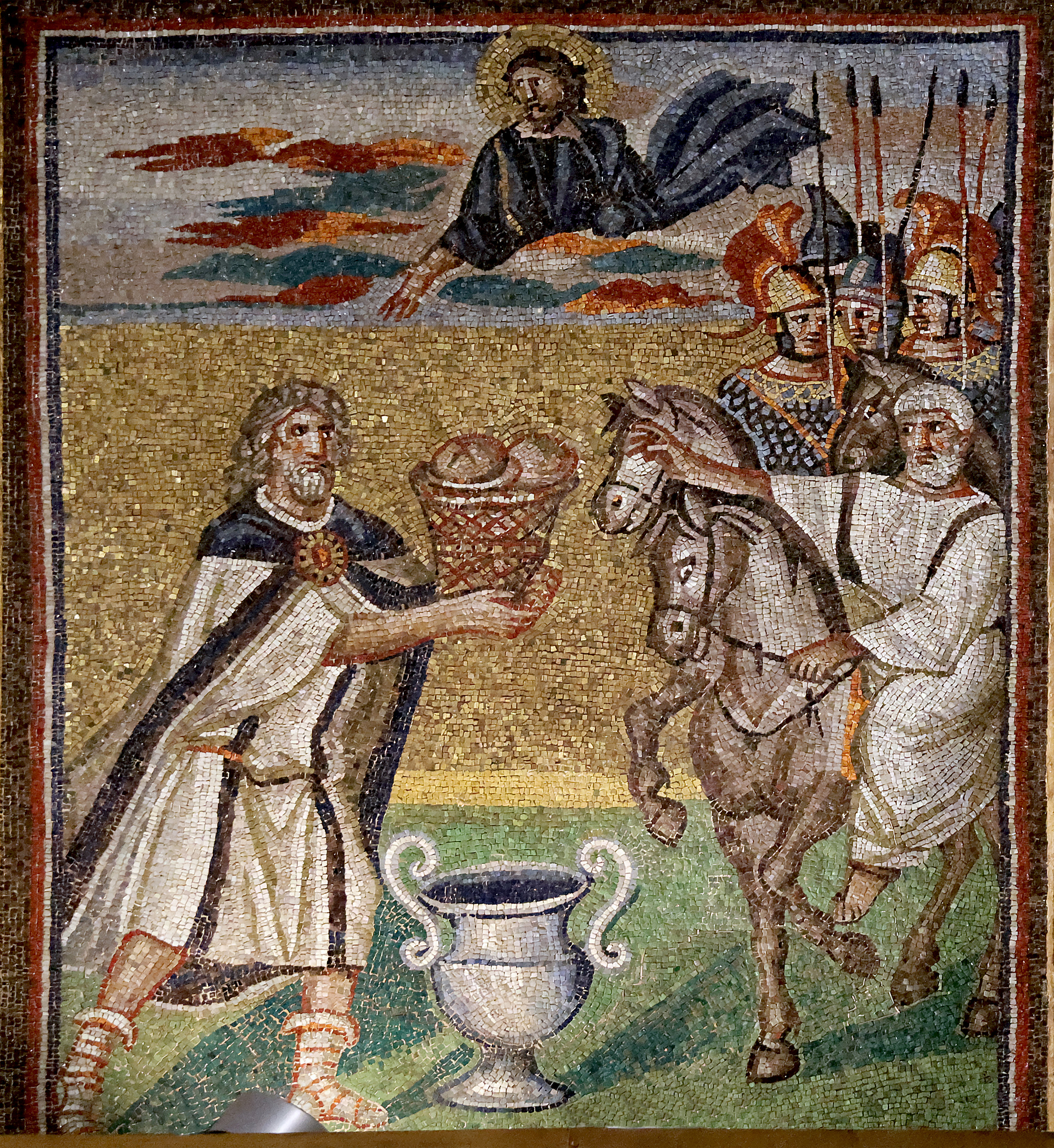
Melchizedek offers bread and wine to Abraham while Christ
blesses from above. Nave mosaic, Basilica of Santa Maria Maggiore, Rome
(c. 432–440). The earliest surviving monumental depiction of
Melchizedek.
Fourth-century Christian sarcophagi, particularly those produced in Roman workshops, occasionally include the Melchizedek scene among their relief carvings. The standard iconographic formula shows Melchizedek as a bearded figure in priestly garments, presenting bread (often depicted as round loaves) and a vessel of wine to Abraham. These sarcophagus carvings are significant because they demonstrate that the Melchizedek typology was not confined to theological treatises; it was part of the visual vocabulary of ordinary Christian burial practice. The faithful who commissioned these sarcophagi expected to be resurrected into the kingdom of the eternal priest.113
The most magnificent surviving depictions of Melchizedek in early Christian art are found in the mosaic programs of Ravenna, the imperial capital of the Western Roman Empire in the fifth and sixth centuries. Ravenna’s churches contain some of the finest and best-preserved mosaics in the world, and Melchizedek figures prominently in two of the most important.
The Basilica of Sant’Apollinare in Classe, consecrated in 549, contains an apse mosaic program that is one of the masterpieces of early Christian art. On the north wall of the apse, a mosaic panel depicts the sacrifice of Abel, the offering of Melchizedek, and the sacrifice of Abraham—the same three figures invoked in the Roman Canon’s Supra quae prayer. The three sacrifices are arranged around a central altar, emphasizing their Eucharistic significance.
Melchizedek is shown standing behind the altar, vested in priestly garments, with bread and a chalice of wine placed on the cloth-covered table before him. Abel stands to one side with a lamb; Abraham, with Isaac, stands to the other. The composition is not a narrative illustration of three separate historical events; it is a theological icon. The three Old Testament sacrifices converge on a single altar, which is itself a figure of the Christian altar on which the Eucharist is celebrated. The mosaic is, in effect, a visual rendering of the Roman Canon.114
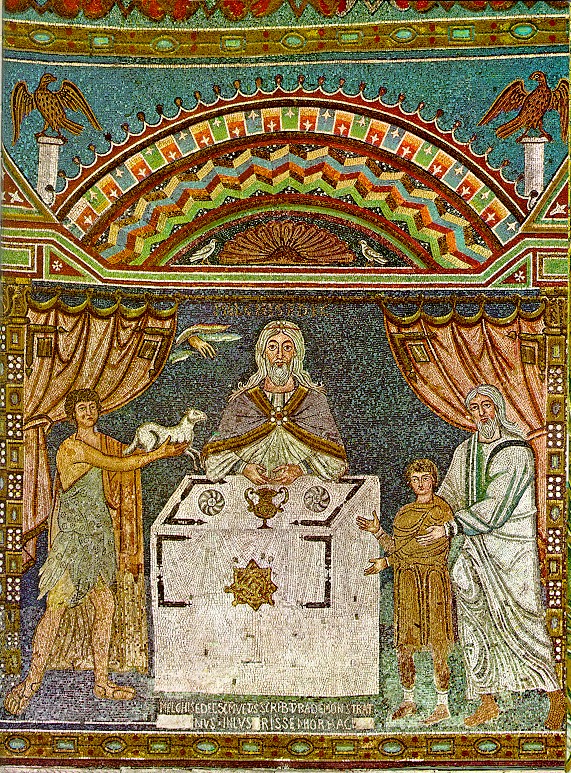
The sacrifices of Abel, Melchizedek, and Abraham. Apse mosaic,
Basilica of Sant’Apollinare in Classe, Ravenna (6th
century).
The Basilica of San Vitale in Ravenna, consecrated in 547, contains another celebrated Melchizedek mosaic. In the north wall lunette of the presbytery, two Old Testament scenes are juxtaposed: on the left, the hospitality of Abraham (the visit of the three angels at Mamre, Genesis 18); on the right, the sacrifice of Isaac. In the adjacent lunette, Abel and Melchizedek flank a central altar, each offering sacrifice.
The San Vitale Melchizedek is depicted as a regal figure, crowned and vested, placing bread on the altar while a chalice stands beside it. His posture and gestures mirror those of a priest at the Eucharistic liturgy. The mosaic artists of Ravenna were not merely recording a biblical scene; they were making a theological argument in glass and gold: the offering of Melchizedek is the offering of the Mass. The bread and wine on the mosaic altar are the bread and wine on the real altar below, where the priest celebrates the Eucharist in the same basilica.115
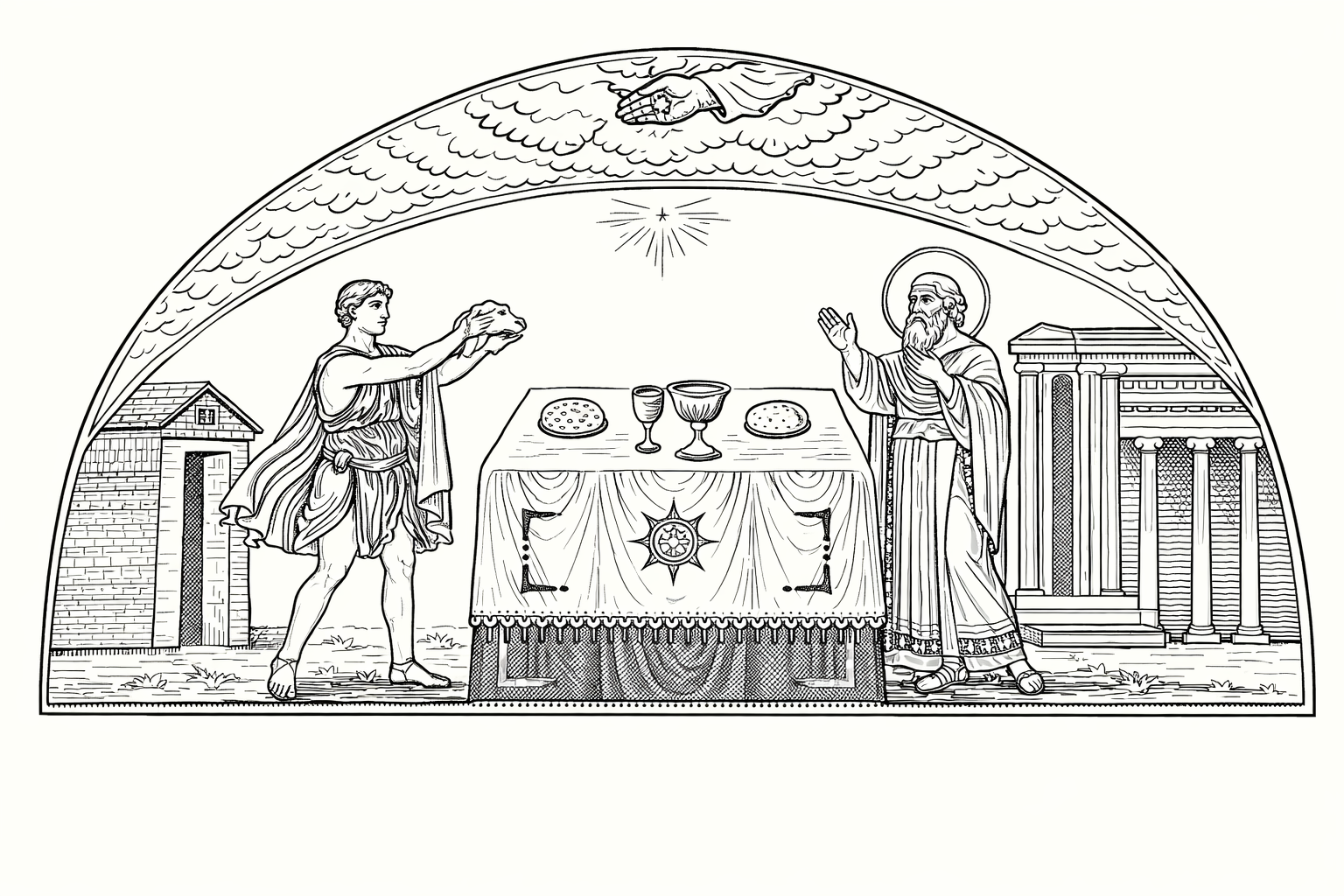
Abel and Melchizedek flank the altar of sacrifice. Line
drawing after the presbytery lunette mosaic, Basilica of San Vitale,
Ravenna (6th century).
The Ravenna mosaics are the supreme artistic expression of the Melchizedek typology. They translate the theology of the Roman Canon into visual form with a directness and beauty that has never been surpassed.
The same Byzantine mosaic tradition carried the Melchizedek typology to Venice. In the Basilica of San Marco (13th century), a mosaic in the atrium depicts the meeting of Abraham and Melchizedek with vivid immediacy: Melchizedek, dressed in priestly robes and a turban, offers a chalice and round loaves of bread to Abraham, who reaches out to receive them. The mosaic inscription identifies both figures by name, and the gold tessera background—characteristic of Byzantine sacred art—signals that the scene belongs not merely to history but to the liturgical present.
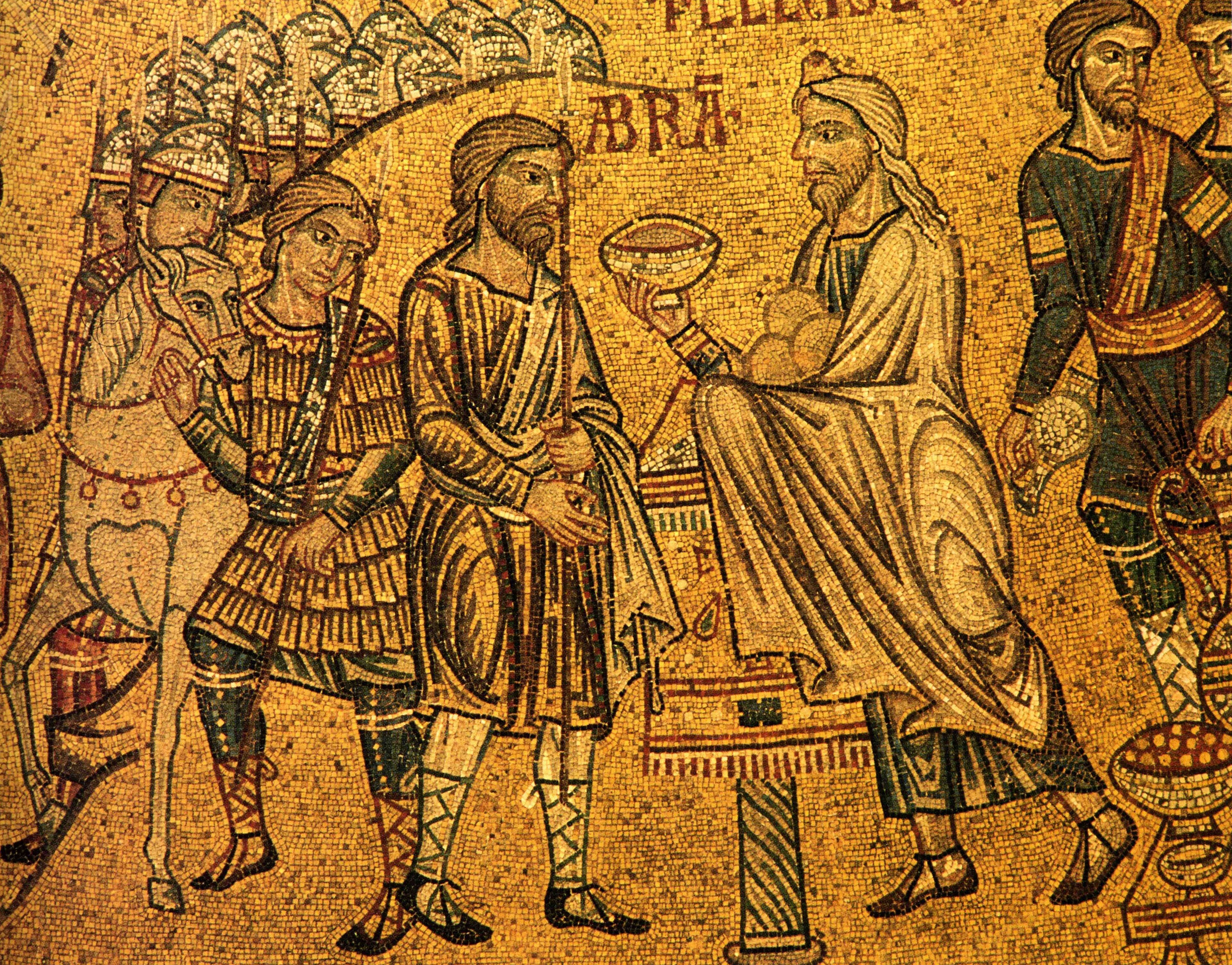
Abraham meets Melchizedek. Atrium mosaic, Basilica of San
Marco, Venice (13th century).
In the medieval West, Melchizedek continued to appear in the visual arts, now shaped by the scholastic theology of the period and the expanding repertoire of Gothic art.
Melchizedek appears frequently in illuminated manuscripts of the Bible, the Psalter, and liturgical books. The typical medieval depiction follows the early Christian formula: Melchizedek, often crowned and vested as a priest-king, presents bread and wine to Abraham. In some manuscripts, he is depicted with a halo, indicating his sanctity, and his priestly vestments are modeled on contemporary liturgical dress—a chasuble or dalmatic—emphasizing the continuity between his priesthood and the priesthood of the medieval Church.
The Bible moralisée, a type of illustrated Bible produced in thirteenth-century France, pairs Old Testament scenes with their New Testament fulfillments. In these manuscripts, the offering of Melchizedek is consistently paired with the Last Supper or the celebration of the Mass, making the typological connection explicit for the reader.116
One of the masterpieces of medieval liturgical art is the Verdun Altar (Verduner Altar) at the Augustinian monastery of Klosterneuburg, near Vienna. Created in 1181 by the Mosan goldsmith Nicholas of Verdun, the altar consists of 51 enamel panels arranged in a typological program of extraordinary sophistication. Each row presents three scenes: an Old Testament type from before the Law (ante legem), the New Testament fulfillment (sub gratia), and an Old Testament type from under the Law (sub lege).
The Melchizedek panel, inscribed abraha\(\cdot\)melchise, depicts Abraham kneeling before Melchizedek, who offers bread and a chalice. The champlevé enamel technique—figures in gold against a deep blue ground—gives the scene a jewel-like clarity. The Latin inscriptions framing the panels make the typological connections explicit, and the Melchizedek scene is paired directly with its Eucharistic fulfillment. Nicholas of Verdun’s altar is, in miniature, a complete visual theology of salvation history, with Melchizedek occupying his proper place as the priestly type of Christ.117
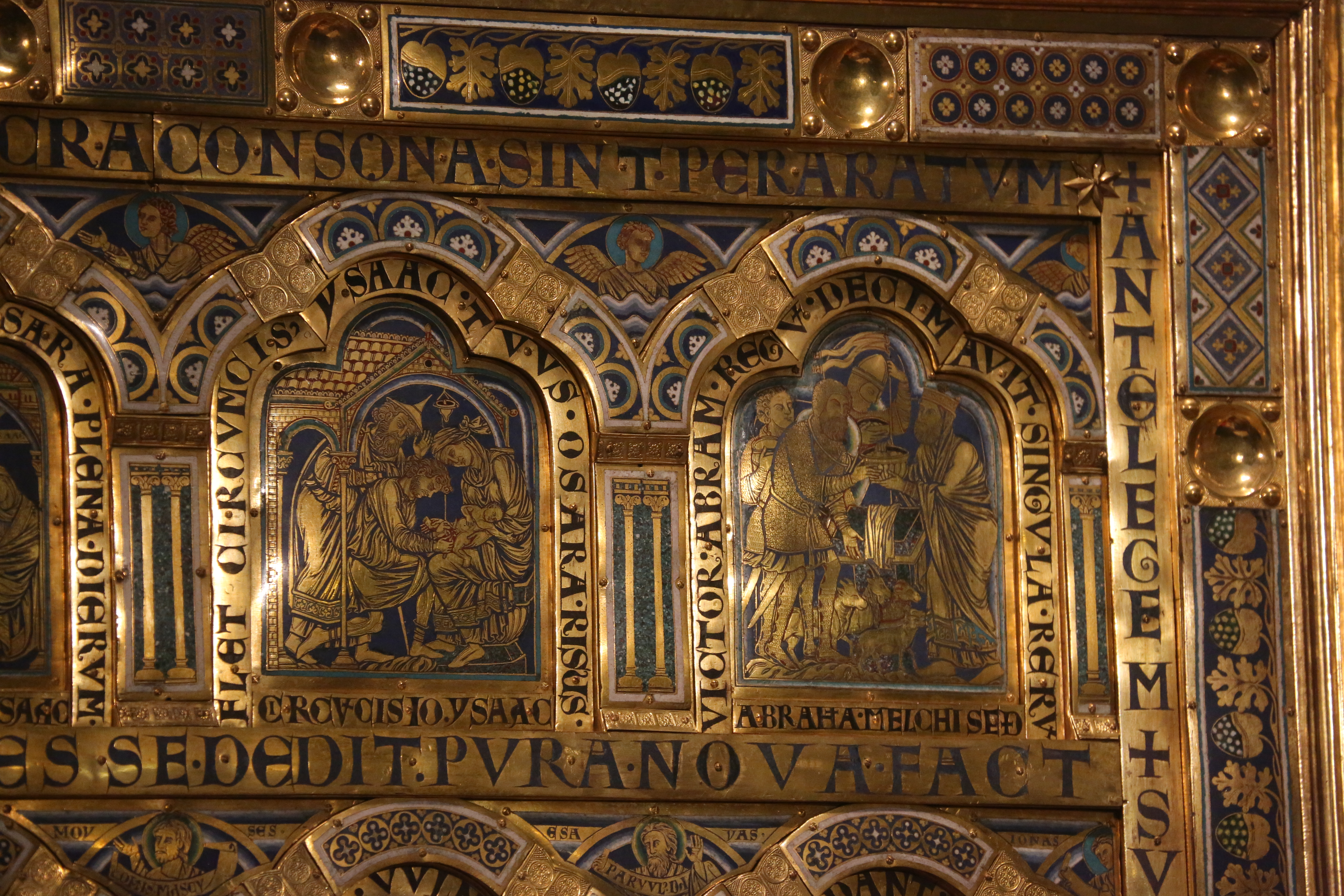
The Verdun Altar (1181), Klosterneuburg Monastery. Champlevé
enamel panels by Nicholas of Verdun. Right panel: Abraham meets
Melchizedek (inscribed abraha\(\cdot\)melchise).
The great Gothic cathedrals of France gave Melchizedek a monumental presence in stone. At Chartres Cathedral (early 13th century), a statue of Melchizedek appears on the north portal of the west façade, among a series of Old Testament figures who prefigure Christ. He is depicted as a king holding a chalice, his royal dignity and priestly office united in a single figure.
At Reims Cathedral—the coronation church of the French kings—Melchizedek is given an even more prominent position. A large statue on the interior west wall depicts him in full priestly vestments, holding a chalice and standing alongside Abraham. The placement of Melchizedek in the coronation church is theologically significant: the French kings were anointed and crowned in a ceremony that consciously echoed the priestly and royal character of Melchizedek’s office. The king, like Melchizedek, was understood to be both ruler and servant of God Most High.118
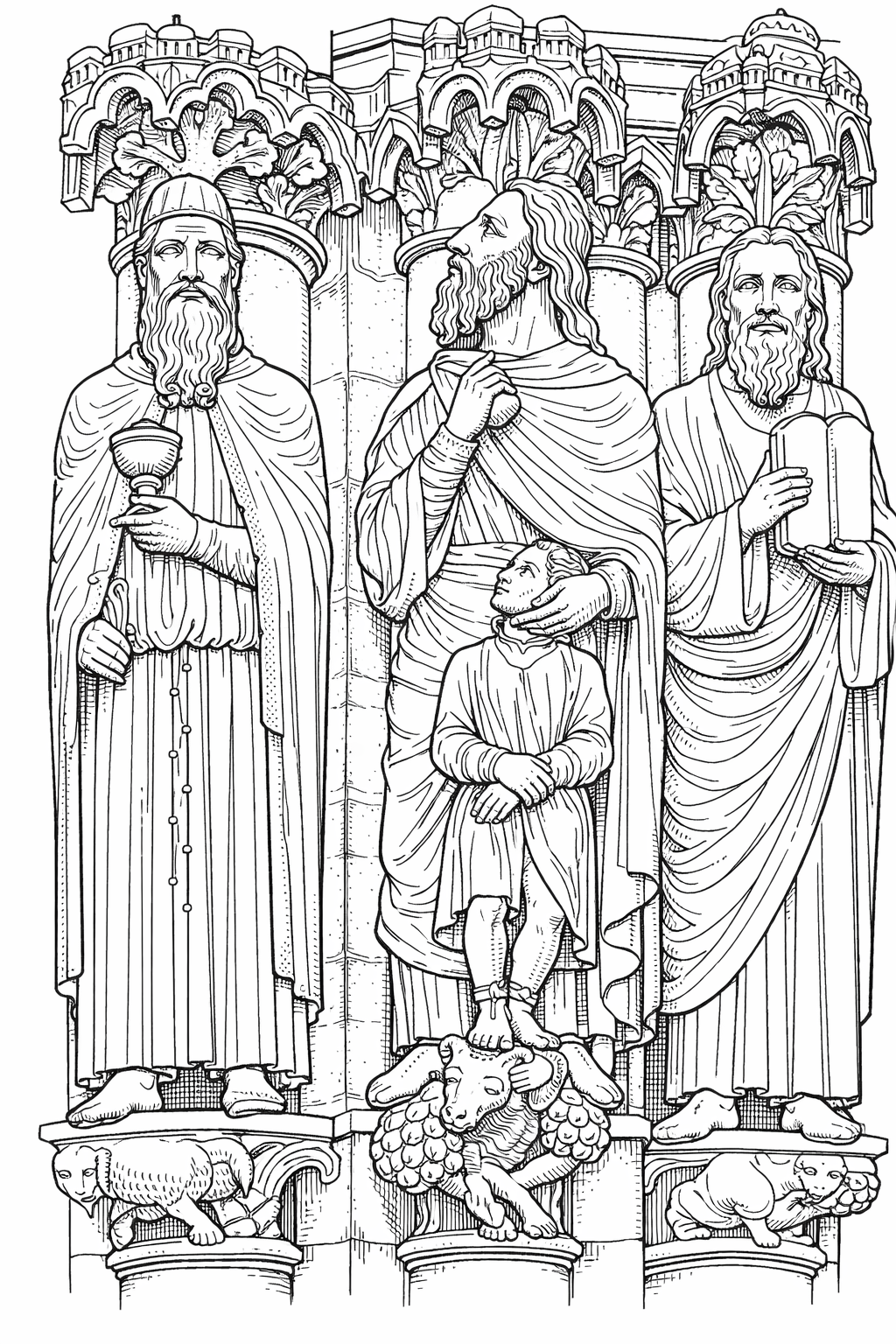
Melchizedek (left, holding chalice), Abraham, and Moses. Line
drawing after the north portal jamb figures, Chartres Cathedral (early
13th century).
The Renaissance and Baroque periods produced some of the most dramatic artistic treatments of Melchizedek, as artists brought new techniques of perspective, chiaroscuro, and emotional expression to the ancient subject.
The Flemish painter Dieric Bouts produced one of the most theologically deliberate paintings of Melchizedek as part of his Altarpiece of the Holy Sacrament, commissioned by the Confraternity of the Blessed Sacrament for the Church of Saint Peter in Leuven. The altarpiece’s central panel depicts the Last Supper; its four flanking panels depict Old Testament types of the Eucharist, including the meeting of Abraham and Melchizedek.
Bouts’s Melchizedek is a regal, bearded figure in a jeweled miter and priestly cope, extending a golden chalice and bread to Abraham, who kneels in full armor amid his soldiers after the battle of the kings. The Flemish cityscape of Leuven itself appears in the background—a deliberate anachronism that collapses the distance between the Genesis narrative and the viewer’s own world. The message is unmistakable: the bread and wine of Melchizedek are the bread and wine of the Eucharist celebrated in the very church where the altarpiece stood.119
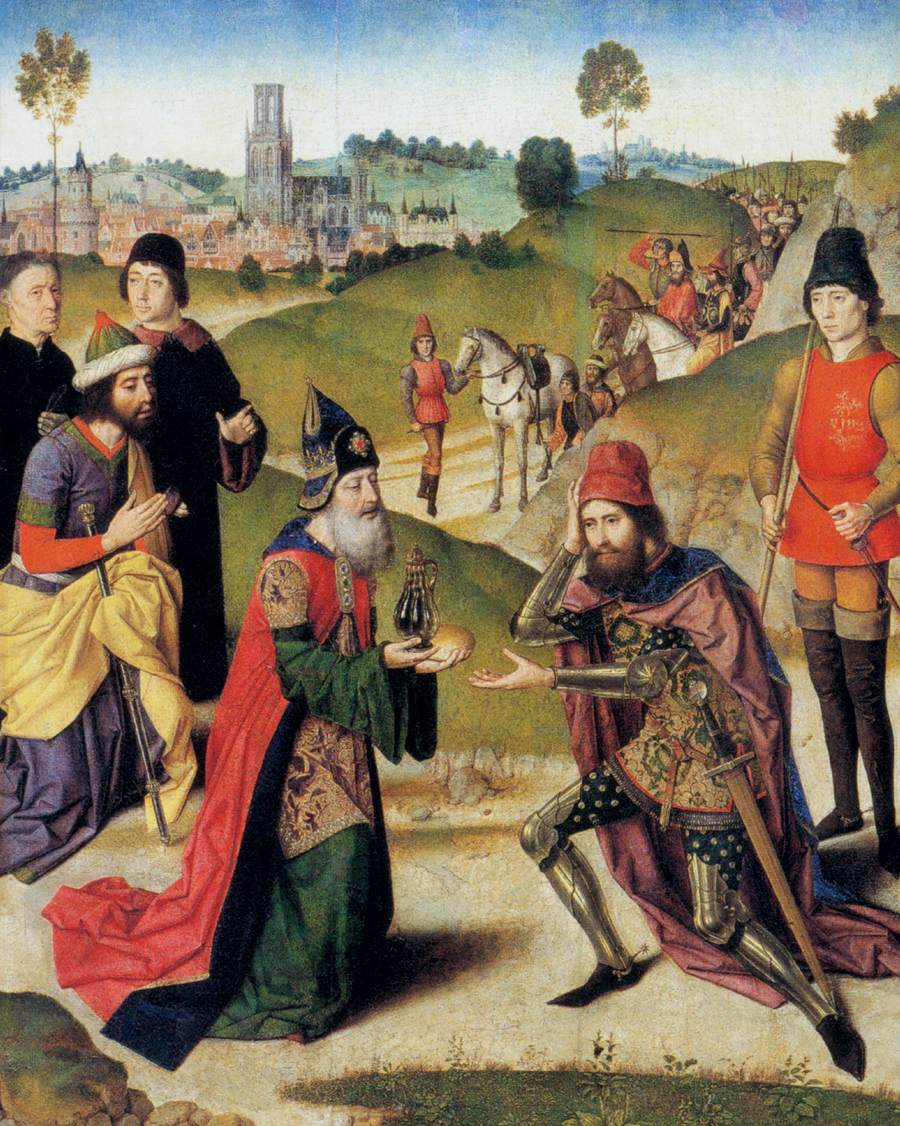
Dieric Bouts, The Meeting of Abraham and Melchizedek
(c. 1464–1468). Panel from the Altarpiece of the Holy Sacrament, Church
of Saint Peter, Leuven.
In the Vatican Logge, the series of frescoes designed by Raphael and executed by his workshop (c. 1517–1519), the meeting of Abraham and Melchizedek is included among the Old Testament scenes that line the vaulted corridors of the Apostolic Palace. Raphael’s composition emphasizes the grandeur of the encounter: Melchizedek, dressed in flowing robes, extends bread and wine to a kneeling Abraham, surrounded by soldiers and spoils of war. The scene is set in a luminous landscape that evokes both the ancient Near East and the idealized classicism of the High Renaissance.120
Rubens painted the meeting of Abraham and Melchizedek at least twice. His large canvas The Meeting of Abraham and Melchizedek (c. 1625, now in the National Gallery of Art, Washington, D.C.) is a work of extraordinary energy and color. Melchizedek, depicted as a vigorous, white-bearded figure in priestly vestments, extends a golden chalice toward Abraham, who kneels amid a throng of soldiers, horses, and captives. The bread is borne on a large platter by attendants. The entire composition swirls with Baroque dynamism, yet the theological focus is clear: the offering of bread and wine is the central action, and Melchizedek is the dominant figure.
Rubens, a devout Catholic, was thoroughly familiar with the Eucharistic typology. His painting is not merely a depiction of a Genesis narrative; it is a meditation on the priesthood. The golden chalice in Melchizedek’s hand is unmistakably a liturgical vessel—the kind of chalice used in the celebration of the Mass. Rubens is telling the viewer that what Melchizedek holds is what the priest holds at the altar: the cup of the New Covenant.121
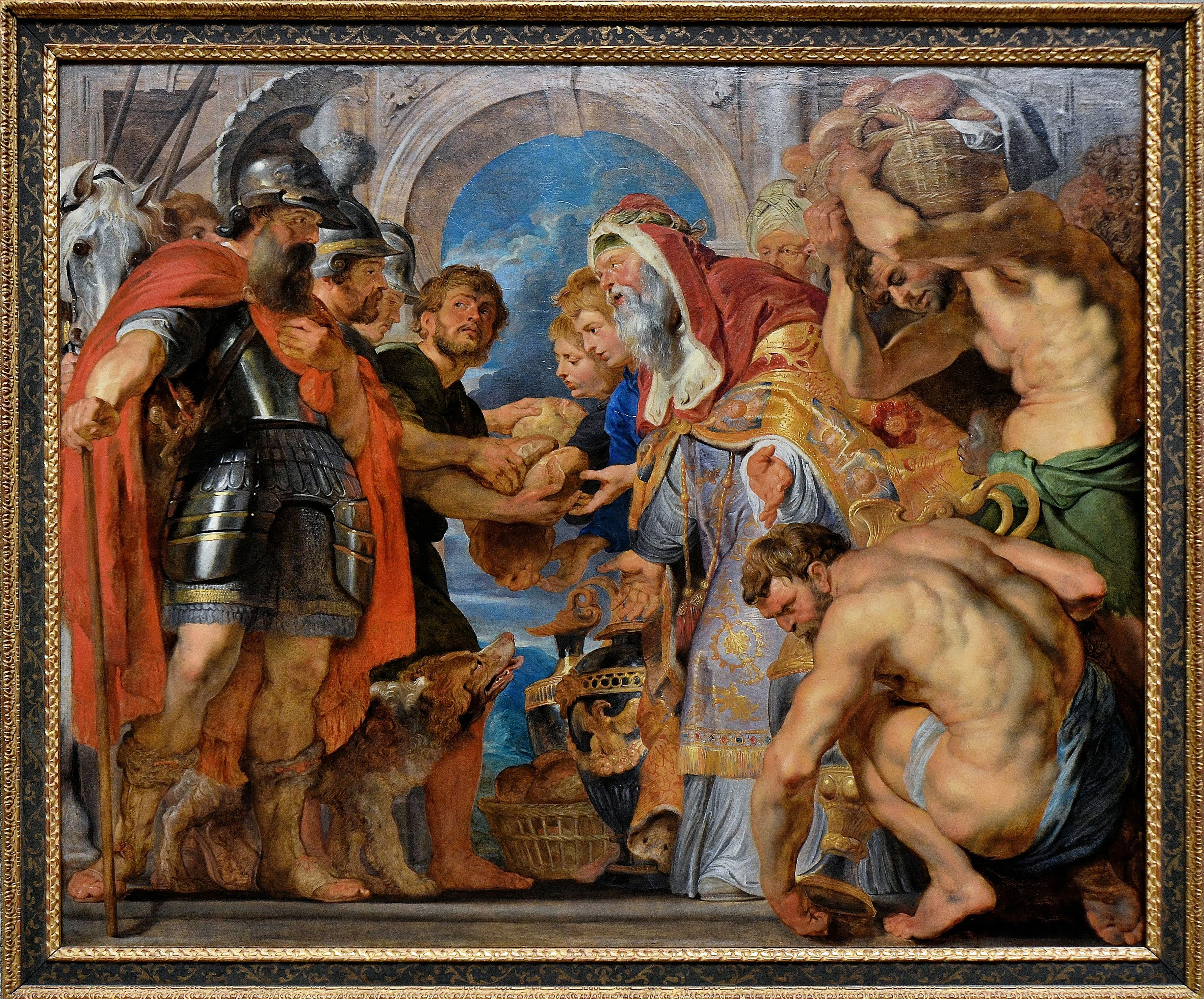
Peter Paul Rubens, The Meeting of Abraham and Melchizedek
(c. 1626). Musée des Beaux-Arts, Caen.
The great Venetian painter Tiepolo returned to the Melchizedek subject in a magnificent ceiling fresco for the Archbishop’s Palace in Udine (c. 1726–1728). Tiepolo’s version is a tour de force of illusionistic painting: the figures of Abraham and Melchizedek appear to float in an open sky, surrounded by angels and billowing clouds. Melchizedek descends from above, offering bread and wine with a gesture of celestial authority. The composition reflects the angelophanic and Christophanic interpretations that the Church Fathers debated: Tiepolo’s Melchizedek is as much a heavenly visitor as an earthly king.122
Melchizedek is a frequent subject in the great stained-glass windows of medieval and modern churches. The typological window programs of the twelfth and thirteenth centuries—at Canterbury, Saint-Denis, and Bourges, among others—consistently include the Melchizedek scene in their Old Testament cycles, pairing it with the Last Supper or the Eucharist.
At Canterbury Cathedral, the “typological windows” of the choir (c. 1180–1220) include a panel depicting Melchizedek offering bread and wine, set alongside panels of the Last Supper and the miracle at Cana. The visual argument is the same as the theological argument of the Roman Canon: Melchizedek’s offering, Christ’s institution of the Eucharist, and the transformation of water into wine at Cana are all moments in a single story—the story of God’s provision of the “true bread from heaven” (John 6:32).123
The tradition extends into the modern period. James Tissot (1836–1902), the French painter who devoted the last decade of his life to illustrating the entire Bible, produced a watercolor of Melchizedek’s offering that is among the most widely reproduced images of the scene. Tissot traveled to the Holy Land to study the landscape, costume, and architecture of the biblical world firsthand, and his Melchizedek stands at a stone altar under an ancient tree, arms raised in blessing over a golden chalice and pitcher of wine, while Abraham prostrates himself before the priest-king. The composition is strikingly liturgical: it could be a scene from the Offertory of the Mass.
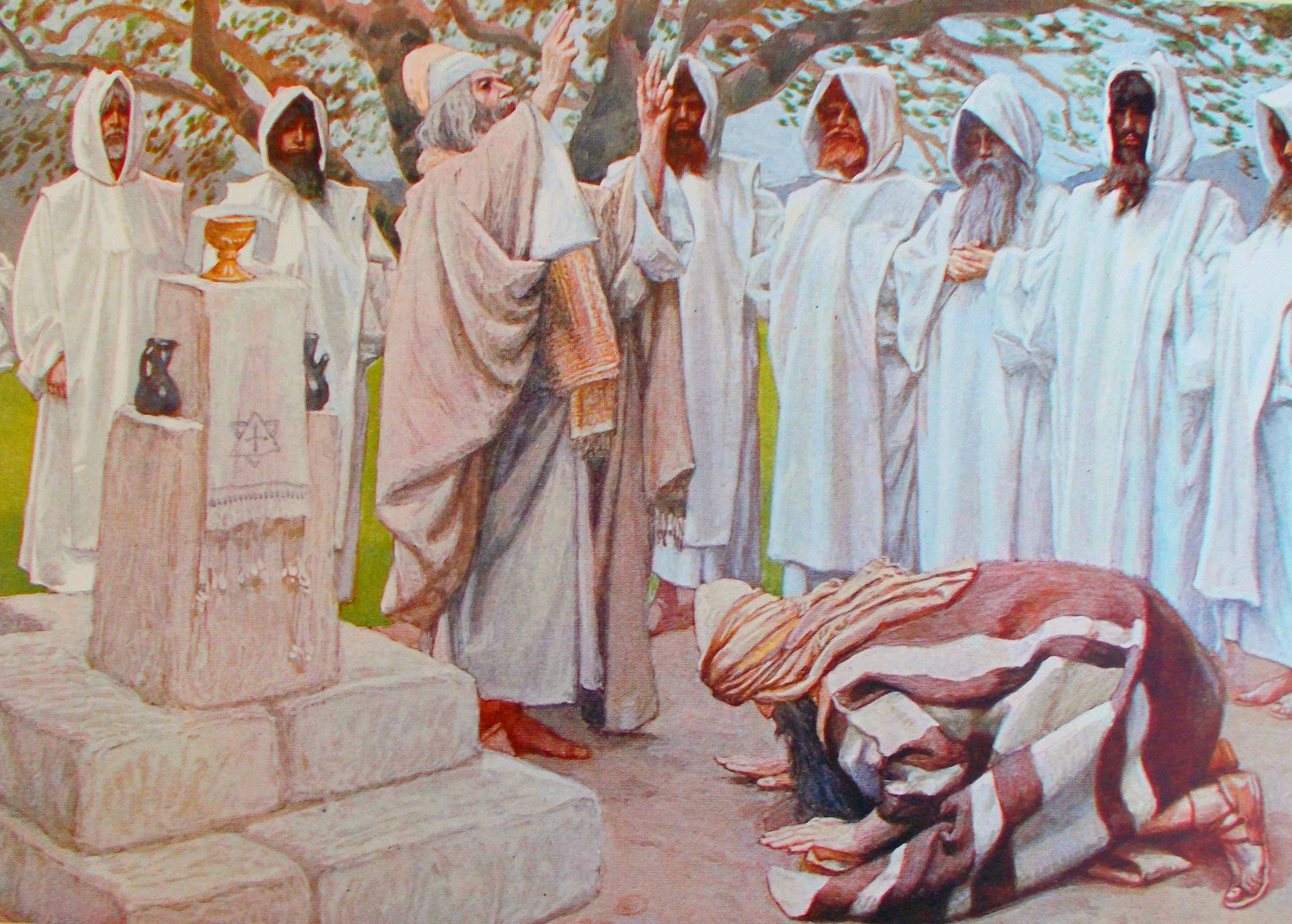
James Tissot, The Offering of Melchizedek (c. 1896–1902).
Watercolor, from The Old Testament series. The Jewish Museum,
New York.
Across nearly two thousand years of sacred art, the iconography of Melchizedek displays several constants:
Bread and wine are always present. No matter the medium or the period, the offering of bread and wine is the defining element of every Melchizedek image. The elements are sometimes depicted as round loaves and a chalice; sometimes as a basket of bread and a pitcher; sometimes as Eucharistic hosts and a golden cup. But they are never absent. The bread and wine are Melchizedek, iconographically speaking.
Priestly and royal vestments are combined. Melchizedek is typically shown wearing both a crown (or royal diadem) and priestly vestments—a chasuble, a dalmatic, or the breastplate of a high priest. This combination reflects the dual office that defines him in Genesis: king of Salem and priest of God Most High.
Abraham is present as recipient. The meeting with Abraham is the standard narrative context. Abraham is shown receiving the offering, often kneeling or bowing—a visual expression of the argument of Hebrews 7 that the one who receives the blessing is inferior to the one who gives it.
The altar is the focal point. In many depictions, particularly in the Ravenna mosaics and in medieval manuscript illumination, an altar stands between Melchizedek and Abraham, making explicit the Eucharistic interpretation. The altar is the link between the Genesis narrative and the Mass.
The placement of Melchizedek images within the architecture of the church is itself theologically significant. In the Ravenna basilicas, the Melchizedek mosaics are located in the apse—the area directly behind and above the altar, where the Eucharist is celebrated. The worshipper who looks up during the Mass sees Melchizedek offering bread and wine in mosaic while the priest offers bread and wine at the altar below. The visual and liturgical actions are perfectly aligned: the type above, the fulfillment below.
In Gothic cathedrals, Melchizedek statues are placed on the exterior portals or on the interior walls near the sanctuary—again, in proximity to the altar. The message is consistent across centuries and styles: Melchizedek belongs near the Eucharist. His image is not decorative; it is catechetical. It teaches the faithful, without words, that the sacrifice of the Mass is the fulfillment of the sacrifice offered in Salem.
The visual tradition of Melchizedek in sacred art confirms and reinforces the theological tradition explored in the preceding chapters. From the catacombs of Rome to the cathedrals of France, from the gold mosaics of Ravenna to the Baroque canvases of Rubens, the Christian artistic imagination has consistently returned to the same three-verse scene in Genesis 14: a priest-king brings forth bread and wine, blesses the father of Israel, and receives his tithe.
The artists knew what the theologians taught: this scene is not merely historical. It is prophetic. The bread and wine of Melchizedek are the bread and wine of the altar. The priesthood of Melchizedek is the priesthood of Christ. And the offering that began in Salem continues, in paint and stone and gold and glass, wherever the Church gathers to celebrate the Eucharist.
The following table presents the ages at which the patriarchs from Shem to Terah fathered the next generation, according to the three principal textual witnesses: the Hebrew Masoretic Text (MT), the Greek Septuagint (LXX), and the Samaritan Pentateuch (SP). The differences between these witnesses are central to the question discussed in Chapter 6: whether Shem’s lifespan could have overlapped with Abraham’s.
| Patriarch | MT | LXX | SP |
|---|---|---|---|
| Patriarch | MT | LXX | SP |
| Shem | 100 | 100 | 100 |
| Arphaxad | 35 | 135 | 135 |
| Cainan | — | 130 | — |
| Shelah | 30 | 130 | 130 |
| Eber | 34 | 134 | 134 |
| Peleg | 30 | 130 | 130 |
| Reu | 32 | 132 | 132 |
| Serug | 30 | 130 | 130 |
| Nahor | 29 | 79 | 79 |
| Terah | 70 | 70 | 70 |
| Total (Shem to Abraham) | 390 | 1170 | 1040 |
Cainan. The LXX includes an additional generation—Cainan, son of Arphaxad—not found in the MT or SP. This additional generation is also attested in Luke 3:36. Its presence in the LXX adds a further 130 years to the genealogy.
The 100-year pattern. For the generations from Arphaxad to Serug, the LXX and SP consistently add exactly 100 years to the MT’s figure. This systematic pattern has led scholars on both sides of the debate to conclude that the difference is the result of deliberate editorial activity, not scribal error. The question is whether the MT reduced the original figures or the LXX inflated them. As discussed in Chapter 6, the agreement of the LXX, SP, and Josephus against the MT favors the view that the MT’s figures were reduced.
Nahor. The difference for Nahor is 50 years (MT: 29; LXX and SP: 79), not 100. This anomaly has never been satisfactorily explained by either side of the debate. Some scholars suggest that the 50-year difference for Nahor is evidence that the systematic alteration was applied imperfectly.
Shem and Terah. The figures for Shem (100) and Terah (70) are identical across all three witnesses.
Josephus. Flavius Josephus (Antiquities I.6.5) provides figures that agree with the LXX for the generations from Arphaxad to Serug, confirming the higher ages from an independent first-century source.
Using the MT’s chronology (total of 390 years from Shem to Abraham), Shem would have been 390 years old at Abraham’s birth. Since Shem lived to 600 (Genesis 11:10–11), he would have survived another 210 years—outliving Abraham (who died at 175) by 35 years. Under this chronology, Shem was alive in Abraham’s day, and the identification of Shem with Melchizedek is chronologically possible.
Using the LXX’s chronology (total of 1,170 years from Shem to Abraham), Shem would have needed to be 1,170 years old at Abraham’s birth—but he lived only 600 years. Shem therefore died approximately 570 years before Abraham was born. Under this chronology, the identification of Shem with Melchizedek is chronologically impossible.
Using the SP’s chronology (total of 1,040 years), the result is similar: Shem died approximately 440 years before Abraham’s birth.
The chronological argument for identifying Melchizedek with Shem depends entirely on the MT’s lower figures. If the original text contained the higher figures preserved by the LXX and SP, the identification fails.
Ambrose of Milan. De Fide. Edited by Otto Faller. Corpus Scriptorum Ecclesiasticorum Latinorum 78. Vienna: Hölder-Pichler-Tempsky, 1962.
Augustine of Hippo. De Civitate Dei. Edited by Bernhard Dombart and Alphons Kalb. Corpus Christianorum Series Latina 47–48. Turnhout: Brepols, 1955. English translation: Marcus Dods, trans. The City of God. New York: Random House, 1950.
Augustine of Hippo. Enarrationes in Psalmos. Edited by Eligius Dekkers and Johannes Fraipont. Corpus Christianorum Series Latina 40. Turnhout: Brepols, 1956. English translation: Maria Boulding, trans. Expositions of the Psalms. The Works of Saint Augustine. Hyde Park, NY: New City Press, 2003.
Clement of Alexandria. Stromata. Edited by Otto Stählin. Die griechischen christlichen Schriftsteller 15. Leipzig: Hinrichs, 1906.
Cyprian of Carthage. Epistolae. Edited by G. Hartel. Corpus Scriptorum Ecclesiasticorum Latinorum 3.2. Vienna, 1871. English translation: Alexander Roberts and James Donaldson, eds. Ante-Nicene Fathers, vol. 5. Buffalo: Christian Literature Publishing, 1886.
Ephrem the Syrian. Hymnen de Azymis. Edited by Edmund Beck. Corpus Scriptorum Christianorum Orientalium 248–249. Leuven: Peeters, 1964.
Epiphanius of Salamis. Panarion. Edited by Karl Holl. Die griechischen christlichen Schriftsteller 25, 31, 37. Leipzig: Hinrichs, 1915–1933. English translation: Frank Williams, trans. The Panarion of Epiphanius of Salamis. 2 vols. Nag Hammadi and Manichaean Studies 35–36. Leiden: Brill, 1987–1994.
Jerome. Quaestiones Hebraicae in Genesim. Edited by Paul de Lagarde. Corpus Christianorum Series Latina 72. Turnhout: Brepols, 1959. English translation: C.T.R. Hayward, trans. Saint Jerome’s Hebrew Questions on Genesis. Oxford: Clarendon Press, 1995.
John Chrysostom. Homilies on the Epistle to the Hebrews. In J.P. Migne, ed. Patrologia Graeca, vol. 63. Paris, 1862. English translation: Philip Schaff, ed. Nicene and Post-Nicene Fathers, first series, vol. 14. New York: Christian Literature Company, 1889.
Josephus, Flavius. Antiquities of the Jews and The Jewish War. Edited and translated by H. St. J. Thackeray et al. 13 vols. Loeb Classical Library. Cambridge, MA: Harvard University Press, 1926–1965.
Justin Martyr. Dialogue with Trypho. Edited by Miroslav Marcovich. Patristische Texte und Studien 47. Berlin: de Gruyter, 1997. English translation: Thomas B. Falls, trans. Saint Justin Martyr: Dialogue with Trypho. Fathers of the Church 6. Washington, DC: Catholic University of America Press, 1948; revised by Thomas P. Halton, 2003.
Missale Romanum, editio typica tertia. Vatican City: Typis Polyglottis Vaticanis, 2002. English translation: International Commission on English in the Liturgy (ICEL). The Roman Missal, 3rd typical edition. Washington, DC: United States Conference of Catholic Bishops, 2011.
Origen. Homiliae in Genesim. Edited by W.A. Baehrens. Die griechischen christlichen Schriftsteller 29. Leipzig: Teubner, 1920. English translation: Ronald E. Heine, trans. Homilies on Genesis and Exodus. Fathers of the Church 71. Washington, DC: Catholic University of America Press, 1982.
Philo of Alexandria. Works. Edited and translated by F.H. Colson and G.H. Whitaker. 12 vols. Loeb Classical Library. Cambridge, MA: Harvard University Press, 1929–1962.
Thomas Aquinas. Summa Theologiae. Leonine edition. Sancti Thomae Aquinatis Opera Omnia, vol. 11. Rome: Typographia Polyglotta, 1903.
Thomas Aquinas. Super Epistolas S. Pauli Lectura. Edited by Raffaele Cai. 8th ed. 2 vols. Turin: Marietti, 1953.
Andersen, F.I. “2 (Slavonic Apocalypse of) Enoch.” In James H. Charlesworth, ed. The Old Testament Pseudepigrapha. 2 vols. Garden City, NY: Doubleday, 1983–1985. Vol. 1, pp. 91–221.
Brightman, F.E. Liturgies Eastern and Western. Vol. 1. Oxford: Clarendon Press, 1896.
Budge, E.A. Wallis, trans. The Kebra Nagast. London: Oxford University Press, 1932.
Charlesworth, James H., ed. The Old Testament Pseudepigrapha. 2 vols. Garden City, NY: Doubleday, 1983–1985.
Daoud, Marcos, and H.E. Blatta Marsie Hazen, trans. The Liturgy of the Ethiopian Church. Kingston, Jamaica: Ethiopian Orthodox Church, 1959.
Epstein, Isidore, ed. The Babylonian Talmud. 35 vols. London: Soncino Press, 1935–1952.
Freedman, H., and Maurice Simon, eds. Midrash Rabbah: Genesis. 2 vols. London: Soncino Press, 1939.
Gall, August Freiherr von, ed. Der hebräische Pentateuch der Samaritaner. Giessen: Töpelmann, 1918; repr. Berlin: de Gruyter, 1966.
García Martínez, Florentino, and Eibert J.C. Tigchelaar, eds. The Dead Sea Scrolls Study Edition. 2 vols. Leiden: Brill, 1997–1998.
Grossfeld, Bernard, trans. The Targum Onqelos to Genesis. The Aramaic Bible 6. Wilmington, DE: Michael Glazier, 1988.
Jasper, R.C.D., and G.J. Cuming, eds. Prayers of the Eucharist: Early and Reformed. 3rd ed. Collegeville, MN: Liturgical Press, 1990.
Maher, Michael, trans. Targum Pseudo-Jonathan: Genesis. The Aramaic Bible 1B. Collegeville, MN: Liturgical Press, 1992.
McNamara, Martin. Targum Neofiti 1: Genesis. The Aramaic Bible 1A. Collegeville, MN: Liturgical Press, 1992.
Pearson, Birger A. “The Tractate Melchizedek (IX,1).” In Nag Hammadi Codex IX and X. Edited by Birger A. Pearson. Nag Hammadi Studies 15. Leiden: Brill, 1981. Pp. 19–85.
Silbermann, A.M., ed. Chumash with Targum Onkelos, Haphtaroth and Rashi’s Commentary: Genesis. Jerusalem: Feldheim, 1934.
Ulrich, Eugene, et al., eds. Qumran Cave 4, VII: Genesis to Numbers. Discoveries in the Judaean Desert 12. Oxford: Clarendon Press, 1994.
VanderKam, James C. The Book of Jubilees. 2 vols. Corpus Scriptorum Christianorum Orientalium 510–511. Leuven: Peeters, 1989.
Albright, William Foxwell. “The Historical Background of Genesis XIV.” Journal of the Society of Oriental Research 10 (1926): 231–269.
Allen, Leslie C. Psalms 101–150. Revised ed. Word Biblical Commentary 21. Nashville: Thomas Nelson, 2002.
Andreescu-Treadgold, Irina, and Warren Treadgold. “Procopius and the Imperial Panels of San Vitale.” Art Bulletin 79, no. 4 (1997): 708–723.
Attridge, Harold W. The Epistle to the Hebrews. Hermeneia. Philadelphia: Fortress Press, 1989.
Beale, G.K. The Temple and the Church’s Mission: A Biblical Theology of the Dwelling Place of God. New Studies in Biblical Theology 17. Downers Grove, IL: InterVarsity Press, 2004.
Catechism of the Catholic Church. 2nd ed. Vatican City: Libreria Editrice Vaticana, 1997.
Caviness, Madeline Harrison. The Windows of Christ Church Cathedral, Canterbury. Corpus Vitrearum Medii Aevi, Great Britain 2. London: British Academy, 1981.
Dacos, Nicole. The Loggia of Raphael: A Vatican Art Treasure. New York: Abbeville Press, 2008.
Dahood, Mitchell. Psalms III: 101–150. Anchor Bible 17A. Garden City, NY: Doubleday, 1970.
Deichmann, Friedrich Wilhelm. Ravenna: Hauptstadt des spätantiken Abendlandes. 3 vols. Wiesbaden: Franz Steiner, 1969–1989.
Deliyannis, Deborah Mauskopf. Ravenna in Late Antiquity. Cambridge: Cambridge University Press, 2010.
Emerton, John A. “The Riddle of Genesis XIV.” Vetus Testamentum 21, no. 4 (1971): 403–439.
Emerton, John A. “Some False Clues in the Study of Genesis XIV.” Vetus Testamentum 21, no. 1 (1971): 24–47.
Ferrua, Antonio. The Unknown Catacomb: A Unique Discovery of Early Christian Art. New Lanark: Geddes & Grosset, 1991.
Fisher, Loren R. “Abraham and His Priest-King.” Journal of Biblical Literature 81, no. 3 (1962): 264–270.
Fitzmyer, Joseph A. The Aramaic Inscriptions of Sefîre. Revised ed. Biblica et Orientalia 19/A. Rome: Pontifical Biblical Institute, 1995.
García Martínez, Florentino. “The Eschatological Figure of 11QMelchizedek.” In Qumran and Apocalyptic. Leiden: Brill, 1992. Pp. 162–179.
Hay, David M. Glory at the Right Hand: Psalm 110 in Early Christianity. Society of Biblical Literature Monograph Series 18. Nashville: Abingdon, 1973.
Horbury, William. Jewish Messianism and the Cult of Christ. London: SCM Press, 1998.
Horton, Fred L. The Melchizedek Tradition: A Critical Examination of the Sources to the Fifth Century A.D. and in the Epistle to the Hebrews. Society for New Testament Studies Monograph Series 30. Cambridge: Cambridge University Press, 1976.
Jensen, Robin Margaret. Understanding Early Christian Art. London: Routledge, 2000.
Kitchen, Kenneth A. On the Reliability of the Old Testament. Grand Rapids: Eerdmans, 2003.
Kraus, Hans-Joachim. Psalms 60–150: A Commentary. Translated by Hilton C. Oswald. Minneapolis: Augsburg, 1989.
Lane, William L. Hebrews 1–8. Word Biblical Commentary 47A. Dallas: Word Books, 1991.
Levenson, Jon D. “The Temple and the World.” Journal of Religion 64, no. 3 (1984): 275–298.
Levey, Michael. Giambattista Tiepolo: His Life and Art. New Haven: Yale University Press, 1986.
Lowden, John. The Making of the Bibles Moralisées. 2 vols. University Park: Pennsylvania State University Press, 2000.
Mason, Eric F. ‘You Are a Priest Forever’: Second Temple Jewish Messianism and the Priestly Christology of the Epistle to the Hebrews. Studies on the Texts of the Desert of Judah 74. Leiden: Brill, 2008.
Newsom, Carol. Songs of the Sabbath Sacrifice: A Critical Edition. Harvard Semitic Studies 27. Atlanta: Scholars Press, 1985.
Sauerländer, Willibald. Gothic Sculpture in France, 1140–1270. Translated by Janet Sondheimer. London: Thames & Hudson, 1972.
Smith, Mark S. The Early History of God: Yahweh and the Other Deities in Ancient Israel. 2nd ed. Grand Rapids: Eerdmans, 2002.
Tov, Emanuel. Textual Criticism of the Hebrew Bible. 3rd ed. Minneapolis: Fortress Press, 2012.
Van der Woude, A.S. “Melchisedek als himmlische Erlösergestalt in den neugefundenen eschatologischen Midraschim aus Qumran Höhle XI.” Oudtestamentische Studiën 14 (1965): 354–373.
Vlieghe, Hans. Corpus Rubenianum Ludwig Burchard. Part 1, Saints. London: Harvey Miller, 1972.
Wellhausen, Julius. Prolegomena to the History of Israel. Translated by J. Sutherland Black and Allan Menzies. Edinburgh: Adam & Charles Black, 1885.
Wenham, Gordon J. Genesis 1–15. Word Biblical Commentary 1. Waco, TX: Word Books, 1987.
Westermann, Claus. Genesis 12–36: A Commentary. Translated by John J. Scullion. Minneapolis: Augsburg, 1985.
Roman Canon (Eucharistic Prayer I), Missale Romanum, editio typica tertia (Vatican City: Typis Polyglottis Vaticanis, 2002).↩︎
This is the standard critical position. See, e.g., Claus Westermann, Genesis 12–36: A Commentary, trans. John J. Scullion (Minneapolis: Augsburg, 1985), pp. 203–204.↩︎
Babylonian Talmud, Nedarim 32b; Targum Pseudo-Jonathan on Genesis 14:18; Bereishit Rabbah 43:6. For the Latter-day Saint position, see Doctrine and Covenants 84:14 and the discussion in John A. Tvedtnes, “Who Was Melchizedek?” in The Most Correct Book (Salt Lake City: Cornerstone, 1999).↩︎
See the text 11Q13 (11QMelchizedek), published in A.S. van der Woude, “Melchisedek als himmlische Erlösergestalt in den neugefundenen eschatologischen Midraschim aus Qumran Höhle XI,” Oudtestamentische Studiën 14 (1965): 354–373. English translation and commentary in Florentino García Martínez and Eibert J.C. Tigchelaar, eds., The Dead Sea Scrolls Study Edition, 2 vols. (Leiden: Brill, 1997–1998), vol. 2, pp. 1206–1207.↩︎
Ambrose, De Fide III.11.88; cf. Epiphanius, Panarion 55, which catalogues and refutes various theories about Melchizedek’s identity, including the claim that he was the Holy Spirit.↩︎
F.I. Andersen, “2 (Slavonic Apocalypse of) Enoch,” in James H. Charlesworth, ed., The Old Testament Pseudepigrapha, 2 vols. (Garden City, NY: Doubleday, 1983–1985), vol. 1, pp. 91–221, esp. pp. 204–213.↩︎
Birger A. Pearson, “The Tractate Melchizedek (IX,1),” in Nag Hammadi Codex IX and X, ed. Birger A. Pearson, Nag Hammadi Studies 15 (Leiden: Brill, 1981), pp. 19–85.↩︎
Babylonian Talmud, Nedarim 32b: “R. Zechariah said on R. Ishmael’s authority: The Holy One, blessed be He, intended to bring forth the priesthood from Shem … But because he gave precedence in his blessing to Abraham over God, He brought it forth from Abraham.” The passage implies that Melchizedek was Shem and that the priesthood was transferred from him to Abraham because of a liturgical error. This tradition effectively absorbs Melchizedek into the patriarchal-Levitical succession.↩︎
See the discussion in Horton 1976, pp. 41–53. The possibility of “Melchizedek” as a dynastic title rather than a personal name is also raised by Mitchell Dahood, Psalms III: 101–150, Anchor Bible 17A (Garden City, NY: Doubleday, 1970), pp. 112–120, in connection with Psalm 110.↩︎
The genre of Genesis 14 has been extensively debated. For a thorough discussion, see John A. Emerton, “The Riddle of Genesis XIV,” Vetus Testamentum 21, no. 4 (1971): 403–439; and idem, “Some False Clues in the Study of Genesis XIV,” Vetus Testamentum 21, no. 1 (1971): 24–47.↩︎
See Kenneth A. Kitchen, On the Reliability of the Old Testament (Grand Rapids: Eerdmans, 2003), pp. 319–320, for parallels in second-millennium Syro-Palestinian correspondence.↩︎
Clement of Alexandria, Stromata IV.25. Greek text in Otto Stählin, ed., Clemens Alexandrinus, vol. 2, Die griechischen christlichen Schriftsteller 15 (Leipzig: Hinrichs, 1906), p. 319.↩︎
Cyprian, Epistola 63.4. Latin text in G. Hartel, ed., S. Thasci Caecili Cypriani Opera Omnia, Corpus Scriptorum Ecclesiasticorum Latinorum 3.2 (Vienna, 1871), pp. 701–717. English translation from Alexander Roberts and James Donaldson, eds., Ante-Nicene Fathers, vol. 5 (Buffalo: Christian Literature Publishing, 1886), p. 359.↩︎
For the Ugaritic evidence, see Mark S. Smith, The Early History of God: Yahweh and the Other Deities in Ancient Israel, 2nd ed. (Grand Rapids: Eerdmans, 2002), pp. 32–43.↩︎
Joseph A. Fitzmyer, The Aramaic Inscriptions of Sefîre, revised ed., Biblica et Orientalia 19/A (Rome: Pontifical Biblical Institute, 1995), pp. 41–43, 72–76.↩︎
This position is argued by Loren R. Fisher, “Abraham and His Priest-King,” Journal of Biblical Literature 81, no. 3 (1962): 264–270.↩︎
See Gordon J. Wenham, Genesis 1–15, Word Biblical Commentary 1 (Waco, TX: Word Books, 1987), pp. 316–317.↩︎
Josephus, Antiquities of the Jews I.10.2 (I.180). Greek text and English translation in H. St. J. Thackeray et al., eds., Josephus, 13 vols., Loeb Classical Library (Cambridge, MA: Harvard University Press, 1926–1965), vol. 4, pp. 86–89.↩︎
Targum Onqelos on Genesis 14:18 renders “Salem” simply as “Jerusalem.” Targum Pseudo-Jonathan expands: “Melchizedek, who was Shem the Great, the king of Jerusalem.”↩︎
Jerome, Quaestiones Hebraicae in Genesim on Genesis 14:18. Latin text in Paul de Lagarde, ed., S. Hieronymi Presbyteri Opera, Corpus Christianorum Series Latina 72 (Turnhout: Brepols, 1959), pp. 17–18.↩︎
Julius Wellhausen, Prolegomena to the History of Israel, trans. J. Sutherland Black and Allan Menzies (Edinburgh: Adam & Charles Black, 1885), pp. 311–312. Wellhausen dismissed the chapter as a “free composition” of the post-exilic period.↩︎
William Foxwell Albright, “The Historical Background of Genesis XIV,” Journal of the Society of Oriental Research 10 (1926): 231–269.↩︎
Kitchen, On the Reliability of the Old Testament, pp. 313–323.↩︎
The count varies depending on how allusions are distinguished from direct quotations, but the figure of more than twenty is standard. See David M. Hay, Glory at the Right Hand: Psalm 110 in Early Christianity, Society of Biblical Literature Monograph Series 18 (Nashville: Abingdon, 1973), pp. 15–33, for a comprehensive catalogue.↩︎
See Hans-Joachim Kraus, Psalms 60–150: A Commentary, trans. Hilton C. Oswald (Minneapolis: Augsburg, 1989), pp. 346–350. Kraus situates the psalm in the royal cult of Jerusalem.↩︎
For a survey of dating proposals, see Leslie C. Allen, Psalms 101–150, revised ed., Word Biblical Commentary 21 (Nashville: Thomas Nelson, 2002), pp. 112–117.↩︎
The Septuagint renders it kata tēn taxin Melchisedek (κατὰ τὴν τάξιν Μελχισεδέκ), “according to the order of Melchizedek.” The Vulgate: secundum ordinem Melchisedech. See the discussion in Hay, Glory at the Right Hand, pp. 19–21.↩︎
Hay, Glory at the Right Hand, pp. 15–33, catalogues the citations and allusions.↩︎
Babylonian Talmud, Nedarim 32b, interprets “my lord” as a reference to Abraham. See also Midrash Tehillim on Psalm 110. The shift is documented in Hay, Glory at the Right Hand, pp. 19–33, and in William Horbury, Jewish Messianism and the Cult of Christ (London: SCM Press, 1998), pp. 109–130.↩︎
Justin Martyr, Dialogue with Trypho 33 and 83. Greek text in Miroslav Marcovich, ed., Iustini Martyris Dialogus cum Tryphone, Patristische Texte und Studien 47 (Berlin: de Gruyter, 1997). English translation from Thomas B. Falls, trans., Saint Justin Martyr: Dialogue with Trypho, Fathers of the Church 6 (Washington, DC: Catholic University of America Press, 1948; revised by Thomas P. Halton, 2003).↩︎
Augustine, Enarrationes in Psalmos 110.4. Latin text in Eligius Dekkers and Johannes Fraipont, eds., Sancti Aurelii Augustini Enarrationes in Psalmos, Corpus Christianorum Series Latina 40 (Turnhout: Brepols, 1956). English translation adapted from Maria Boulding, trans., Expositions of the Psalms, part III/19, The Works of Saint Augustine (Hyde Park, NY: New City Press, 2003).↩︎
The question of authorship has been debated since antiquity. Origen famously remarked, “Who wrote the epistle, in truth God knows” (quoted in Eusebius, Historia Ecclesiastica VI.25.14). For a survey of the debate, see Harold W. Attridge, The Epistle to the Hebrews, Hermeneia (Philadelphia: Fortress Press, 1989), pp. 1–6.↩︎
See Attridge, Hebrews, pp. 187–192; and William L. Lane, Hebrews 1–8, Word Biblical Commentary 47A (Dallas: Word Books, 1991), pp. 163–165. Among the Fathers, John Chrysostom is the most prominent advocate of this reading: “It is not that he had no father, but that his father is not recorded” (Homilies on Hebrews 12.2).↩︎
Epiphanius, Panarion 55, catalogues several groups who held this view, including some who identified Melchizedek with the Holy Spirit. Ambrose appears to lean toward a Christophany reading in De Fide III.11.88.↩︎
For the rabbinic sources, see Babylonian Talmud, Nedarim 32b; Targum Pseudo-Jonathan on Genesis 14:18; Bereishit Rabbah 43:6.↩︎
Numbers 3:7–8; 8:26; 18:5–6. The verbal parallel was noted by G.K. Beale, The Temple and the Church’s Mission: A Biblical Theology of the Dwelling Place of God, New Studies in Biblical Theology 17 (Downers Grove, IL: InterVarsity Press, 2004), pp. 66–70.↩︎
See Beale, The Temple and the Church’s Mission, pp. 66–80, and Jon D. Levenson, “The Temple and the World,” Journal of Religion 64, no. 3 (1984): 275–298.↩︎
Babylonian Talmud, Nedarim 32b. English translation from Soncino Talmud.↩︎
Targum Pseudo-Jonathan on Genesis 14:18. English translation from Michael Maher, trans., Targum Pseudo-Jonathan: Genesis, The Aramaic Bible 1B (Collegeville, MN: Liturgical Press, 1992), p. 58.↩︎
See Martin McNamara, Targum Neofiti 1: Genesis, The Aramaic Bible 1A (Collegeville, MN: Liturgical Press, 1992), p. 99, note.↩︎
Bereishit Rabbah 43:6. English translation in H. Freedman and Maurice Simon, eds., Midrash Rabbah: Genesis, 2 vols. (London: Soncino Press, 1939), vol. 1, pp. 356–358.↩︎
Sefer ha-Yashar 16:11–12. The text is available in English as The Book of Jasher (Salt Lake City: J.H. Parry, 1887). The scholarly consensus is that the book is a medieval composition, not the ancient text referenced in the Hebrew Bible. See Edward Ullendorff, “The ‘Book of Jashar’,” Vetus Testamentum 30, no. 1 (1980): 84–85.↩︎
Rashi on Genesis 14:18. English translation in A.M. Silbermann, ed., Chumash with Targum Onkelos, Haphtaroth and Rashi’s Commentary: Genesis (Jerusalem: Feldheim, 1934), p. 63.↩︎
The calculation is as follows from the Masoretic text: Shem was 100 years old at the birth of Arphaxad, two years after the Flood (Genesis 11:10). From Arphaxad to Abram, the Masoretic genealogy gives 290 years (35 + 30 + 34 + 30 + 32 + 30 + 29 + 70). Shem would therefore have been 390 years old when Abram was born. Since Shem lived to 600, he would have lived another 210 years after Abram’s birth. Since Abraham died at 175 (Genesis 25:7), Shem would have outlived Abraham by 35 years.↩︎
For a side-by-side comparison of the Masoretic, Septuagint, and Samaritan Pentateuch genealogies, see Jeremy Sexton and Henry B. Smith Jr., “Primeval Chronology Restored: Revisiting the Genealogies of Genesis 5 and 11,” in The Table of Nations: Genesis 10 in Its Context, ed. Craig A. Evans (Grand Rapids: Baker Academic, forthcoming). See also Jack P. Lewis, “The Offering of Abel (Gen 4:4): A History of Interpretation,” Journal of the Evangelical Theological Society 37, no. 4 (1994): 481–496, for earlier discussions of the textual divergence.↩︎
For the Samaritan Pentateuch text, see August Freiherr von Gall, ed., Der hebräische Pentateuch der Samaritaner (Giessen: Töpelmann, 1918; repr. Berlin: de Gruyter, 1966).↩︎
Josephus, Antiquities of the Jews I.6.5 (I.148–150). Josephus’s figures agree with the Septuagint for the generations from Arphaxad to Serug.↩︎
The calculation, using the Septuagint’s chronology: Shem was 100 at the birth of Arphaxad (Genesis 11:10). From Arphaxad to Abraham, the Septuagint gives 135 + 130 + 134 + 130 + 132 + 130 + 79 + 70 = 940 years. Shem would therefore have been 1,040 years old when Abraham was born—but Shem lived only 600 years. Shem therefore died 440 years before Abraham was born. The exact figure varies depending on which manuscript of the Septuagint is used, but the gap is consistently in the range of 400–500 years.↩︎
“Were the Pyramids Built Before the Flood? (Masoretic Text vs. Original Hebrew),” YouTube video, https://www.youtube.com/watch?v=VI1yRTC6kGE. The video presents a detailed comparison of the Masoretic, Septuagint, and Samaritan Pentateuch chronologies and argues that the Masoretic ages were deliberately reduced to enable the Shem-Melchizedek identification.↩︎
For the Genesis fragments found at Qumran, see Eugene Ulrich et al., eds., Qumran Cave 4, VII: Genesis to Numbers, Discoveries in the Judaean Desert 12 (Oxford: Clarendon Press, 1994).↩︎
See Emanuel Tov, Textual Criticism of the Hebrew Bible, 3rd ed. (Minneapolis: Fortress Press, 2012), pp. 114–117.↩︎
The Dead Sea Scrolls fragment 4QExoda reads “75” in Exodus 1:5, confirming the Septuagint reading. See Ulrich et al., Qumran Cave 4, VII, p. 79.↩︎
This argument is made by, among others, Pete J. Williams, “Some Remarks Preliminary to a Biblical Chronology,” Journal of the Evangelical Theological Society 41, no. 4 (1998): 527–532. For a rebuttal, see Henry B. Smith Jr., “The Case for the Septuagint’s Chronology in Genesis 5 and 11,” in Proceedings of the International Conference on Creationism 8 (2018): 117–132.↩︎
A.S. van der Woude, “Melchisedek als himmlische Erlösergestalt in den neugefundenen eschatologischen Midraschim aus Qumran Höhle XI,” Oudtestamentische Studiën 14 (1965): 354–373. The standard English translation is in García Martínez and Tigchelaar, DSSSE, vol. 2, pp. 1206–1207. See also Florentino García Martínez, “The Eschatological Figure of 11QMelchizedek,” in Qumran and Apocalyptic: Studies on the Aramaic Texts from Qumran (Leiden: Brill, 1992), pp. 162–179.↩︎
11Q13 (11QMelchizedek), column II. Translation from García Martínez and Tigchelaar, DSSSE, vol. 2, pp. 1206–1207, with minor adjustments for readability.↩︎
11Q13 II.15–20. See the discussion in Mason 2008, pp. 139–157.↩︎
See Mason 2008, pp. 182–199, for a careful comparison of the two traditions. Mason concludes that Hebrews and 11QMelchizedek draw on a common pool of Second Temple Melchizedek speculation but develop it in different directions.↩︎
F.I. Andersen, “2 (Slavonic Apocalypse of) Enoch,” in OTP, vol. 1, pp. 91–100, argues for a first-century AD date. For a more cautious assessment, see Christfried Böttrich, “The ‘Book of the Secrets of Enoch’ (2 En): Between Jewish Origin and Christian Transmission,” in New Perspectives on 2 Enoch: No Longer Slavonic Only, ed. Andrei A. Orlov and Gabriele Boccaccini (Leiden: Brill, 2012), pp. 37–67.↩︎
2 Enoch 71:1–23. Translation from Andersen, in OTP, vol. 1, pp. 204–209.↩︎
2 Enoch 71:29–32. Translation from Andersen, in OTP, vol. 1, pp. 208–209.↩︎
2 Enoch 72:1–10. Translation from Andersen, in OTP, vol. 1, pp. 210–213.↩︎
James C. VanderKam, The Book of Jubilees, 2 vols., Corpus Scriptorum Christianorum Orientalium 510–511 (Leuven: Peeters, 1989). Jubilees was found in multiple copies at Qumran, confirming its antiquity and importance in Second Temple Judaism.↩︎
Jubilees 13:25–27. Translation from O.S. Wintermute, “Jubilees,” in OTP, vol. 2, pp. 35–142, here p. 83.↩︎
Birger A. Pearson, “The Tractate Melchizedek (IX,1),” in Nag Hammadi Codex IX and X, ed. Birger A. Pearson, Nag Hammadi Studies 15 (Leiden: Brill, 1981), pp. 19–85. See also Birger A. Pearson, “The Figure of Melchizedek in the First Tractate of the Unpublished Coptic-Gnostic Codex IX from Nag Hammadi,” in Proceedings of the XIIth International Congress of the International Association for the History of Religions (Leiden: Brill, 1975), pp. 200–208.↩︎
NHC IX,1, 5.1–20. Translation from Pearson, in Nag Hammadi Codex IX and X, pp. 42–47.↩︎
Epiphanius, Panarion 55. Greek text in Karl Holl, ed., Epiphanius, 3 vols., Die griechischen christlichen Schriftsteller 25, 31, 37 (Leipzig: Hinrichs, 1915–1933), vol. 2, pp. 325–340. English translation in Frank Williams, trans., The Panarion of Epiphanius of Salamis, 2 vols., Nag Hammadi and Manichaean Studies 35–36 (Leiden: Brill, 1987–1994), vol. 2, pp. 74–87.↩︎
Alexander Kulik, Retroverting Slavonic Pseudepigrapha: Toward the Original of the Apocalypse of Abraham (Atlanta: Society of Biblical Literature, 2004).↩︎
H.C. Kee, “Testaments of the Twelve Patriarchs,” in OTP, vol. 1, pp. 775–828, esp. pp. 788–795.↩︎
Carol Newsom, Songs of the Sabbath Sacrifice: A Critical Edition, Harvard Semitic Studies 27 (Atlanta: Scholars Press, 1985).↩︎
Philo, Legum Allegoriae III.79–82. Greek text and English translation in F.H. Colson and G.H. Whitaker, eds., Philo, 12 vols., Loeb Classical Library (Cambridge, MA: Harvard University Press, 1929–1962), vol. 1, pp. 398–401.↩︎
Philo, De Abrahamo 235. Greek text and English translation in Colson and Whitaker, Philo, vol. 6, pp. 130–131.↩︎
Josephus, Antiquities of the Jews I.10.2 (I.180–181). Greek text and English translation in Thackeray et al., Josephus, vol. 4, pp. 86–89.↩︎
Josephus, The Jewish War VI.10 (VI.438). Greek text and English translation in Thackeray et al., Josephus, vol. 3, pp. 502–503.↩︎
Targum Onqelos on Genesis 14:18: “And Melchizedek, king of Jerusalem, brought out bread and wine; and he was a priest who ministered before God Most High.” English translation from Bernard Grossfeld, trans., The Targum Onqelos to Genesis, The Aramaic Bible 6 (Wilmington, DE: Michael Glazier, 1988), p. 68.↩︎
Clement of Alexandria, Stromata IV.25. Translation adapted from Alexander Roberts and James Donaldson, eds., Ante-Nicene Fathers, vol. 2 (Buffalo: Christian Literature Publishing, 1885), p. 438.↩︎
Origen, Homilia in Genesim IX.1. Latin text in W.A. Baehrens, ed., Origenes Werke, vol. 6, Die griechischen christlichen Schriftsteller 29 (Leipzig: Teubner, 1920). English translation from Ronald E. Heine, trans., Homilies on Genesis and Exodus, Fathers of the Church 71 (Washington, DC: Catholic University of America Press, 1982), pp. 153–154.↩︎
Ambrose, De Fide III.11.88–89. Latin text in Otto Faller, ed., Sancti Ambrosii Opera, vol. 8, Corpus Scriptorum Ecclesiasticorum Latinorum 78 (Vienna: Hölder-Pichler-Tempsky, 1962), pp. 144–145.↩︎
Jerome, Quaestiones Hebraicae in Genesim on Genesis 14:18. Latin text in Lagarde, S. Hieronymi Presbyteri Opera, CCSL 72, pp. 17–18. Translation adapted from C.T.R. Hayward, trans., Saint Jerome’s Hebrew Questions on Genesis (Oxford: Clarendon Press, 1995), pp. 43–44.↩︎
Augustine, De Civitate Dei XVI.22. Latin text in Bernhard Dombart and Alphons Kalb, eds., Sancti Aurelii Augustini De Civitate Dei, Corpus Christianorum Series Latina 47–48 (Turnhout: Brepols, 1955). English translation from Marcus Dods, trans., The City of God (New York: Random House, 1950), p. 553.↩︎
John Chrysostom, Homilies on the Epistle to the Hebrews 12.2. Greek text in J.P. Migne, ed., Patrologia Graeca, vol. 63 (Paris, 1862), col. 99. English translation from Philip Schaff, ed., Nicene and Post-Nicene Fathers, first series, vol. 14 (New York: Christian Literature Company, 1889), p. 425.↩︎
Epiphanius, Panarion 55.1–9. English translation in Williams, The Panarion of Epiphanius of Salamis, vol. 2, pp. 74–87.↩︎
Thomas Aquinas, Super Epistolam B. Pauli ad Hebraeos Lectura, c. 7, lect. 1. Latin text in Raffaele Cai, ed., Super Epistolas S. Pauli Lectura, 8th ed., 2 vols. (Turin: Marietti, 1953), vol. 2, pp. 396–397.↩︎
Thomas Aquinas, Summa Theologiae III, q. 22, a. 6, ad 2. Latin text in the Leonine edition, Sancti Thomae Aquinatis Opera Omnia, vol. 11 (Rome: Typographia Polyglotta, 1903), pp. 258–259.↩︎
Catechism of the Catholic Church, 2nd ed. (Vatican City: Libreria Editrice Vaticana, 1997), §§1544–1545.↩︎
Cyprian, Epistola 63.4. English translation from Roberts and Donaldson, Ante-Nicene Fathers, vol. 5, p. 359.↩︎
Augustine, De Civitate Dei XVI.22.↩︎
Roman Canon (Eucharistic Prayer I), Missale Romanum, editio typica tertia (Vatican City: Typis Polyglottis Vaticanis, 2002). English translation from the International Commission on English in the Liturgy (ICEL), The Roman Missal, 3rd typical edition (Washington, DC: United States Conference of Catholic Bishops, 2011).↩︎
Catechism of the Catholic Church, 2nd ed. (Vatican City: Libreria Editrice Vaticana, 1997), §1545, quoting St. Thomas Aquinas, Commentary on the Epistle to the Hebrews, c. 7, lect. 4.↩︎
Offertory prayer, Missale Romanum (1962), Ordo Missae. The 1962 Missal preserves the traditional offertory prayers that were simplified in the 1970 reform.↩︎
Liturgy of St. Basil the Great, Anaphora. Greek text in F.E. Brightman, Liturgies Eastern and Western, vol. 1 (Oxford: Clarendon Press, 1896), pp. 321–344. The phrase “reasonable and bloodless service” (logikēn kai anaimakton latreian) echoes the non-animal sacrifice of Melchizedek’s bread and wine.↩︎
Anaphora of St. Basil (Coptic recension). English translation from R.C.D. Jasper and G.J. Cuming, eds., Prayers of the Eucharist: Early and Reformed, 3rd ed. (Collegeville, MN: Liturgical Press, 1990), pp. 67–73.↩︎
E.A. Wallis Budge, trans., The Kebra Nagast (London: Oxford University Press, 1932), chapters 13–14. For the Ethiopian anaphoral tradition, see Marcos Daoud and H.E. Blatta Marsie Hazen, trans., The Liturgy of the Ethiopian Church (Kingston, Jamaica: Ethiopian Orthodox Church, 1959).↩︎
Ephrem the Syrian, Hymns on the Unleavened Bread 4.4. Syriac text and English translation in Edmund Beck, ed., Des heiligen Ephraem des Syrers Hymnen de Azymis, Corpus Scriptorum Christianorum Orientalium 248–249 (Leuven: Peeters, 1964).↩︎
Justin Martyr, Dialogue with Trypho 41: “He speaks of the sacrifices offered to Him in every place by the Gentiles, that is, the bread of the Eucharist, and the cup of the Eucharist.” See also Irenaeus, Adversus Haereses IV.17.5.↩︎
Paul VI, Apostolic Constitution Missale Romanum, April 3, 1969. The new Missal (Missale Romanum, editio typica) was published in 1970.↩︎
Klaus Gamber, The Reform of the Roman Liturgy (Fort Collins: Roman Catholic Books, 1993), p. 109.↩︎
Sacrosanctum Concilium, December 4, 1963, §36: “The use of the Latin language is to be preserved in the Latin rites.”↩︎
The new Offertory prayers were adapted from Jewish table blessings. See Annibale Bugnini, The Reform of the Liturgy 1948–1975 (Collegeville, MN: Liturgical Press, 1990), p. 377.↩︎
Statistical analysis in Michael Davies, The Legal Status of the Traditional Mass (Kansas City: Angelus Press, 1982), Appendix III.↩︎
Studies of liturgical practice consistently show that Eucharistic Prayer II is used at 80–90 percent of weekday Masses and a majority of Sunday Masses. See, e.g., Paul Turner, Understanding the Revised Mass Texts (Collegeville, MN: Liturgical Press, 2007), p. 89.↩︎
Michael S. Rose, Ugly As Sin: Why They Changed Our Churches from Sacred Places to Meeting Spaces and How We Can Change Them Back (Manchester, NH: Sophia Institute Press, 2001), p. 15.↩︎
Sacrosanctum Concilium, §116.↩︎
Congregation for Divine Worship, “Survey of Liturgical Practices,” Notitiae 7 (1971), pp. 227–231.↩︎
Elizabeth Lev, “The Great Divestment,” First Things, November 2009, pp. 45–50.↩︎
Kenneth Clark, Letter to The Times (London), December 3, 1982, p. 15.↩︎
Martin Luther, The Babylonian Captivity of the Church, 1520, in Luther’s Works, vol. 36, p. 35.↩︎
Cardinal Alfredo Ottaviani and Cardinal Antonio Bacci, Short Critical Study of the New Order of Mass, September 25, 1969, §1.↩︎
Pew Research Center, “What Americans Know About Religion,” July 23, 2019, Chapter 4, with supplementary tables.↩︎
See the discussion in the Catholic Encyclopedia, s.v. “Melchisedech,” which summarizes the patristic and scholastic consensus.↩︎
Thomas Aquinas, Summa Theologiae III, q. 22, a. 1, argues that the priestly office requires a human nature, since the priest mediates between God and man.↩︎
This argument is made forcefully by Attridge, Hebrews, p. 189: “The use of aphōmoiomenos implies a comparison between two distinct entities, not an identification.”↩︎
For the nave mosaics of Santa Maria Maggiore, see Beat Brenk, Die frühchristlichen Mosaiken in S. Maria Maggiore zu Rom (Wiesbaden: Franz Steiner, 1975), pp. 44–52. See also Suzanne Spain, “The Promised Blessing: The Iconography of the Mosaics of Santa Maria Maggiore,” Art Bulletin 61, no. 4 (1979): 518–540.↩︎
For early Christian sarcophagus iconography, see Robin Margaret Jensen, Understanding Early Christian Art (London: Routledge, 2000), pp. 64–77.↩︎
For the mosaics of Sant’Apollinare in Classe, see Friedrich Wilhelm Deichmann, Ravenna: Hauptstadt des spätantiken Abendlandes, 3 vols. (Wiesbaden: Franz Steiner, 1969–1989), vol. 2, pp. 241–276. See also Deborah Mauskopf Deliyannis, Ravenna in Late Antiquity (Cambridge: Cambridge University Press, 2010), pp. 283–296.↩︎
For the San Vitale mosaics, see Deichmann, Ravenna, vol. 2, pp. 166–207. For the theological program, see Irina Andreescu-Treadgold and Warren Treadgold, “Procopius and the Imperial Panels of San Vitale,” Art Bulletin 79, no. 4 (1997): 708–723.↩︎
For the Bible moralisée tradition, see John Lowden, The Making of the Bibles Moralisées, 2 vols. (University Park: Pennsylvania State University Press, 2000).↩︎
For the Verdun Altar, see Helmut Buschhausen, Der Verduner Altar (Vienna: Edition Tusch, 1980), pp. 78–85.↩︎
For the Chartres and Reims portal programs, see Willibald Sauerländer, Gothic Sculpture in France, 1140–1270, trans. Janet Sondheimer (London: Thames & Hudson, 1972), pp. 168–175, 432–445.↩︎
For the Altarpiece of the Holy Sacrament, see Catheline Périer-D’Ieteren, Dieric Bouts: The Complete Works (Brussels: Mercatorfonds, 2006), pp. 194–234.↩︎
For the Vatican Logge, see Nicole Dacos, The Loggia of Raphael: A Vatican Art Treasure (New York: Abbeville Press, 2008), pp. 132–137.↩︎
For Rubens’s treatment of the subject, see Hans Vlieghe, Corpus Rubenianum Ludwig Burchard, part 1, Saints (London: Harvey Miller, 1972), and Arthur K. Wheelock Jr., ed., Peter Paul Rubens: The Drawings (New York: Metropolitan Museum of Art, 2005), pp. 234–237.↩︎
For Tiepolo’s Udine frescoes, see Michael Levey, Giambattista Tiepolo: His Life and Art (New Haven: Yale University Press, 1986), pp. 38–47.↩︎
For the Canterbury typological windows, see Madeline Harrison Caviness, The Windows of Christ Church Cathedral, Canterbury, Corpus Vitrearum Medii Aevi, Great Britain 2 (London: British Academy, 1981), pp. 115–134.↩︎