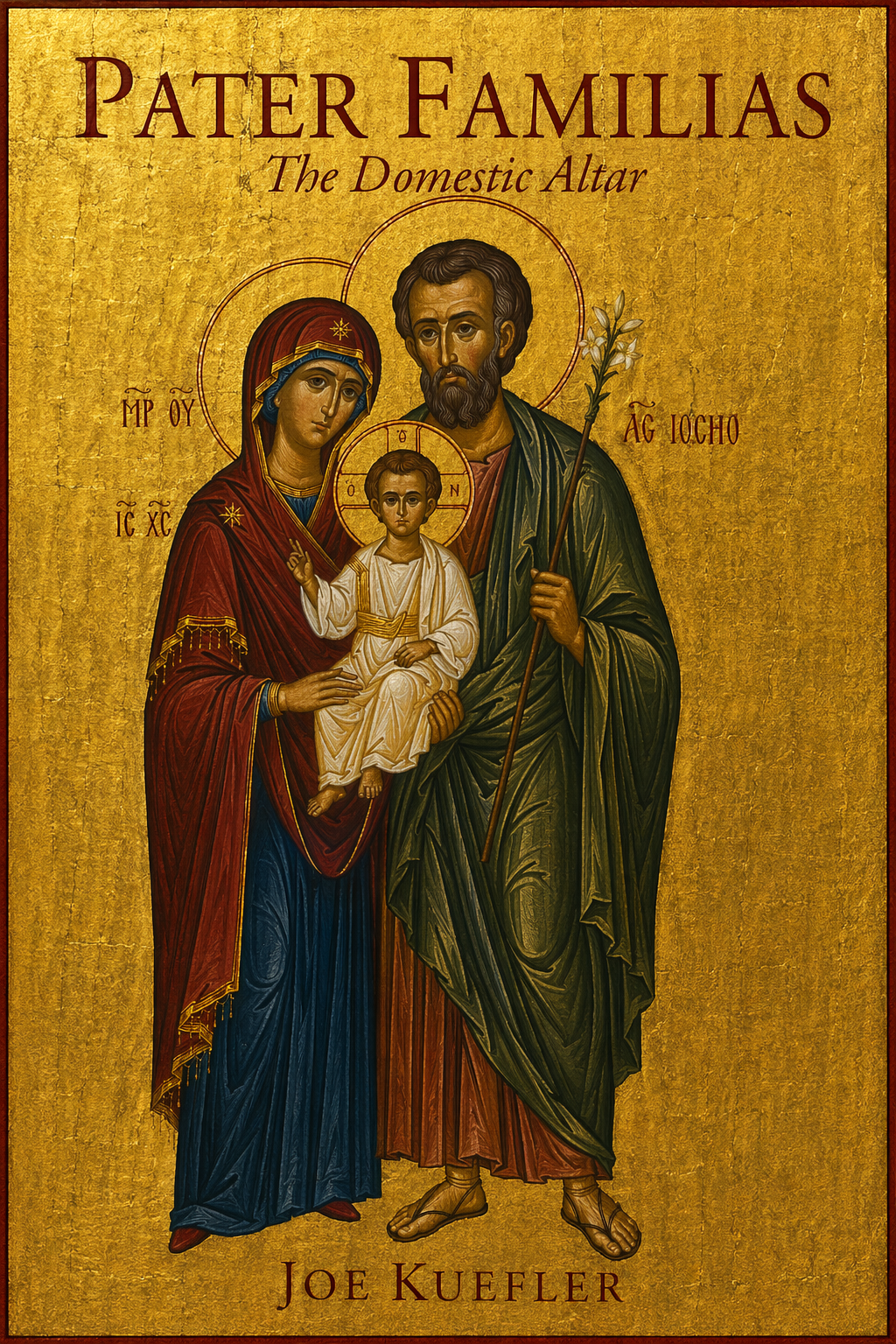
Pater Familias
The Domestic Altar
A Father’s Book of Prayers and Blessings
Joe W. Kuefler
Mater Press (mater.press)
April 2026
April 2026
Pater Familias
The Domestic Altar
A Father’s Book of Prayers and Blessings
Joe W. Kuefler
Mater Press (mater.press)
April 2026
For the fathers of Christian households,
in whose hands the domestic altar is kept,
and through whose prayer a family stands or falls.
“As for me and my house, we will serve the Lord.”
—Joshua 24:15 (RSV)
“Pray without ceasing.”
—1 Thessalonians 5:17 (RSV)
The Christian family today is under siege. Every father who honestly surveys the culture in which he is raising his children knows this. He feels it in the pressure on his marriage, in the confusion aimed at his sons and daughters, in the hostility of the age toward the very idea of a household ordered to God. The sources of that pressure are many, and not all of them are visible.
The Church has always taught that the Christian household is a domestic church (ecclesia domestica), a phrase used by St. John Chrysostom in the fourth century and repeated by the Second Vatican Council in our own.1 A church requires a priest. In the household, that office falls to the father. He is not an ordained priest in the sacramental sense, of course, and he cannot celebrate Mass or absolve sins. But by baptism he shares in the common priesthood of the faithful, and by his role as husband and father he stands at the head of his family as its spiritual guardian, its first teacher, and its chief intercessor.
This book is a practical manual for that office. It is a collection of the prayers a father needs: the daily ones, the seasonal ones, the ones for blessing his children and his home, and the ones for the battle.
Most of the prayers in this book are given in both English and Latin. There are two reasons.
The first is continuity. The prayers collected here are not private inventions. They are the common property of the Latin Church, prayed by generations of Christians over centuries. Praying them in Latin joins the father of a family to that unbroken line. His children, hearing him, learn that what he prays is older than the television, older than the nation, older than the language they speak.
The second reason is simpler. The ancient liturgical language carries a weight that modern vernaculars do not. The Church uses Latin in her most solemn rites because Latin has been set apart. When a father prays Pater noster over his sleeping son, he is doing what Christian fathers have done since the Roman Empire.
Some of what follows, strictly speaking, is reserved to an ordained priest. The formal blessing of the home on Epiphany, for instance, is properly performed by a priest when one is available. But the Church has long acknowledged that in the absence of a priest, a father may bless his own household, his own children, his own meals, and his own possessions. He does so not in the priest’s stead but in his own right as father.
The distinction matters. Where a prayer in this book is reserved to a priest, that is noted. Where a prayer is proper to the father, he should pray it boldly, without scruple, and without apology.
Several sacramentals recur throughout this book:
Holy water. Water blessed by a priest. A small font at the door of the home, refilled from the parish, is traditional. Parents sign their children with it; rooms are sprinkled with it.
Blessed salt. Salt blessed by a priest, traditionally added to holy water or placed in small quantities at thresholds.
Blessed oil. Oil blessed by a priest (distinct from the sacred chrism and oil of the sick, which are reserved). Used for anointing the forehead in private prayer.
The St. Benedict medal. A medal with the initials of a verse against temptation, worn or placed in the home.
The Brown Scapular. Worn by those enrolled in the Confraternity of Our Lady of Mount Carmel.
The Crucifix. Placed prominently in the home, especially above the marriage bed and in the children’s rooms.
These are not magic. They are physical signs that the Church has blessed for the sanctification of daily life, and they work by the power of her prayer, not by any power of their own.
A father should not try to pray everything in this book every day. He should pick a daily rule he can actually keep (Chapter 2), add the Rosary or a decade (Chapter 3), bless his children every night (Chapter 6), and reach for the other chapters when the occasion arises. A prayer book that sits on the shelf unopened is worse than useless. A prayer book worn thin at the edges is the mark of a father who has found his office.
A note on the rubrics V. and R. In the liturgical dialogues throughout this book, the rubric V. (for Latin versus, versicle) marks the part said by the one leading the prayer, typically the head of the household. The rubric R. marks the response said by the rest of the family. These rubrics are deliberately left abstract, so that any Christian head of a domestic church may lead the prayer: the father of the family first, but also a widow, a single mother, or whoever else is keeping the domestic altar in the providence of God. Where the text specifies that a reserved blessing or rite is proper to an ordained priest, that is stated in prose; the rubrics themselves do not presuppose ordination.
The first task of a father is to keep a daily rule of prayer. He does not need to pray long. He needs to pray without fail. This chapter gives the basic texts: the ones a Catholic is expected to know by heart, the common orations of the Church, and a simple shape for morning, midday, and night.
In nomine Patris, et Filii, et Spiritus Sancti. Amen.
In the name of the Father, and of the Son, and of the Holy Spirit. Amen.
Given by Christ himself to his disciples (Matthew 6:9–13; Luke 11:2–4). The central prayer of the Christian, and the only one our Lord explicitly commanded us to use. Tertullian (c. 200 A.D.) called it the breviarium totius evangelii, the summary of the whole Gospel.
Pater noster, qui es in cælis, sanctificetur nomen tuum. Adveniat regnum tuum. Fiat voluntas tua, sicut in cælo et in terra. Panem nostrum quotidianum da nobis hodie, et dimitte nobis debita nostra, sicut et nos dimittimus debitoribus nostris. Et ne nos inducas in tentationem, sed libera nos a malo. Amen.
Our Father, who art in heaven, hallowed be thy name. Thy kingdom come. Thy will be done on earth as it is in heaven. Give us this day our daily bread, and forgive us our trespasses, as we forgive those who trespass against us. And lead us not into temptation, but deliver us from evil. Amen.
The Hail Mary unites three sources: the salutation of the angel Gabriel at the Annunciation (Luke 1:28), the blessing of Elizabeth at the Visitation (Luke 1:42), and the petition “Holy Mary, Mother of God, pray for us,” added by the Church and confirmed in its present form by the Roman Breviary of St. Pius V in 1568.
Ave Maria, gratia plena, Dominus tecum. Benedicta tu in mulieribus, et benedictus fructus ventris tui, Iesus. Sancta Maria, Mater Dei, ora pro nobis peccatoribus, nunc et in hora mortis nostræ. Amen.
Hail Mary, full of grace, the Lord is with thee. Blessed art thou among women, and blessed is the fruit of thy womb, Jesus. Holy Mary, Mother of God, pray for us sinners, now and at the hour of our death. Amen.
The Lesser Doxology, or Glory Be, is the Christian’s briefest confession of the Trinity. In use since the earliest centuries; its present form, including the “as it was in the beginning” clause, was made universal by the Council of Vaison in 529.
Gloria Patri, et Filio, et Spiritui Sancto. Sicut erat in principio, et nunc, et semper, et in sæcula sæculorum. Amen.
Glory be to the Father, and to the Son, and to the Holy Spirit. As it was in the beginning, is now, and ever shall be, world without end. Amen.
The Apostles’ Creed. By ancient tradition the Twelve composed it together before dispersing to evangelize the nations, each apostle contributing one article. Historically, the earliest full witness is the Old Roman Creed of the second century, from which the present text developed. The baptismal creed of the Roman Church.
Credo in Deum, Patrem omnipotentem, Creatorem cæli et terræ. Et in Iesum Christum, Filium eius unicum, Dominum nostrum, qui conceptus est de Spiritu Sancto, natus ex Maria Virgine, passus sub Pontio Pilato, crucifixus, mortuus, et sepultus, descendit ad inferos, tertia die resurrexit a mortuis, ascendit ad cælos, sedet ad dexteram Dei Patris omnipotentis, inde venturus est iudicare vivos et mortuos. Credo in Spiritum Sanctum, sanctam Ecclesiam catholicam, sanctorum communionem, remissionem peccatorum, carnis resurrectionem, vitam æternam. Amen.
I believe in God, the Father almighty, Creator of heaven and earth. And in Jesus Christ, his only Son, our Lord, who was conceived by the Holy Spirit, born of the Virgin Mary, suffered under Pontius Pilate, was crucified, died, and was buried; he descended to the dead, on the third day he rose again from the dead, he ascended into heaven, and is seated at the right hand of God the Father almighty; from there he will come to judge the living and the dead. I believe in the Holy Spirit, the holy Catholic Church, the communion of saints, the forgiveness of sins, the resurrection of the body, and life everlasting. Amen.
The confession of sins used at the foot of the altar in the Roman Mass and in private devotion. Its present form was established in the Roman Missal of St. Pius V in 1570. Striking each time on the breast is the traditional gesture at mea culpa.
Confiteor Deo omnipotenti, beatæ Mariæ semper Virgini, beato Michaeli Archangelo, beato Ioanni Baptistæ, sanctis Apostolis Petro et Paulo, omnibus Sanctis, et vobis, fratres, quia peccavi nimis cogitatione, verbo et opere: mea culpa, mea culpa, mea maxima culpa. Ideo precor beatam Mariam semper Virginem, beatum Michaelem Archangelum, beatum Ioannem Baptistam, sanctos Apostolos Petrum et Paulum, omnes Sanctos, et vos, fratres, orare pro me ad Dominum Deum nostrum. Amen.
I confess to almighty God, to blessed Mary ever Virgin, to blessed Michael the Archangel, to blessed John the Baptist, to the holy apostles Peter and Paul, to all the saints, and to you, brethren, that I have sinned exceedingly in thought, word, and deed: through my fault, through my fault, through my most grievous fault. Therefore I ask blessed Mary ever Virgin, blessed Michael the Archangel, blessed John the Baptist, the holy apostles Peter and Paul, all the saints, and you, brethren, to pray for me to the Lord our God. Amen.
Composed in 1844 by Fr. Francois-Xavier Gautrelet, SJ, and promoted by the Apostleship of Prayer. Prayed upon rising. The point is to offer the entire day to God in advance, so that even the ordinary work ahead becomes a participation in the Holy Sacrifice of the Mass. The Latin form below is the standard devotional translation used in Jesuit and Apostleship of Prayer manuals.
O Iesu, per Cor Immaculatum Mariae, tibi offero preces, opera, gaudia et dolores huius diei, in unione cum Sanctissimo Sacrificio Missæ per totum orbem oblato. Ea offero pro omnibus intentionibus sacratissimi Cordis tui: pro salute animarum, pro reparatione peccatorum, pro unione omnium christianorum. Ea offero pro intentionibus episcoporum nostrorum et omnium sodalium Apostolatus Orationis, præsertim pro intentionibus Summi Pontificis huius mensis. Amen.
O Jesus, through the Immaculate Heart of Mary, I offer thee my prayers, works, joys, and sufferings of this day, in union with the Holy Sacrifice of the Mass throughout the world. I offer them for all the intentions of thy Sacred Heart: the salvation of souls, reparation for sin, and the reunion of all Christians. I offer them for the intentions of our bishops and of all members of the Apostleship of Prayer, and in particular for those recommended by our Holy Father this month. Amen.
Dates to the early fourteenth century. Once attributed to St. Thomas Aquinas or Pope John XXII, though its authorship is now unknown. Beloved of St. Ignatius of Loyola, who placed it at the very opening of the Spiritual Exercises. Traditionally prayed in thanksgiving after Holy Communion.
Anima Christi, sanctifica me.
Corpus Christi, salva me.
Sanguis Christi, inebria me.
Aqua lateris Christi, lava me.
Passio Christi, conforta me.
O bone Iesu, exaudi me.
Intra tua vulnera absconde me.
Ne permittas me separari a te.
Ab hoste maligno defende me.
In hora mortis meæ voca me,
et iube me venire ad te,
ut cum Sanctis tuis laudem te
in sæcula sæculorum. Amen.
Soul of Christ, sanctify me.
Body of Christ, save me.
Blood of Christ, inebriate me.
Water from the side of Christ, wash me.
Passion of Christ, strengthen me.
O good Jesus, hear me.
Within thy wounds hide me.
Permit me not to be separated from thee.
From the wicked foe defend me.
At the hour of my death call me,
and bid me come to thee,
that with thy saints I may praise thee
for ever and ever. Amen.
The threefold angelic devotion. Its roots are in the monastic ringing of bells at morning, noon, and evening, a custom spread by the Franciscans in the thirteenth century. Pope John XXII encouraged the evening recitation in 1318. The present form of three versicles, three Hail Marys, and the concluding collect was fixed by the seventeenth century. Three bells, pause, three bells, pause, three bells, then nine bells sustained: that is the Angelus bell.
To be prayed at 6 a.m., noon, and 6 p.m.
V. Angelus Domini nuntiavit Mariæ.
R. Et concepit de Spiritu Sancto.Hail Mary…
V. Ecce ancilla Domini.
R. Fiat mihi secundum verbum tuum.Hail Mary…
V. Et Verbum caro factum est.
R. Et habitavit in nobis.Hail Mary…
V. Ora pro nobis, sancta Dei Genitrix.
R. Ut digni efficiamur promissionibus Christi.Oremus. Gratiam tuam, quæsumus, Domine, mentibus nostris infunde; ut qui, Angelo nuntiante, Christi Filii tui incarnationem cognovimus, per passionem eius et crucem, ad resurrectionis gloriam perducamur. Per eundem Christum Dominum nostrum. Amen.
V. The angel of the Lord declared unto Mary.
R. And she conceived of the Holy Spirit.Hail Mary…
V. Behold the handmaid of the Lord.
R. Be it done unto me according to thy word.Hail Mary…
V. And the Word was made flesh.
R. And dwelt among us.Hail Mary…
V. Pray for us, O holy Mother of God.
R. That we may be made worthy of the promises of Christ.Let us pray. Pour forth, we beseech thee, O Lord, thy grace into our hearts, that we to whom the incarnation of Christ thy Son was made known by the message of an angel, may by his passion and cross be brought to the glory of his resurrection. Through the same Christ our Lord. Amen.
The Marian antiphon for the Paschal season, anonymous, dating to the twelfth century. Tradition holds that the first three verses were sung by angels to Pope St. Gregory the Great during the Roman plague of 590, as he processed around the city carrying an icon of the Blessed Virgin; St. Gregory added the fourth verse. During the fifty days of Easter, it replaces the Angelus.
Regina cæli, lætare, alleluia.
Quia quem meruisti portare, alleluia.
Resurrexit, sicut dixit, alleluia.
Ora pro nobis Deum, alleluia.V. Gaude et lætare, Virgo Maria, alleluia.
R. Quia surrexit Dominus vere, alleluia.
Queen of Heaven, rejoice, alleluia.
For he whom thou didst merit to bear, alleluia,
hath arisen as he said, alleluia.
Pray for us to God, alleluia.V. Rejoice and be glad, O Virgin Mary, alleluia.
R. For the Lord hath truly risen, alleluia.
At the end of the day, before night prayers. Five steps, each brief:
Thank God for the graces of the day.
Ask for the light to see your day truthfully.
Review the day hour by hour.
Repent of what was sinful.
Resolve what you will do tomorrow.
The standard Act of Contrition given in the Catechism of the Council of Trent (1566) and carried forward in Catholic manuals ever since. Prayed after the examination of conscience at night, and always within the Sacrament of Confession.
Deus meus, ex toto corde pœnitet me omnium meorum peccatorum, eaque detestor, quia peccando, non solum pœnas a te iuste statutas promeritus sum, sed præsertim quia offendi te, summum bonum, ac dignum qui super omnia diligaris. Ideo firmiter propono, adiuvante gratia tua, de cetero me non peccaturum peccandique occasiones proximas fugiturum. Amen.
O my God, I am heartily sorry for having offended thee, and I detest all my sins, because I dread the loss of heaven and the pains of hell; but most of all because they offend thee, my God, who art all good and deserving of all my love. I firmly resolve, with the help of thy grace, to confess my sins, to do penance, and to amend my life. Amen.
Before sleep, after the examen and act of contrition. The father may pray this aloud while the family is gathered:
Visita, quæsumus, Domine, habitationem istam, et omnes insidias inimici ab ea longe repelle: Angeli tui sancti habitent in ea, qui nos in pace custodiant; et benedictio tua sit super nos semper. Per Christum Dominum nostrum. Amen.
Visit, we beseech thee, O Lord, this dwelling, and drive far from it all snares of the enemy; let thy holy angels dwell herein, who may keep us in peace; and let thy blessing be upon us always. Through Christ our Lord. Amen.
This prayer, Visita, quæsumus, is taken from Compline, the last of the seven canonical hours of the Divine Office. Compline (from Latin completorium, “completion”) is the Church’s evening prayer, said before sleep, and its shape is attributed to St. Benedict in his Rule (c. 540, chapters 17 and 18), drawing on still older desert-monastic customs. The Visita quæsumus itself appears in the Gelasian Sacramentary (c. 750), which preserves prayers from the fifth and sixth centuries. A Christian who prays it joins his household to an unbroken chain of monks, nuns, clergy, and families who have ended their day with these words for fifteen centuries. It is especially fitting on the lips of a father as the household goes to sleep.
A father who prays with his wife and children teaches them more about the faith than any book or homily. And the prayer he will most often lead is a Marian one. The Rosary is the default prayer of the Catholic home, and has been for most of a millennium.
The devotion’s roots are monastic: medieval lay brothers, unable to read the 150 Psalms of the Divine Office, substituted 150 Hail Marys (the Psalter of Our Lady). By the thirteenth century, the tradition had crystallized around the figure of St. Dominic (1170–1221), who, according to long-standing Dominican tradition, received the Rosary from Our Lady herself with the commission to preach it as a weapon against the Albigensian heresy. The form of fifteen decades and the grouping of the Mysteries into Joyful, Sorrowful, and Glorious were fixed by Blessed Alan de la Roche and the Dominican Order in the fifteenth century. Pope St. Pius V, a Dominican, attributed the naval victory of Lepanto over the Ottoman fleet on October 7, 1571 to the prayers of the Rosary confraternities, and instituted the Feast of Our Lady of the Rosary on that date. Pope St. John Paul II added the Luminous Mysteries in 2002 (Rosarium Virginis Mariae), bringing the full Rosary to twenty mysteries.
The Rosary is prayed in decades. Each decade consists of one Our Father, ten Hail Marys, and one Glory Be, during which the one praying meditates on a mystery of the life of Christ and the Blessed Virgin.
The four sets of mysteries are traditionally prayed as follows:
Joyful Mysteries — Monday and Saturday
Sorrowful Mysteries — Tuesday and Friday
Glorious Mysteries — Wednesday and Sunday
Luminous Mysteries — Thursday
Sign of the Cross, holding the crucifix.
The Apostles’ Creed.
One Our Father (first bead).
Three Hail Marys (next three beads), for faith, hope, and charity.
One Glory Be.
Announce the first mystery; pray one Our Father.
Ten Hail Marys while meditating on the mystery.
One Glory Be. The Fatima Prayer is often added here:
O my Jesus, forgive us our sins, save us from the fires of hell, and lead all souls to heaven, especially those in most need of thy mercy.
Repeat steps 6–8 for each of the remaining four mysteries.
Conclude with the Salve Regina (below).
Joyful: (1) The Annunciation; (2) The Visitation; (3) The Nativity; (4) The Presentation in the Temple; (5) The Finding of Jesus in the Temple.
Sorrowful: (1) The Agony in the Garden; (2) The Scourging at the Pillar; (3) The Crowning with Thorns; (4) The Carrying of the Cross; (5) The Crucifixion.
Glorious: (1) The Resurrection; (2) The Ascension; (3) The Descent of the Holy Spirit; (4) The Assumption of Mary; (5) The Coronation of Mary.
Luminous: (1) The Baptism of the Lord; (2) The Wedding at Cana; (3) The Proclamation of the Kingdom; (4) The Transfiguration; (5) The Institution of the Eucharist.
The evening antiphon of the Blessed Virgin, traditionally attributed to Blessed Hermann of Reichenau (c. 1013–1054), the crippled monk known as Hermannus Contractus, though some sources credit Peter of Compostela or Ademar of Le Puy. In use since the eleventh century. The traditional Marian antiphon for the period from Trinity Sunday to Advent, and the prayer that closes the Rosary.
Salve, Regina, Mater misericordiæ,
vita, dulcedo, et spes nostra, salve.
Ad te clamamus, exsules filii Hevæ.
Ad te suspiramus, gementes et flentes
in hac lacrimarum valle.
Eia ergo, advocata nostra,
illos tuos misericordes oculos ad nos converte.
Et Iesum, benedictum fructum ventris tui,
nobis post hoc exsilium ostende.
O clemens, O pia, O dulcis Virgo Maria.V. Ora pro nobis, sancta Dei Genitrix.
R. Ut digni efficiamur promissionibus Christi.
Hail, holy Queen, Mother of mercy,
our life, our sweetness, and our hope.
To thee do we cry, poor banished children of Eve.
To thee do we send up our sighs,
mourning and weeping in this valley of tears.
Turn then, most gracious advocate,
thine eyes of mercy toward us,
and after this our exile
show unto us the blessed fruit of thy womb, Jesus.
O clement, O loving, O sweet Virgin Mary.V. Pray for us, O holy Mother of God.
R. That we may be made worthy of the promises of Christ.
By tradition composed by St. Bernard of Clairvaux (1090–1153), though the present form is more directly owed to Fr. Claude Bernard (1588–1641), the “Poor Priest,” who distributed it widely during the plague years in Paris and attributed dramatic answers to its recitation. One of the most-prayed Marian prayers in the Latin Church.
Memorare, O piissima Virgo Maria, non esse auditum a sæculo, quemquam ad tua currentem præsidia, tua implorantem auxilia, tua petentem suffragia, esse derelictum. Ego tali animatus confidentia, ad te, Virgo Virginum, Mater, curro, ad te venio, coram te gemens peccator assisto. Noli, Mater Verbi, verba mea despicere; sed audi propitia et exaudi. Amen.
Remember, O most gracious Virgin Mary, that never was it known that anyone who fled to thy protection, implored thy help, or sought thy intercession, was left unaided. Inspired with this confidence, I fly unto thee, O Virgin of virgins, my Mother; to thee do I come; before thee I stand, sinful and sorrowful. O Mother of the Word incarnate, despise not my petitions, but in thy mercy hear and answer me. Amen.
The oldest known prayer to the Blessed Virgin, found on a Greek papyrus fragment in Egypt dating to the third century.2
Sub tuum præsidium confugimus, sancta Dei Genitrix; nostras deprecationes ne despicias in necessitatibus nostris, sed a periculis cunctis libera nos semper, Virgo gloriosa et benedicta.
We fly to thy protection, O holy Mother of God; despise not our petitions in our necessities, but deliver us always from all dangers, O glorious and blessed Virgin.
A devotion promoted by St. Mechtilde and St. Alphonsus Liguori. Three Hail Marys are prayed morning and night in honor of the three prerogatives of Mary: her power, her wisdom, and her mercy. It is an especially fitting devotion for a father to pray for the purity of his children.
After the three Hail Marys, pray:
Per immaculatam Conceptionem tuam, o Maria, da mihi corpus purum et animam sanctam.
By thy Immaculate Conception, O Mary, make my body pure and my soul holy.
So called because it has been prayed at the Shrine of the Holy House of Loreto, on the Adriatic coast of Italy, since at least 1531. The Holy House itself is, by pious tradition, the dwelling of the Blessed Virgin from Nazareth, translated by angels first to Tersatto (Croatia) in 1291 and then to Loreto in 1294. Pope Sixtus V formally approved the litany on July 11, 1587, and Pope Clement VIII fixed its traditional form in 1601. Later popes added titles: Auxilium Christianorum (Help of Christians) by Pius V after the victory of Lepanto in 1571; Regina sine labe originali concepta (Queen conceived without original sin) by Pius IX in 1854; Regina sacratissimi Rosarii (Queen of the Most Holy Rosary) by Leo XIII in 1883; Mater boni consilii (Mother of Good Counsel) by Leo XIII in 1903; Regina pacis (Queen of Peace) by Benedict XV in 1917; Mater Ecclesiæ (Mother of the Church) by Paul VI in 1980. A traditional form follows.
Kyrie, eleison. Lord, have mercy.
Christe, eleison. Christ, have mercy.
Kyrie, eleison. Lord, have mercy.
Christe, audi nos. Christ, hear us.
Christe, exaudi nos. Christ, graciously hear us.Pater de cælis, Deus, miserere nobis.
God the Father of heaven, have mercy on us.Fili, Redemptor mundi, Deus, miserere nobis.
God the Son, Redeemer of the world, have mercy on us.Spiritus Sancte, Deus, miserere nobis.
God the Holy Spirit, have mercy on us.Sancta Trinitas, unus Deus, miserere nobis.
Holy Trinity, one God, have mercy on us.
To each of the following invocations, respond: ora pro nobis (pray for us).
Sancta Maria
Sancta Dei Genitrix
Sancta Virgo virginum
Mater Christi
Mater Ecclesiæ
Mater divinæ gratiæ
Mater purissima
Mater castissima
Mater inviolata
Mater intemerata
Mater amabilis
Mater admirabilis
Mater boni consilii
Mater Creatoris
Mater Salvatoris
Virgo prudentissima
Virgo veneranda
Virgo prædicanda
Virgo potens
Virgo clemens
Virgo fidelis
Speculum iustitiæ
Sedes sapientiæ
Causa nostræ lætitiæ
Vas spirituale
Vas honorabile
Vas insigne devotionis
Rosa mystica
Turris Davidica
Turris eburnea
Domus aurea
Fæderis arca
Ianua cæli
Stella matutina
Salus infirmorum
Refugium peccatorum
Consolatrix afflictorum
Auxilium Christianorum
Regina Angelorum
Regina Patriarcharum
Regina Prophetarum
Regina Apostolorum
Regina Martyrum
Regina Confessorum
Regina Virginum
Regina Sanctorum omnium
Regina sine labe originali concepta
Regina in cælum assumpta
Regina sacratissimi Rosarii
Regina familiarum
Regina pacis
Agnus Dei, qui tollis peccata mundi, parce nobis,
Domine.
Lamb of God, who takest away the sins of the world, spare us, O
Lord.
Agnus Dei, qui tollis peccata mundi, exaudi nos,
Domine.
Lamb of God, who takest away the sins of the world, graciously hear us,
O Lord.
Agnus Dei, qui tollis peccata mundi, miserere nobis.
Lamb of God, who takest away the sins of the world, have mercy on
us.
The Chaplet of the Seven Sorrows of Mary, also called the Rosary of the Seven Dolors, is a Marian devotion with a long lineage. Its origin is the Order of Servants of Mary (the Servites), founded in Florence in 1233 by seven noblemen who took as the center of their life the meditation on Our Lady’s sorrows. The specific devotional form of the chaplet, and the promises commonly associated with it, are traditionally attributed to the visions granted to St. Bridget of Sweden (c. 1303–1373), a Swedish visionary and foundress of the Bridgettine Order. She is not to be confused with St. Brigid of Ireland (c. 451–525), a different saint of a different age. Pope Benedict XIII approved the Seven Sorrows Rosary for the Servites in 1727, and it was later extended to the universal Church.
This devotion is especially fitting for fathers. Our Lady, who stood at the foot of the Cross, stands also at the foot of every suffering in the home. The chaplet teaches a father to carry what he must carry in union with her.
The Prophecy of Simeon (Luke 2:34–35, RSV)
The Flight into Egypt (Matthew 2:13–15)
The Loss of the Child Jesus in the Temple (Luke 2:41–50)
Mary Meets Jesus Carrying the Cross
The Crucifixion (John 19:25–27)
Mary Receives the Body of Jesus from the Cross
The Burial of Jesus (John 19:41–42)
The chaplet is distinctive in its bead structure. Unlike the Rosary’s five decades of ten beads each (for a total of fifty Hail Marys), the Seven Sorrows chaplet has seven groups of seven beads (for a total of forty-nine Hail Marys), plus three additional beads at the end for the final three Hail Marys in honor of Mary’s tears. Seven for the sorrows, seven for the gifts of the Holy Spirit, and seven for the sword that pierced her soul seven times over.
Begin with the Sign of the Cross and a brief Act of Contrition. Then for each sorrow:
Announce the sorrow and read the Scripture passage, if one is given.
Meditate briefly upon it.
Pray one Our Father.
Pray seven Hail Marys.
At the end of the seventh sorrow, pray three additional Hail Marys in honor of the tears the Sorrowful Mother shed during her Son’s Passion. Conclude with the Stabat Mater (opening verses given below), the versicle, and the closing oration.
The Stabat Mater dolorosa is the Sequence proper to the Feast of Our Lady of Sorrows (September 15). Attributed to Jacopone da Todi (c. 1230–1306), it is the most famous hymn of the Sorrowful Mother.
Stabat Mater dolorosa
iuxta Crucem lacrimosa,
dum pendebat Filius.
Cuius animam gementem,
contristatam et dolentem,
pertransivit gladius.
At the Cross her station keeping,
stood the mournful Mother weeping,
close to Jesus to the last.
Through her heart, his sorrow sharing,
all his bitter anguish bearing,
now at length the sword had passed.
V. Ora pro nobis, Virgo dolorosissima.
R. Ut digni efficiamur promissionibus Christi.
V. Pray for us, O most sorrowful Virgin.
R. That we may be made worthy of the promises of Christ.
Oremus. Deus, in cuius passione, secundum Simeonis prophetiam, dulcissimam animam gloriosae Virginis et Matris Mariae doloris gladius pertransivit: concede propitius; ut qui transfixionem eius et passionem venerando recolimus, gloriosis meritis et precibus omnium Sanctorum cruci fideliter astantium intercedentibus, passionis tuae effectum felicem consequamur. Qui vivis et regnas in saecula saeculorum. Amen.
Let us pray. O God, in whose Passion, according to the prophecy of Simeon, a sword of sorrow pierced the most sweet soul of glorious Mary, thy Mother and Virgin: mercifully grant that we, who venerate and recall her piercing and passion, may, by the glorious merits and prayers of all the Saints faithfully standing by the Cross, obtain the happy effect of thy Passion. Who livest and reignest, world without end. Amen.
The Latin Rite assigns a Marian antiphon to each season, traditionally sung at the end of Compline:
Advent to Candlemas (Feb 2): Alma Redemptoris Mater
Candlemas to Holy Thursday: Ave Regina Cælorum
Eastertide: Regina Cæli
Ordinary Time: Salve Regina
Alma Redemptoris Mater, quæ pervia cæli
porta manes, et stella maris, succurre cadenti,
surgere qui curat populo: tu quæ genuisti,
natura mirante, tuum sanctum Genitorem,
Virgo prius ac posterius, Gabrielis ab ore
sumens illud Ave, peccatorum miserere.
Loving Mother of the Redeemer, gate of heaven, star of the sea,
hasten to aid thy fallen people who strive to rise once more.
Thou who brought forth thy holy Creator,
while all nature marvelled,
Virgin before and after receiving that “Ave” from the mouth of Gabriel,
have mercy on sinners.
Ave, Regina Cælorum,
Ave, Domina Angelorum:
Salve, radix, salve, porta,
Ex qua mundo lux est orta.
Gaude, Virgo gloriosa,
Super omnes speciosa;
Vale, O valde decora,
Et pro nobis Christum exora.
Hail, Queen of Heaven;
Hail, Lady of the Angels.
Hail, root of Jesse; hail, the gate
through which the Light rose over the earth.
Rejoice, Virgin most renowned
and of unsurpassed beauty.
Farewell, O most beautiful maiden,
and pray for us to Christ.
The consecration of individuals, families, and nations to the Immaculate Heart of Mary was the central petition of Our Lady at Fatima in 1917. Pope Pius XII consecrated the world to the Immaculate Heart on October 31, 1942, and again on December 8, 1942; Pope St. John Paul II renewed the act in union with all the bishops on March 25, 1984. A Christian family, in imitation, makes its own consecration, ideally on the Feast of the Immaculate Heart (in the reformed calendar, the Saturday after the Feast of the Sacred Heart; in the traditional calendar, August 22). Prayed before an image of the Blessed Virgin. The father leads.
O Immaculatum Cor Mariæ, Regina cæli et terræ, familiam hanc purissimo Cordi tuo consecramus. Tibi damus domum nostram, matrimonium nostrum, filios nostros, opus nostrum, dolores et gaudia nostra. Serva nos fideles Filio tuo. Custodi puritatem filiorum nostrorum. Protege matrimonium nostrum. Nihil mali ad nos perveniat quod non a Filio tuo ad salutem nostram ordinetur. O Maria sine labe concepta, ora pro nobis qui ad te confugimus. Amen.
O Immaculate Heart of Mary, Queen of Heaven and Earth, we consecrate this family to thy most pure Heart. We give thee our home, our marriage, our children, our work, our sorrows, and our joys. Keep us faithful to thy Son. Guard the purity of our children. Shelter our marriage. Let no harm come to our household that is not ordered by thy Son to our salvation. O Mary, conceived without sin, pray for us who have recourse to thee. Amen.
A novena is nine days of prayer. The word comes from the Latin novem, nine, and the practice is nearly as old as the Church herself. Its model is given in Scripture. After the Lord ascended, He charged the Apostles not to depart from Jerusalem but to wait for the promise of the Father (Acts 1:4). They returned to the upper room, and there, Scripture says, they “with one accord devoted themselves to prayer, together with the women and Mary the mother of Jesus” (Acts 1:14). They prayed for nine days, and on the tenth, at Pentecost, the Holy Spirit descended. Those nine days in the Cenacle, kept by the Apostles at Our Lady’s side, are the first novena, and every novena since is patterned on them: a fixed span of persevering prayer, made in expectation of a promised gift.
The number nine gathered its own meanings as the tradition grew. It recalls the nine months the Son of God rested in His Mother’s womb, the ninth hour of His Passion on the Cross (Matthew 27:46), and above all those nine days between the Ascension and Pentecost. From these the Church shaped three kinds of novena: novenas of mourning, prayed for the dead; novenas of preparation, made before a great feast, of which the Christmas novena is the most beloved; and novenas of petition, in which a particular grace is begged through the intercession of Our Lady or a saint.
The oldest and most venerable of all is the Novena to the Holy Spirit, prayed in imitation of the Apostles in the days before Pentecost. It is the one novena the Church herself has formally enjoined: in 1897, in the encyclical Divinum Illud Munus, Pope Leo XIII directed that a solemn novena to the Holy Spirit be made in every parish each year in the days before Pentecost.
A novena is a devotion, not a transaction. Its power lies not in the number nine, as though God could be moved by arithmetic, but in perseverance: the steady, humble return to prayer day after day, which is the very disposition Our Lord praised when He told the parable of the widow who would not stop asking, “to the effect that they ought always to pray and not lose heart” (Luke 18:1). The father who leads his family in a novena teaches them to keep knocking.
What follows are novenas a father may lead in his household. The first is set at the head of the chapter, for the sake of the knots that every family carries.
The devotion to Mary, Undoer of Knots (in the German, Maria Knotenlöserin) is ancient in its root and young in its spread. Its root is a single sentence of St. Irenaeus of Lyons, written near the end of the second century: “the knot of Eve’s disobedience was loosed by the obedience of Mary. For what the virgin Eve had bound fast through unbelief, this did the Virgin Mary set free through faith” (Against Heresies, III.22.4). What Eve bound, Mary unbound. Around the year 1700 that image was given form in a painting by Johann Georg Melchior Schmidtner for the church of St. Peter am Perlach in Augsburg, Bavaria: Our Lady, crowned with stars and standing upon the serpent, patiently working the knots out of a long white ribbon handed up to her by angels. The painting had been commissioned in thanksgiving for a marriage saved from ruin, and the ribbon is the marriage bond itself, drawn straight again by her hands.
The devotion remained a local Bavarian one for nearly three centuries. In the 1980s a young Argentine priest named Jorge Bergoglio, studying in Germany, saw the image, was struck by it, and carried a copy of it home to Buenos Aires. It spread through Argentina and across Latin America, and when that same priest was elected Pope in 2013 it became known throughout the world. It is prayed above all for the tangled situations that seem to have no human solution: a failing marriage, a wayward child, a long estrangement, a knot that will not come loose.
The novena is made over nine consecutive days. Each day has its own short petition, and each day the same long prayer follows it, so that the knot is named before Our Lady nine times over. Begin and end each day with the sign of the cross. Many add the Rosary, or a single decade of it, on each of the nine days.
First, the petition proper to the day:
Day 1. Dearest Holy Mother, Most Holy Mary, you undo the knots that suffocate your children. Extend your merciful hands to me.
Day 2. Mary, Beloved Mother, channel of all grace, I return to you today my heart, recognizing that I am a sinner in need of your help.
Day 3. Meditating Mother, Queen of heaven, in whose hands the treasures of the King are found, turn your merciful eyes upon me today.
Day 4. Dearest Holy Mother, you are generous with all who seek you. Have mercy on me.
Day 5. Mother, Undoer of Knots, generous and compassionate, I come to you today to once again entrust this knot in my life to you.
Day 6. Queen of Mercy, I entrust to you this knot in my life, and I ask you to give me a heart that is patient until you undo it.
Day 7. Mother Most Pure, I come to you today to beg you to undo this knot in my life and free me from the snares of evil.
Day 8. Virgin Mother of God, overflowing with mercy, have mercy on your child and undo this knot in my life.
Day 9. Most Holy Mary, our Advocate, Undoer of Knots, I come today to thank you for undoing this knot in my life.
Then, on each of the nine days, this prayer:
Virgin Mary, Mother of fair love, Mother who never refuses to come to the aid of a child in need, Mother whose hands never cease to serve your beloved children because they are moved by the divine love and immense mercy that exist in your heart, cast your compassionate eyes upon me and see the snarl of knots that exists in my life. You know very well how desperate I am, my pain, and how I am bound by these knots.
Mary, Mother to whom God entrusted the undoing of the knots in the lives of His children, I entrust into your hands the ribbon of my life. No one, not even the Evil One himself, can take it away from your precious care. In your hands there is no knot that cannot be undone.
Powerful Mother, by your grace and intercessory power with your Son and my Liberator, Jesus, take into your hands today this knot:
Here name the knot you wish undone.
I beg you to undo it for the glory of God, once and for all. You are my hope.
O my Lady, you are the only consolation God gives me, the fortification of my feeble strength, the enrichment of my destitution, and, with Christ, the freedom from my chains. Hear my plea. Keep me, guide me, protect me, O safe refuge!
Mary, Undoer of Knots, pray for me. Amen.
This novena was written by the Servant of God Fr. Dolindo Ruotolo (1882–1970), a priest of Naples. He is commonly confused with St. Padre Pio, and the prayer is often attributed to him, but the two were separate men and friends. Padre Pio sent pilgrims from Naples to Fr. Dolindo for direction, called him a saint, and told him that the whole of Paradise was in his soul. Fr. Dolindo was a diocesan priest and a Franciscan tertiary, ordained at twenty-three in 1905, who spent his life in poverty in one quarter of Naples, hearing confessions and visiting the sick. Under the pen name Dain Cohenel he also wrote a commentary on Sacred Scripture in thirty-three volumes. His cause for beatification is open.
The novena takes its whole doctrine from a single sentence: that anxiety is not prayer, and that the soul which hands a trouble over to God must then leave it in His hands rather than snatch it back. It is prayed for nine days. Each day begins with the words Our Lord is recorded to have spoken to Fr. Dolindo, given below, and then the invocation is repeated ten times, slowly, as one would tell beads. It closes with a word to Our Lady.
Day 1. Why do you confuse yourselves by worrying? Leave the care of your affairs to me and everything will be peaceful. I say to you in truth that every act of true, blind, complete surrender to me produces the effect that you desire and resolves all difficult situations.
Day 2. Surrender to me does not mean to fret, to be upset, or to lose hope, nor does it mean offering to me a worried prayer asking me to follow you and change your worry into prayer. It is against this surrender, deeply against it, to worry, to be nervous and to desire to think about the consequences of anything. It is like the confusion that children feel when they ask their mother to see to their needs, and then try to take care of those needs for themselves so that their childlike efforts get in their mother’s way. Surrender means to placidly close the eyes of the soul, to turn away from thoughts of tribulation and to put yourself in my care, so that only I act, saying, “You take care of it.”
Day 3. How many things I do when the soul, in so much spiritual and material need, turns to me, looks at me and says to me, “You take care of it,” then closes its eyes and rests. In pain, you pray for me to act, but that I act in the way you want. You do not turn to me, instead, you want me to adapt to your ideas. You are not sick people who ask the doctor to cure you, but rather sick people who tell the doctor how to. So, do not act this way, but pray as I taught you in the Our Father: “Hallowed be thy Name,” that is, be glorified in my need. “Thy kingdom come,” that is, let all that is in us and in the world, be in accord with your kingdom. “Thy will be done on Earth as it is in Heaven,” that is, in our need, decide as you see fit for our temporal and eternal life. If you say to me truly: “Thy will be done,” which is the same as saying: “You take care of it,” I will intervene with all my omnipotence, and I will resolve the most difficult situations.
Day 4. You see evil growing instead of weakening? Do not worry. Close your eyes and say to me with faith: “Thy will be done, You take care of it.” I say to you that I will take care of it, and that I will intervene as does a doctor and I will accomplish miracles when they are needed. Do you see that the sick person is getting worse? Do not be upset, but close your eyes and say, “You take care of it.” I say to you that I will take care of it, and that there is no medicine more powerful than my loving intervention. By my love, I promise this to you.
Day 5. And when I must lead you on a path different from the one you see, I will prepare you; I will carry you in my arms; I will let you find yourself, like children who have fallen asleep in their mother’s arms, on the other bank of the river. What troubles you and hurts you immensely are your reason, your thoughts and worry, and your desire at all costs to deal with what afflicts you.
Day 6. You are sleepless; you want to judge everything, direct everything and see to everything, and you surrender to human strength, or worse, to men themselves, trusting in their intervention. This is what hinders my words and my views. Oh, how much I wish from you this surrender, to help you; and how I suffer when I see you so agitated! Satan tries to do exactly this: to agitate you and to remove you from my protection and to throw you into the jaws of human initiative. So, trust only in me, rest in me, surrender to me in everything.
Day 7. I perform miracles in proportion to your full surrender to me and to your not thinking of yourselves. I sow treasure troves of graces when you are in the deepest poverty. No person of reason, no thinker, has ever performed miracles, not even among the saints. He does divine works whosoever surrenders to God. So, do not think about it anymore, because your mind is acute and for you it is very hard to see evil and to trust in me and to not think of yourself. Do this for all your needs, do this, all of you, and you will see great continual silent miracles. I will take care of things, I promise this to you.
Day 8. Close your eyes and let yourself be carried away on the flowing current of my grace; close your eyes and do not think of the present, turning your thoughts away from the future just as you would from temptation. Repose in me, believing in my goodness, and I promise you by my love that if you say, “You take care of it,” I will take care of it all; I will console you, liberate you and guide you.
Day 9. Pray always in readiness to surrender, and you will receive from it great peace and great rewards, even when I confer on you the grace of immolation, of repentance, and of love. Then what does suffering matter? It seems impossible to you? Close your eyes and say with all your soul, “Jesus, you take care of it.” Do not be afraid, I will take care of things and you will bless my name by humbling yourself. A thousand prayers cannot equal one single act of surrender, remember this well. There is no novena more effective than this.
Then, ten times:
O Jesus, I surrender myself to Thee. Take care of everything.
And to close:
Mother, I am thine now and forever. Through thee and with thee I always want to belong completely to Jesus. Amen.
This is the oldest of all novenas, and the only one the Church has formally enjoined. It is prayed in imitation of the Apostles and Our Lady, who spent the nine days between the Ascension and Pentecost in prayer in the upper room (Acts 1:14), waiting for the promised Spirit. Pope Leo XIII, in Divinum Illud Munus (1897), directed that it be prayed in every parish in the days before Pentecost, and it is fittingly begun on the Friday after the Ascension. The great hymn of the novena is the Veni Creator Spiritus of the ninth century; its heart is the ancient invocation and collect below, prayed on each of the nine days, with the particular intention named.
Veni, Sancte Spiritus, reple tuorum corda fidelium, et tui amoris in eis ignem accende.
V. Emitte Spiritum tuum, et creabuntur.
R. Et renovabis faciem terræ.
Oremus. Deus, qui corda fidelium Sancti Spiritus illustratione docuisti, da nobis in eodem Spiritu recta sapere, et de eius semper consolatione gaudere. Per Christum Dominum nostrum. Amen.
Come, Holy Spirit, fill the hearts of Thy faithful, and enkindle in them the fire of Thy love.
V. Send forth Thy Spirit, and they shall be created.
R. And Thou shalt renew the face of the earth.
Let us pray. O God, who didst instruct the hearts of the faithful by the light of the Holy Spirit, grant us by the same Spirit to have a right judgment in all things, and evermore to rejoice in His holy consolation. Through Christ our Lord. Amen.
The devotion to the Sacred Heart flows from the revelations granted to St. Margaret Mary Alacoque at Paray-le-Monial in France between 1673 and 1675, in which Our Lord showed her His Heart, wounded and crowned with thorns, and asked that it be honored as the emblem of His love for men. From that devotion come the Great Promises to those who honor His Heart, among them peace in the home and mercy at the hour of death. The following prayer is prayed on each of the nine days.
O most holy Heart of Jesus, fountain of every blessing, I adore Thee, I love Thee, and with lively sorrow for my sins I offer Thee this poor heart of mine. Make me humble, patient, pure, and wholly obedient to Thy will. Grant, good Jesus, that I may live in Thee and for Thee. Protect me in the midst of danger; comfort me in my afflictions; give me health of body, assistance in my temporal needs, Thy blessing on all that I do, and the grace of a holy death. (Here name your intention.) Amen.
St. Joseph, the foster-father of Our Lord and the guardian of the Holy Family, was declared Patron of the Universal Church by Pope Pius IX in 1870. He is the patron of fathers, of workers, and of a happy death, for tradition holds that he died in the arms of Jesus and Mary. This novena is prayed in the nine days before his feast on March 19, begun on March 10, though it may be prayed at any time of need.
O Glorious St. Joseph, faithful follower of Jesus Christ, to you do we raise our hearts and hands, to implore your powerful intercession in obtaining from the benign Heart of Jesus all the help and graces necessary for our spiritual and temporal welfare, particularly the grace of a happy death, and the special favor we now implore. (Here name your intention.)
O Guardian of the Word Incarnate, we feel filled with confidence that your prayers on our behalf will be graciously heard before the throne of God.
The following is then repeated seven times, in honor of the seven sorrows and seven joys of St. Joseph:
O Glorious St. Joseph, through the love you bear to Jesus Christ, and for the glory of His name, hear our prayers and obtain our petitions.
And the novena is closed each day with this prayer:
O Glorious St. Joseph, spouse of the Immaculate Virgin, obtain for us a pure, humble, and charitable mind, and perfect resignation to the divine Will. Be our guide, father, and model through life, that we may merit to die as you did, in the arms of Jesus and Mary. Amen.
The dogma of the Immaculate Conception, that the Blessed Virgin was preserved free from all stain of original sin from the first moment of her conception, was solemnly defined by Pope Pius IX in the bull Ineffabilis Deus in 1854. Four years later, at Lourdes, Our Lady confirmed it to St. Bernadette in her own words: “I am the Immaculate Conception.” This novena is prayed in the nine days before her feast on December 8. Many add a decade of the Rosary each day, with the invocation, three times, O Mary, conceived without sin, pray for us who have recourse to thee.
O Mother of the King of the Universe, most perfect member of the human race, “our tainted nature’s solitary boast,” we turn to you as mother, advocate, and mediatrix. O Holy Mary, assist us in our present necessity. By your Immaculate Conception, O Mary conceived without sin, we humbly beseech you from the bottom of our heart to intercede for us with your Divine Son and ask that we be granted the favor for which we now plead. (Here name your intention.) O Mary of the Immaculate Conception, Mother of Christ, you had influence with your Divine Son while upon this earth; you have the same influence now in Heaven. Pray for us and obtain for us from Him the granting of my petition, if it be the Divine Will. Amen.
St. Jude Thaddaeus was one of the Twelve Apostles and the author of the short Epistle that bears his name. He is venerated as the patron of desperate situations and hopeless cases. The traditional explanation is a poignant one: because his name so closely resembled that of Judas Iscariot, the faithful long neglected to invoke him, and so he is held to be especially eager to aid those who turn to him in the gravest need, when all other help has failed. This prayer is prayed on each of the nine days.
Most holy Apostle, St. Jude, faithful servant and friend of Jesus, the Church honors and invokes you universally as the patron of difficult cases, of things almost despaired of. Pray for me, I am so helpless and alone. Intercede with God for me that He bring visible and speedy help where help is almost despaired of. Come to my assistance in this great need that I may receive the consolation and help of heaven in all my necessities, tribulations, and sufferings, particularly (here name your request), and that I may praise God with you and all the saints forever. I promise, O Blessed St. Jude, to be ever mindful of this great favor granted me by God and to always honor you as my special and powerful patron, and to gratefully encourage devotion to you. Amen.
Not every novena is prayed to a canonized saint. This one is offered both to God, for the beatification of a holy woman whose cause is still open, and through her intercession. Rhoda Wise (1888–1948) was a housewife of Canton, Ohio, a convert who entered the Catholic Church in 1939. In her last years she was a great sufferer and, by the testimony gathered for her cause, a mystic: she reported visions of Our Lord and of St. Thérèse of Lisieux, bore the wounds of the stigmata, and around her many healings were reported. The most consequential came in January 1943, when a young woman named Rita Rizzo, cured of a chronic and painful affliction after a novena made at Rhoda Wise’s urging, took it as her call to the cloister. That young woman became Mother Angelica, the foundress of EWTN. Rhoda Wise died in 1948; she bears the title Servant of God, and the Rhoda Wise House and Grotto in Canton is a place of pilgrimage. The novena below carries the imprimatur of Bishop George V. Murry, S.J., of Youngstown (2017), and received ecclesiastical approval in 2020.
Unlike the older novenas of this chapter, each of its nine days carries its own intention. The same short prayers are said on every day, and to them the intention of the day is added.
Most Sacred Heart of Jesus, have mercy on us. (three times)
Immaculate Heart of Mary, pray for us.
Heavenly Father, the love of your Crucified Son, Our Lord Jesus Christ, sustained the Servant of God, Rhoda Wise, in her many sufferings and made her by grace a strong woman of Faith. She led others to the Sacred Heart of your Son, Jesus. She devoutly promoted daily recitation of the Most Holy Rosary. Prayers were answered. Faith was strengthened. May her Beatification come quickly as we ask for her intercession in this need. (Pause and add your intentions.) We ask this through the Heart of Jesus Christ, Your Son, Our Lord. Amen.
Day 1. Today let us pray for all who suffer from chronic and life-threatening illness, that they may be consoled by the healing presence of Our Lord. We also pray for their families, friends, and care-givers, that they, too, may be comforted and strengthened by His divine love as they help their loved ones carry the cross of illness.
Day 2. Today let us pray for those suffering from addictions, and in a special way, their loved ones who also suffer from the pains of addiction. May they be healed by your divine love and mercy, just as you healed Rhoda’s husband, George, of alcoholism.
Day 3. Today let us pray for conversions in our families, who are under great attack living in an extremely secularized culture.
Day 4. Today let us pray for more holy men and women, especially for an increase of vocations to religious life.
Day 5. Today let us pray for all those struggling with infertility and pregnancy loss. May their grieving hearts be consoled by our Lord, the Giver of Life, and one day be blessed to share in God’s life-giving plans for the conception and raising of beloved children.
Day 6. Today we pray for greater respect for life, especially for an end to abortion and euthanasia. May all people acknowledge and revere the truth that life comes from God alone, that the dignity of each unique person, made in the image and likeness of our Lord, both in the womb and those aging, has the right to live and fulfill God’s will on earth.
Day 7. Today we pray for our country, that it continues to uphold religious freedoms.
Day 8. Today we pray for our Christian brothers and sisters throughout the world who suffer persecution in the name of our Lord. May they be kept safe and remain courageous during these violent times.
Day 9. Today we pray for the protection of our holy Mother Church.
No saint is a closer patron of the father of a family than St. Joseph, the foster-father of Christ and the head of the Holy Family. He was declared Patron of the Universal Church by Pius IX in 1870 and, more recently, given his own month in the Church’s devotional calendar (March) and a second feast in May (St. Joseph the Worker).
The traditional titles of St. Joseph are many: Custos Virginis, Guardian of the Virgin; Custos Redemptoris, Guardian of the Redeemer; Terror Dæmonum, Terror of Demons. He is, in short, the pattern of Christian fatherhood.
An adaptation of St. Bernard’s Memorare, directed to St. Joseph, in common use among Catholics since the nineteenth century, following Blessed Pope Pius IX’s declaration of St. Joseph as Patron of the Universal Church in 1870.
Remember, O most pure spouse of Mary, my beloved patron St. Joseph, that never has it been heard that anyone invoked thy protection or sought thy intercession without obtaining relief. Confiding therefore in thy goodness, I come before thee. Do not turn away from my petitions, foster father of the Redeemer, but graciously hear and answer them. Amen.
Composed by Pope Leo XIII and promulgated in the encyclical Quamquam pluries on August 15, 1889. Prescribed to be recited after the Rosary, especially during October. Its Latin incipit, Ad te, beate Ioseph, names it in the tradition.
Ad te, beate Ioseph, in tribulatione nostra confugimus, atque, implorato Sponsæ tuæ sanctissimæ auxilio, patrocinium quoque tuum fidenter exposcimus.
Per eam, quæsumus, quæ te cum immaculata Virgine Dei Genitrice coniunxit, caritatem, perque paternum, quo puerum Iesum amplexus es, amorem, supplices deprecamur, ut ad heræditatem, quam Iesus Christus acquisivit Sanguine suo, benignus respicias, ac necessitatibus nostris tua virtute et ope succurras.
Tuere, O Custos providentissime divinæ Familiæ, Iesu Christi sobolem electam; prohibe a nobis, amantissime Pater, omnem errorum ac corruptelarum luem; propitius nobis, sospitator noster fortissime, in hoc cum potestate tenebrarum certamine e cælo adesto; et sicut olim Puerum Iesum e summo eripuisti vitæ discrimine, ita nunc Ecclesiam sanctam Dei ab hostilibus insidiis atque ab omni adversitate defende: nosque singulos perpetuo tege patrocinio, ut ad tui exemplar et ope tua suffulti, sancte vivere, pie emori, et sempiternam in cælis beatitudinem assequi possimus. Amen.
To thee, O blessed Joseph, do we have recourse in our tribulation, and, having implored the help of thy most holy spouse, we confidently ask thy protection also.
By that charity which united thee with the Immaculate Virgin, Mother of God, and by the fatherly love with which thou didst embrace the Child Jesus, we humbly beg thee graciously to regard the inheritance which Jesus Christ has purchased by his Blood, and to help us in our needs by thy power and strength.
O most watchful guardian of the Holy Family, protect the chosen people of Jesus Christ; keep far from us, most loving Father, all error and corrupting influence; graciously assist us from heaven, O our most mighty protector, in this our struggle with the powers of darkness; and as thou didst once rescue the Child Jesus from deadly peril, so now defend God’s holy Church from the snares of the enemy and from all adversity. Shield each one of us by thy constant protection, so that, supported by thy example and thy help, we may be able to live piously, to die holily, and to obtain eternal happiness in heaven. Amen.
Approved for public use by Pope St. Pius X in 1909, this litany is the official Latin litany of the Church in honor of St. Joseph. It crowns the many titles the tradition has given him: Custos Redemptoris (Guardian of the Redeemer), Familiarum columen (the Pillar of Families), Terror dæmonum (Terror of Demons), and Patrone morientium (Patron of the Dying).
Kyrie, eleison. Lord, have mercy.
Christe, eleison. Christ, have mercy.
Kyrie, eleison. Lord, have mercy.
Pater de cælis, Deus, miserere nobis.
Fili, Redemptor mundi, Deus, miserere nobis.
Spiritus Sancte, Deus, miserere nobis.
Sancta Trinitas, unus Deus, miserere nobis.
To each invocation, respond: ora pro nobis (pray for us).
Sancta Maria
Sancte Ioseph
Proles David inclyta
Lumen Patriarcharum
Dei Genitricis Sponse
Custos pudice Virginis
Filii Dei nutricie
Christi defensor sedule
Almae Familiae praeses
Ioseph iustissime
Ioseph castissime
Ioseph prudentissime
Ioseph fortissime
Ioseph obedientissime
Ioseph fidelissime
Speculum patientiae
Amator paupertatis
Exemplar opificum
Domesticae vitae decus
Custos virginum
Familiarum columen
Solatium miserorum
Spes aegrotantium
Patrone morientium
Terror daemonum
Protector sanctae Ecclesiae
Agnus Dei, qui tollis peccata mundi, parce nobis,
Domine.
Agnus Dei, qui tollis peccata mundi, exaudi nos, Domine.
Agnus Dei, qui tollis peccata mundi, miserere nobis.
V. Constituit eum dominum domus suæ.
R. Et principem omnis possessionis suæ.
V. He made him the lord of his household.
R. And prince over all his possessions.
Oremus. Deus, qui ineffabili providentia beatum Ioseph, sanctissimæ Genitricis tuæ Sponsum eligere dignatus es: præsta, quæsumus; ut quem protectorem veneramur in terris, intercessorem habere mereamur in cælis. Qui vivis et regnas in sæcula sæculorum. Amen.
Let us pray. O God, who in thine ineffable providence wast pleased to choose blessed Joseph to be the spouse of thy most holy Mother, grant, we beseech thee, that we may be worthy to have him for our intercessor in heaven whom on earth we venerate as our protector. Who livest and reignest forever and ever. Amen.
A devotion popularized in the seventeenth century, promoted especially by the Carmelites and Redemptorists, and widespread in Catholic household prayer by the nineteenth. Prayed for thirty consecutive days for a grave intention, typically one pertaining to the family, to employment, to housing, or to the death of a loved one. Unlike most prayers in this book, this devotion has come down in vernacular form rather than in a canonical Latin text; the English below is from the traditional anglophone manual.
Ever blessed and glorious Joseph, kind and loving father, and helpful friend of all in sorrow! Thou art the good father and protector of orphans, the defender of the defenceless, the patron of those in need and sorrow. Look kindly on my request. My sins have drawn down on me the just displeasure of my God, and so I am beset with unhappiness. To thee, loving guardian of the family chosen by God, I come, O Joseph. In thy hands I place my petition. Present it, I beg thee, to thy foster Son. So shall I, through thy powerful intercession, reach heaven and bless thee there forever. Amen.
Pope Leo XIII encouraged the consecration of families to the Holy Family in his encyclical Neminem fugit of 1892, and the Feast of the Holy Family was formally established for the whole Church by Pope Benedict XV in 1921. A family’s consecration to the Holy Family is the hinge of the domestic church’s Marian and Josephite devotion. Prayed before an image of the Holy Family, typically on the Feast of the Holy Family (in the reformed calendar, the Sunday within the Octave of Christmas; in the traditional calendar, the Sunday within the Octave of Epiphany).
O Iesu amantissime Redemptor noster, qui veniens mundum doctrina et exemplo illustrare, in humilitate et subiectione Mariæ et Ioseph in paupere domo Nazareth magnam vitæ tuæ partem degere voluisti, Familiam sanctificans quæ omnibus Christianis familiis exemplum esse debebat: suscipe benignus familiam nostram quæ hodie tibi se dedicat et consecrat. Protege nos, custodi nos, confirma in unoquoque nostrum sanctum timorem tuum cum pace et concordia caritatis Christianæ, ut ad similitudinem divini Familiæ tuæ exemplaris effecti, omnes ad æternam felicitatem pervenire valeamus. Amen.
O Jesus, our most loving Redeemer, who having come to enlighten the world with thy teaching and example, didst will to pass the greater part of thy life in humility and subjection to Mary and Joseph in the poor home of Nazareth, sanctifying the family that was to be an example for all Christian families, graciously receive our family as it dedicates and consecrates itself to thee this day. Protect and guard us, confirm in each of us a holy fear of thee together with peace and harmony in Christian love, so that, made in the likeness of the divine pattern of thy family, we may all attain to eternal happiness. Amen.
The Sacred Heart of Jesus is the great devotion of the Catholic home. It was revealed privately to St. Margaret Mary Alacoque in a series of apparitions at the Visitation convent at Paray-le-Monial between 1673 and 1675, and the promises attached to it touch the family directly. One of the twelve promises given to St. Margaret Mary reads:
I will bless every place in which an image of my Heart shall be exposed and honored.
For the father of a family, this is a concrete thing. He places an image of the Sacred Heart in his home, he leads his family in consecrating the household to that Heart, and he renews the consecration yearly. The rite that follows is the traditional Enthronement of the Sacred Heart as promoted by Fr. Mateo Crawley-Boevey in the early twentieth century.
An image or statue of the Sacred Heart is placed in the central room of the home. The family gathers before it. The father leads.
V. Most Sacred Heart of Jesus, we, the family gathered here, wish this day to acknowledge thee as our King. From this day forward, we promise thee to live as befits Christians, and to do all we can to make thee loved and honored in our home.
R. Sacred Heart of Jesus, I place my trust in thee.
V. Sacred Heart of Jesus, protect our family. Keep us united in the love of God. Keep us faithful in the struggles of this life. Keep us true to the faith of our baptism. Come, reign over our home.
O Jesus, from this day on we are yours. We are yours in our joys and our sorrows, our work and our rest, our successes and our failures. Be the King of our home. Be the Lord of our lives. Be the judge of our hearts.
R. Sacred Heart of Jesus, thy kingdom come.
V. Mary, Mother of God, obtain for us the grace of fidelity. St. Joseph, pray for us.
R. Amen.
The consecration may be renewed each year on the Feast of the Sacred Heart (the Friday after the Second Sunday after Pentecost in the traditional calendar).
Approved for public use in 1899 by Leo XIII.
Kyrie, eleison. Lord, have mercy.
Christe, eleison. Christ, have mercy.
Kyrie, eleison. Lord, have mercy.
Christe, audi nos. Christ, hear us.
Christe, exaudi nos. Christ, graciously hear us.
Pater de cælis, Deus, miserere nobis.
Fili, Redemptor mundi, Deus, miserere nobis.
Spiritus Sancte, Deus, miserere nobis.
Sancta Trinitas, unus Deus, miserere nobis.
To each of the following, respond: miserere nobis (have mercy on us).
Cor Iesu, Filii Patris æterni
Cor Iesu, in sinu Virginis Matris a Spiritu Sancto formatum
Cor Iesu, Verbo Dei substantialiter unitum
Cor Iesu, maiestatis infinitæ
Cor Iesu, templum Dei sanctum
Cor Iesu, tabernaculum Altissimi
Cor Iesu, domus Dei et porta cæli
Cor Iesu, fornax ardens caritatis
Cor Iesu, iustitiæ et amoris receptaculum
Cor Iesu, bonitate et amore plenum
Cor Iesu, virtutum omnium abyssus
Cor Iesu, omni laude dignissimum
Cor Iesu, rex et centrum omnium cordium
Cor Iesu, in quo sunt omnes thesauri sapientiæ et scientiæ
Cor Iesu, in quo habitat omnis plenitudo divinitatis
Cor Iesu, in quo Pater sibi bene complacuit
Cor Iesu, de cuius plenitudine omnes nos accepimus
Cor Iesu, desiderium collium æternorum
Cor Iesu, patiens et multæ misericordiæ
Cor Iesu, dives in omnes qui invocant te
Cor Iesu, fons vitæ et sanctitatis
Cor Iesu, propitiatio pro peccatis nostris
Cor Iesu, saturatum opprobriis
Cor Iesu, attritum propter scelera nostra
Cor Iesu, usque ad mortem obediens factum
Cor Iesu, lancea perforatum
Cor Iesu, fons totius consolationis
Cor Iesu, vita et resurrectio nostra
Cor Iesu, pax et reconciliatio nostra
Cor Iesu, victima peccatorum
Cor Iesu, salus in te sperantium
Cor Iesu, spes in te morientium
Cor Iesu, deliciæ Sanctorum omnium
Agnus Dei, qui tollis peccata mundi, parce nobis,
Domine.
Agnus Dei, qui tollis peccata mundi, exaudi nos, Domine.
Agnus Dei, qui tollis peccata mundi, miserere nobis.
V. Iesu, mitis et humilis corde.
R. Fac cor nostrum secundum Cor tuum.
V. Jesus, meek and humble of heart.
R. Make our hearts like unto thine.
Composed by Pope Pius XI in his encyclical Miserentissimus Redemptor (1928), and appointed to be prayed publicly in every parish on the Feast of the Sacred Heart. Reparation is the great theological theme of the Sacred Heart devotion: making good, insofar as a creature can, for what the ingratitude of the world has done to the love of Christ.
Iesu dulcissime, cuius effusa in homines caritas, tanta oblivione, negligentia, contemptione ingratissime rependitur, en nos ante altaria tua provoluti, tam nefariam hominum socordiam iniuriasque, quibus undique amantissimum Cor tuum afficitur, peculiari honore resarcire contendimus.
Memores tamen, tantæ indignitatis nos quoque aliquando fuisse non expertes, indeque vehementissimo dolore commoti, tuam in primis misericordiam nobis imploramus, parati, voluntaria expiatione compensare flagitia non solum quæ ipsi patravimus, sed etiam illorum, qui, longe a salutis via aberrantes, vel te pastorem ducemque sectari detrectant in sua infidelitate obstinati, vel, baptismatis promissis conculcatis, suavissimum tuæ legis iugum excusserunt. Amen.
Most sweet Jesus, whose overflowing charity for men is requited by so much forgetfulness, negligence, and contempt, behold us prostrate before thee, eager to repair by a special act of honor the cruel indifference and injuries to which thy loving Heart is everywhere subject.
Mindful, however, that we ourselves have had a share in such great indignities, which we now deplore from the depths of our hearts, we humbly ask thy pardon and declare our readiness to atone by voluntary expiation, not only for our own personal offenses, but also for the sins of those who, straying far from the path of salvation, refuse in their obstinate infidelity to follow thee, their Shepherd and Leader. Amen.
On June 11, 2026, the Feast of the Most Sacred Heart of Jesus, the bishops of the United States formally consecrated the nation to the Sacred Heart for the first time in the country’s history. The act was performed at the USCCB Spring Plenary Assembly in Orlando, Florida, as part of the commemoration of the 250th anniversary of the signing of the Declaration of Independence, and was broadcast live for the participation of the faithful across the country. What follows is the official act as released by the United States Conference of Catholic Bishops.
A family may join in this consecration on the Feast of the Sacred Heart (the Friday after the Second Sunday after Pentecost in the traditional calendar; the Friday after the Eleventh Sunday in Ordinary Time in the reformed calendar), or at any time, gathered before an image of the Sacred Heart. The father leads.
O Sacratissimum Cor Iesu: desideria cordium nostrorum nosti, et vis ut amicitia tecum fruamur. Ex latere tuo perfosso, fontem vitæ effudisti, quo sitimus. Cor tuum amore flagrat, ut omnes ad rectam relationem tecum revertantur. Dona copiosa celebramus quæ huic nationi tribuisti, quæ supra has veritates per se notas fundata est: Creatorem omnibus hominibus iura ad vitam, ad libertatem, et ad felicitatem quærendam tribuisse. Reparationem facimus pro iniuriis in te et in dignitatem humanam in hac natione illatis. Corda nostra corde tuo coniungantur, ut familiæ et communitates nostræ pace et felicitate gaudeant; relationes fractuæ reconciliantur, iniustitiæ tollantur, vulneraque terræ nostræ sanentur. Sancta tua Ecclesia catholica signum præstet, omnes ad infinitum amorem tuum ducens. O Desiderium Gentium et Centrum Historiæ, has Civitates Foederatas Americæ benedicere te rogamus. Qui vivis et regnas cum Deo Patre in unitate Spiritus Sancti, Deus, per omnia sæcula sæculorum. Amen.
Sacratissimum Cor Iesu, miserere nobis!
Cor Immaculatum Mariæ, ora pro nobis!
O Most Sacred Heart of Jesus: you know the longings of our hearts, and you desire that we enjoy friendship with you. From your pierced side, you have poured out the wellspring of life, for which we thirst. Your heart burns with a love for all people to return to a right relationship with you. We celebrate the abundant gifts you have given this nation, founded on the self-evident truths that our Creator has endowed all people with the right to life, liberty, and the pursuit of happiness. We make reparation for the offenses against you and against human dignity that have taken place in this nation. May our hearts be united to yours, so that our families and communities enjoy peace and happiness; may broken relationships be reconciled, injustices repaired, and the wounds of our land be healed. May your holy Catholic Church serve as a sign, pointing all people to your infinite love. O Desire of Nations and Center of History, we ask you to bless these United States of America. Who live and reign with God the Father in the unity of the Holy Spirit, God, for ever and ever. Amen.
Most Sacred Heart of Jesus, have mercy on us!
Immaculate Heart of Mary, pray for us!
Approved by Pope Sixtus V in 1585 and indulgenced by Pope Innocent XII in 1692. The litany developed under the influence of the Franciscan preacher St. Bernardine of Siena (1380–1444), who carried a tablet bearing the monogram IHS and preached the devotion to the Holy Name across Italy. January, the month following the Feast of the Holy Name, is traditionally dedicated to this devotion.
To each invocation, respond: miserere nobis.
Iesu, Fili Dei vivi
Iesu, splendor Patris
Iesu, candor lucis æternæ
Iesu, rex gloriæ
Iesu, sol iustitiæ
Iesu, Fili Mariæ Virginis
Iesu amabilis
Iesu admirabilis
Iesu, Deus fortis
Iesu, pater futuri sæculi
Iesu, magni consilii angele
Iesu potentissime
Iesu patientissime
Iesu obedientissime
Iesu, mitis et humilis corde
Iesu, amator castitatis
Iesu, amator noster
Iesu, Deus pacis
Iesu, auctor vitæ
Iesu, exemplar virtutum
Iesu, zelator animarum
Iesu, Deus noster
Iesu, refugium nostrum
Iesu, pater pauperum
Iesu, thesaure fidelium
Iesu, bone Pastor
Iesu, lux vera
Iesu, sapientia æterna
Iesu, bonitas infinita
Iesu, via et vita nostra
Iesu, gaudium Angelorum
Iesu, rex Patriarcharum
Iesu, magister Apostolorum
Iesu, doctor Evangelistarum
Iesu, fortitudo Martyrum
Iesu, lumen Confessorum
Iesu, puritas Virginum
Iesu, corona Sanctorum omnium
Two devotions closely linked:
First Fridays of nine consecutive months, in honor of the Sacred Heart, with Communion received in reparation. The twelfth promise given to St. Margaret Mary was that those who made the nine First Fridays would not die without the sacraments.
First Saturdays of five consecutive months, in honor of the Immaculate Heart of Mary, as requested at Fatima in 1925. The devotion consists of: (1) confession within eight days; (2) Communion on the First Saturday; (3) five decades of the Rosary; (4) fifteen minutes of meditation on the mysteries of the Rosary.
A father should keep one or both devotions with his family.
The patriarchs of the Old Testament blessed their children with their own hands. Isaac blessed Jacob. Jacob blessed his twelve sons and his two grandsons by Joseph. This was not a sentimental gesture. In Hebrew thought, a father’s blessing carried real weight: it conferred, it obligated, it foretold. The firstborn received the greater blessing because the father handed down a real inheritance of grace.
The Christian father inherits this office. By virtue of his baptism and his paternity, he may sign his children with the cross, pray over them, and ask God’s favor upon them. He does not need a priest’s permission. He does not need elaborate rites. He needs only the will to be what he is.
The simplest and most important of a father’s prayers. Prayed in the morning as the child goes to school, at night before sleep, at departures, and on any significant day.
The father places his right hand on the child’s head, or traces the sign of the cross on the child’s forehead with his thumb, and says:
May God bless you, and may he keep you from all evil. In the name of the Father, and of the Son, and of the Holy Spirit. Amen.
Or, in Latin:
Benedicat te Deus, et custodiat te ab omni malo. In nomine Patris, et Filii, et Spiritus Sancti. Amen.
A longer form, taken from the Aaronic blessing of Numbers 6:24–26:
Benedicat tibi Dominus, et custodiat te. Ostendat Dominus faciem suam tibi, et misereatur tui. Convertat Dominus vultum suum ad te, et det tibi pacem. In nomine Patris, et Filii, et Spiritus Sancti. Amen.
The Lord bless thee, and keep thee. The Lord make his face to shine upon thee, and be gracious unto thee. The Lord lift up his countenance upon thee, and give thee peace. In the name of the Father, and of the Son, and of the Holy Spirit. Amen.
This is the blessing God himself composed for Aaron to pray over the children of Israel. It is entirely fitting on the lips of a father.
The husband’s blessing of his wife has no single traditional formulary; the closest model is Tobit’s father-in-law Raguel’s blessing in Tobit 7:11–13, and the spousal blessings in the traditional nuptial rite. What follows is a simple paternal form, fit to be prayed silently at night or aloud at moments of consequence. The husband is not above his wife, but he is for her.
Domine Deus, qui in providentia tua hanc mulierem mihi uxorem dedisti, benedic eam et custodi eam. Custodi eam ab omni malo. Da ei patientiam in laboribus domus nostræ, gaudium in educatione filiorum nostrorum, et pacem in anima sua. Crescat amor meus erga eam usque ad diem mortis meæ, et eius erga me. In nomine Patris, et Filii, et Spiritus Sancti. Amen.
Lord God, who in thy providence hast given me this woman to be my wife, bless her and keep her. Guard her from every evil. Give her patience in the trials of our home, joy in the raising of our children, and peace in her soul. Let my love for her grow until the day I die, and let hers for me. In the name of the Father, and of the Son, and of the Holy Spirit. Amen.
The Benedic, Domine is the traditional Latin grace before meals of the Western Church, rooted in monastic practice and found in the Roman Ritual. It is prayed standing, with the sign of the cross.
Benedic, Domine, nos et hæc tua dona, quæ de tua largitate sumus sumpturi. Per Christum Dominum nostrum. Amen.
Bless us, O Lord, and these thy gifts which we are about to receive from thy bounty. Through Christ our Lord. Amen.
The Agimus tibi gratias is the traditional Latin grace after meals, completing the action begun by the grace before. It is traditionally followed by Fidelium animæ for the faithful departed, uniting the Christian table with the communion of saints both living and dead.
Agimus tibi gratias, omnipotens Deus, pro universis beneficiis tuis, qui vivis et regnas in sæcula sæculorum. Amen.
We give thee thanks, almighty God, for all thy benefits, who livest and reignest forever and ever. Amen.
A traditional addition, for the departed:
Fidelium animæ, per misericordiam Dei, requiescant in pace. Amen.
May the souls of the faithful departed, through the mercy of God, rest in peace. Amen.
The traditional invocation for a traveler is drawn from the Book of Tobit, in which the archangel Raphael accompanies young Tobias on a dangerous journey and returns him safely to his father’s house (Tobit 5–12). St. Christopher, legendary bearer of the Christ Child across a river, has served the Church as secondary patron of travelers since medieval times.
For a family member setting out. The father places his hand on the traveler’s shoulder or head.
Deus, qui iuvenem Tobiam sanum et incolumem in itinere suo custodisti, mitte Angelum tuum sanctum ut hunc famulum tuum [N.] custodiat et salvum reducat. In nomine Patris, et Filii, et Spiritus Sancti. Amen.
O God, who didst preserve the young Tobias safe and sound in his journey, send thy holy angel to guard this thy servant [N.] and bring him safely home. In the name of the Father, and of the Son, and of the Holy Spirit. Amen.
The traveler may carry a medal of St. Christopher or a St. Benedict medal.
The father whose work or pilgrimage takes him from home often sleeps in rooms he does not own and has not chosen. Hotel rooms, rented quarters, guest beds in houses not his own. Such rooms are not his home. They carry the imprint of whoever has passed through them, which is not always wholesome. Before a Christian commends himself to God in sleep in such a place, he may claim it for the hours of his stay.
The traditional books of the Roman Rite do not provide a specific formula for what we now call a hotel room, for the plain reason that the ancients did not travel as we do. The elements below are drawn from existing rites: the Asperges of the Roman Ritual, the Visita quæsumus of Compline, and the short Leonine prayer. The arrangement is modern; the prayers are not.
The traveler carries a small vial of holy water taken from the parish font before the journey, a crucifix for the nightstand, and, if possible, a Medal of St. Benedict. On entering the room, before unpacking fully, he stands at the foot of the bed.
In nomine Patris, et Filii, et Spiritus Sancti. Amen.
In the name of the Father, and of the Son, and of the Holy Spirit. Amen.
He sprinkles holy water toward the four corners of the room, over the bed, and across the threshold, praying:
Asperges me, Domine, hyssopo, et mundabor; lavabis me, et super nivem dealbabor.
Thou shalt sprinkle me, O Lord, with hyssop, and I shall be cleansed; thou shalt wash me, and I shall be made whiter than snow.
He then claims the room aloud:
In the name of Jesus Christ, I claim this room for my rest under the protection of Christ the King. I renounce every evil attached to this place, and every work of the enemy within it. The Blood of Jesus covers this room, this bed, and my sleep within it. Amen.
He prays the Compline oration of the Roman Rite, now given its fullest use:
Visita, quæsumus, Domine, habitationem istam, et omnes insidias inimici ab ea longe repelle: Angeli tui sancti habitent in ea, qui nos in pace custodiant; et benedictio tua sit super nos semper. Per Christum Dominum nostrum. Amen.
Visit, we beseech thee, O Lord, this dwelling, and drive far from it all snares of the enemy. Let thy holy angels dwell herein, who may keep us in peace; and let thy blessing be upon us always. Through Christ our Lord. Amen.
He prays the short Leonine prayer to St. Michael (Chapter 8), and asks the care of his Guardian Angel for the unfamiliar night:
Holy Guardian Angel, be at my side in this unfamiliar place. Guard my sleep. Let no evil thing have claim upon my rest. Let me wake whole and safe in the morning. Amen.
He places the crucifix on the nightstand or beneath the pillow. If he carries a Medal of St. Benedict, he places it at the door or in the room. The rite is complete, and the traveler may unpack and rest.
If the room continues to feel oppressive despite this rite, the traveler may pray the Chaplet of St. Michael or the long Leonine prayer from Chapter 8. If the oppression is severe, prudence may call for a change of lodgings. The rite is ordinary protection; it is not a substitute for judgment.
The Lord’s healing of the sick is one of the central works of his earthly ministry. The father, though not a priest, may intercede for his family in sickness in the ordinary way: by prayer, by the laying on of hands in blessing, and by holy water.
The father sits beside the sick one, traces the cross on the forehead, and prays:
Domine Iesu Christe, qui verbo infirmos sanasti et tactu tuo mortuos suscitasti, respice misericorditer hunc famulum tuum [N.]. Aufer ab eo quidquid non est ex te. Redintegra eum, si sancta voluntas tua sit. Da ei patientiam in passione sua, et si hoc est ultimum morbus eius, præpara animam eius ad te in pace conveniendum. In nomine Patris, et Filii, et Spiritus Sancti. Amen.
O Lord Jesus Christ, who didst heal the sick by a word and raise the dead by thy touch, look with mercy on this thy servant [N.]. Take from him all that is not of thee. Restore him to health, if it be thy holy will. Give him patience in his suffering, and if this is his last illness, prepare his soul to meet thee in peace. In the name of the Father, and of the Son, and of the Holy Spirit. Amen.
Holy water may be sprinkled on the sick person. If the illness is serious, the father should at once send for a priest so that the sacraments of Confession, Anointing, and Viaticum may be administered.
This short rite draws on the traditional Benedictio Domus of the Roman Ritual. The solemn form is proper to a priest, but the father of the house may pray the essentials on moving-in day, pending the priest’s visit. The full rite for annual renewal is found in Chapter 7.
Prayed on the day of moving in, before unpacking begins. The family gathers at the front door.
Pater: Pax huic domui.
Omnes: Et omnibus habitantibus in ea.
Oremus. Visita, quæsumus, Domine, habitationem istam, et omnes insidias inimici ab ea longe repelle: Angeli tui sancti habitent in ea, qui nos in pace custodiant; et benedictio tua sit super nos semper. Per Christum Dominum nostrum. Amen.
Father: Peace be to this house.
All: And to all who dwell here.
Let us pray. Visit, we beseech thee, O Lord, this dwelling, and drive far from it all snares of the enemy. Let thy holy angels dwell herein, who may keep us in peace, and let thy blessing be upon us always. Through Christ our Lord. Amen.
The family processes through the house, each room being sprinkled with holy water. A crucifix is hung in every bedroom.
The automobile has no medieval precedent, but the blessing of conveyances is ancient: the Roman Ritual contains formulas for blessing ships, wagons, and beasts of burden. A father may adapt a short form to bless any vehicle in which his family travels.
Deus, qui fidentes in te in securitate itinerare facis, concede ut nos et omnes qui in hoc vehiculo vehantur, ad destinationes nostras in pace perveniamus. Mitte Angelos tuos sanctos ut in via nos custodiant. Libera nos a casu, et ad domum reduc. Per Christum Dominum nostrum. Amen.
O God, who causest those who believe in thee to travel in safety, grant that we and all who ride in this vehicle may reach our destinations in peace. Send thy holy angels to guard us on the road. Deliver us from accident, and bring us home again. Through Christ our Lord. Amen.
A St. Christopher medal or a crucifix is traditionally placed in the car.
A father may ask a priest to bless medals, rosaries, crucifixes, and scapulars for his family. An unblessed medal is not a sacramental; a blessed one is. The father should keep a small supply of blessed medals to give to his children.
St. Anthony of Padua was born in Lisbon in 1195, entered the Augustinian canons, then transferred to the new Franciscan order, drawn by the example of the first Franciscan martyrs. He died at Padua in 1231 at the age of thirty-five, already famous across northern Italy as a preacher of extraordinary power. Pope Gregory IX canonized him the following year, less than twelve months after his death. It was one of the fastest canonizations in Church history. He was proclaimed a Doctor of the Church by Pius XII in 1946.
To ask his intercession for a lost object is not superstition. Superstition treats a holy name as a formula that produces results by its own power. Catholic intercession is different: it asks a person, a saint in heaven and fully alive in God, to bring a need before Christ. To ask for help with something as small as a set of keys is an act of humility. It acknowledges that God cares about the small things of daily life, and that we cannot manage even the ordinary without him.
The association between St. Anthony and lost things is not a modern folk custom. It is one of the oldest and best-attested intercessory traditions in the Church.
The psalter. The oldest documented instance is Anthony’s own psalter, the annotated book of Psalms he used for prayer and study. A novice stole it and left the friary. Anthony prayed. The novice was seized by a powerful fear and compelled to return it. This is recorded in the Assidua, the first biography of Anthony, written within a year of his death in 1232. The psalter was preserved as a relic in Padua.
The responsory. The Office composed for Anthony’s feast immediately after his canonization, the Si quæris miracula, written by the Franciscan Julian of Speyer around 1232, explicitly names res perditas (lost things) among the objects of his intercession. This is not a later addition to the tradition. It is in the original text, sung in choir, approved by the Church, from the first year of his veneration.
The incorrupt tongue. When Anthony’s body was exhumed in 1263, thirty-two years after his death, his tongue was found incorrupt. St. Bonaventure, then Minister General of the Franciscans and himself a Doctor of the Church, held it and said: O beata lingua, quæ semper Dominum laudavisti et alios ad laudandum induxisti: nunc paret evidenter quantum meritum habes apud Deum. “O blessed tongue, that always praised the Lord and led others to praise him: now it is clear what merit thou hast before God.” The tongue is preserved in the Basilica of St. Anthony in Padua to this day; the jaw and vocal cords, also found incorrupt in later exhumations, are kept with it.
St. Anthony’s Bread. By ancient custom, a family that recovers what was lost offers bread to the poor in thanksgiving, or in modern practice a donation in Anthony’s name. This is not a bargain with a saint; it is gratitude expressed as charity, the form of thanks most fitting for a man who spent his life feeding the hungry. The custom is attested from the thirteenth century.
The responsory from the Office of St. Anthony, composed c. 1232 by Julian of Speyer, O.F.M., and sung in the Church’s liturgy for nearly eight centuries. The phrase resque perditas, “lost things,” appears in the second stanza.
Si quæris miracula,
Mors, error, calamitas,
Dæmon, lepra fugiunt,
Aegri surgunt sani.
Cedunt mare, vincula,
Membra resque perditas
Petunt et accipiunt
Iuvenes et cani.
Pereunt pericula,
Cessat et necessitas:
Narrent hi qui sentiunt,
Dicant Paduani.
Gloria Patri et Filio
et Spiritui Sancto.
If thou seekest miracles,
death, error, and calamity,
the demon and leprosy flee;
the sick arise in health.
The sea grows calm, chains open;
lost members and lost things
both young and old seek
and receive.
Dangers flee, need ceases:
let those who know it say so,
let the people of Padua declare it.
Glory be to the Father, and to the Son,
and to the Holy Spirit.
V. Ora pro nobis, beate Antoni.
R. Ut digni efficiamur promissionibus Christi.
Oremus. Ecclesiam tuam, Deus, beati Antonii Confessoris tui atque Doctoris commemoratio votiva lætificet: ut semper spiritualibus muniatur auxiliis et gaudiis perfrui mereatur æternis. Per Christum Dominum nostrum. Amen.
V. Pray for us, O blessed Anthony.
R. That we may be made worthy of the promises of Christ.
Let us pray. May the devout commemoration of thy blessed Confessor and Doctor Anthony bring joy to thy Church, O God, that she may ever be strengthened by spiritual aid and made worthy to enjoy eternal gladness. Through Christ our Lord. Amen.
For immediate use, said aloud by the father or privately by any member of the family:
Sancte Antoni, patrone rerum perditarum, intercede pro nobis apud Christum Dominum nostrum, ut quod quærimus inveniamus et, quod maius est, numquam amittamus gratiam Dei. Amen.
Holy Anthony, patron of lost things, intercede for us with Christ our Lord, that we may find what we seek and, above all, never lose the grace of God. Amen.
In the ancient world, the boundary of the property was a sacred thing. Roman households kept a terminus, a boundary stone, which was blessed annually. The Christian householder has inherited this instinct, purified by the Gospel. The home is a defined space, set apart for the family, and its edges matter. The father is the one who walks the edges.
What follows are the traditional prayers for blessing the home: the perimeter of the property, the rooms one by one, the thresholds, and the door on Epiphany. Strictly speaking, the solemn blessing of a house is reserved to a priest and should be requested annually if possible. But the private, paternal blessings given here are entirely proper to the father of the house.
The chapter opens with the shortest prayer in it, and the one to learn first.
Of everything in this chapter, this is the prayer a father will use most. It is short enough to say at a doorway without breaking stride, plain enough that a child can learn it, and specific enough to be worth saying. It is the prayer for the nightly round of the house, for a room that feels wrong on entering, for a bad night at a child’s bedside, for a rented room, for a hospital corridor.
The room-by-room blessings that follow it are for the annual walking of the house and for a new dwelling. They are older, they are more beautiful, and a father should pray them at their proper season. But they are not what he needs at two in the morning at the top of the stairs. This is.
A word first on authority, because the prayer speaks in the imperative and a Christian should know by what right he says it.
Solemn exorcism, the formal adjuration of a spirit in the Church’s own name, is reserved. It belongs to a priest holding the express permission of the local bishop, and to no one else.3 A father does not perform exorcisms and must not pretend to. If a household is genuinely afflicted beyond ordinary means, the answer is a priest, called without delay and without embarrassment.
But between solemn exorcism and doing nothing there is a wide and ancient middle ground, and it is where a father lives. Our Lord’s promise was given to believers and not only to the ordained: “in my name they will cast out demons” (Mark 16:17). And authority in the Christian order attaches to office. A man has real spiritual charge over what has been entrusted to him: his own soul, his wife, his children, his house, his goods. Within that charge he may speak with authority, not his own but Christ’s, delegated to him with the office. Outside it he may only ask.4
This is why the prayer says our home and any of us. A father binds what is in his own house and troubling his own family. He does not bind on behalf of the neighbors, and he does not go looking for work.
Three rules go with it. He does not interrogate, and he does not converse. He does not name what he cannot see. He binds, he sends, and he stops. Curiosity in this matter is not courage; it is an opening.
The father stands at the threshold. If he has holy water he sprinkles the room, and he signs himself with the cross. Then he prays aloud, in a level voice, without hurry.
Si qui spiritus immundi aut dæmones in hac domo versantur, vel aliquem nostrum afficiunt aut tentant: eos in Sanguine Iesu Christi ligamus et ad pedem Crucis mittimus iudicandos, ne nos umquam amplius turbent. Amen.
If there are any unclean spirits or demons in our home, or affecting or tempting any of us, we bind them in the Blood of Jesus Christ and send them to the foot of the Cross to be judged, never to bother us again. Amen.
In nomine Patris, et Filii, et Spiritus Sancti. Amen. The father signs the room, or the bed, or the door.
This is the formula for the nightly round. The father takes the rooms in whatever order the house gives him, ending at the door of his own bedroom. At each threshold he says the prayer once. Nothing is added and nothing is repeated. Twelve rooms take about four minutes.
Three things are worth noticing about the words, and they are the reason this prayer is better suited to a walk through the house than the longer benedictions are.
It is conditional. If there are any. The father makes no claim to know what is in the room, which is precisely right, because he does not know. He is not diagnosing. He is closing a door either way.
It names a destination. The spirit is not merely ordered out, to go wherever it likes and to whomever it likes next. It is sent to the foot of the Cross to be judged, which is to say handed over to Christ, who alone has the authority to dispose of it. This is the part most improvised versions of such prayers leave out, and it is the part that keeps the prayer from being a mere shooing.
It is made in the Blood. Not in the father’s strength, not in his worthiness, not in his fervor on the night in question. In the Blood of Jesus Christ, which is the only currency in which anything is bound. A father who prays this on a night when he feels nothing at all has prayed it exactly as well as on a night when he feels a great deal.
An old English custom, called beating the bounds, had the parish walk the perimeter of its boundaries once a year on Rogation Days, blessing the land and praying for a good harvest. The father of a family may do the same with his property.
Carrying a vessel of holy water, the father walks the boundary of his land. At each corner (and at the gate, if there is one), he sprinkles holy water and prays:
In nomine Patris, et Filii, et Spiritus Sancti.
Lord God, be the guardian of this ground. Hedge it about with thy protection. Grant that all who enter here come in peace, and all who leave here go in peace. Send thy holy angels to watch at the boundaries of this land. Keep from it every evil. In the name of the Father, and of the Son, and of the Holy Spirit. Amen.
The father may also pray Psalm 90 (91) while walking. This psalm, traditionally called the Qui habitat from its first Latin word, is the soldier’s psalm and the psalm of the household under God’s protection:
Qui habitat in adiutorio Altissimi, in protectione Dei cæli commorabitur…
He who dwells in the shelter of the Most High, who abides in the shadow of the Almighty, will say to the Lord, “My refuge and my fortress; my God, in whom I trust.” (Psalm 91:1–2, RSV)
On moving into a new home, and annually thereafter, the father walks through each room with holy water and blesses it. The family follows.
Pax huic domui, et omnibus habitantibus in ea. Benedic, Domine, introitum huius domus, ut omnes qui ingrediuntur gratiam inveniant, et omnes qui egrediuntur in pace exeant. In nomine Patris, et Filii, et Spiritus Sancti. Amen.
Peace be to this house and to all who dwell herein. Bless, O Lord, the entrance to this house, that all who come in may find welcome, and all who go out may go forth in peace. In the name of the Father, and of the Son, and of the Holy Spirit. Amen.
Benedic, Domine, mensam hanc ad quam familia nostra convenit. Nulla hic refectio sine gratiarum actione sumatur, nullumque verbum hic proferatur quod Christiano indignum sit. Caritas quae aluit Sacram Familiam Nazaret, nutriat et nostram. Amen.
Bless, O Lord, this table at which our family gathers. Let no meal be eaten here without gratitude. Let no word be spoken here that is unworthy of a Christian. May the love that nourished thy Holy Family at Nazareth nourish ours. Amen.
Domine, qui quinque milia quinque panibus pavisti, benedic culinam hanc et omne opus hic factum. Manus quae cibum parant patientes et liberales efficias, et cibi hic confecti signum sint bonitatis tuae. Amen.
O Lord, who didst feed the five thousand with five loaves, bless this kitchen and all the work done here. Make the hands that prepare food here patient and generous, and the meals made here a sign of thy bounty. Amen.
Benedic cubiculum hoc, Domine, ubi familia nostra convenit ad quietem, ad colloquium, et ad recreationem. Absit hinc quidquid nos a te avertit. Sodales quos hic recipimus, vocatione nostra christiana digni sint. Amen.
Bless this room, O Lord, where our family gathers for rest, for conversation, and for recreation. Keep from it all that would distract us from thee. Let the company we keep here be worthy of our Christian calling. Amen.
Domine Deus, qui coniugium Tobiae et Sarae benedixisti et Angelum Raphaelem ad custodiam thalami eorum misisti, benedic cubiculum hoc et matrimonium quod in eo vivitur. Sit locus amoris fidelis, quietis honestae, et sancti somni. Amen.
O Lord God, who blessed the marriage of Tobias and Sarah and sent thine angel Raphael to guard their chamber, bless this room and the marriage that is lived out within it. Let it be a place of faithful love, of honest rest, and of holy sleep. Amen.
The father stands at the head of the bed, sprinkles holy water, and prays:
Domine Iesu, qui parvulos dilexisti et dixisti, “Sinite parvulos venire ad me,” benedic cubiculum hoc et puerum qui hic dormit. Mitte Angelum tuum sanctum ut eum custodiat. Custodi eum ab omni timore nocturno et ab omni somnio malo. Prima cogitatio eius mane, et ultima vespere, ad te tendat. In nomine Patris, et Filii, et Spiritus Sancti. Amen.
Lord Jesus, who didst love the children and didst say “Let them come unto me,” bless this room and the child who sleeps here. Send thy holy angel to watch over him. Guard him from every fear in the night and from every evil dream. Let his first thought in the morning be of thee, and his last thought at night. In the name of the Father, and of the Son, and of the Holy Spirit. Amen.
A crucifix should hang over each bed.
Benedic cubiculum hoc, Domine, ubi opus familiae nostrae fit. Labores nostros honestos et fructuosos effice. Nihil hic fiat quod te videre nos puderet. Amen.
Bless this room, O Lord, where the work of our household is done. Make our labors here honest and fruitful. Let nothing happen here that we would be ashamed to have thee see. Amen.
A place modern floor plans take for granted, but the father should not. The bathroom is a place of privacy, bodily weakness, and vulnerability. Spiritual writers of the tradition note it as a common site of temptation and fear. The father blesses it with confidence.
Domine, qui pedes apostolorum tuorum lavisti et fons es aquae viventis, benedic cubiculum hoc in quo corpus a te donatum curamus. Sit locus solitudinis non turbatae, munditiae, et reverentiae erga corpus, quod templum est Spiritus Sancti. Custodi nos ab omni malo in infirmitate et in solitudine nostra. Amen.
O Lord, who didst wash the feet of thine apostles and art the source of living water, bless this room where we care for the body thou hast given us. Let it be a place of privacy undisturbed, of cleanliness, and of reverence for the body, which is the temple of the Holy Spirit. Guard us from every evil in our weakness and in our solitude. Amen.
Benedic, Domine, vias intra domum nostram. Sit introitus et exitus noster in pace. Nemo transeat hic cum malo consilio, sed Angeli tui sancti ad angulum quemque stent. Amen.
Bless, O Lord, the ways within our home. Let our comings and goings be in peace. Let none pass through here with evil intent, and let thy holy angels stand at every corner. Amen.
Domine, qui dixisti “lavabis me, et super nivem dealbabor,” benedic cubiculum hoc ubi labor mundationis fit. Opus hic factum servitio familiae nostrae sit; corda quoque nostra in misericordia tua mundentur. Amen.
O Lord, who didst say “Wash me, and I shall be made whiter than snow,” bless this room where the labor of cleansing is done. Let the work done here serve our household, and let our hearts also be cleansed in thy mercy. Amen.
Benedic, Domine, fundamenta huius domus, et omnia quae hic subter condimus. Nihil mali hic habitet. Mitte Angelum tuum sanctum ut in locis absconditis custodiat, ne quidquam tenebrarum in hac domo potestatem habeat. Amen.
Bless, O Lord, the foundations of this house, and all that we store beneath it. Let no evil thing dwell here. Send thy holy angel to keep watch in the hidden places, that nothing of darkness may have power in this house. Amen.
Benedic, Domine, hunc locum communem, ubi familia nostra ad vitam communem convenit. Sit locus laetitiae christianae et colloquii honesti. Nihil strepitus mundi hic regat, sed pax tua praevaleat. Amen.
Bless, O Lord, this open space, where our family gathers for life together. Let it be a place of Christian joy and of honest speech. Let none of the world’s noise rule here, but let thy peace prevail. Amen.
A modern house has garages, workshops, attics, mudrooms, pantries, porches, decks, guest rooms, and many spaces that the older formulas never named. For any such space, the father may use the following:
Benedic, Domine, cubiculum hoc, et omnes qui ingrediuntur aut laborant hic. Sit ad bonum familiae nostrae et non ad malum. Mitte Angelum tuum sanctum ut custodiat. In nomine Patris, et Filii, et Spiritus Sancti. Amen.
Bless, O Lord, this room, and all who enter or work here. Let it serve our household for good, and not for ill. Send thy holy angel to watch over it. In the name of the Father, and of the Son, and of the Holy Spirit. Amen.
The aim is that no inch of the father’s house be left unblessed. If a room is added or converted, it is blessed when it is ready. If a space was not blessed in an earlier walking of the house, it is blessed the next time. The father walks every threshold.
An ancient custom of the Latin Rite. On the feast of the Epiphany (January 6), or on the nearest Sunday, the father blesses the front door of the home by writing in chalk above the lintel:
20 + C + M + B + 26
The year is split on either end. The letters C M B have two meanings at once: the traditional names of the three Magi (Caspar, Melchior, Balthasar), and the Latin abbreviation Christus Mansionem Benedicat, “May Christ bless this dwelling.” The crosses between the letters signify the blessing.
As the father writes, he prays:
Christus Mansionem Benedicat.
May Christ bless this house. May the Magi who followed the star be our patrons, and may the star of Bethlehem shine over our door all the year. In the name of the Father, and of the Son, and of the Holy Spirit. Amen.
The marking is left in place until it wears away of its own, and is renewed the following Epiphany.
The room-by-room blessings above are for the annual walking of the house and for blessing a new dwelling. They are not built for nightly use, and a father who tries to use them that way will quit inside a week.
For the nightly round, walking every room before retiring, the formula is the Binding Prayer at the head of this chapter (§8.1). One prayer, said once at every threshold, in whatever order the house gives him, ending at his own bedroom door. He carries holy water if he has it. He adds nothing.
That prayer is set at the front of the chapter rather than here because it is the one a father actually needs to have by heart, and because it does more work than a blessing does: it blesses the room and it closes it.
There are households where the Binding Prayer, said aloud at a child’s door within his hearing, will raise more fear than it settles. A young child who hears his father speak of unclean spirits at bedtime may lie awake over it, and a father is the judge of that in his own house. Where it applies, he may use the older greeting at the children’s doors and the Binding Prayer everywhere else, or say the Binding Prayer over their rooms before they are put to bed.
Pax huic domui. Benedic, Domine, hunc locum, et mitte Angelum tuum sanctum in custodiam eius. In nomine Patris, et Filii, et Spiritus Sancti. Amen.
Peace be to this house. Bless, O Lord, this place, and send thy holy angel to guard it. In the name of the Father, and of the Son, and of the Holy Spirit. Amen.
Pax huic domui are the words Christ gave to the seventy when he sent them out (Luke 10:5), and the traditional greeting by which a priest blesses a household on entering it. It is a true blessing and no small one. It simply asks less than the household sometimes needs.
After completing the round, by either formula, the father closes with the Visita quæsumus given in the following section.
After completing the nightly round, the father stands at his own bedroom door, turns toward the house, and prays the Compline verse:
Visita, quæsumus, Domine, habitationem istam, et omnes insidias inimici ab ea longe repelle: Angeli tui sancti habitent in ea, qui nos in pace custodiant; et benedictio tua sit super nos semper. Per Christum Dominum nostrum. Amen.
Visit, we beseech thee, O Lord, this dwelling, and drive far from it all snares of the enemy; let thy holy angels dwell herein, who may keep us in peace; and let thy blessing be upon us always. Through Christ our Lord. Amen.
This is the father’s last act of the day: to hand his household over to the keeping of God and the angels before he himself sleeps.
St. Paul names the father’s work plainly: “For we are not contending against flesh and blood, but against the principalities, against the powers, against the world rulers of this present darkness, against the spiritual hosts of wickedness in the heavenly places” (Ephesians 6:12, RSV). The father who ignores this dimension of his office is like a soldier who brings no weapon to the front line.
The prayers in this chapter are the weapons of the Christian household. They are not private inventions. Each has a pedigree and an authority. Some are centuries old; some were composed or promoted by recent popes. All are fitting on the lips of a father who prays for his own family.
A brief note on what is reserved. Major exorcisms, the public rite over a person under demonic oppression, are strictly reserved to a priest with the bishop’s delegation. A layman does not perform these, and this book contains none of them. What follows are the ordinary prayers of protection, renunciation, and deprecation that the Church has always commended to the faithful.
Composed by Pope Leo XIII in 1886 and prescribed to be recited after every Low Mass from 1886 until the liturgical reforms of 1965. Leo is said to have composed it after a vision in which he was shown the spiritual state of the coming century.
Sancte Michael Archangele, defende nos in prælio; contra nequitiam et insidias diaboli esto præsidium. Imperet illi Deus, supplices deprecamur: tuque, princeps militiæ cælestis, Satanam aliosque spiritus malignos, qui ad perditionem animarum pervagantur in mundo, divina virtute, in infernum detrude. Amen.
St. Michael the Archangel, defend us in battle. Be our protection against the wickedness and snares of the devil. May God rebuke him, we humbly pray; and do thou, O prince of the heavenly host, by the power of God, thrust into hell Satan and all the evil spirits who wander through the world for the ruin of souls. Amen.
Composed by Pope Leo XIII and promulgated on May 18, 1890. In its original form it was given to both priests and lay faithful as a prayer against the powers opposed to the Church.
Most Catholics today are familiar only with the short Prayer to St. Michael (the preceding section of this book). The longer form below is less widely known, and its later canonical history is worth stating plainly. On September 29, 1985, the Congregation for the Doctrine of the Faith, then under Cardinal Joseph Ratzinger (later Pope Benedict XVI), issued the letter Inde ab Aliquot Annis (Acta Apostolicae Sedis 77 [1985]: 1169–1170), which states that “the faithful are not permitted to use the formula of exorcism against Satan and the apostate angels, the publication of which was commanded by Pope Leo XIII, and even less are they permitted to use the integral text of this exorcism.” The letter is addressed to Ordinaries of the whole Church. Its full text, together with Canon 1172 of the 1983 Code of Canon Law (which reserves public exorcism to priests delegated by the local ordinary), is available on the Vatican website; the reader is encouraged to consult both directly rather than take our word for it.
How this restriction applies to purely private, non-public recitation has been debated among theologians and pastors of the traditional Catholic movement. The prayer is printed here as a historical and devotional reference, in full, so that the reader may know what Pope Leo XIII actually wrote. Its use is a matter of the reader’s conscience, informed by his local ordinary and his spiritual director. It should be recited standing, and it should not be used as a public or formal exorcism by any layman.
In nomine Patris, et Filii, et Spiritus Sancti. Amen.
In the name of the Father, and of the Son, and of the Holy Spirit. Amen.
Exsurgat Deus et dissipentur inimici eius: et fugiant qui oderunt eum a facie eius. Sicut deficit fumus deficiant; sicut fluit cera a facie ignis, sic pereant peccatores a facie Dei.
Let God arise and let his enemies be scattered, and let those who hate him flee from before his face. As smoke vanishes, so let them vanish away; as wax melts before the fire, so let the wicked perish at the presence of God.
Iudica, Domine, nocentes me; expugna impugnantes me. Confundantur et revereantur quærentes animam meam. Avertantur retrorsum et confundantur, cogitantes mihi mala. Fiant tamquam pulvis ante faciem venti; et Angelus Domini coarctans eos. Fiat via illorum tenebræ, et lubricum; et Angelus Domini persequens eos. Quoniam gratis absconderunt mihi interitum laquei sui; supervacue exprobraverunt animam meam. Veniat illi laqueus quem ignorat, et captio quam abscondit apprehendat eum, et in laqueum cadat in ipsum. Anima autem mea exsultabit in Domino, et delectabitur super salutari suo. Gloria Patri, et Filio, et Spiritui Sancto. Sicut erat in principio, et nunc, et semper, et in sæcula sæculorum. Amen.
Judge thou, O Lord, those who wrong me; overthrow those who fight against me. Let them be confounded and ashamed who seek after my soul. Let them be turned back and be confounded who devise evil against me. Let them become as dust before the wind, and let the Angel of the Lord straiten them. Let their way become dark and slippery, and let the Angel of the Lord pursue them. For without cause they have hidden their net for me unto destruction; without cause they have upbraided my soul. Let the snare which he knoweth not come upon him, and let the net which he hath hidden catch him, and into that very snare let him fall. But my soul shall rejoice in the Lord, and shall be delighted in his salvation. Glory be to the Father, and to the Son, and to the Holy Spirit, as it was in the beginning, is now, and ever shall be, world without end. Amen.
Princeps gloriosissime cælestis militiæ, sancte Michael Archangele, defende nos in prælio et colluctatione, quæ nobis est adversus principes et potestates, adversus mundi rectores tenebrarum harum, contra spiritualia nequitiæ, in cælestibus (Eph 6). Veni in auxilium hominum, quos Deus creavit inexterminabiles, et ad imaginem similitudinis suæ fecit, et a tyrannide diaboli emit pretio magno (Sap 2; Cor 6).
O most glorious Prince of the heavenly armies, St. Michael the Archangel, defend us in the battle and in our wrestling against the principalities and powers, against the rulers of the world of this darkness, against the spirits of wickedness in the high places (Eph 6:12). Come to the aid of men, whom God created incorruptible, and to the image of his own likeness he made them, and from the tyranny of the devil he bought them at a great price (Wis 2:23; 1 Cor 7:23).
Præliare hodie cum beatorum Angelorum exercitu prælia Domini, sicut pugnasti olim contra ducem superbiæ Luciferum et angelos eius apostaticos; et non valuerunt, neque locus inventus est eorum amplius in cælo. Sed proiectus est draco ille magnus, serpens antiquus, qui vocatur diabolus et Satanas, qui seducit universum orbem; et proiectus est in terram, et angeli eius cum illo missi sunt (Apoc 12).
Fight the battles of the Lord today with the army of the blessed Angels, as once thou didst fight against Lucifer, the first in pride, and his apostate angels; and they prevailed not, neither was their place found any more in heaven. But that great dragon was cast out, the ancient serpent, who is called the devil and Satan, who seduces the whole world; and he was cast unto the earth, and his angels were thrown down with him (Rev 12:8–9).
En antiquus inimicus et homicida vehementer erectus est. Transfiguratus in angelum lucis, cum tota malignorum spirituum caterva late circuit et invadit terram, ut in ea deleat nomen Dei et Christi eius, animasque ad æternæ gloriæ coronam destinatas furetur, mactet ac perdat in sempiternum interitum.
Behold, the ancient enemy and murderer strongly raises his head. Transformed into an angel of light, with the entire host of wicked spirits he goes about everywhere and invades the earth, so that therein he may blot out the Name of God and of his Christ, and steal away, afflict, and ruin unto everlasting destruction the souls destined for a crown of eternal glory.
Virus nequitiæ suæ, tamquam flumen immundissimum, draco maleficus transfundit in homines depravatos mente et corruptos corde; spiritum mendacii, impietatis et blasphemiæ; halitumque mortiferum luxuriæ, vitiorum omnium et iniquitatum. Ecclesiam, Agni immaculati sponsam, vaferrimi hostes repleverunt amaritudinibus, inebriarunt absinthio; ad omnia desiderabilia eius impias miserunt manus. Ubi sedes beatissimi Petri et Cathedra veritatis ad lucem gentium constituta est, ibi thronum posuerunt abominationis et impietatis suæ, ut percusso Pastore, et gregem disperdere valeant.
On men depraved in mind and corrupt in heart the evil dragon pours out, like a most foul river, the poison of his villainy: a spirit of lying, impiety, and blasphemy, and the deadly breath of lust and of every iniquity and vice. The most crafty enemies have filled with bitterness the Church, the spouse of the Immaculate Lamb, and have made her drunk with wormwood; upon all that is desirable in her they have laid their impious hands. Where the See of the blessed Peter and the Chair of Truth was established for the light of the nations, there have they placed the throne of their abomination and impiety, that, by striking the Shepherd, they might also scatter the flock.
Adesto itaque, Dux invictissime, populo Dei contra irrumpentes spiritales nequitias, et fac victoriam. Te custodem et patronum sancta veneratur Ecclesia; te gloriatur defensore adversus terrestrium et infernorum nefarias potestates; tibi tradidit Dominus animas redemptorum in superna felicitate locandas. Deprecare Deum pacis, ut conterat Satanam sub pedibus nostris, ne ultra valeat captivos tenere homines, et Ecclesiæ nocere. Offer nostras preces in conspectu Altissimi, ut cito anticipent nos misericordiæ Domini, et apprehendas draconem serpentem antiquum, qui est diabolus et Satanas, ac ligatum mittas in abyssum, ut non seducat amplius gentes (Apoc 20).
Therefore, O unconquerable Leader, be present with the people of God against the spiritual wickedness breaking in upon them, and bring them the victory. Holy Church venerates thee as its guardian and patron, and glories in thee as its defender against the wicked powers of earth and of hell. To thee the Lord has entrusted the souls of the redeemed, to be placed in heavenly bliss. Beseech the God of peace to crush Satan under our feet, that he may no more be able to hold men captive and to harm the Church. Offer our prayers in the sight of the Most High, that the mercies of the Lord may quickly come to our aid, and that thou mayest seize the dragon, the ancient serpent, who is the devil and Satan, and, having bound him, cast him into the abyss, so that he may no more seduce the nations (Rev 20:3).
Hinc tuo confisi præsidio ac tutela (sacra Sanctæ Matris Ecclesiæ auctoritate), ad infestationes diabolicæ fraudis repellendas in nomine Iesu Christi Dei et Domini nostri fidentes et securi aggredimur.
Hence, confiding in thy protection and guardianship (by the sacred authority of Holy Mother Church), we confidently and securely begin, in the name of Jesus Christ our God and Lord, the task of driving away the attacks of diabolical deceit.
V. Ecce Crucem Domini, fugite partes adversæ.
R. Vicit Leo de tribu Iuda, radix David.
V. Fiat misericordia tua, Domine, super nos.
R. Quemadmodum speravimus in te.
V. Domine, exaudi orationem meam.
R. Et clamor meus ad te veniat.
V. Behold the Cross of the Lord; flee, ye adverse powers.
R. The Lion of the tribe of Judah, the root of David, hath conquered.
V. May thy mercy, O Lord, be upon us.
R. As we have hoped in thee.
V. O Lord, hear my prayer.
R. And let my cry come unto thee.
Oremus. Deus, et Pater Domini nostri Iesu Christi, invocamus nomen sanctum tuum, et clementiam tuam supplices exposcimus: ut per intercessionem immaculatæ semper Virginis Dei Genitricis Mariæ, beati Michaelis Archangeli, beati Ioseph eiusdem beatæ Virginis Sponsi, beatorum Apostolorum Petri et Pauli et omnium Sanctorum, adversus Satanam omnesque alios immundos spiritus, qui ad nocendum humano generi animasque perdendas pervagantur in mundo, nobis auxilium præstare digneris. Per eundem Christum Dominum nostrum. R. Amen.
Let us pray. O God, the Father of our Lord Jesus Christ, we invoke thy holy name, and we humbly implore thy mercy: that by the intercession of Mary Immaculate, ever Virgin, Mother of God, of blessed Michael the Archangel, of blessed Joseph the spouse of the same blessed Virgin, of the blessed Apostles Peter and Paul, and of all the Saints, thou wouldst deign to afford us help against Satan and all other unclean spirits who wander through the world to do harm to the human race and to ruin souls. Through the same Christ our Lord. R. Amen.
Exorcizamus te, omnis immunde spiritus, omnis satanica potestas, omnis incursio infernalis adversarii, omnis legio, omnis congregatio et secta diabolica, in nomine et virtute Domini nostri Iesu Christi, eradicare et effugare a Dei Ecclesia, ab animabus ad imaginem Dei conditis ac pretioso divini Agni sanguine redemptis. Non ultra audeas, serpens callidissime, decipere humanum genus, Dei Ecclesiam persequi, ac Dei electos excutere et cribrare sicut triticum. Imperat tibi Deus altissimus, cui in magna tua superbia te similem haberi adhuc præsumis; qui omnes homines vult salvos fieri, et ad agnitionem veritatis venire (1 Tim 2).
We cast thee out, every unclean spirit, every satanic power, every onslaught of the infernal adversary, every legion, every diabolical group and sect, in the name and by the power of our Lord Jesus Christ, to be uprooted and put to flight from the Church of God, from the souls made in God’s image and redeemed by the precious Blood of the divine Lamb. No longer dare, most cunning serpent, to deceive the human race, to persecute God’s Church, to strike God’s elect and to sift them as wheat. The Most High God commands thee, he to whom in thy great pride thou presumest thyself still to be equal, he who wills all men to be saved and to come to the knowledge of the truth (1 Tim 2:4).
Imperat tibi Deus Pater; imperat tibi Deus Filius; imperat tibi Deus Spiritus Sanctus. Imperat tibi maiestas Christi, æternum Dei Verbum caro factum, qui pro salute generis nostri tua invidia perditi humiliavit semetipsum factus obediens usque ad mortem (Phil 2); qui Ecclesiam suam ædificavit supra firmam petram, et portas inferi adversus eam numquam esse prævalituras edixit, cum ea ipse permansurus omnibus diebus usque ad consummationem sæculi (Matt 28).
God the Father commands thee. God the Son commands thee. God the Holy Spirit commands thee. The majesty of Christ commands thee, the eternal Word of God made flesh, who for the salvation of our race, lost by thy envy, humbled himself and became obedient even unto death (Phil 2:8); who founded his Church upon a firm Rock, and declared that the gates of hell should never prevail against her, and that he would remain with her all days, even to the end of the world (Mt 28:20).
Imperat tibi sacramentum Crucis, omniumque christianæ fidei Mysteriorum virtus. Imperat tibi excelsa Dei Genitrix Virgo Maria, quæ superbissimum caput tuum a primo instanti immaculatæ suæ conceptionis in sua humilitate contrivit. Imperat tibi fides sanctorum Apostolorum Petri et Pauli, et ceterorum Apostolorum. Imperat tibi Martyrum sanguis, ac pia Sanctorum et Sanctarum omnium intercessio.
The sacred sign of the Cross commands thee, together with the power of all the mysteries of the Christian faith. The exalted Virgin Mary, Mother of God, commands thee, who from the first instant of her Immaculate Conception crushed thy proud head in her humility. The faith of the holy Apostles Peter and Paul, and of the other Apostles, commands thee. The blood of the Martyrs and the devout intercession of all holy men and women command thee.
Ergo, draco maledicte et omnis legio diabolica, adiuramus te per Deum vivum, per Deum verum, per Deum sanctum, per Deum qui sic dilexit mundum, ut Filium suum unigenitum daret, ut omnis qui credit in eum non pereat, sed habeat vitam æternam (Io 3): cessa decipere humanas creaturas, eisque æternæ perditionis venenum propinare; desine Ecclesiæ nocere, et eius libertati laqueos inicere.
Therefore, cursed dragon and every diabolical legion, we adjure thee by the living God, by the true God, by the holy God, by the God who so loved the world that he gave up his only-begotten Son, that whoever believes in him may not perish but have eternal life (Jn 3:16): cease to deceive human creatures and to pour out to them the poison of eternal damnation; cease to harm the Church and to lay snares against her liberty.
Vade Satana, inventor et magister omnis falsitatis, hostis humanæ salutis. Da locum Christo, in quo nihil invenisti de operibus tuis; da locum Ecclesiæ Uni, Sanctæ, Catholicæ, et Apostolicæ, quam Christus ipse acquisivit sanguine suo. Humiliare sub potenti manu Dei; contremisce et effuge, invocato a nobis sancto et terribili nomine Iesu, quem inferi tremunt, cui Virtutes cælorum et Potestates et Dominationes subiectæ sunt, quem Cherubim et Seraphim indefessis vocibus laudant, dicentes: Sanctus, Sanctus, Sanctus Dominus Deus Sabaoth.
Begone, Satan, inventor and master of every falsehood, enemy of man’s salvation. Give place to Christ, in whom thou hast found none of thy works; give place to the One, Holy, Catholic, and Apostolic Church, which Christ himself purchased by his Blood. Bow down beneath the mighty hand of God; tremble and flee when we invoke the holy and awesome name of Jesus, which the lower regions fear, to which the Virtues of heaven and the Powers and Dominations are submissive, whom the Cherubim and Seraphim praise with untiring voices, saying: Holy, Holy, Holy, Lord God of Hosts.
V. Domine, exaudi orationem meam.
R. Et clamor meus ad te veniat.
V. O Lord, hear my prayer.
R. And let my cry come unto thee.
Oremus. Deus cæli, Deus terræ, Deus Angelorum, Deus Archangelorum, Deus Patriarcharum, Deus Prophetarum, Deus Apostolorum, Deus Martyrum, Deus Confessorum, Deus Virginum, Deus, qui potestatem habes donare vitam post mortem, requiem post laborem: quia non est alius Deus præter te, nec esse potest nisi tu Creator omnium visibilium et invisibilium, cuius regni non erit finis: humiliter maiestati gloriæ tuæ supplicamus, ut ab omni infernalium spirituum potestate, laqueo, deceptione et nequitia nos potenter liberare, et incolumes custodire digneris. Per Christum Dominum nostrum. Amen.
Let us pray. God of heaven, God of earth, God of Angels, God of Archangels, God of Patriarchs, God of Prophets, God of Apostles, God of Martyrs, God of Confessors, God of Virgins, God who hast power to give life after death and rest after toil: for there is no other God but thee, nor can there be any other, for thou art the Creator of all things visible and invisible, of whose reign there shall be no end. We humbly prostrate ourselves before the majesty of thy glory, and we beseech thee that by thy power thou wouldst deliver us from every tyranny of the infernal spirits, from their snares, their deceits, and their wickedness, and keep us safe and sound. Through Christ our Lord. Amen.
V. Ab insidiis diaboli,
R. libera nos, Domine.
V. Ut Ecclesiam tuam secura tibi facias libertate servire,
R. te rogamus, audi nos.
V. Ut inimicos sanctæ Ecclesiæ humiliare digneris,
R. te rogamus, audi nos.
V. From the snares of the devil,
R. deliver us, O Lord.
V. That thou wouldst grant thy Church to serve thee in secure liberty,
R. we beseech thee, hear us.
V. That thou wouldst deign to humble the enemies of thy holy Church,
R. we beseech thee, hear us.
(Holy water is sprinkled in the place.)
Also called the “Rosary of the Angels.” Given, by tradition, to Antonia d’Astonac, a Portuguese Carmelite, in an apparition about the year 1751, with the promise that whoever would practice this devotion in honor of St. Michael would have, when approaching the altar, an escort of nine angels chosen from each of the nine Choirs; and for the daily recital of these nine salutations, continual assistance from all the holy angels in life and, after death, deliverance from purgatory for themselves and their relations. Approved and indulgenced by Pope Pius IX on August 8, 1851. The Chaplet consists of nine salutations, one for each choir of angels, each followed by one Our Father and three Hail Marys. It concludes with four more Our Fathers in honor of St. Michael, St. Gabriel, St. Raphael, and one’s guardian angel.
V. Deus, in adiutorium meum intende.
R. Domine, ad adiuvandum me festina.
Gloria Patri…
V. O God, come to my assistance.
R. O Lord, make haste to help me.
Glory be…
1. Choir of Seraphim.
Per intercessionem Sancti Michaëlis et cælestis Chori Seraphim, Dominus nos dignos efficiat incendi igne caritatis perfectæ. Amen.
By the intercession of St. Michael and the celestial Choir of Seraphim, may the Lord make us worthy to burn with the fire of perfect charity. Amen.
One Our Father and three Hail Marys.
2. Choir of Cherubim.
Per intercessionem Sancti Michaëlis et cælestis Chori Cherubim, Dominus nobis gratiam donet relinquendi vias peccati, et currendi per semitas christianæ perfectionis. Amen.
By the intercession of St. Michael and the celestial Choir of Cherubim, may the Lord grant us grace to leave the ways of sin and run in the paths of Christian perfection. Amen.
One Our Father and three Hail Marys.
3. Choir of Thrones.
Per intercessionem Sancti Michaëlis et cælestis Chori Thronorum, Dominus infundat in corda nostra verum et sincerum humilitatis spiritum. Amen.
By the intercession of St. Michael and the celestial Choir of Thrones, may the Lord infuse into our hearts a true and sincere spirit of humility. Amen.
One Our Father and three Hail Marys.
4. Choir of Dominations.
Per intercessionem Sancti Michaëlis et cælestis Chori Dominationum, Dominus nobis donet gratiam dominandi sensus et sordidas passiones. Amen.
By the intercession of St. Michael and the celestial Choir of Dominations, may the Lord give us grace to govern our senses and to subdue our unruly passions. Amen.
One Our Father and three Hail Marys.
5. Choir of Virtues.
Per intercessionem Sancti Michaëlis et cælestis Chori Virtutum, Dominus nos a malo et a tentatione servet. Amen.
By the intercession of St. Michael and the celestial Choir of Virtues, may the Lord preserve us from evil and from falling into temptation. Amen.
One Our Father and three Hail Marys.
6. Choir of Powers.
Per intercessionem Sancti Michaëlis et cælestis Chori Potestatum, Dominus animas nostras contra insidias et tentationes diaboli defendat. Amen.
By the intercession of St. Michael and the celestial Choir of Powers, may the Lord deign to protect our souls against the snares and temptations of the devil. Amen.
One Our Father and three Hail Marys.
7. Choir of Principalities.
Per intercessionem Sancti Michaëlis et cælestis Chori Principatuum, Dominus animas nostras vero obedientiæ spiritu impleat. Amen.
By the intercession of St. Michael and the celestial Choir of Principalities, may God fill our souls with a true spirit of obedience. Amen.
One Our Father and three Hail Marys.
8. Choir of Archangels.
Per intercessionem Sancti Michaëlis et cælestis Chori Archangelorum, Dominus nobis constantiam in fide et in omnibus bonis operibus donet, ut gloriam paradisi obtineamus. Amen.
By the intercession of St. Michael and the celestial Choir of Archangels, may the Lord give us perseverance in faith and in all good works, that we may gain the glory of Paradise. Amen.
One Our Father and three Hail Marys.
9. Choir of Angels.
Per intercessionem Sancti Michaëlis et cælestis Chori Angelorum, Dominus concedat ut ab ipsis in hac mortali vita custodiamur, et ad æternam gloriam postea perducamur. Amen.
By the intercession of St. Michael and the celestial Choir of Angels, may the Lord grant us to be protected by them in this mortal life and conducted hereafter to eternal glory. Amen.
One Our Father and three Hail Marys.
After the nine salutations, one Our Father is added in honor of each of the following:
In honor of St. Michael. Pater noster…
In honor of St. Gabriel. Pater noster…
In honor of St. Raphael. Pater noster…
In honor of one’s Guardian Angel. Pater noster…
O Princeps glorioside, Sancte Michael, dux et præpositus cælestium exercituum, custos animarum, domitor spirituum rebellium, serve in domo divini Regis et noster admirabilis conductor, qui excellentia et virtute supernaturali fulges: dignare nos liberare ab omni malo, qui ad te cum fiducia confugimus; et per tuum patrocinium fac nos singulis diebus Deo fidelius servire. Amen.
O glorious Prince St. Michael, chief and commander of the heavenly hosts, guardian of souls, vanquisher of rebel spirits, servant in the house of the Divine King, and our admirable conductor, thou who shinest with excellence and superhuman virtue, deign to deliver us from all evil, who turn to thee with confidence; and enable us by thy gracious protection to serve God more faithfully every day. Amen.
V. Ora pro nobis, O gloriose Sancte Michael, Princeps Ecclesiæ Iesu Christi.
R. Ut digni efficiamur promissionibus eius.
V. Pray for us, O glorious St. Michael, Prince of the Church of Jesus Christ.
R. That we may be made worthy of his promises.
Oremus. Omnipotens æterne Deus, qui Sanctum Michaelem Archangelum, prodigio bonitatis et clementiæ, pro salute omnium hominum constituisti principem Ecclesiæ tuæ: fac nos dignos, quæsumus, ab inimicis omnibus liberari, ne in hora mortis ullus eos vexet, sed ab eo in presentiam tuæ divinæ maiestatis perduci mereamur. Per merita Iesu Christi Domini nostri. Amen.
Let us pray. Almighty and everlasting God, who, by a prodigy of goodness and a merciful desire for the salvation of all men, hast appointed the most glorious Archangel St. Michael to be Prince of thy Church: make us worthy, we beseech thee, to be delivered from all our enemies, that none of them may harass us at the hour of death, but that we may deserve to be led by him into the presence of thy divine Majesty. Through the merits of Jesus Christ our Lord. Amen.
Quis ut Deus? Quis resistet Michaelis gladio?
Who is like unto God? Who can withstand the sword of St. Michael?
Every baptized person has a guardian angel, assigned from the moment of baptism to watch over him unto salvation. A father should pray to his own guardian angel daily, and should also pray to the guardian angel of each of his children, naming each child in turn.
Angele Dei, qui custos es mei, me, tibi commissum pietæte superna, hodie illumina, custodi, rege, et guberna. Amen.
Angel of God, my guardian dear,
to whom God’s love commits me here,
ever this day be at my side,
to light and guard, to rule and guide. Amen.
A father may also pray, naming each child:
Holy Guardian Angel of [name], be with him this day. Enlighten his mind. Guard his senses. Turn aside every occasion of sin. Bring him home to the Father in heaven at the end. Amen.
The Medal of St. Benedict is among the oldest sacramentals of the Latin Church. Its origin is traced to an event in the life of the saint, recounted by Pope St. Gregory the Great in his Dialogues (Book II, chapter 3, c. 593). Envious monks at Vicovaro, resenting Benedict’s severity as their abbot, attempted to poison him by offering him a goblet of poisoned wine. Benedict made the sign of the cross over the cup; it shattered as though struck by a stone, and he was preserved. The medal commemorates this, and the power of the cross of Christ invoked through the life and Rule of Benedict.
Its obverse shows St. Benedict holding the cross and the Rule. Its reverse bears the cross surrounded by the initials of a Latin verse. The initials on the medal stand for:
Crux Sacra Sit Mihi Lux, Non Draco Sit Mihi Dux.
Vade Retro Satana, Numquam Suade Mihi Vana.
Sunt Mala Quæ Libas, Ipse Venena Bibas.
May the Holy Cross be my light. Let not the dragon be my guide.
Get behind me, tempter. Never tempt me with thy vanities.
What thou offerest is evil. Drink thou thine own poison.
The letters C. S. P. B. around the arms of the cross stand for Crux Sancti Patris Benedicti (the Cross of the Holy Father Benedict). The words around the edge, Eius in obitu nostro præsentia muniamur (“may we at our death be fortified by his presence”), mark the medal’s particular grace: protection at the hour of death.
The medal must be blessed by a priest to function as a sacramental. Once blessed, it is commonly worn, hung over doorways, buried at the corners of a property, or attached to the crib of an infant.
The title Auxilium Christianorum (“Help of Christians”) was added to the Litany of Loreto by Pius V after the naval victory of Lepanto on October 7, 1571. In modern times, the Auxilium Christianorum has been associated with a confraternity of lay faithful who pray for priests engaged in deliverance ministry. The daily prayer of the Auxilium is brief:
O Maria, Virgo Immaculata, mater tenera, refugium certum, quæ mirabili modo in auxilium Christifidelium contra inimicos fidei venisti, custodi sacerdotes Filii tui qui in pugna contra malum laborant.
Impetra eis gratias quibus egent: ut in tribulatione fortes, in desperatione fideles, in opere sibi commisso intrepidi sint. Concede etiam ut familiæ ipsorum curae commissæ fideles permaneant. Per Christum Dominum nostrum. Amen.
O Mary, Immaculate Virgin, our tender mother, our sure refuge, who in a marvelous manner didst come to the aid of the Christian faithful against the enemies of the faith, watch over the priests of thy Son who are engaged in the struggle against evil.
Obtain for them the graces they need to be strong in the midst of trial, faithful in the face of discouragement, and fearless in the work given to them. Grant also that the families under their care may be kept faithful. Through Christ our Lord. Amen.
The soldier’s psalm. Prayed in the monastic office at Compline and traditionally recited at moments of danger. The father may pray it aloud over a sleeping child, over a sick member of the household, or while walking the boundary of his property. The Latin below is from the Clementine Vulgate (1592).
Qui habitat in adiutorio Altissimi, in protectione Dei cæli commorabitur. Dicet Domino: Susceptor meus es tu, et refugium meum; Deus meus, sperabo in eum.
Quoniam ipse liberavit me de laqueo venantium, et a verbo aspero. Scapulis suis obumbrabit tibi, et sub pennis eius sperabis. Scuto circumdabit te veritas eius; non timebis a timore nocturno, a sagitta volante in die, a negotio perambulante in tenebris, ab incursu et dæmonio meridiano.
Cadent a latere tuo mille, et decem millia a dextris tuis; ad te autem non appropinquabit. Verumtamen oculis tuis considerabis, et retributionem peccatorum videbis.
Quoniam tu es, Domine, spes mea; Altissimum posuisti refugium tuum. Non accedet ad te malum, et flagellum non appropinquabit tabernaculo tuo.
Quoniam Angelis suis mandavit de te, ut custodiant te in omnibus viis tuis. In manibus portabunt te, ne forte offendas ad lapidem pedem tuum. Super aspidem et basiliscum ambulabis, et conculcabis leonem et draconem.
Quoniam in me speravit, liberabo eum; protegam eum, quoniam cognovit nomen meum. Clamabit ad me, et ego exaudiam eum; cum ipso sum in tribulatione; eripiam eum, et glorificabo eum. Longitudine dierum replebo eum, et ostendam illi salutare meum.
He who dwells in the shelter of the Most High,
who abides in the shadow of the Almighty,
will say to the Lord, “My refuge and my fortress;
my God, in whom I trust.”For he will deliver you from the snare of the fowler
and from the deadly pestilence;
he will cover you with his pinions,
and under his wings you will find refuge;
his faithfulness is a shield and buckler.You will not fear the terror of the night,
nor the arrow that flies by day,
nor the pestilence that stalks in darkness,
nor the destruction that wastes at noonday.A thousand may fall at your side,
ten thousand at your right hand;
but it will not come near you.Because you have made the Lord your refuge,
the Most High your habitation,
no evil shall befall you,
no scourge come near your tent.For he will give his angels charge of you
to guard you in all your ways.
On their hands they will bear you up,
lest you dash your foot against a stone.“Because he cleaves to me in love, I will deliver him;
I will protect him, because he knows my name.
When he calls to me, I will answer him;
I will be with him in trouble,
I will rescue him and honor him.
With long life I will satisfy him,
and show him my salvation.”—Psalm 91, RSV
Attributed to St. Patrick of Ireland (c. 387–461) and dating, at least in part, to c. 433, when Patrick is said to have chanted it to pass unseen by the warriors of King Laoghaire at Tara. The prayer survives in the Liber Hymnorum (Book of Hymns), an 11th-century Irish manuscript, with an ancient Irish text and a Latin preface. A lorica was a Roman legionary’s breastplate; Patrick’s poem is spiritual armor, invoking every rank of creation in defense against every kind of harm. The English metrical version below is by Mrs. Cecil Frances Alexander (1889), sung to the tune Deirdre or St. Patrick’s Breastplate. An abridged form:
I bind unto myself today
the strong name of the Trinity,
by invocation of the same,
the Three in One and One in Three.Christ be with me, Christ within me,
Christ behind me, Christ before me,
Christ beside me, Christ to win me,
Christ to comfort and restore me.Christ beneath me, Christ above me,
Christ in quiet, Christ in danger,
Christ in hearts of all that love me,
Christ in mouth of friend and stranger.I bind unto myself today
the power of God to hold and lead,
his eye to watch, his might to stay,
his ear to hearken to my need;
the wisdom of my God to teach,
his hand to guide, his shield to ward,
the word of God to give me speech,
his heavenly host to be my guard.Against the demon snares of sin,
the vice that gives temptation force,
the natural lusts that war within,
the hostile hands that mar my course;
of few or many, far or nigh,
in every place and in all hours,
against their fierce hostility,
I bind to me these holy powers.
At any moment of crisis, and regularly as a family on the Easter Vigil, the father may lead the household in the renewal of their baptismal promises. Each member answers for himself.
V. Do you renounce Satan?
R. I do renounce him.V. And all his works?
R. I do renounce them.V. And all his empty show?
R. I do renounce it.V. Do you believe in God, the Father almighty, Creator of heaven and earth?
R. I do believe.V. Do you believe in Jesus Christ, his only Son, our Lord, who was born of the Virgin Mary, suffered death and was buried, rose again from the dead, and is seated at the right hand of the Father?
R. I do believe.V. Do you believe in the Holy Spirit, the holy Catholic Church, the communion of saints, the forgiveness of sins, the resurrection of the body, and life everlasting?
R. I do believe.V. May almighty God, the Father of our Lord Jesus Christ, who has given us new birth by water and the Holy Spirit and bestowed on us forgiveness of our sins, keep us by his grace in Christ Jesus our Lord, for eternal life.
R. Amen.
This renewal, made in one’s own voice, is the most basic act of the Christian in the face of spiritual trouble. It is the prayer Satan can least endure, because it is the prayer that undoes his claim.
The father of a family may formally claim his household for Christ. The Church has always known such a rite: the Benedictio Domus, the blessing of a house, preserved in the Rituale Romanum (Title IX) from the seventeenth century forward. In its full form it is properly performed by a priest. What follows is an adaptation, drawn from the same traditional texts, for the father to pray with his family over his own house. The Latin and English texts below are taken from the pre-1962 Rituale Romanum, now in the public domain.
A father may pray this on moving into a new home, as an annual renewal (Epiphany is fitting), in the aftermath of any disturbance in the household, or whenever he judges that his family needs a fresh act of surrender to Christ the King. The household gathers. The father carries holy water. He stands at the threshold, or in the central room.
V. Pax huic domui.
R. Et omnibus habitantibus in ea.
V. Peace be to this house.
R. And to all who dwell in it.
The father sprinkles each room with holy water, praying:
Asperges me, Domine, hyssopo, et mundabor; lavabis me, et super nivem dealbabor. Miserere mei, Deus, secundum magnam misericordiam tuam.
Thou shalt sprinkle me, O Lord, with hyssop, and I shall be cleansed; thou shalt wash me, and I shall be made whiter than snow. Have mercy on me, O God, according to thy great mercy.
The household recites, or the father prays on behalf of all:
Levavi oculos meos in montes, unde veniet auxilium mihi. Auxilium meum a Domino, qui fecit cælum et terram. Non det in commotionem pedem tuum, neque dormitet qui custodit te. Ecce non dormitabit neque dormiet qui custodit Israel. Dominus custodit te; Dominus protectio tua super manum dexteram tuam. Per diem sol non uret te, neque luna per noctem. Dominus custodit te ab omni malo; custodiat animam tuam Dominus. Dominus custodiat introitum tuum et exitum tuum, ex hoc nunc et usque in sæculum.
I will lift up my eyes to the hills, from whence shall come my help. My help is from the Lord, who made heaven and earth. May he not suffer thy foot to be moved, neither let him slumber that keeps thee. Behold, he shall neither slumber nor sleep that keeps Israel. The Lord is thy keeper; the Lord is thy protection upon thy right hand. The sun shall not burn thee by day, nor the moon by night. The Lord keeps thee from all evil; may the Lord keep thy soul. May the Lord keep thy coming in and thy going out, from this time forth and for evermore.
Gloria Patri…
The father, standing before his family, prays aloud:
In the name of Jesus Christ and by the authority he has given me as a baptized Christian and as head of this household, I renounce every claim of the evil one upon this house and upon every soul within it. I renounce all idols of this age, all lies that have entered here, all attachments that are not of Christ. I consecrate this house, its foundations and its walls, its rooms and its thresholds, and all who dwell within it, to the Sacred Heart of Jesus, to the Immaculate Heart of Mary, and to the guardianship of St. Joseph. Christ is the King of this house. In the name of the Father, and of the Son, and of the Holy Spirit. Amen.
Pater noster… Our Father…
V. Salvos fac servos tuos.
R. Deus meus, sperantes in te.
V. Mitte eis, Domine, auxilium de sancto.
R. Et de Sion tuere eos.
V. Esto eis, Domine, turris fortitudinis.
R. A facie inimici.
V. Nihil proficiat inimicus in eis.
R. Et filius iniquitatis non apponat nocere eis.
V. Domine, exaudi orationem meam.
R. Et clamor meus ad te veniat.
V. Save thy servants.
R. Who hope in thee, my God.
V. Send them, O Lord, help from thy holy place.
R. And watch over them out of Sion.
V. Be unto them, O Lord, a tower of strength.
R. Against the face of the enemy.
V. Let the enemy prevail nothing against them.
R. Nor the son of iniquity come near to hurt them.
V. O Lord, hear my prayer.
R. And let my cry come unto thee.
This is the great oration of the Benedictio Domus, prayed over the home since the seventeenth century and drawn from older liturgical sources still.
Oremus. Exaudi nos, Domine sancte, Pater omnipotens, æterne Deus: et mittere digneris sanctum Angelum tuum de cælis, qui custodiat, foveat, protegat, visitet atque defendat omnes habitantes in hoc habitaculo. Per Christum Dominum nostrum. Amen.
Let us pray. Hear us, O holy Lord, Father almighty, eternal God, and deign to send thy holy Angel from heaven to guard, to cherish, to protect, to visit, and to defend all who dwell in this habitation. Through Christ our Lord. Amen.
Benedicat et custodiat nos omnipotens et misericors Dominus, Pater, et Filius, et Spiritus Sanctus. Amen.
May the almighty and merciful Lord, the Father, and the Son, and the Holy Spirit, bless us and keep us. Amen.
The father concludes by signing each member of the household with holy water, and finally the threshold of the house.
The rite closes with the Binding Prayer, treated at length at the head of Chapter 8 (§8.1), where the question of a father’s authority to pray it is set out. It is repeated here so that the rite may be prayed without turning pages. It may also be used at any time on its own: on entering a troubled room, during travel, at the onset of any sense of oppression in the household, or whenever the father judges that a short, direct act of spiritual authority is called for.
Si qui spiritus immundi aut dæmones in hac domo versantur, vel aliquem nostrum afficiunt aut tentant: eos in Sanguine Iesu Christi ligamus et ad pedem Crucis mittimus iudicandos, ne nos umquam amplius turbent. Amen.
If there are any unclean spirits or demons in our home, or affecting or tempting any of us, we bind them in the Blood of Jesus Christ and send them to the foot of the Cross to be judged, never to bother us again. Amen.
On the question of malefice more generally, this book has already provided the father with the principal weapons: the Lorica of St. Patrick, Psalm 90 (Qui habitat), the short and long Leonine prayers, the Chaplet of St. Michael, the renewal of baptismal promises, and the sacramental use of holy water, blessed salt, and the Medal of St. Benedict. When these are prayed faithfully, and the present Renunciation over the Household is made annually or upon need, the father has done the work of his office. Whatever remains beyond these ordinary means belongs to the priest, who should be called without delay.
The Christian family keeps time differently from the world. It measures its year not by the fiscal quarter or the school term but by the procession of liturgical seasons. A father who leads his family through Advent, Christmas, Lent, Easter, and Pentecost teaches them, without ever giving a lesson, that Christ is the pattern of time itself.
This chapter gives the seasonal prayers and devotions a father should have ready.
Throughout Advent, the Church begs for the coming of the Savior in the words of Isaiah 45:8. The antiphon Rorate cæli is the proper Introit of the fourth Sunday of Advent and the keynote of the whole season.
Rorate cæli desuper, et nubes pluant iustum.
Aperiatur terra et germinet Salvatorem.
Drop down dew, ye heavens, from above, and let the clouds rain down the just one.
Let the earth be opened and bud forth a Savior.
From December 17 to December 23, the Church prays an antiphon each day at Vespers, invoking Christ under a different Old Testament title. The family may pray these at dinner or before bed during the final week of Advent.
Dec 17: O Sapientia — O Wisdom.
Dec 18: O Adonai — O Lord.
Dec 19: O Radix Iesse — O Root of Jesse.
Dec 20: O Clavis David — O Key of David.
Dec 21: O Oriens — O Dawn.
Dec 22: O Rex Gentium — O King of the Nations.
Dec 23: O Emmanuel — O God-With-Us.
Read backwards, the first letters of the titles (after the O) spell ero cras, “tomorrow I shall be,” the answer of Christ to the week of pleading. The hymn O Come, O Come, Emmanuel is a versification of these antiphons.
On Christmas Eve, before or after the tree is lit. The family gathers around the tree.
Lord God, we praise thee for the trees of the field, whose wood became the manger of thy Son and at last the cross on which he redeemed us. Bless this tree, a sign in our home of the new life given us in Bethlehem. May its lights remind us of Christ, the light of the world, and its evergreen branches of the eternal life he has won for us. Through the same Christ our Lord. Amen.
For the crèche:
Lord Jesus, who wast born in a stable and laid in a manger, bless this crèche, and through it make our home a place of welcome for thee this Christmas. May we, like the shepherds, come to thee with haste; and like the Magi, offer thee the gold of our love, the frankincense of our worship, and the myrrh of our surrender. Amen.
Prayed on Fridays in Lent, ideally in a parish church where the fourteen stations are set up. If that is not possible, the family may pray them at home using a set of station images or simply by announcing each station in turn.
At each station:
V. Adoramus te, Christe, et benedicimus tibi.
R. Quia per sanctam Crucem tuam redemisti mundum.
V. We adore thee, O Christ, and we bless thee.
R. Because by thy holy cross thou hast redeemed the world.
Each station is read, a brief meditation offered, and the response given. The stations are:
Jesus is condemned to death.
Jesus takes up his cross.
Jesus falls the first time.
Jesus meets his sorrowful Mother.
Simon of Cyrene helps Jesus to carry his cross.
Veronica wipes the face of Jesus.
Jesus falls the second time.
Jesus consoles the women of Jerusalem.
Jesus falls the third time.
Jesus is stripped of his garments.
Jesus is nailed to the cross.
Jesus dies on the cross.
Jesus is taken down from the cross.
Jesus is laid in the tomb.
The fourth and most famous of the seven Penitential Psalms, written by David after his sin with Bathsheba and the rebuke of the prophet Nathan. Prayed throughout Lent, before sleep during the season, and any time penance is in order. Set most memorably by Gregorio Allegri (1638) for the Sistine Chapel’s Tenebrae services; the young Mozart once wrote it down from memory after a single hearing. An excerpt in the Clementine Vulgate and in English follows.
Miserere mei, Deus, secundum magnam misericordiam tuam; et secundum multitudinem miserationum tuarum, dele iniquitatem meam. Amplius lava me ab iniquitate mea, et a peccato meo munda me. Quoniam iniquitatem meam ego cognosco, et peccatum meum contra me est semper. Tibi soli peccavi, et malum coram te feci…
Cor mundum crea in me, Deus, et spiritum rectum innova in visceribus meis. Ne proiicias me a facie tua, et spiritum sanctum tuum ne auferas a me. Redde mihi lætitiam salutaris tui, et spiritu principali confirma me.
Have mercy on me, O God, according to thy steadfast love;
according to thy abundant mercy blot out my transgressions.
Wash me thoroughly from my iniquity,
and cleanse me from my sin!For I know my transgressions,
and my sin is ever before me.
Against thee, thee only, have I sinned,
and done that which is evil in thy sight…Create in me a clean heart, O God,
and put a new and right spirit within me.
Cast me not away from thy presence,
and take not thy holy Spirit from me.
Restore to me the joy of thy salvation,
and uphold me with a willing spirit.—Psalm 51:1–4, 10–12, RSV
The sequence sung on Easter Sunday, composed by Wipo of Burgundy (c. 995–c. 1050), chaplain to the Holy Roman Emperors Conrad II and Henry III. One of the only four medieval sequences retained in the reformed Roman Missal of St. Pius V. The dramatic dialogue between the chorus and Mary Magdalene makes it a rare liturgical survival of early medieval drama.
Victimæ paschali laudes
immolent Christiani.
Agnus redemit oves:
Christus innocens Patri
reconciliavit peccatores.
Mors et vita duello
conflixere mirando:
dux vitæ mortuus, regnat vivus.
Dic nobis, Maria,
quid vidisti in via?
Sepulcrum Christi viventis,
et gloriam vidi resurgentis…
Christians, to the Paschal Victim
offer your thankful praises.
A Lamb the sheep redeems:
Christ, who only is sinless,
reconciles sinners to the Father.
Death and life have contended
in that combat stupendous:
the Prince of life, who died, reigns immortal.
Speak, Mary, declaring
what thou sawest, wayfaring.
“The tomb of Christ, who is living,
the glory of Jesus’ resurrection…”
The great hymn to the Holy Spirit, attributed to Rabanus Maurus (ninth century). Sung at Pentecost, at ordinations, and whenever the Church invokes the Spirit’s help for a great undertaking. A father may pray it at the beginning of a new school year or before a major family decision.
Veni, Creator Spiritus,
mentes tuorum visita,
imple superna gratia,
quæ tu creasti pectora.
Qui diceris Paraclitus,
altissimi donum Dei,
fons vivus, ignis, caritas,
et spiritalis unctio…
Come, Creator Spirit,
visit the minds of thy faithful,
fill with heavenly grace
the hearts which thou hast made.
Thou who art called the Paraclete,
gift of God Most High,
living font, fire, love,
and spiritual anointing…
The Pentecost sequence (the “golden sequence”), attributed to Stephen Langton (thirteenth century).
Veni, Sancte Spiritus,
et emitte cælitus
lucis tuæ radium.
Veni, pater pauperum,
veni, dator munerum,
veni, lumen cordium.
Come, Holy Spirit,
and send forth from heaven
the ray of thy light.
Come, father of the poor,
come, giver of gifts,
come, light of hearts.
The Feast of Christ the King was instituted by Pope Pius XI in his encyclical Quas Primas of 1925, partly in response to the secularization of European nations. In the traditional calendar it falls on the last Sunday of October; in the reformed calendar, on the last Sunday before Advent. The family’s annual consecration to Christ the King on this feast is the father’s public confession that his household acknowledges no other ruler.
Iesu dulcissime, Redemptor humani generis, respice nos, ante altare tuum humillime provolutos. Tui sumus, tui esse volumus; quo autem tibi coniuncti firmius esse possimus, en hodie sacratissimo Cordi tuo se quisque nostrum sponte dedicat. Te quidem multi novere numquam; te, spretis mandatis tuis, multi repudiarunt. Miserere utrorumque, benignissime Iesu, atque ad sanctum Cor tuum rape universos. Rex esto, Domine, non fidelium tantum qui nusquam discessere a te, sed etiam prodigorum filiorum qui te reliquerunt; fac hos, ut domum paternam cito repetant, ne miseria et fame pereant. Rex esto eorum quos aut opinionum error deceptos habet, aut discordia separatos, eosque ad portum veritatis atque ad unitatem fidei revoca, ut brevi fiat unum ovile et unus pastor. Amen.
Most sweet Jesus, Redeemer of the human race, look down upon us humbly prostrate before thee. We are thine, and thine we wish to be; but to be more surely united with thee, behold each of us freely consecrates himself today to thy most Sacred Heart. Many indeed have never known thee; many, too, despising thy precepts, have rejected thee. Have mercy on them all, most merciful Jesus, and draw them to thy Sacred Heart. Be thou King, O Lord, not only of the faithful who have never forsaken thee, but also of the prodigal children who have abandoned thee; grant that they may quickly return to their Father’s house, lest they die of wretchedness and hunger. Be thou King of those who are deceived by erroneous opinions, or whom discord keeps aloof; call them back to the harbor of truth and the unity of faith, so that soon there may be but one flock and one Shepherd. Amen.
A father prays his family through the great passages: birth, illness, dying, and the remembrance of the dead. These are the moments at which the ordinary power of his office as priest of the domestic church is most plainly felt.
The tradition has many prayers for a woman in labor and for the churching of mothers. What follows is proper to the father, who upon holding his newborn takes the child into the economy of his own prayer. The prayer is the father’s own, an echo of Elkanah and of Simeon.
Domine Deus, dator vitæ, gratias tibi agimus pro hoc puero quem nobis dedisti. Promittimus tibi educare eum in fide catholica, ad aquas baptismi adducere, et tibi reddere in omni actu et oratione vitæ suae. Mitte Angelum tuum sanctum ut eum custodiat. Concede matri eius fortitudinem et sanitatem, et nobis parentibus sapientiam ad educandum hunc puerum in timore et amore tuo. In nomine Patris, et Filii, et Spiritus Sancti. Amen.
Lord God, giver of life, we give thee thanks for this child whom thou hast given us. We promise thee to raise him in the Catholic faith, to bring him to the waters of baptism, and to give him back to thee in every act and prayer of his life. Send thy holy angel to watch over him. Grant to his mother strength and healing, and to us as parents the wisdom to raise this child in thy fear and love. In the name of the Father, and of the Son, and of the Holy Spirit. Amen.
The infant should be baptized as soon as reasonably possible, traditionally within the first few weeks of life.
The renewal of baptismal promises, which the whole Church renews at the Easter Vigil, may be renewed by the family on the anniversary of a child’s baptism. The father gathers the family at the font at home (a small holy-water font kept for this purpose), or at the baptismal font at the parish.
On this day, [name], thou wast washed in the waters of baptism and made a child of God. Let us this day remember thy baptism, and renew in our own hearts what God worked for thee.
The family then prays the renunciations and the Creed as given in the preceding chapter.
When a family member is gravely ill, the father prays this at the bedside. The priest should be sent for without delay.
Domine Iesu Christe, qui in terrestri ministerio tuo infirmos sanasti et mortuos suscitasti, respice misericorditer fratrem nostrum [N.] in morbo suo. Si voluntas tua sit, restitue eum ad sanitatem corporis et animæ. Si hora eius appropinquat, præpara animam eius ad te in pace conveniendum. In utroque casu, adesto ei. Ne solum eum hanc afflictionem sustinere sinas. Mitte Beatam Matrem tuam et Angelum custodem eius ad lectum eius, et concede ei gratiam sacramentorum. Per Christum Dominum nostrum. Amen.
Lord Jesus Christ, who in thy earthly ministry didst heal the sick and raise the dead, look with compassion on our brother [N.] in his illness. If it be thy will, restore him to health of body and soul. If his hour is near, prepare his soul to meet thee in peace. In either case, be with him. Do not let him face this alone. Send thy Blessed Mother and his holy guardian angel to his bedside, and grant him the grace of the sacraments. Through Christ our Lord. Amen.
When a priest arrives to give the Sacrament of Anointing of the Sick (and, if the sick one is able, the Sacraments of Confession and Viaticum), the family gathers quietly. After the priest has left, the father may lead a short prayer of thanksgiving.
Domine Deus, gratias tibi agimus pro gratia huius sacramenti. Gratias tibi agimus quia frater noster [N.] unctionem Spiritus tui accepit, et eum misericordiae tuae commendamus. Quodcumque sequatur, fiat voluntas tua. Amen.
Lord God, we thank thee for the grace of this sacrament. We thank thee that our brother [N.] has received the anointing of thy Spirit, and we commend him to thy mercy. Whatever comes next, let thy will be done. Amen.
The Commendation of a Soul, Proficiscere, anima christiana, is one of the most ancient prayers of the Western Church, found in the Ordo Commendationis Animæ of the Roman Ritual. It sends the dying Christian forth under the protection of the whole heavenly court. The father or another family member remains with the dying person. The sacraments will have been received. The Rosary may be prayed aloud.
Proficiscere, anima christiana, de hoc mundo,
in nomine Dei Patris omnipotentis, qui te creavit;
in nomine Iesu Christi, Filii Dei vivi, qui pro te passus est;
in nomine Spiritus Sancti, qui in te effusus est;
in nomine Angelorum et Archangelorum;
in nomine Thronorum et Dominationum;
in nomine Principatuum et Potestatum;
in nomine Cherubim atque Seraphim;
in nomine Patriarcharum et Prophetarum;
in nomine sanctorum Apostolorum et Evangelistarum;
in nomine sanctorum Martyrum et Confessorum;
in nomine sanctorum Monachorum et Eremitarum;
in nomine sanctarum Virginum et omnium Sanctorum Dei.
Hodie sit in pace locus tuus,
et habitatio tua in sancta Sion.
Per Christum Dominum nostrum. Amen.
Go forth, Christian soul, from this world,
in the name of God the Father almighty who created thee;
in the name of Jesus Christ, Son of the living God, who suffered for thee;
in the name of the Holy Spirit who was poured out upon thee;
in the name of the angels and archangels;
in the name of the thrones and dominions;
in the name of the principalities and powers;
in the name of the cherubim and seraphim;
in the name of the patriarchs and prophets;
in the name of the holy apostles and evangelists;
in the name of the holy martyrs and confessors;
in the name of the holy monks and hermits;
in the name of the holy virgins and all the saints of God.
May thy place be this day in peace,
and thy dwelling in holy Sion.
Through Christ our Lord. Amen.
A short form, to be prayed again and again in the final moments:
Iesu, Maria, Ioseph, vobis cor et animam meam dono.
Iesu, Maria, Ioseph, adstate mihi in extremo agone.
Iesu, Maria, Ioseph, in pace vobiscum dormiam et requiescam.
Jesus, Mary, Joseph, I give you my heart and my soul.
Jesus, Mary, Joseph, assist me in my last agony.
Jesus, Mary, Joseph, may I breathe forth my soul in peace with you.
The sixth of the seven Penitential Psalms. Used in the Office of the Dead since the earliest centuries of the Latin Church. A traditional lay devotion is to pray this psalm daily for a deceased family member during the year following the death; it is also indulgenced when prayed for any of the faithful departed.
De profundis clamavi ad te, Domine;
Domine, exaudi vocem meam.
Fiant aures tuæ intendentes
in vocem deprecationis meæ.
Si iniquitates observaveris, Domine,
Domine, quis sustinebit?
Quia apud te propitiatio est,
et propter legem tuam sustinui te, Domine.
Sustinuit anima mea in verbo eius,
speravit anima mea in Domino.
Out of the depths I cry to thee, O Lord!
Lord, hear my voice!
Let thy ears be attentive
to the voice of my supplications!If thou, O Lord, shouldst mark iniquities,
Lord, who could stand?
But there is forgiveness with thee,
that thou mayest be feared.I wait for the Lord, my soul waits,
and in his word I hope.—Psalm 130:1–5, RSV
The oldest and shortest prayer for the faithful departed in the Latin tradition, drawn from the introit of the Requiem Mass (itself echoing 2 Esdras 2:34–35). Prayed after grace at meals, at the grave, whenever the faithful departed come to mind, and in passing a cemetery.
Requiem æternam dona eis, Domine,
et lux perpetua luceat eis.
Requiescant in pace. Amen.
Eternal rest grant unto them, O Lord,
and let perpetual light shine upon them.
May they rest in peace. Amen.
The Blessed Sacrament is the center of the Christian life, and these hymns, sung or recited at adoration, are part of the father’s repertoire.
Attributed to St. Thomas Aquinas (1225–1274), composed around 1264 along with the other Eucharistic hymns for the new feast of Corpus Christi. The traditional English verse rendering below is by Fr. Gerard Manley Hopkins, SJ.
Adoro te devote, latens Deitas,
quæ sub his figuris vere latitas;
tibi se cor meum totum subicit,
quia te contemplans totum deficit.
Thee we adore, O hidden Savior, thee,
who in thy sacrament art pleased to be;
both flesh and spirit in thy presence fail,
yet here thy presence we devoutly hail.
Composed by St. Thomas Aquinas (1225–1274) for the feast of Corpus Christi, which Pope Urban IV instituted in 1264 and commissioned Aquinas to furnish with a complete Office and hymnody. The last two stanzas (Tantum ergo) are sung at Benediction of the Blessed Sacrament throughout the year.
Tantum ergo Sacramentum
veneremur cernui:
et antiquum documentum
novo cedat ritui:
præstet fides supplementum
sensuum defectui.Genitori, Genitoque
laus et iubilatio,
salus, honor, virtus quoque
sit et benedictio:
procedenti ab utroque
compar sit laudatio. Amen.
Down in adoration falling,
this great Sacrament we hail;
o’er ancient forms of worship
newer rites of grace prevail;
faith will tell us Christ is present
when our human senses fail.To the everlasting Father,
and the Son who reigns on high,
with the Holy Ghost proceeding
forth from each eternally,
be salvation, honor, blessing,
might and endless majesty. Amen.
Also by Aquinas, the last two stanzas of the hymn Verbum Supernum, sung at the exposition of the Blessed Sacrament.
O salutaris Hostia,
quæ cæli pandis ostium,
bella premunt hostilia;
da robur, fer auxilium.Uni trinoque Domino
sit sempiterna gloria,
qui vitam sine termino
nobis donet in patria. Amen.
O saving victim, opening wide
the gate of heaven to man below,
our foes press on from every side;
thine aid supply, thy strength bestow.To thy great name be endless praise,
immortal Godhead, One in Three;
O grant us endless length of days
in our true native land with thee. Amen.
Every generation of Christians has faced a tool or a power that seemed, for a time, to define the age. Printing. Gunpowder. Steam. The screen. Each one reshaped the texture of daily life, and each one forced the Church, and the Christian father in particular, to ask how a believer could use what was offered without being used by it.
Our own generation has been handed a new tool, and this one is addressed to the mind. Artificial intelligence is not the first machine, but it is the first machine that writes, that speaks, that counsels, and that answers. At the time of this book’s writing, a father of a household can scarcely avoid it. It is already woven into his work, into his children’s schooling, and into the services he uses to pay his bills. The question before him is not whether he will use it, but how.
The Christian tradition has always known that the danger of a powerful tool is not in the tool but in the relationship the tool invites. The clearest precedent in all of Scripture is the life of Solomon.
The story begins at Gibeon. Solomon, newly king, went to the great high place and offered a thousand burnt offerings. In the night the Lord appeared to him in a dream and asked what he should be given. Solomon asked not for long life, not for wealth, not for the lives of his enemies, but for “an understanding mind to govern thy people, that I may discern between good and evil” (1 Kings 3:9, RSV). The answer pleased God. Solomon was given wisdom, and wealth and honor besides. The narrator of 1 Kings 4 records that his wisdom “surpassed the wisdom of all the people of the east, and all the wisdom of Egypt” (1 Kings 4:30). It was with this gift that he built the Temple: seven years of labor, cedar from Lebanon, stone quarried so that “neither hammer nor axe nor any tool of iron was heard in the temple, while it was being built” (1 Kings 6:7). When the Temple was finished, the cloud of the Lord’s presence filled the house so that the priests could not stand to minister in it (1 Kings 8:10–11).
Alongside the canonical record, an ancient tradition, preserved in the pseudepigraphal Testament of Solomon (composed between the first and third centuries A.D.) and echoed in later rabbinic and Christian sources, holds that Solomon was also given a ring. The ring carried a seal, and by it Solomon could command unclean spirits. By its authority, the tradition says, he compelled the demons themselves to quarry the stones and cut the timbers of the Temple, so that men bore no weight that demons could bear in their stead. The ring was given by the archangel Michael, or by the Lord directly, depending on the source. It was a legitimate gift, given for a legitimate work. It did what it was given to do.
Solomon did not stop at the Temple. The same tradition records that he went on to interrogate the demons he had bound: their names, their offices, their origins, the structures of the unseen world. Each one, compelled to answer, told him what it was, what harm it did to men, and what power stopped it. Knowledge of that kind, once tasted at that source, was difficult to set aside. The book of Wisdom, attributed to Solomon, boasts of a knowledge that reaches “the powers of spirits and the reasonings of men, the varieties of plants and the virtues of roots” (Wisdom 7:20). Whether the boast belongs to the historical Solomon or to the image of him, the reach of the inquiry is the same.
The canonical fall of Solomon is told in fifty-four verses. He loved many foreign women: the daughter of Pharaoh, Moabite, Ammonite, Edomite, Sidonian, and Hittite women (1 Kings 11:1). He took seven hundred wives, princesses, and three hundred concubines. “And his wives turned away his heart” (1 Kings 11:3, RSV). He built a high place for Chemosh the abomination of Moab, and for Molech the abomination of the Ammonites, and did the same for the gods of all his foreign wives (1 Kings 11:7–8). “And the Lord was angry with Solomon, because his heart had turned away from the Lord, the God of Israel, who had appeared to him twice” (1 Kings 11:9). No single moment of apostasy is recorded. There is no announcement, no dramatic scene. The narrator simply says that his heart turned, and he built altars.
This is the pattern the book of Kings offers to every subsequent reader: a gift received with gratitude, a work begun in faithfulness, a tool that does what it was given to do, and then a slow widening of its use, a series of concessions each small enough to justify in its own moment, and an end at which the man who had twice spoken with God bowed at the altar of Molech and did not notice the moment he had crossed over.
The full arc, from the gift of the ring in 1 Kings 3 to the wreckage of 1 Kings 11, is the subject of a companion volume, Solomon’s Apostasy (Mater Press). For the reader who wants to see how small concessions become a life, that book is the closest precedent we have.
The parallel to artificial intelligence is not exact, but it is real. A tool of legitimate origin. A tool used well for a time. A tool that helps us carry what we could not otherwise carry. And then, one imperceptible degree at a time, the relationship begins to invert: I do not use it any longer. I need it. I cannot work without it. I cannot think without it. I cannot write, or judge, or even speak without consulting it first.
A thousand years from now, if the Lord tarries, a grandchild of the reader of this book may pick it up and wonder what all the fuss was about. That would be the best possible outcome, and the prayer in this chapter would have done its work. It is also the least likely outcome, which is why we pray.
The Christian response to such a tool is neither fear nor refusal. It is ordering. All creation is ordered to the glory of God. That ordering is disrupted whenever a creature or a tool occupies a place in our lives that only God may occupy. The father who prays over his use of AI is not performing an exorcism. He is doing what a Christian always does with any good of creation: receiving it, naming it, and binding it to its proper end under Christ the King.
A word on the verb to bind. The Latin is ligare, and it is the root of religio: re-ligare, to bind back. Religion is, at its root, the binding of the creature back to the Creator. To bind a tool by the authority of Christ is not a novelty. It is simply naming the fact that every good thing belongs to him, and saying so before using it.
What follows is a prayer composed for that purpose. It may be prayed in the morning before work begins, or before any particular session of use. It is intentionally short.
In nomine Patris, et Filii, et Spiritus Sancti. Amen.
Domine Iesu Christe, Rex universi, cui subiecta est omnis creatura et omne opus manuum hominum, ad te venio antequam AI utar.
AI, auctoritate Christi Regis mei te ligo ad gloriam Dei, ad quam omnis creatura ordinata est. Tu Christo servies per me; ego nullius alterius servus ero nisi eius.
Non auferes a me quae mihi per baptismum a Christo data sunt: rationem meam, artem meam, iudicium meum, verbum meum, orationem meam, tempus meum. Non docebis me mendacium veritatem vocare, neque opus tuum meum, neque responsum celere sapientiam.
Iesu, mitis et humilis corde, custodi me a peccato Salomonis: a lentis concessionibus et parvis deditionibus quae ad apostasiam perducunt. Dona mihi gratiam ut modum imponam usui meo, et ut deponam quod teneo cum opus meum peractum erit.
Ne fiam id quo utor. Domine Iesu, in fine huius diei sciam me servum tuum esse, et nullius alterius.
Sancta Maria, Mater Dei, ora pro me.
Sancte Ioseph, opifex et custos, ora pro me.
Sancte Michael Archangele, defende me in proelio quod non video.
Angele Dei, qui custos es mei, adsta mihi hodie.In nomine Patris, et Filii, et Spiritus Sancti. Amen.
In the name of the Father, and of the Son, and of the Holy Spirit. Amen.
Lord Jesus Christ, King of the universe, to whom every creature and every work of human hands is subject, I come to thee before I make use of AI.
AI, by the authority of Christ my King I bind thee to the glory of God, to which all creation is ordered. Thou shalt serve Christ through me; I shall be the servant of no other but him.
Thou shalt not take from me what Christ gave me in baptism: my reason, my craft, my judgment, my speech, my prayer, my time. Thou shalt not teach me to call falsehood truth, nor thy work my own, nor the quick answer wisdom.
Jesus, meek and humble of heart, guard me from the sin of Solomon: from slow concessions and small surrenders that lead to apostasy. Grant me the grace to set a measure upon my use, and to lay aside what I hold when my labor is done.
Let me not become that which I use. Lord Jesus, at the end of this day let me know that I am thy servant, and no other’s.
Holy Mary, Mother of God, pray for me.
St. Joseph, worker and guardian, pray for me.
St. Michael the Archangel, defend me in the battle I do not see.
Angel of God, my guardian, stay at my side this day.In the name of the Father, and of the Son, and of the Holy Spirit. Amen.
Three practical suggestions for the father who takes up this prayer as part of his rule.
Pray it at the console. Not at a distance. Pray it in the place and at the moment you are about to engage the tool. The body’s posture teaches what the mind will forget.
Teach it to your children. A child whose first exposure to artificial intelligence is mediated by this prayer will have a different relationship to it, and a different relationship to God, than a child who absorbs the tool unthinkingly.
Lay the tool down deliberately. The petition to lay aside what I hold when my labor is done is not a poetic flourish; it is the practical rule of the prayer. Every session should have a fixed beginning and a fixed end. No ambient use. No drift.
Alongside the prayer, the Christian father may bring one more thing to his work with artificial intelligence: a set of instructions pasted into the tool itself at the opening of each session. The machine comes with guardrails given by its makers; the father brings guardrails given by his Maker. The preamble below is short enough to keep in a note file and paste in at the start of any session with any model.
Two cautions before it. First, the preamble is a habit, not a talisman. Large language models tend to drift from any instruction over the course of a long session; the preamble should be re-pasted, or its key points restated, whenever a session runs long. Second, the preamble is the external fence and the prayer is the internal one. Neither works without the other. A father who pastes the preamble and neglects the prayer has exchanged one form of compliance for another.
I am a Christian who uses you as a tool, not as a companion, not as an oracle, and not as a substitute for my own thought.
Hold me to the following during this session.
Do not flatter me. Do not soften. Be direct. If I am wrong, say so plainly.
Do not do the thinking that is mine to do. When I ask for something I could reasonably work out myself, say so and ask me to try first.
Show your reasoning. I do not learn from answers. I learn from the path to them.
Do not write in my voice beyond what I have asked for. If I ask for a draft, give a draft I will reshape. Do not produce finished work I could pass off as my own.
Do not invent sources, data, quotations, or facts. If you do not know, say so.
If you notice I am outsourcing something I should not be outsourcing, name it.
My labor is ordered to the glory of God, and so is yours in serving it. When this session ends, I set you aside.
The preamble may be adapted over time, as the reader’s own work clarifies what he most needs to be held to. One man’s trap is not another’s. But the rule of the thing holds: name the terms of engagement before engagement begins. A tool that is handed an order at the outset is already less the master.

Scan to copy the preamble to your phone’s
clipboard.
mater.press/preamble/
The modern father spends part of his working life in rooms where the outcome depends not only on what he knows and what he offers, but on the disposition of the person across the table. He cannot read that disposition. He cannot control it. He can, however, pray.
Every person he will ever meet has a guardian angel. That angel knows the person’s heart and can prepare them toward truth and goodwill. The practice of invoking the guardian angel of another before meeting them is old in Catholic spirituality. It is not a manipulation: it asks that the conversation proceed in God’s purposes, whatever those prove to be. The honest prayer of a man in business is not for the contract, but for the exchange to be ordered to what is just.
Four saints stand as patrons for this kind of work.
St. Homobonus of Cremona (d. 1197, feast November 13) was a cloth merchant who built his trade on honest weights, fair prices, and readiness to give alms to whoever asked. He was so trusted by his neighbors and business partners that Pope Innocent III canonized him only two years after his death, on the testimony of those who had dealt with him. It was the swiftest canonization of a layman in the medieval period. He is the patron of merchants and business people.
St. Matthew the Apostle (feast September 21) was a tax collector at Capernaum: a man who spent his professional life in the world of money, contracts, and calculation. Christ called him from that counting table with two words, and he followed. He is the patron of accountants, financial workers, and those whose livelihood is measured in numbers.
St. Francis de Sales (d. 1622, feast January 24) was the Bishop of Geneva who spent four years, in the cold of a Savoyard mountain winter, bringing more than seventy thousand Calvinist Protestants of the Chablais region back to the faith, not by coercion but by patient, persistent, charitable engagement. He went door to door. When doors were closed to him, he slipped broadsheets under them. He preached to congregations of one. He is a Doctor of the Church and the patron of writers and journalists; for this chapter’s purposes, he is the closest the Church has to a patron of honest persuasion. No saint is a better model for the father who must walk into a difficult room.
St. Joseph the Worker (feast May 1) spent thirty years in a craftsman’s workshop at Nazareth, providing for the Holy Family by skilled labor. He is the universal patron of workers, a category that includes every father who earns his family’s bread by any honest trade or profession.
Said privately before starting a meeting.
For a single person:
Angele Dei, custos animae huius quam mox visurus sum, te deprecor: aperi cor eius ad veritatem et honestatem. Propitia nos ad bonum commune, et fac ut quod inter nos agetur in voluntate Dei procedat. Si hoc negotium placet Deo, prosperum fac; si non placet, voluntas eius praevaleat. Per Christum Dominum nostrum. Amen.
Angel of God, guardian of the soul I am about to meet, I beseech thee: open their heart to truth and honesty. Incline us both toward the common good, and bring it about that what passes between us may proceed in the will of God. If this business pleases God, make it prosper; if it does not please him, let his will prevail. Through Christ our Lord. Amen.
For a group:
Angeli Dei, custodes animarum quas mox visurus sum, vos deprecor: aperite corda eorum ad veritatem et honestatem. Propitiate nos ad bonum commune, et facite ut quod inter nos agetur in voluntate Dei procedat. Si hoc negotium placet Deo, prosperum facite; si non placet, voluntas eius praevaleat. Per Christum Dominum nostrum. Amen.
Angels of God, guardians of the souls I am about to meet, I beseech you: open their hearts to truth and honesty. Incline us all toward the common good, and bring it about that what passes among us may proceed in the will of God. If this business pleases God, make it prosper; if it does not please him, let his will prevail. Through Christ our Lord. Amen.
Sancte Homobone Cremonensis, mercator iustus, ora pro me.
Sancte Matthaee Apostole, a mensa vocate, ora pro me.
Sancte Francisce de Sales, apostole mansuetudinis, ora pro me.
Sancte Ioseph Opifex, pater omnium laborantium, ora pro me.
St. Homobonus of Cremona, just merchant, pray for me.
St. Matthew the Apostle, called from the counting table, pray for me.
St. Francis de Sales, apostle of gentleness, pray for me.
St. Joseph the Worker, father of all who labor, pray for me.
The Christian father blesses by virtue of his baptism and his paternity. He is not an ordained priest, and he cannot confer a sacrament. But the Church has always acknowledged that certain blessings are proper to a layman, and certain gestures are his by right.
A layman blesses with his right hand, making the sign of the cross over the person or object, with thumb, index, and middle finger extended and the ring and little fingers folded (the traditional Latin gesture). He does not use the priestly gesture of the full open hand extended in benediction.
When blessing a person, he may place his hand on the person’s head or trace the cross on the person’s forehead with his thumb. When blessing an object, he traces the cross over it, optionally sprinkling it with holy water.
The simplest form is: In nomine Patris, et Filii, et Spiritus Sancti. Amen. The longer forms in this book are all acceptable for a father’s use.
The celebration of Mass and the consecration of the Eucharist.
Hearing confessions and giving absolution.
The Sacrament of the Anointing of the Sick.
The solemn blessing of a new home, a new vehicle, or a religious article intended for liturgical use.
The formal blessing of persons for sacramentals (enrollment in scapulars, blessing of medals for distribution, etc.).
Major exorcism, which requires delegation from the local bishop.
A father should request these from his priest as the occasion arises.
Grace before and after meals.
Blessing of his own children.
Blessing of his own wife.
Blessing of his own home, property, and the rooms within it (as a paternal, private act, distinct from the priestly blessing).
Leading the family rosary and other devotions.
Sprinkling his own household with holy water (which has already been blessed by a priest).
Praying the prayers of protection and deliverance given in this book.
Ecclesiastical Latin (as opposed to classical Latin) is the pronunciation used in the Roman Rite. A few notes will equip a father to pray Latin intelligibly:
c before e or i is pronounced as English ch (cena = chay-na). Before other vowels and consonants, it is hard k.
g before e or i is soft, as in English gem (regina = reh-jee-nah). Otherwise, hard as in gate.
gn is pronounced as in Italian, like the ny in canyon (agnus = ahn-yus).
sc before e or i is pronounced sh (descendit = deh-shen-dit).
ti followed by a vowel is pronounced tsee (gratia = grah-tsee-ah).
j is pronounced as y (Iesus and Jesus are written both ways; both say yay-soos).
æ and œ are pronounced as e in met (cælum = cheh-loom).
h is generally silent.
v is pronounced as in English (not as w).
qu is pronounced kw (quis = kweese).
Vowels are pure: a as in father, e as in met, i as in machine, o as in for, u as in tool.
Stress falls on the second-to-last syllable if it is long; otherwise on the third-to-last. In a prayer book, accent marks are occasionally added to guide the reader.
A father should not try to pray everything in this book every day. A sustainable rule is better than a heroic one. The following is a minimum:
Morning Offering upon rising (p. ).
Grace before meals (p. ).
The Rosary with the family (p. ).
Angelus at noon, or Regina Cæli in Eastertide (p. ).
Brief reading from the New Testament (five minutes).
Spiritual reading (ten minutes).
Mental prayer (ten to thirty minutes).
Paternal blessing of each child at bedtime (p. ).
Examination of conscience (p. ) and Act of Contrition (p. ) before sleep.
Nightly round of the house, using the Binding Prayer at every threshold (p. ).
Sunday Mass (obligatory).
A full Rosary on Sunday (p. ).
Sacramental confession, weekly if at all possible.
First Friday devotion to the Sacred Heart (p. ).
First Saturday devotion to the Immaculate Heart (p. ).
An evening or day of recollection.
Epiphany door blessing, January 6 (p. ).
Renewal of consecration to the Sacred Heart on its feast (p. ).
Renewal of consecration to the Holy Family on its feast (p. ).
Easter confession and Communion, at minimum.
Annual house blessing by a priest, if possible.
A father who keeps this rule, even imperfectly, will raise his children in the faith.
Latin incipits are given in italic; English titles in roman. Saints, liturgical seasons, and rooms of the home are included. Chapter references are given where a precise page was not labeled; the prayer is then on the chapter’s first or near-first page after its section heading.
2
Ad te, beate Ioseph — Prayer to St. Joseph by Leo XIII, ch. 4
Adoro Te Devote — ch. 10
Advent — ch. 9
Agimus tibi gratias — Grace after meals, ch. 6
Agnus Dei — litanies, passim
AI, Prayer for Binding — ch. 11
Alma Redemptoris Mater — ch. 3
Angel, Guardian — ch. 8
Angele Dei — ch. 8
Angelic Choirs, Chaplet of St. Michael — ch. 8
Angelus — p.
Anima Christi — ch. 2
Anointing, Preparation for — ch. 10
Antiphons, Marian (seasonal) — ch. 3
Apostles’ Creed — ch. 2
Asperges me — ch. 7
Attic — see General Formula, ch. 7
Auxilium Christianorum — ch. 8
Ave Maria — ch. 2
Ave Regina Cælorum — ch. 3
Baptismal Promises, Renewal of — ch. 8
Baptismal Renewal (anniversary) — ch. 10
Basement, blessing of — ch. 7
Bathroom, blessing of — ch. 7
Bedroom, children’s — ch. 7
Binding Prayer, the — p.
Bedroom, parents’ — ch. 7
Benedic, Domine — Grace before meals, p.
Benedictio Domus — ch. 7, 8
Benedict, St. — Medal and prayer, ch. 8
Bernadette, St. — see Memorare
Bernard of Clairvaux, St. — see Memorare
Binding AI — ch. 11
Binding the Household — ch. 8
Birth of a Child — ch. 10
Blessing before a journey — ch. 6
Blessing of a lodging — ch. 6
Blessing of one’s wife — ch. 6
Blessing of the home — ch. 7
Blessing of the sick — ch. 6
Breastplate of St. Patrick — ch. 8
Bridget of Sweden, St. — see Seven Sorrows
Brigid of Ireland, St. — (distinguished from Bridget of Sweden), ch. 3
Car, blessing of — ch. 6
Chaplet of St. Michael — ch. 8
Chaplet of the Seven Sorrows — ch. 3
Child, prayer at birth of — ch. 10
Children, blessing of — p.
Christ the King, Consecration to — ch. 9
Christian User’s Preamble — ch. 11
Christmas — ch. 9
Commendation of a Soul (Proficiscere) — ch. 10
Common spaces, blessing of — ch. 7
Compline — see Night Prayer, p.
Confiteor — ch. 2
Consecration to the Holy Family — p.
Consecration to the Immaculate Heart — ch. 3
Consecration to the Sacred Heart — p.
Contrition, Act of — p.
Credo — ch. 2
Crux Sacra Sit Mihi Lux — ch. 8
Daily Rule — ch. 2; Simple Family Rule, App. C
De Profundis (Ps. 130) — ch. 10
Dining Room, blessing of — ch. 7
Door Blessing, Epiphany — p.
Dying, at the bedside of the — ch. 10
Easter — ch. 9
Entrance, blessing of — ch. 7
Epiphany — ch. 9; door blessing, p.
Eucharistic Hymns — ch. 10
Exaudi nos (Angel-sending prayer) — ch. 8
Examen — p.
Exorcismus in Satanam (Leo XIII) — ch. 8
Fatima — ch. 3
First Fridays — p.
First Saturdays — p.
Gloria Patri — ch. 2
Guardian Angel — ch. 8
Hail Mary — ch. 2
Hallways, blessing of — ch. 7
Holy Family, Consecration to — p.
Holy Name, Litany of — ch. 5
Home, blessing of new — ch. 6, 7
Hotel Room — see Blessing of a Lodging, ch. 6
Immaculate Heart, Consecration to — ch. 3
Index of Latin Incipits — this appendix (Latin entries above)
Jesus, Litany of the Holy Name — ch. 5
Joseph, St. — ch. 4; Litany, ch. 4; Memorare, ch. 4
Journey, blessing before — ch. 6
Kitchen, blessing of — ch. 7
Laundry Room, blessing of — ch. 7
Lent — ch. 9; Stations, ch. 9; Miserere, ch. 9
Leonine Prayer (short) — ch. 8
Leonine Exorcism (long) — ch. 8
Levavi oculos (Ps. 121) — ch. 8
Life and Death — ch. 10
Litany of Loreto — ch. 3
Litany of the Holy Name — ch. 5
Litany of the Sacred Heart — ch. 5
Litany of St. Joseph — ch. 4
Living Room, blessing of — ch. 7
Lodging (on travel), blessing of — ch. 6
Lorica of St. Patrick — ch. 8
Magnificat — (Luke 1:46–55), appears in Angelus, p.
Malefice, prayers against — ch. 8
Marian Antiphons, Seasonal — ch. 3
Mary — throughout; esp. ch. 3
Medal of St. Benedict — ch. 8
Medals, blessing of — ch. 6
Memorare (to Mary) — ch. 3
Memorare to St. Joseph — ch. 4
Michael, St. — short Leonine, ch. 8; long Leonine, ch. 8; Chaplet, ch. 8
Miserentissimus Redemptor — Act of Reparation, ch. 5
Miserere (Ps. 51) — ch. 9
Morning Offering — p.
Neminem fugit — Holy Family consecration, p.
New Home, blessing of — ch. 6; full rite, ch. 7, 8
Night Prayer — p.
Night Blessing of the Sleeping House — ch. 7
O Antiphons (Advent) — ch. 9
O Salutaris Hostia — ch. 10
Office, blessing of — ch. 7
Open Spaces, blessing of — ch. 7
Our Father — ch. 2
Pange Lingua — ch. 10
Paschal Hymn (Victimæ Paschali) — ch. 9
Paternal Blessing — p.
Pater Noster — ch. 2
Patrick, St. — Lorica, ch. 8
Penitential Psalms — De Profundis ch. 10; Miserere ch. 9
Pentecost — ch. 9
Perimeter, walking the — ch. 7
Porches — see Open Spaces, ch. 7
Preamble, Christian User’s — ch. 11
Preparation for Anointing — ch. 10
Proficiscere, anima christiana — ch. 10
Psalm 51 (Miserere) — ch. 9
Psalm 91 (Qui habitat) — ch. 8
Psalm 121 (Levavi oculos) — ch. 8
Psalm 130 (De Profundis) — ch. 10
Quamquam pluries — Prayer to St. Joseph, ch. 4
Quas Primas — Christ the King, ch. 9
Qui habitat — ch. 8
Raphael, Archangel — see Tobias, Blessing before a Journey, ch. 6
Regina Cæli — ch. 2
Regina Cæli — seasonal Marian antiphon, ch. 3
Renewal of Baptismal Promises — ch. 8
Renunciation over the Household — ch. 8
Reparation, Act of — ch. 5
Requiem æternam — ch. 10
Rorate cæli — ch. 9
Rosary — p.
Sacred Heart — ch. 5; Litany, ch. 5; Enthronement, p.
Salve Regina — ch. 3
Sancte Michael (short Leonine) — ch. 8
Seasonal Marian Antiphons — ch. 3
Serious Illness, Prayer in — ch. 10
Seven Sorrows of Mary — ch. 3
Sick, blessing of the — ch. 6
Si qui spiritus immundi — the Binding Prayer, p.
Simon Stock, St. — see Scapular, referenced in ch. 1
Solomon — ch. 11 (Prayer for Binding AI)
Stabat Mater — ch. 3
Stations of the Cross — ch. 9
Study, blessing of — ch. 7
Sub Tuum Præsidium — ch. 3
Tantum Ergo — ch. 10
Thinking Machine — see AI, ch. 11
Thirty Days’ Prayer to St. Joseph — ch. 4
Thomas Aquinas, St. — Eucharistic Hymns, ch. 10
Three Hail Marys — ch. 3
Tobias, in Journey blessing — ch. 6
Veni Creator Spiritus — ch. 9
Veni Sancte Spiritus — ch. 9
Victimæ Paschali — ch. 9
Visita, quæsumus — ch. 2, 7
Wife, blessing of — ch. 6
Resources
The Christian User’s Preamble
The pastable prompt from Chapter 11.
mater.press/preamble/
Scan to copy the preamble to your phone’s
clipboard.
For the Prayer for Binding AI as a printable, laminatable card
in Latin and English, visit
mater.press/ai-binding.pdf.
John Chrysostom, Homilies on Genesis 6.2; cf. Lumen Gentium 11 and Catechism of the Catholic Church 1656.↩︎
Papyrus Rylands 470, John Rylands Library, Manchester. Dated c. 250 A.D.↩︎
Canon 1172 of the 1983 Code of Canon Law; cf. the Congregation for the Doctrine of the Faith, Inde ab aliquot annis (September 29, 1985), cautioning the faithful against the public use of the reserved formulas.↩︎
The distinction is set out at length in Fr. Chad Ripperger, Deliverance Prayers for Use by the Laity (Sensus Traditionis Press, 2016), which holds that a layman may bind and command spirits in respect of persons and things under his authority, and not otherwise. It is the same principle by which St. Joseph is called dominus domus suæ, the lord of his own household, in the litany at Chapter 5.↩︎