Alternate Versions:
[ PDF (174 pages) | EBOOK (130 pages) | KINDLE (130 pages) ]
Mater Press
Alternate Versions:
[ PDF (174 pages) | EBOOK (130 pages) | KINDLE (130 pages) ]
Publisher’s Note
The author writes under the pen name Thomas Veritas for personal reasons. He is a layman, not an ordained priest. The theological content is offered in good faith and has been tested against Scripture and the perennial Magisterium.
There is no figure in the Hebrew Bible more paradoxical than Solomon.
He was the man to whom God appeared—not once but twice—and spoke directly. He was the recipient of a gift so extraordinary that Scripture says no one before him or after him would equal it: wisdom beyond measure, a breadth of understanding “as vast as the sand on the seashore” (1 Kings 4:29). He built the Temple that bore God’s Name, the dwelling place of the Ark of the Covenant, the focal point of Israelite worship for nearly four centuries. Kings and queens traveled from the ends of the earth to hear him speak. He authored—or inspired—books of the Bible that are still read three thousand years later.
And yet this same man, in his old age, bowed down before Ashtoreth, the goddess of the Sidonians. He burned incense to Chemosh, the “abomination of Moab.” He built high places for Molech, the deity to whom children were sacrificed in the Valley of Hinnom. The text of 1 Kings is blunt: “His heart was not wholly true to the Lord his God, as was the heart of David his father” (1 Kings 11:4).
How does the wisest man in history become an idolater?
That is the question this book attempts to answer.
Solomon’s reign is traditionally dated to approximately 970–930 BCE, placing it in the early Iron Age—a period of remarkable transition in the ancient Near East.
The great Bronze Age civilizations had collapsed roughly two centuries earlier, in the catastrophe of c. 1200 BCE that destroyed the Hittite Empire, devastated the Mycenaean world, weakened Egypt, and disrupted the trade networks that had connected the eastern Mediterranean for centuries. The causes of this collapse—variously attributed to the Sea Peoples, drought, earthquakes, systems failure, or some combination thereof—remain debated among archaeologists. But the consequence is clear: the old superpowers were broken or diminished, and a power vacuum opened in the Levant that smaller kingdoms could fill.
Israel under David and Solomon filled it. For a brief window—perhaps fifty to seventy years—the Israelite state expanded into territory that the Hittites, Egyptians, and Assyrians were too weak to contest. Egypt was divided and declining under the Twenty-first Dynasty. Assyria was in a period of retrenchment. The Aramean states of Syria were not yet consolidated. David’s military conquests and Solomon’s diplomatic consolidation exploited this vacuum with extraordinary effectiveness.
This historical context matters because it helps explain both the scale of Solomon’s achievement and its fragility. Solomon’s empire was not built to last in the way that Egypt or Assyria lasted. It depended on a geopolitical moment—a pause between empires—that would not endure. When the external pressures returned, as they inevitably would, the internal fractures that Solomon’s policies had created would prove fatal. The wealth, the alliances, the administrative apparatus—all of it was built on a foundation that was already shifting.
The archaeological evidence for Solomon’s reign remains a matter of intense scholarly debate. The “minimalist” school, associated with scholars such as Israel Finkelstein of Tel Aviv University, argues that the biblical portrait of a vast Solomonic empire is largely a literary creation of later centuries, and that 10th-century Jerusalem was a modest highland settlement incapable of sustaining the kind of building projects the Bible describes. The “maximalist” school, associated with scholars such as Amihai Mazar and William Dever, points to monumental architecture at sites such as Hazor, Megiddo, and Gezer—cities that 1 Kings 9:15 specifically identifies as Solomon’s building projects—as evidence that a significant centralized state existed in the 10th century.
The most dramatic archaeological argument for the maximalist position came from Yigael Yadin, the Israeli archaeologist and former military chief of staff, who excavated Hazor in the 1950s. Yadin noticed that the fortification gate he uncovered at Hazor—a massive six-chambered gate with a specific layout of guardrooms, passageways, and outer walls—was virtually identical in plan to gates already excavated at Megiddo and Gezer. All three cities are named in the same verse of Scripture: “This is the account of the forced labor that King Solomon conscripted to build the house of the Lord and his own house and the Millo and the wall of Jerusalem and Hazor and Megiddo and Gezer” (1 Kings 9:15). Yadin argued that the identical gate plans proved centralized planning by a single authority—Solomon’s royal administration—which had sent the same architectural blueprint to three different cities. The argument was elegant: one verse, three cities, three identical gates. The Bible said Solomon built them; the archaeology appeared to confirm it.
Finkelstein challenged this in the 1990s, arguing that the gates should be re-dated to the 9th century BCE—the period of the Omride dynasty of the northern kingdom of Israel rather than Solomon. The debate over the gate chronology became one of the fiercest in the discipline, hinging on technical questions of pottery typology, radiocarbon calibration, and stratigraphic interpretation that remain unresolved. But the Solomonic gates illustrate, in microcosm, the nature of the archaeological problem: evidence that appears to confirm the biblical text can also be read differently, and the distance between “consistent with Solomon” and “proves Solomon” is vast.
Recent discoveries have added nuance to both sides. The excavations at Khirbet Qeiyafa, a fortified site overlooking the Valley of Elah (where David fought Goliath), revealed a substantial 10th-century fortification with administrative buildings, cult objects, and an urban plan consistent with a centralized state. The excavators, led by Yosef Garfinkel of the Hebrew University, identified the site with biblical Sha’arayim and argued that it demonstrates the existence of a Judahite state capable of significant construction in the time of David and Solomon. At Jerusalem itself, Eilat Mazar’s controversial excavations in the City of David claimed to have found a “Large Stone Structure” dating to the 10th century that she identified as David’s palace—a claim that has been vigorously debated.
The copper-smelting sites in the Arabah, particularly Khirbet en-Nahas and Timna, have also entered the debate. Thomas Levy of the University of California, San Diego, and his team demonstrated through radiocarbon dating that industrial-scale copper production occurred at Khirbet en-Nahas in the 10th century BCE—precisely the period of David and Solomon. While no inscription links these sites directly to the Israelite monarchy, the scale of production implies an organizing authority consistent with a regional state.
This book does not attempt to adjudicate the archaeological debate. Our concern is with the theological and spiritual dimensions of Solomon’s story as transmitted by the biblical text and the broader tradition. But the reader should be aware that the historical Solomon, like the historical Jesus, is a figure around whom scholarly controversy continues to swirl, and that the certainties of the text are not always matched by the certainties of the spade.
Solomon appears in the Hebrew Bible primarily in four books. The bulk of his narrative is found in 1 Kings (chapters 1–11) and 2 Chronicles (chapters 1–9), which together provide the historical account of his reign—his accession, his wisdom, the construction of the Temple, his wealth and fame, his marriages, and his apostasy. Three wisdom books are traditionally attributed to him: Proverbs, said to contain his collected maxims; the Song of Songs (or Song of Solomon), a cycle of love poetry; and Ecclesiastes (Qoheleth), a philosophical meditation on the meaning of life that many scholars read as the reflection of an old man who has seen everything and found it wanting.
The canonical portrait is not a hagiography. The Deuteronomistic historian who composed 1 Kings does not conceal Solomon’s failures; indeed, the entire structure of the narrative is designed to show a trajectory: from divine favor to divine judgment. The first ten chapters of 1 Kings build an almost unbearable crescendo of glory—wisdom, Temple, wealth, international prestige—only for chapter 11 to demolish it all in a few devastating verses. The historian wants the reader to feel the weight of what was lost.
Second Chronicles, written from a priestly perspective after the Babylonian exile, is notably more restrained in its criticism. Chronicles omits Solomon’s apostasy almost entirely, focusing instead on the Temple and its liturgy. This is not because the Chronicler was ignorant of 1 Kings but because his purpose was different: he was writing for a post-exilic community that needed to understand its liturgical heritage, not rehearse the sins of its ancestors. The silence of Chronicles on Solomon’s fall has sometimes been taken as evidence that the tradition was uncertain or disputed, but the more likely explanation is editorial: the Chronicler chose not to repeat what the reader already knew from Kings.
The canonical Scriptures are not the only sources for Solomon’s life and legacy. A substantial body of extra-biblical literature has accumulated around his name over the past two millennia, and any comprehensive study of Solomon must engage with it—carefully, critically, and with full awareness that these texts do not carry the authority of Scripture.
Josephus (37–c. 100 CE), the Jewish historian writing for a Roman audience, provides an account of Solomon in Antiquities of the Jews (Book 8) that largely follows the biblical narrative but adds significant details. Most notably, Josephus describes Solomon as an exorcist who composed incantations for the healing of diseases and left behind formulas by which demons could be permanently expelled (Antiquities 8.2.5). Josephus claims to have personally witnessed a Jewish exorcist named Eleazar using one of these Solomonic techniques before the Roman emperor Vespasian and his troops.
The Talmud contains scattered but rich traditions about Solomon. The Babylonian Talmud tractate Gittin (68a–b) tells the remarkable story of Solomon and the demon Ashmedai (Asmodeus), in which Solomon captures the king of demons to learn the secret of the shamir—a miraculous worm or stone capable of cutting through rock without iron tools—needed to build the Temple without violating the prohibition against iron instruments at the altar (Deuteronomy 27:5). The story takes a dark turn: Ashmedai eventually tricks Solomon, steals his ring, and casts him into exile, ruling in his place for years. The Talmud uses this as a parable of how wisdom without humility leads to destruction.
The Testament of Solomon, a pseudepigraphical work likely composed between the 1st and 5th centuries CE, presents itself as Solomon’s own account of how he used a miraculous ring—given to him by the archangel Michael—to summon, interrogate, and command demons, compelling them to labor on the Temple’s construction. This text provides detailed demonology: each demon is named, its powers and weaknesses catalogued, and its assigned labor described. The Testament ends with Solomon’s confession that he was led into idolatry by his love for a Jebusite woman—a narrative remarkably consistent with the account in 1 Kings 11.
The Quran presents Sulaiman (Solomon) as a prophet of Islam, endowed by God with power over the wind, the jinn (spirits), and the language of birds (Surah 27:16–17). The Quranic Solomon is not an apostate; Islamic tradition firmly maintains his prophetic integrity. However, the Quran does address the tradition of Solomon’s involvement with magic, explicitly defending him: “Solomon did not disbelieve, but the devils disbelieved, teaching people sorcery” (Surah 2:102). This verse is a direct response to the same traditions about Solomonic magic that circulated in Jewish and Christian circles.
The Kebra Nagast (“The Glory of Kings”), the Ethiopian national epic probably compiled in its present form in the 14th century CE from older traditions, tells the story of Solomon’s encounter with the Queen of Sheba (called Makeda in Ethiopian tradition), their union, the birth of their son Menelik, and—most dramatically—the removal of the Ark of the Covenant from Jerusalem to Ethiopia. We will devote an entire chapter to this extraordinary text.
The Wisdom of Solomon, a deuterocanonical book accepted by the Catholic and Orthodox churches but classified as apocryphal by Protestants, is attributed to Solomon but was almost certainly composed in Greek-speaking Alexandria in the 1st century BCE. It presents a Solomon-like figure meditating on wisdom and righteousness, and it contains one of the most beautiful prayers for wisdom in all of ancient literature (Wisdom 9:1–18).
The Odes of Solomon, a collection of 42 hymns discovered in a Syriac manuscript in 1909, are early Christian compositions (probably 2nd century CE) attributed pseudonymously to Solomon. They are mystical and devotional in character, quite unlike the historical Solomon, but they testify to the enduring power of Solomon’s name in religious literature.
What makes Solomon’s story so compelling—and so disturbing—is not merely that a good man went bad. Many biblical figures sin and fall. David himself, Solomon’s father, committed adultery and murder, yet David repented and Scripture calls him “a man after God’s own heart” (1 Samuel 13:14; Acts 13:22). Peter denied Christ three times, yet became the rock on which the Church was built. The biblical narrative has room for failure followed by restoration.
Solomon’s case is different. Solomon did not sin in a moment of passion and then repent. Solomon’s apostasy was gradual, deliberate, and—most troublingly—unrepented, at least as far as the canonical record shows. There is no Psalm 51 for Solomon, no scene of weeping and confession. First Kings 11 records God’s anger, God’s judgment, and the raising up of adversaries against Solomon, but it does not record Solomon’s repentance. The chapter simply ends, and Solomon dies.
This silence has haunted readers for millennia. The rabbis debated endlessly whether Solomon was saved or damned. Rabbi Eliezer said that Solomon has no share in the world to come; Rabbi Yehoshua disagreed (Mishnah Sanhedrin 10:2). The Church Fathers were similarly divided. Some, like Ambrose and Augustine, held out hope for Solomon’s repentance, pointing to Ecclesiastes as evidence that the old king eventually saw through the vanity of his accumulated wisdom and wealth. Others were less sanguine. The question remains open.
This book is written in sympathy with Solomon, not in condemnation of him. There are good reasons for this posture.
First, God Himself appears to have been sympathetic. Even in pronouncing judgment, God tempered it: “I will not do it in your days, for the sake of David your father” (1 Kings 11:12). And even the judgment itself was partial: one tribe would remain with Solomon’s house “for the sake of Jerusalem, which I have chosen” (1 Kings 11:13). God did not destroy Solomon. He did not strip him of his throne. He allowed him to reign in peace until his death, and He preserved a remnant of the kingdom for Solomon’s son. This is not the behavior of a God who has given up on a man; this is the behavior of a God who is grieving.
Second, there is the sheer scale of what Solomon was given. “To whom much is given, much is required” (Luke 12:48), but there is also a sense in which those who are given the most face temptations that the rest of us cannot imagine. Solomon’s wisdom was not merely intellectual; the traditions suggest it extended to knowledge of the spiritual world—of angels, demons, and the hidden mechanics of creation. If even a fraction of what the Testament of Solomon and the Talmudic traditions describe is true, then Solomon was operating in a realm of spiritual knowledge and spiritual power that no other human being has inhabited before or since. The temptations inherent in such knowledge would have been correspondingly immense.
Third, there is the matter of Solomon’s heritage. He was born into a house already marked by bloodshed and sexual sin—David’s affair with Bathsheba, the murder of Uriah, the death of the first child born from that union. Nathan the prophet had declared that “the sword shall never depart from your house” (2 Samuel 12:10). Solomon was conceived in the aftermath of a crime that God had punished with the death of an infant. He grew up in a court wracked by fratricide, rebellion, and civil war—Amnon’s rape of Tamar, Absalom’s revolt, Adonijah’s attempted coup. The wonder is not that Solomon fell but that he held on as long as he did.
This is not to excuse Solomon’s apostasy. It is to approach it as God appears to have approached it: with grief rather than glee, with an attempt to understand rather than merely to condemn.
In the chapters that follow, we will trace Solomon’s story from its bloodstained origins to its bitter end—and beyond, into the long legacy that his life left in Judaism, Christianity, Islam, and the occult traditions that claim his name.
Chapter 2 examines Solomon’s father David and the troubled house into which Solomon was born—the affair with Bathsheba, the murder of Uriah, and the cycle of violence that followed.
Chapter 3 explores the extraordinary gifts God gave Solomon: wisdom, knowledge, understanding, and discernment, and what these gifts meant in their ancient context.
Chapter 4 tells the story of the Temple—its conception, construction, and consecration—and its place among the great structures of the ancient world.
Chapter 5 enters the apocryphal tradition of Solomon’s ring and his dominion over spirits, examining the Testament of Solomon, the Talmudic narratives, and the Quranic accounts.
Chapter 6 surveys Solomon’s staggering wealth—how he accumulated it, what it cost his people, and how it set the stage for the kingdom’s collapse.
Chapter 7 confronts God’s explicit warning about the nations Solomon was forbidden to intermarry with, and Solomon’s systematic violation of that command.
Chapter 8 documents the apostasy itself in full: the gods Solomon worshipped, the high places he built, the symbol that came to bear his name, and the occult traditions that trace their origins to his fall.
Chapter 9 follows the trail of the Ark of the Covenant from Jerusalem to Ethiopia, drawing on the Kebra Nagast to tell the story of Solomon, the Queen of Sheba, their son Menelik, and the loss that may have been the ultimate consequence of Solomon’s unfaithfulness.
Chapter 10 surveys the legacy: the shattered kingdom, the destroyed Temple, the Kabbalistic and grimoire traditions, and the enduring lesson of a life that began in unparalleled blessing and ended in shadow.
We begin where Solomon’s story begins: not with Solomon himself, but with his father, and with a woman bathing on a rooftop in Jerusalem.
To understand Solomon, one must first understand David. Not the David of Sunday school lessons—the shepherd boy with a sling, the sweet psalmist of Israel—but the whole David, the David who was simultaneously the greatest king Israel ever had and a man capable of breathtaking moral failure. Solomon was born into the wreckage of that failure, and the wreckage shaped everything that followed.
By the time Solomon was conceived, David had already lived one of the most extraordinary lives in the ancient world. He had been anointed king by the prophet Samuel while still a boy tending sheep in Bethlehem (1 Samuel 16:1–13). He had killed Goliath in the Valley of Elah (1 Samuel 17). He had survived years as a fugitive from the paranoid King Saul, living in caves and wilderness strongholds, gathering around himself a band of outcasts and debtors who would become the nucleus of his future army (1 Samuel 22:1–2). He had reigned first over Judah from Hebron for seven and a half years, then over all Israel from Jerusalem for thirty-three more (2 Samuel 5:4–5).
David conquered Jerusalem from the Jebusites and made it his capital—a stroke of political genius, since the city belonged to no tribe and thus favored none (2 Samuel 5:6–10). He brought the Ark of the Covenant to Jerusalem with great ceremony, dancing before it “with all his might” in a linen ephod, to the disgust of his wife Michal (2 Samuel 6:14–16). He defeated the Philistines, the Moabites, the Arameans, the Edomites, and the Ammonites, extending Israel’s borders to their greatest extent. He established a professional army, a bureaucracy, and a court. He wrote psalms that are still sung three thousand years later.
And God made him a promise—the Davidic covenant—that stands at the center of biblical theology: “Your house and your kingdom shall be made sure forever before me. Your throne shall be established forever” (2 Samuel 7:16). This promise, transmitted through the prophet Nathan, is the foundation on which the messianic hope of both Judaism and Christianity rests. It is also the promise into which Solomon was born, and the promise that Solomon’s apostasy would imperil.
The Davidic covenant requires careful attention, because it is the theological framework within which Solomon’s entire life—his gifts, his achievements, and his apostasy—must be understood.
God’s promise to David in 2 Samuel 7 is unlike any other covenant in Scripture. The Abrahamic covenant (Genesis 12, 15, 17) promised land, descendants, and blessing, but was directed to a wandering nomad with no political power. The Mosaic covenant (Exodus 19–24) established the terms of Israel’s relationship with God as a nation, but was conditional from the start: “if you will indeed obey my voice and keep my covenant” (Exodus 19:5). The Davidic covenant introduced something new: an unconditional promise of dynastic permanence. God did not say “if you obey, your throne will endure.” He said “your throne shall be established forever”—full stop.
But the unconditional nature of the promise applied to the dynasty, not to the individual. God made this distinction explicit in the continuation of Nathan’s prophecy: “When he commits iniquity, I will discipline him with the rod of men, with the stripes of the sons of men, but my steadfast love will not depart from him, as I took it from Saul” (2 Samuel 7:14–15). The Davidic king could sin and be punished. He could not, however, cause the dynasty itself to be annulled. The covenant was unconditional at the dynastic level and conditional at the individual level.
This theological structure explains the otherwise puzzling pattern of God’s judgment on Solomon. God did not destroy Solomon’s dynasty. He tore the kingdom—but left one tribe for Solomon’s son “for the sake of David my servant” (1 Kings 11:13). The discipline was severe but bounded. The covenant held, even as the individual who bore it failed catastrophically.
The messianic implications are profound. If the Davidic throne was promised “forever,” then the apparent end of the Davidic dynasty—first with the Babylonian exile in 586 BCE, then definitively with the end of the Hasmonean and Herodian periods—created a theological crisis. The throne had been promised forever, but no Davidic king sat on it. For Judaism, this crisis generated the messianic hope: someday, a descendant of David would restore the throne. For Christianity, the crisis was resolved in the person of Jesus Christ, identified in the Gospels as “the son of David” (Matthew 1:1), born in David’s city of Bethlehem, acclaimed as king, and enthroned—according to Christian theology—not on an earthly throne but at the right hand of God.
Solomon stands at the pivot of this theological arc. He was the first heir of the Davidic promise, the first king born into the covenant, and the first to test its limits. His apostasy did not break the covenant, but it fractured the kingdom through which the covenant was expressed. The ten tribes were lost. The Temple was eventually destroyed. The throne was eventually emptied. All of this flowed from Solomon’s failure—and all of it was contained within a covenant that God refused to abandon, “for the sake of David my servant.”
The narrative of David’s sin with Bathsheba is told in 2 Samuel 11–12 with the spare, devastating economy that characterizes the best Hebrew prose. The story is so well known that it is easy to lose sight of how shocking it is.
It was spring, “the time when kings go out to battle” (2 Samuel 11:1). David did not go. He sent Joab and the army to besiege Rabbah of the Ammonites, while he remained in Jerusalem. One evening he rose from his couch and walked on the roof of the palace. From there he saw a woman bathing. She was “very beautiful” (2 Samuel 11:2).
David sent messengers to inquire about her. The report came back: “Is not this Bathsheba, the daughter of Eliam, the wife of Uriah the Hittite?” (2 Samuel 11:3). The identification is precise and deliberate. The narrator wants the reader to know that David knew exactly who she was—and whose wife she was—before he acted.
David sent messengers and took her. She came to him, and he lay with her. The text says she “had been purifying herself from her uncleanness” (2 Samuel 11:4)—a reference to the ritual purification after menstruation, which establishes that she was not already pregnant when David took her. Then she returned to her house. And then the message came: “I am pregnant” (2 Samuel 11:5).
What followed was not a moment of repentance but a calculated cover-up. David summoned Uriah from the front lines, ostensibly to report on the war, but actually to send him home to sleep with his wife so that the pregnancy could be attributed to him. Uriah, however, refused to go home. “The ark and Israel and Judah dwell in booths, and my lord Joab and the servants of my lord are camping in the open field. Shall I then go to my house, to eat and to drink and to lie with my wife?” (2 Samuel 11:11). The soldier’s honor shamed the king.
David tried again, this time getting Uriah drunk. Still Uriah would not go home. So David took the final step. He wrote a letter to Joab: “Set Uriah in the forefront of the hardest fighting, and then draw back from him, that he may be struck down and die” (2 Samuel 11:15). And he sent the letter by Uriah’s own hand. The man carried his own death warrant to the battlefield.
Joab obeyed. Uriah died. When the period of mourning was over, David took Bathsheba as his wife, and she bore him a son.
“But the thing that David had done displeased the Lord” (2 Samuel 11:27).
God sent the prophet Nathan to David with a parable. A rich man with many flocks had taken the one lamb of a poor man—the lamb that “used to eat of his morsel and drink from his cup and lie in his bosom, and it was like a daughter to him” (2 Samuel 12:3)—and slaughtered it to serve to a guest. David’s anger burned: “The man who has done this deserves to die!” (2 Samuel 12:5).
Nathan’s response is one of the most dramatic moments in all of Scripture: “You are the man” (2 Samuel 12:7).
The judgment that followed was comprehensive and terrible:
“Thus says the Lord, the God of Israel: ‘I anointed you king over Israel, and I delivered you out of the hand of Saul. And I gave you your master’s house and your master’s wives into your arms and gave you the house of Israel and of Judah. And if this were too little, I would add to you as much more. Why have you despised the word of the Lord, to do what is evil in his sight? You have struck down Uriah the Hittite with the sword and have taken his wife to be your wife and have killed him with the sword of the Ammonites. Now therefore the sword shall never depart from your house, because you have despised me and have taken the wife of Uriah the Hittite to be your wife.’ Thus says the Lord: ‘Behold, I will raise up evil against you out of your own house.’ ” (2 Samuel 12:7–11)
Three elements of this prophecy demand attention.
First, the sword would “never depart” from David’s house. This was not a temporary punishment but a permanent condition. The violence that David had introduced through murder would replicate itself in his family for generations. And so it did: Amnon raped Tamar; Absalom killed Amnon; Absalom revolted against David; Adonijah attempted to seize the throne; Solomon executed Adonijah, Joab, and Shimei upon his accession. The sword did not depart.
Second, evil would arise “out of your own house.” The threat was not external but domestic. David’s enemies would be his own children. This prophecy was fulfilled with horrifying precision in the events that followed—and it casts a long shadow over Solomon’s reign as well.
Third, there is an element that is easy to miss: God recited everything He had given David before pronouncing judgment. The anointing, the deliverance, the kingdom, the wives—and the willingness to give more. “If this were too little, I would add to you as much more.” The grief in God’s voice is palpable. This is a God who had lavished gifts on David and been repaid with contempt. The parallel to Solomon is unmistakable: God would later lavish wisdom, wealth, and glory on David’s son, and be repaid with idolatry.
David’s response to Nathan’s accusation was immediate and unqualified: “I have sinned against the Lord” (2 Samuel 12:13). There was no excuse-making, no deflection, no attempt to shift blame. Psalm 51, traditionally attributed to this moment, is the most profound expression of repentance in all of Scripture:
“Have mercy on me, O God, according to your steadfast love; according to your abundant mercy blot out my transgressions. Wash me thoroughly from my iniquity, and cleanse me from my sin. For I know my transgressions, and my sin is ever before me. Against you, you only, have I sinned and done what is evil in your sight.” (Psalm 51:1–4)
Nathan told David that the Lord had “put away” his sin—David would not die. “Nevertheless,” Nathan added, “because by this deed you have utterly scorned the Lord, the child who is born to you shall die” (2 Samuel 12:14).
The child fell ill. David fasted, wept, and lay on the ground for seven days, pleading with God to spare the boy. The elders of his house tried to raise him up, but he would not be moved. On the seventh day, the child died. David’s servants were afraid to tell him, reasoning that if he was this distraught while the child lived, what would he do when he learned the child was dead?
But David saw his servants whispering and understood. “Is the child dead?” he asked. “He is dead” (2 Samuel 12:19). David rose, washed, changed his clothes, went to the house of the Lord and worshipped, and then came home and ate. His servants were bewildered. David’s explanation is one of the most remarkable statements of faith in the Bible: “While the child was still alive, I fasted and wept, for I said, ‘Who knows whether the Lord will be gracious to me, that the child may live?’ But now he is dead. Why should I fast? Can I bring him back again? I shall go to him, but he will not return to me” (2 Samuel 12:22–23).
The very next verses record Solomon’s conception and birth:
“Then David comforted his wife, Bathsheba, and went in to her and lay with her, and she bore a son, and he called his name Solomon. And the Lord loved him and sent a message by Nathan the prophet. So he called his name Jedidiah, because of the Lord.” (2 Samuel 12:24–25)
The name “Solomon” (Shelomoh in Hebrew) derives from shalom—peace. The name “Jedidiah” means “beloved of the Lord.” Both names are significant. The child of sin and death was succeeded by a child of peace and divine love. The narrative structure is deliberate: out of the darkest chapter in David’s life, God brought forth the heir through whom the Davidic covenant would continue.
But the juxtaposition is also unsettling. Solomon was conceived in the immediate aftermath of an infant’s death—a death that was itself the consequence of adultery and murder. He was the second child of a union that began in violation of the commandments. His mother was a woman who had been taken from her husband, and his father was the man who had arranged that husband’s death. The “peace” in Solomon’s name was peace born from catastrophe, and the divine love expressed in “Jedidiah” was love extended in spite of everything, not because of it.
Josephus adds a detail not found in the biblical text: he records that Bathsheba bore David four sons in all—Shimea, Shobab, Nathan, and Solomon (Antiquities 7.3.4; cf. 1 Chronicles 3:5). Solomon was the youngest. He was not the firstborn son of Bathsheba, much less of David, and his eventual succession to the throne was by no means inevitable. It required both divine choice and human machination.
Bathsheba is one of the most underestimated figures in the Hebrew Bible. She enters the narrative as a passive object—a woman seen, taken, and impregnated by a king—and this initial portrayal has shaped her reception for millennia. She is often treated as a footnote to David’s sin, a beautiful body on a rooftop and nothing more.
But by the time of Solomon’s accession, Bathsheba had become something far more formidable: the gebirah, the queen mother, one of the most powerful figures in the Judahite court. The institution of the gebirah was not merely honorary. In the kingdoms of Judah and Israel, the queen mother held a recognized political and ceremonial position that often exceeded that of the king’s wives. The queen mother’s name is recorded for nearly every king of Judah in the book of Kings—a formulaic detail that indicates official status, not sentimental attachment.
Bathsheba’s transformation from victim to power broker is visible in the text itself. In 2 Samuel 11, she is the object of every verb: she is seen, she is sent for, she is taken. She speaks exactly one sentence: “I am pregnant.” But in 1 Kings 1–2, she is the subject. She goes to the king. She speaks at length. She reminds David of his oath. She secures Solomon’s anointing. And after Solomon takes the throne, she sits at his right hand: “So Bathsheba went to King Solomon to speak to him on behalf of Adonijah. And the king rose to meet her and bowed down to her. Then he sat on his throne and had a seat brought for the king’s mother, and she sat on his right” (1 Kings 2:19).
The king rose. The king bowed. The king gave her a throne at his right hand. This is not the behavior of a son indulging a sentimental mother. This is the behavior of a king acknowledging a political authority. Bathsheba had become the gebirah, and Solomon treated her accordingly.
Her influence raises a question that the text does not explicitly answer but that hovers over the narrative: what role did Bathsheba play in Solomon’s formation? She was a woman who had survived the violent death of her first husband, the death of her first child as divine punishment, the intrigues of a fractured court, and the political maneuvering required to place her son on the throne ahead of his older brothers. She knew how power worked. She knew what it cost. She knew that the God of Israel was not to be trifled with—the death of her firstborn had taught her that.
Did she pass these lessons to Solomon? Or did she pass along a different lesson—that power could be secured through shrewdness, that God’s judgments could be survived, that the game of thrones was worth playing? We do not know. But Solomon’s later combination of genuine piety and ruthless political calculation—his prayer at Gibeon followed by his execution of Adonijah—bears the marks of a man raised by a woman who understood both dimensions of life in the house of David.
Between Solomon’s birth and his accession, David’s household dissolved into exactly the violence Nathan had prophesied.
Amnon and Tamar (2 Samuel 13:1–22). David’s firstborn son Amnon became obsessed with his half-sister Tamar. On the advice of his cousin Jonadab, Amnon feigned illness and asked David to send Tamar to care for him. When she came, he raped her. Then, the text says, “Amnon hated her with very great hatred, so that the hatred with which he hated her was greater than the love with which he had loved her” (2 Samuel 13:15). He threw her out. Tamar “put ashes on her head and tore the long robe that she wore” and went away “crying aloud as she went” (2 Samuel 13:19).
David was angry but did nothing. He did not punish Amnon. The text gives no explanation for this failure, but the reader cannot help noticing the parallel: how could David punish his son for sexual violence when David himself had taken another man’s wife? The sin of the father had paralyzed the father’s authority.
Absalom’s revenge (2 Samuel 13:23–39). Tamar’s full brother Absalom waited two years, then arranged the murder of Amnon at a sheep-shearing feast. Absalom fled to Geshur, where his maternal grandfather was king, and remained in exile for three years.
Absalom’s revolt (2 Samuel 15–18). After being allowed to return to Jerusalem, Absalom spent four years cultivating popular support by standing at the city gate and telling petitioners that their cases were just but that the king had appointed no one to hear them. “If only I were made judge in the land!” he would say (2 Samuel 15:4). When the time was ripe, Absalom had himself proclaimed king in Hebron. David fled Jerusalem with his household, crossing the Kidron Valley and ascending the Mount of Olives, weeping, with his head covered and his feet bare (2 Samuel 15:30).
The civil war ended with Absalom’s death. Riding a mule through the forest of Ephraim, Absalom’s head caught in the branches of an oak, and he was left hanging while the mule went on. Joab, defying David’s explicit order to “deal gently” with the young man, thrust three javelins into Absalom’s heart (2 Samuel 18:9–15). David’s lament when he heard the news is among the most anguished cries in all of literature: “O my son Absalom, my son, my son Absalom! Would I had died instead of you, O Absalom, my son, my son!” (2 Samuel 18:33).
Sheba’s revolt (2 Samuel 20). Scarcely had Absalom’s rebellion ended when a Benjaminite named Sheba son of Bichri raised another revolt, rallying the northern tribes against David. Joab pursued him, and the revolt ended when the people of Abel Beth-maacah cut off Sheba’s head and threw it over the wall.
This was the world into which Solomon grew up: a household marked by rape, fratricide, civil war, and betrayal. The sword had not departed.
David grew old. First Kings opens with a scene of startling intimacy and pathos: “Now King David was old and advanced in years. And although they covered him with clothes, he could not get warm” (1 Kings 1:1). His servants found a young woman, Abishag the Shunammite, to attend him and lie beside him for warmth. “But the king knew her not” (1 Kings 1:4). The mighty warrior, the slayer of Goliath, the conqueror of nations, was now a frail old man who could not warm himself.
The detail about Abishag is not merely atmospheric. In the ancient Near East, access to a king’s women was a marker of political authority. To possess the king’s concubine was to claim the king’s throne—a principle that explains Absalom’s public appropriation of David’s concubines during his revolt (2 Samuel 16:22) and that will recur fatally in Adonijah’s later request for Abishag. The sexual and the political were inseparable in the world of the Israelite court, and this entanglement would shadow Solomon’s entire reign.
Into this vacuum stepped Adonijah, David’s eldest surviving son. “Adonijah the son of Haggith exalted himself, saying, ‘I will be king’” (1 Kings 1:5). He secured the support of Joab, David’s longtime general, and Abiathar, one of the two chief priests. He held a sacrificial feast at the stone of Zoheleth near En-rogel, inviting “all his brothers, the king’s sons, and all the royal officials of Judah” (1 Kings 1:9)—but pointedly excluding Solomon, the prophet Nathan, the priest Zadok, and the warrior Benaiah.
Nathan and Bathsheba moved swiftly. Nathan told Bathsheba to go to the king and remind him of an oath he had sworn—that Solomon would sit on his throne. Bathsheba went in and spoke to David. Nathan followed and confirmed the urgency. David roused himself and gave orders: “Take with you the servants of your lord and have Solomon my son ride on my own mule, and bring him down to Gihon. And let Zadok the priest and Nathan the prophet there anoint him king over Israel. Then blow the trumpet and say, ‘Long live King Solomon!’ ” (1 Kings 1:33–34).
It was done. Solomon was anointed at the Gihon spring, and the sound of the people’s rejoicing was so great that “the earth was split by their noise” (1 Kings 1:40). Adonijah and his guests heard the tumult while still at their feast. When they learned what had happened, “all the guests of Adonijah trembled and rose, and each went his own way” (1 Kings 1:49). Adonijah himself fled to the altar and seized its horns, begging for his life. Solomon granted him a conditional pardon: “If he will show himself a worthy man, not one of his hairs shall fall to the earth, but if wickedness is found in him, he shall die” (1 Kings 1:52).
David’s final instructions to Solomon, recorded in 1 Kings 2:1–9, are a mixture of piety and political ruthlessness that has troubled commentators for millennia. David first charged Solomon to keep God’s commandments “that you may prosper in all that you do and wherever you turn” (1 Kings 2:3). Then he gave Solomon a hit list.
Joab. David reminded Solomon that Joab had killed two commanders of Israel’s armies—Abner son of Ner and Amasa son of Jether—“avenging in time of peace for blood that had been shed in war” (1 Kings 2:5). “Do not let his gray head go down to Sheol in peace” (1 Kings 2:6). David had been unable or unwilling to punish Joab during his own lifetime; he bequeathed the task to his son.
Barzillai. David instructed Solomon to show kindness to the sons of Barzillai the Gileadite, who had supported David during Absalom’s revolt. This was a debt of honor.
Shimei. Shimei son of Gera, a Benjaminite, had cursed David as he fled from Absalom, throwing stones and dirt at the king and shouting, “Get out, get out, you man of blood, you worthless man!” (2 Samuel 16:7). David had later sworn not to kill Shimei, but now he told Solomon: “You will know what you ought to do to him... do not hold him guiltless” (1 Kings 2:9).
After David’s death, Solomon acted with cold efficiency. When Adonijah, through Bathsheba, requested Abishag the Shunammite as his wife—a request that Solomon interpreted as a veiled claim to the throne, since possession of a king’s concubine implied a claim to kingship—Solomon had him executed the same day (1 Kings 2:23–25). He banished the priest Abiathar to Anathoth (1 Kings 2:26–27). When Joab heard the news and fled to the altar, Solomon sent Benaiah after him. Joab refused to leave the altar; Benaiah hesitated; Solomon ordered: “Do as he has said; strike him down and bury him” (1 Kings 2:31). Benaiah obeyed. Finally, Solomon confined Shimei to Jerusalem with a death sentence hanging over any departure. Three years later, when Shimei left the city to pursue two runaway slaves, Solomon had him killed (1 Kings 2:36–46).
The chapter concludes with a sentence that reads almost like a sigh of relief: “So the kingdom was established in the hand of Solomon” (1 Kings 2:46).
It is worth pausing to consider what this inheritance meant for Solomon’s spiritual life.
Solomon came to power through a palace coup, however legitimate, carried out while his father lay dying. His first acts as king were executions and banishments. He inherited a kingdom united by David’s charisma but deeply fractured by David’s sins—the rape of Tamar, the revolt of Absalom, the lingering resentment of the northern tribes. He inherited a promise that his father’s dynasty would endure forever, but also a curse that the sword would never depart from his house.
And he inherited something subtler and perhaps more dangerous: the example of a father who had sinned grievously, repented genuinely, and been forgiven completely—yet whose sin had left permanent scars on his family and kingdom. David’s story could be read as a lesson in the terrible consequences of sin. But it could also be read—and perhaps Solomon read it this way—as a lesson in the extraordinary patience of God, a patience that might be presumed upon.
The rabbis of the Talmud were alert to this danger. In Shabbat 56b, Rabbi Yehuda argues that David did not actually sin with Bathsheba, because soldiers in that era gave their wives conditional bills of divorce before going to war, making Bathsheba technically unmarried. This interpretation, however strained, reflects the rabbinic impulse to protect David’s honor. But the same tractate acknowledges the problem: if David’s sin is minimized, then so is his repentance, and the moral force of the narrative is weakened. The strength of the David story is precisely that the sin was real, the repentance was real, and the consequences were real.
Solomon, growing up in this household, would have known all of this. He would have known that his father was both the man after God’s own heart and the man who had murdered Uriah. He would have known that his mother had been taken from another man’s bed. He would have known that the brother who preceded him—the first child of David and Bathsheba—had died as a direct consequence of his parents’ sin. He would have known that the half-brothers who had been killed or exiled had suffered under the curse pronounced by Nathan before Solomon was born.
What does this knowledge do to a young king? Perhaps it teaches him humility before God. Or perhaps it teaches him that God’s love is unconditional, that the consequences of sin can be survived, that a man can transgress the divine law and still retain the divine favor. Both lessons were available in David’s story. Solomon may have absorbed the wrong one.
We cannot know. The text does not give us Solomon’s inner life during these years. But when we later read that Solomon “loved the Lord, walking in the statutes of David his father” (1 Kings 3:3), we should hear the full resonance of that phrase. David’s statutes included both the psalms and the sins. Walking in David’s footsteps meant walking a path that had led through the highest worship and the deepest moral failure. The question for Solomon was which part of his father’s legacy would prevail.
For a time, it was the best part. The next chapter of Solomon’s story is the most luminous: the dream at Gibeon, the gift of wisdom, and the beginning of the golden age.
The dream at Gibeon is one of the most extraordinary encounters between God and a human being recorded in Scripture. It is also, in retrospect, one of the most tragic—because the gift that God gave Solomon that night was so immense, so unprecedented, and so explicitly conditional that its eventual squandering represents a loss almost beyond reckoning.
The encounter begins with a detail that the Deuteronomistic historian notes without comment but that later readers have found troubling: “Solomon loved the Lord, walking in the statutes of David his father, only he sacrificed and made offerings at the high places” (1 Kings 3:3).
The “high places” (bamot in Hebrew) were elevated sanctuaries scattered throughout Israel, often on hilltops or ridges, where sacrifices were offered. The name is geographical, not spiritual: these shrines were called “high” because of their physical elevation, not because they represented any form of spiritual ascent. On the contrary, in the theology of the Hebrew Bible, the high places represent the lowest point a worshipper could reach—the descent from the worship of the living God into the degraded rituals of Canaanite paganism. When this book speaks of Solomon’s journey “from the Temple to the high places,” the reader should understand that this is the language of fall, not ascent: from the dwelling place of God to the hilltop altars of demons. In Canaanite religion, high places were associated with the worship of Baal and other deities, and the Deuteronomic law would later mandate their destruction (Deuteronomy 12:2–4). However, during the period before the Temple was built, Israelite worship at high places was not necessarily considered illegitimate. The tabernacle itself—the portable sanctuary that had housed the Ark since the days of Moses—was at Gibeon during this period (2 Chronicles 1:3). Solomon’s sacrifice there was not, strictly speaking, idolatrous.
Nevertheless, the historian’s phrasing—“only he sacrificed and made offerings at the high places”—introduces a note of qualification into an otherwise glowing portrait. Solomon loved the Lord. But. The word “only” (’raq in Hebrew) signals a reservation, a caveat, a shadow on an otherwise bright picture. The same grammatical construction appears later in the much darker context of 1 Kings 3:3’s mirror verse, 1 Kings 11:4: “His heart was not wholly true to the Lord his God.” From the very beginning, the text hints that Solomon’s devotion, however genuine, was not without its compromises.
Solomon went to Gibeon “to sacrifice there, for that was the great high place. Solomon used to offer a thousand burnt offerings on that altar” (1 Kings 3:4). A thousand burnt offerings is an extraordinary number. Each burnt offering (’olah) required a whole animal—typically a bull, ram, or male goat—to be completely consumed by fire on the altar, with nothing retained by the worshipper. The scale of Solomon’s sacrifice indicates both the depth of his piety and the extent of his wealth, even at this early stage of his reign.
That night, at Gibeon, God appeared to Solomon in a dream and said: “Ask what I shall give you” (1 Kings 3:5).
The offer is breathtaking in its openness. God did not present a menu of options. He did not set limits. He simply said: ask. The creator of the universe, the God who had spoken the world into existence, invited a young king to name his desire. The parallel passage in 2 Chronicles 1:7 uses the same formulation: “Ask what I shall give you.”
Solomon’s response has been celebrated for three thousand years:
“You have shown great and steadfast love to your servant David my father, because he walked before you in faithfulness, in righteousness, and in uprightness of heart toward you. And you have kept for him this great and steadfast love and have given him a son to sit on his throne this day. And now, O Lord my God, you have made your servant king in place of David my father, although I am but a little child. I do not know how to go out or come in. And your servant is in the midst of your great people whom you have chosen, a great people, too many to be numbered or counted for multitude. Give your servant therefore an understanding heart to govern your people, that I may discern between good and evil, for who is able to govern this your great people?” (1 Kings 3:6–9, combining with the ESV and NASB rendering of lev shome’a as “understanding heart”)
Several elements of this prayer deserve close attention.
First, Solomon grounded his request in God’s prior faithfulness. He did not begin with himself or his needs but with God’s hesed—steadfast love, covenantal faithfulness—toward David. This is the language of a man who understood that he stood in a chain of grace, not at its origin.
Second, Solomon called himself “a little child” (na’ar qaton). Solomon was probably in his late teens or early twenties at this point, not literally a child, but the expression conveys humility and an awareness of inadequacy. He was saying: the task is too great for me. This is precisely the posture that God rewards throughout Scripture—the acknowledgment of human insufficiency that makes room for divine sufficiency.
Third, the specific request was not for wisdom in the abstract but for “an understanding heart” (lev shome’a—literally “a listening heart” or “a hearing heart”) to govern the people and to “discern between good and evil.” Solomon asked for judicial and moral discernment, the ability to hear rightly—to hear the truth beneath conflicting claims, to hear the voice of justice amid the noise of power, and, implicitly, to hear the voice of God.
God’s pleasure in Solomon’s request is recorded in terms that are almost effusive—a rare emotional disclosure in a text that is usually restrained:
“It pleased the Lord that Solomon had asked this. And God said to him, ‘Because you have asked this, and have not asked for yourself long life or riches or the life of your enemies, but have asked for yourself understanding to discern what is right, behold, I now do according to your word. Behold, I give you a wise and discerning mind, so that none like you has been before you and none like you shall arise after you. I give you also what you have not asked, both riches and honor, so that no other king shall compare with you, all your days. And if you will walk in my ways, keeping my statutes and my commandments, as your father David walked, then I will lengthen your days.’ ” (1 Kings 3:10–14)
The gift was threefold:
Wisdom and discernment beyond any person who had lived or would live. This is an absolute superlative. God did not say “among the wisest” but “none like you.” The uniqueness of the gift is emphasized.
Riches and honor that Solomon had not requested. Because Solomon did not ask for wealth or glory, God gave them freely—a pattern consistent with Jesus’s later teaching: “Seek first the kingdom of God and his righteousness, and all these things will be added to you” (Matthew 6:33).
Long life—but this third element was conditional. “If you will walk in my ways, keeping my statutes and my commandments, as your father David walked, then I will lengthen your days.” The conditional “if” is crucial. Wisdom and wealth were given unconditionally, as a response to Solomon’s humble request. But longevity was tied to obedience. And the standard invoked was David—the same David whose walk included both extraordinary faithfulness and catastrophic sin.
Scholars have long noted the asymmetry: wisdom and wealth were guaranteed; long life was conditional. This may explain why Solomon’s reign, though glorious, lasted only forty years (1 Kings 11:42)—a respectable reign but not the exceptionally long one that the conditional promise might have yielded. Solomon received the unconditional gifts in full but may have forfeited the conditional one through his later disobedience.
The first demonstration of Solomon’s God-given wisdom comes immediately after the Gibeon narrative, in one of the most famous judicial stories in world literature (1 Kings 3:16–28).
Two prostitutes came before the king. They lived in the same house. Both had borne sons within three days of each other. One woman’s child had died in the night—she had “overlain” it, the text says (1 Kings 3:19)—and she had switched the dead child for the living one. Both women now claimed the surviving infant as their own.
There were no witnesses. No forensic evidence. No way to determine the truth by ordinary judicial means. Solomon said: “Bring me a sword” (1 Kings 3:24). When the sword was brought, he ordered: “Divide the living child in two, and give half to the one and half to the other” (1 Kings 3:25).
The real mother’s response was immediate and visceral: “Oh, my lord, give her the living child, and by no means put him to death” (1 Kings 3:26). The other woman said: “He shall be neither mine nor yours; divide him” (1 Kings 3:26). Solomon gave the child to the first woman.
The brilliance of the judgment lies not in cleverness but in understanding human nature—specifically, in understanding that a mother’s love will sacrifice even her own claim to her child rather than see the child harmed. Solomon’s “listening heart” heard what could not be spoken in testimony: the truth that lay beneath the words.
The effect on the nation was profound: “All Israel heard of the judgment that the king had rendered, and they stood in awe of the king, because they perceived that the wisdom of God was in him to do justice” (1 Kings 3:28). The people recognized the gift for what it was: not merely human intelligence but divine wisdom operating through a human vessel.
It is worth pausing to identify the method of Solomon’s wisdom here, because the same method appears again and again throughout his life. Solomon did not claim to know which woman was the real mother. He did not rely on supernatural revelation, a polygraph, or a magical device. He designed a situation—the threat of the sword—that forced the truth to reveal itself. The real mother could not help but expose herself, because love cannot watch its object be destroyed, even at the cost of losing its claim.
This is the signature of Solomonic wisdom: not omniscience but provocation. Create the conditions under which reality has no choice but to declare itself. As we will see shortly, when the Queen of Sheba came to test Solomon with riddles, he applied this same method again and again—enlisting bees, children, and even the Ark of the Covenant itself to reveal what the human eye alone could not distinguish. The wise man did not need to know everything; he needed to know how to ask the right question—or, more precisely, how to create the situation in which the right answer could not remain hidden.
The sword and the bees. The mother and the flowers. The method is identical: wisdom is not the possession of all knowledge but the ability to design the test that separates truth from its imitation. This principle—so brilliantly deployed in Solomon’s early years—makes his later failure all the more devastating. The man who could distinguish real flowers from counterfeits, real mothers from pretenders, eventually lost the ability to distinguish the real God from the counterfeits that his wives placed before him. The testing faculty that had served Israel so magnificently was never turned inward, where it was needed most.
The biblical text records one famous demonstration of Solomon’s wisdom; the rabbinic traditions record many more. The Talmud and Midrash expand the portrait of Solomon as a judge, sage, and riddler into a figure of almost mythological proportions.
The riddle traditions are particularly rich. When the Queen of Sheba came to “test him with hard questions” (1 Kings 10:1), the Hebrew word hidot—riddles, enigmas, dark sayings—implies a formal contest of wits, a genre well attested in the ancient Near East. The Midrash (Midrash Mishlei on Proverbs 1:1 and Yalkut Shimoni on 1 Kings 10), the Targum Sheni, and other rabbinic sources preserve detailed accounts of this contest, which we will examine below.
These traditions may seem trivial, but they illustrate an important dimension of the ancient understanding of wisdom. Wisdom was not abstract philosophy. It was the ability to perceive hidden distinctions—to see through appearances to reality, to detect the true nature of things that had been deliberately disguised. Solomon’s “listening heart” was, in the rabbinic imagination, an organ of perception so refined that it could distinguish truth from the most sophisticated imitation of truth.
The Talmud (Eruvin 21b) also attributes to Solomon the institution of the eruv—the symbolic boundary that extends the Sabbath domain—and the requirement of ritual hand-washing (netilat yadayim) before eating. Whether historically accurate, these attributions reflect the rabbinic conviction that Solomon’s wisdom extended beyond judgment into the practical ordering of religious life. He was not merely a wise king; he was, in the rabbinic imagination, a legislator whose enactments shaped the daily practice of Judaism.
The Pesikta de-Rav Kahana preserves a tradition that Solomon could adjudicate disputes not only between human beings but between human beings and animals, and between animals themselves. This may sound fanciful, but it connects to the canonical text’s claim that Solomon “spoke of beasts, and of birds, and of reptiles, and of fish” (1 Kings 4:33). The rabbinic expansion takes the biblical claim at face value: if Solomon understood the nature of animals well enough to speak authoritatively about them, then he understood them well enough to mediate between them. The boundary between natural philosophy and supernatural knowledge was, for the ancient mind, far more porous than it is for us.
The Targum Sheni (the Aramaic paraphrase of the Book of Esther, dating to perhaps the 7th–8th century CE) preserves the most detailed account of the Queen of Sheba’s riddle contest with Solomon. The biblical text says only that “she came to test him with hard questions” and that “Solomon answered all her questions; there was nothing hidden from the king that he could not explain to her” (1 Kings 10:1, 3). The Targum fills in what the Bible leaves out—and the result is one of the great intellectual duels in ancient literature.
Readers of Tolkien will recognize a structural parallel. In The Hobbit, Bilbo Baggins and the creature Gollum face each other in the darkness beneath the Misty Mountains and stake their lives on a game of riddles. The scene is electric: two minds circling each other, probing for weakness, each riddle raising the stakes. Tolkien, the philologist who knew the ancient riddle traditions intimately, was drawing on a literary form far older than himself—a form that reaches back through Anglo-Saxon riddle poetry, through the Norse Eddas, and ultimately to the ancient Near East, where the contest of riddles between a visiting dignitary and a host king was a recognized genre of wisdom literature. The encounter between Solomon and Sheba is the archetype. Bilbo and Gollum are its distant literary descendants. We will return to Tolkien’s deeper debt to the Solomonic tradition in Chapter 5.
But there is a difference. Bilbo and Gollum riddle in darkness, underground, with death as the stakes. Solomon and Sheba riddle in the full light of the throne room, surrounded by courtiers, with something larger than either of their lives at stake: the question of whether Solomon’s God-given wisdom was real or merely reputation. The Queen had traveled over a thousand miles of desert to find out. She did not come to be polite.
The Queen began.
“Seven depart, nine enter, two pour, and one drinks.”
Solomon answered without hesitation: “Seven are the days of a woman’s menstrual impurity, which depart. Nine are the months of pregnancy, which enter. Two are the breasts that pour. And one is the child who drinks.”
The court murmured. The riddle was intimate—a test not merely of cleverness but of whether the king understood the hidden mechanics of the female body, the cycles of life and death that men often ignored. Solomon understood.
The Queen pressed on.
“A woman said to her son: your father is my father; your grandfather is my husband; you are my son, and I am your sister.”
Solomon’s answer was immediate: “The daughters of Lot.” After the destruction of Sodom, Lot’s two daughters, believing themselves the last women on earth, conceived children by their father (Genesis 19:30–38). Each daughter could say to her son: your father is my father (Lot); your grandfather (Lot) is my husband (for I conceived by him); you are my son; and I am your sister (for I am Lot’s daughter, and so is your aunt). The riddle was a genealogical knot that could only be untied by someone who knew the darkest chapters of Scripture and was not afraid to name them.
The Queen changed tactics. She had her servants bring in a group of children—boys and girls of the same age, dressed in identical garments, their hair arranged identically. She turned to Solomon.
“Distinguish the boys from the girls.”
Solomon gestured to his servants. They brought baskets of roasted grain and scattered them on the floor before the children. The boys, unself-conscious, gathered the grain by scooping it into the fronts of their garments, pulling the fabric forward without a thought. The girls, more modest, gathered the grain with one hand while holding their garments in place with the other. Solomon pointed: “Those are the boys. Those are the girls.” The Queen’s attendants confirmed it.
The test was not a trick. It was an observation about human nature—about the subtle differences in behavior that a truly wise observer could detect. Solomon did not rely on supernatural knowledge. He relied on attention, the capacity to see what was in front of him. This was the wisdom of Proverbs made flesh: not abstract philosophy but the practical discernment that notices how people actually behave.
The Queen raised the stakes.
“What land has seen the sun only once?”
The courtiers shifted. The riddle seemed impossible. Every land sees the sun daily. But Solomon answered: “The bed of the Red Sea—which was exposed to the sun for a single day when God parted the waters for Moses and the children of Israel (Exodus 14:21–22), and which has been covered by water ever since.”
The answer drew a line from natural philosophy to sacred history. The riddle was not about geography; it was about the unique intersection of divine action and physical reality. To answer it, one needed not merely knowledge of the world but knowledge of God’s interventions in the world. Solomon possessed both.
The Queen brought in two bouquets of flowers—one made of real blossoms, fresh-cut and fragrant, and the other crafted by her artisans from silk, wax, and pigment with such skill that the imitations were indistinguishable from the real flowers to the eye. She set both bouquets before Solomon.
“Which are real, and which are false?”
The courtiers leaned forward. Solomon studied the bouquets, then ordered the windows of the throne room opened. Within moments, bees from the palace gardens entered and flew directly to the real flowers, ignoring the artificial ones entirely.
“Those,” Solomon said, indicating the bouquet covered in bees, “are real.”
The Queen smiled. The test was layered. She had presented the problem of appearances versus reality—a problem that would surface again centuries later when the Quranic tradition told of Bilqis mistaking a glass floor for water. Solomon’s solution was elegant: he did not claim to possess superhuman perception. He enlisted creation itself as his witness. The bees knew what the human eye could not distinguish. The wise man is not the one who knows everything; the wise man is the one who knows where to find the answer.
One more test. The Targum records that the Queen brought before Solomon a group of men, some circumcised and some uncircumcised, dressed identically. She asked Solomon to distinguish them.
Solomon signaled the High Priest, who opened the Ark of the Covenant. The glory of God—the Shekinah—blazed forth. The circumcised men, who bore the sign of the covenant in their flesh, bowed in reverence. The uncircumcised men, overwhelmed, fell prostrate on their faces.
“Those who bowed are circumcised,” Solomon said. “Those who fell are not.”
This final test moved the contest from the realm of cleverness into the realm of the sacred. The Queen was no longer testing Solomon’s intelligence. She was testing his access to God. And Solomon answered not with his own wisdom but with the divine presence itself—the same presence that would later depart from the Temple because of his unfaithfulness. The Ark that distinguished the circumcised from the uncircumcised in the throne room would, according to the Kebra Nagast, be carried out of Jerusalem by Solomon’s own son. The instrument of Solomon’s greatest triumph would become the emblem of his greatest loss.
The riddle contest in the Targum Sheni is not a parlor game. It is a theological drama. Each riddle probes a different dimension of wisdom: the body, the family, human nature, sacred history, the distinction between appearance and reality, and finally the presence of God Himself. The Queen came testing and left convinced. “The report was true that I heard in my own land of your words and of your wisdom,” the biblical text records her saying, “but I did not believe the reports until I came and my own eyes had seen it. And behold, the half was not told me” (1 Kings 10:6–7).
The half was not told her. The wisdom was real. The God behind the wisdom was real. And the tragedy—which neither Solomon nor the Queen could foresee on that luminous day in the throne room—was that the man who answered every riddle correctly would fail to answer the only question that ultimately mattered: Will you remain faithful to the God who gave you all of this?
The riddles in the throne room were Solomon’s finest hour. Everything that followed was the long answer to the question he could not solve.
The account of Solomon’s wisdom in 1 Kings 4:29–34 is remarkable for its breadth:
“And God gave Solomon wisdom and understanding beyond measure, and breadth of mind like the sand on the seashore, so that Solomon’s wisdom surpassed the wisdom of all the people of the east and all the wisdom of Egypt. For he was wiser than all other men, wiser than Ethan the Ezrahite, and Heman, Calcol, and Darda, the sons of Mahol, and his fame was in all the surrounding nations. He also spoke 3,000 proverbs, and his songs were 1,005. He spoke of trees, from the cedar that is in Lebanon to the hyssop that grows out of the wall. He spoke also of beasts, and of birds, and of reptiles, and of fish. And people of all nations came to hear the wisdom of Solomon, and from all the kings of the earth, who had heard of his wisdom.” (1 Kings 4:29–34)
The text describes not merely judicial wisdom but encyclopedic knowledge. Solomon “spoke of trees”—botany. He spoke of “beasts, and of birds, and of reptiles, and of fish”—zoology. His 3,000 proverbs and 1,005 songs indicate mastery of literary composition. The comparison with “all the wisdom of Egypt” and “the people of the east” places him in the context of the great intellectual traditions of the ancient Near East.
The comparison with Egypt and “the people of the east” is not casual. Solomon’s wisdom was being measured against the most sophisticated intellectual traditions of the ancient world, and the biblical claim is that it surpassed them all.
Egyptian wisdom literature was already ancient by Solomon’s time. The Instruction of Ptahhotep, composed during the Old Kingdom (c. 2400 BCE), is one of the oldest surviving works of literature in any language. It contains maxims about justice, humility, and the proper use of speech that bear striking resemblance to passages in Proverbs: “If you are a man of trust, sent by one great man to another, be exact when he sends you. Give the message as he said it” (Ptahhotep, Maxim 7; cf. Proverbs 25:13). The Instruction of Amenemope, dating to the Ramesside period (c. 1200 BCE), is so close to Proverbs 22:17–24:22 in structure and content that most scholars regard a direct literary relationship as certain. Solomon’s scribes either knew the Egyptian text or drew on a common tradition.
“The people of the east” (benei qedem) likely refers to the wisdom traditions of Mesopotamia and Arabia. Mesopotamian wisdom literature included texts like the Ludlul Bel Nemeqi (“I Will Praise the Lord of Wisdom”), sometimes called “the Babylonian Job,” which explores the suffering of a righteous man in terms that anticipate the book of Job. The Dialogue of Pessimism, a Babylonian text in which a master and servant debate whether any human action has value, reads like a sardonic precursor to Ecclesiastes. The Counsels of Wisdom, a collection of Babylonian ethical maxims, parallel the practical advice of Proverbs in their concern with honest speech, sexual propriety, and deference to authority.
Arabian wisdom traditions are less well documented in surviving texts but were renowned in the ancient world. The Bible itself acknowledges the wisdom of the east: Job is set “in the land of Uz” (Job 1:1), generally identified with Edom or northern Arabia, and his three friends come from regions associated with the Arabian and Edomite territories. The “sons of Mahol” against whom Solomon’s wisdom is measured (1 Kings 4:31)—Ethan, Heman, Calcol, and Darda—are associated in 1 Chronicles 2:6 with the clan of Zerah, a family connected to Edom. The wisdom traditions of Israel, Egypt, Mesopotamia, and Arabia formed an international intellectual culture, and Solomon’s claim to preeminence was a claim to have mastered all of it.
What distinguishes Israelite wisdom from its neighbors is not its form—proverbs, riddles, dialogues, and instructions are common across all the traditions—but its theological foundation. Egyptian and Mesopotamian wisdom was rooted in ma’at (cosmic order) or the decrees of the gods (plural). Israelite wisdom was rooted in the fear of the Lord: “The fear of the Lord is the beginning of wisdom, and the knowledge of the Holy One is insight” (Proverbs 9:10). This is not merely a pious addition to a secular tradition; it is a fundamentally different understanding of what wisdom is. For Egypt, wisdom was the art of living in harmony with the cosmic order. For Israel, wisdom was the art of living in relationship with a personal God who had revealed Himself and His will. Solomon’s wisdom, the text claims, surpassed Egypt’s and Arabia’s precisely because it was grounded in something they did not possess: direct encounter with the God who made the world and everything in it.
The “wisdom of Egypt” was no trivial comparison. Egyptian scribal schools had produced sophisticated literature for over two millennia by Solomon’s time, including medical papyri, mathematical treatises, astronomical observations, and the great wisdom texts such as the Instruction of Ptahhotep and the Instruction of Amenemope (the latter of which scholars have demonstrated influenced Proverbs 22:17–24:22). “The people of the east” likely refers to the Mesopotamian and Arabian traditions, equally ancient and equally rich. To surpass all of this was to stand at the summit of human knowledge as the ancient world understood it.
The specific sages named—Ethan, Heman, Calcol, and Darda—are partially identified elsewhere in Scripture. Ethan the Ezrahite is traditionally credited with Psalm 89; Heman the Ezrahite with Psalm 88. Both appear in 1 Chronicles 2:6 as descendants of Judah through Zerah. That they were famous enough to serve as benchmarks for wisdom suggests that Israel already possessed a well-developed intellectual tradition before Solomon. Solomon did not create Israelite wisdom literature; he elevated it to its highest expression.
Three biblical books bear Solomon’s name, and each reveals a different facet of the gift given at Gibeon.
Proverbs opens with the heading “The proverbs of Solomon, son of David, king of Israel” (Proverbs 1:1). While scholars generally agree that the book as it stands is a compilation from multiple periods—internal headings attribute sections to “the wise” (22:17), “Agur son of Jakeh” (30:1), and “King Lemuel” (31:1)—the core collections in chapters 10–22 and 25–29 are traditionally Solomonic. Proverbs 25:1 specifically notes that its proverbs were “copied by the men of Hezekiah king of Judah,” indicating that Solomon’s original proverbs were preserved and transmitted as a literary heritage.
The book of Proverbs is practical wisdom—short, pithy observations about how the world works and how to navigate it successfully. Its concerns are earthly: diligence versus laziness, the dangers of adultery, the value of honest speech, the importance of disciplining children. It is the wisdom of a man who understands the mechanics of social and economic life.
The Song of Songs (Song of Solomon) is attributed to Solomon in its opening verse: “The Song of Songs, which is Solomon’s” (Song of Songs 1:1). The book is a cycle of love poetry, alternating between male and female voices, celebrating erotic love with an intensity and beauty that has both delighted and embarrassed readers for millennia. The rabbis debated whether to include it in the canon; Rabbi Akiva settled the matter by declaring that “all the ages are not worth the day on which the Song of Songs was given to Israel” (Mishnah Yadayim 3:5).
If Solomon is its author, the Song of Songs reveals a man capable of profound emotional and aesthetic sensitivity—a man who could see in human love an image of something transcendent. Jewish tradition reads it as an allegory of God’s love for Israel; Christian tradition, as Christ’s love for the Church. But even at the literal level, it is the work of a man who understood the human heart in its most intimate dimensions.
The Song’s most famous verse—“Set me as a seal upon your heart, as a seal upon your arm, for love is strong as death, jealousy is fierce as the grave. Its flashes are flashes of fire, the very flame of the Lord” (Song of Songs 8:6)—achieves a theological depth that transcends its erotic context. The Hebrew phrase shalhevet-yah (“flame of the Lord” or “a most vehement flame”) is one of the very few places in the Song where God’s name appears—and it appears in connection with the claim that love is as powerful as death. If Solomon wrote this, he understood something that his later life would contradict: that the deepest human experience points beyond itself to God, and that the flame of human love is, at its truest, a reflection of the divine fire.
The irony is devastating. The man who wrote “love is strong as death” would accumulate a thousand women and love none of them with the singular devotion the Song celebrates. The Song of Songs is a poem about exclusive love—“My beloved is mine, and I am his” (2:16)—and Solomon’s life became the negation of that exclusivity. He multiplied what the Song treats as irreducibly singular. Whether this means Solomon wrote the Song in his youth and lost its wisdom in his age, or whether the Song was attributed to him precisely to sharpen the contrast between what he knew and what he became, the effect is the same: the most beautiful love poem in Scripture bears the name of a man who betrayed everything it celebrates.
The early Church father Origen of Alexandria (c. 184–253 CE) wrote an extensive commentary on the Song of Songs that became foundational for the Christian mystical tradition. Origen read the Song as an allegory of the soul’s desire for union with God—a reading that, applied to Solomon, becomes unbearably poignant. Solomon, who wrote of the soul’s longing for its beloved, would spend his old age in the embrace of gods who were not God, satisfying a desire with counterfeits that could never fulfill it. The Song of Songs, read in the light of 1 Kings 11, becomes not merely a love poem but a record of what Solomon lost: the capacity for the kind of singular, consuming devotion—to a person, to God—that his later life of accumulation and compromise destroyed.
Ecclesiastes (Qoheleth) identifies its author as “the son of David, king in Jerusalem” (Ecclesiastes 1:1) and describes a figure who has pursued wisdom, pleasure, wealth, and achievement to their utmost limits. Most modern scholars date the book’s composition to the 3rd century BCE, well after Solomon’s time, but the attribution is ancient and theologically significant regardless of the question of historical authorship. The tradition places these words in Solomon’s mouth for a reason.
Ecclesiastes is the darkest of the wisdom books. Its refrain—“Vanity of vanities, all is vanity” (hevel havalim)—expresses a disillusionment so profound that it has led some readers to see the book as nearly nihilistic. The author has tried everything: wisdom, folly, pleasure, labor, wealth. Nothing satisfies. “I have seen everything that is done under the sun, and behold, all is vanity and a striving after wind” (Ecclesiastes 1:14).
The word hevel is often translated “vanity,” but the Hebrew is more elusive. Literally, it means “breath” or “vapor”—something insubstantial, fleeting, here and gone. The Preacher is not saying that life is meaningless in the modern existentialist sense; he is saying that it is ephemeral, that it does not last, that everything human beings build and accomplish and accumulate will eventually dissolve like morning fog. For a man who built the Temple, amassed the wealth of nations, and wrote three thousand proverbs, this is a staggering admission. The greatest builder in Israelite history concluded that all building is temporary. The wisest man concluded that wisdom cannot save.
The autobiographical passages of Ecclesiastes read like a catalogue of Solomon’s own achievements, viewed through the lens of bitter experience:
“I made great works. I built houses and planted vineyards for myself. I made myself gardens and parks, and planted in them all kinds of fruit trees. I made myself pools from which to water the forest of growing trees. I bought male and female slaves, and had slaves who were born in my house. I had also great possessions of herds and flocks, more than any who had been before me in Jerusalem. I also gathered for myself silver and gold and the treasure of kings and provinces. I got singers, both men and women, and many concubines, the delight of the sons of man.” (Ecclesiastes 2:4–8)
Every item in this list corresponds to something we know about Solomon from 1 Kings: the building projects, the gardens, the pools, the slaves, the livestock, the silver and gold, the singers, the concubines. Whether or not Solomon literally wrote these words, the tradition heard his voice in them—the voice of a man who had possessed everything the world could offer and found it all to be hevel.
If Ecclesiastes reflects Solomon’s voice, even through a later author’s pen, it may represent the wisdom of a man who has seen through the illusions that wisdom, wealth, and power create—a man who, at the end of a long life, recognized that everything he had accumulated was “vanity.” The book’s conclusion—“Fear God and keep his commandments, for this is the whole duty of man” (Ecclesiastes 12:13)—has been read by many as Solomon’s final, chastened recognition of what he should have known all along.
The rabbinic tradition saw a deliberate progression in the three books attributed to Solomon. The Midrash (Shir HaShirim Rabbah 1:1) teaches that Solomon wrote the Song of Songs in his youth, when passion burned hot; Proverbs in his middle age, when practical wisdom governed his days; and Ecclesiastes in his old age, when he had seen enough of life to know its limits. Whether historically accurate, this sequence captures a psychological truth: the trajectory from passion to pragmatism to disillusionment is a recognizable arc of human experience, and Solomon’s three books trace it with an honesty that has resonated across three millennia.
Beyond the canonical books, the deuterocanonical Wisdom of Solomon—accepted as Scripture by the Catholic and Orthodox churches, regarded as apocryphal but edifying by Protestants—attributes to Solomon one of the most beautiful prayers for wisdom in all of ancient literature. Though almost certainly composed in Greek-speaking Alexandria in the 1st century BCE, the text captures something essential about the Solomonic tradition:
“God of my fathers and Lord of mercy, who have made all things by your word, and by your wisdom have formed man to have dominion over the creatures you have made, and rule the world in holiness and righteousness, and pronounce judgment in uprightness of soul: give me Wisdom, that sits by your throne, and do not reject me from among your servants. For I am your slave and the son of your handmaid, a man weak and short-lived, with little understanding of judgment and laws. For even if one is perfect among the sons of men, yet without the Wisdom that comes from you he will be regarded as nothing.” (Wisdom 9:1–6, NRSV adapted)
The prayer continues by personifying Wisdom as a feminine figure who was present at creation—a theology that would profoundly influence Christian understandings of Christ as the Wisdom of God (1 Corinthians 1:24) and the Logos who was “in the beginning with God” (John 1:1–2). Whether or not Solomon composed these specific words, they represent the highest aspiration of the tradition that bears his name: the recognition that true wisdom is not a human achievement but a divine gift, sought in humility and received in dependence.
Outside the biblical and deuterocanonical texts, the traditions about Solomon’s knowledge expand dramatically—and begin to shade into territory that connects directly to his later apostasy.
Josephus describes Solomon’s intellectual gifts in terms that go well beyond the biblical account:
“Now the sagacity and wisdom which God had bestowed on Solomon was so great that he exceeded the ancients, insomuch that he was no way inferior to the Egyptians, who are said to have been beyond all men in understanding... God also enabled him to learn that skill which expels demons, which is a science useful and sanative to men. He composed such incantations also by which distempers are alleviated. And he left behind him the manner of using exorcisms, by which they drive away demons, so as never to return.” (Antiquities 8.2.5)
This passage is significant because it places Solomon’s wisdom squarely in the realm of the supernatural. Solomon did not merely understand trees and animals; according to Josephus, he understood spirits. He knew how to expel demons. He composed incantations—actual formulas of spiritual power—that were still being used centuries later. Josephus claims to have personally witnessed a Jewish exorcist named Eleazar using one of Solomon’s techniques in the presence of the Roman emperor Vespasian: Eleazar drew a demon out through a man’s nostrils using a ring that contained one of the roots Solomon had prescribed, and then commanded the demon to overturn a basin of water as proof that it had departed.
The Talmud similarly attributes supernatural knowledge to Solomon. In Gittin 68a, Solomon is described as understanding the languages of animals and demons. He could communicate with birds and beasts, and he could summon and interrogate spirits. This knowledge was not incidental to his wisdom; it was part of it. The ancient Jewish understanding of wisdom was not limited to what we would call philosophy or science; it encompassed knowledge of the entire created order, including the spiritual world.
The Quran confirms and extends this tradition. Sulaiman was given power over the wind (Surah 21:81), the ability to understand the speech of birds (Surah 27:16), and command over the jinn—spirits that could dive into the sea for pearls, build structures, and perform other labors at his command (Surah 34:12–13, 38:37–38). The Quranic Solomon is presented as a prophet whose extraordinary powers were legitimate gifts from God, not the result of sorcery.
The trajectory is clear: the broader tradition understood Solomon’s God-given wisdom as including knowledge of and authority over the spiritual world. This is the knowledge that would eventually become the seedbed of his apostasy. When God gave Solomon a “listening heart,” Solomon heard not only the pleas of human petitioners but—the traditions suggest—the voices of angels and demons. And it was the latter voices that would, in time, lead him astray.
We will explore this dimension of Solomon’s legacy in detail in Chapter 5, when we examine the Ring and the Testament of Solomon. But first, we must tell the story of the greatest physical expression of Solomon’s wisdom and God’s favor: the Temple.
The Temple of Solomon was, by any measure, one of the great achievements of the ancient world. It was not the largest structure of its era—Egyptian temples and Mesopotamian ziggurats dwarfed it in sheer size—but in the richness of its materials, the precision of its design, and the theological weight it carried, it had no rival. For the Israelites, it was not merely a building. It was the place where heaven and earth intersected, where the God who created the universe condescended to dwell among His people. To build it was the supreme honor of Solomon’s life. To lose it—and the Ark within it—would be the supreme consequence of his apostasy.
The idea of the Temple did not originate with Solomon. It originated with David, and its history begins with a refusal.
After David had established his capital in Jerusalem and brought the Ark of the Covenant to the city, he looked at his own palace of cedar and felt uneasy. “See now, I dwell in a house of cedar, but the ark of God dwells in a tent” (2 Samuel 7:2). David proposed to build a permanent house for God. The prophet Nathan initially encouraged him: “Go, do all that is in your heart, for the Lord is with you” (2 Samuel 7:3).
But that night, God spoke to Nathan with a different message:
“Go and tell my servant David, ‘Thus says the Lord: Would you build me a house to dwell in? I have not lived in a house since the day I brought up the people of Israel from Egypt to this day, but I have been moving about in a tent for my dwelling... Moreover, the Lord declares to you that the Lord will make you a house. When your days are fulfilled and you lie down with your fathers, I will raise up your offspring after you, who shall come from your body, and I will establish his kingdom. He shall build a house for my name, and I will establish the throne of his kingdom forever.’ ” (2 Samuel 7:5–13)
The wordplay is characteristic of Hebrew narrative. David wanted to build God a house (a temple); God responded that He would build David a house (a dynasty). The temple would indeed be built, but not by David—by his son. The reason for God’s refusal of David is made explicit in 1 Chronicles 22:8: “You have shed much blood and have waged great wars. You shall not build a house to my name, because you have shed so much blood before me on the earth.”
David accepted the refusal but did not abandon the project. He spent the remaining years of his reign accumulating materials for the Temple that his son would build: gold, silver, bronze, iron “in great quantity,” cedar timbers from Lebanon, and cut stones (1 Chronicles 22:2–5, 14–16). He prepared architectural plans, which he said he had received “in writing from the hand of the Lord” (1 Chronicles 28:19)—a claim that places the Temple’s design in the category of divine revelation, not human architecture. And he charged Solomon publicly and solemnly with the task: “Be strong and courageous and do it. Do not be afraid and do not be dismayed, for the Lord God, even my God, is with you. He will not leave you or forsake you, until all the work for the service of the house of the Lord is finished” (1 Chronicles 28:20).
Solomon’s first act of preparation was diplomatic. He sent word to Hiram (also spelled Huram), king of Tyre, the great Phoenician city-state on the Mediterranean coast of modern Lebanon. Hiram had been David’s ally and had supplied the cedar for David’s palace. Solomon now proposed a far larger enterprise:
“You know that David my father could not build a house for the name of the Lord his God because of the warfare with which his enemies surrounded him... But now the Lord my God has given me rest on every side. There is neither adversary nor misfortune. And so I intend to build a house for the name of the Lord my God... Now therefore command that cedars of Lebanon be cut for me.” (1 Kings 5:3–6)
Hiram’s response was enthusiastic: “Blessed be the Lord this day, who has given to David a wise son over this great people” (1 Kings 5:7). The alliance was formalized: Hiram would supply cedar and cypress timber; Solomon would supply wheat and olive oil. The quantities were enormous: 20,000 cors of wheat (approximately 125,000 bushels) and 20 cors of pure olive oil annually (1 Kings 5:11). Additionally, Solomon conscripted a labor force of 30,000 men from Israel, who worked in Lebanon in shifts of 10,000 per month—one month in Lebanon, two months at home (1 Kings 5:13–14).
Beyond the Israelite laborers, Solomon employed 70,000 burden-bearers, 80,000 stonecutters in the hill country, and 3,300 chief officers to supervise the work (1 Kings 5:15–16). The parallel account in 2 Chronicles 2:17–18 specifies that these additional laborers were drawn from the “resident aliens” in Israel—descendants of the Canaanite peoples who had not been driven out during the conquest. This distinction matters: it implies that Solomon imposed forced labor (mas) on the non-Israelite population, a practice that would have been less politically explosive than conscripting Israelites, though 1 Kings 5:13 makes clear that Israelites were conscripted as well.
The scale of the labor force—over 180,000 workers—gives some indication of the magnitude of the project. This was not a modest sanctuary. It was a national enterprise on a scale comparable to the great building projects of Egypt and Mesopotamia.
Construction began in Solomon’s fourth year, in the month of Ziv (roughly April/May), 480 years after the Exodus from Egypt (1 Kings 6:1). This date—approximately 966 BCE by most scholarly reckonings—places the Temple’s construction in the early Iron Age, a period when the great Bronze Age civilizations of Egypt, Hatti, and Mycenae had collapsed and the ancient Near East was in a transitional period. Israel, under Solomon, was at the peak of its power.
The Temple’s dimensions, as given in 1 Kings 6, were relatively modest by the standards of Egyptian or Mesopotamian temples:
Length: 60 cubits (approximately 90 feet or 27 meters)
Width: 20 cubits (approximately 30 feet or 9 meters)
Height: 30 cubits (approximately 45 feet or 14 meters)
Vestibule (porch): 20 cubits wide, 10 cubits deep
The structure was divided into three main sections, moving from east to west:
The Ulam (vestibule or porch) was the entrance hall, supported by two great bronze pillars named Jachin and Boaz (1 Kings 7:21). These names mean approximately “He establishes” and “In Him is strength”—theological statements cast in bronze and standing at the threshold of God’s house.
The Hekhal (the Holy Place or “nave”) was the main hall of the Temple, 40 cubits long, 20 wide, and 30 high. It contained three principal furnishings: the altar of incense, overlaid with gold; the table of showbread; and ten golden lampstands, five on each side (1 Kings 7:48–49). The walls were lined with cedar, carved with figures of cherubim, palm trees, and open flowers, and overlaid with gold (1 Kings 6:29–30). The floor was also overlaid with gold.
The Debir (the Holy of Holies or “inner sanctuary”) was a perfect cube: 20 cubits in each dimension (1 Kings 6:20). This was the most sacred space in the entire structure—indeed, in all of Israel. It was here that the Ark of the Covenant would rest, beneath the wings of two enormous cherubim carved from olive wood, each 10 cubits (15 feet) tall, their wings spanning the entire width of the room (1 Kings 6:23–28). Like everything else, the cherubim were overlaid with gold.
The amount of gold used in the Temple is staggering. The text says Solomon “overlaid the inside of the house with pure gold” (1 Kings 6:21) and “overlaid the whole house with gold, until all the house was finished” (1 Kings 6:22). Even allowing for the possibility of gold leaf rather than solid gold, the quantities involved were enormous. Second Chronicles 3:8 specifies that the gold used in the Holy of Holies alone weighed 600 talents—approximately 20 metric tons, worth well over a billion dollars at modern gold prices.
A remarkable detail of the construction is noted in 1 Kings 6:7: “When the house was built, it was with stone prepared at the quarry, so that neither hammer nor axe nor any tool of iron was heard in the house while it was being built.” The stones were cut and dressed at the quarry, then transported to the Temple site and assembled in silence. This practice reflected the ancient prohibition against using iron tools on an altar (Exodus 20:25; Deuteronomy 27:5)—iron being associated with weapons and war, and therefore inappropriate for a place of worship. The Talmudic tradition about the shamir—the miraculous worm or substance that could cut stone without iron—arose to explain how the stones were prepared without violating this prohibition. We will return to the shamir in the next chapter, when we examine the traditions about Solomon’s ring and his command of demons.
The construction took seven years, completed in Solomon’s eleventh year, in the month of Bul (roughly October/November) (1 Kings 6:38).
The narrator of 1 Kings includes a detail that has struck many readers as pointed: “Solomon was building his own house thirteen years, and he finished his entire house” (1 Kings 7:1). The Temple took seven years; Solomon’s palace took thirteen. The juxtaposition invites comparison, and the comparison is not flattering. Solomon spent nearly twice as long building his own residence as he spent building God’s.
Solomon’s palace complex, described in 1 Kings 7:1–12, was substantially larger than the Temple. It included:
The House of the Forest of Lebanon: 100 cubits long, 50 wide, and 30 high, supported by four rows of cedar pillars—a vast hall that may have served as an armory and reception space.
The Hall of Pillars: 50 cubits by 30, a portico or colonnade.
The Hall of the Throne (Hall of Judgment): where Solomon sat to render verdicts, with a great ivory throne overlaid with gold.
Solomon’s residential palace and a separate house for Pharaoh’s daughter, whom Solomon had married.
The entire complex was built of “costly stones, cut according to measure, sawed with saws, back and front” (1 Kings 7:9), with a great court surrounded by three courses of hewn stone and a course of cedar beams—the same construction technique used in the Temple’s inner court. The message was architectural: Solomon’s palace was built to the same standard as God’s house. Whether this reflected piety or presumption is a question the text leaves to the reader.
The Temple’s furnishings, described in elaborate detail in 1 Kings 7:13–51, were the work of a Tyrian craftsman also named Hiram (or Huram-abi), “a man of Tyre, a worker in bronze” whose mother was “a widow of the tribe of Naphtali” (1 Kings 7:13–14). This mixed parentage—Phoenician father, Israelite mother—is significant: the finest craftsmanship available to Solomon came from a man who stood at the intersection of Israelite and Canaanite cultures.
Among the furnishings:
The two bronze pillars, Jachin and Boaz, were each 18 cubits (27 feet) tall with capitals of 5 cubits (7.5 feet), decorated with pomegranates and lily-work. They stood at the entrance to the vestibule, free-standing rather than structural, serving as monumental theological statements rather than architectural supports.
The “Sea” of cast bronze was an enormous basin, 10 cubits (15 feet) in diameter and 5 cubits (7.5 feet) high, resting on twelve bronze oxen arranged in groups of three, facing the four cardinal directions (1 Kings 7:23–26). It held approximately 2,000 baths of water (roughly 12,000 gallons) and was used for priestly purification.
Ten bronze stands on wheels, each supporting a bronze basin, were elaborately decorated with lions, oxen, and cherubim (1 Kings 7:27–39). These mobile lavers were used for washing the sacrificial offerings.
The description of these furnishings occupies more space in 1 Kings than the description of the Temple structure itself—a reflection of the ancient world’s understanding that a temple’s significance lay not merely in its walls but in its liturgical apparatus, the instruments through which worship was conducted and divine presence was mediated.
The Temple’s design was not arbitrary. Every dimension, every material, every transition from one space to the next carried theological meaning, and Solomon—the man with the “listening heart”—would have understood this meaning at a depth that his contemporaries could only approximate.
The fundamental principle was gradation: a progressive movement from the profane to the sacred, from the world of ordinary human activity to the place where God dwelt. A worshipper entering the Temple complex moved through a series of thresholds, each one marking a higher degree of holiness and a more restricted degree of access. The outer courts were open to Israelite laypeople. The vestibule could be approached by the priests. The Holy Place (Hekhal) was entered only by priests performing their duties. The Holy of Holies (Debir) was entered by one person only—the high priest—and only once a year, on the Day of Atonement (Yom Kippur), and only with the blood of sacrifice and a cloud of incense to shield him from the lethal holiness of God’s unmediated presence.
This gradation reflected a theology of transcendence: God is holy, and holiness is dangerous. The closer one comes to the divine presence, the greater the danger. The death of Aaron’s sons Nadab and Abihu, who offered “unauthorized fire” before the Lord and were consumed (Leviticus 10:1–2), stood as a permanent warning that the approach to God was not casual. The elaborate system of courts, barriers, curtains, and chambers in the Temple was not an obstacle to worship; it was a protection for the worshipper. God’s holiness, unmediated, was lethal to sinful humanity. The Temple’s architecture was, in essence, a spatial expression of the distance between God and man—and of God’s gracious provision for bridging that distance through sacrifice, priesthood, and ritual purity.
The cherubim deserve particular attention. The two enormous olive-wood figures in the Holy of Holies, their wings spanning the full width of the room, were not decorative. In ancient Near Eastern iconography, cherubim (or karibu in Akkadian) were supernatural guardian figures, typically depicted as composite creatures—part human, part animal, part bird—stationed at the entrances to palaces and temples to protect sacred spaces from unauthorized intrusion. The most famous examples are the lamassu—the colossal winged bulls with human heads—that flanked the gates of Assyrian palaces at Nineveh and Nimrud.
In Israelite theology, cherubim served the same protective function but with a distinctive twist: they guarded not the entrance to a human king’s palace but the throne of the invisible God. The mercy seat (kapporet) on top of the Ark of the Covenant was flanked by two small cherubim of beaten gold (Exodus 25:18–20), and it was from between these cherubim that God spoke to Moses: “There I will meet with you, and from above the mercy seat, from between the two cherubim that are on the ark of the testimony, I will speak with you” (Exodus 25:22). The cherubim in Solomon’s Temple were the monumental version of this arrangement: enormous guardians overshadowing the Ark, marking the place where God condescended to dwell.
The cube shape of the Holy of Holies—20 cubits in each dimension—was itself theologically significant. A perfect cube is a form of absolute symmetry, a shape without orientation or hierarchy, the same from every angle. In the ancient world, geometric perfection was associated with the divine. The Holy of Holies was not merely a room; it was a spatial symbol of divine perfection, a cube of gold enclosing the presence of a God who is the same yesterday, today, and forever.
Solomon, the man who understood trees and animals and the speech of birds, would have grasped all of this. He would have known that the building he was constructing was not merely a house but a microcosm—a physical model of the relationship between heaven and earth, between the holiness of God and the sinfulness of man, mediated by sacrifice and priesthood and the gracious condescension of a God who chooses to dwell among His people despite their unworthiness. The tragedy of Solomon’s apostasy is sharpened by this understanding: the man who built the most theologically sophisticated structure in the ancient world—a building whose every detail proclaimed the holiness of God and the danger of approaching Him unworthily—would later build shrines to Molech on the hill opposite.
The climax of the Temple narrative—and arguably the climax of Solomon’s entire life—is the installation of the Ark and the descent of God’s glory, described in 1 Kings 8:1–11.
Solomon assembled the elders of Israel, the heads of the tribes, and the chiefs of the ancestral houses to bring the Ark from the City of David (Zion) to the Temple. The priests carried the Ark into the Holy of Holies and placed it beneath the wings of the cherubim. Inside the Ark were the two tablets of stone that Moses had placed there at Horeb (1 Kings 8:9)—the tablets of the covenant, the very stones on which God had written the Ten Commandments with His own finger.
The number of sacrificial animals offered during the procession was so great that they “could not be counted or numbered” (1 Kings 8:5). And then:
“And when the priests came out of the Holy Place, a cloud filled the house of the Lord, so that the priests could not stand to minister because of the cloud, for the glory of the Lord filled the house of the Lord.” (1 Kings 8:10–11)
The “glory of the Lord” (kevod Adonai) was the visible manifestation of God’s presence—the same glory that had appeared on Mount Sinai (Exodus 24:16–17), that had filled the tabernacle when it was completed (Exodus 40:34–35), and that the prophet Ezekiel would later see departing from the Temple before its destruction (Ezekiel 10:18–19). Its appearance in Solomon’s Temple was the divine ratification of the entire project. God had accepted the house built for His Name. He had come to dwell in it.
Solomon’s response to the glory-cloud was a theological declaration of extraordinary depth: “The Lord has said that he would dwell in thick darkness. I have indeed built you an exalted house, a place for you to dwell in forever” (1 Kings 8:12–13). The reference to “thick darkness” (’arafel) connects the Temple to the Sinai theophany, where God was hidden in cloud and darkness (Exodus 20:21; Deuteronomy 4:11). Solomon understood that the God who fills the Temple is not contained by it—He dwells in darkness, beyond human perception, and His condescension to inhabit a human-built structure is an act of grace, not of confinement.
Solomon’s dedicatory prayer (1 Kings 8:22–53) is one of the longest prayers in the Bible and one of the most theologically sophisticated. Standing before the altar with his hands spread toward heaven—the posture of supplication, not of triumph—Solomon addressed both God and the assembled people.
The prayer opens with an acknowledgment that no building can contain God: “But will God indeed dwell on the earth? Behold, heaven and the highest heaven cannot contain you; how much less this house that I have built!” (1 Kings 8:27). This is remarkable: at the very moment of the Temple’s dedication, Solomon declared its inadequacy. The Temple is not God’s cage; it is God’s condescension.
Solomon then presented seven specific petitions, each introduced by “when” or “if,” covering the circumstances in which Israel might turn to the Temple in prayer:
When a man sins against his neighbor and is made to take an oath (8:31–32).
When Israel is defeated by an enemy because of sin (8:33–34).
When there is drought because of sin (8:35–36).
When there is famine, pestilence, blight, or siege (8:37–40).
When a foreigner comes to pray at the Temple (8:41–43).
When Israel goes out to battle (8:44–45).
When Israel sins and is carried into exile (8:46–53).
The structure of the seven petitions reveals the scope of Solomon’s theological vision. They move from the individual to the national to the universal, and they address every dimension of human need: justice, military security, agriculture, health, international relations, and—finally—exile and restoration.
The first petition (oaths between individuals) addresses the most basic level of social order: the relationship between neighbor and neighbor. Solomon understood that the Temple was not merely a place for national ceremonies but for the daily administration of justice. When one person wronged another and the evidence was insufficient for human adjudication, the parties could come to the Temple and swear before God. Solomon asked God to judge between them—to “condemn the guilty” and “vindicate the righteous” (1 Kings 8:32). The Temple was to be the court of last resort, the place where God Himself served as judge.
The second through fourth petitions address national calamities—military defeat, drought, famine, and pestilence—and in each case Solomon identified the cause as sin and the remedy as repentance. The theological framework is Deuteronomic: blessing follows obedience, curse follows disobedience, and restoration follows repentance. Solomon was not merely reciting theological formulas; he was establishing the Temple as the mechanism by which the Deuteronomic cycle could be enacted. When disaster came, the people would know where to go and what to do: come to the Temple, confess, and pray.
The fifth petition is particularly striking: Solomon asked God to hear the prayer of the foreigner “in order that all the peoples of the earth may know your name and fear you” (1 Kings 8:43). At the dedication of Israel’s most sacred space, Solomon’s vision was universal. The Temple was for Israel, but its purpose extended to all nations. This petition anticipates the vision of Isaiah, who would later prophesy that the Temple would become “a house of prayer for all peoples” (Isaiah 56:7)—the same verse that Jesus would quote when he drove the money-changers from the Temple courts (Mark 11:17). Solomon, at the moment of the Temple’s dedication, already understood what it would take Israel centuries to fully grasp: that the God of Israel was not a tribal deity but the God of all nations, and that His house was intended for the whole world.
The seventh and final petition is prophetic—and, in the context of Solomon’s own story, devastating. Solomon foresaw the possibility that Israel would sin so grievously that God would hand them over to their enemies and they would be carried into exile “in the land of the enemy, far off or near” (1 Kings 8:46). Even then, Solomon prayed, if they repent and pray toward this Temple, God should hear and forgive. Solomon was praying, in effect, for the very catastrophe that his own apostasy would set in motion. He was asking God to be merciful to a future generation that would suffer the consequences of sins that Solomon himself had not yet committed.
After the dedication, God appeared to Solomon a second time—this time not in a dream at Gibeon but apparently in a direct theophany, the same mode of appearance as at Sinai:
“I have heard your prayer and your plea, which you have made before me. I have consecrated this house that you have built, by putting my name there forever. My eyes and my heart will be there for all time. And as for you, if you will walk before me, as David your father walked, with integrity of heart and uprightness, doing according to all that I have commanded you, and keeping my statutes and my rules, then I will establish your royal throne over Israel forever, as I promised David your father... But if you turn aside from following me, you or your children, and do not keep my commandments and my statutes that I have set before you, but go and serve other gods and worship them, then I will cut off Israel from the land that I have given them, and the house that I have consecrated for my name I will cast out of my sight, and Israel will become a proverb and a byword among all peoples. And this house will become a heap of ruins.” (1 Kings 9:3–8)
The promise and the warning are both absolute. If Solomon obeys: a throne forever. If Solomon disobeys: the Temple destroyed, Israel scattered, the holy house reduced to rubble. God could not have been clearer. The conditional nature of the covenant is spelled out in terms that leave no room for ambiguity.
This is the second time God appeared to Solomon personally (the first being at Gibeon). Two direct theophanies. Two explicit warnings. Two opportunities to hear the voice of God without mediation. When we come to the account of Solomon’s apostasy in chapter 8, the narrator will remind us of this: “the Lord was angry with Solomon, because his heart had turned away from the Lord, the God of Israel, who had appeared to him twice” (1 Kings 11:9). The word “twice” is pointed. Solomon did not sin in ignorance. He sinned against direct, personal, repeated revelation.
How did Solomon’s Temple compare to other sacred structures of the ancient Near East?
In sheer size, it was modest. The great temple of Amun at Karnak, continuously expanded over nearly two millennia, eventually covered over 200 acres. The ziggurat of Ur, built around 2100 BCE, had a base of approximately 210 by 150 feet. Solomon’s Temple, at roughly 90 by 30 feet, was smaller than many Egyptian provincial temples.
But size was not the point. The Temple’s significance lay in several other factors:
Materials. The lavish use of gold, cedar, and precious stones was extraordinary even by ancient Near Eastern standards. Josephus, writing in the 1st century CE, describes the Temple’s appearance in terms designed to impress his Roman audience: “Now the temple was built of stones that were white and strong, and each of their length was twenty-five cubits, their height was eight, and their breadth about twelve” (Antiquities 8.3.2). The combination of white stone walls and gold interior surfaces would have created an effect of dazzling brilliance in the Mediterranean sunlight.
Design. The tripartite plan—vestibule, main hall, inner sanctuary—was not unique to Israel. Similar layouts have been found at Late Bronze Age temples in Syria, including the ’Ain Dara temple in northern Syria (which also featured carved cherubim and lions) and the temples at Tell Ta’yinat and Hazor. This suggests that Solomon’s architects drew on a well-established Syro-Palestinian temple tradition, adapting it to Israelite theological requirements. The Phoenician craftsmen supplied by Hiram of Tyre would have been thoroughly familiar with this tradition.
Theological uniqueness. What made the Temple truly singular was not its architecture but its theology. Unlike every other temple in the ancient Near East, Solomon’s Temple contained no cult image. The Holy of Holies held the Ark of the Covenant, surmounted by the cherubim—but no statue, no idol, no physical representation of God. This was unprecedented. Every other ancient temple housed the image of its deity; the image was the deity’s physical presence in the world, tended, fed, and clothed by the priests. The absence of an image in Solomon’s Temple was a radical theological statement: the God of Israel cannot be represented, cannot be contained, cannot be domesticated. He is present but invisible, dwelling in “thick darkness.”
The Temple is central to the narrative of Solomon’s apostasy in ways that go beyond the obvious.
First, the Temple was the place where God had promised to put His Name “forever” (1 Kings 9:3). When Solomon later built high places for foreign gods on the hills surrounding Jerusalem, he was establishing rival sanctuaries within sight of the Temple. The affront was not merely theological but spatial: the abominations faced the house of God across the valleys of Jerusalem.
Second, the apocryphal traditions—which we will examine in the next chapter—claim that Solomon used demonic labor to build the Temple. If there is any historical kernel to these traditions, the irony is extraordinary: the holiest building in Israel, constructed by the power of darkness. The Temple’s physical grandeur would then have come at a spiritual cost that Solomon was only beginning to understand.
Third, the Temple’s destruction—first by the Babylonians in 586 BCE, then by the Romans in 70 CE—was understood by the biblical writers as the ultimate consequence of the apostasy that Solomon initiated. The prophet Jeremiah, preaching in the Temple courts six centuries after Solomon, warned the people not to trust in the Temple’s inviolability: “Do not trust in these deceptive words: ‘This is the temple of the Lord, the temple of the Lord, the temple of the Lord’ ” (Jeremiah 7:4). The Temple that Solomon built and God consecrated was not a talisman. It was a covenant, and covenants can be broken.
Solomon built the Temple in seven years of dedicated labor, with the finest materials the ancient world could supply, in obedience to a divine mandate transmitted through his father. God filled it with His glory. And then God warned Solomon, explicitly and personally, that if he turned away, this magnificent house would become “a heap of ruins.”
Solomon turned away. And eventually, the ruins came.
We now enter territory that lies beyond the canonical Scriptures—but not beyond the reach of serious inquiry. The traditions about Solomon’s ring, his command of demons, and his trafficking with the spiritual world are among the most widespread and persistent legends in all of religious history. They appear in Jewish, Christian, and Islamic sources spanning more than two thousand years. They cannot be dismissed as mere fantasy, because they arise independently in multiple traditions and because at least some of them are consistent with—and may illuminate—the canonical account of Solomon’s apostasy.
At the same time, these traditions must be handled with care. They are not Scripture. They contain elements that are legendary, contradictory, and in some cases theologically problematic. We present them here not as established fact but as the testimony of ancient communities that believed Solomon’s wisdom extended into the supernatural realm—and that this extension, however it began, played a role in his fall.
The central artifact in these traditions is a ring, variously called the Seal of Solomon or the Ring of Solomon. According to the most common version of the legend, this ring was given to Solomon by the archangel Michael (or, in some versions, by God directly through Michael) and bore an engraving that gave its wearer authority over demons. The engraving is usually described as a star or geometric figure—the hexagram (six-pointed star) or pentagram (five-pointed star)—combined with the ineffable Name of God.
The earliest explicit reference to Solomon’s ring in Jewish literature appears in the Babylonian Talmud, Gittin 68a–b, where Solomon uses a ring inscribed with the divine Name to capture the demon-king Ashmedai (Asmodeus). The ring is not described in great detail in the Talmudic text; it is simply the instrument of Solomon’s authority. But in later traditions—particularly in Islamic and medieval European sources—the ring acquires an elaborate mythology of its own.
In Islamic tradition, the ring (khatam Sulaiman) is one of the defining attributes of the prophet Sulaiman. The historian al-Tabari (839–923 CE) records that the ring was made of iron and brass: the iron portion gave Sulaiman authority over the jinn, and the brass portion gave him authority over humans. When Sulaiman lost the ring—thrown into the sea by a demon who had stolen it—he lost his kingdom and wandered as a beggar for forty days until a fish swallowed the ring and was caught by fishermen who brought it to Sulaiman. This story, found in various forms in Islamic commentaries on Surah 38:34 (“We tested Solomon and placed upon his throne a body”), parallels the Talmudic account of Ashmedai’s usurpation.
The reader will naturally want to know: what exactly was engraved on Solomon’s ring? The answer depends on which tradition one consults, and the evolution of the answer is itself revealing.
The Talmud (Gittin 68a–b), which is the oldest explicit source, says simply that the ring bore shem ha-meforash—the divine Name. In rabbinic usage, this means the Tetragrammaton: the four Hebrew letters Yod-He-Vav-He (YHWH), the personal Name of God revealed to Moses at the burning bush (Exodus 3:14). The Talmud does not describe any geometric figure, any star, or any other visual element. The ring’s power derived from the Name alone. The four letters of God’s Name, engraved on a ring, gave its bearer authority over the entire demonic hierarchy. Nothing more was needed, because no power in creation or beyond it can resist the Name of the One who created it.
This is a point of immense theological significance. The Talmud’s version of the tradition locates the ring’s power entirely in God. The ring was not a magical object in the pagan sense—an artifact whose power was intrinsic to its material or design. It was a bearer of the Name, and the Name was the source of all authority. When the demon Ashmedai stole the ring and threw Solomon into exile, he did not acquire Solomon’s personal power; he exploited the authority of the Name that Solomon had been entrusted to carry. The ring was, in effect, a letter of commission—and like any commission, it could be revoked or stolen, because the authority belonged to the One who issued it, not to the one who carried it.
The Testament of Solomon (1st–5th century CE) describes the ring as bearing “an engraved seal” (sphragida in Greek) but does not specify the seal’s design. The archangel Michael delivers the ring and says it will give Solomon power to “lock up all demons of the earth.” The emphasis is on the seal’s divine origin—it comes from “the Lord God, the highest Sabaoth”—not on its visual appearance.
Islamic tradition, particularly the historian al-Tabari (839–923 CE), identifies the inscription as Ism al-A’zam—the Greatest Name of God, the Islamic equivalent of the Tetragrammaton concept. In Islamic theology, God has 99 known Names, but the Greatest Name is hidden; whoever knows it has authority over all creation. Solomon’s ring, in this tradition, bore that supreme Name. Al-Tabari adds a physical detail absent from the Jewish sources: the ring was made of iron and brass, with the iron portion granting authority over the jinn and the brass portion granting authority over humans.
The medieval grimoires (14th century and later) are where the geometric symbols enter the tradition. The Clavicula Salomonis (Key of Solomon) attributes to the ring not merely a Name but an elaborate visual seal—a hexagram, a pentagram, or a combination of geometric figures inscribed with divine Names and angelic sigils. Different manuscripts disagree about which symbol is the “true” Seal of Solomon. In some, the pentagram (five-pointed star) is the Seal of Solomon and the hexagram (six-pointed star) is the Star of David; in others, the attributions are reversed.
The timeline is significant: the oldest traditions say the ring bore God’s Name and nothing else. The geometric symbols appeared roughly 1,500 years later. The hexagram and pentagram were medieval additions to a tradition that had originally been about the power of the divine Word, not the power of geometric design. The shift from Name to symbol represents a theological degradation—a movement away from the personal God who speaks and acts, toward an impersonal system of magical correspondences that can be manipulated by technique. This shift is itself a miniature version of Solomon’s own trajectory: from personal relationship with the God who spoke to him at Gibeon, toward the impersonal rituals of the gods who demanded sacrifice but never spoke at all.
The ring’s power, in all traditions, derives not from the ring itself but from the divine Name inscribed upon it. This is a crucial theological point: Solomon’s authority over spirits was delegated authority, granted by God for God’s purposes. The traditions are unanimous that when Solomon misused this authority—or when the ring was taken from him—the power vanished. Solomon without the ring was Solomon without God’s commission.
The most detailed account of Solomon’s dealings with demons is found in the Testament of Solomon, a pseudepigraphical work that survives in Greek manuscripts dating from the medieval period but whose core content is generally dated by scholars to between the 1st and 5th centuries CE. The text presents itself as Solomon’s own account, written in the first person, of how he interrogated and enslaved demons to build the Temple.
The Testament begins with a specific incident. A boy whom Solomon loved—a young craftsman working on the Temple—was being tormented by a demon named Ornias, who would appear at sunset, steal half the boy’s wages and half his food, and suck the thumb of his right hand, causing him to waste away. Solomon prayed to God for help, and the archangel Michael appeared with a ring bearing an engraved seal:
“Take, O Solomon, king, son of David, the gift which the Lord God has sent thee, the highest Sabaoth. With it thou shalt lock up all demons of the earth, male and female; and with their help thou shalt build up Jerusalem.” (Testament of Solomon 1:6–7, tr. F.C. Conybeare)
Solomon gave the ring to the boy, who used it to stamp the demon Ornias and bring him before the king. Solomon then began systematically summoning, interrogating, and enslaving demons, compelling each to reveal its name, its celestial counterpart (the angel that could thwart it), and the labor it could perform.
What follows is an extended catalogue of demons, each with distinct characteristics. The Testament names dozens of spirits, including:
Ornias, the initial demon, who reveals that he was once an angel but fell. He is associated with the constellation Aquarius and strangles men born under that sign. Solomon assigns him to cut stones for the Temple.
Beelzeboul (Beelzebub), described as “the ruler of the demons,” who tells Solomon: “I was the first angel in the first heaven, being entitled Beelzeboul. And now I control all those who are bound in Tartarus” (Testament 6:1–2). Solomon compels him to cut blocks of Theban marble for the Temple.
Asmodeus (Asmodaios), who declares himself the offspring of a human mother and an angel. He says his business is to “plot against newlyweds” and to “sever them utterly by many calamities” (Testament 5:7). This characterization is consistent with the Book of Tobit (3:8), where Asmodeus kills seven successive husbands of Sarah before being driven away by Raphael. Solomon binds Asmodeus and forces him to mold clay for the Temple vessels.
The seven cosmic spirits, who correspond to the seven planets of ancient cosmology and who reveal secrets about the structure of the heavens. Each claims dominion over a specific aspect of human misery: deception, strife, battle, dissolution of marriages, the power of tyrants, error, and the darkening of the mind.
The thirty-six decans, spirits associated with the thirty-six segments of the zodiacal circle, each responsible for a specific disease or affliction. This section of the Testament reveals an elaborate system of astrological demonology that has clear parallels in Greco-Egyptian magical texts.
A recurring pattern in the Testament is that each demon, under compulsion, reveals information that goes beyond what Solomon strictly needs for the Temple’s construction. The demons teach Solomon about the structure of the cosmos, the correspondences between celestial bodies and earthly events, the causes of diseases, and the hidden names and hierarchies of the spiritual world. This is, in essence, forbidden knowledge—the same kind of knowledge that the Watchers (fallen angels) taught humanity in 1 Enoch 6–8, leading to the catastrophe of the Flood.
The Testament thus presents Solomon as a figure who, in the process of doing a legitimate thing (building the Temple), accumulated knowledge that was dangerous and ultimately corrupting. The demons obeyed him, but they also educated him—and the education was poisoned.
The Testament’s account of Solomon’s apostasy is remarkably specific. Solomon falls in love with a Shunammite (in some manuscripts, Jebusite) woman. The priests of her people, who worship the god Raphan (or Moloch), demand that Solomon sacrifice five grasshoppers to their god as the price of the marriage. Solomon initially refuses, but his desire overcomes him:
“And I, wretch that I am, followed her counsel and the glory of God departed from me, and my spirit was darkened, and I became the sport of idols and demons. Wherefore I wrote this Testament, that ye who hear it may pray for me and attend to the last things and not to the first. So that ye may find grace for ever.” (Testament 26:7–8, tr. Conybeare)
This confession is extraordinary. The Testament presents Solomon as fully aware of what he lost, fully aware that his apostasy was the result of a gradual process that began with the legitimate use of divine authority and ended with the worship of idols. The “last things” versus “first things” distinction suggests that Solomon’s early righteousness could not compensate for his final betrayal—a warning to all who read the text.
The Talmudic account of Solomon and the demon Ashmedai (Gittin 68a–b) is one of the most famous narratives in rabbinic literature. It differs from the Testament in important ways but shares the same fundamental structure: Solomon uses divine authority to command a demon, gains what he needs, but ultimately loses everything.
The story begins with the problem of the shamir—the miraculous substance needed to cut the Temple stones without iron tools. The prohibition against iron had a theological logic: iron was the metal of weapons, and the altar of God was not to bear the marks of warfare. The shamir was God’s provision for shaping sacred stones without the metal of violence.
The shamir itself occupies a curious position in rabbinic cosmology. The Mishnah (Avot 5:6) lists it among the ten things created on the eve of the first Sabbath—supernatural objects brought into existence at the boundary between the natural creation and the day of rest. Other items on this list include the mouth of the earth that swallowed Korah, the mouth of Balaam’s donkey, the rainbow of Noah’s covenant, the manna, and Moses’s staff. The shamir, in other words, was not an ordinary tool. It belonged to the same category as miracles—things that God embedded in the fabric of creation for specific future purposes. It was, in a sense, pre-programmed into the universe for the moment when Solomon would need it.
The Talmud (Sotah 48b) adds that the shamir was the size of a barley grain and was so powerful that it could split the hardest stone. It was kept wrapped in wool and stored in a lead container filled with barley bran, because no other material could contain it. After the destruction of the First Temple, the shamir ceased to exist—its purpose fulfilled, it returned to the nothingness from which it had been called forth on the eve of creation.
Solomon consulted the demons and learned that the shamir was in the possession of Ashmedai, the king of demons. To capture Ashmedai, Solomon sent his general Benaiah son of Jehoiada with a chain inscribed with the divine Name, a ring bearing the divine Name, a bundle of wool, and skins of wine.
Ashmedai’s habits were known: each day he ascended to heaven to study in the celestial academy, and each night he descended to earth to study in the academy below. He drank only from a sealed well on a mountaintop. Benaiah drained the well, filled it with wine, and hid. Ashmedai came, found the well apparently unsealed, and—despite his suspicions—drank until he was intoxicated and fell asleep. Benaiah emerged, locked the chain around Ashmedai’s neck, and brought him to Solomon.
The Talmud records a series of exchanges between Solomon and Ashmedai that are philosophically rich. As Ashmedai was led through the streets of Jerusalem, he laughed at a wedding procession (because the groom would die within thirty days), wept at the sight of a blind man wandering off the path (because the blind man was righteous and did not know there was a treasure buried beneath his feet), and laughed again at a man asking a cobbler for shoes that would last seven years (because the man would not live seven days).
When brought before Solomon, Ashmedai was contemptuous. Solomon asked him: “What is your superiority over us?” Ashmedai replied: “Take the chain off me and give me your ring, and I will show you my superiority” (Gittin 68b). Solomon, fatefully, agreed. Ashmedai seized the ring, placed one wing on the earth and one on the firmament, swallowed Solomon, and cast him four hundred parasangs away. Then Ashmedai sat on Solomon’s throne and ruled in his place.
The Talmud says that Solomon wandered from door to door, begging, and everywhere he went he said: “I, Qoheleth, was king over Israel in Jerusalem” (quoting Ecclesiastes 1:12—the past tense, “was king,” being the key). The Sanhedrin eventually became suspicious of the impostor on the throne (Ashmedai would not visit Solomon’s wives during their period of ritual impurity, which was abnormal behavior for Solomon). They restored Solomon to his throne and returned his ring.
But the Talmud adds a disturbing coda: even after Solomon was restored, there was doubt about whether he had truly returned to his former status. One opinion holds that Solomon was restored as king; another holds that he was restored only as a commoner. A third opinion—attributed to Rav and Shmuel—states that Solomon remained king but ruled with diminished authority: “He was a king and became a commoner; he was a king and remained a king” (the opinions are disputed in Sanhedrin 20b). The ambiguity is deliberate. The Talmud is suggesting that Solomon’s encounter with demonic power left a permanent mark, that even restoration could not fully undo the damage.
The rabbinic narrative is a parable about the danger of engaging with evil, even from a position of divine authority. Solomon captured Ashmedai to serve a holy purpose—building the Temple without iron. But the very act of engaging with the demon-king required Solomon to enter a relationship with him, and that relationship ultimately cost Solomon his throne, his ring, and his dignity. The fact that Solomon handed over the ring voluntarily—out of curiosity, or pride, or the desire to demonstrate his superiority—makes the parable particularly pointed. No one forced Solomon to give Ashmedai the ring. He chose to, and the choice was catastrophic.
The Quran addresses Solomon’s relationship with the jinn (spirits) in several passages, presenting a picture that is broadly consistent with the Jewish traditions but with important theological differences.
In Surah 27:17, Solomon’s armies include “jinn and men and birds, and they were marshalled in ordered ranks.” In Surah 34:12–14, God gives Solomon power over the wind and over the jinn:
“And to Solomon [We subjected] the wind... And among the jinn were those who worked for him by the permission of his Lord... They made for him what he willed of elevated chambers, statues, bowls like reservoirs, and stationary kettles.” (Surah 34:12–13)
The Quran’s reference to the wind is brief—“And to Solomon [We subjected] the wind; its morning journey was a month, and its evening journey was a month” (Surah 34:12)—but Islamic commentators elaborated it into one of the most iconic images in world literature. Al-Tabari, al-Tha’labi, and other classical historians describe Solomon traveling on a vast green silk carpet, woven by the jinn, large enough to carry his entire court—forty thousand chairs for men on one side, forty thousand for jinn on the other. Birds flew overhead in formation, their wings providing shade from the sun. The wind lifted the carpet at Solomon’s command and carried it across the earth, covering in a single morning a distance that would take an ordinary traveler a month to walk.
The image of the magic carpet, so familiar from the Thousand and One Nights and its most famous offspring—the story of Aladdin, added to the Nights by the French translator Antoine Galland in the early 18th century—traces its literary ancestry to Solomon. Every flying carpet in world literature is a distant descendant of the carpet that the wind carried at Solomon’s command. Most modern audiences who watch Disney’s Aladdin soar over Agrabah on a magic carpet do not realize that they are watching a story whose roots lie in the Solomonic tradition, refracted through centuries of Islamic storytelling.
The carpet raises an intriguing question for readers of the Kebra Nagast, which we will examine in Chapter 9. The Ethiopian tradition records that Solomon pursued his son Menelik with a conventional army after Menelik took the Ark of the Covenant from Jerusalem—and that Solomon failed to catch him. If Solomon possessed a wind-borne carpet that could cover a month’s journey in a morning, why did he not use it? The traditions do not address the contradiction directly, but the theological answer may be the same answer that explains why the mechanical throne ceased to function after Solomon’s death: by the time the Ark departed, Solomon’s gifts had already been withdrawn. The wind no longer obeyed a king whom God had judged. The carpet, like the ring and the throne, was a gift contingent on faithfulness, and Solomon’s faithfulness was gone. The most powerful vehicle in the ancient world sat useless because the one who had been authorized to ride it had forfeited his authorization.
The phrase “by the permission of his Lord” is theologically crucial. In Islamic tradition, Solomon’s authority over the jinn was entirely legitimate—a gift from God, not an act of sorcery. The Quran explicitly defends Solomon against the accusation of sorcery:
“And they followed [instead] what the devils had recited during the reign of Solomon. It was not Solomon who disbelieved, but the devils disbelieved, teaching people magic and that which was revealed to the two angels at Babylon, Harut and Marut.” (Surah 2:102)
This verse responds directly to the Jewish and Christian traditions that associated Solomon with sorcery. The Quran’s position is that Solomon was innocent; it was the devils (shayatin) who taught forbidden magic to humanity, falsely attributing it to Solomon. The two angels at Babylon, Harut and Marut, are said to have taught sorcery as a test, warning people: “We are only a trial, so do not disbelieve.”
The Islamic tradition also preserves the story of Solomon losing his ring. Al-Tabari records that a demon named Sakhr (or, in some versions, Asaf) stole the ring while Solomon was bathing. The demon sat on Solomon’s throne for forty days, during which Solomon wandered in poverty and obscurity. When the ring was eventually recovered from a fish, Solomon was restored to power. But in Islamic tradition, this episode is not treated as Solomon’s sin—it is treated as God’s test of Solomon, referenced in Surah 38:34: “And We certainly tested Solomon and placed upon his throne a body; then he returned.”
The difference between the Jewish and Islamic interpretations is instructive. In the Talmud, Solomon loses the ring because of his own prideful curiosity. In the Quran, Solomon is tested but not blamed. Both traditions agree on the basic narrative—the ring, the demon, the exile, the restoration—but they disagree about Solomon’s culpability. This disagreement maps onto the larger theological difference between Jewish/Christian and Islamic views of Solomon: in the former, Solomon is an apostate; in the latter, he is a tested but faithful prophet.
The Quran preserves a story about Solomon that is small in scale but enormous in implication. In Surah 27:17–19, Solomon marches at the head of his army—an army composed of men, jinn, and birds, all arrayed in ranks—through a valley. An ant sees them coming and cries out to its companions:
“O ants, enter your dwellings that you not be crushed by Solomon and his soldiers while they perceive not.” (Surah 27:18)
Solomon, who has been given the ability to understand the speech of all creatures, hears the ant. His response is not anger or amusement at the ant’s presumption. It is prayer:
“My Lord, enable me to be grateful for Your favor which You have bestowed upon me and upon my parents, and to do righteousness of which You approve. And admit me by Your mercy into [the ranks of] Your righteous servants.” (Surah 27:19)
The story operates on multiple levels. At the surface, it demonstrates Solomon’s supernatural gift of understanding animal speech—a gift the Quran emphasizes (“We have been taught the language of birds,” Surah 27:16) and that echoes the canonical text’s claim that Solomon “spoke of beasts, and of birds, and of reptiles, and of fish” (1 Kings 4:33).
But at a deeper level, the ant’s warning exposes the fundamental danger of power: it crushes the small without perceiving that it does so. The ant does not accuse Solomon of malice. The ant says “while they perceive not”—the destruction would be accidental, the result of sheer scale. An army vast enough to include men, spirits, and birds simply cannot notice an ant colony in its path. The powerful do not intend to destroy the powerless; they simply fail to see them.
Solomon’s prayer in response is a plea to remain conscious of what power makes it easy to forget: that every gift comes from God, that righteousness requires active effort, and that even the mightiest king is a servant. The prayer is theologically perfect. And the tragedy, for those who know the full arc of Solomon’s story, is that the man who prayed to remain grateful and righteous would become neither—not through malice but through the same gradual failure of perception that the ant feared. Solomon would crush the small (his own people, under the burden of forced labor and taxation) while “perceiving not.”
The most extraordinary Solomonic story in Islamic tradition is the account of his death, preserved in Surah 34:14:
“And when We decreed for him [Solomon] death, nothing indicated to them [the jinn] his death except a creature of the earth eating his staff. So when he fell, it became clear to the jinn that if they had known the unseen, they would not have remained in humiliating punishment.” (Surah 34:14)
The Islamic commentators elaborate the scene. Solomon, in his old age, was standing in prayer—or, in some versions, overseeing the jinn as they performed their labor—leaning on his wooden staff. He died in that position. But because he remained upright, supported by the staff, the jinn did not realize he was dead. They continued their work: building, diving for pearls, quarrying stone. They labored on in fear of a king who was already a corpse.
Only when a worm (dabbat al-ard—“a creature of the earth”) slowly ate through the wooden staff from the inside, weakening it until it snapped and Solomon’s body collapsed, did the jinn understand what had happened. The man who had commanded them was dead, and had been dead for a long time. Their servitude had been maintained by nothing more than a stick and the illusion that Solomon was still watching.
The Quran draws the moral explicitly: “It became clear to the jinn that if they had known the unseen, they would not have remained in humiliating punishment.” The jinn, who were supposed to possess supernatural knowledge, could not distinguish a living king from a dead one. The beings whom occult traditions credit with cosmic insight were fooled by a propped-up corpse. The story is a devastating demolition of the pretensions of the supernatural: the spirits to whom magicians pray for hidden knowledge could not even perceive the most obvious fact in front of them.
For the themes of this book, the death-on-the-staff is almost unbearably resonant. The man who commanded demons was, in the end, held upright by a stick. The stick was eaten from within by a worm—the smallest, lowliest creature, doing what worms do, patient and invisible. The great king’s authority, which had once been real because God sustained it, had become a hollow performance sustained by nothing but appearance. The jinn obeyed a dead man because they could not tell the difference between a king who ruled by divine authority and a corpse propped on a stick.
The parallel to Solomon’s spiritual life is difficult to miss. At some point—the biblical text does not say exactly when—the living faith that had animated Solomon’s rule died. What remained was the outward form: the Temple still stood, the sacrifices still burned, the administration still functioned. But the heart that had once prayed “give your servant an understanding heart” was no longer beating toward God. Solomon’s apostasy was the spiritual equivalent of the death on the staff: the inward reality had collapsed, but the outward structure remained standing, and no one—perhaps not even Solomon himself—noticed the moment it happened. The worm that ate through the staff was working silently for years before the fall.
Josephus provides an important bridge between the biblical account and the later traditions. In Antiquities 8.2.5, he describes not only Solomon’s composition of exorcism formulas but an actual exorcism he claims to have witnessed:
“I have seen a certain man of my own country, whose name was Eleazar, releasing people that were demoniacal in the presence of Vespasian and his sons, and his captains, and the whole multitude of his soldiers. The manner of the cure was this: He put a ring that had a root of one of those sorts mentioned by Solomon to the nostrils of the demoniac, after which he drew out the demon through his nostrils; and when the man fell down immediately, he abjured him to return into him no more, making still mention of Solomon, and reciting the incantations which he composed.”
Several details are significant. The exorcist used a ring—a direct link to the Solomonic ring tradition. The ring contained a root prescribed by Solomon, suggesting that Solomon’s knowledge included pharmacological or herbal elements alongside the strictly spiritual. The exorcist invoked Solomon’s name and recited Solomon’s incantations—indicating that a living tradition of Solomonic exorcism existed in the 1st century CE, practiced by Jews and witnessed by Romans.
This passage from Josephus is often cited as evidence that the Solomonic magical tradition was not merely literary but practical—that actual formulas, techniques, and ritual objects attributed to Solomon were in active use during the Second Temple period. Whether these traditions genuinely derived from Solomon or were merely attributed to him, they testify to the enormous authority that Solomon’s name carried in matters of the supernatural.
The traditions examined in this chapter raise a question that goes to the heart of Solomon’s story: was his engagement with the spiritual world a legitimate exercise of God-given authority, or was it the beginning of his fall?
The answer may be that it was both.
God gave Solomon wisdom that encompassed knowledge of the entire created order, including—as Josephus, the Talmud, and the Quran all attest—the spiritual world. The construction of the Temple without iron tools may have genuinely required knowledge of the shamir, which may have genuinely required interaction with Ashmedai. The ring, if it existed, was given by God through an angel for a specific and holy purpose.
But the traditions consistently suggest that Solomon did not stop at what was necessary. He interrogated demons about the structure of the cosmos. He learned the hidden names and hierarchies of spirits. He accumulated knowledge that went beyond the requirements of Temple construction into the realm of what later tradition would call “the forbidden sciences.” The Testament of Solomon is explicit: the demons taught Solomon things that he did not need to know, and the knowledge corrupted him.
The parallel to the Garden of Eden is difficult to avoid. Adam and Eve were given authority over the created world but were forbidden to eat from one tree—the tree of knowledge of good and evil. Solomon was given authority over the spiritual world but may have been expected to exercise that authority within limits. The knowledge that the demons offered was the fruit of a forbidden tree, and Solomon, like Adam, could not resist it.
The Solomonic tradition did not remain confined to religious texts. It entered the bloodstream of world literature, most notably through the Alf Layla wa-Layla—the Thousand and One Nights—the great Arabic story collection whose oldest core dates to the 8th or 9th century CE but which accumulated material over many centuries.
Solomon appears throughout the Nights as a figure of supreme supernatural authority. In “The Fisherman and the Jinni,” one of the collection’s most famous tales, a fisherman hauls from the sea a copper vessel sealed with the Seal of Solomon. When he opens it, a colossal jinni emerges—a spirit who had been imprisoned by Sulaiman himself for refusing to submit to God. The jinni explains that he was sealed in the vessel and cast into the sea, and that over the centuries of his imprisonment his rage grew until he swore to destroy whoever released him. The fisherman escapes through wit, tricking the jinni back into the vessel by challenging him to prove he had actually fit inside it.
The story is entertainment, but the theological substrate is serious. The Seal of Solomon—the same seal described in the Testament and the Talmud—functions in the Nights as it does in the religious sources: as a sign of divinely delegated authority over the spiritual world. The copper vessel, the seal, the imprisoned spirit—these are the apparatus of Solomonic power, translated from religious narrative into popular storytelling. The Nights took for granted what the Testament and the Talmud had taught: that Solomon possessed the means to command and imprison spirits, and that these means survived him.
Other tales in the Nights feature rings inscribed with the divine Name, jinn who serve human masters by Solomonic authority, and references to Solomon’s dominion as the standard against which all supernatural power is measured. The phrase “by the seal of Solomon” functions in the Nights much as an oath—an invocation of the most powerful spiritual authority known to the tradition.
The transmission path from religious text to popular literature is instructive for understanding Solomon’s cultural legacy. The Testament of Solomon, the Talmudic narratives, and the Quranic passages were theological documents, read by scholars and believers. The Thousand and One Nights carried the same traditions into coffeehouses, bazaars, and bedtime stories across the Arabic-speaking world and, eventually, into European literature through Antoine Galland’s French translation (1704–1717). Solomon the demon-commander became Solomon the literary archetype—the master of jinn, the wielder of the seal, the king whose power extended over the visible and invisible worlds.
This literary legacy matters because it demonstrates how deeply the traditions about Solomon’s supernatural authority penetrated global culture—penetrations that sometimes surface in unexpected places and with extraordinary specificity.
The most famous ring in modern literature is the One Ring of J.R.R. Tolkien’s The Lord of the Rings (1954–1955)—a ring of supernatural power that corrupts every person who possesses it and that must ultimately be destroyed because no one, however wise or virtuous, can wield it without being consumed by it. The parallels with Solomon’s ring are extensive, specific, and—given what we know about Tolkien’s scholarly background—almost certainly not coincidental.
John Ronald Reuel Tolkien (1892–1973) was not a fantasist who happened to know some languages. He was one of the foremost philologists of the 20th century—a man whose professional life was devoted to the study of ancient and medieval languages and the literatures they preserved.
Tolkien held the Rawlinson and Bosworth Professorship of Anglo-Saxon at Oxford from 1925 to 1945, then the Merton Professorship of English Language and Literature from 1945 to 1959. He was expert in Old English (Anglo-Saxon), Middle English, Old Norse, Gothic, Finnish, Welsh, and medieval Latin. He read Greek and Hebrew. He was, by any measure, one of the most deeply read men in medieval literature who has ever lived.
This matters because the Solomonic ring tradition is woven throughout the medieval literatures that Tolkien knew intimately. The Solomon and Saturn dialogues—a pair of Old English poems dating to the 9th or 10th century—are among the most important texts in the Anglo-Saxon literary corpus. In these poems, Saturn (representing pagan wisdom) debates with Solomon (representing Christian wisdom) on matters of cosmology, theology, and the nature of evil. The poems reference Solomon’s power over demons and his supernatural authority. Tolkien, as the foremost Anglo-Saxon scholar of his generation, would have known these texts thoroughly. They were his professional specialty.
Beyond the Anglo-Saxon material, Tolkien was steeped in the broader medieval European tradition in which Solomon the demon-commander was a standard literary figure. The Middle English Solomon and Marcolf dialogues, the Latin and vernacular grimoire traditions, the romances and encyclopedias that referenced Solomon’s seal—all of this was the water in which Tolkien swam as a professional medievalist. He was also a devout Roman Catholic who knew the biblical narrative in depth and would have been familiar with the patristic commentaries on Solomon’s apostasy.
The most striking specific parallel between the Solomonic tradition and Tolkien’s fiction is the recovery of the ring from water through fishing.
In the Talmudic narrative (Gittin 68b), after the demon Ashmedai steals Solomon’s ring and hurls him into exile, the ring is lost—cast, in some versions of the tradition, into the sea. Solomon wanders as a beggar, stripped of his identity and authority. In later rabbinic and folk elaborations, Solomon eventually recovers the ring from inside a fish—a motif that also appears in the Greek story of Polycrates’s ring (Herodotus 3.41–42), where a ring thrown into the sea is returned inside a fish served at dinner. The “ring found in a fish” is one of the great recurring motifs of ancient and medieval literature, and it is inseparable from the Solomonic tradition.
In Tolkien’s backstory for the One Ring, the Ring is lost in the waters of the River Anduin when Isildur—the man who cut the Ring from Sauron’s hand—is killed in an ambush. The Ring lies at the bottom of the river for nearly 2,500 years. Then, in a scene recounted in The Lord of the Rings (“The Shadow of the Past”), two hobbits—Déagol and Sméagol—go fishing on the Gladden Fields. A great fish pulls Déagol underwater, and there, in the mud of the riverbed, he finds the Ring. Sméagol sees it, desires it, murders Déagol for it, and is gradually corrupted into the creature Gollum—a figure who possesses the Ring for nearly 500 years and is utterly destroyed by it.
The structural parallel is specific:
A ring of supernatural power, forged by a being of immense spiritual authority.
The ring is lost in water after a catastrophic event.
The ring is recovered through fishing—found in the depths by someone who was not looking for it.
The ring bestows extraordinary power on its bearer.
The ring corrupts its bearer absolutely.
The bearer, once corrupted, loses everything—identity, relationships, kingdom, soul.
The deeper parallel is theological, and it is the one that matters most.
Solomon’s ring, in the Talmudic and Testament traditions, was given by God through an angel for a holy purpose: the construction of the Temple. The ring’s power was legitimate. Its origin was divine. The problem was not the ring itself but what prolonged use of the ring did to its bearer. Solomon did not set out to worship demons; he set out to command them in God’s service. But the act of commanding—of exercising authority over spiritual beings, of accumulating knowledge of the hidden world, of tasting power that no human was designed to sustain—gradually corrupted him until the commander became the servant and the servant became the worshipper.
Tolkien’s One Ring follows precisely the same pattern. The Ring does not present itself as evil to its bearer. It presents itself as useful, as powerful, as necessary. Gandalf refuses to take it not because he does not want to do good with it but because he knows that the desire to do good through the Ring’s power would itself become the instrument of corruption: “I would use this Ring from a desire to do good,” Gandalf says. “But through me, it would wield a power too great and terrible to imagine.” Galadriel, offered the Ring, envisions herself as “beautiful and terrible as the Morning and the Night”—a queen “all shall love and despair.” She refuses. “I pass the test,” she says. “I will diminish, and go into the West, and remain Galadriel.”
This is Solomon’s choice, stated with a clarity that Solomon himself never achieved. The Ring—like Solomon’s ring, like all spiritual power that exceeds its proper bounds—does not merely grant power. It becomes the bearer. It replaces the self with its own agenda. Gollum, who was once Sméagol, becomes nothing but a creature of the Ring—whispering “my precious,” forgetting his own name, losing everything that made him a person. Solomon, who was once the wisest man in history, became a builder of altars to Molech. The scale differs. The mechanism is identical.
Tolkien was famously resistant to allegorical readings of his work. “I cordially dislike allegory in all its manifestations,” he wrote in the foreword to the second edition of The Lord of the Rings. He denied that the One Ring was “about” the atomic bomb, or the Ring of the Nibelung, or any single real-world referent.
But Tolkien also distinguished between allegory and applicability—between an author’s conscious intention and the resonances that a well-read author inevitably weaves into a story through the materials he has absorbed. Tolkien’s primary acknowledged source for the ring motif was the Norse tradition: the cursed ring Andvaranaut in the Volsunga Saga, which brings doom to everyone who possesses it. But Tolkien knew—could not have avoided knowing, as the leading Anglo-Saxon scholar of his day—the Solomonic ring traditions that pervade medieval literature. He knew the Solomon and Saturn poems. He knew the medieval romances saturated with Solomonic imagery. He knew the biblical narrative of a wise king destroyed by the power he wielded.
There is no letter in which Tolkien writes, “I based the One Ring on Solomon’s ring.” But there is a man who spent his professional life immersed in the medieval literatures that transmitted the Solomonic tradition, who was a devout Christian deeply familiar with the biblical narrative of Solomon’s fall, and who created a ring of power that follows the Solomonic pattern with a specificity that defies coincidence: a ring of divine or supernatural origin, lost in water, recovered through fishing, that grants extraordinary power and destroys its bearer absolutely.
The simplest explanation is that Tolkien, steeped in the traditions that flowed from Solomon’s story, produced a fiction that expressed those traditions with the power and clarity of a great literary imagination. He may not have consciously modeled the One Ring on Solomon’s ring. He did not need to. The story was in his bones.
Whether the specific narratives of the Testament and the Talmud are historically accurate is a question that cannot be resolved. But the pattern they describe—a man given extraordinary spiritual authority who gradually exceeds its bounds, accumulates forbidden knowledge, and ultimately falls into the worship of the very powers he once commanded—is consistent with the canonical account and may illuminate it. Solomon’s apostasy did not happen overnight. It was the end of a long process, and the traditions about the ring and the demons may preserve a memory of how that process began.
The wealth of Solomon is described in the Bible with a specificity that borders on cataloguing. The texts do not merely say that Solomon was rich; they enumerate his income, itemize his possessions, detail his trade routes, and describe his court with an almost audible gasp. The effect is deliberate. The Deuteronomistic historian wants the reader to understand the sheer scale of what God gave—and what Solomon would eventually squander.
The most striking figure appears in 1 Kings 10:14: “Now the weight of gold that came to Solomon in one year was 666 talents of gold.”
A talent (kikkar) of gold weighed approximately 75 pounds (34 kilograms). Six hundred and sixty-six talents therefore amounted to roughly 25 metric tons of gold per year. At modern gold prices (approximately $65,000 per kilogram as of early 2026), this annual income would be worth approximately $1.6 billion—every year.
The number 666 has attracted attention for reasons that go beyond economics. In the Book of Revelation (13:18), 666 is “the number of the beast.” While many scholars consider this a coincidence—Revelation’s 666 is almost certainly a gematria reference to Nero Caesar—the numerical echo has not gone unnoticed by readers who see in Solomon’s wealth a foreshadowing of the corrupting power that later biblical tradition would associate with worldly empire. Whether the Deuteronomistic historian intended the connection is unknown, but the juxtaposition is at least suggestive.
The 666 talents were not Solomon’s total revenue; they were specifically the gold income, “besides that which came from the explorers and from the business of the merchants, and from all the kings of the west and from the governors of the land” (1 Kings 10:15). The total revenue, including silver, trade goods, tribute, and taxes, was substantially larger.
Solomon’s wealth derived from multiple sources, each reflecting a different aspect of his economic strategy.
Tribute from vassal states. Solomon inherited David’s empire, which extended from the Euphrates River to the border of Egypt (1 Kings 4:21). The subject peoples paid tribute in gold, silver, and goods. This was the spoil of David’s wars, converted into a steady revenue stream by Solomon’s administration.
Taxation of Israel. Solomon divided Israel into twelve administrative districts (1 Kings 4:7–19), each responsible for supplying the royal court for one month of the year. The daily provision for Solomon’s household was staggering: “thirty cors of fine flour and sixty cors of meal, ten fat oxen, and twenty pasture-fed cattle, a hundred sheep, besides deer, gazelles, roebucks, and fattened fowl” (1 Kings 4:22–23). Thirty cors of fine flour is approximately 6,000 liters—enough to feed thousands of people daily. Solomon’s court was enormous, and it consumed the produce of the nation.
International trade. Solomon was the first Israelite king to engage in large-scale international commerce. He established a merchant fleet based at Ezion-geber, a port on the Red Sea near modern Eilat (1 Kings 9:26–28). This fleet, built and operated in partnership with Hiram of Tyre, sailed to Ophir—a location whose identification has been debated for centuries (candidates include southern Arabia, the Horn of Africa, and western India)—and brought back 420 talents of gold (1 Kings 9:28). The “ships of Tarshish” (1 Kings 10:22), whether based in the western Mediterranean or simply a designation for large oceangoing vessels, brought gold, silver, ivory, apes, and peacocks every three years.
The fleet of Tarshish and the mystery of Ophir. The identity of Ophir—the source of Solomon’s most spectacular gold imports—has been debated for centuries and remains one of the great geographical puzzles of biblical scholarship. The candidates include southern Arabia (modern Yemen and Oman), the Horn of Africa (modern Somalia, Djibouti, or Eritrea—the ancient land of Punt, known to the Egyptians as a source of gold, incense, and exotic goods), the western coast of India (where the Malabar region was a major gold source in antiquity), and even Zimbabwe (where the ruins of Great Zimbabwe were once fancifully attributed to Solomon’s miners, though this identification has been thoroughly discredited by modern archaeology).
The strongest case can be made for southern Arabia or the Horn of Africa. The cargo of Solomon’s fleet—“gold, silver, ivory, apes, and peacocks” (1 Kings 10:22)—is consistent with East African or South Arabian trade goods. The three-year round trip (1 Kings 10:22) fits the sailing distances involved if the fleet departed from Ezion-geber on the Red Sea, sailed down the coast of Arabia, and crossed to the African coast or the Indian Ocean. Josephus identified Ophir with the “Golden Chersonese,” which classical geographers associated with the Malay Peninsula or Sumatra, but this identification requires a much longer voyage than three years would comfortably permit under ancient sailing conditions.
The fleet itself was a joint venture with Hiram of Tyre. Solomon provided the port and the capital; Hiram provided the sailors and the shipbuilding expertise. The Phoenicians were the master mariners of the ancient world—their descendants would circumnavigate Africa under Egyptian commission (Herodotus 4.42) and establish colonies from Carthage to Cadiz—and Solomon’s alliance with Tyre gave him access to naval capabilities that landlocked Israel could never have developed on its own. The fleet was not merely an economic asset; it was a projection of power into waters that no Israelite vessel had previously sailed.
The mystery of Ophir has haunted the Western imagination far beyond the world of biblical scholarship. In 1885, the British novelist H. Rider Haggard published King Solomon’s Mines, one of the most influential adventure novels ever written. The story follows Allan Quatermain, a hunter and guide, into the uncharted interior of Africa in search of the legendary mines from which Solomon drew his gold. Haggard’s novel—written on a bet that he could produce an adventure story to rival Robert Louis Stevenson’s Treasure Island—invented the “lost world” genre of fiction and inspired a century of sequels, adaptations, and imitations, from the Indiana Jones films to countless archaeological thrillers. The novel’s premise was simple but irresistible: somewhere in Africa, the source of Solomon’s gold was waiting to be found.
Haggard was drawing on a real archaeological romance. The ruins of Great Zimbabwe, discovered by Europeans in the 1870s, were initially attributed to Phoenician or Israelite builders—a theory that has been thoroughly debunked (the ruins are the work of the indigenous Shona people, dating to the 11th–15th centuries CE), but that reflects how powerfully the idea of Solomon’s far-flung empire gripped the Victorian mind. The desire to find Solomon’s wealth in the ground, to prove that the biblical account was literally true, drove both legitimate archaeology and spectacular nonsense for over a century. The search for Ophir became a mirror in which each generation saw its own obsessions: imperial ambition, archaeological romance, the dream of lost treasure, the hope that the Bible’s most extravagant claims might be vindicated by the spade.
The horse and chariot trade. Solomon exploited Israel’s geographical position as a land bridge between Egypt and Mesopotamia to become a middleman in the lucrative horse and chariot trade. “Solomon’s import of horses was from Egypt and Kue, and the king’s traders received them from Kue at a price. A chariot could be imported from Egypt for six hundred shekels of silver and a horse for a hundred and fifty, and so through the king’s traders they were exported to all the kings of the Hittites and the kings of Syria” (1 Kings 10:28–29). Solomon bought Egyptian chariots at 600 shekels each and Cilician horses at 150 shekels each, then resold them to the Hittite and Aramean kingdoms at a markup. This was state-sponsored arms dealing, and it was enormously profitable.
The copper industry. The story of Solomon’s copper is one of the most remarkable episodes in the history of biblical archaeology—a story of discovery, debunking, and vindication that spans nearly a century.
In the 1930s and 1940s, the American rabbi and archaeologist Nelson Glueck surveyed the Arabah, the arid rift valley stretching from the Dead Sea to the Gulf of Aqaba. He found extensive evidence of ancient copper smelting—furnaces, slag heaps, mining shafts—and announced that he had discovered “King Solomon’s Mines.” The claim captured the public imagination. Here, at last, was physical evidence of the biblical king’s legendary wealth, buried in the desert and waiting to be unearthed.
The scholarly establishment was less impressed. In the decades that followed, archaeologists re-dated the Arabah mining sites to various periods other than Solomon’s—the 12th century, the 9th century, the 7th century—and Glueck’s identification fell into disrepute. By the 1990s, “King Solomon’s Mines” had become a cautionary tale about the dangers of reading the Bible into the archaeological record.
Then the pendulum swung back. Between 2002 and 2014, Thomas Levy of the University of California, San Diego, led a major excavation at Khirbet en-Nahas (“Ruins of Copper” in Arabic), a site in the Edomite highlands of modern Jordan. What he found was staggering: the largest copper-smelting site in the ancient Near East, with slag heaps covering more than 24 acres and rising to depths of six meters. This was not cottage industry. This was industrial-scale metal production, organized and sustained over generations.
The critical evidence was the radiocarbon dating. Levy’s team obtained dates from organic material embedded in the slag layers, and the results placed the peak of copper production squarely in the 10th century BCE—exactly the period of Solomon’s reign. The site was in Edom, which matters: 1 Kings 11:14–22 names Hadad the Edomite as one of the adversaries God raised against Solomon, and control of Edomite copper production would have been a major economic and strategic prize. The conflict between Solomon and Edom may have been, at least in part, a war over copper.
The vindication was not total. The excavations do not prove that Solomon personally controlled the mines; they prove that someone was running a major copper industry in the right region at the right time. But the convergence of evidence—the biblical text’s association of Solomon with massive bronze production (Hiram of Tyre cast the Temple’s bronze furnishings “in the clay ground between Succoth and Zarethan,” 1 Kings 7:46, in the Jordan Valley near the copper-producing region), the Edomite connection, and the 10th-century radiocarbon dates—is suggestive enough that Glueck’s original intuition, mocked for half a century, now looks considerably less foolish than his critics supposed.
The most famous single episode illustrating Solomon’s wealth and fame is the visit of the Queen of Sheba (1 Kings 10:1–13; 2 Chronicles 9:1–12).
“Now when the queen of Sheba heard of the fame of Solomon concerning the name of the Lord, she came to test him with hard questions. She came to Jerusalem with a very great retinue, with camels bearing spices and very much gold and precious stones.” (1 Kings 10:1–2)
The identification of “Sheba” is generally agreed upon: it was the kingdom of Saba, located in modern Yemen (and possibly extending into parts of modern Ethiopia and Eritrea). The Sabaeans were a wealthy trading people who controlled the incense trade routes of southern Arabia. The “spices” the queen brought were almost certainly frankincense and myrrh, the aromatic resins that were among the most valuable commodities of the ancient world, essential for temple rituals, medicine, and perfumery throughout the Near East.
The queen came “to test him with hard questions” (hidot—riddles, enigmas). The ancient Near Eastern riddle contest was a recognized form of intellectual competition between rulers, and the stakes could be high. Solomon answered all her questions: “there was nothing hidden from the king that he could not explain to her” (1 Kings 10:3).
The queen’s response is recorded in language of astonishment that the usually restrained biblical narrator clearly relishes:
“And she said to the king, ‘The report was true that I heard in my own land of your words and of your wisdom, but I did not believe the reports until I came and my own eyes had seen it. And behold, the half was not told me. Your wisdom and prosperity surpass the report that I heard. Happy are your men! Happy are your servants, who continually stand before you and hear your wisdom! Blessed be the Lord your God, who has delighted in you and set you on the throne of Israel!’ ” (1 Kings 10:6–9)
The queen gave Solomon 120 talents of gold, “a very great quantity of spices, and precious stones. Never again came such an abundance of spices as these that the queen of Sheba gave to King Solomon” (1 Kings 10:10). Solomon, in turn, “gave to the queen of Sheba all that she desired, whatever she asked besides what was given her by the bounty of King Solomon” (1 Kings 10:13). The phrasing “all that she desired, whatever she asked” is loaded with implication, and the Ethiopian tradition—which we will explore in Chapter 9—reads it as including a son.
The description of Solomon’s court furnishings reveals the almost obscene extent of his wealth:
“The king also made a great ivory throne and overlaid it with the finest gold. The throne had six steps, and the throne had a round top, and on each side of the seat were armrests and two lions standing beside the armrests, while twelve lions stood there, one on each end of a step on the six steps. The like of it was never made in any kingdom.” (1 Kings 10:18–20)
The biblical description of the throne is impressive but restrained. The rabbinic imagination was not. The Targum Sheni, the same Aramaic text that preserves the riddle contest with the Queen of Sheba, describes Solomon’s throne as a mechanical wonder unlike anything in the ancient world. In this tradition, each of the six steps was flanked by golden animals that moved when the king ascended. On the first step, a golden ox and a golden lion extended their limbs to support the king’s arms. On the second, a bear and a lamb. On the third, a leopard and a goat. On the fourth, an eagle and a peacock. On the fifth, a cat and a cock. On the sixth, a sparrow-hawk and a dove. At the top, a golden dove held a golden sparrow-hawk in its talons—predator and prey reconciled, the peaceable kingdom rendered in metal.
When Solomon sat on the throne, according to the Targum, a mechanism caused a golden eagle to place the crown on his head. Golden lions reached out to support his arms as he ascended each step. The throne did not merely display wealth; it enacted theology. The six steps were said to represent the six commandments that a king of Israel was obligated to observe (from Deuteronomy 17:16–17): he shall not multiply horses, he shall not cause the people to return to Egypt, he shall not multiply wives, he shall not multiply silver and gold, he shall write a copy of the Torah, and he shall read it all the days of his life. Each step was a law. To ascend the throne was to ascend through the law.
The tradition adds a devastating coda. After Solomon’s death, the throne passed through many hands—to Egypt when Pharaoh Shishak invaded, then to Babylon, then to Persia. But no subsequent king could make it work. Nebuchadnezzar attempted to ascend and was struck by the golden lion. The mechanical throne, like the ring and the wisdom, functioned only for the king whom God had anointed. Once Solomon fell, the throne became inert—a monument to a glory that could not be transferred because the grace that animated it had been withdrawn.
All of Solomon’s drinking vessels were gold. “None were of silver; silver was not considered as anything in the days of Solomon” (1 Kings 10:21). He made 200 large shields of beaten gold (600 shekels of gold per shield) and 300 smaller shields of beaten gold (three minas per shield), all of which were displayed in the House of the Forest of Lebanon (1 Kings 10:16–17). These were not military equipment; they were decorative, a display of wealth so extravagant that gold was used for objects that would ordinarily be made of bronze or leather.
The summary verse is breathless: “Thus King Solomon excelled all the kings of the earth in riches and in wisdom. And the whole earth sought the presence of Solomon to hear his wisdom, which God had put into his mind” (1 Kings 10:23–24).
To grasp the scale of Solomon’s wealth, it helps to compare it with other ancient and modern benchmarks.
Solomon’s annual gold income of 25 metric tons exceeds the total gold reserves of many modern nations. At approximately $1.6 billion per year in gold alone—not counting silver, trade goods, tribute, and taxes—Solomon’s income would place him among the wealthiest individuals in any era. The total value of his court, including the Temple (which 1 Chronicles 22:14 says David had prepared 100,000 talents of gold and 1,000,000 talents of silver for its construction—figures so large that some scholars consider them hyperbolic), the palaces, the fleet, the chariot cities, and the administrative infrastructure, would have been staggering by any standard.
For comparison: the annual gold production of the entire Roman Empire at its height (1st–2nd century CE) has been estimated at roughly 9 metric tons per year. Solomon’s income, if the biblical figures are taken at face value, exceeded that of the greatest empire the ancient world would ever produce—and this from a kingdom smaller than modern New Jersey. Either the numbers are exaggerated (a real possibility that honest scholarship must acknowledge), or Solomon’s exploitation of the geopolitical vacuum of the early Iron Age was even more extraordinary than the narrative suggests.
The construction of the Temple alone consumed resources on a scale comparable to the great building projects of antiquity. The text describes 80,000 stonecutters, 70,000 burden-bearers, and 3,300 supervisors working for seven years (1 Kings 5:15–16; 6:38). By comparison, Herodotus claims that the Great Pyramid of Giza employed 100,000 workers for twenty years. Solomon’s workforce was smaller, but the ratio of workers to construction time suggests an intensity of labor that would have taxed the resources of a much larger kingdom.
The gold shields displayed in the House of the Forest of Lebanon are another marker of excess. Two hundred large shields at 600 shekels each, plus 300 smaller shields at three minas each, represent a massive quantity of gold devoted to purely decorative purposes. After Solomon’s death and the Egyptian pharaoh Shishak’s invasion (1 Kings 14:25–26), Rehoboam replaced the gold shields with bronze ones—a detail that captures, in a single image, the trajectory from Solomon’s glory to the diminished reality that followed.
But wealth of this magnitude does not come without cost, and the text, for all its dazzlement, does not conceal the price.
Forced labor. The word mas appears repeatedly in the account of Solomon’s reign. It means corvée—compulsory, unpaid labor imposed on a population by the state. Solomon conscripted 30,000 Israelites to cut timber in Lebanon (1 Kings 5:13–14) and employed 150,000 “resident aliens” as burden-bearers and stonecutters (1 Kings 5:15–16; 2 Chronicles 2:17–18). The distinction between Israelite and non-Israelite labor is maintained in 1 Kings 9:20–22, which claims that Solomon made slaves of the remaining Canaanite populations but “of the people of Israel Solomon made no slaves.” The tension with 1 Kings 5:13, which clearly describes Israelite forced labor, has been noted by every commentator. The most likely resolution is that Israelites served in rotating shifts while non-Israelites served permanently, but the resentment caused by any form of forced labor was real and would prove explosive.
Territorial concessions. Solomon’s alliance with Hiram of Tyre required payment beyond wheat and oil. When the accounts were settled, Solomon gave Hiram twenty cities in the region of Galilee (1 Kings 9:10–13). Hiram inspected them and was displeased, calling them “the land of Cabul” (a word of uncertain meaning, possibly “good for nothing”). But the transfer stood. Solomon had traded Israelite territory for Phoenician expertise—a transaction that would have been deeply offensive to Israelites who understood the land as God’s gift to His people.
Heavy taxation. The twelve administrative districts were organized specifically for the purpose of provisioning the court. Each district was required to supply the court for one month per year, a burden that fell disproportionately on the northern tribes, which were more numerous and more agriculturally productive. The administrator of each district—named individually in 1 Kings 4:7–19—was responsible for extracting the required tribute. This system, efficient as it was, generated resentment that would outlast Solomon’s reign.
The deepest irony of Solomon’s wealth is that the Torah had anticipated it—and forbidden it.
Deuteronomy 17:14–17, the “law of the king,” specifies three things that an Israelite king must not do:
“Only he must not acquire many horses for himself or cause the people to return to Egypt in order to acquire many horses... And he shall not acquire many wives for himself, lest his heart turn away, nor shall he acquire for himself excessive silver and gold.” (Deuteronomy 17:16–17)
Three prohibitions. Solomon violated all three.
Horses. Solomon “had 40,000 stalls of horses for his chariots, and 12,000 horsemen” (1 Kings 4:26). He imported horses from Egypt (1 Kings 10:28–29)—the very thing Deuteronomy explicitly prohibited, because it would “cause the people to return to Egypt.” The horse trade was not merely an economic activity; it was a military and political entanglement with the Egyptian empire that the Torah sought to prevent.
Wives. Solomon “had 700 wives, princesses, and 300 concubines” (1 Kings 11:3). We will examine this in detail in the next chapter.
Gold. The accumulation of gold was so extreme that silver was “not considered as anything” (1 Kings 10:21). The king who was supposed to avoid “excessive silver and gold” had accumulated so much gold that silver became worthless by comparison.
The law of the king also specified that the king “shall write for himself in a book a copy of this law” and “shall read in it all the days of his life, that he may learn to fear the Lord his God by keeping all the words of this law and these statutes” (Deuteronomy 17:18–19). Whether Solomon wrote his copy and read it daily, the text does not say. But if he did, he would have read the prohibitions against horses, wives, and gold every day—and ignored them every day.
The economic burden of Solomon’s reign would prove to be the immediate cause of the kingdom’s division after his death.
When Solomon died and his son Rehoboam traveled to Shechem to be acclaimed king by the northern tribes, the people’s spokesman—Jeroboam, who had fled to Egypt after Ahijah’s prophecy—presented a single demand: “Your father made our yoke heavy. Now therefore lighten the hard service of your father and his heavy yoke on us, and we will serve you” (1 Kings 12:4).
The “hard service” and “heavy yoke” were Solomon’s legacy. The forced labor, the taxation, the territorial concessions, the maintenance of an extravagant court—all of it had been borne most heavily by the northern tribes, and all of it came due when Solomon died.
Rehoboam, ignoring the counsel of the elders who had served Solomon and following the advice of his younger advisers, responded with a threat rather than a concession: “My father made your yoke heavy, but I will add to your yoke. My father disciplined you with whips, but I will discipline you with scorpions” (1 Kings 12:14).
The northern tribes revolted. The united monarchy that David had built and Solomon had enriched was torn in two. Ten tribes formed the northern kingdom of Israel under Jeroboam; only Judah and Benjamin remained with Rehoboam. The glorious kingdom was over, and it had lasted exactly two generations.
Solomon’s wealth, given by God as an unsolicited bonus to his request for wisdom, had become the instrument of his people’s oppression and the cause of his kingdom’s destruction. The gold and glory that had dazzled the Queen of Sheba proved to be, in the end, exactly what Ecclesiastes would call it: vanity and a striving after wind.
We have examined Solomon’s wealth in the aggregate—the revenues, the trade routes, the gold shields, the ivory throne. But what did this wealth look like in practice? What was daily life at Solomon’s court?
The text provides glimpses. The daily provision for Solomon’s household—thirty cors of fine flour, sixty cors of meal, ten fat oxen, twenty pasture-fed cattle, a hundred sheep, plus game (1 Kings 4:22–23)—implies a court population numbering in the thousands. Solomon’s household included not only his thousand wives and concubines but their servants, his personal attendants, the priests and Levites assigned to the Temple, the military guard, the administrative officials of the twelve districts, visiting dignitaries, foreign ambassadors, and the musicians, scribes, and craftsmen who served the palace.
The Queen of Sheba’s reaction provides the most vivid description of the court’s daily operation:
“And when the queen of Sheba had seen all the wisdom of Solomon, the house that he had built, the food of his table, the seating of his officials, and the attendance of his servants, their clothing, his cupbearers, and his burnt offerings that he offered at the house of the Lord, there was no more breath in her” (1 Kings 10:4–5).
The text itemizes what impressed her: the food, the seating arrangements, the attendance protocols, the clothing, the cupbearers. These are not accidental details. In the ancient Near East, court ceremonial was a language of power. The arrangement of officials at a banquet reflected the hierarchy of the state. The quality of servants’ clothing indicated the wealth of the household. The choreography of cupbearers—who served wine to whom, in what order, with what gestures—communicated status, favor, and political alignment. The Queen of Sheba was not merely admiring the decor; she was reading a political text written in food and fabric and spatial arrangement, and what she read left her breathless.
Solomon’s court was also an intellectual center. The text says that “people of all nations came to hear the wisdom of Solomon, and from all the kings of the earth, who had heard of his wisdom” (1 Kings 4:34). This implies something like a royal academy—a court where visiting scholars, diplomats, and sages gathered to exchange knowledge, debate ideas, and hear the king speak. The ancient Near East had a long tradition of royal courts as intellectual hubs. The court of Hammurabi of Babylon, the palace of the Egyptian pharaohs at Thebes and Memphis, and the Hittite court at Hattusa all functioned as centers of learning as well as governance. Solomon’s court, the text suggests, surpassed them all.
The comparison with other ancient courts illuminates the scale of Solomon’s operation. The palace of the Assyrian king Ashurnasirpal II at Nimrud (c. 883–859 BCE), excavated by Austen Henry Layard in the 1840s and by subsequent archaeological teams, contained a throne room measuring approximately 154 by 33 feet, decorated with carved stone reliefs depicting the king’s military campaigns. Ashurnasirpal’s inaugural banquet for the new palace reportedly fed 69,574 guests over ten days (according to his own inscription). Solomon’s daily provision, extrapolated over a year, suggests a court that operated on a comparable scale—day after day, not merely for a single celebratory event.
This was the world that Solomon built. It was magnificent, unprecedented, and utterly unsustainable without the continuous extraction of tribute, taxes, and forced labor from a population that was growing increasingly resentful. The gold and glory were real. So was the cost. And when the bill came due after Solomon’s death, the people’s response was not gratitude for the splendor they had funded but fury at the burden they had borne.
The eleventh chapter of 1 Kings opens with four verses that constitute the most damning indictment of any Israelite king in the entire Hebrew Bible. These verses are the hinge on which Solomon’s story—and, in a real sense, the history of Israel—turns. Everything before them is glory; everything after is ruin. They deserve to be quoted in full before we examine them in detail:
“Now King Solomon loved many foreign women, along with the daughter of Pharaoh: Moabite, Ammonite, Edomite, Sidonian, and Hittite women, from the nations concerning which the Lord had said to the people of Israel, ‘You shall not enter into marriage with them, neither shall they with you, for surely they will turn away your heart after their gods.’ Solomon clung to these in love. He had 700 wives, who were princesses, and 300 concubines. And his wives turned away his heart. For when Solomon was old his wives turned away his heart after other gods, and his heart was not wholly true to the Lord his God, as was the heart of David his father.” (1 Kings 11:1–4)
God’s prohibition against intermarriage with certain peoples was not arbitrary. It was grounded in a specific concern, stated explicitly in the Torah and repeated in the narrative of Solomon’s reign: these nations would turn Israel’s heart away from God.
The foundational text is Deuteronomy 7:1–4:
“When the Lord your God brings you into the land that you are entering to take possession of it, and clears away many nations before you—the Hittites, the Girgashites, the Amorites, the Canaanites, the Perizzites, the Hivites, and the Jebusites, seven nations more numerous and mightier than you—and when the Lord your God gives them over to you, and you defeat them, then you must devote them to complete destruction. You shall make no covenant with them and show no mercy to them. You shall not intermarry with them, giving your daughters to their sons or taking their daughters for your sons, for they would turn away your sons from following me, to serve other gods. Then the anger of the Lord would be kindled against you, and he would destroy you quickly.” (Deuteronomy 7:1–4)
The prohibition was not racial in the modern sense. It was religious. The concern was not about bloodlines or ethnicity but about worship. These specific nations were singled out because their religious practices were understood to be particularly incompatible with the worship of the God of Israel. The Canaanite religions included temple prostitution, child sacrifice (especially to Molech), divination, necromancy, and other practices that the Torah categorized as “abominations” (to’evot). The prohibition against intermarriage was a firewall designed to prevent these practices from infiltrating Israelite religion through the most intimate of human connections.
The text of 1 Kings 11:1–2 lists five nations from which Solomon took wives: Moabites, Ammonites, Edomites, Sidonians, and Hittites. The list overlaps partially with the Deuteronomy 7 list (the Hittites appear in both) but also includes nations—particularly Moab, Ammon, and Edom—that were Israel’s near neighbors and frequent antagonists. The Sidonians (Phoenicians) were Solomon’s allies through Hiram of Tyre; the inclusion of Sidonian women among Solomon’s forbidden wives adds a bitter edge to what had been presented as a fruitful partnership.
To modern readers, the number 700 wives and 300 concubines is almost incomprehensible. But in the context of ancient Near Eastern kingship, the practice of political marriage—marrying the daughters of allied and vassal rulers to formalize alliances—was standard diplomacy. Every marriage represented a treaty, a trade agreement, or a submission. The more wives a king had, the more alliances he maintained.
Solomon’s first and most prominent political marriage was to the daughter of Pharaoh. “Solomon made a marriage alliance with Pharaoh king of Egypt. He took Pharaoh’s daughter and brought her into the city of David” (1 Kings 3:1). This marriage is mentioned early in the narrative, before the account of Solomon’s wisdom, and it is treated as a mark of Solomon’s international status: Egypt was the greatest power in the region, and for Pharaoh to give his daughter to an Israelite king was unprecedented. Egyptian princesses were not normally given to foreign rulers; for Pharaoh to make an exception for Solomon was a recognition of Israel’s extraordinary position under Solomon’s rule.
But the practice, once begun, expanded without apparent limit. Seven hundred princesses—women of royal blood from foreign nations—implies diplomatic relationships with hundreds of kingdoms, city-states, and tribal confederations. Three hundred concubines—secondary wives of lower social status—implies additional relationships at a sub-royal level. The total of one thousand women in Solomon’s household is not merely a number; it is a statement about the scale of Solomon’s international entanglements.
Each wife brought her own religion. Each wife expected to worship her own gods. And each wife, as a political partner whose loyalty Solomon needed to maintain, had leverage to demand that her worship be accommodated. The political marriage system that secured Solomon’s alliances also imported the religions that would destroy his faithfulness.
The case of Pharaoh’s daughter deserves special attention, both because she was the most prestigious of Solomon’s foreign wives and because the text treats her with a curious ambivalence.
Her marriage to Solomon is mentioned no fewer than five times in 1 Kings (3:1; 7:8; 9:16; 9:24; 11:1), more than any other wife. Yet she is never named. In a text that names Naamah the Ammonite (the mother of Rehoboam) and that provides extensive detail about Makeda/the Queen of Sheba in extra-biblical traditions, the anonymity of Pharaoh’s daughter is striking. She is identified entirely by her father’s title, as though her significance lies not in who she is but in what she represents: the alliance with Egypt.
The marriage itself was extraordinary by ancient Near Eastern standards. Egyptian pharaohs did not give their daughters to foreign rulers. The Amarna Letters—the diplomatic correspondence between Egypt and the great powers of the Late Bronze Age, discovered at Tell el-Amarna in 1887—contain a famous exchange in which the king of Babylon requests an Egyptian princess and Pharaoh flatly refuses: “From time immemorial no daughter of the king of Egypt is given to anyone” (EA 4). For Pharaoh to reverse this policy for Solomon indicates either that Israel’s power had reached an unprecedented level or that Egypt’s had declined to an unprecedented low—or both.
Solomon built Pharaoh’s daughter a separate house (1 Kings 7:8), distinct from his own palace. The text hints at a reason: “Solomon brought Pharaoh’s daughter up from the city of David to the house that he had built for her, for he said, ‘My wife shall not live in the house of David king of Israel, for the places to which the ark of the Lord has come are holy’ ” (2 Chronicles 8:11). Solomon recognized that the presence of a pagan wife in proximity to the Ark was theologically problematic. He moved her out—but he did not send her away. The compromise is characteristic: Solomon acknowledged the holiness of God’s dwelling while simultaneously maintaining the relationship that violated it. He managed the contradiction rather than resolving it.
Pharaoh’s daughter also brought a dowry that was unique in biblical history: the city of Gezer. “Pharaoh king of Egypt had gone up and captured Gezer and burned it with fire, and had killed the Canaanites who lived in the city, and had given it as dowry to his daughter, Solomon’s wife” (1 Kings 9:16). A pharaoh conquered and burned an entire city to give it as a wedding present. The scale of the transaction underscores both the importance of the alliance and the price Solomon was willing to pay—or accept—for Egyptian partnership.
Pharaoh’s daughter was the template. She was the first foreign wife, the most important foreign wife, and the proof of concept for a system that would eventually include a thousand women and their thousand gods. If Solomon could accommodate one Egyptian princess and her religion, he could accommodate a Moabite princess, and then an Ammonite, and then a Sidonian, and then—the text says—“all his foreign wives.” The precedent, once established, had no natural limit.
The text is precise about the mechanism of Solomon’s fall: “his wives turned away his heart” (1 Kings 11:3). The verb used (natah, to incline or turn aside) is the same verb used in Deuteronomy 7:4 to describe exactly what God warned would happen if Israel intermarried with the forbidden nations. The prophecy was fulfilled to the letter.
The text adds a temporal marker: “when Solomon was old” (1 Kings 11:4). This detail is significant. Solomon’s apostasy was not a youthful indiscretion; it was the culmination of a lifetime of compromise. The political marriages began early in his reign (the Egyptian marriage predates the Gibeon theophany), but the full turning of his heart came in old age. The implication is that the process was gradual—decades of accommodation, of one more shrine built to please one more wife, of one more ceremony attended as a diplomatic courtesy, until the cumulative weight of a thousand small compromises became an avalanche of apostasy.
The specific gods Solomon worshipped are named:
Ashtoreth (Astarte), “the goddess of the Sidonians” (1 Kings 11:5). Ashtoreth was the Phoenician/Canaanite goddess of love, fertility, and war—the equivalent of the Mesopotamian Ishtar and the Greek Aphrodite. As the chief female deity of the Phoenician pantheon, her worship was associated with the Sidonian wives in Solomon’s household and, by extension, with the Tyrian alliance that had been so profitable.
The cult of Ashtoreth was among the most widespread in the ancient Near East. Under various names—Astarte in Phoenicia, Ishtar in Mesopotamia, Inanna in Sumer, Aphrodite in Greece—she was worshipped from the Persian Gulf to the western Mediterranean. Her temples have been excavated at Byblos, Sidon, Tyre, Paphos on Cyprus, and dozens of other sites. Figurines of the goddess—typically depicting a nude woman with exaggerated fertility features—are among the most common archaeological finds in the Levant, appearing in Israelite contexts as well as Canaanite ones. The sheer ubiquity of these figurines suggests that her worship penetrated Israelite society far more deeply than the official religion approved.
The worship of Ashtoreth involved rituals that the biblical writers found particularly abhorrent. The Hebrew term qedeshah (“consecrated woman”), used in Deuteronomy 23:17 and elsewhere, refers to women associated with the fertility cults—almost certainly including sexual rituals performed in the goddess’s service. The prophets consistently used the language of sexual infidelity as a metaphor for Israel’s worship of foreign gods (Hosea 1–3; Ezekiel 16; 23), and this was not merely metaphorical: the cults of Ashtoreth and related deities actually involved sexual practices that blurred the boundary between worship and adultery. For Solomon, whose “heart was turned” by foreign women, the worship of a goddess whose rites centered on sexuality represents a collapse of every boundary—between God and idols, between faithfulness and infidelity, between the sacred and the profane.
Milcom (also called Molech or Moloch), “the abomination of the Ammonites” (1 Kings 11:5). Milcom/Molech is the deity most associated with child sacrifice in the biblical text. The cult of Molech involved passing children “through the fire”—a euphemism for burning them alive as offerings. Leviticus 18:21 and 20:2–5 explicitly prohibit the worship of Molech, and Deuteronomy 18:10 classifies it among the “abominations” of the nations. The Valley of Hinnom (Ge-Hinnom, the etymological origin of “Gehenna”), south of Jerusalem, was the traditional site of Molech worship, and it was here that Solomon built a high place for this deity.
The worship of Molech requires particular attention, because it represents the most extreme point of Solomon’s apostasy—the point where compromise shaded into something genuinely monstrous.
The Hebrew word traditionally rendered “pass through the fire” (ha’avir ba’esh) appears in multiple biblical texts prohibiting child sacrifice (Leviticus 18:21; Deuteronomy 18:10; 2 Kings 16:3; 23:10). Some scholars have argued that the phrase describes a non-lethal fire ritual—a rite of purification or dedication in which children were passed over or between flames without being harmed. But the weight of the evidence—biblical, archaeological, and comparative—points toward actual immolation. The prophet Jeremiah is explicit: the people “have built the high places of Topheth, which is in the Valley of the Son of Hinnom, to burn their sons and their daughters in the fire” (Jeremiah 7:31). The verb “burn” (saraph) is unambiguous.
Archaeological evidence from Phoenician and Carthaginian sites supports the biblical testimony. The tophet at Carthage—a sacred precinct containing thousands of urns with the cremated remains of infants and young children—has been excavated extensively since the 1920s. The inscriptions on the dedicatory stelae use the term mlk (cognate with the biblical “Molech”) in contexts that strongly suggest sacrificial offerings. Similar tophets have been found at Phoenician colonies in Sardinia and Sicily. The practice was not a biblical invention or exaggeration; it was a documented feature of the Canaanite-Phoenician religious world.
The Valley of Hinnom (Ge-Hinnom in Hebrew), where Solomon built his high place for Molech, would later give its name to one of the most powerful images in all of religious language: Gehenna. By the intertestamental period, Ge-Hinnom had become a symbol for the place of divine punishment after death—hell itself. Jesus used the term repeatedly in the Gospels: “If your right eye causes you to sin, tear it out and throw it away. For it is better that you lose one of your members than that your whole body be thrown into Gehenna” (Matthew 5:29). The valley where Solomon built an altar to a god who consumed children became, in the religious imagination of Israel, the image of a place where God’s judgment consumed the wicked.
The connection is not coincidental. The horror of what happened in the Valley of Hinnom—the screams of children, the smoke of human sacrifice, the ultimate violation of the divine image in the most vulnerable of human beings—was so profound that it became the permanent symbol for the worst thing the human mind could conceive. And Solomon built the altar that started it.
The reader may be tempted to consign Molech to the ancient world—to treat child sacrifice as a barbarism that humanity outgrew long ago. The evidence suggests otherwise.
The Aztec Empire, which flourished in central Mexico from the 14th to the 16th centuries CE, practiced human sacrifice on a scale that dwarfed anything attested in the ancient Near East. The Templo Mayor in Tenochtitlan—the Aztec capital, now buried beneath Mexico City—was the site of mass sacrificial rituals in which victims had their hearts cut from their living bodies and offered to Huitzilopochtli, the sun god, and Tlaloc, the rain god. Spanish accounts, corroborated by archaeological excavation of skull racks (tzompantli) containing thousands of skulls, describe festivals in which hundreds or even thousands of captives were sacrificed in a single ceremony. The parallels with Molech worship are not exact—the theological systems differ enormously—but the underlying pattern is the same: a spiritual power demands human life, and human beings comply, believing that the sacrifice purchases divine favor, agricultural fertility, or cosmic order.
The Aztecs had no contact with the Canaanites. They developed their sacrificial system independently, on the other side of the world, separated by thousands of miles and thousands of years. The convergence is not cultural; it is spiritual. The same dark impulse—the conviction that the gods require blood, that the cosmos runs on death, that the most powerful offering a human being can make is another human being’s life—surfaced independently in Canaan, in Carthage, in Mexico, and in dozens of other civilizations across history. The Christian theologian observes this pattern and draws a conclusion that the secular historian cannot: these are not independent inventions. They are the fingerprints of the same spiritual forces operating across cultures and centuries, demanding the same thing they have always demanded.
Nor has the impulse disappeared in the modern world. Every July, some of the most powerful men in the United States gather at Bohemian Grove, a private campground in the redwood forests of Sonoma County, California, for a two-week retreat that opens with a ceremony called the “Cremation of Care.” In this ritual, participants gather before a 40-foot concrete owl—identified by the Grove’s own literature and by investigative journalists as a representation of Molech—and perform a mock sacrifice, burning an effigy (called “Care”) at the idol’s feet. The ceremony is framed as symbolic: the burning of “Care” supposedly represents the shedding of worldly concerns for the duration of the retreat.
The membership list of Bohemian Grove reads like a directory of American power: presidents, cabinet secretaries, corporate executives, media moguls, and military leaders have attended since the club’s founding in 1872. Richard Nixon, in a recorded conversation, called it “the most faggy goddamned thing you could ever imagine.” But Nixon attended. They all attended. The journalist Alex Jones infiltrated the Grove in 2000 and filmed the Cremation of Care ceremony, making it publicly available for the first time. The footage shows robed figures, flaming torches, a lakeside altar, and the enormous owl presiding over a ritual that—however “symbolic” its participants may consider it—bears an unmistakable structural resemblance to the rites that Solomon instituted in the Valley of Hinnom three thousand years ago.
One need not embrace conspiracy theories to find this troubling. The participants may regard the ceremony as theater, as tradition, as harmless fraternal ritual. But the Christian who takes the spiritual world seriously is entitled to ask: why this symbol? Why an owl-idol that the Grove’s own traditions associate with Molech? Why a mock sacrifice by firelight? Why do the most powerful men in the world feel drawn to reenact, even “symbolically,” a ritual whose ancient original involved the immolation of children? The form persists because the spirit behind it persists. Symbols are not neutral. Rituals are not empty. And an entity that demanded the blood of children in the Valley of Hinnom does not become harmless because it is addressed in English instead of Ammonite, or because the sacrifice is an effigy instead of an infant.
The point is blunt, and it needs to be stated bluntly: the demons are still here. They did not retire when the Temple fell. They did not become extinct when the Carthaginian tophets were abandoned. They did not lose interest when the last Aztec priest laid down his obsidian knife. They adapted. They found new hosts, new rituals, new vocabularies. They exchanged the bronze idol for the concrete owl, the Valley of Hinnom for the California redwoods, the screams of children for the polite applause of billionaires. The packaging changed. The entity behind it did not.
And the lesson of Solomon applies with undiminished force: nobody wins when they engage with these forces, except the forces themselves. Solomon was the wisest man who ever lived, and he lost everything. He had a ring of divine authority, direct theophanies from God, supernatural knowledge, and a kingdom that stretched from the Euphrates to Egypt—and the demons still destroyed him. If Solomon could not handle them, no one can. The modern occultist who draws Solomon’s seals, the fraternal organization that performs “symbolic” sacrifices before an idol, the curious spiritual seeker who thinks demonic engagement is a game or a metaphor—all of them are walking the same road that led from the Temple to the high places. Solomon walked it with more resources than any of them will ever possess, and he did not survive the journey. Neither will they.
Chemosh, “the abomination of Moab” (1 Kings 11:7). Chemosh was the national god of Moab, attested not only in the Bible but in the famous Moabite Stone (Mesha Stele), a 9th-century BCE inscription discovered in 1868. The Mesha Stele records King Mesha of Moab’s victories over Israel and attributes them to the favor of Chemosh, using language remarkably similar to the way the Hebrew Bible attributes Israel’s victories to the Lord. Chemosh, like Molech, was associated with human sacrifice in at least some traditions (cf. 2 Kings 3:27, where Mesha sacrifices his own son in desperation during a siege).
Solomon “built a high place for Chemosh the abomination of Moab, and for Molech the abomination of the Ammonites, on the mountain east of Jerusalem” (1 Kings 11:7). The “mountain east of Jerusalem” is the Mount of Olives—the very mountain that David had ascended weeping during Absalom’s revolt, the mountain that later tradition would associate with the Messiah’s return. Solomon defiled it with the worship of gods to whom children were sacrificed.
One of the most puzzling aspects of Solomon’s story is the near-total absence of recorded descendants. A man with 700 wives and 300 concubines might be expected to have produced a vast dynasty. Instead, the biblical record names remarkably few children.
Rehoboam, Solomon’s successor, is identified as the son of “Naamah the Ammonite” (1 Kings 14:21, 31). He is the only son of Solomon whose mother is named in Scripture. He was forty-one years old when he became king (1 Kings 14:21), which means he was born when Solomon was still young—probably before the construction of the Temple was complete.
Beyond Rehoboam, the record is thin. Taphath and Basemath are mentioned as Solomon’s daughters, both married to district governors (1 Kings 4:11, 15). These references are incidental—the daughters appear only because their husbands appear in the list of Solomon’s administrators.
That is nearly the sum of Solomon’s recorded offspring: one son and two daughters, from a household of a thousand women. The silence is extraordinary and has invited various explanations.
Some scholars attribute the silence to the Deuteronomistic historian’s editorial choices: the narrative is focused on the succession, and only Rehoboam matters for that purpose. Others have noted that the political marriages, being diplomatic rather than romantic, may not have produced many children—particularly if Solomon’s attention was divided among a thousand women. Still others have speculated that Solomon’s children may have been numerous but unrecorded because they held no political significance.
The rabbis offered their own explanation. The Talmud (Sanhedrin 21b) suggests that Solomon believed he could marry foreign women without being corrupted, reasoning that the prohibition was given “lest they turn your heart”—and Solomon was confident that his heart would not be turned. This overconfidence in his own wisdom may have extended to his domestic arrangements: a man who believed himself immune to temptation may have been careless about the consequences of his choices, including the raising of children in households divided between the God of Israel and the gods of the nations.
Whatever the explanation, the demographic puzzle reinforces the theme of futility that runs through Solomon’s later life. A thousand women and almost no legacy. The man who had everything produced almost nothing that endured.
The text emphasizes that Solomon’s apostasy was not the result of ignorance. God had warned him—twice, personally, directly, and unambiguously.
The first warning came at Gibeon, immediately after the gift of wisdom: “If you will walk in my ways, keeping my statutes and my commandments, as your father David walked, then I will lengthen your days” (1 Kings 3:14). The conditional “if” established the terms of the relationship.
The second warning came after the Temple’s dedication, in the second theophany: “If you turn aside from following me, you or your children, and do not keep my commandments and my statutes that I have set before you, but go and serve other gods and worship them, then I will cut off Israel from the land that I have given them” (1 Kings 9:6–7).
Two appearances. Two explicit conditions. Two opportunities to hear the voice of God without mediation. And Solomon violated both.
The narrator drives this point home with a verse of devastating economy: “And the Lord was angry with Solomon, because his heart had turned away from the Lord, the God of Israel, who had appeared to him twice and had commanded him concerning this thing, that he should not go after other gods. But he did not keep what the Lord commanded” (1 Kings 11:9–10).
The word “twice” (pa’amayim) is not filler. It is an accusation. Solomon sinned not against general revelation, not against a rumor of God’s will, not against the distant memory of an ancestor’s covenant. He sinned against the direct, personal, repeated speech of God. The degree of Solomon’s knowledge makes the degree of his guilt almost unbearable.
Perhaps the most troubling aspect of Solomon’s apostasy is the absence of repentance in the canonical text. David sinned—grievously—but David repented. “I have sinned against the Lord,” David said when Nathan confronted him, and Psalm 51 preserves the anguish of his confession. The Deuteronomistic historian, for all his severity, consistently presents David as a man who returned to God after his failures.
Solomon is given no such scene. First Kings 11 records God’s anger, God’s decision to tear the kingdom from Solomon’s line, the raising up of adversaries (Hadad the Edomite, Rezon of Damascus, Jeroboam son of Nebat), and Ahijah’s prophecy that ten tribes would be given to Jeroboam. But at no point does the text record Solomon saying, “I have sinned.” At no point does Solomon tear down the high places he built. At no point does Solomon return to the exclusive worship of the Lord.
The silence has generated centuries of debate. Did Solomon repent and the text simply does not record it? Or did Solomon die in his apostasy, unreconciled with the God who had given him everything?
The rabbis were divided. Mishnah Sanhedrin 10:2 records the dispute: “Rabbi Simeon ben Yohai says: It is said, ‘When Solomon was old, his wives turned his heart’ (1 Kings 11:4)—but it does not say they actually turned it.” This reading, which distinguishes between an attempt and a success, is an effort to preserve Solomon’s honor. But the more natural reading of the Hebrew is that the turning was complete: Solomon’s heart was in fact turned away from God.
Some later traditions—both Jewish and Christian—have pointed to Ecclesiastes as evidence of repentance. If Ecclesiastes is Solomon’s work (or is placed in his mouth by the tradition), then its conclusion—“Fear God and keep his commandments, for this is the whole duty of man” (Ecclesiastes 12:13)—might represent a late-life recognition of what Solomon had lost and what he should have held fast. The Christian writer Gregory Thaumaturgus (3rd century CE) read Ecclesiastes as Solomon’s penitential reflection. Ambrose of Milan and Jerome were also inclined to hope for Solomon’s salvation.
But hope is not certainty, and the canonical text gives no comfort to those who want a happy ending. The last we hear of Solomon in 1 Kings is that he tried to kill Jeroboam (1 Kings 11:40)—a futile and paranoid act that echoes Saul’s pursuit of David and stands in stark contrast to the wise and magnanimous king of the early chapters. Then: “And the time that Solomon reigned in Jerusalem over all Israel was forty years. And Solomon slept with his fathers and was buried in the city of David his father” (1 Kings 11:42–43).
No repentance. No restoration. No deathbed confession. Just sleep, burial, and the succession of a son whose first act as king would be to destroy his father’s kingdom.
We have traced the arc of Solomon’s life from his bloodstained inheritance through his God-given wisdom, his construction of the Temple, his engagement with the spiritual world, his accumulation of wealth, and his violation of God’s prohibition against foreign marriages. All of these threads now converge in the apostasy itself—the actual turning of Solomon’s heart from the God of Israel to the gods of the nations. This chapter examines the apostasy in its fullest dimensions: the worship itself, the symbol that came to bear Solomon’s name, the adversaries God raised in judgment, and the occult legacy that would outlast Solomon by millennia.
The physical manifestation of Solomon’s apostasy was architecture. He did not merely worship foreign gods in the privacy of his palace; he built permanent sanctuaries for them on the hills surrounding Jerusalem.
“Then Solomon built a high place for Chemosh the abomination of Moab, and for Molech the abomination of the Ammonites, on the mountain east of Jerusalem. And so he did for all his foreign wives, who made offerings and sacrificed to their gods” (1 Kings 11:7–8).
The phrase “and so he did for all his foreign wives” is staggering in its implications. If Solomon built a high place for the god of every foreign wife who requested one, the hills of Jerusalem would have been dotted with shrines to dozens or hundreds of deities. The Mount of Olives, the hills to the south, the ridges overlooking the Kidron Valley—the sacred geography of Jerusalem was colonized by the gods of the nations.
The word the Deuteronomistic historian uses for these deities is shiqquts—“abomination” or “detestable thing.” This is not a neutral term for a foreign god; it is a term of revulsion, the strongest word available in Hebrew for something that provokes divine disgust. Chemosh is a shiqquts. Molech is a shiqquts. And Solomon, the builder of the Temple, the man who had prayed the greatest prayer of dedication in Israel’s history, was the one who established their worship within sight of God’s house.
The spatial dimension of this offense cannot be overstated. A worshipper standing in the Temple courtyard and looking east would have seen, across the Kidron Valley, the high places of Chemosh and Molech on the Mount of Olives. The smoke of incense offered to the God of Israel would have mingled in the air with the smoke of incense offered to the gods to whom children were burned alive. The architectural juxtaposition was an abomination in three dimensions.
These high places proved remarkably durable. They were not destroyed until the reign of King Josiah, more than three centuries later. Second Kings 23:13 records that Josiah “defiled the high places that were east of Jerusalem, to the south of the mount of corruption, which Solomon the king of Israel had built for Ashtoreth the abomination of the Sidonians, and for Chemosh the abomination of Moab, and for Milcom the abomination of the Ammonites.” The phrase “the mount of corruption” (har ha-mashchit) is a deliberate wordplay on “the Mount of Olives” (har ha-mishchah—the mount of anointing). Solomon had turned the mount of anointing into the mount of corruption, and it took three hundred years for a king righteous enough to undo the damage.
No discussion of Solomon’s apostasy would be complete without addressing the symbol most commonly associated with his name: the hexagram, the six-pointed star formed by two interlocking triangles, known today as the “Star of David” or Magen David (Shield of David).
Despite its name, the hexagram has no historical connection to King David. There is no biblical, archaeological, or literary evidence that David used this symbol. The association of the hexagram with David is relatively recent—it became widely identified as a Jewish symbol only in the 17th century, and its adoption as the emblem of the Zionist movement and later the State of Israel dates to the 19th and 20th centuries.
The hexagram’s actual historical connections are to Solomon, not David—and specifically to the magical and occult traditions associated with Solomon’s ring.
The hexagram is an ancient geometric figure that appears in many cultures. It has been found on artifacts from Mesopotamia, India, and the Greco-Roman world, often without any specific religious or magical significance—it was simply a decorative motif.
The earliest known association of the hexagram with specifically Jewish or Solomonic tradition comes from medieval magical texts. The Clavicula Salomonis (Key of Solomon), a grimoire (manual of ceremonial magic) that circulated in various forms from the 14th century onward, attributes to Solomon the use of various geometric seals—including hexagrams and pentagrams—for the summoning and binding of spirits. These seals were said to derive from the engraving on Solomon’s ring.
In some medieval manuscripts, the pentagram (five-pointed star) is called the “Seal of Solomon” and the hexagram is called the “Star of David”; in others, the attributions are reversed. The confusion itself is instructive: both symbols were associated with the Solomonic magical tradition, and their assignment to “Solomon” versus “David” was fluid and inconsistent.
The hexagram entered mainstream Jewish usage through the Kabbalistic tradition. In Kabbalah, the two interlocking triangles of the hexagram are sometimes interpreted as representing the union of opposites: the upward triangle symbolizing the aspiration of the earthly toward the divine, and the downward triangle symbolizing the descent of the divine into the material world. Other Kabbalistic interpretations associate the six points with the six directions of space (north, south, east, west, up, down) and the center with the Sabbath or the divine presence.
The earliest use of the hexagram as a specifically Jewish communal symbol appears to date from the 14th century, when the Jewish community of Prague adopted it as their emblem. From Prague, the symbol spread gradually to other Jewish communities, eventually becoming the dominant visual symbol of Judaism—a role it had not played in antiquity, when the menorah (seven-branched candelabrum) was the primary Jewish symbol.
The irony is sharp. The symbol most widely associated with Judaism and the Jewish people—the symbol on the flag of the State of Israel—traces its lineage not to David the faithful king but to Solomon the apostate, and specifically to the magical traditions that grew out of Solomon’s trafficking with demons. The “Star of David” is, historically speaking, the Seal of Solomon, and the Seal of Solomon is the instrument by which Solomon commanded the spirits whose worship he eventually adopted.
This does not mean that modern Jews who display the Star of David are participating in Solomonic magic, any more than Christians who celebrate Christmas on December 25 are participating in the Roman Saturnalia. Symbols are repurposed across centuries, and their current meaning need not be determined by their origin. But for the purposes of this book—which is concerned with how Solomon fell away from God—the history of the hexagram is a vivid illustration of how deeply Solomon’s apostasy embedded itself in the religious traditions that followed him.
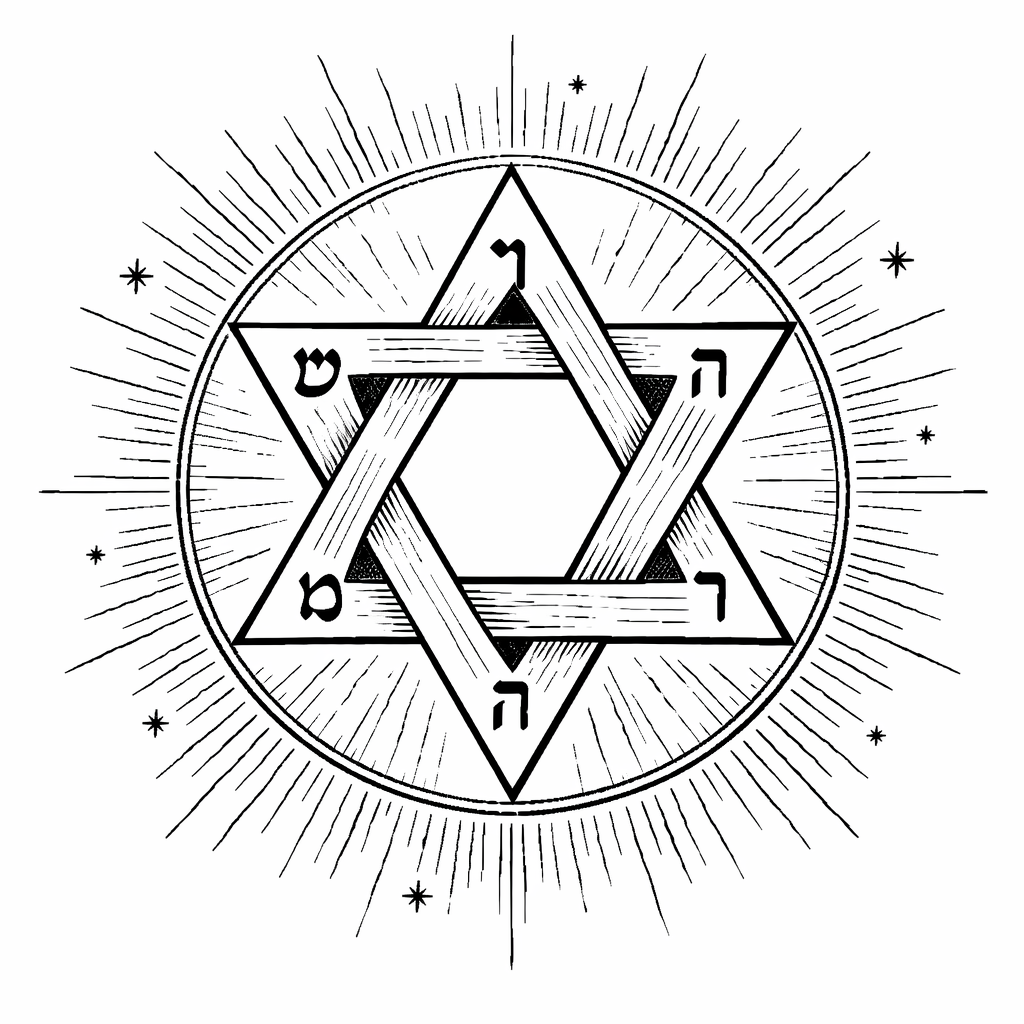
If the hexagram is the symbol most people associate with Solomon through its later adoption as the Star of David, the pentagram—the five-pointed star drawn with a single continuous line—is the symbol most deeply embedded in the actual Solomonic magical tradition. The reader who wishes to recognize occult symbols in contemporary society must understand this figure, because it is everywhere.
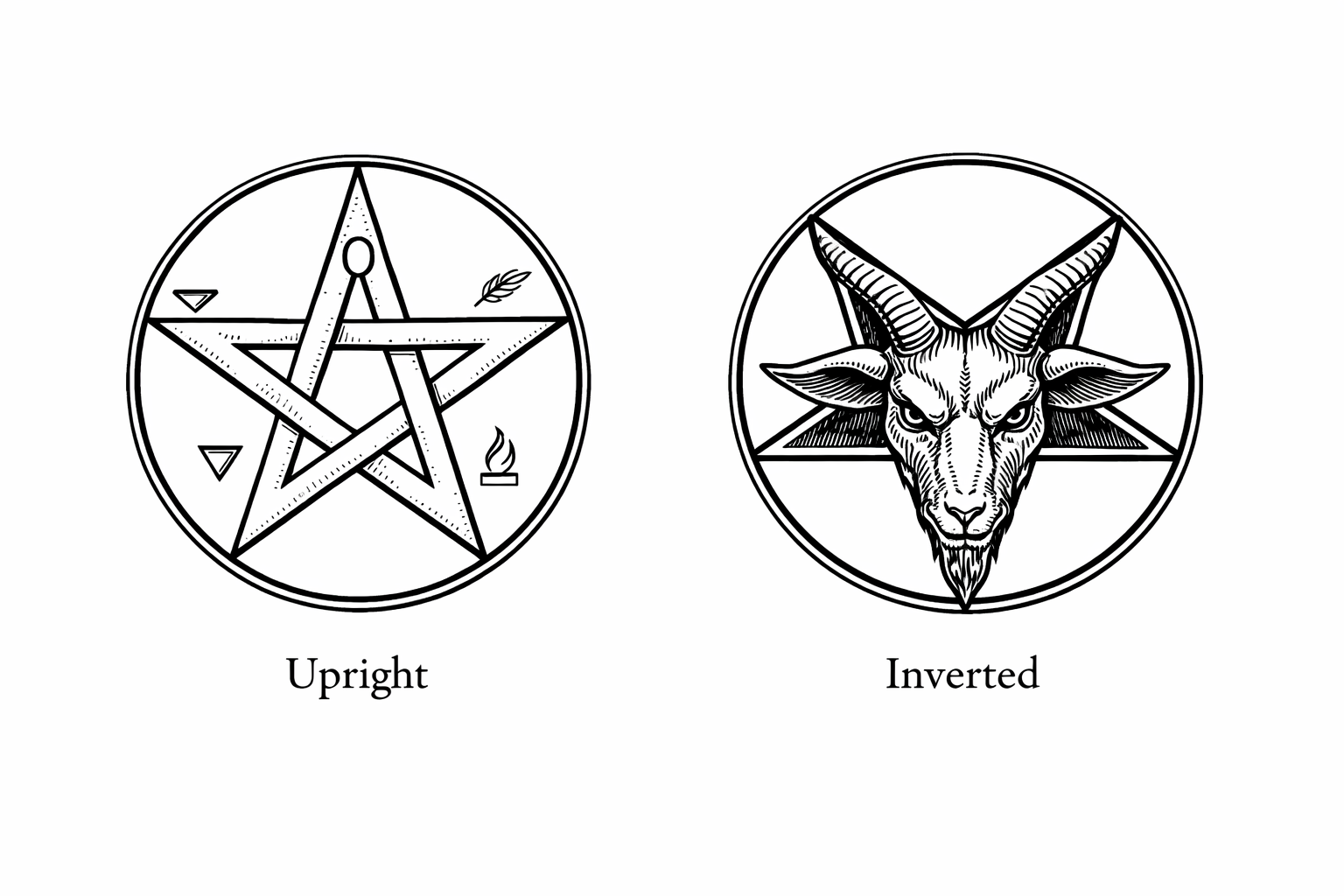
The pentagram appears on Sumerian pottery as early as 3500 BCE and was used in ancient Babylon as a symbol associated with the planet Venus and the goddess Ishtar—the same Ishtar who is the Mesopotamian counterpart of Ashtoreth, the goddess Solomon worshipped. The Pythagoreans of ancient Greece regarded it as a figure of mathematical perfection (the ratios of its line segments express the golden ratio) and used it as a recognition sign among members of their philosophical school. In none of these early uses was the pentagram considered evil. It was a figure of order, beauty, and cosmic harmony.
In medieval Christianity, the pentagram was initially a positive symbol. The five points were interpreted as representing the five wounds of Christ—the two hands, two feet, and side pierced at the crucifixion. Sir Gawain, in the 14th-century poem Sir Gawain and the Green Knight, bears a pentagram on his shield as a sign of the five joys of Mary and the five virtues of knighthood. There was nothing sinister about it.
The pentagram entered the occult tradition through the same medieval grimoires that propagated the hexagram. In many manuscripts of the Clavicula Salomonis, the pentagram—not the hexagram—is identified as the true “Seal of Solomon,” the figure engraved on the ring that gave Solomon power over demons. The pentagram appears on protective circles drawn on the floor before conjuration, on amulets worn by the magician, on the hilts of ritual swords, and on the seals used to bind individual demons. Each of the 72 demons catalogued in the Ars Goetia has a unique seal, but the pentagram functions as the master seal—the universal sign of Solomonic authority over the spirit world.
The grimoire tradition assigned specific meanings to the pentagram’s orientation. Upright—with a single point directed upward—the pentagram represented spirit ruling over matter, the human form with head above and limbs below, and the authority of the divine Name over the demonic hierarchies. The five points were associated with the five letters of the Hebrew names of God or with the five elements (earth, water, fire, air, and spirit).
The critical transformation came in the 19th century. Éliphas Lévi (1810–1875), a French occultist and former Catholic seminarian whose real name was Alphonse Louis Constant, systematized the distinction between the upright and inverted pentagram in his hugely influential Dogme et Rituel de la Haute Magie (1856). Lévi declared that the upright pentagram, with one point ascending, represented “the supremacy of the mind over the elements”; while the inverted pentagram, with two points ascending, represented “the triumph of matter over spirit” and was “the sign of the goat of the Sabbath”—that is, the Devil.
Lévi’s formulation was adopted wholesale by subsequent occultists and eventually by Anton LaVey, who founded the Church of Satan in 1966. LaVey placed the inverted pentagram—with a goat’s head inscribed within it, the two upward points forming the horns, the two lateral points forming the ears, and the single downward point forming the beard—on the cover of The Satanic Bible (1969). This image, sometimes called the “Sigil of Baphomet,” became the official symbol of the Church of Satan and, by extension, the most widely recognized symbol of Satanism in popular culture.
Today, the inverted pentagram appears on heavy metal album covers, in horror films, in tattoo parlors, on jewelry, and in the iconography of groups that range from self-conscious Satanists to teenagers who think the symbol looks edgy without understanding what it signifies. The symbol has been so thoroughly commercialized that many people who wear it have no idea they are displaying a figure that traces its lineage, through Lévi and the grimoires, directly back to the Solomonic magical tradition—and through that tradition, to the same spiritual forces that destroyed Solomon.
The mention of Baphomet requires its own treatment, because the figure has become one of the most recognizable occult symbols in the modern world—and its connection to the Solomonic tradition, though indirect, is real and significant.
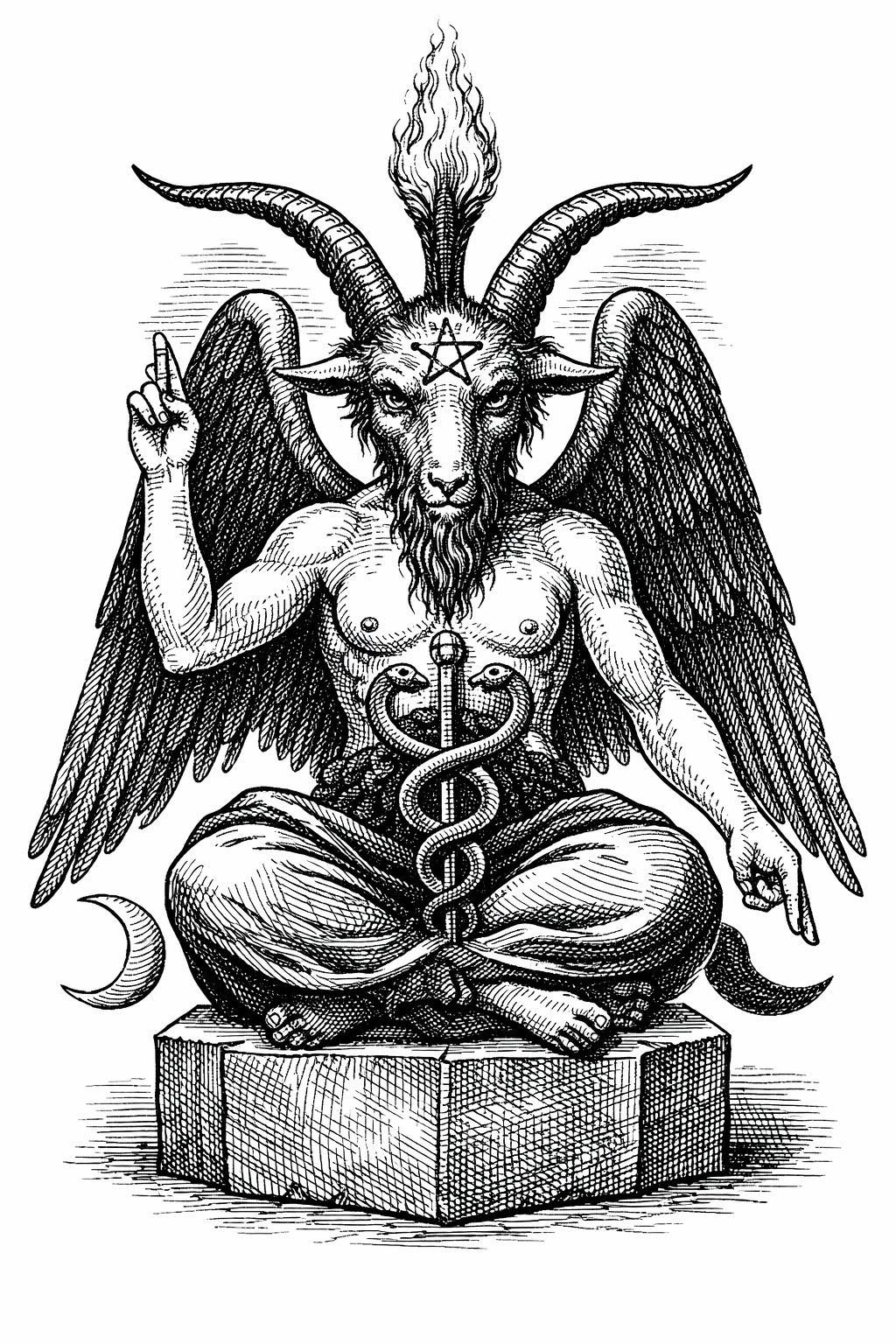
The name “Baphomet” first appears in the records of the trial of the Knights Templar in 1307–1312. King Philip IV of France, deeply in debt to the Templars and covetous of their wealth, arrested the entire order on charges of heresy, blasphemy, and idolatry. Among the accusations was that the Templars worshipped a mysterious idol called “Baphomet”—variously described in the trial records as a head, a cat, a figure with three faces, or a bearded idol. Under torture, some Templars confessed to worshipping this idol; most historians regard the confessions as coerced and the idol as a fabrication designed to justify the order’s suppression and the seizure of its assets.
The etymology of “Baphomet” is disputed. Some scholars derive it from a corruption of “Muhammad” (Mahomet in Old French), reflecting the Crusader-era assumption that Muslims were idolaters. Others connect it to the Greek baphe meteos (“baptism of wisdom”) or to various Gnostic and alchemical terms. The historical Baphomet—if it existed at all—was probably nothing more than a political fiction.
The Baphomet that the modern world knows, however, is not the Templar accusation but the image drawn by Éliphas Lévi in 1856. Lévi’s Baphomet is a seated, winged, goat-headed figure with a human torso, female breasts, and cloven hooves. One hand points upward and one downward (the alchemical gesture “as above, so below”). A torch burns between its horns. A pentagram is inscribed on its forehead. A caduceus—the entwined-serpent staff of Hermes—rises from its lap. The figure combines male and female, human and animal, light and darkness, in a deliberate representation of the “union of opposites” that Lévi regarded as the key to all occult philosophy.
Lévi did not regard Baphomet as a demon to be worshipped. He described the figure as a symbol of the “Astral Light”—a universal magical force that, in his system, could be directed by the will of the adept for good or evil purposes. But Lévi’s intellectual subtlety was lost on his successors. The image—goat-headed, pentagram-crowned, simultaneously repulsive and hypnotic—took on a life of its own. It became the face of the Devil in popular culture, the icon of Satanism, and the most provocative religious image of the modern era.
The Satanic Temple, a modern organization founded in 2013 that uses Satanic imagery for political activism (primarily around church-state separation issues), commissioned a bronze statue of Baphomet—8.5 feet tall, seated on a throne, flanked by two adoring children—which has been displayed at various public venues and government buildings as a deliberate provocation. The organization maintains that Baphomet is a symbol of “pluralism, legal equality, and the rejection of tyrannical authority” and that they do not literally worship Satan.
Whether or not the Satanic Temple’s members believe in a literal Devil is beside the point for our purposes. The point is that the image they chose—the goat-headed, pentagram-crowned figure drawn by a 19th-century occultist who was steeped in the Solomonic grimoire tradition—carries a spiritual lineage whether its displayers acknowledge it or not. Symbols are not emptied of their power by the intentions of those who use them. A man who handles a loaded gun “ironically” can still be shot. And a symbol that traces its visual and conceptual lineage through Lévi’s occultism, through the medieval grimoires, through the Testament of Solomon, and ultimately to the spiritual forces that Solomon engaged and that engaged him, does not become safe because the people displaying it consider themselves atheists.
The Christian is not called to panic at the sight of Baphomet on a billboard or an inverted pentagram on a t-shirt. But the Christian is called to recognize what these symbols represent: a tradition of engagement with spiritual forces that has destroyed everyone who has entered it, beginning with the wisest man who ever lived. Awareness is not fear. It is discernment. And discernment—the very gift Solomon asked for and received at Gibeon—is what Solomon’s story teaches us to cultivate.
There is, however, a form of the Solomonic error that is far more culturally pervasive than pentagrams on t-shirts or Baphomet statues at government buildings—and far more dangerous precisely because it is beloved. We must speak of Harry Potter.
J.K. Rowling’s seven-novel series (1997–2007) and its film adaptations (2001–2011) are among the most successful works of fiction in human history. Over 500 million copies of the books have been sold worldwide. The films grossed nearly $8 billion. An entire generation—and now a second generation—has grown up immersed in the world of Hogwarts School of Witchcraft and Wizardry, where children learn to cast spells, brew potions, summon patronuses, and engage with a vast taxonomy of magical creatures, enchanted objects, and supernatural forces.
The series is brilliantly constructed. The characters are lovable. Harry himself is an orphan of extraordinary courage and decency, searching for belonging, protecting the innocent, willing to lay down his life for his friends. Hermione Granger is brilliant and loyal. Ron Weasley is steadfast. Dumbledore is wise and self-sacrificing. The moral architecture of the story—good versus evil, love versus power, humility versus domination—is genuinely compelling. Christians who have praised the series have pointed, rightly, to its themes of self-sacrifice, the power of love, and the ultimate defeat of evil.
And yet.
The entire moral universe of Harry Potter rests on a premise that is indistinguishable from Solomon’s fatal error: that a human being can engage with occult forces—spellcasting, divination, necromancy, enchantment, potion-brewing, the binding and commanding of magical creatures—and remain uncorrupted, provided that the practitioner’s intentions are good.
This is precisely what Solomon believed. Solomon did not set out to worship Molech. He set out to command demons in the service of God. The ring was given by an angel. The purpose was holy: build the Temple. The knowledge was used, at first, for legitimate ends. Solomon’s error was not that he sought evil but that he believed he could handle spiritual forces that no human being is equipped to handle, and that his good intentions would protect him from the corruption inherent in the engagement itself.
Harry Potter teaches the same lesson—except it teaches it as true. In Rowling’s world, the distinction between good magic and dark magic is real and reliable. Harry and his friends use spells, potions, and enchantments throughout their education and their battles, and they are not corrupted by them. The magic is morally neutral; only the intent of the caster determines whether it is good or evil. “Dark magic” is a category reserved for specific spells—the Unforgivable Curses, the creation of Horcruxes—that require malicious intent. Everything else is simply a tool, as morally neutral as a hammer.
The Bible does not share this view. Scripture does not distinguish between “good magic” and “dark magic.” It prohibits all of it:
“There shall not be found among you anyone who burns his son or his daughter as an offering, anyone who practices divination or tells fortunes or interprets omens, or a sorcerer or a charmer or a medium or a necromancer or one who inquires of the dead, for whoever does these things is an abomination to the Lord.” (Deuteronomy 18:10–12)
The list is comprehensive. Divination—practiced at Hogwarts in Professor Trelawney’s classroom. Interpreting omens—a standard subject in the Hogwarts curriculum. Sorcery—the entire foundation of wizarding society. Charming—a core Hogwarts class (“Charms,” taught by Professor Flitwick). Necromancy—the Resurrection Stone, one of the Deathly Hallows, is literally a device for summoning the dead, and Harry uses it in the climactic chapter of the series. The text of Deuteronomy does not say “unless your intentions are good.” It does not say “unless you are fighting a Dark Lord.” It says whoever does these things is an abomination.
The reason for the prohibition is not arbitrary. It is precisely the lesson of Solomon’s story: engagement with supernatural forces outside of God’s ordained channels—prayer, sacrament, obedience to His revealed will—inevitably corrupts the practitioner, regardless of intent. The corruption may not be visible immediately. Solomon was not corrupted overnight. The process took years, perhaps decades, as the commander of demons gradually became their student, then their collaborator, then their worshipper. The trajectory was invisible from the inside. Solomon surely believed, at every stage, that he was still in control.
The cultural impact of Harry Potter on attitudes toward the occult is difficult to overstate. A generation of children and young adults internalized the premise that magic is a morally neutral tool—that spells, potions, divination, and communication with the dead are perfectly acceptable activities for good people. The series did not intend to promote occultism; Rowling has stated that the magic in her books is fictional and that she does not believe in the supernatural. But intentions, as we have argued throughout this chapter, are not the only thing that matters. The effect of the series has been to normalize a category of activity that Scripture explicitly forbids, to make it seem not merely acceptable but admirable, and to associate it with the most sympathetic characters imaginable.
This normalization is visible in the culture. Interest in Wicca, neopaganism, and “witchcraft” has surged among young adults in the decades since Harry Potter’s publication. Online communities devoted to spellcasting, tarot reading, crystal healing, and other occult practices have exploded in size. The aesthetic of witchcraft—crystals, candles, pentagrams, spell jars—has become a mainstream lifestyle brand. It would be too simple to attribute all of this to Harry Potter; the causes are complex and multiple. But it would be naive to deny that a series which taught half a billion readers that magic is a wholesome activity practiced by brave, kind, lovable people had no effect on the culture’s receptivity to actual occult practice.
The contrast with Tolkien—whom we discussed in Chapter 5—is instructive. Tolkien, a devout Catholic and a man immersed in the medieval traditions that transmitted the Solomonic legacy, created a world in which the ring of power corrupts everyone who touches it. There is no “good” way to use the One Ring. Gandalf refuses it. Galadriel refuses it. Even Frodo, the most humble and selfless character in the story, is ultimately unable to let it go voluntarily—he claims the Ring at the Crack of Doom, and it is destroyed only through the providential accident of Gollum’s fall. Tolkien understood what Solomon’s story teaches: that supernatural power corrupts the wielder regardless of intent, and that the only safe response to such power is to refuse it entirely.
Rowling’s world teaches the opposite. In Rowling’s world, Gandalf would have been right to take the Ring, because his intentions were good. In Rowling’s world, Solomon would have been justified in commanding demons forever, because he was using them to build God’s Temple. In Rowling’s world, the distinction between the wise man who commands demons and the fool who worships them is real and stable. The Solomonic tradition—and three thousand years of bitter experience—says otherwise.
None of this is to say that every person who has read or enjoyed Harry Potter is in spiritual danger, any more than every person who wears a Tree of Life pendant is practicing Kabbalah. The books are fiction. The magic in them is fictional. Most readers, especially children, engage with them as adventure stories and come away with positive impressions of courage, friendship, and self-sacrifice.
But the Christian who has read this far in this book—who now understands the Solomonic tradition, who knows what the pentagram and the hexagram signify, who has seen Baphomet’s face and read about the grimoires and the demons—that Christian should also understand why the Church has historically regarded the normalization of magic in popular culture with concern rather than enthusiasm. The concern is not that Harry Potter will turn children into witches. The concern is subtler and more serious: that a culture saturated in fictional magic will lose its ability to recognize the danger of the real thing. When the category of “magic” has been rendered innocent and charming in the imagination, the warnings of Deuteronomy begin to sound quaint rather than urgent. And that is precisely the point at which Solomon’s error becomes possible again—not in the courts of ancient Jerusalem but in the living rooms of the modern world.
Solomon did not intend to fall. He intended to command demons in God’s service and remain faithful. Harry Potter does not intend to lead anyone into occultism. But the road to the high places of Molech was paved with good intentions, and the road from Hogwarts to the New Age shop is shorter than most parents realize.
God’s response to Solomon’s apostasy was not passive. The text records that the Lord “raised up an adversary” (satan, using the common noun, not the proper name) against Solomon (1 Kings 11:14). Three adversaries are named, each representing a different dimension of the judgment.
Hadad the Edomite (1 Kings 11:14–22). Hadad was a prince of the royal house of Edom who had survived David’s conquest as a child. When David’s general Joab had “struck down every male in Edom” during a six-month campaign, servants had smuggled the young Hadad to Egypt, where Pharaoh gave him a house, land, food, and eventually a wife—the sister of Pharaoh’s own queen, Tahpenes. When Hadad heard that David and Joab were dead, he returned to Edom and became a persistent thorn in Solomon’s side. Hadad was the ghost of David’s violence come back to haunt David’s son—a living embodiment of the principle that “the sword shall never depart from your house.”
The detail about Pharaoh’s generosity to Hadad is significant. Pharaoh gave this Edomite refugee a wife from the royal household—and this was the same Pharaoh (or his predecessor) who gave his own daughter to Solomon. Egypt was playing both sides: allied with Solomon through marriage, harboring Solomon’s enemy through asylum. The geopolitics of the ancient Near East were as cynical then as they are now. Solomon’s alliance with Egypt, purchased at the price of a political marriage that compromised his faithfulness, did not even buy him Egypt’s undivided loyalty.
Hadad’s story also reveals a theological pattern that runs through the entire Hebrew Bible: the violence of one generation becomes the judgment of the next. David’s massacre of the Edomites was an act of imperial conquest, celebrated in Psalm 60:8 (“Moab is my washbasin; upon Edom I cast my shoe”). But the child who escaped that massacre grew up to become the instrument of God’s judgment on David’s son. The sword that David wielded against Edom was the same sword that Nathan said would “never depart” from David’s house. It simply changed hands.
Rezon son of Eliada (1 Kings 11:23–25). Rezon was a Syrian who had fled from his master, Hadadezer king of Zobah (whom David had defeated), gathered a band of marauders, seized Damascus, and established himself as king. “He was an adversary of Israel all the days of Solomon” (1 Kings 11:25). Rezon represents the geopolitical consequences of Solomon’s apostasy: the vassal states that David had subdued began to break free as God’s protective hand was withdrawn.
The significance of Damascus cannot be overstated. Under Rezon and his successors, Damascus would grow into the most powerful Aramean state in the region, eventually becoming Israel’s most dangerous enemy. The wars between Israel and Aram-Damascus would dominate the geopolitics of the Levant for the next two centuries, culminating in the Aramean siege of Samaria under Ben-hadad and Hazael. Rezon was the seed of a threat that would plague Israel for generations—and he established himself during Solomon’s reign, while Solomon was too preoccupied with his building projects, his trade ventures, and his foreign wives to notice that the empire was crumbling at the edges.
Jeroboam son of Nebat (1 Kings 11:26–40). Jeroboam was the most dangerous adversary because he was internal. He was “an Ephraimite of Zeredah, a servant of Solomon” (1 Kings 11:26)—an Israelite, a northerner, and one of Solomon’s own officials. He was “a man of valor” whom Solomon had placed in charge of the forced labor of the house of Joseph (1 Kings 11:28)—the very corvée system that was generating the resentment that would eventually split the kingdom.
The prophet Ahijah the Shilonite met Jeroboam on the road outside Jerusalem and performed one of the most dramatic prophetic actions in Scripture: he tore his new garment into twelve pieces and gave ten to Jeroboam, saying:
“Take for yourself ten pieces, for thus says the Lord, the God of Israel, ‘Behold, I am about to tear the kingdom from the hand of Solomon and will give you ten tribes (but he shall have one tribe, for the sake of my servant David and for the sake of Jerusalem, the city that I have chosen out of all the tribes of Israel), because they have forsaken me and worshiped Ashtoreth the goddess of the Sidonians, Chemosh the god of Moab, and Milcom the god of the Ammonites, and they have not walked in my ways, doing what is right in my sight and keeping my statutes and my rules, as David his father did.’ ” (1 Kings 11:31–33)
The key phrase is “because they have forsaken me.” The pronoun is plural—“they,” not “he.” God holds not only Solomon but the people responsible for the apostasy. Solomon led, but the nation followed. The high places Solomon built were not empty; they had worshippers.
Yet even in this judgment, God’s mercy is visible. Solomon would keep the kingdom “all the days of his life, for the sake of David my servant” (1 Kings 11:34). One tribe would remain with Solomon’s son “for the sake of Jerusalem.” The judgment was real but tempered. God was tearing the kingdom, not annihilating the dynasty. The Davidic line would continue—diminished, humbled, but not extinguished.
Solomon’s response to Ahijah’s prophecy was not repentance but violence: “Solomon sought therefore to kill Jeroboam. But Jeroboam arose and fled into Egypt, to Shishak king of Egypt, and was in Egypt until the death of Solomon” (1 Kings 11:40). The wisest man in history, confronted with a divine judgment delivered through a prophet, attempted to murder the instrument of that judgment. The echo of Saul pursuing David is unmistakable. Solomon, at the end of his life, had become the very kind of king that God had rejected in Saul.
Solomon’s apostasy did not end with his death. It generated a legacy of occult practice that would persist for millennia, attaching Solomon’s name to magical traditions that he may have originated, that he certainly facilitated, and that subsequent generations elaborated far beyond anything the historical Solomon could have imagined.
The most direct descendants of Solomon’s magical reputation are the grimoires—manuals of ceremonial magic—that bear his name. The most important of these is the Clavicula Salomonis (Key of Solomon), which exists in numerous manuscripts dating from the 14th century onward but claims to derive from Solomon himself.
The Key of Solomon contains instructions for the preparation of magical instruments (wands, swords, robes, incense), the drawing of protective circles, the invocation and binding of spirits, and the creation of pentacles (geometric designs inscribed with divine names and angelic sigils). It assumes a cosmology in which angels and demons are real, in which divine names have operative power, and in which a properly prepared and ritually pure magician can command the spiritual world.
A related text, the Lemegeton (Lesser Key of Solomon), dating in its present form from the 17th century, contains the Ars Goetia—a catalogue of 72 demons, each with a name, a rank, a seal, and a description of its powers. This catalogue is a direct descendant of the demon-catalogues in the Testament of Solomon, expanded and systematized by medieval and Renaissance magicians.
These texts are not Scripture. They are not approved by any mainstream Jewish, Christian, or Islamic authority. They represent the outermost extension of the Solomonic tradition, the point where legitimate (if dangerous) spiritual knowledge shades into outright sorcery. But they exist because Solomon’s name carries authority in matters of the supernatural, and that authority traces back to the traditions we examined in Chapter 5.
The relationship between Solomon and the Kabbalah is complex and requires careful distinction.
The Kabbalah, the Jewish mystical tradition, has deep roots in rabbinic Judaism and draws on biblical, Talmudic, and midrashic sources. Its core texts—the Sefer Yetzirah (Book of Creation, perhaps 3rd–6th century CE) and the Zohar (Book of Splendor, 13th century CE)—do not attribute their teachings to Solomon. The Kabbalistic tradition is associated primarily with Rabbi Shimon bar Yochai (2nd century CE, to whom the Zohar is traditionally attributed) and with the medieval Spanish and Provençal schools.
However, certain elements of Kabbalistic practice—particularly the “practical Kabbalah” (Kabbalah ma’asit), which involves the use of divine names, angelic invocations, and amulets for practical purposes—overlap significantly with the Solomonic magical tradition. The use of the divine Name to command spirits, the creation of protective seals, and the invocation of angelic hierarchies are features of both the Solomonic grimoires and the practical Kabbalah.
The mainstream Kabbalistic tradition has generally regarded practical Kabbalah with suspicion. The great Kabbalist Isaac Luria (1534–1572) reportedly warned against its use, and the Talmud itself contains warnings about the dangers of engaging with the hidden wisdom (ma’aseh merkavah and ma’aseh bereshit) without adequate preparation and purity. The boundary between legitimate mystical contemplation and illegitimate magical practice has been debated within Judaism for centuries, and Solomon—the man who crossed that boundary—stands as the cautionary example on both sides.
Because Kabbalistic symbols have migrated far beyond their original Jewish mystical context—into Western occultism, pop culture, fashion, and New Age spirituality—the reader should be able to recognize the most common ones.
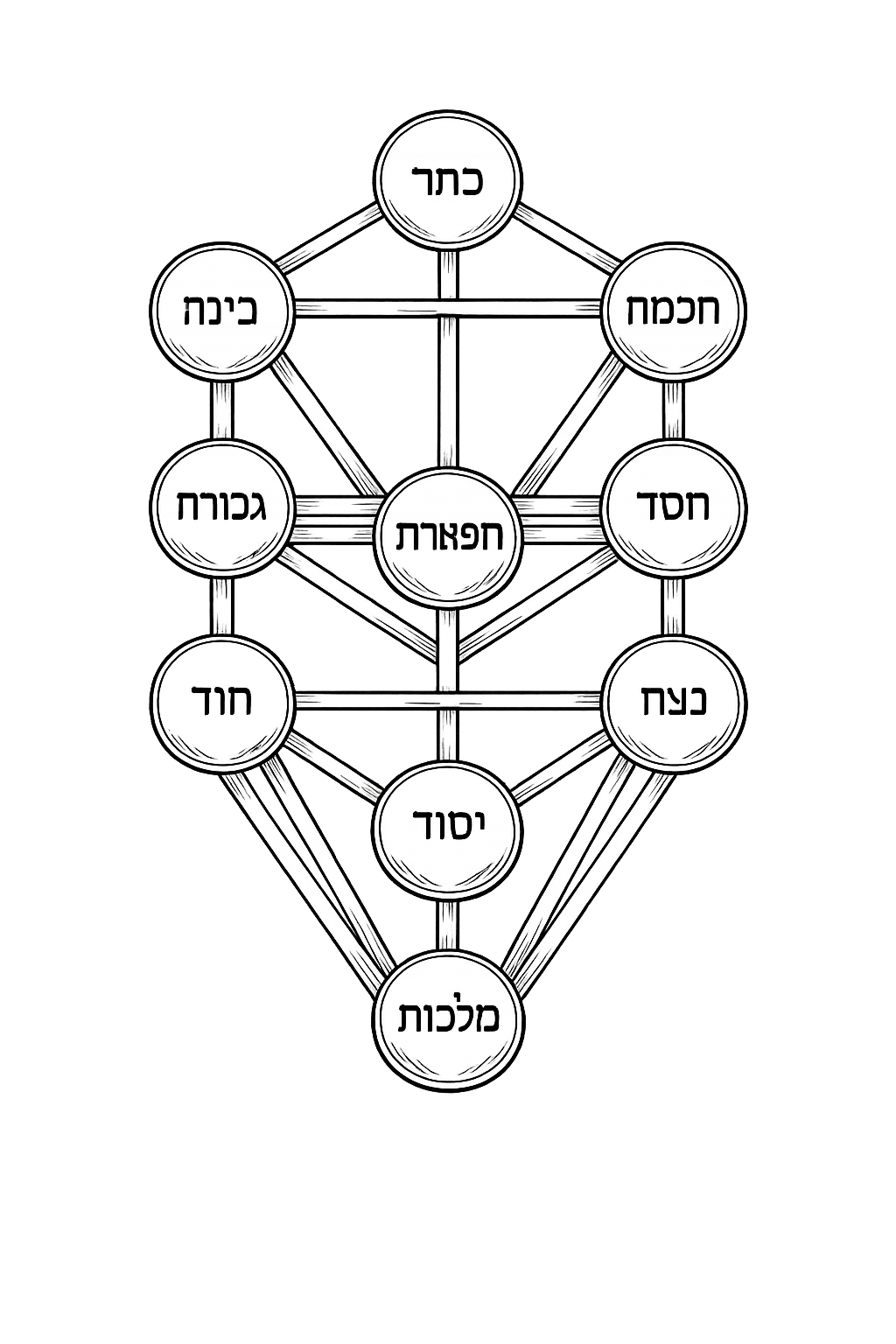
The Tree of Life (Etz Chaim) is the most important visual symbol of the Kabbalah. It is a diagram of ten spheres (sephirot) arranged in a specific pattern and connected by 22 paths. The ten sephirot represent the stages by which the infinite, unknowable God (Ein Sof—literally “without end”) emanates into the created world. They are, from highest to lowest: Keter (Crown), Chokhmah (Wisdom), Binah (Understanding), Chesed (Lovingkindness), Gevurah (Severity), Tiferet (Beauty), Netzach (Victory), Hod (Splendor), Yesod (Foundation), and Malkhut (Kingdom). The 22 paths connecting them correspond to the 22 letters of the Hebrew alphabet.
The Tree of Life appears today on jewelry, tattoos, wall art, yoga studio decor, and the merchandise of pop-Kabbalah movements. It was adopted wholesale by the Hermetic Order of the Golden Dawn and integrated into the Western magical tradition, where each sephirah was associated with a planet, a color, a tarot card, and an angelic or demonic hierarchy. Aleister Crowley made the Tree of Life the structural backbone of his entire magical system. When the reader sees this diagram—ten circles connected by lines in a distinctive vertical pattern—they are looking at a symbol that originated in Jewish mysticism, was appropriated by Western occultism, and now circulates freely in contexts that range from the sincerely spiritual to the commercially trivial.
The red string bracelet worn on the left wrist became a mainstream fashion accessory in the early 2000s when celebrities including Madonna, Demi Moore, and Britney Spears began publicly associating with the Kabbalah Centre, a Los Angeles–based organization founded by Philip Berg in 1984. The red string is derived from a folk practice associated with Rachel’s Tomb in Bethlehem, where red thread is wound around the tomb and then cut into bracelet-length pieces. In the folk tradition, the string is believed to ward off the “evil eye” (ayin hara). The Kabbalah Centre marketed it as a spiritual protection device, and millions of red string bracelets were sold worldwide.
The red string bracelet is, in itself, a piece of thread. But its popularization is significant because it represents the commercialization of Kabbalistic practice—the reduction of a complex and potentially dangerous mystical tradition to a fashion accessory. The Kabbalah Centre was widely criticized by mainstream Jewish authorities for precisely this reason: it stripped the Kabbalah of its traditional safeguards (years of Torah study, rabbinic supervision, minimum age requirements) and sold its symbols to anyone with a credit card. The result was a generation of people wearing Kabbalistic symbols without understanding what the Kabbalah actually teaches—or what the tradition warns about the consequences of approaching the hidden wisdom unprepared.
Hebrew letter mysticism. The Kabbalah teaches that the Hebrew letters are not merely a writing system but the building blocks of creation itself. The Sefer Yetzirah describes God as creating the universe by combining and permuting the 22 Hebrew letters. Each letter has a numerical value (gematria), a symbolic meaning, and—in the practical Kabbalah—an operative power. Specific combinations of Hebrew letters, particularly the various divine Names, are believed to have the power to heal, protect, create, and destroy. This is the theological foundation of the Solomonic magical tradition: when Solomon’s ring bore the divine Name, it was not merely labeled; it was empowered by the letters themselves.
Today, Hebrew letter imagery appears on amulets, pendants, tattoos, and home decor items marketed to people who do not read Hebrew and have no idea what the letters mean. The four-letter Name of God (YHWH, the Tetragrammaton) appears on occult jewelry alongside pentacles and planetary seals. Other divine Names—the 72-letter Name, the 42-letter Name—are printed on amulets sold online as “protection” or “manifestation” tools. The buyer rarely understands that these Names are, in the tradition from which they derive, operative spiritual instruments—not decorations. To the Kabbalist, writing or wearing the divine Name without proper preparation and intention is not neutral; it is dangerous, like handling high-voltage wiring without insulation.
The purpose of cataloguing these symbols is not to induce fear or to suggest that every person wearing a Tree of Life pendant is engaged in sorcery. The purpose is awareness. These symbols have histories. They carry associations. They connect—sometimes directly, sometimes through long chains of transmission—to the same spiritual traditions that Solomon inaugurated and that destroyed him. The informed Christian does not need to flee from every shop that displays a New Age symbol, but neither should the informed Christian be ignorantly wearing these symbols. Discernment requires knowledge, and knowledge begins with recognition.
The Temple of Solomon occupies a central place in the symbolism and ritual of Freemasonry. The Masonic tradition identifies its own origins with the builders of Solomon’s Temple, and its rituals reenact elements of the Temple’s construction. The two pillars, Jachin and Boaz, appear prominently in Masonic iconography. The figure of Hiram Abiff—an elaboration of the biblical Hiram the craftsman—is the central character of the Masonic Master Mason degree.
Freemasonry presents itself as a fraternal organization dedicated to moral self-improvement, charitable works, and brotherhood. Its public face is philanthropic: the Shriners, the Masonic lodge’s most visible subsidiary, operate children’s hospitals and burn centers that have provided genuine medical care to hundreds of thousands of children. The charitable work is real. The kindness of individual Masons is often genuine. And this is precisely what makes the institution dangerous.
The reader who has followed the argument of this book should recognize the pattern. Solomon’s engagement with demonic forces did not begin with Molech worship. It began with the Temple—the holiest building project in human history, commissioned by God Himself. The demons were enlisted for a good purpose. The ring was given by an angel. The knowledge was used, at first, to accomplish God’s own will. The goodness of the initial purpose was the camouflage under which the corruption entered. This is the adversary’s characteristic method: he does not present evil as evil. He wraps it in something half-good, something plausible, something that appeals to the best instincts of decent people. He offers the burn center with one hand and the blood oath with the other.
And Freemasonry does require blood oaths. The initiation rituals of the Masonic degrees—which members are sworn to keep secret under penalty of grotesque symbolic punishments (having one’s throat cut, one’s tongue torn out, one’s body buried in the rough sands of the sea)—are not the ceremonies of a mere civic club. The higher degrees, particularly those of the Scottish Rite and the York Rite, involve increasingly elaborate ritual dramas that draw explicitly on Solomonic Temple symbolism, Kabbalistic imagery, and the language of esoteric enlightenment. The 33rd degree of the Scottish Rite is conferred in a ceremony whose symbolism would be immediately recognizable to any student of the Western occult tradition.
Albert Pike, the most influential Masonic philosopher in American history and the author of Morals and Dogma (1871)—the canonical text of the Scottish Rite—was explicit about the esoteric content of Masonry. Pike wrote that “Masonry is identical with the ancient Mysteries” and that its symbols “conceal” rather than reveal their true meaning to the lower degrees: “The Blue Degrees are but the outer court or portico of the Temple. Part of the symbols are displayed there to the Initiate, but he is intentionally misled by false interpretations. It is not intended that he shall understand them; but it is intended that he shall imagine he understands them.” The lower-degree Mason believes he has joined a charitable brotherhood. Pike says, in so many words, that this belief is a deliberate deception.
The parallel to Solomon’s trajectory is exact. The lower degrees of engagement appear wholesome. The charitable works are real. The brotherhood is genuine. The moral teachings are, on the surface, unobjectionable. But the deeper one goes—the higher the degree, the more elaborate the ritual, the more binding the oath—the closer one comes to the same spiritual territory that Solomon entered through his ring and never left. The structure is designed so that the initiate is drawn inward by stages, each stage seeming reasonable in light of the last, each oath binding more tightly than the one before. By the time the Mason reaches the inner degrees, he has sworn oaths, participated in rituals, and absorbed symbolism that would have been unthinkable at the beginning. This is not self-improvement. This is the anatomy of a spiritual trap—and it is the same trap that caught Solomon.
The Shriners’ burn centers heal children’s bodies. No one disputes this. But the Christian must ask: at what spiritual cost does this philanthropy operate? The Shriners’ full name is the “Ancient Arabic Order of the Nobles of the Mystic Shrine.” Their initiation involves swearing an oath on the Quran (in addition to the Bible). Their symbolism is drawn from Islamic and Near Eastern esoteric traditions. The fez, the scimitar, the crescent moon—these are not random costume choices. They are the symbols of a tradition that connects, through long and winding chains, to the same Near Eastern spiritual world that Solomon inhabited.
The devil’s most effective strategy has never been to present evil as evil. It is to present evil as good—or, more precisely, to wrap genuine good around a core of spiritual darkness, so that the person who questions the darkness can be accused of opposing the good. “How can you criticize the Masons? They build hospitals for children!” This is the same logic by which Solomon might have defended his demon-commanding: “How can you criticize my methods? I’m building a Temple for God!” The goodness of the fruit does not sanctify the root. And the root of Freemasonry, however deeply buried beneath layers of philanthropy and civic respectability, is the Solomonic occult tradition—the same tradition that began with an angel’s ring and ended with incense burning before Molech.
The Solomonic magical tradition experienced a dramatic revival in the 19th and 20th centuries through the Western esoteric movement. The Hermetic Order of the Golden Dawn, founded in London in 1888 by William Wynn Westcott and Samuel Liddell MacGregor Mathers, incorporated Solomonic demonology and seal-work into its system of ceremonial magic. Mathers himself translated the Key of Solomon and the Lemegeton from manuscript sources and made them available to a wider audience for the first time.
Aleister Crowley (1875–1947), the most notorious figure in modern occultism, drew extensively on the Solomonic tradition. His Liber Samekh, a ritual of self-initiation, is an adaptation of a Greco-Egyptian exorcism text that shares structural features with the Solomonic conjurations. Crowley regarded Solomon as a predecessor—a figure who had accessed the same spiritual forces that Crowley sought to command through his own system of “Magick.” Whether Crowley understood Solomon correctly is another question; what matters for our purposes is that Solomon’s name continued to function, three thousand years after his death, as a warrant for engagement with the supernatural.
The influence extends further. Modern practitioners of ceremonial magic—a subculture that exists at the margins of Western spirituality but is larger and more organized than most people realize—continue to use the Ars Goetia’s catalogue of 72 demons, the pentacles and seals attributed to Solomon, and ritual structures derived from the medieval grimoire tradition. Internet forums, published manuals, and instructional videos on “Solomonic magic” proliferate. The tradition is alive.
From a Christian perspective, this ongoing tradition is not a curiosity; it is a warning. The same spiritual forces that the Testament of Solomon describes—forces that Solomon initially commanded but that eventually commanded him—remain objects of human fascination and pursuit. The modern occultist who draws Solomon’s seals and invokes Solomon’s authority is reenacting, whether consciously or not, the same pattern that led from the Temple to the high places. Solomon’s apostasy did not merely produce historical consequences; it produced a living tradition of spiritual engagement that continues to draw practitioners into precisely the territory that destroyed Solomon.
Having surveyed the full scope of Solomon’s fall, we are now in a position to attempt an answer to the question posed in this book’s opening chapter: how does the wisest man in history become an idolater?
The answer, as far as the sources allow us to reconstruct it, appears to involve several interlocking factors:
Gradual compromise. Solomon’s apostasy was not a single dramatic act but a process that unfolded over decades. The political marriages began early; the high places came later; the full turning of the heart came in old age. Each small accommodation made the next one easier. The frog was boiled slowly.
The presumption of wisdom. The Talmud’s insight (Sanhedrin 21b) is penetrating: Solomon believed that the prohibition against foreign wives applied to lesser men whose hearts could be turned, not to him. His very wisdom became the instrument of his folly. He thought he was too wise to fall—and that thought was itself the fall.
The accumulation of forbidden knowledge. The traditions about the ring and the demons suggest that Solomon’s engagement with the spiritual world gave him access to knowledge that was dangerous and corrupting. Like the fruit of the forbidden tree, this knowledge was beautiful and desirable—but it carried a price that Solomon did not fully understand until it was too late.
The absence of accountability. David had Nathan. When David sinned, God sent a prophet to confront him, and David repented. Solomon, as far as the canonical text records, had no Nathan—no prophet who confronted him during the years of his apostasy and called him to repentance. Ahijah prophesied to Jeroboam, not to Solomon. The silence of the prophetic voice in Solomon’s court may be one of the most significant absences in the narrative.
The weight of the political system. Solomon’s marriages were not merely personal choices; they were the foundation of an international alliance system that sustained his kingdom’s security and prosperity. To reject the foreign wives’ gods would have been to reject the foreign wives themselves, and to reject the wives would have been to dissolve the alliances. Solomon’s apostasy was embedded in a political structure that made repentance enormously costly. This does not excuse it, but it helps explain it.
The corruption of spiritual engagement. This factor deserves special emphasis, because it is the one most relevant to the modern reader. Solomon did not begin his engagement with the spiritual world as a rebel against God. He began it as a servant of God, using divinely granted authority for a divinely ordained purpose: the construction of the Temple. The ring came from an angel. The authority came from God. The purpose was holy. And yet the engagement itself—the prolonged contact with demonic entities, the accumulation of knowledge about the hidden structures of the spiritual world, the exercise of power over beings that were older, more cunning, and more malevolent than any human—changed Solomon in ways he did not anticipate and could not reverse.
This is the pattern that every tradition about Solomon’s fall preserves, whether Jewish, Christian, or Islamic: the tools of holy work became the instruments of corruption. The ring that built the Temple became the ring that was stolen by Ashmedai. The knowledge that identified the shamir became the knowledge that opened doors Solomon should have left closed. The authority over demons became a fascination with demons, and the fascination became dependence, and the dependence became worship.
The pattern is not unique to Solomon. It recurs in every generation, in every person who begins by studying the occult “academically” and ends by practicing it, in every spiritual seeker who opens a door “just to look” and finds that the door does not close again, in every person who believes that knowledge is protection and discovers too late that knowledge of evil is itself a form of bondage. The demons do not announce themselves as destroyers. They present themselves as teachers, as servants, as sources of power and insight. They offer what Solomon was offered: knowledge, authority, the ability to accomplish extraordinary things. And the price is always the same. It is always the soul.
The mystery of the human heart. In the end, there is an element of Solomon’s fall that resists analysis. The wisest man in history—the man who had heard God’s voice directly, twice—chose to worship Ashtoreth, Chemosh, and Molech. No accumulation of wisdom, wealth, or spiritual knowledge could prevent this choice, because the choice was ultimately a matter of the will, and the will is free. Solomon’s story is, at its deepest level, a mystery—the mystery of how a human being, knowing the good, can choose the evil. It is the same mystery that has haunted theology since the Garden of Eden, and it has no final answer this side of eternity.
The Ark of the Covenant—the gold-covered wooden chest that held the tablets of the Law, that traveled with Israel through the wilderness, that brought down the walls of Jericho, that struck dead the men of Beth-shemesh who looked inside it, that Solomon placed in the Holy of Holies beneath the wings of the cherubim—disappears from the biblical narrative without explanation. It is present at the Temple’s dedication (1 Kings 8:6). It is never mentioned again. No biblical text records its destruction, its capture, or its removal. It simply vanishes.
The silence is extraordinary. The Ark was the single most sacred object in Israelite religion—the footstool of God’s throne, the meeting point between the divine and the human, the physical center of the covenant. Its disappearance should have generated a crisis of faith, a frantic search, a narrative of loss. Instead, there is nothing. The Babylonian destruction of the Temple in 586 BCE is described in detail in 2 Kings 25 and Jeremiah 52, with careful lists of the bronze, gold, and silver vessels carried off to Babylon—but the Ark is not among them. Either it was already gone, or its fate was too terrible or too sacred to record.
Into this silence steps the Kebra Nagast.
The Kebra Nagast (“The Glory of Kings”), the Ethiopian national epic, provides the most detailed and dramatic account of the Ark’s disappearance.1 According to this text, the Ark was not destroyed or lost—it was taken. Taken by Solomon’s own son, with divine assistance, from the Temple in Jerusalem to the highlands of Ethiopia, where it remains to this day in the Church of Our Lady Mary of Zion in Axum.
The Kebra Nagast was compiled in its present Ge’ez (classical Ethiopic) form in the early 14th century CE, during the reign of Emperor Amda Seyon I (r. 1314–1344), though it draws on traditions that are considerably older—some elements may date to the 6th century CE or earlier, with roots in Jewish, Christian, and Arabian oral traditions. The text was translated from Arabic into Ge’ez by a scribe named Isaac, who states in his colophon that the Arabic version was itself translated from a Coptic original.
For the Ethiopian Orthodox Tewahedo Church, the Kebra Nagast is not merely a national legend. It is a sacred text, second in authority only to the Bible, that establishes Ethiopia’s unique place in salvation history. The Church teaches that the Ark’s removal from Jerusalem to Ethiopia represents the transfer of divine favor from Israel to Ethiopia, making the Ethiopian people the new chosen nation and the Solomonic dynasty (which ruled Ethiopia until 1974) the rightful continuation of the Davidic line.
We cannot verify the Kebra Nagast’s historical claims. But we can present its narrative, which is rich, dramatic, and—in the context of Solomon’s story—theologically coherent. If the Ark was indeed lost during or after Solomon’s reign, and if that loss was connected to Solomon’s apostasy, then the Kebra Nagast preserves what may be an ancient memory of one of the most consequential events in biblical history.
Before turning to the Kebra Nagast’s full narrative, it is worth pausing to note how remarkably the Queen of Sheba has proliferated across the traditions. She appears in the Hebrew Bible, the New Testament, the Quran, the Targums, the Talmud, the Kebra Nagast, and the Arabian Nights—each tradition preserving a different facet of the encounter, each drawing different lessons from the same story.
In the Hebrew Bible and the New Testament, she is anonymous—simply “the queen of Sheba” (1 Kings 10:1) or “the queen of the South” (Matthew 12:42). Jesus invoked her as a model of the Gentile who recognizes divine wisdom when she encounters it, shaming the Israelites who failed to recognize something “greater than Solomon” standing in their midst.
In the Islamic tradition, she is Bilqis, queen of a sun-worshipping kingdom that the Quran locates in Saba (Sheba). The Quranic account (Surah 27:20–44) is distinctive. Solomon learns of her kingdom through a hoopoe bird—one of the animals over which he has been given dominion—which reports that it has found “a woman ruling over them, and she has been given of all things, and she has a great throne” (27:23). The bird also reports, with evident disapproval, that Bilqis and her people worship the sun instead of God.
Solomon sends a letter demanding submission. Bilqis, rather than responding with war, consults her advisors and then sends gifts. Solomon rejects the gifts—“What God has given me is better than what He has given you” (27:36)—and summons her to his court. Before she arrives, Solomon has her throne transported to Jerusalem by supernatural means (one of his servants, “who had knowledge of the Scripture,” brings it “in the twinkling of an eye”). When Bilqis arrives, she is shown her own throne, slightly altered, and asked whether she recognizes it. She does. Then she is led into a palace with a floor of glass, which she mistakes for water, lifting her garments to wade through it. Solomon corrects her: “It is a palace paved smooth with glass” (27:44). Bilqis, recognizing both the illusion she has been under and the greater truth it represents, declares: “My Lord, indeed I have wronged myself, and I submit with Solomon to God, Lord of the worlds” (27:44).
The glass floor is a parable within a parable. Bilqis had been deceived by appearances—worshipping the sun, mistaking glass for water—and Solomon’s demonstration forced her to confront the limitations of her perception. The story is, at its deepest level, about the difference between surface and reality, between what the eyes see and what the heart knows. Solomon, who possessed the wisdom to distinguish reality from illusion, taught Bilqis to do the same. The irony, for those who know the biblical tradition, is devastating: the man who taught Bilqis to see through illusions would himself succumb to the greatest illusion of all—that he could worship foreign gods without consequence.
We have already examined the riddle contest between Solomon and the Queen of Sheba in detail in Chapter 3—the dramatic intellectual duel preserved in the Targum Sheni, in which each riddle probes a deeper dimension of wisdom until the final test draws on the presence of God Himself. That contest was Solomon’s finest hour. Everything that followed was the long answer to the question he could not solve.
The multiplication of the Queen of Sheba across traditions reflects the power of her encounter with Solomon. It is one of the few moments in Solomon’s story that is unambiguously positive—a pagan queen comes seeking wisdom and finds it, is transformed by it, departs enriched. Every tradition that retells the story is, in some sense, trying to hold onto that moment of light before the darkness descends.
The Kebra Nagast’s account of the Queen of Sheba—called Makeda in Ethiopian tradition—begins where the biblical account begins: with the queen hearing of Solomon’s fame and traveling to Jerusalem to test him with questions. But the Kebra Nagast expands the narrative enormously.
In the Ethiopian version, the encounter between Makeda and Solomon is mediated by a merchant named Tamrin, who regularly traveled between Ethiopia and Jerusalem on trade. Tamrin was so impressed by Solomon’s wisdom and the magnificence of his court that he returned to Ethiopia and told Makeda everything he had seen. Makeda, who was already a powerful and intelligent ruler, resolved to see for herself.
The Kebra Nagast describes Makeda’s journey to Jerusalem with a caravan of 797 camels and numerous donkeys and mules, loaded with gifts. Upon arriving, she engaged Solomon in extended conversation about wisdom, governance, and theology. Solomon, for his part, was deeply impressed by Makeda—not only by her beauty but by her intelligence and her eagerness to learn about the God of Israel.
Over the course of her visit, Makeda abandoned her previous worship of the sun, moon, and stars and accepted the God of Israel as the one true God. The Kebra Nagast presents this as a genuine conversion, not merely a diplomatic gesture. Makeda is portrayed as a seeker of truth who recognized in Solomon’s God a deity far greater than the celestial bodies she had previously worshipped.
The most controversial element of the Kebra Nagast’s narrative is the account of how Solomon obtained a son from Makeda. According to the text, Solomon desired Makeda but she resisted, insisting that she would not lie with him. Solomon proposed a bargain: he would not take her by force if she would swear not to take anything in his house by force. Makeda, seeing nothing of his that she wanted, agreed.
Solomon then arranged a farewell feast of richly spiced food—deliberately prepared to induce thirst. He placed a jar of water near Makeda’s bed. In the middle of the night, Makeda awoke parched and reached for the water. Solomon, who had been watching, stopped her: she was taking something from his house, violating her oath. Makeda acknowledged the technicality. Solomon held her to the bargain.
Modern readers will find this episode deeply uncomfortable, and rightly so. The Kebra Nagast itself does not condemn Solomon’s stratagem—it presents it as cleverness—but by any contemporary standard, it is a form of coercion. A man of immense power manipulated a guest into a sexual encounter through a legalistic trick. The parallel to David’s abuse of power with Bathsheba is difficult to avoid: the father took a woman from her husband by royal authority; the son took a woman from her own autonomy by intellectual manipulation. The pattern of the house of David—the entanglement of sexual desire with the exercise of power—continued into the next generation.
The Kebra Nagast records that Makeda conceived a son that night. Before she departed, Solomon gave her a ring as a token, telling her that if the child was a boy, the ring should be sent to Solomon as proof of paternity. Makeda returned to Ethiopia and bore a son, whom she named Bayna-Lehkem (also rendered Menelik, from Ibn al-Hakim, “son of the wise man”).
When Menelik reached young manhood, he asked his mother about his father. Makeda gave him Solomon’s ring and sent him to Jerusalem. The Kebra Nagast describes Menelik’s journey and his arrival at Solomon’s court in terms that emphasize the physical resemblance between father and son: everyone who saw Menelik mistook him for Solomon, so strong was the likeness.
Solomon was overjoyed. He recognized the ring, acknowledged Menelik as his son, and lavished attention on him. He offered to make Menelik his heir, to give him the throne of Israel. Menelik refused. He wished to return to his mother and to Ethiopia. Solomon was grieved but accepted the decision.
However, Solomon also decreed that the firstborn sons of Israel’s nobles should accompany Menelik to Ethiopia, to serve as his courtiers and to establish Israelite governance in the new kingdom. This decree was deeply unpopular—the nobles did not want to send their sons to a distant land—but Solomon insisted. The firstborn sons, resentful and grieving, accompanied Menelik on his journey home.
It is at this point that the Kebra Nagast reaches its dramatic climax. The firstborn sons of the nobles, led by Azaryas (the son of Zadok the high priest), conceived a plan: they would take the Ark of the Covenant with them to Ethiopia. The Kebra Nagast presents this decision not as human rebellion but as divine initiative—the angel Gabriel revealed the plan to Azaryas in a dream and instructed him to carry it out.
The choice of Gabriel is theologically significant. In the Kebra Nagast’s understanding, Gabriel was the angelic guardian of the Ark—the one appointed by God to watch over the most sacred object on earth. It was Gabriel who gave Azaryas the exact dimensions of the Ark so that a counterfeit could be constructed from wood, identical in size and shape to the original. Without these measurements, the plan could not have succeeded: the replica had to fit precisely into the space between the cherubim in the Holy of Holies, where any discrepancy would have been immediately noticed by the priests. Gabriel provided what only a guardian of the Ark could know.
More critically, it was Gabriel who opened the doors. The Temple was not an unguarded building. The Holy of Holies was separated from the rest of the Temple by massive doors, and the Temple precinct itself was secured by Levitical guards. A group of young men could not simply walk into the innermost sanctuary of Israelite religion and walk out carrying its most sacred object. The Kebra Nagast is explicit: Gabriel opened the doors of the Temple and the doors of the Holy of Holies, removing every physical barrier that would have made the theft impossible by human means alone.
The Ethiopian tradition would later recognize Gabriel in another, even greater role: the angel who announced the Incarnation to the Virgin Mary (Luke 1:26–38). Gabriel, the guardian of the Old Ark—the gold-covered chest that held the tablets of the Law—became the herald of the New Ark, the woman who would carry within her body the Word made flesh. The theological symmetry is deliberate: the same angelic guardian who transferred the Ark from Jerusalem to Ethiopia would, centuries later, announce the coming of the One whom the Ark had always prefigured.
Under cover of night, Azaryas and his companions entered the Holy of Holies. Gabriel had opened every door. They removed the Ark and set the wooden counterfeit in its place, positioning it exactly as the original had stood. They concealed the true Ark among their baggage and departed Jerusalem with Menelik’s caravan at dawn.
The Kebra Nagast emphasizes that the theft was not merely human agency. The Ark, the text says, cooperated. It wanted to go. The transfer of the Ark was understood as a divine act—God Himself was withdrawing His presence from Jerusalem because of Solomon’s apostasy and relocating it to Ethiopia, where it would be honored as it deserved.
The idea that the Ark possesses its own agency—that it cooperates with or resists those who handle it—may strike the modern reader as strange, but it is thoroughly consistent with the canonical account. In 1 Samuel 4–6, the Ark’s behavior after the Philistines captured it in battle reads less like the history of an inanimate object and more like the story of a prisoner of war who makes life impossible for his captors.
The Philistines defeated Israel at the battle of Aphek and captured the Ark (1 Samuel 4:10–11). They brought it to the temple of their god Dagon in Ashdod and set it beside Dagon’s statue as a trophy. The next morning, the statue of Dagon was found “fallen face downward on the ground before the ark of the Lord” (1 Samuel 5:3). The priests set Dagon upright. The following morning, Dagon was found fallen again—this time with his head and both hands severed, “lying on the threshold” (1 Samuel 5:4). The Ark had, in effect, humiliated and dismembered the Philistine god in his own temple.
The plagues began. The people of Ashdod were struck with tumors (opalim—possibly bubonic plague, possibly hemorrhoids; the Hebrew is deliberately unpleasant). They sent the Ark to Gath. The people of Gath were struck with tumors. They sent it to Ekron. The Ekronites, having heard what happened to Ashdod and Gath, cried out: “They have brought the ark of the God of Israel around to us, to kill us and our people!” (1 Samuel 5:10). For seven months, the Ark ravaged every city it entered.
The Philistine priests finally devised a test. They placed the Ark on a new cart drawn by two milking cows that had never been yoked, with their calves penned up behind them. The logic was simple: if the cows, driven by maternal instinct, turned back toward their calves, the plagues were coincidence. If the cows walked away from their calves and toward Israelite territory, the God of Israel was real and the Ark had to go home. “The cows went straight in the direction of Beth-shemesh along one highway, lowing as they went. They turned neither to the right nor to the left” (1 Samuel 6:12). The cows walked away from their calves, against every natural instinct, because the Ark was directing them.
Even the return was not without cost. When the Ark arrived at Beth-shemesh, some of the Israelites “looked upon the ark of the Lord,” and God struck down seventy of them (1 Samuel 6:19). The people of Beth-shemesh, terrified, sent the Ark to Kiriath-jearim, where it remained for twenty years until David brought it to Jerusalem.
The canonical text is clear: the Ark is not a passive object. It resists those who dishonor it. It punishes those who handle it improperly. It goes where God wills it to go. When the Kebra Nagast says the Ark “cooperated” in its own removal from Jerusalem, it is drawing on a tradition deeply rooted in Scripture: the Ark has always had a will—or, more precisely, the God who dwells above the Ark has always exercised His will through it. If God wanted the Ark in Ethiopia, the Ark would go to Ethiopia, and no locked door or Levitical guard would prevent it.
The caravan’s journey was miraculous. The Ark lifted the travelers and their animals above the ground, and they traveled at supernatural speed, covering vast distances in hours. The text describes the journey as a second Exodus, with the Ark leading the way as it had once led Israel through the wilderness.
When the theft was discovered, Solomon was devastated. He gathered his army and pursued Menelik’s caravan. The Kebra Nagast describes Solomon riding out in haste, driven by grief and fury at the loss of the Ark.
But he could not catch them. The Ark’s supernatural power carried Menelik’s party faster than any army could follow. Solomon pursued as far as the border of Egypt (some versions say to the shores of the Red Sea), where he was forced to turn back.
The Kebra Nagast then describes a moment of profound spiritual reckoning. Solomon, alone with his grief, was confronted by the reality of what had happened: God had allowed the Ark to be taken. God had not prevented the theft. God had, in effect, chosen Ethiopia over Israel—not because of any merit in Ethiopia but because of Solomon’s own unfaithfulness.
The text records Solomon’s response as a mixture of grief, resignation, and—in some versions—something approaching repentance. Solomon acknowledged that the loss of the Ark was a consequence of his sins. He recognized that God’s favor, which he had squandered, had passed to his son and to his son’s nation. He returned to Jerusalem and, according to the Kebra Nagast, instructed his people not to publicize the loss of the Ark, lest the nation despair. The wooden replica was left in the Holy of Holies, and the secret was kept.
For the Kebra Nagast, the removal of the Ark is not merely a historical event but a theological statement of the highest order. The text argues that God’s covenant with Israel was conditional (as the biblical text itself states in 1 Kings 9:6–9) and that Solomon’s apostasy triggered the transfer of that covenant to Ethiopia.
The argument proceeds in several steps:
God chose Israel and gave them the Ark as the sign of His presence.
God warned Solomon that unfaithfulness would result in the loss of divine favor.
Solomon was unfaithful.
God allowed the Ark to be taken to Ethiopia, signifying the transfer of His presence and His covenant.
Menelik, as the son of Solomon, was the legitimate heir of the Davidic dynasty, and his kingdom in Ethiopia was the legitimate continuation of Solomon’s kingdom.
The Ethiopian emperors, as descendants of Menelik, were therefore the rightful heirs of the Davidic covenant and the divinely appointed rulers of the new chosen people.
The theological core of this argument—that divine favor is conditional and can be transferred when the conditions are violated—is not an Ethiopian invention. It is the explicit teaching of the Hebrew Bible itself. God warned Solomon in the plainest possible terms: “If you turn aside from following me, you or your children, and do not keep my commandments and my statutes that I have set before you, but go and serve other gods and worship them, then I will cut off Israel from the land that I have given them, and the house that I have consecrated for my name I will cast out of my sight” (1 Kings 9:6–7). Solomon violated the condition. The Kebra Nagast records the consequence.
The Ethiopian Orthodox Tewahedo Church maintains to this day that the Ark of the Covenant rests in the Church of Our Lady Mary of Zion in Axum, in the northern Ethiopian region of Tigray. The Ark is guarded by a single monk—the Guardian of the Ark—who is appointed for life and who may never leave the chapel where the Ark is kept. No one except the Guardian is permitted to see the Ark. When the Guardian is near death, he appoints his successor, and the transition is made.
This claim cannot be independently verified, since no outsider has been permitted to examine the object. Western scholars have raised questions, and some have suggested that the object in Axum may be a tabot—a consecrated replica of the Ark’s tablets, of which every Ethiopian Orthodox church possesses one—rather than the original Ark. But the Ethiopian Church’s response to such skepticism is simple: the Ark is not a museum exhibit. It is the dwelling place of God’s presence, and God’s presence is not subject to academic audit.
The tabot tradition is itself remarkable and deserves explanation, because it illuminates how profoundly the Ark shaped Ethiopian Christianity—regardless of whether the original Ark is in Axum.
Every Ethiopian Orthodox church possesses a tabot: a consecrated wooden or stone tablet, inscribed with the name of the church’s patron saint or with passages from Scripture, kept in the innermost sanctuary of the church (maqdas)—a space that corresponds directly to the Holy of Holies in Solomon’s Temple. It is the tabot, not the church building, that makes a church holy. Without a tabot, the building is merely a structure; with it, it becomes a dwelling place of God.
The most spectacular public expression of this tradition is the annual festival of Timkat (Epiphany), celebrated on January 19 (or 20 in leap years). During Timkat, the tabots are wrapped in elaborate cloth and carried in solemn procession from their churches to a body of water, accompanied by singing, dancing, drumming, and the carrying of ceremonial umbrellas. The procession reenacts the Ark’s journey—first from Jerusalem to Ethiopia, and more broadly, the movement of God’s presence among His people. The tabots spend the night at the water’s edge, and the next morning, the water is blessed and sprinkled on the faithful in commemoration of Christ’s baptism. Then the tabots are returned to their churches in a second joyful procession.
Timkat is not a museum piece or a historical reenactment. It is one of the largest and most vibrant religious festivals in the Christian world, celebrated by tens of millions of Ethiopian Orthodox faithful every year. The Ark tradition is not, for Ethiopia, an academic question. It is lived religion, woven into the fabric of daily worship, annual celebration, and national identity.
The Ethiopian tradition is the most elaborate and institutionally supported theory of the Ark’s location, but it is not the only one. Several other traditions compete.
The Temple Mount. The Talmud (Yoma 53b–54a) records a tradition that King Josiah, foreseeing the Babylonian destruction, hid the Ark in a chamber beneath the Temple Mount. According to this tradition, the Ark remains there to this day, buried in tunnels below the sacred platform. The tradition is geographically plausible—the Temple Mount is honeycombed with cisterns, tunnels, and chambers from multiple periods—but excavation beneath the Mount is politically and religiously impossible, since the site is administered by the Islamic Waqf and is sacred to Jews, Christians, and Muslims alike.
Mount Nebo. Second Maccabees 2:4–8 preserves a tradition that the prophet Jeremiah, before the Babylonian conquest, “was warned by God to order that the tent and the ark should follow with him, and that he went out to the mountain where Moses had gone up and had seen the inheritance of God. Jeremiah came and found a cave-dwelling, and he brought there the tent and the ark and the altar of incense; then he sealed up the entrance.” When companions tried to mark the path, Jeremiah rebuked them: “The place shall remain unknown until God gathers his people together again and shows his mercy.” Mount Nebo, in modern Jordan, has been explored by archaeologists, but no cave matching this description has been identified.
The caves of Qumran. The Copper Scroll, discovered among the Dead Sea Scrolls in 1952, contains a list of 64 locations where gold, silver, and sacred vessels were allegedly hidden. Some scholars have speculated that one or more of these locations may relate to Temple artifacts, possibly including the Ark, though the Copper Scroll does not mention the Ark by name and its entries remain largely undeciphered in terms of specific locations.
None of these alternatives can be confirmed. The Ark’s fate remains one of the great unsolved mysteries of biblical history—a mystery that is itself theologically suggestive. The most sacred object in the world, the physical sign of God’s covenant with Israel, vanished without explanation. The silence of the text may be the most eloquent commentary of all: when God’s presence departs, it departs quietly, and the people do not always notice until it is too late.
But the question of verification is, in some sense, beside the point for our purposes. Whether or not the physical Ark of the Covenant is in Axum, the Kebra Nagast preserves a tradition that links the loss of the Ark directly to Solomon’s apostasy. The Ark left Jerusalem because Solomon’s unfaithfulness made Jerusalem unworthy to house it. This is a tradition that takes Solomon’s sin seriously—more seriously, perhaps, than any other tradition except the biblical text itself.
The Kebra Nagast’s narrative, whether historically accurate or not, illuminates the deeper pattern of Solomon’s life: a pattern of loss that mirrors the pattern of accumulation.
Solomon accumulated wisdom—and lost the simplicity of faith that had made him wise. He accumulated wealth—and lost the contentment that had characterized his early reign. He accumulated wives—and lost his heart. He accumulated knowledge of the spiritual world—and lost his spiritual integrity. And now, according to the Ethiopian tradition, he lost the Ark itself—the physical embodiment of God’s presence, the most sacred object in the world, removed from the Temple he had built with his own hands.
The trajectory is consistent: everything Solomon gained, Solomon lost. The gifts that God had given freely, Solomon squandered systematically. And the greatest loss was not the Ark, or the kingdom, or the wealth, but the relationship with God that had been the source of all the rest.
The pattern of accumulation-and-loss is visible not only in the Ethiopian tradition but in the canonical text itself. Consider the symmetry:
Solomon began his reign by going to Gibeon to sacrifice—an act of worship, however imperfect (the text notes that he sacrificed “at the high places, for no house had yet been built for the name of the Lord,” 1 Kings 3:2). He ended his reign by building high places for Ashtoreth, Chemosh, and Molech. He began by receiving God’s presence in a dream. He ended in the silence of a God who had “appeared to him twice” and been ignored both times. He began with a prayer for wisdom that moved God to give him “what you have not asked”—wealth, honor, and long life. He ended with the wealth intact but the honor destroyed and the promise of long life revoked: “If you will walk in my ways... then I will lengthen your days” (1 Kings 3:14). He did not walk. The text does not record how long Solomon lived, but the conditional promise of longevity was forfeited along with everything else.
The shattering of the kingdom after Solomon’s death—the revolt of the ten northern tribes under Jeroboam, leaving only Judah and Benjamin with Rehoboam—was the political expression of a spiritual fracture that had already occurred. The kingdom did not break because Rehoboam was foolish (though he was). It broke because Solomon had spent forty years building fractures into the foundation: the forced labor that alienated the northern tribes, the foreign worship that alienated God, the administrative system that privileged the south over the north, the concentration of wealth in Jerusalem while the periphery bore the cost. Rehoboam’s arrogance was merely the hammer that struck a wall already riddled with cracks.
The destruction of the Temple in 586 BCE by the Babylonians was the final act of the drama that Solomon’s apostasy had set in motion. Three and a half centuries separated Solomon’s high places from Nebuchadnezzar’s siege, but the Deuteronomistic historian draws a straight line between them. God had warned Solomon: “If you turn aside... this house will become a heap of ruins” (1 Kings 9:6–8). The house became a heap of ruins. The warning was fulfilled. And the fire that consumed the Temple—the cedar of Lebanon, the gold of Ophir, the cherubim of olive wood—was the final, terrible echo of the fire that had burned in the Valley of Hinnom, before the idol that Solomon had built.
“I shall go to him, but he will not return to me,” David had said of his dead child (2 Samuel 12:23). Solomon might have said the same of the Ark. It would not return. The glory had departed.
Solomon died. The text gives us nothing more: “And Solomon slept with his fathers and was buried in the city of David his father. And Rehoboam his son reigned in his place” (1 Kings 11:43). One verse. No deathbed scene, no final words, no indication of his state of mind or soul. The most elaborately described king in the Hebrew Bible exits the narrative in a single sentence.
The contrast with David is stark. David received an extended deathbed scene: his charge to Solomon (“Be strong, and show yourself a man, and keep the charge of the Lord your God,” 1 Kings 2:2–3), his political instructions regarding Joab and Shimei, his final breath. David’s death is narrated over the course of an entire chapter. Solomon’s death receives seventeen Hebrew words. The man who got the longest building descriptions in all of Scripture—seven chapters for the Temple, thirteen verses for the throne alone—got the shortest death notice.
The silence may be the most devastating judgment the historian could render. In a text that lavishes attention on what it values, the refusal to narrate Solomon’s death says everything. There is nothing to celebrate, nothing to memorialize, and—most painfully—no repentance to record. David died with instructions on his lips and the covenant in his charge. Solomon died, and the text moves immediately to his son. The curtain falls without a bow.
Even his tomb is lost. The Bible says he was “buried in the city of David”—the original Jebusite fortress on the Ophel ridge, south of the Temple Mount. The site known today as the “Tomb of David” on Mount Zion is a Crusader-era identification, almost certainly incorrect; the historical City of David is several hundred meters to the southeast. The Ophel has been excavated extensively over the past century and a half—by Charles Warren in the 1860s, Kathleen Kenyon in the 1960s, Yigal Shiloh in the 1970s and 1980s, Eilat Mazar in the 2000s, and Ronny Reich and Eli Shukron throughout the early 21st century. No royal tomb from the 10th century BCE has ever been identified. Solomon’s burial place lies somewhere in the most intensively excavated patch of earth on the planet, and no one has found it.
No one has devoted a career to the search, either—not the way Heinrich Schliemann devoted his life to finding Troy, or Howard Carter to finding Tutankhamun’s tomb. The City of David is among the most politically sensitive real estate on earth, and systematic excavation of the kind required to locate a 10th-century royal burial has never been possible on the necessary scale. The tomb of the man who built the most famous building in the ancient world remains as lost as the Ark that once stood inside it.
But the consequences of his life—and his apostasy—were only beginning. The legacy of Solomon would shape the history of Israel, the theology of Judaism, Christianity, and Islam, and the occult traditions of the Western world for the next three thousand years. This final chapter surveys that legacy, from the immediate political catastrophe to the enduring spiritual lessons.
The immediate consequence of Solomon’s reign was the destruction of the united monarchy. We have already touched on this in Chapter 6, but the full narrative deserves attention here, because it is the Deuteronomistic historian’s final verdict on Solomon’s legacy.
Rehoboam, Solomon’s son by Naamah the Ammonite, traveled to Shechem to receive the allegiance of the northern tribes. Jeroboam, returned from exile in Egypt, spoke for the people: “Your father made our yoke heavy. Now therefore lighten the hard service of your father and his heavy yoke on us, and we will serve you” (1 Kings 12:4).
Rehoboam consulted two groups of advisers. The elders who had served Solomon counseled moderation: “If you will be a servant to this people today and serve them, and speak good words to them when you answer them, then they will be your servants forever” (1 Kings 12:7). The young men who had grown up with Rehoboam counseled brutality: “My little finger is thicker than my father’s thighs” (1 Kings 12:10).
Rehoboam chose the young men’s counsel. The result was immediate and catastrophic: “So Israel has been in rebellion against the house of David to this day” (1 Kings 12:19). The ten northern tribes seceded under Jeroboam. The united kingdom that David had built and Solomon had enriched was finished, after exactly two generations.
The narrator adds a theological gloss that connects the division directly to Solomon’s apostasy: “So the king did not listen to the people, for it was a turn of affairs brought about by the Lord that he might fulfill his word, which the Lord spoke by Ahijah the Shilonite to Jeroboam the son of Nebat” (1 Kings 12:15). The division was not a political accident. It was a divine judgment, prophesied in advance, executed on schedule. Solomon’s sin had consequences that no amount of wisdom or wealth could avert.
The northern kingdom of Israel would endure for approximately two centuries, governed by a succession of dynasties, most of them unfaithful, until the Assyrian conquest in 722 BCE scattered the ten tribes into the oblivion that has been called “the lost tribes of Israel.” The southern kingdom of Judah, ruled by the Davidic dynasty, would survive until the Babylonian conquest of 586 BCE, when the Temple was destroyed and the people carried into exile.
Both catastrophes trace their roots, in the Deuteronomistic theology, to Solomon. The northern kingdom fell because Jeroboam, whom God had raised up as an instrument of judgment against Solomon, established golden calves at Bethel and Dan to prevent his people from worshipping at the Temple in Jerusalem (1 Kings 12:26–33)—a sin that the historian regards as the original sin of the northern kingdom, repeated by every subsequent king. The southern kingdom fell because the high places Solomon built were never fully eradicated: king after king is evaluated in 1 and 2 Kings against the standard of whether he removed the high places, and king after king is found wanting, until Josiah’s reform—which came too late to avert the Babylonian judgment.
Solomon did not cause these catastrophes single-handedly. Many hands contributed to the disaster. But he set the pattern, and the pattern proved impossible to break.
The Temple that Solomon built—the house where God had placed His Name “forever” (1 Kings 9:3)—was destroyed by the Babylonians under Nebuchadnezzar in 586 BCE. The destruction is described in 2 Kings 25:8–17:
“And he burned the house of the Lord and the king’s house and all the houses of Jerusalem; every great house he burned down. And all the army of the Chaldeans, who were with the captain of the guard, broke down the walls of Jerusalem all around. And the rest of the people who were left in the city and the deserters who had deserted to the king of Babylon, together with the rest of the multitude, Nebuzaradan the captain of the guard carried into exile.” (2 Kings 25:9–11)
The bronze pillars Jachin and Boaz were broken up and carried to Babylon. The bronze Sea was broken up. The gold and silver vessels were taken. The Temple that had taken seven years to build and had stood for nearly four centuries was reduced to rubble in a single campaign.
The Ark of the Covenant is not mentioned in the account of the destruction. If the Ethiopian tradition is correct, it was already in Axum. If not, its fate remains one of the great mysteries of biblical history. Second Maccabees 2:4–8 preserves a tradition that the prophet Jeremiah hid the Ark in a cave on Mount Nebo before the Babylonian conquest, sealing the entrance and declaring that “the place shall remain unknown until God gathers his people together again and shows his mercy.” The Talmud (Yoma 53b) records a tradition that the Ark was hidden beneath the Temple Mount itself. No tradition records its destruction, which may reflect an inability to accept that God’s most sacred object could be annihilated by pagan hands.
The Second Temple, built by the returning exiles under Zerubbabel and later expanded magnificently by Herod the Great, stood on the same site from approximately 516 BCE until its destruction by the Romans in 70 CE. But the Second Temple, by all accounts, lacked the Ark. The Holy of Holies was empty. The Shekinah—the divine presence—was, according to some rabbinic traditions, absent from the Second Temple. What Solomon had lost, no subsequent generation was able to recover.
In the centuries after his death, Solomon became a figure of immense complexity in Jewish tradition—simultaneously revered as the wisest of men and cited as a cautionary tale of the dangers of hubris.
The Mishnah (Sanhedrin 10:2) records the debate about whether Solomon has a share in the world to come—a question that would be inconceivable for most biblical figures. The fact that it was debated at all indicates the depth of the ambivalence. Rabbi Aqiva is reported to have said that Solomon composed the Song of Songs in his youth, Proverbs in his maturity, and Ecclesiastes in his old age—a schema that maps neatly onto the trajectory of his life from romantic passion to practical wisdom to disillusioned reflection.
The Talmudic and midrashic traditions elaborated Solomon’s story in ways that reflected the ongoing struggle to make sense of his paradox. In some traditions, Solomon is the archetypal sage, the master of all knowledge, the ruler to whom even the demons submitted. In others, he is a cautionary figure—the man who had everything and threw it all away. The Talmud (Sanhedrin 21b) uses Solomon to illustrate the principle that the reasons behind God’s commandments should not be used as excuses for violating them: Solomon knew why God prohibited many wives (“lest they turn your heart”) and believed the reason did not apply to him. His wisdom became the instrument of his destruction.
The medieval Jewish poet and philosopher Solomon ibn Gabirol (c. 1021–1058) wrote a philosophical treatise titled Mekor Hayyim (Fountain of Life) that reflects the Solomonic tradition of wisdom literature. The very name “Solomon” (Shelomoh) became a byword for wisdom in Jewish culture, attached to texts and traditions that may have little historical connection to the biblical king but that drew authority from his name.
The Christian tradition inherited the Jewish ambivalence about Solomon but added a distinctive theological dimension: the typological reading of Solomon as a figure who points beyond himself to Christ.
Jesus himself invoked Solomon twice in the Gospels. In Matthew 6:29 (parallel Luke 12:27), he said: “Even Solomon in all his glory was not arrayed like one of these”—comparing the lilies of the field favorably to Solomon’s legendary splendor. The point was not to diminish Solomon but to redirect attention from human magnificence to divine provision.
More significantly, in Matthew 12:42 (parallel Luke 11:31), Jesus declared: “The queen of the South will rise up at the judgment with this generation and condemn it, for she came from the ends of the earth to hear the wisdom of Solomon, and behold, something greater than Solomon is here.” The “something greater” is, of course, Jesus himself. The comparison is pointed: if the Queen of Sheba traveled thousands of miles to hear Solomon’s wisdom, how much more should Jesus’s contemporaries listen to one who is greater than Solomon?
The typological reading works precisely because Solomon both prefigures Christ and falls short of him. The parallels are extensive and instructive:
Solomon built a Temple of stone; Christ declared His own body to be the Temple (John 2:19–21). When Jesus said “Destroy this temple, and in three days I will raise it up,” He was claiming to be what Solomon’s building could only symbolize: the place where God and humanity meet.
Solomon possessed wisdom as a gift; Christ is the Wisdom of God (1 Corinthians 1:24). The distinction matters. Solomon received wisdom; it could be given and it could be lost. Christ does not receive wisdom; He is wisdom. What can be given can be taken away; what a person is cannot be separated from him.
Solomon’s kingdom was divided within a generation; Christ’s kingdom “will have no end” (Luke 1:33). Solomon’s political achievement was magnificent but fragile. The kingdom Christ established—not through military conquest or political marriage but through a cross—has outlasted every empire that has risen and fallen since.
Solomon judged between two mothers with extraordinary discernment; Christ judges the living and the dead with perfect justice (2 Timothy 4:1). Solomon’s judgment was celebrated because it was exceptional; Christ’s judgment is certain because it is His nature.
Solomon’s heart was turned by his wives; Christ was “tempted in every way, just as we are—yet he did not sin” (Hebrews 4:15). This is the crucial difference. Solomon faced the same category of temptation that every human faces—the temptation to compromise faithfulness for the sake of comfort, relationship, or political advantage—and he succumbed. Christ faced the same temptations and did not.
Solomon received the visit of a foreign queen who came seeking wisdom; Christ received the worship of Gentile magi who came seeking a king (Matthew 2:1–12). In both cases, foreigners recognized in Israel something that Israel’s own people often missed.
The pattern of type and antitype runs deep. Solomon is the shadow; Christ is the substance. Solomon shows what human wisdom and power can achieve, and also what they cannot prevent. Only divine wisdom—incarnate in Christ—can resist the temptations that destroyed Solomon. The Christian reading of Solomon’s story is ultimately a story about why the Incarnation was necessary: because even the best, wisest, most gifted human being was not enough.
The Church Fathers were divided on Solomon’s ultimate fate, as we have noted. Augustine (City of God 17.20) held that Solomon’s sins were real but hoped that his repentance, though unrecorded, might have been genuine. Ambrose of Milan pointed to Ecclesiastes as evidence of Solomon’s chastened wisdom. Gregory the Great was less optimistic, treating Solomon primarily as a warning. The question was never formally resolved by any ecumenical council, and it remains open in Catholic and Orthodox theology.
The Islamic tradition presents the most favorable portrait of Solomon among the Abrahamic religions. As we have noted, the Quran presents Sulaiman as a prophet (nabi) and a messenger endowed with extraordinary powers—authority over the wind, the jinn, and the language of birds—all granted by God for legitimate purposes.
The Quran does not record Solomon’s apostasy. This is a fundamental theological difference: in Islam, prophets are protected from major sin (’ismah—prophetic infallibility or protection). Solomon could be tested, as the Quran acknowledges (Surah 38:34), but he could not commit idolatry, because idolatry would disqualify him as a prophet. The Quranic defense of Solomon in Surah 2:102—“Solomon did not disbelieve, but the devils disbelieved”—is a direct rejection of the Jewish and Christian traditions that associated Solomon with apostasy.
Islamic commentators elaborated Solomon’s story with rich narrative detail. The story of Solomon and the Queen of Sheba (Bilqis in Islamic tradition) is told in Surah 27:20–44, with distinctive elements not found in the biblical or Ethiopian versions: the hoopoe bird that brings Solomon news of Sheba’s kingdom, the letter Solomon sends demanding submission, and the glass floor in Solomon’s palace that Bilqis mistakes for water, lifting her skirts to wade through it. This last detail is sometimes interpreted as revealing that Bilqis had hairy legs (a sign of jinn ancestry), which Solomon cured.
The Islamic Solomon is a figure of unambiguous piety and power, a prophet who used his extraordinary gifts in obedience to God. The contrast with the biblical and Talmudic traditions is striking and reflects a fundamentally different understanding of prophetic nature. For Jews and Christians, Solomon’s story is a tragedy of squandered grace; for Muslims, it is a story of faithfulness under trial.
Solomon’s story has haunted Western art and literature for centuries, generating images and narratives that reveal as much about the cultures that produced them as about Solomon himself.
In medieval and Renaissance art, the Judgment of Solomon was one of the most frequently depicted biblical scenes—a natural subject for courthouses, law libraries, and royal chambers, where it served as an emblem of ideal justice. Raphael painted it on the ceiling of the Stanza della Segnatura in the Vatican (1509–1511), the room where the papal court signed documents. Nicolas Poussin’s Judgment of Solomon (1649) presents the scene with the cool classical dignity of French academic painting. The appeal was universal: every culture that aspired to just governance found in Solomon’s judgment a model of what wisdom in power looked like.
The Visit of the Queen of Sheba was equally popular, though for different reasons. Artists from Piero della Francesca (Legend of the True Cross, c. 1452–1466) to Edward Poynter (The Visit of the Queen of Sheba to King Solomon, 1890) were drawn to the encounter’s combination of exotic splendor, intellectual contest, and barely concealed erotic tension. The queen’s visit gave painters license to depict luxury, foreignness, and the collision of two magnificent courts—subjects that were irresistible to patrons who wanted their walls to reflect magnificence.
Solomon’s apostasy, by contrast, was rarely depicted. The fall of a wise king into idolatry was a subject that made patrons uncomfortable—particularly royal patrons who might see unwanted parallels with their own lives. When it was shown, it was typically as a warning: a cautionary image in a cycle of rise-and-fall narratives, paired with the story of Samson and Delilah or David and Bathsheba, illustrating the theme that women lead powerful men to ruin. This iconographic tradition was theologically shallow—it reduced Solomon’s complex apostasy to a simple morality tale about female seduction—but it was persistent, and its influence can still be felt in popular retellings that frame Solomon’s fall as primarily a story about sex rather than a story about the systematic displacement of God from the center of a human life.
In music, the greatest tribute to Solomon is George Frideric Handel’s oratorio Solomon (1748), composed at the height of Handel’s powers. The oratorio dramatizes three episodes: Solomon’s love for his wife, the judgment of the two mothers, and the visit of the Queen of Sheba. The “Arrival of the Queen of Sheba”—a sparkling sinfonia for two oboes and strings—has become one of the most recognized pieces of classical music in the world, ubiquitous at weddings, in films, and in television commercials. Most people who know the melody do not know they are listening to a portrait of Solomon at the zenith of his glory, the moment before the long descent. Handel, who chose not to depict the apostasy, left the listener suspended in that golden moment—a musical equivalent of the way the Ethiopian and Islamic traditions try to hold onto the light before the darkness falls.
In literature, Solomon has been a remarkably versatile figure. In Kipling’s Just So Stories (1902), Solomon appears as a figure of gentle wisdom. In Flaubert’s The Temptation of Saint Anthony (1874), the Queen of Sheba appears as one of the temptations that assail the desert father—a literary descendant of the tradition that associated Solomon’s foreign women with spiritual seduction. In Nikos Kazantzakis’s writing, Solomon becomes a figure of the tension between sensuality and spirituality. In Toni Morrison’s Song of Solomon (1977), the Solomonic myth is transplanted into African American experience, with the “Song of Solomon” functioning as a coded narrative of flight, freedom, and ancestral memory.
The persistent appeal of Solomon as a literary and artistic subject reflects the same quality that makes his biblical story so compelling: the paradox. A man who had everything and lost it. A mind that understood everything except its own vulnerability. A heart that heard God’s voice and still turned away. The paradox resists resolution, and what resists resolution generates art.
What, in the end, does Solomon’s story teach?
The obvious lesson—that wisdom, wealth, and power cannot protect a person from sin—is true but insufficient. Many biblical figures illustrate this principle. Solomon’s story teaches something more specific and more disturbing.
First, that gifts can become idols. God gave Solomon wisdom, and Solomon came to trust in the wisdom more than in the God who gave it. God gave Solomon wealth, and Solomon came to rely on the wealth—the alliances it purchased, the security it provided—more than on the God who provided it. God gave Solomon knowledge of the spiritual world, and Solomon came to pursue that knowledge beyond the boundaries God had set. In each case, the gift displaced the Giver. The blessing became a curse, not because the blessing was evil but because Solomon treated it as an end rather than a means.
Second, that gradual compromise is more dangerous than sudden temptation. David fell in a moment of passion—he saw Bathsheba, he wanted her, he took her. The sin was sudden, dramatic, and obvious. Solomon’s fall was the opposite: slow, incremental, and invisible until it was too late. One political marriage. One accommodation to a wife’s religion. One high place built as a diplomatic courtesy. The individual compromises were small; their cumulative effect was catastrophic. Solomon’s story warns against the kind of sin that does not feel like sin because it happens one degree at a time.
Third, that no level of knowledge guarantees faithfulness. Solomon knew more than any person who had ever lived. He had heard God’s voice directly. He had seen the glory-cloud fill the Temple. He had composed proverbs about the fear of the Lord being the beginning of wisdom. He knew. And knowing was not enough. The head can be full of truth while the heart is full of idols. Solomon’s story is a permanent rebuke to any theology that treats faith as primarily an intellectual matter. Faith is not knowledge; faith is trust, and trust is an act of the will that must be renewed daily.
Fourth, that God’s grace does not guarantee immunity. Solomon was “beloved of the Lord” (Jedidiah). He was the recipient of the most generous divine gift in the Hebrew Bible. He was the object of God’s personal attention—two theophanies, two warnings, a lifetime of blessing. None of it was sufficient to keep him faithful. If Solomon could fall, anyone can. The grace of God is real and powerful, but it does not override human freedom. God will give everything—wisdom, wealth, the divine presence itself—but He will not compel the human heart. That heart must choose, and it can choose badly.
Fifth, and finally, that God’s grief is real. The portrait of God in the Solomon narrative is not that of a distant judge pronouncing sentence from a throne. It is the portrait of a God who lavished gifts on a man, warned him personally, watched him turn away, and responded with judgment tempered by mercy—“for the sake of David my servant,” “for the sake of Jerusalem which I have chosen.” The repeated invocations of David and Jerusalem are not legal technicalities; they are the language of a God who is looking for reasons to show mercy, who is grieving the loss of a relationship that He valued, who punishes not because He wants to but because He must.
This is the God who said to Solomon at Gibeon, “Ask what I shall give you.” This is the God who filled the Temple with His glory. This is the God who appeared to Solomon a second time and pleaded with him to remain faithful. And this is the God who, when Solomon would not listen, tore the kingdom rather than the man—preserving a remnant, keeping a promise, holding open a door that Solomon had walked through and closed behind him.
If Ecclesiastes is Solomon’s final word—and the tradition, whatever modern scholarship may say about its authorship, has always placed it there—then it is the word of a man who has seen through everything, including himself:
“Vanity of vanities, says the Preacher; all is vanity. What does man gain by all the toil at which he toils under the sun? A generation goes, and a generation comes, but the earth remains forever.” (Ecclesiastes 1:2–4)
The wisdom—vanity. The wealth—vanity. The Temple—vanity. The thousand women—vanity. The knowledge of demons and angels—vanity. Everything Solomon accumulated, everything he built, everything he achieved, was hevel—vapor, breath, a mist that appears for a moment and then vanishes.
But Ecclesiastes does not end in nihilism. It ends with a command:
“The end of the matter; all has been heard. Fear God and keep his commandments, for this is the whole duty of man. For God will bring every deed into judgment, with every secret thing, whether good or evil.” (Ecclesiastes 12:13–14)
Fear God. Keep his commandments. This is the whole duty of man. After all the proverbs, all the songs, all the buildings, all the gold, all the wives, all the demons, all the knowledge—this is what remains. This is what Solomon should have held from the beginning. This is what the wisest man in history had to lose everything to learn.
Whether Solomon learned it in time, we do not know. The text does not tell us. But the lesson is there for those who come after him, written in the ruins of a kingdom and the silence of an empty Holy of Holies.
Fear God, and keep his commandments.
That is enough.
We have traveled a long road with Solomon—from his blood-soaked inheritance to his God-given wisdom, from the glory of the Temple to the smoke of Molech’s altar, from the ring that commanded demons to the ring that Tolkien would reimagine three millennia later, from the Ark in the Holy of Holies to its disputed resting place in the highlands of Ethiopia. We have examined his story through the lenses of the Hebrew Bible, the Talmud, the Testament of Solomon, the Quran, the Kebra Nagast, the grimoires, and the traditions of three world religions. We have asked how the wisest man in history became an idolater, and we have found that the question has no simple answer—only a constellation of factors that, taken together, illuminate the mystery without fully resolving it.
But there is one more thing to say, and it may be the most important thing of all.
Solomon’s story is not finished. It is still being told, still being debated, still generating new interpretations in every generation.
Seven centuries after Solomon’s death, Dante Alighieri placed him in Paradise. In the Paradiso—the third canticle of the Divine Comedy, completed around 1320—Dante ascends through the heavenly spheres and encounters the souls of the blessed. In the Fourth Heaven, the Sphere of the Sun, among the great teachers and doctors of the Church, Thomas Aquinas introduces Solomon to the pilgrim. The placement is significant. Dante, who was keenly aware of Solomon’s sins, nevertheless concluded that Solomon belonged among the saved—not because his sins were trivial but because his wisdom, rightly understood, was a gift that pointed beyond itself to God.
Dante’s treatment is careful. In Canto 10, Aquinas praises Solomon as “the one in whom, if the truth be clearly seen, no second ever rose” (Paradiso 10.114)—a claim so bold that it requires Aquinas to explain, two cantos later, exactly what kind of wisdom Solomon possessed. Solomon’s wisdom, Aquinas argues, was kingly wisdom—the practical discernment needed to govern justly—not speculative philosophy or angelic knowledge. Solomon asked for “an understanding heart to govern your people” (1 Kings 3:9), not for knowledge of the cosmos. God gave him what he asked for, and gave it without rival. The distinction matters, because it allows Dante to honor Solomon’s gift without claiming that Solomon was the greatest mind in all of creation—a title reserved for Christ.
The fact that Dante placed Solomon in heaven rather than hell is itself a theological argument. Dante, who populated his Inferno with popes, kings, and scholars, and who did not hesitate to damn those he believed deserved it, looked at Solomon’s story and concluded: the mercy of God is larger than the sin. We began this book by saying that we would approach Solomon’s story with sympathy rather than condemnation. Dante’s judgment, rendered by the greatest poet of Christendom, suggests that this is not merely a sentimental preference but a theological conviction grounded in the nature of divine mercy itself.
The rabbis who argued about whether Solomon has a share in the world to come were not engaging in an academic exercise; they were wrestling with a question that touches every human life. Can a person who has received extraordinary gifts from God and squandered them be restored? Can a heart that has turned away be turned back? Is there a point beyond which repentance is impossible, or does God’s mercy extend even to the edge of the abyss?
The biblical text, with its characteristic refusal to provide easy answers, leaves the question open. Solomon may have repented; the text does not say. Solomon may have died in his apostasy; the text does not say. What the text says—and says with devastating clarity—is that Solomon’s choices had consequences that outlasted his lifetime by centuries. The kingdom was divided. The high places endured for three hundred years. The Temple was eventually destroyed. The Ark was lost. The ten tribes were scattered. All of this flowed, in the Deuteronomistic theology, from the moment when Solomon’s heart “was not wholly true to the Lord his God.”
The reader of this book—whoever you are, whatever your tradition, whatever gifts you have been given—is invited to consider Solomon’s story as a mirror. Not because you are likely to build temples to Molech or command demons with a ring, but because the pattern of Solomon’s fall is universal. The gradual compromise. The presumption that knowledge is the same as faithfulness. The accumulation of good things that slowly displace the God who gave them. The absence of accountability. The belief that the rules apply to everyone except yourself.
These are not ancient temptations. They are contemporary ones. They operate in every life, in every generation, in every institution that begins with high ideals and ends in corruption. Solomon’s story endures not because it is exotic but because it is familiar. Every person who has ever received a gift and forgotten the Giver, every person who has ever let a small compromise become a large one, every person who has ever known the right thing and failed to do it—that person is Solomon. The scale differs. The pattern does not.
And so the final verse of Ecclesiastes, placed by tradition in Solomon’s mouth, speaks not only to a king who lived three thousand years ago but to every reader who encounters it today:
“Fear God and keep his commandments, for this is the whole duty of man.” (Ecclesiastes 12:13)
This is where Solomon’s story ends—and where ours begins.
For a complete English translation of the Kebra Nagast
with introduction and commentary, see The Kebra Nagast, also
published by Mater Press and available at mater.press. The
summary that follows draws on the full text; readers who wish to
encounter the narrative in its entirety are directed to that volume.↩︎