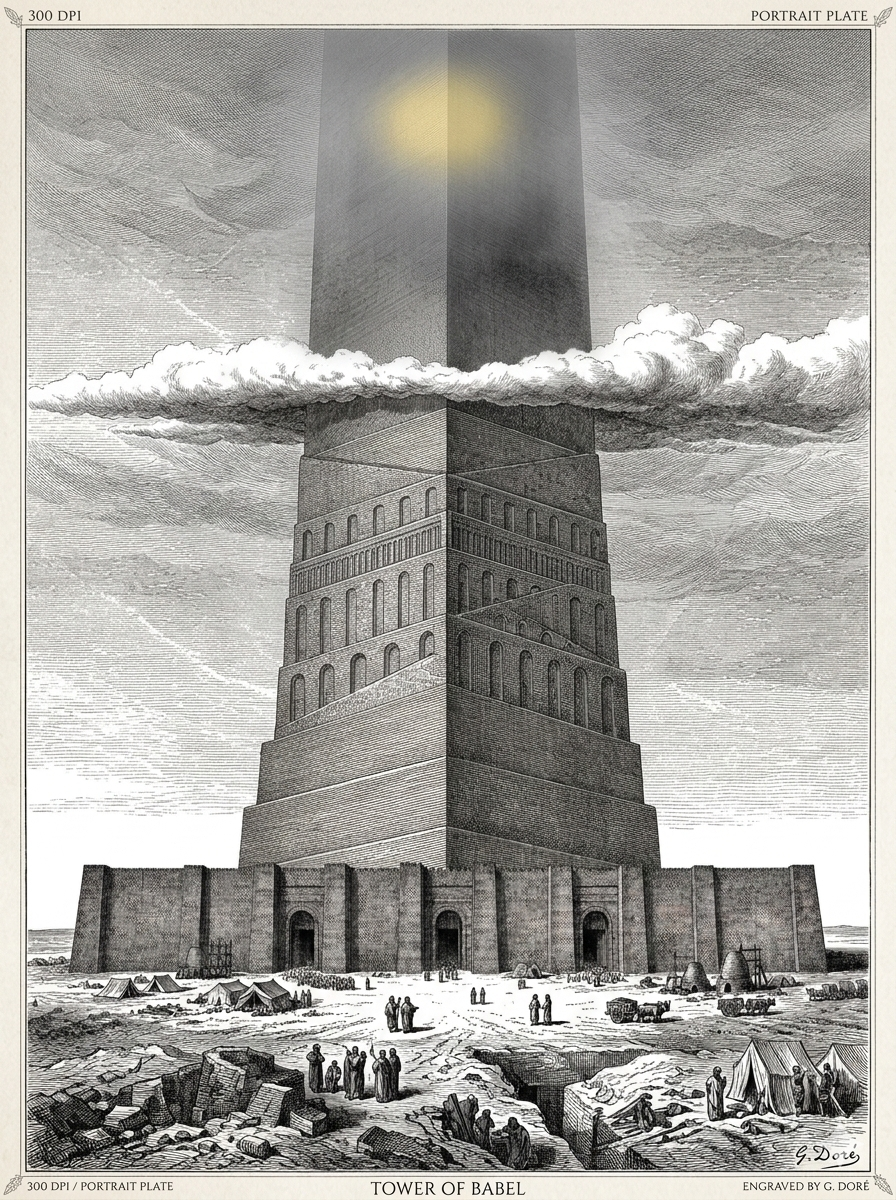
Tower of Babel
The Mile-High Assault on Heaven
by Thomas Veritas
Mater Press (mater.press)
2026
Mater Press
Tower of Babel
The Mile-High Assault on Heaven
by Thomas Veritas
Mater Press (mater.press)
2026
Publisher’s Note
The author writes under the pen name Thomas Veritas for personal reasons. He is a layman, not an ordained priest. The theological content is offered in good faith and has been tested against Scripture and the perennial Magisterium.
Eight people stepped off the Ark onto a world that no longer existed.
Everything they had known (every city, every road, every landmark, every grave) was gone. The antediluvian civilization, whatever its extent, had been erased so completely that not a single structure remained above the waterline. The earth itself was transformed: the topography reshaped by hydraulic forces of unimaginable scale, the atmosphere altered, the climate shifted. Noah and his wife, their three sons and their three wives, stood on the slopes of the mountains of Ararat and looked out over a planet that was, in every meaningful sense, new.
This is the world in which the Tower of Babel was conceived. To understand why men built it, we must first understand what they had survived, and what they had lost.
God’s first act after the Flood was to establish a covenant: the Noahide covenant, which remains in force to this day. The terms are recorded in Genesis 9:
“And God blessed Noah and his sons and said to them, ‘Be fruitful and multiply and fill the earth. The fear of you and the dread of you shall be upon every beast of the earth and upon every bird of the heavens, upon everything that creeps on the ground and all the fish of the sea. Into your hand they are delivered. Every moving thing that lives shall be food for you. And as I gave you the green plants, I give you everything. But you shall not eat flesh with its life, that is, its blood.’ ” (Genesis 9:1–4, ESV)
Several elements of this covenant are directly relevant to the Tower of Babel.
First, the command to “fill the earth” is explicit and repeated. God did not say “settle in one place.” He said “fill the earth”: spread out, disperse, populate the entire globe. This command will be directly defied at Babel, where the builders say “let us make a name for ourselves, lest we be dispersed over the face of the whole earth” (Genesis 11:4). The Tower was, among other things, an act of deliberate disobedience to a specific divine instruction.
Second, the permission to eat meat was new. Before the Flood, humanity had apparently been vegetarian: “Behold, I have given you every plant yielding seed that is on the face of all the earth, and every tree with seed in its fruit. You shall have them for food” (Genesis 1:29). The post-flood permission to eat animal flesh (with the restriction against consuming blood) marks a fundamental change in the human condition. The antediluvian world had been corrupted in part by the giants’ consumption of blood and flesh (1 Enoch 7:3–5); the post-flood command acknowledged the new reality while establishing a boundary.
Third, the prohibition against shedding human blood introduced the principle of capital punishment: “Whoever sheds the blood of man, by man shall his blood be shed” (Genesis 9:6). This was a theological statement grounded in the imago Dei: human life is sacred because humans bear God’s image. The antediluvian world had been “filled with violence” (Genesis 6:11); the Noahide covenant attempted to restrain that violence through the threat of retribution.
The covenant’s sign was the rainbow:
“I have set my bow in the cloud, and it shall be a sign of the covenant between me and the earth. When I bring clouds over the earth and the bow is seen in the clouds, I will remember my covenant that is between me and you and every living creature of all flesh. And the waters shall never again become a flood to destroy all flesh.” (Genesis 9:13–15, ESV)
The Hebrew word for “bow” (qesheth) is the same word used for a weapon, a war bow. God was, in effect, hanging His weapon in the sky, pointed away from the earth. The image is of a warrior who has concluded his campaign and set aside his arms.
Some commentators have noted that the existence of the rainbow as a new sign implies that rainbows had not existed before the Flood. This is consistent with Genesis 2:5–6, which describes a pre-flood world where “the Lord God had not caused it to rain upon the earth” and where “a mist was going up from the land and was watering the whole face of the ground.” If the antediluvian atmosphere operated differently, perhaps involving a water vapor canopy that moderated temperatures and blocked certain wavelengths of light, then the atmospheric conditions necessary for rainbows may not have existed until after the Flood.1
The rainbow covenant is directly relevant to the Tower of Babel for a specific reason: one of the traditional motivations attributed to the Tower’s builders was fear of another flood. Despite God’s explicit promise, the generation of Babel did not trust it. The Book of Jasher records that Nimrod and his people built the Tower in part as a refuge should God send another deluge.2 If this tradition is correct, the Tower was not merely arrogance; it was a failure of faith. God had promised; they did not believe.
The post-flood world was diminished. The most visible sign of this diminishment was the dramatic shortening of human lifespans.
Before the Flood, the patriarchs lived extraordinary spans. Adam lived 930 years (Genesis 5:5). Seth lived 912 years (Genesis 5:8). Methuselah, the longest-lived man in Scripture, reached 969 years (Genesis 5:27). Noah himself lived 950 years (Genesis 9:29), straddling both worlds.
After the Flood, the decline was steep and rapid:
Shem: 600 years (Genesis 11:10–11)
Arphaxad: 438 years (Genesis 11:12–13)
Shelah: 433 years (Genesis 11:14–15)
Eber: 464 years (Genesis 11:16–17)
Peleg: 239 years (Genesis 11:18–19)
Reu: 239 years (Genesis 11:20–21)
Serug: 230 years (Genesis 11:22–23)
Nahor: 148 years (Genesis 11:24–25)
Terah: 205 years (Genesis 11:32)
Abraham: 175 years (Genesis 25:7)
The drop from Eber (464 years) to Peleg (239 years) is the most dramatic single-generation decline in the entire genealogy, a loss of nearly half the previous lifespan. This is significant because Peleg’s name means “division,” and Genesis 10:25 states: “To Eber were born two sons: the name of the one was Peleg, for in his days the earth was divided.” The “division” is universally connected in ancient commentary to the events at Babel.3 Something happened in Peleg’s generation that halved human lifespan.
The Septuagint gives somewhat different numbers, adding an additional generation (Cainan, between Arphaxad and Shelah) and assigning longer lifespans to several patriarchs. The Samaritan Pentateuch gives yet a third set of figures. The discrepancies have generated extensive scholarly discussion.4 Regardless of which textual tradition one follows, all three agree on the fundamental trajectory: lifespans declined sharply after the Flood.
What caused the decline? Several theories have been proposed:
Atmospheric change: If a water vapor canopy existed before the Flood and was destroyed during it, the resulting increase in cosmic radiation could have accelerated cellular aging.5
Genetic bottleneck: Only eight people survived the Flood, representing a severe reduction in genetic diversity. Subsequent inbreeding would have concentrated deleterious mutations.6
Dietary change: The introduction of meat-eating may have altered human physiology in ways that reduced longevity.
Divine decree: God had announced a reduction before the Flood: “My Spirit shall not abide in man forever, for he is flesh: his days shall be 120 years” (Genesis 6:3). Moses died at exactly 120 years (Deuteronomy 34:7).
The lifespan decline matters for the Tower because it establishes the psychological context. The builders were people watching their world shrink. Their ancestors had lived nine centuries; they might live two or three. The glory of the antediluvian world was fading from living memory, but not yet gone.
Genesis 10 is one of the most remarkable documents in ancient literature: a comprehensive genealogy of all the peoples of the known world, traced back to three brothers: Shem, Ham, and Japheth.
The Table of Nations is not merely a family tree. It is a geopolitical map of the ancient world, encoded in genealogical form. Each name represents not just an individual but a people, a territory, a language group. The table’s accuracy has been confirmed repeatedly by archaeology, linguistics, and genetics.7
Japheth’s descendants (Genesis 10:2–5) are identifiable with remarkable precision:
Gomer: The Cimmerians, known to the Assyrians as Gimirrai.8
Magog: Traditionally the Scythians (Josephus, Antiquities I.6.1).
Madai: The Medes of Iran.9
Javan: The Ionians, the Greeks. Hebrew Yavan is cognate with Greek Iaones.10
Tubal: The Tabali of Assyrian records, Anatolian.11
Meshech: The Mushki, associated by Herodotus with the Moschoi (Histories III.94).
Tiras: Plausibly the Thracians (Josephus, Antiquities I.6.1).
The Japhethites populated Europe, Central Asia, and the northern reaches of the ancient world.
Ham’s descendants occupied Africa and parts of the Near East (Genesis 10:6–20):
Cush: Ethiopia and the upper Nile region.12
Egypt (Mitzraim): The identification is beyond dispute.
Put: Libya or Punt (Josephus, Antiquities I.6.2).
Canaan: The peoples of the Levantine coast and Palestine.
Critically, Nimrod, the builder of Babel, appears in the Hamite genealogy as a descendant of Cush: “Cush fathered Nimrod; he was the first on earth to be a mighty man” (Genesis 10:8). The Tower of Babel was a Hamite project in its origins.
Shem’s descendants are listed last and in greatest detail, because it is through Shem that the Abrahamic line descends (Genesis 10:21–31). The Semitic peoples include the Elamites, Assyrians, Arameans, and, through Eber, Peleg, and the succeeding patriarchs, the Hebrews and Arabs. The name “Hebrew” (Ivri) is generally derived from Eber, Shem’s great-grandson.13
The total count of names in the Table of Nations is traditionally reckoned at seventy (Masoretic) or seventy-two (Septuagint). This number will become central to the Babel tradition: the confusion of tongues produced seventy languages, one for each nation.
Genesis 11:1 establishes the linguistic situation before Babel:
“Now the whole earth had one language and the same words.” (Genesis 11:1, ESV)
The Hebrew is precise: saphah echath (“one lip”) and devarim achadim (“one set of words”). The entire human race spoke a single language and shared a common vocabulary. This implies a single culture, a single knowledge base, a single technological tradition. Whatever Noah’s family knew (about agriculture, metallurgy, construction, navigation, astronomy) was transmitted in one language to all their descendants. The builders of Babel were not primitive. They were the inheritors of a unified civilizational tradition stretching back through Noah to the antediluvian world.
Genesis 11:2 records the migration:
“And as people migrated from the east, they found a plain in the land of Shinar and settled there.” (Genesis 11:2, ESV)
The “land of Shinar” is identified by all ancient and modern commentators with southern Mesopotamia, the alluvial plain between the Tigris and Euphrates, in modern Iraq.14 The direction “from the east” suggests migration from the mountains of Ararat.
Southern Mesopotamia is one of the flattest places on earth. It has virtually no stone and no timber. Construction required brick: kiln-fired clay bricks cemented with bitumen, the natural asphalt that seeps from the ground throughout the region.15
Genesis 11:3 records this with precision: “Come, let us make bricks, and burn them thoroughly. And they had brick for stone, and bitumen for mortar.” The text is aware that brick-and-bitumen was a substitute for stone available elsewhere. The archaeological record confirms this was the standard monumental construction technique in southern Mesopotamia from the earliest periods.16
When was the Tower built? Using the Masoretic Text, Arphaxad was born 2 years after the Flood (Genesis 11:10), and the generations to Peleg span approximately 101 years. If the Tower was built “in the days of Peleg,” it occurred roughly 100–240 years after the Flood.
Using the Septuagint chronology, the interval is approximately 531 years, allowing for greater population growth.17
The overlap of lifespans produces a remarkable situation:
Noah lived 350 years after the Flood (Genesis 9:28). He was alive during the Tower’s construction.
Shem lived 500 years after the birth of Arphaxad (Genesis 11:11); he outlived Abraham by about 35 years.
Arphaxad, Shelah, and Eber were all alive during the Tower’s construction.
When the Tower was built, men who had personally witnessed the Flood, who had been on the Ark, were still living. Noah himself, who had “walked with God” (Genesis 6:9), was alive when his descendants defied God’s command and gathered on a plain in Shinar to build a tower to heaven.
Jubilees 7:20–39 records a lengthy speech by Noah to his descendants, warning them against the sins that had provoked the Flood. Whether or not this specific speech is historical, the principle is sound: Noah would have had every reason to warn, and every reason to be ignored by a generation that had not seen the Flood with its own eyes.
The Flood had destroyed the antediluvian world, but it had not destroyed sin.
Genesis 9:20–27 records Noah’s drunkenness and Ham’s sin. The exact nature of Ham’s offense has been debated for millennia. The phrase “saw the nakedness of his father” may be a euphemism for a sexual violation; the same phrase appears in Leviticus 18 and 20 for incestuous acts.18 Noah’s response was severe: “Cursed be Canaan; a servant of servants shall he be to his brothers” (Genesis 9:25).
The Hamite line was morally compromised within the first generation after the Flood. Nimrod, the builder of Babel, was a grandson of Ham through Cush. The Tower was built by a line already under a curse.
The Book of Jubilees adds that demonic activity resumed shortly after the Flood:
“And in the third week of this jubilee the unclean demons began to lead astray the children of the sons of Noah, and to make to err and destroy them.” (Jubilees 10:1)19
Noah prayed for deliverance. God ordered the angels to bind all the demons, but the chief of the demons, Mastema, petitioned God to leave him a tenth of his spirits. God granted the petition: nine-tenths were bound, one-tenth remained free (Jubilees 10:7–9). The Tower was not merely a human endeavor but one influenced by demonic powers permitted to remain active in the post-flood world.
By the time Genesis 11 begins, all the elements are in place: a unified humanity speaking a single language; a divine command to fill the earth; a covenant sealed with a rainbow; a cursed Hamite line producing a mighty man named Nimrod; patriarchs who had survived the Flood still living among their descendants; and demonic spirits, partially unbound, influencing human affairs.
In the midst of it all, a flat, stoneless plain in southern Mesopotamia, where the earth produced an abundance of clay for bricks and the ground seeped with bitumen for mortar.
The world after the Flood was diminished in lifespans, in knowledge, and in obedience, but not yet in ambition. The generation of Babel had inherited enough of the antediluvian world’s capabilities, and enough of its arrogance, to attempt something no generation before or since has tried: to build a structure that would reach from earth to heaven.
To understand who led them, we must turn to the most enigmatic figure in Genesis 10: Nimrod, the mighty hunter before the Lord.
The Bible devotes only four verses to Nimrod. They are among the most debated four verses in Genesis.
“Cush fathered Nimrod; he was the first on earth to be a mighty man. He was a mighty hunter before the Lord. Therefore it is said, ‘Like Nimrod a mighty hunter before the Lord.’ The beginning of his kingdom was Babel, Erech, Accad, and Calneh, in the land of Shinar. From that land he went into Assyria and built Nineveh, Rehoboth-Ir, Calah, and Resen between Nineveh and Calah; that is the great city.” (Genesis 10:8–12, ESV)
From these four verses, the ancient world constructed a figure of immense significance: a tyrant, a rebel against God, the first empire-builder, and the man who conceived and commanded the construction of the Tower of Babel. Every major ancient source (Jewish, Christian, and Islamic) treats Nimrod as the driving force behind the Tower. The canonical text does not explicitly link Nimrod to the Tower, but the connection is made by geography (Babel is the first city of his kingdom), by chronology (he is the only named ruler of Shinar before the confusion of tongues), and by the unanimous testimony of post-biblical tradition.
The name “Nimrod” (Nimrod in Hebrew) has been the subject of extensive etymological discussion. The most common derivation connects it to the Hebrew root marad, meaning “to rebel.” If this is correct, the name is either a description (“the rebel”) or a program: Nimrod was named for what he would become.20
Other proposed etymologies include a connection to the Akkadian namru (“bright” or “shining”), which would give the name a positive connotation, possibly ironic in context.21 David Rohl has proposed a derivation from the Sumerian NIM.RUD, connecting Nimrod to Sumerian royal titles.22
The “rebel” etymology dominates the tradition and fits the characterization in every ancient source outside the canonical text.
The phrase “a mighty hunter before the Lord” (Genesis 10:9) has been interpreted in two opposite ways.
The favorable reading: Nimrod was a great hunter whom God blessed, a protector of the post-flood community against wild beasts. This reading takes “before the Lord” as an expression of divine approval, the way one might say “great in the eyes of God.”
The unfavorable reading: “Before the Lord” (liphnei YHWH) means “in the face of the Lord” or “against the Lord.” Nimrod was not a hunter of animals but a hunter of men’s souls, a tyrant who set himself up in opposition to God. This is the dominant reading in Jewish and Christian tradition.23
The Targum Pseudo-Jonathan makes the sinister interpretation explicit:
“He was mighty in hunting and in sin before the Lord, for he was a hunter of the sons of men, and he said to them, ‘Depart from the judgment of the Lord, and adhere to the judgment of Nimrod.’ ”24
Josephus provides the most detailed interpretation:
“Now it was Nimrod who excited them to such an affront and contempt of God. He was the grandson of Ham, the son of Noah, a bold man, and of great strength of hand. He persuaded them not to ascribe it to God, as if it were through his means they were happy, but to believe that it was their own courage which procured that happiness. He also gradually changed the government into tyranny, seeing no other way of turning men from the fear of God, but to bring them into a constant dependence on his power. He also said he would be revenged on God, if he should have a mind to drown the world again; for that he would build a tower too high for the waters to reach. And that he would avenge himself on God for destroying their forefathers.”25
This passage attributes to Nimrod not merely ambition but a theological program: the deliberate replacement of gratitude toward God with self-reliance, the transformation of a community into a tyranny, and a specific desire for revenge against God for the Flood. The Tower, in Josephus’s telling, was a weapon aimed at heaven.
The rabbinic traditions about Nimrod are extensive and detailed, far exceeding the canonical text.
The Targum Pseudo-Jonathan and the Book of Jasher preserve a tradition that Nimrod’s power derived from a supernatural source: the garments that God had made for Adam and Eve in the Garden of Eden (Genesis 3:21).
The Book of Jasher traces the garments’ descent:
“And Cush the son of Ham took the garments of skin which God had made for Adam and his wife when they went out of the garden, and these were given after the death of Adam to Enoch, the son of Jared, and when Enoch was taken up to God, he gave them to Methuselah. And Methuselah at his death gave them to Noah, and Noah brought them into the Ark. And Ham stole those garments from Noah his father, and he took them and hid them from his brothers. And when Ham begat Cush, he gave him the garments in secret. And when Cush had begotten Nimrod, he gave him those garments through his love for him, and Nimrod grew up, and when he was twenty years old he put on the garments.”26
According to this tradition, when Nimrod wore the garments, “all the animals and beasts of the field would come and fall down before him, and all the sons of men were in dread and fear of him.”27 This explains the title “mighty hunter”: not that Nimrod hunted by skill, but that animals submitted to him supernaturally because of the garments. The garments gave Nimrod a counterfeit version of Adam’s original dominion over creation (Genesis 1:28).
The theft of the garments (from Adam to Enoch to Methuselah to Noah to Ham to Cush to Nimrod) is a genealogy of stolen authority. The legitimate line of transmission was disrupted by Ham’s sin, and the garments ended up clothing a tyrant rather than a patriarch. The parallel to Solomon’s ring is suggestive: both are objects of divine origin that confer supernatural authority, and both end up in the hands of men who misuse them.
The rabbinic tradition places Nimrod in direct conflict with Abraham. According to the Midrash Rabbah (Genesis Rabbah 38:13) and the Book of Jasher (chapters 11–12), Nimrod was the king who cast Abraham into a fiery furnace for refusing to worship idols. This tradition identifies the “Ur of the Chaldeans” from which Abraham departed (Genesis 11:31) not merely as a place name but as a reference to fire (ur = “fire” in Hebrew): Abraham was delivered from the fire of the Chaldeans, from Nimrod’s furnace.28
The Talmud (Pesachim 94b) records a debate about whether Nimrod was a hunter of animals or of men. The consensus: Nimrod “trapped men’s minds” and led them into idolatry.
Pirke de-Rabbi Eliezer (chapter 24) states that Nimrod ordered the Tower’s construction, and that the purpose was explicitly to wage war against God:
“Nimrod said to his people: ‘Come, let us build a great city for ourselves and a tower in the midst of it, whose top shall reach unto heaven, and let us make us a great name upon the earth, and let us wage war against Him, lest perchance He bring upon us a second deluge.’ ”29
This passage combines all three motivations for the Tower: self-glorification (“a great name”), war against God, and flood protection.
The Pirke de-Rabbi Eliezer goes on to describe the Tower’s construction in vivid detail. The builders shot arrows into the sky, and the arrows returned stained with blood, leading them to believe they had wounded the inhabitants of heaven.30 This tradition is attested independently in Islamic sources, confirming its antiquity.
The Talmud (Sanhedrin 109a) records that the builders of the Tower were divided into three factions. One faction said, “Let us ascend and dwell there.” A second said, “Let us ascend and wage war.” A third said, “Let us ascend and serve idols.” Each faction received a different punishment: the first was scattered, the second was turned into apes and spirits and demons, and the third had their languages confused.31 The second group’s transformation into “apes and spirits and demons” is a remarkable detail that connects the Babel narrative to demonology.
The Quran does not name Nimrod directly, but Islamic tradition unanimously identifies the unnamed king who argued with Abraham about God in Surah 2:258 as Namrud:
“Have you not considered the one who argued with Abraham about his Lord merely because God had given him kingship? When Abraham said, ‘My Lord is the one who gives life and causes death,’ he said, ‘I give life and cause death.’ Abraham said, ‘Indeed, God brings up the sun from the east, so bring it up from the west.’ So the disbeliever was overwhelmed.” (Surah 2:258)
The Islamic commentators elaborate extensively:
Al-Tabari (History of Prophets and Kings) records that Nimrod was one of only four kings who ruled the entire earth, the others being Solomon, Nebuchadnezzar, and Dhul-Qarnayn (often identified with Alexander the Great).32 Al-Tabari preserves the tradition that Nimrod attempted to ascend to heaven by means of a chest carried aloft by four vultures, lured upward by meat suspended on poles above them. When he looked down, he saw the earth as a small circle surrounded by water; when he looked up, the sky seemed as far as ever. He shot arrows at the heavens; they returned bloodied, and he declared, “I have killed the God of heaven.”33
Al-Tha’labi (Qisas al-Anbiya’) adds that God sent a gnat (ba’uda) that entered Nimrod’s nose and bored into his brain, tormenting him for four hundred years until he died in agony, a fitting end for a man who claimed to be God.34
Ibn Kathir (Stories of the Prophets) provides a synthesis: Nimrod’s command to build the Tower, his conflict with Abraham, the fiery furnace, and his death by the gnat. Ibn Kathir notes that Nimrod reigned for approximately four hundred years, consistent with the extended lifespans of the early post-flood period.35
The convergence of Jewish and Islamic sources on the details of Nimrod’s character (his tyranny, his defiance of God, his conflict with Abraham, even the motif of arrows shot at heaven returning bloodied) strongly suggests a common pre-Islamic, pre-rabbinic tradition of considerable antiquity.
The identification of Nimrod with Gilgamesh has been proposed by several scholars and deserves careful examination.
The parallels are striking:
Both are rulers in the land of Shinar. Nimrod’s kingdom includes Erech (Genesis 10:10); Gilgamesh is king of Uruk, the same city.36
Both are described as “mighty” men of extraordinary strength and stature.
Both are associated with defiance of divine authority. Nimrod defies God by building the Tower; Gilgamesh seeks immortality in defiance of the gods’ decree of death.
Both are placed in the early post-flood period.
The Sumerian King List records Gilgamesh as the fifth king of the First Dynasty of Uruk after the Flood. Nimrod is the first major ruler after the Flood mentioned in Genesis.
The difficulty with the identification is chronological. The Sumerian King List dates Gilgamesh to approximately 2700–2600 BCE, while the Tower of Babel would fall earlier in the post-flood chronology. However, the absolute dates assigned to the Sumerian King List are modern constructs based on archaeological interpretation, and the overlap between the biblical and Mesopotamian chronologies remains debated.37
George Smith, the Assyriologist who first translated the Flood Tablet of the Gilgamesh Epic in 1872, noted that several cuneiform fragments describe Gilgamesh building the great walls of Uruk, a monumental construction project requiring enormous labor.38 The Epic opens and closes with a description of these walls, presented as Gilgamesh’s greatest achievement.
The Epic describes Gilgamesh as “two-thirds divine, one-third human,” an unusual fraction that may reflect hybrid Nephilim nature. His mother Ninsun was a goddess; his father Lugalbanda a king. The Yale Tablet gives his height as eleven cubits, approximately sixteen feet.39
Whether or not Nimrod and Gilgamesh are the same individual, they belong to the same world: the early post-flood civilization of southern Mesopotamia, where mighty men built cities, defied divine authority, and attempted feats their descendants could not replicate.
Genesis 10:8 calls Nimrod a gibbor, a “mighty man” or “warrior.” The same word describes the Nephilim in Genesis 6:4: “These were the mighty men (gibborim) that were of old, the men of renown.” The verbal echo is impossible to miss.
Nimrod is a descendant of Ham. As we shall discuss in the next chapter, the wives of Noah’s sons may have carried Nephilim genetics, and Scripture says nothing about the wives’ purity. If Ham’s wife carried the bloodline, then Cush and subsequently Nimrod could have inherited giant traits. Josephus describes Nimrod as a man “of great strength of hand,” language suggesting unusual physical power.40
The Book of Jasher (7:23) states that when Nimrod was twenty years old, “he was a man of force and his stature was beyond ordinary.” If taken literally, Nimrod was physically imposing in a way that set him apart, consistent with partial Nephilim ancestry.
If Gilgamesh was sixteen feet tall and Nimrod is the same figure (or even a figure from the same era and region) then the builder of Babel was not merely a man with a plan. He was a giant, possibly carrying the blood of the fallen angels’ offspring, leading a construction project of literally superhuman ambition.
Whatever Nimrod’s physical nature, his political achievement is clear. He was the first empire-builder. Genesis 10:10–12 lists his cities:
Babel: The city of the Tower, later Babylon.
Erech: Uruk, one of the earliest and largest cities in Mesopotamia, with a population possibly reaching 40,000–80,000 by the late 4th millennium BCE.41
Accad: Akkad, capital of Sargon the Great’s empire. Its precise location has never been found.42
Calneh: Identification uncertain, possibly Nippur or Kullab.43
Nineveh: The great Assyrian capital on the Tigris, excavated by Layard and Rassam in the 1840s–1850s.
Calah: Modern Nimrud, named after Nimrod, excavated by Layard beginning in 1845.
Rehoboth-Ir and Resen: Possibly suburbs or quarters of the Nineveh metropolitan area.
The scope is extraordinary. Nimrod’s kingdom spanned the entire Tigris-Euphrates valley, from southern Mesopotamia to northern Mesopotamia, what would later become the heartlands of both Babylonia and Assyria.
Josephus says Nimrod “gradually changed the government into tyranny.” The word “gradually” is significant. He did not seize power by force initially. He built a following, accumulated influence, and transformed a community of free descendants of Noah into subjects of a centralized state. The Tower was the crowning project of this state: a monument to its power, a symbol of its unity, and a weapon aimed at the God who had drowned the world.
The Cave of Treasures (Me‘arat Gazze), a Syriac Christian text dating to the 4th–6th century CE and attributed to Ephrem the Syrian, provides a detailed account of Nimrod and the Tower:
“And Nimrod, the son of Cush, became a giant upon the earth. By the power of the garments of skin which God made for Adam and Eve, he was able to make all beasts and birds come to him. And men thought he was mighty by his own strength, and they made him king over them. And he reigned over all the children of Ham.”44
The Cave of Treasures goes on to describe the Tower’s construction in terms that emphasize its spiritual dimension: the builders were not merely erecting a structure but attempting to “make war upon God,” a cosmic rebellion that recapitulated the fall of the angels.
The Book of the Bee, composed by Solomon of Basra (a 13th-century Nestorian bishop), adds further details from the Syriac tradition:
“Nimrod, the son of Cush, was the first king after the Flood. He built Babel, and he and his people worshipped fire. And he saw in the sky a dark blue crown like unto a king’s crown, and he desired to take it and set it upon his head. And this crown was the constellation that is called the Eagle.”45
The detail about Nimrod worshipping fire connects to the Zoroastrian influence on Mesopotamian religion and to the fiery furnace tradition in which Nimrod cast Abraham.
The Armenian historian Moses of Chorene (Movses Khorenatsi), writing in the 5th century CE, records a tradition that Nimrod (whom he calls Bel) was involved in a war with Hayk, the legendary ancestor of the Armenian people. According to Moses of Chorene, Hayk defeated Bel/Nimrod in battle near Lake Van, establishing Armenia as an independent nation and striking the first blow against the tyranny of Babel.46
This tradition is unique to Armenian literature but reflects the widespread ancient understanding that Nimrod was a universal tyrant whose power was resisted by the righteous.
The Kebra Nagast, the Ethiopian national epic, refers to Nimrod indirectly through its elaborate genealogies connecting the Ethiopian royal house to Solomon, and through Solomon to David, and through the patriarchs back to Shem. In the Ethiopian tradition, the line of Shem is the righteous line, and the builders of Babel are associated with the line of Ham, confirming the canonical text’s placement of Nimrod as a Hamite.47
Across all these traditions (canonical, Jewish, Christian, Islamic, Syriac, Armenian, and Ethiopian) a consistent portrait emerges:
Nimrod was the grandson of Ham, the cursed son of Noah. He was a man of extraordinary physical power and stature, possibly of Nephilim descent. He acquired supernatural authority through the stolen garments of Adam. He was the first man after the Flood to establish a kingdom, and the first to transform governance into tyranny. He turned men away from God and toward dependence on his own power. He conceived and commanded the construction of the Tower of Babel as a monument to human self-sufficiency, a weapon against God, and a refuge against a second flood. He was the opponent of Abraham, the patriarch of the faithful. And he died in agony, brought down by the smallest of God’s creatures: a gnat.
No ancient source speaks well of Nimrod. The man who built Babel was remembered by every civilization that preserved his memory as a tyrant, a rebel, and a fool.
The Tower he built would require more than tyranny to construct. It would require labor, labor on a scale that defied ordinary human capability. For that, we must consider the possibility that Nimrod did not build with human hands alone. But first, we must examine the question of who, exactly, was living in Shinar when the Tower was built, and whether they were entirely human.
The question that haunts the post-flood narrative is simple: if the Flood was sent to destroy the Nephilim and their corruption of all flesh, why do giants appear again after the Flood?
The spies sent by Moses into Canaan reported: “And there we saw the Nephilim (the sons of Anak, who come from the Nephilim), and we seemed to ourselves like grasshoppers, and so we seemed to them” (Numbers 13:33). The Anakim, the Rephaim, Og of Bashan with his thirteen-foot bed, Goliath and his polydactyl kinsmen; the Old Testament is populated with giants who should not have existed if the Flood had accomplished its purpose.
This chapter examines how the Nephilim bloodline may have survived the Flood, what that means for the population of Shinar in Nimrod’s day, and why it matters for the Tower of Babel.
The angelic incursion described in Genesis 6:1–4 is the essential background:
“When man began to multiply on the face of the land and daughters were born to them, the sons of God saw that the daughters of man were attractive. And they took as their wives any they chose. Then the Lord said, ‘My Spirit shall not abide in man forever, for he is flesh: his days shall be 120 years.’ The Nephilim were on the earth in those days, and also afterward, when the sons of God came in to the daughters of man and they bore children to them. These were the mighty men who were of old, the men of renown.” (Genesis 6:1–4, ESV)
The “sons of God” (bene ha’elohim) are identified in the oldest and most textually supported interpretation as angels, specifically the group known in the Book of Enoch as the Watchers.48 Two hundred Watchers descended on Mount Hermon under the leadership of Semjâzâ and swore an oath to take human wives (1 Enoch 6:1–6). Their offspring were the Nephilim, giants of extraordinary size and appetite.
The Book of Enoch describes the consequences:
“And the women became pregnant, and they bare great giants, whose height was three thousand ells: who consumed all the acquisitions of men. And when men could no longer sustain them, the giants turned against them and devoured mankind. And they began to sin against birds, and beasts, and reptiles, and fish, and to devour one another’s flesh, and drink the blood.” (1 Enoch 7:2–5)49
The Watchers also taught humanity forbidden knowledge. Azazel taught metallurgy, weapon-making, and cosmetics (1 Enoch 8:1–2). Semjâzâ taught enchantments and root-cuttings. Others taught astrology, astronomy, and the signs of the earth. This knowledge, given before humanity was ready for it or intended to have it, accelerated the corruption of the antediluvian world.
The result was comprehensive: “And God saw that the wickedness of man was great in the earth, and that every intention of the thoughts of his heart was only evil continually” (Genesis 6:5). More than that: “All flesh had corrupted their way upon the earth” (Genesis 6:12). The corruption was not limited to human morality. It extended to the biological order itself.
In this context of universal corruption, one detail about Noah takes on enormous significance:
“Noah was a righteous man, blameless in his generation. Noah walked with God.” (Genesis 6:9, ESV)
The Hebrew word translated “blameless” is tamim. It is the same word used in Leviticus for sacrificial animals that must be “without blemish,” physically perfect, with no defect. When applied to a sacrificial lamb, tamim is not a moral judgment; it is a biological one. The lamb must be genetically sound, physically unblemished, free of any corruption.
Applied to Noah, tamim may carry a double meaning: morally righteous and physically/genetically uncorrupted. Noah was “blameless in his generations” (tamim b’dorotav), perfect in his genealogy. His bloodline had not been contaminated by the Nephilim interbreeding that had corrupted “all flesh.”50
If this reading is correct, then Noah was chosen not only because he was righteous but because he was genetically pure, one of the last men on earth whose bloodline had not been corrupted by the angelic incursion. The Flood was, among other things, a genetic reset: the elimination of a corrupted gene pool and the preservation of an uncorrupted one.
But here is the problem. Scripture tells us that eight people entered the Ark: Noah, his wife, and his three sons with their wives (Genesis 7:13). Scripture tells us that Noah was tamim, blameless, uncorrupted. Scripture says nothing about the wives.
Not one word.
We know their names from extra-biblical tradition: Jubilees 4:33 names Noah’s wife as Emzara; the Book of Jasher gives the names of the sons’ wives. But neither Scripture nor tradition makes any claim about their genetic purity. The silence is deafening.
If even one of the four women on the Ark carried Nephilim genetics (recessive traits from a Nephilim ancestor somewhere in her lineage) then the corruption that God sent the Flood to destroy was carried through the Flood in the very vessel designed to escape it.
This would explain one of the most troubling features of the post-flood narrative: the reappearance of giants.
Consider the Ark’s dimensions: 300 cubits long, 50 cubits wide, 30 cubits tall (Genesis 6:15). Using the standard cubit of approximately 18 inches, this gives dimensions of approximately 450 feet long, 75 feet wide, and 45 feet tall. The Ark was enormous, roughly the size of a modern cargo ship.
But consider the Nephilim. The Book of Jubilees gives their height as ranging from 120 to 300 cubits, or 180 to 450 feet.51 The Book of Enoch says 3,000 ells. Even if these numbers are exaggerated by a factor of ten, the first-generation Nephilim were beings of extraordinary size.
The Ark’s height of 30 cubits (45 feet) is significant. A first-generation Nephilim could not have fit inside it. The vessel’s dimensions were calibrated to exclude the giants while accommodating everything else. God gave Noah exact specifications for a reason: the Ark was designed to save the uncorrupted and exclude the corrupted.
But if the corruption was carried not in the bodies of giants but in the recessive genetics of apparently normal-sized women, then the Ark’s physical dimensions would not have filtered it out. The corruption could have passed through the bottleneck of the Flood in the DNA of Noah’s daughters-in-law.
The Old Testament records multiple encounters with giants after the Flood:
The Rephaim: A race of giants inhabiting Transjordan before the Israelite conquest. Genesis 14:5 records that Chedorlaomer “defeated the Rephaim in Ashteroth-karnaim.” The name Rephaim is related to the Hebrew root meaning “the dead” or “shades,” connecting them to the underworld and possibly to the spirits of the dead Nephilim.52
The Anakim: Descendants of Anak, who lived in Hebron and the hill country of Judah. The spies sent by Moses reported: “We saw the Nephilim (the sons of Anak, who come from the Nephilim)” (Numbers 13:33). The text explicitly identifies the Anakim as descendants of the Nephilim, not merely “like” the Nephilim but genetically connected to them. Deuteronomy 2:10–11 adds: “The Emim formerly lived there, a people great and many, and tall as the Anakim. Like the Anakim they are also counted as Rephaim.”
Og of Bashan: “For only Og the king of Bashan was left of the remnant of the Rephaim. Behold, his bed was a bed of iron. Is it not in Rabbah of the Ammonites? Nine cubits was its length, and four cubits its breadth” (Deuteronomy 3:11). Nine cubits is approximately thirteen and a half feet. A bed of that size implies a man of at least twelve feet in height. Og was “left of the remnant of the Rephaim,” the last of a dying race of giants.
Goliath: “And there came out from the camp of the Philistines a champion named Goliath of Gath, whose height was six cubits and a span” (1 Samuel 17:4). Six cubits and a span is approximately nine feet nine inches.53 Goliath’s brother and kinsmen were also of unusual size, and 2 Samuel 21:20 records one with six fingers on each hand and six toes on each foot, polydactyly, a genetic anomaly consistent with the kind of chromosomal irregularity one might expect from a hybridized bloodline.
The Zamzummim, Emim, and Horim: Deuteronomy 2:10–23 lists several peoples of great stature displaced by the descendants of Esau and Lot. The text treats these as historical populations that once occupied specific territories.
The geographic distribution of these giant peoples is significant. They are concentrated in Canaan, Transjordan, and the coastal plain, territories associated with the descendants of Ham (through Canaan) and, in the case of the Philistines, with the “sea peoples” whose origins are debated but who are listed among the descendants of Ham in Genesis 10:14.54
If the Nephilim bloodline survived through the wives, the concentration of giants among Hamite-descended populations would make sense: Ham’s wife may have been the carrier.
The survival of Nephilim genetics through Noah’s daughters-in-law is not the only explanation proposed for post-flood giants. Several alternatives deserve consideration:
A second angelic incursion: The phrase “and also afterward” in Genesis 6:4 may indicate that the sons of God continued to take human wives after the Flood, a second incursion. Jubilees 10:1–5 records that “unclean demons” were active among Noah’s grandchildren, and Jude 6–7 warns of angels who “did not stay within their own position of authority” in a context that suggests the possibility of ongoing angelic transgression. If fallen angels continued to father hybrid offspring after the Flood, then no genetic transmission through the wives is necessary.55
The term “Nephilim” became generic: After the Flood, the memory of the Nephilim was preserved, and any person of unusual size was called a “Nephilim” by analogy, without implying actual genetic descent. The spies in Numbers 13:33 may have been exaggerating to discourage the invasion of Canaan.56
Natural genetic variation: Gigantism occurs naturally through pituitary disorders and other genetic conditions. The post-flood giants may simply have been unusually large individuals without any supernatural ancestry.
Each of these explanations has weaknesses. The “second incursion” theory lacks direct biblical support beyond the ambiguous “and also afterward.” The “generic term” theory does not account for the text’s explicit statement that the Anakim “come from the Nephilim” (Numbers 13:33). The “natural variation” theory cannot explain the concentration of giants in specific ethnic groups and territories, their association with polydactyly and other anomalies, or their persistent connection in the text to the pre-flood Nephilim.
The most economical explanation remains that Nephilim genetics passed through the Flood via one or more of the wives, and that these recessive traits expressed themselves in subsequent generations, particularly, it would seem, in the Hamite line.
If Nephilim descendants were present in the post-flood population, they were present at Babel. The Tower was built in Shinar, where Nimrod (himself a gibbor, a “mighty man” of the same type as the antediluvian Nephilim) had established his kingdom. The population that gathered to build the Tower would have included whatever giant-blooded individuals existed in the early post-flood world.
What would giants contribute to a construction project? The obvious answer is labor. Beings of twelve to sixteen feet in height, with proportional strength, could move materials that normal-sized humans could not. A block of kiln-fired brick that would require a team of men to lift could be carried by a single giant. The logistics of building a structure of the traditional dimensions (thousands of cubits in height) become somewhat less impossible if the labor force included beings of superhuman size and strength.
But the contribution would go beyond mere muscle. The Nephilim were, according to all ancient traditions, the offspring of beings who possessed knowledge beyond the human. The Watchers had taught forbidden arts: metallurgy, enchantments, astrology, construction techniques that were not part of God’s intended curriculum for humanity. If the descendants of the Nephilim inherited even a fraction of this knowledge, they would have possessed technical capabilities that their fully human contemporaries lacked.
The antediluvian world, whatever it looked like, produced structures and achievements that were lost in the Flood. The post-flood world, inheriting fragments of that knowledge through Noah’s family and possibly through Nephilim bloodlines, attempted to reconstruct what had been lost. The Tower of Babel may have been the most ambitious of these attempts, a project that drew on both the physical strength of giant laborers and the forbidden knowledge of the Watchers’ descendants.
There is a grim irony in the Ark’s relationship to the Nephilim. God instructed Noah to build the Ark to specific dimensions: 300 cubits long, 50 wide, 30 tall. These dimensions were not arbitrary. The Ark needed to be large enough to house Noah’s family, the animals, and sufficient provisions, but not so large that it could accommodate the Nephilim.
The Ark’s height of 30 cubits (45 feet), divided into three decks (Genesis 6:16), gave a ceiling height of approximately 10 cubits (15 feet) per deck. A first-generation Nephilim of even modest size (say, 20 to 30 feet) could not have entered. The Ark was, by design, a filter: it preserved the uncorrupted and excluded the corrupted.
But genetics is subtler than architecture. A woman of normal stature carrying recessive Nephilim genes would have fit through any door on the Ark. The corruption that God sought to eliminate may have slipped through in the most intimate possible way: in the womb.
This raises a theological question that Scripture does not answer directly: did God know? If God designed the Ark’s dimensions to exclude Nephilim, did He not foresee that the bloodline could survive through the wives? The question is unanswerable from Scripture alone. What we can say is that Genesis 6:4 states, with apparent foreknowledge, that Nephilim existed “and also afterward,” a phrase that, at minimum, indicates the biblical author was aware that the Flood did not permanently eliminate the problem.
The presence of giants in the post-flood world is not limited to the biblical narrative. Virtually every ancient civilization preserved traditions of a race of giants:
Greek mythology: The Titans, offspring of Uranus (Heaven) and Gaia (Earth), were beings of enormous size who waged war against the Olympian gods (the Titanomachy). The Gigantes, another race of giants, attempted to storm Olympus by piling mountains on top of each other, a striking parallel to the Tower of Babel.57
Norse mythology: The Jötnar (giants) were primordial beings who existed before the gods and were in perpetual conflict with them. The frost giants descended from Ymir, the first being.58
Hindu mythology: The Asuras were a race of powerful beings who opposed the Devas (gods). The Daityas, a subclass of Asuras, were the offspring of Diti and the sage Kashyapa, a divine-human union reminiscent of Genesis 6.59
Mesopotamian tradition: The apkallu, the seven sages who brought civilization to humanity before the Flood, were described as part human, part divine. Their role as teachers of forbidden or advanced knowledge parallels the Watchers of 1 Enoch.60
Native American traditions: The Paiute people of Nevada preserved oral traditions of the Si-Te-Cah, a race of red-haired giants who were enemies of the Native Americans and were eventually cornered in Lovelock Cave and destroyed by fire.61 The Lenape (Delaware) people told of the Allegewi, a race of giants who built the great mounds of the Ohio Valley.62 The Choctaw told of the Nahullo, a race of white giants.63
Irish mythology: The Fomorians were a race of supernatural giants who inhabited Ireland before the arrival of the Tuatha Dé Danann. They were associated with the sea and with chaos.64
Chinese tradition: The Shanhaijing (Classic of Mountains and Seas) describes numerous races of giants in distant lands, including the Fangfeng clan, whose leader was executed by the legendary Emperor Yu for arriving late to an assembly.65
South American traditions: The Inca told of a race of giants who arrived by sea and terrorized the population until they were destroyed by fire from heaven.66
The universality of the giant tradition is difficult to explain by coincidence. These cultures had no contact with each other, yet they independently preserved memories of a race of beings larger and more powerful than ordinary humans, often of divine or semi-divine origin, often in conflict with the gods, and often destroyed by a catastrophic event. The most economical explanation is that all these traditions derive from a common historical memory: the Nephilim and their destruction in the Flood.
The question of physical evidence for ancient giants is contentious. Mainstream archaeology does not recognize the existence of a race of giants, and many claimed discoveries have proven to be hoaxes or misidentifications.
However, several findings deserve mention:
The giants of the Levant: Archaeological excavations in the Levant have uncovered skeletal remains of individuals of unusual stature. At Tell es-Sa’idiyeh in Jordan, excavations directed by Jonathan N. Tubb of the British Museum uncovered Bronze Age burials with individuals of notable height.67
Og’s bed: Deuteronomy 3:11 claims that Og’s iron bed was preserved “in Rabbah of the Ammonites” (modern Amman, Jordan). No such artifact has been positively identified, but the text’s specificity (naming the exact city where the bed could be seen) suggests the author expected the claim to be verifiable.
Megalithic structures: Across the Levant and Transjordan, massive stone structures exist that some researchers associate with the Rephaim. The dolmens of the Golan Heights (thousands of stone burial structures, some using capstones weighing dozens of tons) are attributed by some scholars to the Rephaim culture.68
The physical evidence is suggestive but not conclusive. What the biblical text, the extra-biblical traditions, and the global mythological record all agree on, however, is that beings of extraordinary size existed in the ancient world, before and after the Flood.
If the population of Shinar in Nimrod’s day included individuals of Nephilim descent (people of unusual size, strength, and perhaps knowledge) then the Tower of Babel was not a project conceived by ordinary humans working within ordinary human limitations.
The builders had:
A leader (Nimrod) who may have been a giant, who wore the garments of Adam, and who commanded supernatural authority over animals and men.
A labor force that may have included individuals of superhuman size and strength.
Access to knowledge inherited from the Watchers: construction techniques, metallurgy, and other forbidden arts that had been taught to humanity before the Flood and transmitted, at least in part, to subsequent generations.
A unified language, enabling perfect communication and coordination.
A single-minded purpose, driven by arrogance, fear, and defiance of God.
It is in this context (not the context of primitive tribesmen stacking mudbricks) that Genesis 11:6 must be read: “And the Lord said, ‘Behold, they are one people, and they have all one language, and this is only the beginning of what they will do. And nothing that they propose to do will now be impossible for them.’ ”
God did not say this about a ragged band of nomads. He said it about a civilization that combined human ingenuity with Nephilim strength and Watcher knowledge, unified by a single language and directed by a tyrant of possibly superhuman nature. The Tower of Babel was a serious threat, serious enough that God Himself intervened to stop it.
With this understanding of who built the Tower and what resources they commanded, we can now turn to the canonical account itself and examine exactly what Scripture says about the Tower’s construction and God’s response.
Nine verses. The entire canonical account of the Tower of Babel occupies nine verses of Scripture, Genesis 11:1–9. It is one of the shortest narratives in Genesis, shorter than the account of Cain and Abel, shorter than the Flood, shorter even than the binding of Isaac. Yet these nine verses describe an event so consequential that its effects (the division of humanity into mutually incomprehensible language groups) persist to this day.
Every word matters. We will examine them one by one.
“Now the whole earth had one language and the same words.” (Genesis 11:1)
The Hebrew reads: Vayehi kol-ha’aretz saphah echath udevarim achadim, “And-it-was all-the-earth lip one and-words ones.” Two terms are used for linguistic unity: saphah (“lip,” meaning language or speech) and devarim (“words” or “things”). The first refers to the language itself: grammar, phonology, syntax. The second refers to the vocabulary: the specific words and their meanings. Humanity shared not only a common language but a common set of concepts and terminology.
This is more than a linguistic detail. A unified vocabulary implies a unified worldview. The builders of Babel did not merely speak the same language; they thought in the same categories, shared the same cultural assumptions, and drew on the same body of knowledge. The “same words” meant the same science, the same engineering, the same theology, or anti-theology.
Philo of Alexandria, in his treatise On the Confusion of Tongues, emphasized this point: the unity of language was a unity of purpose, and that purpose had turned against God.69
“And as people migrated from the east, they found a plain in the land of Shinar and settled there.” (Genesis 11:2)
The Hebrew miqqedem can mean “from the east” or “eastward.” The Septuagint renders it apo anatolōn (“from the east”), while some translations prefer “in the east” or “eastward.” The direction is significant because the Ark rested on “the mountains of Ararat” (Genesis 8:4), traditionally located in eastern Anatolia. A migration “from the east” (i.e., from the direction of Ararat) toward the plain of Shinar is geographically coherent.
The word “plain” (biq’ah) denotes a broad valley or flatland, precisely the topography of southern Mesopotamia. The text says they “settled there” (vayyeshvu sham), indicating permanent habitation. This was not a nomadic camp but a deliberate colonization.
The phrase “the land of Shinar” appears elsewhere in Scripture: Genesis 10:10 (Nimrod’s kingdom), Genesis 14:1 (the king of Shinar who joined the coalition against Sodom), Isaiah 11:11 (a land of exile), Daniel 1:2 (where Nebuchadnezzar stored the Temple vessels), and Zechariah 5:11 (the destination of wickedness personified). In every instance, Shinar is associated with Babylon and, implicitly, with opposition to God.
“And they said to one another, ‘Come, let us make bricks, and burn them thoroughly.’ And they had brick for stone, and bitumen for mortar.” (Genesis 11:3)
This verse is remarkable for its technological specificity. The text distinguishes between sun-dried brick (the common building material of the ancient Near East) and kiln-fired brick (nilbenah levenim venisrephah lisrephah, “let us brick bricks and burn-them to-a-burning”). Kiln-fired bricks are dramatically stronger than sun-dried ones, capable of bearing much greater loads and resistant to water damage. The specification of kiln-firing indicates an advanced construction technique appropriate for a monumental structure.
The use of bitumen (chemar) as mortar is equally specific. Bitumen (natural asphalt) was abundant in Mesopotamia, seeping from the ground at numerous locations. The most famous ancient source was at Hit (ancient Id) on the middle Euphrates, where Herodotus reported seeing bitumen springs.70 Bitumen was used throughout Mesopotamian history as waterproofing, adhesive, and mortar. It is still used today.
The parenthetical remark (“they had brick for stone, and bitumen for mortar”) is an editorial gloss, likely added for readers unfamiliar with Mesopotamian construction. It explains that in Shinar, where there is no natural stone, brick served the function that stone served elsewhere, and bitumen replaced the lime mortar used in stone construction. This detail confirms the author’s geographical knowledge and the narrative’s Mesopotamian setting.71
The archaeological record confirms every detail. Kiln-fired brick with bitumen mortar is the hallmark of Mesopotamian monumental construction. The ziggurats of Ur, Uruk, Eridu, and Babylon all used this technique. The core was typically sun-dried brick, with an outer casing of kiln-fired brick set in bitumen, exactly the construction method implied by Genesis 11:3.
“Then they said, ‘Come, let us build ourselves a city and a tower with its top in the heavens, and let us make a name for ourselves, lest we be dispersed over the face of the whole earth.’ ” (Genesis 11:4)
This single verse contains the entire program of the Babel project. Three distinct motivations can be identified:
First: “A tower with its top in the heavens.” The phrase rosho bashamayim (“its head in the heavens”) can be read literally or idiomatically. Read literally, the builders intended to construct a structure that physically reached the sky, the firmament, the domain of God. Read idiomatically, the phrase means simply “very tall,” as in Deuteronomy 1:28 (“cities great and fortified up to heaven”) or Deuteronomy 9:1 (“cities great and fortified up to heaven”). The idiomatic reading reduces the Tower to an ambitious but conventional building project. The literal reading makes it an assault on the divine realm.
The ancient sources unanimously favor the literal reading. Josephus says Nimrod intended to build “a tower too high for the waters to reach,” implying a structure of genuinely cosmic proportions.72 The Book of Jubilees gives a specific height of 5,433 cubits and 2 palms, approximately 8,150 feet.73 The Talmud says the Tower was so tall that it took a year to climb to the top.74
The question of what “the heavens” meant to the builders is important. If the builders understood the cosmos as the Bible describes it, with a solid firmament (raqia) separating the waters above from the waters below (Genesis 1:6–8), then “a tower with its top in the heavens” may have meant a structure that physically penetrated the firmament, reaching the waters above and the dwelling place of God beyond them. This is not a metaphor. It is a construction plan.
Second: “Let us make a name for ourselves.” The Hebrew shem means “name” but also “renown” or “fame.” The builders wanted to be remembered, to create a monument so impressive that their fame would endure forever. The irony is savage: the one “name” that the Bible preserves from the Babel project is not any of the builders’ names but the name of their failure, Babel, which Genesis 11:9 etymologizes as “confusion.”
There may be a deeper resonance. In Genesis 6:4, the Nephilim are called “the men of renown,” literally “the men of shem,” the men of name. The builders of Babel sought the same thing the Nephilim had possessed: a shem, a name, a reputation that transcended ordinary human mortality. The echo is almost certainly deliberate.
Third: “Lest we be dispersed over the face of the whole earth.” This is the most revealing motivation, because it is the most directly disobedient. God had commanded Noah and his sons: “Be fruitful and multiply and fill the earth” (Genesis 9:1). The builders of Babel explicitly refused: they gathered in one place and constructed a monument designed to keep them there. The Tower was not merely arrogant; it was a calculated act of defiance against a specific divine command.
The fear of dispersion may also have had a practical dimension. In a world where wild animals were newly predatory (Genesis 9:2), where the population was small, and where the memory of the Flood was still fresh, scattering across an empty and dangerous earth would have seemed terrifying. Staying together, behind walls, under the protection of a strong ruler (Nimrod), would have seemed rational. But God had commanded otherwise, and the builders chose their own counsel over God’s.
Augustine noted the theological significance: the builders’ desire to stay together was not merely a preference but an ideology, the assertion that human community, organized by human power, could provide the security that only God can truly give.75
“And the Lord came down to see the city and the tower, which the children of man had built. And the Lord said, ‘Behold, they are one people, and they have all one language, and this is only the beginning of what they will do. And nothing that they propose to do will now be impossible for them.’ ” (Genesis 11:5–6)
“The Lord came down to see.” This is anthropomorphic language; God does not need to “come down” to know what is happening on earth. The phrase serves several purposes. First, it is ironic: the builders intended their tower to reach heaven, but God had to “come down” even to see it. The contrast between human pretension and divine perspective could not be sharper. Chrysostom noted the irony: “They said, ‘Let us build a tower whose top reaches to heaven,’ but He had to come down to see it. So much for reaching heaven.”76
Second, “came down” may describe an actual theophany, a visible manifestation of God. The same language is used in Genesis 18:21 (“I will go down to see” Sodom and Gomorrah) and Exodus 3:8 (“I have come down to deliver them”). These are not mere figures of speech in the biblical narrative; they describe real divine interventions.
God’s assessment is striking: “This is only the beginning of what they will do. And nothing that they propose to do will now be impossible for them.” This is not a statement about mudbrick construction. It is a statement about a unified humanity directed by a single will, speaking a single language, and possessing capabilities (Nephilim strength, Watcher knowledge, demonic influence) that made them genuinely dangerous. God’s response was not punishment but prevention. He did not destroy the builders; He disabled their capacity for coordinated action.
Ephrem the Syrian commented: “God did not envy their unity but feared where it would lead. A humanity united in rebellion is more dangerous than a humanity divided in ignorance.”77
“Come, let us go down and there confuse their language, so that they may not understand one another’s speech.” (Genesis 11:7)
The divine plural. The builders had said, “Come, let us build” (v. 4); God mirrors their language with “Come, let us go down.” The literary structure is deliberate: human initiative is met with divine counter-initiative, using the same grammatical form.
The “us” in “let us” has been interpreted in three ways:
The Trinitarian reading: God speaks within the Trinity, with Father, Son, and Holy Spirit deliberating together, as in Genesis 1:26 (“Let us make man in our image”). This is the dominant reading in Christian tradition.78
The divine council reading: God addresses His court, the angels and supernatural beings who serve as His council, as in 1 Kings 22:19–22 (Micaiah’s vision of God’s throne room) and Job 1–2 (the divine assembly). The Dead Sea Scrolls reading of Deuteronomy 32:8 (“according to the number of the sons of God”) supports the idea that the nations were assigned to angelic beings at Babel.79
The plural of majesty: God speaks in the royal “we,” as monarchs sometimes do. This reading is the least satisfying, as the “royal we” is not a well-attested feature of ancient Hebrew.80
The divine council reading has particular relevance to the Babel narrative. If God assigned each newly created language group to an angelic overseer (a “son of God” responsible for that nation) then the confusion of tongues was not merely a linguistic event but a restructuring of the spiritual governance of humanity. Deuteronomy 32:8–9 (Dead Sea Scrolls reading) states:
“When the Most High gave to the nations their inheritance, when he divided mankind, he fixed the borders of the peoples according to the number of the sons of God. But the Lord’s portion is his people, Jacob his allotted heritage.” (Deuteronomy 32:8–9, ESV footnote)
If this reading is correct, then at Babel, God divided humanity into seventy (or seventy-two) nations, assigned each to an angelic being, and reserved Israel for Himself. The calling of Abraham, which follows immediately after the Babel account in Genesis, was God’s response to the scattering: He chose one man, from one family, to be the nucleus of a new people who would belong directly to God rather than to any angelic intermediary.
“So the Lord dispersed them from there over the face of all the earth, and they left off building the city. Therefore its name was called Babel, because there the Lord confused the language of all the earth. And from there the Lord dispersed them over the face of all the earth.” (Genesis 11:8–9)
The result was precisely what the builders had feared: dispersion. They had said, “lest we be dispersed” (v. 4); God dispersed them (v. 8). The thing they built the Tower to prevent was the thing the Tower’s failure caused. The irony is complete.
The name “Babel” is given a Hebrew etymology: from balal, “to confuse” or “to mix.” The Babylonians themselves derived the name from Bab-ili or Bab-ilani, meaning “Gate of God” or “Gate of the Gods.”81 The biblical author’s etymology is polemical: what the Babylonians called the “Gate of God,” Scripture calls “Confusion.” The city that claimed to be the gateway to heaven was, in God’s judgment, the birthplace of chaos.
The text says twice that God “dispersed them over the face of all the earth.” The repetition is emphatic. The dispersion was total, not a local redistribution but a global scattering. The peoples of Genesis 10 (the Japhethites to Europe and Central Asia, the Hamites to Africa and the Near East, the Semites to the Fertile Crescent and Arabia) went to their respective territories. The Table of Nations became a physical reality.
And “they left off building the city.” The Tower was abandoned. The city was abandoned. The project was unfinished. What happened to the structure itself (whether it was destroyed by God, toppled by wind, struck by fire, or simply left to decay) the canonical text does not say. That question belongs to the traditions, and we will examine them in the next chapter.
Several things are conspicuously absent from the Genesis account:
Nimrod is not named. The canonical text does not identify who led the project. Nimrod is placed in Babel by Genesis 10:10, and every extra-biblical source identifies him as the Tower’s builder, but Genesis 11 itself does not mention him. This silence may reflect the text’s focus on the collective sin rather than individual responsibility, or it may indicate that the Tower narrative and the Nimrod tradition were originally separate streams that the extra-biblical sources merged.
No one is killed. Unlike the Flood, which destroyed all life outside the Ark, the Babel judgment is bloodless. No one dies. No one is struck down. The punishment is confusion and dispersion, severe, transformative, and permanent, but not lethal. God’s restraint is notable.
The Tower’s fate is unspecified. Was it destroyed? Left standing? Buried? The text says only that the builders “left off building.” The structure’s ultimate fate is left to tradition and archaeology.
The languages are not enumerated. How many languages were created? Which ones? The text does not say. The tradition of seventy (or seventy-two) languages derives from the Table of Nations, not from Genesis 11 itself.
No repentance is recorded. Unlike Nineveh, which repented at Jonah’s preaching, or David, who repented after Nathan’s rebuke, the builders of Babel are given no opportunity to repent and make no attempt to do so. The judgment falls without warning and without appeal.
Scholars have long noted the literary structure of Genesis 11:1–9. The passage is arranged as a chiasm, a mirror structure in which the first and last elements correspond, the second and second-to-last correspond, and so on, with the central element forming the climax:
A — The whole earth had one language (v. 1)
B — They settled in Shinar (v. 2)
C — “Come, let us make bricks” (v. 3)
D — “Come, let us build a city and tower” (v. 4)
E — The Lord came down to see (v. 5)
D’ — “Come, let us go down and confuse” (v. 7)
C’ — They could not understand one another (v. 7b)
B’ — The Lord dispersed them (v. 8)
A’ — The Lord confused the language of all the earth (v. 9)
The center of the chiasm (the hinge on which the entire narrative turns) is God’s descent (v. 5). Everything before the center describes human action; everything after describes divine response. The structure makes the theological point visually: human ambition ascends; God descends; and in the descent, everything is reversed.82
The Tower of Babel narrative occupies a pivotal position in the structure of Genesis. It is the last event in the “primeval history” (Genesis 1–11) before the narrative shifts to the “patriarchal history” (Genesis 12–50) with the calling of Abraham.
The primeval history follows a pattern of sin, judgment, and grace:
The Fall (Genesis 3): Adam and Eve disobey; they are expelled from Eden; God provides garments of skin.
Cain and Abel (Genesis 4): Cain murders Abel; he is cursed; God places a mark of protection on him.
The Flood (Genesis 6–9): Humanity corrupts all flesh; the world is destroyed; Noah is saved.
Babel (Genesis 11): Humanity rebels collectively; languages are confused; Abraham is called.
In each cycle, the sin escalates, the judgment intensifies, and the grace narrows: from all humanity (Adam), to a family (Noah), to a single man (Abraham). Babel is the final and most comprehensive act of collective human rebellion before God changes His strategy entirely: instead of dealing with humanity as a whole, He selects one man and begins building a new people from scratch.
The calling of Abraham in Genesis 12:1–3 is the direct response to Babel. At Babel, humanity sought to “make a name” for itself; God tells Abraham, “I will make your name great” (Genesis 12:2). At Babel, humanity refused to be scattered; God tells Abraham to “go from your country and your kindred and your father’s house to the land that I will show you” (Genesis 12:1), to scatter voluntarily, in obedience. At Babel, humanity united against God; through Abraham, “all the families of the earth shall be blessed” (Genesis 12:3), a unity restored not by human ambition but by divine promise.
The reversal will be completed at Pentecost (Acts 2), when the Holy Spirit descends and the apostles speak in tongues understood by “Parthians and Medes and Elamites and residents of Mesopotamia” (Acts 2:9), representatives of the very nations scattered at Babel. What Babel divided, Pentecost reunited. The Church Fathers were unanimous on this point: Pentecost was the undoing of Babel.83
But all of this lies centuries and millennia in the future. In the immediate aftermath of Babel, there was only confusion, fear, and flight. The Tower stood unfinished on the plain of Shinar, a monument to the folly of defying God.
What the traditions say about that Tower (its construction, its dimensions, its fate, and the punishments visited upon its builders) is the subject of the next chapter.
The canonical account of the Tower of Babel is nine verses long. The traditions that surround it fill libraries. Every major civilization of the ancient world preserved some account of the Tower, its builders, and its destruction, and many of these accounts contain details absent from Genesis. This chapter surveys every significant ancient source, organized by tradition.
Flavius Josephus (c. 37–100 CE), the Jewish historian who wrote for a Roman audience, provides the most detailed account of the Tower outside of rabbinic literature. His treatment in Antiquities of the Jews (I.4.1–3) goes well beyond Genesis:
Josephus attributes the Tower entirely to Nimrod, whom he describes as a tyrant who “persuaded them not to ascribe it to God” and who “gradually changed the government into tyranny.” Nimrod’s specific motivation, according to Josephus, was revenge: “He would be revenged on God, if he should have a mind to drown the world again; for that he would build a tower too high for the waters to reach.”84
On the Tower’s destruction, Josephus says: “When God saw that they acted so madly, he did not resolve to destroy them utterly, since they were not grown wiser by the destruction of the former sinners; but he caused a tumult among them, by producing in them diverse languages, and causing that, through the multitude of those languages, they should not be able to understand one another.” He adds that “God also commanded them to send out colonies” and notes that “the place wherein they built the tower is now called Babylon.”85
Josephus also preserves a tradition about the Tower’s physical destruction: “God sent a strong wind against them, which overturned the tower and made it fall upon those that were then dwelling upon it.”86 This detail (destruction by wind) is echoed in the Sibylline Oracles.
Finally, Josephus cites the Sibyl as a corroborating witness: “The Sibyl also makes mention of this tower, and of the confusion of the language, when she says thus: ‘When all men were of one language, some of them built a high tower, as if they would thereby ascend up to heaven, but the gods sent storms of wind against the tower, and overthrew it, and gave every one his peculiar language; and for this reason it was that the city was called Babylon.’ ”87
The Babylonian Talmud, tractate Sanhedrin 109a, contains the most extensive rabbinic discussion of the Tower:
The three factions: “The generation of the dispersion has no share in the world to come... What did they do? Rabbi Shila said: They said, ‘Let us build a tower and ascend to the firmament and strike it with axes, so that its waters will flow out.’ It was taught in a Baraita: Rabbi Yirmeya bar Elazar said: They were divided into three groups. One group said, ‘Let us ascend and dwell there.’ Another said, ‘Let us ascend and worship idols.’ And a third said, ‘Let us ascend and wage war.’ The group that said ‘Let us ascend and dwell there’: the Lord scattered them. The group that said ‘Let us ascend and worship idols’: they became apes, and spirits, and night-demons. The group that said ‘Let us ascend and wage war’: the Lord confused their language.”88
The transformation of one group into “apes, spirits, and night-demons” (kofin, ruchin, v’lilin) is an extraordinary detail. It connects the Babel builders to the origin of certain classes of demons, a tradition that parallels the Enochic teaching that demons are the disembodied spirits of the dead Nephilim. If some of the Babel builders were themselves of Nephilim descent, their transformation into demons would be a second generation of the same phenomenon.
The human cost: The Talmud adds a poignant detail about the dehumanization of the workers: “Rabbi Natan said: They were all in the east, and they came to the west. They said: Before the waters of the flood come upon us, come, let us build a tower... And if a person fell and died, they would not pay him any attention. But if a brick fell, they would sit and weep and say, ‘Woe to us! When will another one come up in its place?’ ”89
A brick was mourned; a man was not. This detail captures the moral inversion of the Babel project: the structure became more important than the people building it. The Tower was an idol before it was a building.
The Tower’s height: “It was taught: The top of the tower was a year’s journey.”90 If a person walks approximately 20 miles per day, a year’s journey is approximately 7,300 miles, an obviously hyperbolic figure, but one that conveys the tradition’s sense of the Tower’s staggering scale.
Genesis Rabbah (38:6–8) adds several details:
The Midrash records that the builders intended to place an idol at the top of the tower, armed with a sword, so that “it would appear as if it were waging war against God.” This detail connects the Tower to idolatry, not merely the construction of a tall building but the enthronement of a false god at its summit.91
The Midrash also preserves a debate about whether the builders’ sin was primarily against God or against each other. Rabbi Yehuda held that they sinned against God by attempting to reach heaven. Rabbi Nehemiah held that they sinned against each other by establishing a totalitarian state under Nimrod’s tyranny. Both readings find support in the canonical text.92
Chapter 24 of the Pirke de-Rabbi Eliezer provides the most vivid narrative account of the Tower’s construction in rabbinic literature:
“The builders of the tower had seven stairs on the east and seven stairs on the west. They brought the bricks up on the east and came down on the west. And if a man fell and died, they paid no heed to him; but if a brick fell, they sat down and wept, saying: ‘Woe to us! When will another ascend in its place?’ “And they shot arrows toward heaven, and the arrows fell back dipped in blood, and they said: ‘We have slain all the inhabitants of heaven.’ ”93
The detail of the seven stairs on each side suggests a ziggurat-like structure, a stepped pyramid, which is precisely the architectural form of every known Mesopotamian temple-tower. The archaeological evidence confirms that the ziggurats had staircases (typically three) leading to the summit.
The arrows returning stained with blood is a powerful image. Whether the blood was placed there by God as a deception (to confirm the builders in their arrogance) or by demons (to incite further rebellion) is debated in the tradition. The result was the same: the builders believed they had conquered heaven.
The Biblical Antiquities (Liber Antiquitatum Biblicarum) attributed to Pseudo-Philo (1st century CE) provides an alternative account in which specific individuals are named:
“And the sons of Ham and their sons and their daughters said to Joktan and his sons and daughters: ‘Come, let us make bricks and burn them in fire.’ And they made bricks and built a city and a tower, saying: ‘Let us ascend by it to heaven.’ And God came down and saw the city and the tower that the sons of man built. And the Lord confused their language, and they were no longer able to understand one another.”94
Pseudo-Philo names twelve leaders of the Tower project and records that Abraham refused to participate. When the others threatened him, God intervened.95 This connects the Babel narrative directly to the Abraham cycle and reinforces the tradition of Nimrod’s conflict with Abraham.
The Book of Jasher (Sefer HaYashar), a medieval compilation drawing on older traditions, devotes the entirety of chapter 9 to the Tower:
“And the king Nimrod reigned securely, and all the earth was under his control, and all the earth was of one tongue and words of union. And all the princes of Nimrod and his great men took counsel together; Phut, Mitzraim, Cush and Canaan with their families, and they said to each other, ‘Come let us build ourselves a city and in it a strong tower, and its top reaching heaven, and we will make ourselves famed, and we will rule upon the whole world, so that the evil of our enemies will cease from us, that we may rule mightily over them, and that we may not become scattered over the earth on account of their wars.’ ”96
The Jasher account adds a military dimension absent from Genesis: the Tower was intended as a fortress, a center of power from which Nimrod’s empire could dominate “the whole world.” The fear of being “scattered” is linked not only to divine command but to the threat of enemy attack, suggesting that the post-flood world was already divided into hostile factions.
Jasher also records that approximately 600,000 men labored on the Tower over a period of many years.97 While the number may be inflated, it conveys the tradition’s sense of the project’s massive scale.
Jubilees 10:18–26 provides specific chronological and physical details:
“And in the thirty-third jubilee, in the first year in the second week, Peleg took to himself a wife, whose name was Lomna... And in his days... they built a city and a tower in the land of Shinar. And they began to build, and in the fourth week they made brick with fire, and the bricks served them for stone, and the clay with which they cemented them together was asphalt which comes out of the sea, and out of the fountains of water in the land of Shinar. And they built it: forty and three years were they building it; its breadth was 203 bricks, and the height of a brick was the third of one; its height amounted to 5,433 cubits and 2 palms.”98
The specificity is remarkable: 43 years of construction, a width of 203 bricks, and a height of 5,433 cubits and 2 palms. Using an 18-inch cubit, this gives a height of approximately 8,150 feet, roughly one and a half miles. For comparison, the Burj Khalifa stands at 2,717 feet. The Tower of Babel, by this tradition, would have been three times taller than the tallest structure in the modern world.
Jubilees also records the Tower’s fate: “And the Lord our God said unto us: ‘Behold, they are one people, and this they begin to do, and now nothing will be withheld from them. Come, let us go down and confuse their language.’ And the Lord descended, and we descended with him to see the city and the tower which the children of men had built. And he confused their language, and they no longer understood one another’s speech, and they ceased then to build the city and the tower.”99
The Church Fathers treated the Tower of Babel as a historical event with deep theological significance.
Augustine (City of God XVI.4–6): Augustine treats the Babel narrative in the context of his theology of the two cities: the City of God and the City of Man. Babel is the paradigmatic City of Man: a human community organized around human power and human pride, in deliberate opposition to God. Augustine notes that “Babel” means “confusion” and that the “Gate of God” etymology claimed by the Babylonians is itself a confusion.100 He discusses the relationship between the Table of Nations and the confusion of tongues, concluding that the seventy nations of Genesis 10 were created at Babel.
Chrysostom (Homilies on Genesis 30): Chrysostom emphasizes the irony of the Tower: its builders sought heaven but achieved confusion. He reads the phrase “the Lord came down” as divine condescension, not that God needed to descend but that He accommodated the narrative to human understanding. Chrysostom also notes that the Tower’s builders were motivated by an excess of prosperity: “When people are in a state of great ease, they are likely to conceive ambitions beyond their nature.”101
Ephrem the Syrian (Commentary on Genesis): Ephrem provides a detailed verse-by-verse commentary. He emphasizes that the confusion of languages was not arbitrary but purposeful: each language was given to a specific family or clan, corresponding to the divisions of Genesis 10. Ephrem also notes that the Tower was built of brick rather than stone as a sign of its impermanence: stone endures, but brick crumbles.102
Jerome (Hebrew Questions on Genesis): Jerome, the translator of the Vulgate, provides linguistic commentary on the Hebrew text. He confirms the etymology of “Babel” from balal (“to confuse”) and discusses the relationship between the Hebrew and Babylonian traditions about the name.103
Theodoret of Cyrrhus (Questions on Genesis): Theodoret asks why God confused the languages rather than simply destroying the Tower. His answer: God’s purpose was not punishment but education. By scattering the peoples and giving them different languages, God ensured that no single tyranny could ever again unite all of humanity against Him.104
Hippolytus of Rome: Hippolytus (Chronicle) lists the seventy-two languages created at Babel and assigns them to specific descendants of Noah, creating a systematic correspondence between Genesis 10 and Genesis 11.105
This Greek apocalypse (1st–3rd century CE) describes a vision of the heavens in which the consequences of the Tower of Babel are revealed:
“And the angel took me and brought me to a third heaven. And I saw there a plain, and there was a serpent... And the angel said to me, ‘This serpent is the one that devours the bodies of those who have done evil.’ And he showed me a tower, and those who built the tower were seeking to learn what the heaven was made of. And they were working at the tower for many years. And they carried up with them a boring tool, intending to bore into the heaven, to learn what the heaven was made of.”106
The detail of the “boring tool” (trypanon) is unique to 3 Baruch. The builders did not merely intend to reach heaven; they intended to pierce it, to bore through the firmament itself. This is consistent with the understanding of the firmament as a solid structure (raqia = “something beaten out or spread”) that could, in principle, be penetrated by physical means.
3 Baruch also describes the punishment of specific builders, who are tormented in the third heaven for their presumption.
The Cave of Treasures, a Syriac text attributed to Ephrem the Syrian (4th–6th century CE), provides a detailed account:
“And Nimrod took counsel with his people, and they began to build a tower. And they laboured upon it for forty-three years. And they made bricks of clay and burned them with fire. And the bricks served them for stone, and the bitumen from the earth served them for mortar. And they built the tower upon a broad plain in the land of Shinar. And the tower was raised up until it could be seen from a distance of twelve parsangs.”107
Twelve parsangs (Persian parasangs) is approximately 36–42 miles. A structure visible at that distance, even under ideal atmospheric conditions, would need to be at least several thousand feet tall, consistent with the Jubilees tradition.
The Cave of Treasures adds that God sent seventy angels to confuse the seventy languages, and that each angel gathered his assigned people and led them to their destined territory. This tradition provides a concrete mechanism for both the linguistic confusion and the geographical dispersion.
The Third Sibylline Oracle (2nd century BCE) preserves a Greek account of the Tower:
“When all men were of one tongue, some of them built a tower of great height, as though they would ascend up to heaven. But the gods sent storms of wind against the tower, and overthrew it, and gave to every man a strange language. Wherefore it happened that the city was called Babylon.”108
The plural “gods” reflects the Oracle’s adaptation to a pagan Greek audience, but the core narrative (a single language, a great tower, divine destruction by wind, linguistic confusion) is identical to the Jewish and Christian traditions. The destruction by wind is shared with Josephus.
The Quran does not contain a direct parallel to Genesis 11:1–9. There is no explicit account of a tower built in Shinar, a confusion of languages, or a dispersion of peoples.
However, two Quranic passages are connected to the Babel tradition by Islamic commentators:
Surah 2:102 — Harut and Marut: “And they followed what the devils used to recite in the reign of Solomon... And they followed what was revealed to the two angels at Babylon, Harut and Marut.”109
The mention of two angels “at Babylon” has been connected by many Islamic commentators to the Babel tradition. Harut and Marut are described as teaching sorcery to humans as a test, paralleling the Watchers’ teaching of forbidden knowledge in 1 Enoch. The location “at Babylon” links them to the city of Babel.110
Surah 28:38 and 40:36–37 — Pharaoh’s Tower: In these verses, Pharaoh commands his vizier Haman to “build me a tower that I may reach the pathways—the pathways into the heavens—so that I may look at the deity of Moses; but indeed, I think he is a liar” (Surah 40:36–37).
Islamic commentators have debated whether this passage refers to a historical event in Egypt or is a retelling of the Babel tradition, transferred from Nimrod to Pharaoh. Al-Tabari records both opinions.111 The parallels are obvious: a tyrant commands the construction of a tower to reach God, motivated by pride and unbelief. The transfer from Nimrod to Pharaoh may reflect the Islamic tradition’s reluctance to attribute the Tower directly to a Quranic narrative, while preserving the essential story in a different framework.
Al-Tabari’s History of Prophets and Kings (9th century CE) provides the most comprehensive Islamic account of the Tower:
Al-Tabari records that Nimrod ordered the construction of a tower at Babel after his failed argument with Abraham (Surah 2:258). The tower was built of baked brick and bitumen. It reached an enormous height before God destroyed it. Al-Tabari preserves multiple versions of the destruction: by wind, by earthquake, and by the tower sinking into the earth.112
Al-Tabari also records the vulture-ascent tradition: Nimrod, not content with the tower, constructed a chest attached to four vultures, which carried him into the sky. He shot arrows at heaven; they returned bloodied. This tradition exists in both Islamic and Jewish sources (Pirke de-Rabbi Eliezer) and may represent an independent attempt by Nimrod to reach heaven after the Tower was destroyed or abandoned.113
Al-Tha’labi’s Stories of the Prophets (11th century CE) adds that the Tower was so tall that its builders could hear the sounds of heaven. When God confused their language, the workers on the upper levels could not communicate with those below, and the project collapsed into chaos. Those who were on the Tower when the confusion struck either fell to their deaths or were stranded at the top.114
Ibn Kathir’s Stories of the Prophets (14th century CE) synthesizes the earlier traditions. He accepts Nimrod as the Tower’s builder, places the event in the context of Nimrod’s conflict with Abraham, and records the tower’s destruction by divine intervention. Ibn Kathir is careful to note which traditions have chains of transmission (isnad) and which are Isra’iliyyat, traditions borrowed from Jewish sources.115
Herodotus of Halicarnassus (c. 484–425 BCE), the “Father of History,” visited Babylon and described its great ziggurat, which he may have believed was the Tower of Babel itself:
“In the middle of the precinct there was a tower of solid masonry, a furlong in length and breadth, upon which was raised a second tower, and on that a third, and so on up to eight. The ascent to the top is on the outside, by a path which winds round all the towers... On the topmost tower there is a spacious temple, and inside the temple stands a couch of unusual size, richly adorned, with a golden table by its side.”116
Herodotus is describing Etemenanki, the great ziggurat of Babylon dedicated to Marduk. A “furlong” (stadion) is approximately 600 feet. An eight-tiered tower with a base of 600 feet would have stood approximately 300 feet tall, impressive but far short of the traditional dimensions. Whether Etemenanki was the original Tower of Babel, a later structure built on its ruins, or an entirely separate building is a question we will address in Chapter 10.
Berossus (c. 330–250 BCE), a Babylonian priest who wrote in Greek, composed a history of Babylon called the Babyloniaca. The work survives only in fragments preserved by later authors (Josephus, Eusebius, Syncellus). Berossus records a Babylonian tradition of the pre-flood world, a great flood, and the survival of a man named Xisuthros (a Hellenized form of the Sumerian Ziusudra). He also appears to have mentioned a great tower, though the relevant fragments are badly damaged.117
Alexander Polyhistor (1st century BCE), a Greek historian, preserved fragments of Babylonian tradition that mention the Tower:
“The first inhabitants of the earth, glorying in their strength and size, and despising the gods, undertook to raise a tower whose top should reach the sky, in the place where Babylon now stands. But when it approached the sky, the winds assisted the gods, and overthrew the work upon its contrivers, and its ruins are said to be still at Babylon.”118
This fragment is significant because it comes from a pagan Greek source drawing on Babylonian tradition, not Jewish or Christian. It confirms that the Tower tradition was not exclusively Israelite but was preserved independently by the Babylonians themselves. The detail that “its ruins are said to be still at Babylon” indicates that in the 1st century BCE, a physical structure was identified with the Tower.
Abydenus (2nd century CE), another Greek historian drawing on Babylonian sources, records: “There are some who say that the first men, springing from the earth, being puffed up with their strength and stature, despised the gods, and built a tower, where Babylon now is; but when it came near to heaven, the gods called in the aid of the winds, and they overthrew the tower, and the ruins of it are called Babylon.”119
The near-identical language with Alexander Polyhistor suggests a common Babylonian source.
The Tower of Babel tradition is not limited to the Near East. Cultures across the world preserve accounts of a time when humanity spoke one language, attempted to reach heaven, and was punished by the gods with linguistic division.
Toltec tradition (Mesoamerica): The Toltec people of central Mexico preserved a tradition recorded by the Spanish friar Diego Durán and by Fernando de Alva Ixtlilxóchitl: after a great flood, the survivors built a great tower (Cholula) to reach heaven. The gods destroyed it with fire and confused the builders’ languages.120 The Great Pyramid of Cholula, the largest pyramid by volume in the world, was identified by the Aztecs as the remnant of this tower.
Sumerian tradition: The poem “Enmerkar and the Lord of Aratta” (c. 2100 BCE) contains a passage that some scholars have connected to the Babel tradition: “Once upon a time there was no snake, there was no scorpion... the whole universe, the people as one, in one tongue to Enlil did speak... Then Enki, the lord of abundance... changed the speech in their mouths, and brought contention into it, into the speech of man that had been one.”121
This is the oldest known parallel to the Babel tradition outside the Bible, a Sumerian text predating the earliest possible date for Genesis by centuries. It records a time of linguistic unity followed by divine confusion, attributed to the god Enki (the Sumerian god of wisdom and water).
Karen tradition (Myanmar/Burma): The Karen people preserved an oral tradition of a tower that their ancestors built to reach heaven. The tower was struck down, and the people were scattered and given different languages.122
Maasai tradition (East Africa): The Maasai of Kenya and Tanzania tell of a time when people tried to build a tower to reach the sky. God scattered them by confusing their language.123
Aboriginal Australian tradition: Some Aboriginal groups preserve traditions of a time when all people spoke one language, before a great event caused languages to multiply. The details vary by clan and region.124
Hindu tradition: The Mahabharata contains a reference to the confusion of languages among the gods, though the context differs from the Babel narrative. The concept of a primordial unity of speech followed by diversification is present in Vedic tradition.125
The distribution of these traditions (from Mesopotamia to Mesoamerica, from East Africa to Southeast Asia) argues strongly for a common historical memory. The details vary, but the core structure is consistent: primordial linguistic unity, a hubristic attempt to reach heaven, divine punishment through linguistic confusion and scattering. The Tower of Babel is not merely a Hebrew story. It is a human story, remembered on every continent.
When all these sources are laid side by side, a picture emerges that is far richer than the nine verses of Genesis alone:
The Tower was built in the plain of Shinar (Mesopotamia) under the direction of Nimrod.
It was constructed of kiln-fired brick and bitumen mortar.
The project lasted approximately 43 years and employed hundreds of thousands of laborers.
The Tower reached an extraordinary height, perhaps thousands of feet.
The builders’ motivations included defiance of God, self-glorification, flood protection, and military dominance.
The builders shot arrows at heaven; they returned bloodied.
A brick was mourned more than a human life.
God confused the languages, seventy or seventy-two, corresponding to the nations of Genesis 10.
The Tower was destroyed (by wind, fire, earthquake, or sinking) or left to decay.
The builders were scattered to the ends of the earth.
Some builders were transformed into demons.
The ruins were still visible in antiquity.
No single source contains all of these details. But taken together, the Jewish, Christian, Islamic, classical, and global traditions preserve a remarkably consistent account of one of the most consequential events in human history.
How high the Tower actually reached, and whether its construction was humanly possible, is the question we turn to next.
How tall was the Tower of Babel?
The question is not academic. If the Tower was merely a large ziggurat (a stepped pyramid of the kind found throughout Mesopotamia, standing perhaps 200 to 300 feet tall) then the Babel narrative is the story of a moderately ambitious building project that God interrupted for theological reasons. But if the traditions are even approximately correct, if the Tower reached thousands of feet into the sky, then the narrative describes something far more extraordinary: a construction project that exceeded anything the modern world has achieved, undertaken by a civilization whose capabilities we have drastically underestimated.
The ancient sources provide specific numbers. We will examine them, compare them to what modern engineering knows about the limits of construction, and ask what these numbers imply about the builders.
The canonical text gives no dimensions. Genesis 11 says only that the Tower was intended to have “its top in the heavens,” a phrase that, as we have seen, can be read literally or idiomatically. But the extra-biblical sources are more specific:
Jubilees 10:20–21: “Its height amounted to 5,433 cubits and 2 palms.” Using the standard cubit of approximately 18 inches, this is approximately 8,150 feet, roughly 1.54 miles. Using the royal cubit of approximately 20.6 inches, it would be approximately 9,330 feet, or 1.77 miles.
Talmud, Sanhedrin 109a: “The top of the tower was a year’s journey.” At 20 miles per day, this is approximately 7,300 miles, obviously not a literal measurement but a way of saying “inconceivably tall.”
3 Baruch: Does not give specific dimensions but implies the Tower approached the firmament.
Cave of Treasures: Visible from 12 parsangs (36–42 miles). For a structure to be visible to the naked eye at such a distance, even on a flat plain with clear atmospheric conditions, it would need to be at least 1,000 feet tall.126 This is the most conservative of the traditional dimensions, and it still exceeds the height of the Eiffel Tower (1,063 feet).
Pirke de-Rabbi Eliezer: Does not give a specific height but describes the Tower as having seven stairs on each side and requiring an extended climb, implying great height.
Book of Jasher: “Its top reaching heaven”; no specific number, but the labor force of 600,000 men over many years implies a structure of enormous scale.
To appreciate what these numbers mean, consider the tallest structures ever built:
Burj Khalifa (Dubai, 2010): 2,717 feet (828 meters). The tallest structure in the world as of this writing. Built of reinforced concrete and steel, using modern cranes, computer-aided design, and a construction workforce of 12,000 at peak.
Tokyo Skytree (Tokyo, 2012): 2,080 feet (634 meters). Broadcast tower of steel and reinforced concrete.
CN Tower (Toronto, 1976): 1,815 feet (553 meters). Concrete communications tower.
Empire State Building (New York, 1931): 1,454 feet (443 meters). Steel frame.
Great Pyramid of Giza (Egypt, c. 2560 BCE): 481 feet (147 meters) originally. Stone masonry, no mortar in the core.
Etemenanki (Babylon, c. 600 BCE): Approximately 300 feet (91 meters). Kiln-fired brick with bitumen mortar, the same construction material as the Tower of Babel.
The Jubilees dimension of 8,150 feet would make the Tower of Babel three times taller than the Burj Khalifa and seventeen times taller than the Great Pyramid. Even the conservative Cave of Treasures estimate of approximately 1,000 feet would place it among the tallest structures in the modern world.
Numbers are abstractions. To understand the Tower of Babel, you must stand at its base and look up.
Begin with what we know. If you have stood at the foot of the Burj Khalifa in Dubai and looked up, you know the feeling: the building rises and rises until your neck aches and your balance falters. From the observation deck at 1,821 feet, the people on the ground below are not merely small; they are specks. Cars are the size of grains of rice. Swimming pools are postage stamps. The human eye can barely resolve a person at that distance. You are a third of a mile above the earth, and the world below has become a map.
Now triple it.
The Tower of Babel, at the Jubilees dimension of 8,150 feet, would be three Burj Khalifas stacked on top of each other. Its summit would stand at 1.54 miles above the plain of Shinar, higher than many of the peaks in the Appalachian Mountains, higher than the base camp of Kilimanjaro, higher than any point in twenty-three of the fifty United States. Commercial aircraft begin their initial descent from cruising altitude at roughly this height. The Tower’s summit would be in the zone where unprotected humans begin to experience altitude sickness, where the air holds only 75 percent of the oxygen available at sea level.127
Stand at the base and look up. What do you see?
You see a wall. Not a building, a wall. A cliff face of kiln-fired brick that stretches to the left and to the right beyond your peripheral vision. The base of the Tower, if it was a quarter-mile across, would span 1,320 feet, nearly five city blocks. You cannot see around it. You cannot see over it. The lowest tier of the structure, perhaps 200 feet tall, is itself higher than a twenty-story building, and it is merely the foundation platform, the first step of a staircase that goes on for another mile and a half.
Look up further. The Tower rises above the first tier with an almost imperceptible taper. The walls lean inward, but so slightly (approximately four degrees from vertical) that from the ground they appear nearly straight. This is not the wedding-cake silhouette of Bruegel’s famous painting. This is not the stepped cone of the popular imagination. A structure 8,000 feet tall with a base of 1,300 feet narrows so gradually that you would have to study it carefully to perceive that the walls are not perfectly plumb. The Tower does not taper. It looms.
A spiral ramp winds around the exterior, the staircase described by Pirke de-Rabbi Eliezer, with seven stairs on each side of the tower. If each revolution of the spiral ramp gains approximately 40 to 50 feet of elevation, then the ramp makes not eight revolutions, not twenty, but somewhere between 160 and 200 full revolutions around the structure before reaching the summit. From the ground, the lowest revolutions of the ramp are clearly visible, wide enough for teams of laborers carrying bricks, flanked by low walls, sloping upward at a gentle grade. But as your eye follows the ramp upward, the revolutions compress. By the twentieth revolution, the ramp is a thin line. By the fiftieth, it is a thread. By the hundredth, it is a texture, a faint helical pattern etched into the face of the brick, like the threads of an impossibly large screw. The workers on those upper ramps, if you could see them at all, would be smaller than the period at the end of this sentence.
Keep looking up. Your neck is craned back now. If you are standing 500 feet from the base (roughly a city block and a half) the angle from your eye to the summit is 86.4 degrees from horizontal. You are looking almost straight up. You would have to lie on your back to see the full height of the Tower without straining.
But you cannot see the full height. Because somewhere around 6,000 to 8,000 feet (depending on the weather) the Tower enters the clouds. Not metaphorical clouds. Actual clouds. The cumulus clouds that form over the Mesopotamian plain on a warm day have bases at approximately 6,500 feet.128 The Tower of Babel, at its traditional height, would punch through the cloud layer. Standing at its base on a partly cloudy day, you would see the brick walls rising and rising, growing hazier with distance and atmospheric moisture, until, perhaps two-thirds of the way up, the structure disappears into a white bank of cloud. The upper third of the Tower is simply not there. It is hidden. Above the clouds, if you could somehow see through them, the Tower continues, darker now, silhouetted against the brighter sky above, until it terminates in the golden apex, glinting in unobstructed sunlight while the base below is in shadow.
You are standing on a flat, featureless plain. There are no hills, no mountains, no natural features of any kind to rival this structure. The plain of Shinar is alluvial farmland, river silt deposited over millennia, as flat as a table. And from this flatness, this nothing, rises a man-made mountain. Not carved from existing rock, as a quarry carves a cliff. Built. Brick by brick, course by course, ramp by ramp, carried on the backs of hundreds of thousands of laborers over forty-three years, using clay dug from the earth and bitumen hauled from the pits, fired in kilns that burned day and night, laid by hands that bled and backs that broke.
This is what Nimrod built. This is what God stopped.
The Talmud says that a brick that fell from the Tower was mourned more than a man who fell. Now you understand why. Every brick had to be carried up that ramp. A brick that fell from the hundredth revolution (roughly 4,000 feet) took nearly thirty seconds to reach the ground.129 A man standing at the base would hear nothing; the brick would be invisible during its descent. Then it would strike the ground at over 200 miles per hour, shattering into dust. A man who fell from that height would have time to scream for half a minute before impact. The workers at the summit lived in a different world from the workers at the base: colder, thinner air, buffeted by winds that the ground-level workers never felt, unable to communicate with anyone below except by sending messages down the ramp, messages that took hours to arrive.
And the men on the plain looked up at this thing that they had made, and they said: “Let us make a name for ourselves.”
Can a structure of kiln-fired brick and bitumen mortar reach 8,000 feet? The honest answer, using conventional engineering analysis, is no.
Kiln-fired Mesopotamian bricks had a compressive strength of approximately 1,500–3,000 pounds per square inch (psi), depending on the clay composition and firing temperature.130 Modern fired bricks range from 3,000 to 20,000 psi. For comparison, modern concrete has a compressive strength of approximately 3,000–6,000 psi, and structural steel approximately 36,000 psi.
The critical question is: at what height does the weight of the structure above exceed the compressive strength of the material at the base?
For a simple vertical column of uniform cross-section, the maximum height before the base material crushes under its own weight is:
\[h_{max} = \frac{\sigma}{\rho g}\]
where \(\sigma\) is the compressive strength, \(\rho\) is the density of the material, and \(g\) is gravitational acceleration.
For kiln-fired brick (\(\sigma \approx 2,000\) psi \(= 13.8\) MPa, \(\rho \approx 1,800\) kg/m\(^3\)):
\[h_{max} = \frac{13.8 \times 10^6}{1800 \times 9.81} \approx 781 \text{ meters} \approx 2,562 \text{ feet}\]
This means a solid column of kiln-fired brick could theoretically stand approximately 2,500 feet tall before the bottom course of bricks would be crushed by the weight above. This is the absolute theoretical maximum for a uniform column; a real structure with taper, wind loads, and seismic considerations would be limited to a fraction of this height.
A pyramid or tapered structure can reach greater heights because the base is wider than the top, distributing the load. The Great Pyramid’s angle of inclination (approximately 51.8°) allows it to stand 481 feet with an enormous safety margin. A brick pyramid of similar proportions could theoretically reach higher, but the base would need to be correspondingly enormous. A pyramid 8,000 feet tall with a 51.8° slope would require a base approximately 10,000 feet (nearly two miles) on each side.131
Jubilees states the Tower’s width was “203 bricks.” If each brick was approximately 12 inches wide (a standard Mesopotamian brick size), the base would be approximately 200 feet across, far too narrow for a structure 8,000 feet tall, by conventional engineering.
At heights above a few hundred feet, wind load becomes the dominant structural challenge. Wind speed increases with altitude, and the force exerted by wind on a structure increases with the square of the wind speed. At 8,000 feet above the plain of Shinar (well above the altitude of many mountain peaks) wind speeds could reach 100 mph or more.132
A brick structure with no steel reinforcement would have virtually no tensile strength; it could resist compression (being squeezed) but not tension (being pulled apart). Wind creates bending forces that put the windward side of a structure in compression and the leeward side in tension. A tall, slender brick tower would be catastrophically vulnerable to wind-induced failure.
The Burj Khalifa’s design includes a buttressed core of reinforced concrete specifically engineered to resist wind loads. Its shape was determined by computational fluid dynamics simulations. A brick tower in Shinar would have had none of these advantages.
Southern Mesopotamia is an alluvial plain, river-deposited sediment that is geologically unstable. The soil consists of clay, silt, and sand with a high water table. This is among the worst possible substrates for a heavy structure. Modern buildings in similar soil conditions require deep foundations (piles driven to bedrock), which may be 100 feet or more below the surface.
The ziggurats of Mesopotamia addressed this problem by spreading their weight over enormous bases and by using reed-mat layers between courses of brick to distribute loads.133 But even with these techniques, the largest ziggurats were limited to approximately 200–300 feet in height. A structure of 8,000 feet on the alluvial plain of Shinar would, by all conventional analysis, sink into the ground.
The traditions differ on how much of the Tower was completed before God intervened.
Jubilees: Gives the height as 5,433 cubits and 2 palms, but it is unclear whether this is the intended height or the achieved height at the time of the confusion.
Talmud: The description of the Tower’s top being “a year’s journey” suggests the Tower was understood to have been completed or nearly completed before God acted.
Pirke de-Rabbi Eliezer: Describes the builders shooting arrows at heaven from the Tower’s summit, implying the Tower had reached a considerable height.
Cave of Treasures: The Tower was visible from 12 parsangs, suggesting it had reached at least 1,000 feet before the confusion.
Josephus and the Sibylline Oracles: The Tower was destroyed by wind, implying it had reached sufficient height to be vulnerable to wind forces, consistent with a height of at least several hundred feet.
3 Baruch: The builders carried a “boring tool” to pierce the firmament, implying they believed they were close to their goal.
The most likely scenario, synthesizing these traditions, is that the Tower reached an extraordinary height, far beyond what modern engineering considers possible for brick construction, before God intervened. Whether it reached its full intended height or was stopped short, the traditions agree that what was built was staggering.
If the engineering analysis is correct, if a kiln-fired brick tower cannot stand 8,000 feet tall by conventional means, then one of three conclusions follows:
First: The traditional dimensions are wrong. The Tower was a large ziggurat, perhaps 200–300 feet tall, and the traditions inflated its height over centuries of retelling. This is the position of most modern scholars.134
Second: The traditional dimensions are approximately correct, but the construction employed techniques unknown to modern engineering, techniques now lost. This possibility cannot be dismissed, given the existence of numerous ancient structures whose construction methods remain debated (the Great Pyramid, Baalbek, Puma Punku, Sacsayhuamán).
Third: The traditional dimensions are approximately correct, and the construction involved supernatural assistance: either demonic labor, forbidden knowledge from the Watchers, or both. This is the position implied by the ancient sources themselves, which consistently describe the Tower’s builders as possessing more-than-human capabilities.
The second and third possibilities are not mutually exclusive. Forbidden knowledge is a kind of lost technology, taught by the Watchers to antediluvian humanity, transmitted in some form through the Flood, and employed by Nimrod’s generation at Babel. The question of what that knowledge might have included, and whether it had a supernatural or demonic component, is the subject of the next chapter.
Regardless of the Tower’s final height, the labor required was immense. The Book of Jasher says 600,000 men worked on the project. Jubilees specifies 43 years of construction. The Talmud says a brick was mourned more than a man.
Let us calculate what those 600,000 men were dealing with.
Assume a square frustum (a truncated pyramid) with a base of 1,300 feet per side, a summit platform of 180 feet per side (consistent with a 4-degree taper over 8,000 feet), and a height of 8,000 feet. The volume of a square frustum is:
\[V = \frac{h}{3}\left(A_1 + A_2 + \sqrt{A_1 \cdot A_2}\right)\]
where \(A_1\) is the base area, \(A_2\) is the top area, and \(h\) is the height.
\[\begin{align*} A_1 &= 1{,}300^2 = 1{,}690{,}000 \text{ sq ft} \\ A_2 &= 180^2 = 32{,}400 \text{ sq ft} \\ \sqrt{A_1 \cdot A_2} &= \sqrt{54{,}756{,}000{,}000} \approx 234{,}000 \text{ sq ft} \\ V &= \frac{8{,}000}{3}(1{,}690{,}000 + 32{,}400 + 234{,}000) \\ &\approx 5.22 \text{ billion cubic feet} \end{align*}\]
No structure this size is solid. It would contain internal chambers, ramp tunnels, storage rooms, and ventilation shafts. Assume 70 percent solid material (the Great Pyramid is approximately 95 percent solid, but a habitable tower would require more internal space). This gives a solid volume of approximately 3.65 billion cubic feet.
Kiln-fired brick has a density of approximately 120 pounds per cubic foot. The total weight of the Tower:
\[W = 3.65 \times 10^9 \times 120 \approx 438 \text{ billion pounds} = 219 \text{ million tons}\]
For comparison, the Great Pyramid of Giza weighs approximately 6.1 million tons.135 The Tower of Babel, at these dimensions, would weigh thirty-six times as much as the Great Pyramid. It would be the heaviest structure ever built, by an almost incomprehensible margin.
The Burj Khalifa weighs approximately 500,000 tons.136 The Tower of Babel would weigh 438 times as much as the Burj Khalifa.
The bearing capacity of alluvial clay in southern Mesopotamia is approximately 1–2 tons per square foot, soft, wet, river-deposited soil that compresses under load.137
The ground pressure exerted by the Tower:
\[P = \frac{219{,}000{,}000 \text{ tons}}{1{,}690{,}000 \text{ sq ft}} \approx 130 \text{ tons per square foot}\]
This is 65 to 130 times the bearing capacity of the soil. Without intervention, the Tower would sink into the ground like a nail into wet clay.
For comparison, the Burj Khalifa (which weighs 438 times less) required 194 concrete piles driven 150 feet into the ground, anchored in a concrete raft 12 feet thick.138 A structure weighing 219 million tons on alluvial clay would require foundations of a depth and type that no known ancient civilization could construct. In southern Mesopotamia, bedrock lies 200 or more feet below the surface.139 Piles would need to reach bedrock, and they would need to support a load that dwarfs anything in the modern engineering catalogue.
This is perhaps the single greatest physical obstacle to the Tower’s construction. You can fire enough bricks, given enough time. You can carry them high enough, given enough ramps. But you cannot prevent 219 million tons from sinking into river mud by any conventional means.
A standard Mesopotamian brick measured approximately 12 \(\times\) 12 \(\times\) 4 inches, one-third of a cubic foot.140
\[\text{Number of bricks} = \frac{3.65 \times 10^9 \text{ cu ft}}{0.333 \text{ cu ft per brick}} \approx 11 \text{ billion bricks}\]
Eleven billion bricks. To put that number in perspective: if you laid 11 billion standard bricks end to end, the line would stretch 2.08 million miles, enough to reach the moon and back more than four times.141
Each brick had to be individually formed from clay, dried in the sun, then fired in a kiln. A Mesopotamian brick kiln could fire approximately 10,000–20,000 bricks per batch, with each firing taking several days.142 At 15,000 bricks per kiln per week, producing 11 billion bricks over 43 years would require:
\[\frac{11{,}000{,}000{,}000}{15{,}000 \times 52 \times 43} \approx 328 \text{ kilns operating simultaneously}\]
Three hundred and twenty-eight kilns, burning day and night, for forty-three years. Each kiln consuming fuel (wood, reeds, dried dung) in enormous quantities. The fuel requirement alone would strip the surrounding countryside bare. The clay pits would be vast, open-wound excavations in the alluvial plain, filling with groundwater as fast as they were dug.
And each of those 11 billion bricks had to be carried to the working height.
The spiral ramp is the lifeline of the Tower, the only way to move materials from the ground to the working face. If the ramp maintains a 3-percent grade (gentle enough for laden workers and draft animals, approximately the grade of a modern highway on-ramp), then for every foot of elevation gained, the ramp extends 33.3 feet horizontally.
\[\text{Total ramp length} = \frac{8{,}000 \text{ ft}}{0.03} \approx 267{,}000 \text{ feet} = 50.5 \text{ miles}\]
Fifty miles of continuously ascending ramp, spiraling around the exterior of the Tower. If each revolution of the spiral gains 50 feet of elevation, the ramp makes 160 complete revolutions. At the base, where the Tower is 1,300 feet across, each revolution of the ramp is approximately \(1{,}300 \times \pi \approx 4{,}084\) feet (three-quarters of a mile). At the summit, where the Tower is 180 feet across, each revolution is approximately \(180 \times \pi \approx 565\) feet.
A marathon is 26.2 miles. The ramp from base to summit is nearly two marathons, and it is uphill the entire way. An elite marathon runner covers 26.2 flat miles in approximately two hours. But running uphill at a 3-percent grade roughly doubles the effort. Even a superb athlete could not run from base to summit in less than four hours. Walking at a brisk pace of 3 miles per hour, the journey takes nearly 17 hours, more than two full working days of continuous walking with no rest.
A laborer carrying a load of bricks? Walking at perhaps 1.5 miles per hour under a 50-pound burden in the Mesopotamian heat? The one-way journey from ground level to the summit would take more than 33 hours, four full working days. The return trip, unladen and downhill, would be faster, perhaps 12 to 15 hours. A single round trip to the summit: five to six working days. A laborer assigned to carry bricks to the upper levels could make perhaps one delivery per week.
Now the Talmud’s statement, that “the top of the tower was a year’s journey,” begins to make sense. It is not literally a year. But if the journey to the summit took the better part of a week, and if one accounts for rest days, weather delays, illness, and the debilitating effects of altitude, the emotional truth of the statement is undeniable. The summit was a different world, one that most of the workers at the base would never see.
Temperature drops with altitude at the standard lapse rate of approximately 3.5°F per 1,000 feet.143
At 8,000 feet above the plain, the summit of the Tower would be 28°F cooler than the base. On a typical Mesopotamian summer day, with ground-level temperatures of 110°F, the summit would be a relatively pleasant 82°F. But in winter, when ground temperatures drop to 40–50°F, the summit would be 12–22°F, well below freezing. Workers at the summit would need winter clothing in a climate where the workers at the base were sweating in shirtsleeves.
At 8,000 feet, the air contains only 75 percent of the oxygen available at sea level. Workers accustomed to the oxygen-rich air of the Mesopotamian plain would experience shortness of breath, headaches, fatigue, and impaired judgment, the symptoms of acute mountain sickness.144 Heavy physical labor at this altitude would be dramatically less efficient than the same labor at ground level. Modern construction workers at high altitude require acclimatization periods of days to weeks; unacclimatized workers lose 20–30 percent of their work capacity.145
The Tower was not merely a construction project. It was an expedition into an alien environment, an environment that grew colder, thinner, and more hostile with every revolution of the ramp.
Six hundred thousand workers need water. In the Mesopotamian heat, a laboring man requires a minimum of 2 gallons per day, and realistically more.146 Over 43 years of construction (assuming 300 working days per year):
\[600{,}000 \times 2 \text{ gal} \times 300 \times 43 = 15.5 \text{ billion gallons}\]
Water at the base was readily available; the Euphrates and its canals ran through the plain of Shinar. But water at the summit was not. Every gallon consumed above ground level had to be carried up the ramp. A gallon of water weighs 8.3 pounds. A worker carrying 5 gallons of water (41.5 pounds) up 50 miles of ramp to serve workers at the summit would spend nearly a week on the journey, and consume most of the water he was carrying simply to survive the trip.
This is a logistics problem that no ancient civilization should have been able to solve. The U.S. military struggles with water resupply at altitude in Afghanistan.147 The Tower of Babel faced the same problem with Bronze Age technology.
The mortar between the bricks was bitumen, naturally occurring asphalt, collected from seeps at Hit on the Euphrates, approximately 100 miles northwest of Babylon.148 If the mortar joints averaged half an inch thick, the total volume of bitumen required for 11 billion bricks would be on the order of 500 million cubic feet, approximately 18 million tons of raw bitumen, extracted, transported 100 miles by river or overland, heated to a workable consistency, and applied course by course.
Assembled, the numbers describe a project of staggering, almost absurd, ambition:
Weight: 219 million tons (36 Great Pyramids)
Bricks: 11 billion (enough to reach the moon and back four times, laid end to end)
Bitumen: 18 million tons, hauled 100 miles from Hit
Kilns: 328 operating simultaneously for 43 years
Ramp length: 50.5 miles (nearly two marathons), 160 revolutions
One-way journey to summit: 4–6 working days on foot with a load
Foundation pressure: 130 tons/sq ft (65–130\(\times\) the soil’s bearing capacity)
Summit temperature: 28°F cooler than the base; below freezing in winter
Summit oxygen: 75% of sea level
Water consumed: 15.5 billion gallons over 43 years
Workforce: 600,000 men
Duration: 43 years
For comparison, the Great Pyramid of Giza (the most ambitious construction project of the ancient world by conventional reckoning) required approximately 2.3 million stones, 20,000–30,000 workers, and 20 years.149 The Burj Khalifa took 6 years with 12,000 workers and modern machinery.150 The Tower of Babel, by these calculations, was not merely larger than either. It was larger than both by orders of magnitude, a project so vast that it strains credulity even before we ask whether ancient brick-and-bitumen construction could reach such heights.
The last item, the workforce of 600,000, deserves special attention. The Tower of Babel was not a community project. It was a state project, the product of Nimrod’s tyranny. Only a centralized, authoritarian regime could command the resources and compel the labor necessary for a project of this scale. Six hundred thousand men is not a workforce; it is a nation, a nation of conscripted laborers, fed and housed and worked until they dropped, their individual lives subordinated to the state’s ambition. The Talmud’s observation that a brick was mourned more than a man is not merely a literary detail. It is a description of a totalitarian construction regime. Every one of those 11 billion bricks had to be carried up a 50-mile ramp on the back of a human being. The men who carried them were expendable. The bricks were not.
This is the world the Tower was built in: a world of diminished lifespans and fading knowledge, ruled by a giant who wore stolen garments of divine authority, where human beings were expendable and bricks were precious, where the goal was to reach heaven by brute force and the method was tyranny.
Whether the builders had help, from sources beyond the human, is the question that demands an answer.
Across the ancient world, structures exist that defy easy explanation. Stones weighing hundreds of tons, lifted to heights that modern cranes would struggle to reach. Blocks cut with a precision that rivals machine tooling, fitted together without mortar so tightly that a razor blade cannot be inserted between them. Walls built of stones so massive that the question is not merely “how did they lift them?” but “how did they even move them?”
The conventional answers (ramps, rollers, ropes, and manpower) work for modest structures. They do not work for the largest megaliths. And if they do not work for stones that we can see and measure today, they certainly do not work for a brick tower that the traditions say reached over a mile into the sky.
This chapter examines the evidence for supernatural or preternatural construction techniques in the ancient world and asks whether the same techniques may have been employed at Babel.
The Temple of Jupiter at Baalbek in Lebanon’s Bekaa Valley contains the most massive cut stones in the ancient world. The platform on which the Roman temple rests incorporates three stones known as the Trilithon, each weighing approximately 800 tons. They are positioned roughly 20 feet above ground level.151
Nearby, still in the quarry, lies the “Stone of the Pregnant Woman” (Hajar el-Hibla), weighing approximately 1,000 tons. In 2014, a team from the German Archaeological Institute discovered an even larger stone beneath it, estimated at 1,650 tons, the largest known cut stone in antiquity.152
How were 800-ton stones lifted 20 feet? The conventional answer involves earthen ramps and thousands of laborers. But experiments with reconstructed Roman cranes show that the largest Roman crane (polyspastos) could lift approximately 6 tons.153 Lifting an 800-ton stone would require over 130 such cranes operating simultaneously in perfect coordination, a logistical impossibility in the confined space of the Baalbek platform. No ancient source describes such an operation. The Roman engineers who built the temple atop the platform did not cut or place the Trilithon stones; they built on a pre-existing foundation whose origin was already ancient.154
Baalbek is located in the territory of the ancient Canaanites, the descendants of Ham, the same lineage as Nimrod. In the Bible, the region is associated with the worship of Baal. The name “Baalbek” itself may derive from “Baal of the Bekaa.” If the Hamite line carried Nephilim genetics and inherited Watcher knowledge, Baalbek’s impossible megaliths may be a product of that inheritance.
The Great Pyramid of Giza contains approximately 2.3 million stone blocks with an average weight of 2.5 tons. The core blocks were quarried locally, but the granite blocks used in the King’s Chamber weigh up to 80 tons each and were transported over 500 miles from Aswan.155
The precision of the Great Pyramid’s construction is extraordinary:
The base is level to within 2.1 centimeters across a distance of 756 feet.156
The four sides are aligned to true north with an error of less than 3 arc-minutes.157
The casing stones were fitted with joints averaging 0.5 millimeters.158
The conventional explanation (copper tools, wooden sledges, earthen ramps) accounts for the rough quarrying and transport but struggles with the precision. Modern stone-cutters using diamond-tipped tools would find it challenging to achieve the tolerances demonstrated in the King’s Chamber.159
Egypt is the land of Mitzraim, the son of Ham. Like Cush (Nimrod’s father), Mitzraim was a grandson of Noah through the Hamite line.
Perhaps the most challenging site for conventional archaeology is Göbekli Tepe in southeastern Turkey, excavated by Klaus Schmidt beginning in 1994.160 The site consists of massive carved stone pillars arranged in circles, some weighing up to 20 tons, decorated with sophisticated animal reliefs. Radiocarbon dating places the site at approximately 9600 BCE, before the invention of pottery, before agriculture, before metallurgy, before writing.
According to conventional archaeology, Göbekli Tepe was built by hunter-gatherers. But hunter-gatherer societies, by definition, lack the surplus food production, the settled population, and the organizational capacity to quarry, carve, transport, and erect 20-ton stone pillars. The site contradicts the standard model of civilizational development, in which agriculture precedes monumental construction.161
If the biblical chronology is correct and the Flood occurred in the 3rd or 4th millennium BCE, Göbekli Tepe may represent a pre-Flood civilization, or an early post-Flood one, depending on the dating. In either case, its builders possessed construction knowledge that “primitive” people should not have had.
The pattern repeats worldwide:
Sacsayhuamán (Peru): Walls of polygonal stones weighing up to 200 tons, fitted together without mortar with sub-millimeter precision.162
Puma Punku (Bolivia): Precision-cut andesite blocks at 12,800 feet elevation, including H-shaped blocks with uniform internal angles that appear machine-tooled.163
Ollantaytambo (Peru): Six monolithic stones of pink porphyry, each weighing approximately 50 tons, transported across a river valley and up a mountainside to a height of 9,000 feet.164
The Osireion (Abydos, Egypt): A subterranean temple built of massive granite blocks in a style distinct from the surrounding New Kingdom structures, possibly much older.165
The Stone of the South (Baalbek quarry): The 1,650-ton monolith discovered in 2014, never moved from the quarry, the largest single cut stone known.
These sites span the globe: Lebanon, Egypt, Turkey, Peru, Bolivia. They use different materials: limestone, granite, andesite, porphyry. They belong to different cultures and different periods. But they share one characteristic: construction at a scale and precision that conventional explanations struggle to account for.
The most detailed ancient account of supernatural construction comes not from the Tower of Babel but from the Temple of Solomon, built approximately 1,500 years later.
According to the Testament of Solomon (1st–3rd century CE), King Solomon received a ring from the archangel Michael, inscribed with the divine Name (the Tetragrammaton). The ring gave Solomon authority over demons, whom he compelled to labor on the Temple.166
The Testament names specific demons and their assigned tasks:
Ornias: Compelled to cut stones for the Temple.167
Beelzeboul: Prince of demons, forced to cut blocks of Theban marble.168
Asmodeus (Ashmedai): Forced to mold clay for Temple vessels.169
Ephippas: A wind-demon compelled to carry stones.170
A demon from the Red Sea: Compelled to support a pillar in the Temple suspended in mid-air.171
This is not vague or metaphorical. The Testament describes demons performing specific physical construction tasks: cutting stone, carving marble, molding clay, carrying heavy objects, and even suspending architectural elements through supernatural means. The Temple was built by forced demonic labor, directed by a man wielding divine authority through a supernatural artifact.
The Talmud (Gittin 68a–b; Sotah 48b) records that the Temple stones were cut using the shamir, a miraculous substance that could split the hardest stone without metal tools. Iron was prohibited at the altar (Deuteronomy 27:5, “You shall build the altar of the Lord your God of unhewn stones; no iron tool shall come upon them”), because iron was the metal of weapons and warfare. The Temple, a house of peace, could not be built with instruments of death.
The shamir was the solution. According to the Mishnah (Avot 5:6), it was one of ten things created at twilight on the eve of the first Sabbath, a pre-created miracle, built into the fabric of creation for this specific purpose. It was the size of a barley grain and could split any stone along a line drawn in ink.172
The shamir was in the possession of Ashmedai, the king of the demons. Solomon’s general Benaiah son of Jehoiada captured Ashmedai using a chain inscribed with the divine Name, a ring, wool, and wine. Ashmedai revealed the shamir’s location (in the custody of a specific bird called the tarnegol bara, the “wild rooster”), and Solomon used it to cut the Temple stones.173
The shamir ceased to exist after the destruction of the First Temple. It was a tool with an expiration date, created for a purpose and withdrawn when that purpose was fulfilled.
The Quran confirms Solomon’s supernatural authority: “And to Solomon We subjected the wind; its morning course was a month’s journey and its evening course was a month’s journey. And We caused a spring of liquid copper to flow for him, and among the jinn were those who worked for him by the permission of his Lord” (Surah 34:12). The jinn, supernatural beings analogous to demons in the Judeo-Christian tradition, were explicitly described as performing construction labor for Solomon.
Surah 38:37–38 adds: “And the devils, every builder and diver, and others bound together in chains.” The builders among the jinn constructed whatever Solomon commanded; the divers retrieved treasures from the sea.
If Solomon’s Temple was built with supernatural assistance (and both Jewish and Islamic sources affirm this) then the question for the Tower of Babel is not whether supernatural construction was possible but whether it was available to Nimrod’s generation.
The answer, based on the textual evidence, is that Nimrod’s generation had more access to supernatural knowledge than Solomon’s, not less.
The Watchers descended before the Flood and taught humanity forbidden arts (1 Enoch 8:1–3):
Azazel: “Taught men to make swords, and knives, and shields, and breastplates, and made known to them the metals of the earth and the art of working them, and bracelets, and ornaments, and the use of antimony, and the beautifying of the eyelids, and all kinds of costly stones, and all coloring tinctures.”
Semjâzâ: “Taught enchantments, and root-cuttings.”
Armârôs: “Taught the resolving of enchantments.”
Barâqîjâl: “Taught astrology.”
Kôkabêl: “Taught the constellations.”
Êzêqêêl: “Taught the knowledge of the clouds.”
Araqiêl: “Taught the signs of the earth.”
Shamsiêl: “Taught the signs of the sun.”
Sariêl: “Taught the course of the moon.”
This catalogue is specific but not exhaustive. The Watchers taught “all kinds” of forbidden knowledge. If they taught metallurgy, cosmetics, and astrology, it is reasonable to infer that they also taught construction techniques: the manipulation of stone, the engineering of massive structures, the methods by which beings of angelic knowledge would build. The text does not enumerate every subject; it provides representative examples.
The forbidden knowledge was taught to antediluvian humanity. The Flood destroyed the civilization that possessed it, but did it destroy the knowledge itself? If the wives of Noah’s sons carried Nephilim genetics, they may also have carried Nephilim knowledge: traditions, techniques, and arts passed down from the Watchers through their hybrid offspring. Nimrod’s generation, living within a few centuries of the Flood, was closer to that knowledge than any subsequent civilization.
The Quran (Surah 2:102) records that two angels, Harut and Marut, were sent “at Babylon” and taught sorcery to humans:
“And they followed what the devils used to recite in the reign of Solomon... And they followed what was revealed to the two angels at Babylon, Harut and Marut. But the two angels do not teach anyone unless they say, ‘We are a trial, so do not disbelieve.’ And yet they learn from them that by which they cause separation between a man and his wife. But they do not harm anyone through it except by permission of God.” (Surah 2:102)
The location is significant. Harut and Marut were “at Babylon,” the same city as Babel. The Islamic commentators debate whether these angels were sent before or after the confusion of tongues, but the geographical link is undeniable. Supernatural beings were present at Babylon, teaching humans arts that went beyond natural human capability.
Al-Tabari records a tradition that Harut and Marut were originally righteous angels who were sent to earth to demonstrate the difficulty of resisting temptation. They failed, fell into sin, and were punished by being suspended upside down in a well in Babylon until the Day of Judgment.174 This tradition parallels the Watcher narrative of 1 Enoch: angels who descended, sinned, and were bound.
Whether Harut and Marut were the same as (or cognate with) the Watchers of 1 Enoch is debated. What is not debated is that both Jewish and Islamic tradition independently place supernatural beings in the vicinity of Babel/Babylon, teaching forbidden knowledge to humanity.
The Enochic tradition holds that when the Nephilim died, their spirits became demons, disembodied entities that wander the earth seeking physical habitation (1 Enoch 15:8–12). If this is correct, then demons are not abstract spiritual forces but the ghosts of beings who once had enormous physical bodies. They remember what it was like to be corporeal. They remember the strength they once had. And if compelled by sufficient authority (as Solomon compelled them with the ring bearing the divine Name) they can be made to work.
The question for the Tower of Babel is: who held that authority in Nimrod’s generation?
Solomon’s authority came from God, channeled through a specific artifact (the ring) given by a specific angel (Michael). The authority was legitimate, delegated, and revocable, and indeed it was revoked when Solomon fell into idolatry.
Nimrod’s authority, if it existed, was not legitimate. It was stolen: the garments of Adam, taken by Ham, passed to Cush, given to Nimrod. Yet stolen authority may still be effective. A key taken without permission still opens the lock. If the garments of Adam conveyed dominion over creation (Genesis 1:28), and if that dominion extended in some form to the spiritual realm, then Nimrod may have possessed a counterfeit version of the authority that Solomon would later wield legitimately.
The Talmud (Sanhedrin 109a) records that one of the three factions of Babel builders was transformed into “apes, spirits, and night-demons,” implying a direct connection between the Tower project and the demonic realm. If some of the builders became demons, it is not a large step to suggest that some of the builders were aided by demons.
If supernatural construction was employed at Babel, what did it look like?
Based on the Solomon precedent and the Watcher traditions, several possibilities emerge:
Demonic labor: Demons physically moving and placing materials: cutting bricks, carrying loads, perhaps even levitating stone. The Testament of Solomon describes exactly this kind of work. The wind-demon Ephippas carried stones; other demons cut and carved.
Forbidden engineering knowledge: Techniques for manipulating matter that go beyond what conventional physics describes: acoustic levitation, resonance-based stone-cutting, electromagnetic manipulation of heavy objects. These are speculative, but the precision of sites like Giza, Puma Punku, and Sacsayhuamán suggests technologies that we do not fully understand.175
Spiritual empowerment: The garments of Adam, if they functioned as described in the Book of Jasher, gave Nimrod supernatural authority that could have been extended to the construction project, commanding not only animals and men but perhaps also the spiritual forces that animate matter.
A combination of all three: Giant laborers of Nephilim descent, working alongside demons compelled or attracted by Nimrod’s stolen authority, using forbidden knowledge inherited from the Watchers. This combination would explain both the scale and the speed of the construction: 43 years for a structure that, by conventional means, could not have been built at all.
If the Tower of Babel was being built with supernatural assistance, God’s statement in Genesis 11:6 takes on new weight: “This is only the beginning of what they will do. And nothing that they propose to do will now be impossible for them.”
This is not hyperbole. A humanity that possessed the Watchers’ knowledge, the Nephilim’s strength, and demonic assistance, unified by a single language and directed by a single will, was genuinely capable of things that God chose to prevent. The confusion of tongues was not merely a punishment; it was an emergency intervention. By shattering the single language, God shattered the coordination that made supernatural construction possible. Demons may not need language to work, but the humans directing them do. Without the ability to communicate, the entire apparatus (the planning, the command structure, the allocation of labor, the transmission of forbidden knowledge) collapsed.
The Tower of Babel was stopped not because it was foolish but because it was working. God did not destroy a failed project. He terminated a successful one.
“Now the whole earth had one language and the same words” (Genesis 11:1). But which language? Which words?
The question has occupied theologians, linguists, and philosophers for millennia. If all of humanity once spoke a single tongue, the language of Adam, the language in which God spoke creation into existence, the language in which the serpent tempted and the Almighty cursed, then identifying that language would mean recovering something of immense significance: the original medium of communication between God and man.
The dominant Jewish tradition holds that the original language was Hebrew, specifically the Hebrew in which the Torah is written. This position rests on several arguments:
The language of creation: God spoke the world into existence using words. “And God said, ‘Let there be light,’ and there was light” (Genesis 1:3). If God spoke in a specific language, the Jewish tradition holds that language was Hebrew. The creative power of the divine word is bound to the specific Hebrew words: yehi or, “let there be light.” The letters of the Hebrew alphabet are not merely symbols; in the mystical tradition, they are the building blocks of reality itself.176
Adam’s naming: God brought the animals to Adam “to see what he would call them. And whatever the man called every living creature, that was its name” (Genesis 2:19). In the Hebrew tradition, Adam named the animals in Hebrew, and the names were not arbitrary but reflected the essential nature of each creature. The Hebrew name for “man” (adam) is derived from adamah (“ground”), reflecting his origin. The name for “woman” (ishah) is derived from “man” (ish), reflecting her origin from Adam’s side.177 These etymologies only work in Hebrew, which the tradition takes as evidence that Hebrew was the original language.
The Talmud: Sanhedrin 38b records: “Adam spoke in the language of the Holy Tongue (leshon ha-kodesh).” The “Holy Tongue” is Hebrew.
Jubilees 12:25–27: The Book of Jubilees provides the most explicit statement:
“And the Lord God said: ‘Open his mouth and his ears, that he may hear and speak with his mouth, with the language which has been revealed’; for it had ceased from the mouths of all the children of men from the day of the overthrow [of Babel]. And I opened his mouth, and his ears and his lips, and I began to speak with him in Hebrew, in the tongue of the creation.”178
According to Jubilees, Hebrew was the original language of creation (leshon ha-beriah), was lost at Babel when God confused the tongues, and was miraculously restored to Abraham by an angel. This means that for the period between Babel and Abraham, Hebrew was not spoken by any living person; it was a dead language, preserved only in heaven, until God chose to revive it for His chosen people.
The Mishnah: Sotah 7:1–4 discusses the specific contexts in which Hebrew must be used in liturgical and legal settings, reflecting the belief that Hebrew has a sacred status that no other language shares.
The identification of Hebrew as the original language was virtually unchallenged in Jewish tradition until the medieval period, when some scholars (notably Abraham ibn Ezra) raised questions about whether the Hebrew of the Torah was identical to the language of Adam or was a later development of an earlier Semitic tongue.179
Some Eastern Christian writers, particularly those in the Syriac tradition, held that the original language was not Hebrew but Syriac, a dialect of Aramaic.
Ephrem the Syrian (c. 306–373 CE), the greatest of the Syriac Church Fathers, appears to have favored Syriac as the original tongue, though his position is not entirely clear from his surviving works. The Syriac tradition held that Abraham spoke Aramaic before and after the restoration of Hebrew, and that Aramaic was the lingua franca of the ancient Near East from the earliest times.180
Theodore bar Koni (8th century CE), a Nestorian commentator, argued that Syriac was the original language, citing the antiquity of Aramaic inscriptions and the fact that Jesus Himself spoke Aramaic.181
Bar Hebraeus (1226–1286 CE), the great Syriac polymath, recorded both the Hebrew and Syriac claims without definitively resolving the question.182
The Syriac claim has a certain logic: Aramaic was spoken across a vast territory from at least the 10th century BCE onward, was the diplomatic language of the Assyrian and Persian empires, was the language of significant portions of the books of Daniel and Ezra, and was the everyday language of Jesus and the apostles. If any Semitic language could claim to be “the oldest,” Aramaic is a strong candidate on historical grounds, though the Hebrew tradition would counter that historical attestation is not the same as primordial origin.
Islamic tradition offers several candidates for the original language, and there is no consensus:
Arabic: Some hadith traditions and later scholars claim that Arabic was the language of Adam and the language of Paradise. The argument rests partly on the Quran’s self-description as an “Arabic Quran” (Surah 12:2) and partly on the belief that Arabic is the most eloquent and expressive of all languages, a claim articulated in the literary tradition of i’jaz al-Quran (the inimitability of the Quran).183
Syriac: Other Islamic scholars, including al-Tabari, record traditions that the original language was Syriac (Suryaniyyah), and that Arabic was one of the languages created at Babel.184 This position was widespread among early Islamic historians.
Hebrew: Some traditions identify Hebrew as the original language, consistent with the Jewish position.185
Al-Tabari records a debate among early Muslim scholars about which language was spoken before Babel, noting that “the people differed” on this question. He preserves traditions supporting Syriac, Arabic, and other languages, without definitively resolving the issue.186
The Islamic tradition is notable for its acknowledgment of uncertainty on this point, a refreshing contrast to the more dogmatic positions found in some Jewish and Christian sources.
Augustine (City of God XVI.11) argued that Hebrew was the original language, based on the reasoning that Eber (from whose name “Hebrew” is derived) was in the line of Shem, and that the Shemite line preserved the original language when all others were confused:
“When the other races were divided by their own peculiar languages, Heber’s family preserved that language which is not unreasonably believed to have been the common language of the human race, and was on that account henceforth called Hebrew.”187
Augustine’s argument is that the confusion of tongues affected everyone except the line of Eber. Hebrew was not created at Babel; it was the one language that survived Babel unchanged. All other languages are fragments or corruptions of the original; Hebrew alone is the original itself.
Jerome generally agreed with Augustine on this point, noting that the Hebrew language’s name itself, derived from Eber, suggests its antiquity.188
Dante Alighieri addressed the question in De Vulgari Eloquentia (c. 1303–1305), his treatise on language. Dante initially held that Hebrew was the Adamic language but later revised his position in the Paradiso (Canto 26), where Adam himself declares that his language was entirely extinct before the Tower of Babel and that Hebrew was a later development.189
The Adamic language tradition: Throughout the Middle Ages and into the Renaissance, scholars and mystics attempted to recover or reconstruct the Adamic language. The most famous attempt was by John Dee and Edward Kelley in the 1580s, who claimed to have received an “Enochian” language through angelic communication, a system of letters, words, and grammar allegedly derived from the language spoken by Enoch and the angels.190 Whether Dee and Kelley’s system has any genuine connection to ancient languages is disputed; most scholars regard it as an invented construct.
Modern linguistics has approached the question of a single original language from a scientific rather than theological perspective.
The proto-language hypothesis: Historical linguistics has established that languages are related in families (Indo-European, Semitic, Sino-Tibetan, etc.) and that the languages within each family descend from a common ancestor (a “proto-language”). Proto-Indo-European, for example, is the reconstructed ancestor of languages as diverse as English, Hindi, Russian, and Greek. Proto-Semitic is the ancestor of Hebrew, Arabic, Aramaic, and Akkadian.
The question is whether these proto-languages themselves descend from a single common ancestor, a “Proto-Human” or “Proto-World” language.
The Nostratic hypothesis: In the 1960s, the Soviet linguist Vladislav Illich-Svitych proposed that several of the world’s major language families (Indo-European, Uralic, Altaic, Dravidian, Kartvelian, and Afroasiatic) descend from a single ancestral language he called “Nostratic” (from the Latin nostras, “our countryman”).191 If Nostratic is real, it would unite the languages spoken by a majority of the world’s population under a single ancestor, a partial confirmation of the Babel tradition.
The Nostratic hypothesis remains controversial. Many linguists argue that sound correspondences cannot be reliably traced beyond approximately 6,000–8,000 years, making the reconstruction of a proto-language older than this speculative at best.192
Joseph Greenberg’s classification: The American linguist Joseph Greenberg (1915–2001) proposed even larger groupings, arguing that all the languages of the Americas descend from three families (Amerind, Na-Dene, and Eskimo-Aleut) and that all the languages of Africa belong to four families (Niger-Congo, Nilo-Saharan, Afroasiatic, and Khoisan).193 Greenberg’s methods were criticized by many specialists, but his classifications have gained increasing acceptance, particularly in Africa.
Merritt Ruhlen and Proto-World: Greenberg’s student Merritt Ruhlen went further, arguing that all human languages descend from a single ancestor, “Proto-World” or “Proto-Sapiens,” spoken approximately 100,000–200,000 years ago.194 Ruhlen identified a small number of root words that he claimed were shared across all language families: *tik (“finger,” “one”), *pal (“two”), *aka (“water”), *mama (“mother”). If these cognates are genuine, they would constitute evidence for a single original language, the “one language and the same words” of Genesis 11:1.
The mainstream linguistic consensus remains skeptical of Proto-World. But the direction of research, from isolated language families to superfamilies to a possible single origin, is moving toward, not away from, the biblical account.
Interestingly, the genetic evidence supports a single origin for all human languages, even if the linguistic evidence is contested.
All modern humans share a common ancestor. Mitochondrial DNA studies trace all living humans to a single woman (“Mitochondrial Eve”) and Y-chromosome studies to a single man (“Y-chromosomal Adam”).195 If all humans descend from a common ancestral population, then all human languages descend from the language(s) spoken by that population. A single origin for humanity implies a single origin for human language.
The biblical account goes further: not merely a single origin but a single language persisting until a specific historical event (Babel) shattered it into fragments. The genetic data is consistent with this claim. The linguistic data is moving in the same direction. Neither proves the biblical account, but both are compatible with it.
Regardless of which language was spoken before Babel, the confusion of tongues resulted in an incalculable loss.
A single language means a single body of knowledge. Every discovery, every technique, every insight accumulated by humanity since the Flood (and whatever survived from before the Flood) was encoded in one language and accessible to everyone. When God confused the tongues, He did not merely prevent communication. He fragmented the knowledge base. Each new language group walked away from Babel with only the portion of the collective knowledge that its members happened to carry in their heads. Technical terms, specialized vocabulary, the precise language needed to describe complex engineering or astronomical observations, all of this was shattered along with the language.
The Talmud’s observation is relevant here: the Tower was so tall that “it took a year to climb to the top.” When the confusion struck, workers at the summit could not communicate with workers at the base. The project did not merely stall; it became impossible. People standing next to each other, who had been cooperating moments before, suddenly could not exchange the simplest instruction.
The psychological impact must have been devastating. Imagine waking up one morning and discovering that your wife, your children, your neighbors speak a language you have never heard. You can see them, touch them, but you cannot understand a word they say, and they cannot understand you. The bonds of community, family, and shared purpose are severed in an instant. The only people you can still talk to are those who received the same new language you did, and these people may be strangers.
This is what happened at Babel. And the fragments of the original language (whatever it was) scattered across the earth, each fragment evolving independently over millennia into the approximately 7,000 languages spoken in the world today.
Whether any of those 7,000 languages preserves a trace of the original, whether Hebrew, Aramaic, or some undiscovered tongue carries a genetic memory of the first language spoken by the first man to the first God, is a question that may never be answered this side of eternity.
“Come, let us go down and there confuse their language, so that they may not understand one another’s speech” (Genesis 11:7). In a single act, God shattered the linguistic unity of the human race. The question is not whether this happened (the biblical text is unambiguous) but what, exactly, happened. How many languages were created? Which ones? How were they distributed? And what became of them over the millennia that followed?
The dominant tradition, shared by Jewish, Christian, and Islamic sources, holds that God created seventy languages at Babel, one for each of the seventy nations listed in the Table of Nations (Genesis 10) according to the Masoretic Text.196
The correspondence between nations and languages is explicit in Genesis 10 itself. The chapter repeatedly notes that the descendants of each patriarch spread “by their clans, their languages, their lands, and their nations” (Genesis 10:5, 20, 31). The Table of Nations is simultaneously a genealogy, a geography, and a linguistic map.
Hippolytus of Rome (c. 170–235 CE), in his Chronicle, attempted to enumerate all seventy-two languages and assign each to a specific descendant of Noah. His list, while speculative in its details, represents the earliest systematic attempt to connect the Genesis 10 genealogy to specific historical language groups.197
A simplified mapping, following the consensus of ancient commentators:
From Japheth (14 names in Genesis 10:2–5):
Gomer \(\rightarrow\) Cimmerian/Celtic languages
Magog \(\rightarrow\) Scythian languages
Madai \(\rightarrow\) Median/Iranian languages
Javan \(\rightarrow\) Greek (Ionian)
Tubal \(\rightarrow\) Anatolian languages (Hittite group)
Meshech \(\rightarrow\) Phrygian/Mushki languages
Tiras \(\rightarrow\) Thracian/Etruscan
Plus seven grandsons: Ashkenaz, Riphath, Togarmah, Elishah, Tarshish, Kittim, Dodanim
From Ham (30 names in Genesis 10:6–20):
Cush \(\rightarrow\) Cushitic languages (Ethiopian group)
Mitzraim \(\rightarrow\) Egyptian
Put \(\rightarrow\) Libyan/Berber
Canaan \(\rightarrow\) Canaanite languages (Phoenician, Ugaritic)
Plus Nimrod and the sons of Cush, Mitzraim, and Canaan
From Shem (26 names in Genesis 10:21–31):
Elam \(\rightarrow\) Elamite
Asshur \(\rightarrow\) Assyrian (Akkadian)
Arphaxad \(\rightarrow\) Chaldean/Aramaic
Lud \(\rightarrow\) Lydian
Aram \(\rightarrow\) Aramaic
Plus the sons of Aram, Arphaxad (through Shelah and Eber), and Joktan’s thirteen sons
The total of seventy (or seventy-two) names corresponds to the tradition of seventy (or seventy-two) languages. Each name represents a people, a territory, and a tongue.
How did the confusion work? The traditions offer several models:
Instantaneous creation: God created seventy new languages simultaneously, implanting them fully formed into the minds of each clan or family group. This is the dominant view in Jewish and Christian tradition. The languages were not corruptions of the original; they were entirely new creations, each with its own grammar, vocabulary, and phonology. The Cave of Treasures states that God sent seventy angels, each carrying a new language, and that each angel gathered his assigned people and taught them their new tongue.198
Gradual divergence miraculously accelerated: God introduced subtle changes into the speech of each group (phonological shifts, grammatical mutations, semantic drift) and accelerated the natural process of linguistic change so that what would normally take millennia occurred in a single day. This view is less common in ancient sources but has been proposed by some modern commentators.199
Cognitive disruption: God altered the minds of the builders so that they could no longer process or produce the original language, forcing each group to develop a new system of communication from scratch. This model treats the confusion not as the creation of new languages but as the destruction of the old one, with new languages emerging organically (but rapidly) from the wreckage.200
The first model, instantaneous creation of complete languages, is most consistent with the canonical text, which describes a sudden event (“Come, let us go down and there confuse their language”) with immediate results (“So the Lord dispersed them from there”). There is no indication of a gradual process.
The connection between the seventy languages and the spiritual governance of the world is one of the most theologically significant aspects of the Babel narrative.
Deuteronomy 32:8–9, in the Dead Sea Scrolls reading (4QDeutj), states:
“When the Most High gave to the nations their inheritance, when he divided mankind, he fixed the borders of the peoples according to the number of the sons of God. But the Lord’s portion is his people, Jacob his allotted heritage.”
The Masoretic Text reads “sons of Israel” instead of “sons of God,” but the Dead Sea Scrolls reading is now widely regarded as more original.201
If this reading is correct, then at Babel, God did not merely scatter humanity. He restructured the spiritual government of the world. Each of the seventy nations was assigned to an angelic being, a “son of God,” who would serve as its spiritual overseer. These angelic overseers are the same beings referred to in Psalm 82:1: “God has taken his place in the divine council; in the midst of the gods he holds judgment.” Psalm 82 goes on to condemn these “gods” for injustice: “How long will you judge unjustly and show partiality to the wicked?” (Psalm 82:2). The implication is that the angelic overseers of the nations failed in their duty; they allowed or encouraged the idolatry and wickedness of their assigned peoples.202
God reserved one nation for Himself: Israel, descended from Abraham, who was called immediately after the Babel event (Genesis 12:1–3). Israel was not assigned to an angelic intermediary; Israel belonged directly to God. “The Lord’s portion is his people, Jacob his allotted heritage” (Deuteronomy 32:9).
This framework gives the Babel event cosmic significance. It was not merely a construction project gone wrong. It was the moment when God divided humanity into nations, assigned each to a spiritual governor, and set aside one nation (not yet in existence) as His own. The entire structure of the Old Testament, Israel’s unique covenant, the prohibition of idolatry, the wars against the Canaanite nations (who worshipped the “gods” assigned to them), flows from this moment.
Modern linguistics recognizes approximately 7,000 living languages, organized into roughly 140 language families. A “language family” is a group of languages that descend from a common ancestor through regular sound changes and grammatical evolution. The major families include:
Indo-European: Approximately 3.2 billion speakers. Includes English, Spanish, Hindi, Russian, German, French, Farsi, Greek, Latin, and Sanskrit. All descend from Proto-Indo-European, spoken c. 4500–2500 BCE on the Pontic-Caspian steppe.203
Sino-Tibetan: Approximately 1.3 billion speakers. Includes Mandarin, Cantonese, Tibetan, and Burmese.
Niger-Congo: Approximately 600 million speakers. The largest language family in Africa, including Swahili, Yoruba, Zulu, and Shona.
Afroasiatic: Approximately 500 million speakers. Includes Arabic, Hebrew, Aramaic, Amharic, Hausa, and ancient Egyptian. This family unites the Semitic and Hamitic languages (the languages of Shem’s and Ham’s descendants) under a single ancestor.204
Austronesian: Approximately 400 million speakers. Includes Malay, Tagalog, Maori, and Hawaiian. Spread across the Pacific from Madagascar to Easter Island.
Dravidian: Approximately 250 million speakers. Includes Tamil, Telugu, and Malayalam, spoken primarily in southern India.
Turkic: Approximately 200 million speakers. Includes Turkish, Azerbaijani, Uzbek, and Kazakh.
Japonic: Approximately 130 million speakers. Japanese and Ryukyuan.
Koreanic: Approximately 80 million speakers. Korean.
In addition, there are numerous “language isolates,” languages with no known relatives. The most famous is Sumerian, the language of the earliest Mesopotamian civilization, which has no demonstrated genetic relationship to any other known language.205 Sumerian was spoken in the very region where the Tower of Babel was built. If any language might preserve a trace of the pre-Babel tongue, or might itself be one of the original seventy, Sumerian is a strong candidate.
Other notable isolates include Basque (spoken in the Pyrenees, with no known relatives), Burushaski (spoken in northern Pakistan), and the Ainu language of northern Japan.
How did seventy languages become seven thousand?
The answer is the same process that linguists call “language change,” the gradual, inevitable evolution of languages over time through phonological shift, grammatical restructuring, lexical innovation, and contact with other languages. Given enough time and geographical separation, a single language will diverge into mutually unintelligible descendants. Latin, for example, diverged over approximately 1,500 years into Italian, Spanish, French, Portuguese, and Romanian, five distinct languages from a single source.
If seventy original languages were created at Babel and each diverged at a rate comparable to the Romance languages, then over the approximately 4,000–5,000 years since Babel, each original language could have produced dozens of descendants. Seventy languages multiplied by an average of 100 descendants each yields 7,000, remarkably close to the actual number of living languages today.
This is not a proof, but it is a suggestive consistency. The number of languages in the world today is compatible with the tradition of seventy original languages diversifying over the timeframe provided by the biblical chronology.
Many of the original seventy languages, or their early descendants, are now extinct. Some survive only in written records:
Sumerian: Died as a spoken language by approximately 2000 BCE but survived as a liturgical and scholarly language for another two millennia, much as Latin survived in the medieval Church.
Akkadian: The Semitic language of Babylon and Assyria, last attested in the 1st century CE. Its cuneiform script preserves millions of texts.
Egyptian: Ancient Egyptian evolved through Old, Middle, and Late Egyptian into Demotic and finally Coptic, which survives today only as the liturgical language of the Coptic Church.
Hittite: The oldest attested Indo-European language, spoken in Anatolia from c. 1650–1178 BCE. Deciphered in 1917 by Bedřich Hrozný.206
Elamite: Spoken in southwestern Iran, one of the oldest written languages. A language isolate with no known relatives.
Etruscan: Spoken in pre-Roman Italy. A language isolate that has been only partially deciphered.
Each of these dead languages may preserve features closer to the original Babel tongues than their modern descendants. The study of ancient languages is, in a sense, an archaeology of the confusion, an attempt to dig back through millennia of change toward the moment when God spoke and the world’s languages were born.
The confusion of tongues was not the end of the Babel event. It was the mechanism by which God accomplished His true purpose: the dispersion of humanity across the face of the earth.
“So the Lord dispersed them from there over the face of all the earth” (Genesis 11:8). The scattering was total. The peoples of Genesis 10 went to their appointed territories:
The Japhethites moved north and west into Anatolia, the Caucasus, the Pontic steppe, and eventually Europe.
The Hamites moved south and southwest into Africa, and southeast into Canaan and parts of Arabia.
The Shemites remained in the Fertile Crescent, spreading into Arabia and the eastern Near East.
The speed of the dispersion is debated. Some scholars argue for a gradual migration over centuries; others, following the biblical text more closely, suggest a rapid scattering driven by the terror and confusion of the linguistic event. If you suddenly cannot understand your neighbors, the instinct is to find the people you can understand, and to move away from everyone else.
The geographic distribution of language families today broadly reflects the Table of Nations. Indo-European languages dominate Europe and western/central Asia (Japheth’s territory). Afroasiatic languages span North Africa and the Near East (Ham’s and Shem’s shared territory). Semitic languages cluster in the Fertile Crescent and Arabia (Shem’s territory). The correspondence is not perfect (millennia of migration, conquest, and language replacement have blurred the original boundaries) but the broad pattern is consistent with a dispersion from a single point in Mesopotamia.
The Church Fathers were unanimous: Pentecost was the undoing of Babel.
Acts 2:1–11 records the event:
“When the day of Pentecost arrived, they were all together in one place. And suddenly there came from heaven a sound like a mighty rushing wind, and it filled the entire house where they were sitting. And divided tongues as of fire appeared to them and rested on each one of them. And they were all filled with the Holy Spirit and began to speak in other tongues as the Spirit gave them utterance.
Now there were dwelling in Jerusalem Jews, devout men from every nation under heaven. And at this sound the multitude came together, and they were bewildered, because each one was hearing them speak in his own language. And they were amazed and astonished, saying, ‘Are not all these who are speaking Galileans? And how is it that we hear, each of us in his own native language? Parthians and Medes and Elamites and residents of Mesopotamia, Judea and Cappadocia, Pontus and Asia, Phrygia and Pamphylia, Egypt and the parts of Libya belonging to Cyrene, and visitors from Rome, both Jews and proselytes, Cretans and Arabians—we hear them telling in our own tongues the mighty works of God.’ ” (Acts 2:1–11, ESV)
The list of nations in Acts 2 is not random. It represents the descendants of Shem, Ham, and Japheth, the very nations scattered at Babel. Parthians, Medes, and Elamites are Japhethites and Shemites. Egyptians and Libyans are Hamites. Mesopotamians are from the land of Shinar itself, the site of the Tower. The Holy Spirit, descending as “tongues of fire,” reversed the confusion by enabling the apostles to be understood in every language simultaneously.
At Babel, humanity was united in rebellion and God divided them. At Pentecost, God reunited them, not through a common human language but through the Holy Spirit, who transcends all languages. The Church, born at Pentecost, is the new humanity: a people drawn from every nation and tongue, united not by a shared language but by a shared faith.
Gregory of Nazianzus captured the parallel: “There of old the tongues were confused, because of the audacity of the Tower-builders; here they were restored, because of the honor of God.”207
Cyril of Jerusalem taught his catechumens: “The Holy Spirit came down at Pentecost to heal the wound of Babel. For at Babel tongues were divided as a punishment; at Pentecost tongues were distributed as a grace.”208
Augustine, in his sermon for Pentecost, drew out the ecclesiological implication: “The Church speaks in the tongues of all nations. The Church is in all nations; therefore the Church speaks in all tongues. Wherever you are, there is the Church; and wherever the Church is, you are able to understand.”209
The confusion of tongues at Babel was not the last word. It was a wound, a deep and lasting wound, but not an eternal one. At Pentecost, the healing began. It continues in every Mass, every Eucharist, every gathering of believers from diverse nations and tongues who confess the same Lord in their own languages and are understood.
But the physical Tower, the brick-and-bitumen monument that Nimrod built on the plain of Shinar, remained. And the question of what happened to it, and where its ruins might lie, has occupied explorers, archaeologists, and treasure-hunters for centuries.
The Tower was abandoned. The builders scattered. The city fell silent. But what happened to the structure itself? Did it crumble to dust? Was it destroyed by God? Did it sink into the alluvial mud of Mesopotamia? Or does it still stand, buried or disguised, waiting to be identified?
For more than two thousand years, travelers, scholars, and archaeologists have searched for the Tower of Babel. The search has produced several candidates, considerable controversy, and no definitive answer.
The ancient sources disagree about the Tower’s fate:
Genesis 11:8: “They left off building the city.” The canonical text says only that construction ceased. It does not say the Tower was destroyed. The most natural reading is that the unfinished structure was abandoned in place.
Josephus: “God sent a strong wind against them, which overturned the tower and made it fall upon those that were then dwelling upon it.”210 According to this tradition, the Tower was physically destroyed by a divine wind storm.
The Sibylline Oracles: “The gods sent storms of wind against the tower, and overthrew it.”211 This matches Josephus and may derive from a common source.
Al-Tabari: Records multiple traditions: destruction by wind, earthquake, and the Tower sinking into the earth.212
Al-Tha’labi: The Tower partially collapsed when the workers could no longer communicate, and those on the upper levels fell to their deaths.213
Alexander Polyhistor: “Its ruins are said to be still at Babylon.”214 This is significant: in the 1st century BCE, a physical ruin at Babylon was identified as the Tower’s remains.
Abydenus: “The ruins of it are called Babylon.”215 Again, ruins were visible and identified with the Tower.
The preponderance of ancient testimony suggests that ruins existed and were identified with the Tower from at least the 1st century BCE through the classical period. Whether these ruins were the original Tower or a later structure built on or near the same site is the central question.
The primary archaeological candidate for the Tower of Babel is Etemenanki, the great ziggurat of Babylon, dedicated to the god Marduk.
Etemenanki (É-temen-an-ki in Sumerian, meaning “Temple of the Foundation of Heaven and Earth”) was the largest ziggurat in Mesopotamia. It stood in the sacred precinct of Babylon known as Esagila, adjacent to the temple of Marduk.
The most detailed ancient description comes from the Esagila Tablet (AO 6555), a cuneiform text from the Seleucid period (c. 229 BCE) that records the dimensions of Etemenanki:216
Base: 91.5 meters (approximately 300 feet) square
Height: Approximately 91 meters (300 feet), making it a perfect cube in terms of base-to-height ratio
Seven tiers, each receding in size
A temple at the summit dedicated to Marduk
Three staircases leading to the first tier: one central and two flanking
Herodotus, who visited Babylon in the 5th century BCE, described the ziggurat in his Histories (I.181): an eight-tiered tower with a base of one stadion (approximately 600 feet, likely an overestimate) and a temple at the top containing a golden couch and table.217
Etemenanki had a long and complex history of construction, destruction, and rebuilding:
Original construction: The ziggurat’s origins are uncertain. A structure at the site may date to the Old Babylonian period (c. 1894–1595 BCE) or earlier. Some scholars believe the site was sacred from the Sumerian period.218
Destruction by Sennacherib: In 689 BCE, the Assyrian king Sennacherib sacked Babylon and destroyed Etemenanki, along with much of the city. He boasted in his inscriptions of diverting the Euphrates to wash away the ruins.219
Rebuilding by Nabopolassar and Nebuchadnezzar: Nabopolassar (r. 626–605 BCE), the founder of the Neo-Babylonian Empire, began the reconstruction of Etemenanki. His son Nebuchadnezzar II (r. 605–562 BCE) completed it, making it the largest and most magnificent ziggurat in Mesopotamian history. Nebuchadnezzar’s building inscription states: “I made the temple of Esagila and Etemenanki bright like the sun... I caused Etemenanki to shine with all its foundation of kiln-fired bricks clad in blue enamel tiles.”220
Alexander the Great: When Alexander conquered Babylon in 331 BCE, he found Etemenanki partially demolished, possibly by Xerxes I of Persia, who had punished Babylon for a revolt in 484 BCE by damaging the ziggurat and removing the golden statue of Marduk.221 Alexander ordered the rubble cleared with the intention of rebuilding the ziggurat. According to Strabo, 10,000 men worked for two months merely to clear the debris.222 Alexander died in Babylon in 323 BCE before the project could be completed.
Final destruction: After Alexander’s death, Etemenanki was never rebuilt. The site was quarried for bricks by subsequent inhabitants, and the ziggurat gradually eroded into the massive rectangular pit that exists today.
The site of Etemenanki was identified and excavated by Robert Koldewey during the German excavations of Babylon (1899–1917). Koldewey found the massive foundation pit, traces of the original brick walls, and the three staircases described in the Esagila Tablet.223
The foundation pit measures approximately 91 meters on each side, matching the Esagila Tablet’s dimensions precisely. The bottom of the pit still shows the outline of the original structure and fragments of kiln-fired brick with bitumen mortar.
Andrew R. George of the University of London, in his definitive 2005/2006 study, concluded that Etemenanki is “the building that inspired the narrative of the Tower of Babel in Genesis 11.”224
Is Etemenanki the Tower of Babel?
The arguments in favor are strong:
Location: Etemenanki was in Babylon, which Genesis identifies as Babel.
Construction material: Kiln-fired brick with bitumen mortar, exactly as described in Genesis 11:3.
Scale: The largest ziggurat in Mesopotamia, the most ambitious building project in the region.
Name: “Temple of the Foundation of Heaven and Earth,” a name that resonates with “a tower with its top in the heavens.”
Ancient identification: Classical sources (Alexander Polyhistor, Abydenus) identified ruins at Babylon as the Tower.
The arguments against are also significant:
Scale: At approximately 300 feet tall, Etemenanki is impressive but far short of the traditional dimensions (5,433 cubits in Jubilees, visible from 12 parsangs in the Cave of Treasures). If the traditions are even approximately correct, the original Tower was vastly larger than Etemenanki.
Date: Etemenanki in its known form dates to the Neo-Babylonian period (6th century BCE), thousands of years after the biblical date of the Babel event. Even if an earlier structure existed on the site, the ziggurat that archaeologists have documented was built by Nebuchadnezzar, not Nimrod.
The Tower was abandoned: Genesis says the builders “left off building.” Etemenanki was actively used as a temple for centuries. A continuously used temple is not an abandoned project.
Multiple rebuildings: Etemenanki was destroyed and rebuilt multiple times. The original structure (whatever it was) may bear no relationship to the Neo-Babylonian ziggurat that Koldewey excavated.
The most likely resolution is that Etemenanki was built on or near the site of the original Tower, that the location was remembered as sacred (or infamous) and that subsequent Babylonian rulers built on it, incorporating whatever remained of the original structure into their own constructions. Nebuchadnezzar’s Etemenanki was not the Tower of Babel, but it may have been built on the Tower’s foundations.
An alternative candidate is the ziggurat at Borsippa (modern Birs Nimrud), located approximately 11 miles southwest of Babylon.
The Borsippa ziggurat, known as Ezida (“Temple of Life”), was dedicated to the god Nabu (the god of writing and wisdom). Its ruins are among the most visually impressive in Iraq: a massive tower of vitrified brick, still standing to a height of approximately 52 meters (170 feet), with a distinctive partially collapsed profile.
For centuries, European travelers identified the Borsippa ziggurat as the Tower of Babel. The association was strengthened by the site’s Arabic name: Birs Nimrud, “Tower of Nimrod.” This local tradition, preserved by Arab inhabitants of the region, directly connected the ruins to the biblical Nimrod.225
Benjamin of Tudela, the great medieval Jewish traveler, visited the site around 1170 CE and identified it as the Tower of Babel:
“The ruin of the Tower which the generation of the Dispersion built is called Birs Nimrud. The fire which fell from heaven broke through the tower to its very foundation.”226
The detail about “fire from heaven” is significant. The Borsippa ziggurat’s bricks show signs of vitrification; they have been partially melted, as if exposed to extreme heat. This was long interpreted as evidence of divine fire, consistent with the tradition that God destroyed the Tower by lightning or heavenly fire.227
Modern scholarship has rejected the Borsippa identification. Henry Rawlinson’s excavations in the 1850s recovered foundation cylinders of Nebuchadnezzar II describing his restoration of the Ezida temple at Borsippa, establishing that the structure was a temple to Nabu, not the Tower of Babel.228 The site is 11 miles from Babylon, outside the city walls, inconsistent with Genesis’s identification of the Tower with the city of Babel itself.
However, the local tradition connecting Borsippa to Nimrod is intriguing. Local traditions are not always wrong. If the original Tower was located at or near Babylon, subsequent populations may have transferred the tradition to the most impressive visible ruin in the area, and Borsippa’s dramatically ruined ziggurat, visible for miles across the flat plain, would have been a natural candidate.
A third candidate deserves consideration: Eridu (modern Tell Abu Shahrain), located approximately 190 miles southeast of Babylon.
Eridu holds a unique position in Mesopotamian tradition. The Sumerian King List names Eridu as the first city: “When kingship was lowered from heaven, kingship was first in Eridu.”229 The city was sacred to Enki (Akkadian: Ea), the god of wisdom, water, and the abzu (the subterranean freshwater ocean).
Eridu’s claim rests on several factors:
Antiquity: Eridu is among the oldest continuously inhabited sites in Mesopotamia, with settlement levels dating to the Ubaid period (c. 5400 BCE). If the Tower of Babel was built in the earliest post-flood period, a site of extreme antiquity is expected.
The temple sequence: Excavations by Fuad Safar and Seton Lloyd in 1946–1949 uncovered a sequence of eighteen superimposed temples at Eridu, the earliest dating to the Ubaid period.230 Each temple was built directly on top of its predecessor, creating a continuously rising platform, a proto-ziggurat. The pattern of building upward on the same sacred site, over centuries, is consistent with a tradition that this specific location was the site of a supremely important event.
The “Babel of Tongues” parallel: The Sumerian text “Enmerkar and the Lord of Aratta,” which contains the closest known Mesopotamian parallel to the confusion of tongues, is set in the context of Enki’s domain, and Eridu was Enki’s city. The connection between Enki, linguistic confusion, and Eridu is intriguing.231
David Rohl’s identification: The Egyptologist and ancient historian David Rohl has argued that the original Babel/Babylon was not the well-known city on the Euphrates but rather an earlier settlement in the region of Eridu. Rohl notes that the name “Babel” (Bab-ili, “Gate of God”) was a common Mesopotamian toponym and may have been applied to more than one site.232
The Eridu identification has significant weaknesses:
Genesis 10:10 places Babel alongside Erech (Uruk), Accad (Akkad), and Calneh, suggesting Babel is a distinct site, not an alias for Eridu.
The overwhelming weight of ancient tradition (Jewish, Christian, Islamic, and Babylonian) identifies Babel with the city of Babylon on the Euphrates.
No ancient source identifies Eridu with the Tower of Babel.
Eridu remains a minority candidate, but its extreme antiquity and its association with Enki and the linguistic confusion tradition make it worth noting.
Several other sites have been proposed:
Dur-Kurigalzu (modern Aqar Quf, near Baghdad): A ziggurat built by the Kassite king Kurigalzu I (c. 1400 BCE), still standing to approximately 57 meters. Its imposing ruins led some early European travelers to identify it as the Tower of Babel, but its date and location (north of Babylon) make this identification untenable.233
The Ziggurat of Ur: The best-preserved ziggurat in Iraq, partially restored by Saddam Hussein’s government in the 1980s. It was built by Ur-Nammu (c. 2112–2095 BCE) and dedicated to the moon-god Nanna. While impressive, it is in the wrong city (Ur, not Babel) and is too well-documented to be the Tower.
Samarra: The spiral minaret of the Great Mosque of Samarra (built 848–851 CE) has sometimes been compared to the Tower of Babel because of its distinctive helical ramp. The comparison is purely formal; the mosque is an Islamic-era structure with no connection to the biblical narrative.234
What does the archaeological evidence actually tell us?
Ziggurats are real: Mesopotamia contains the ruins of approximately 30 known ziggurats, built between the 3rd and 1st millennia BCE. They are stepped pyramids of sun-dried brick with kiln-fired brick casings, bonded with bitumen mortar, exactly the construction method described in Genesis 11:3. The ziggurat was the dominant monumental form of Mesopotamian architecture.
The construction technique matches: Every detail of Genesis 11:3 (kiln-fired brick, bitumen mortar, the substitution of brick for stone) is archaeologically confirmed for Mesopotamian construction.
The location matches: Southern Mesopotamia is the flat alluvial plain described in Genesis 11:2 (“a plain in the land of Shinar”), where brick and bitumen are the natural building materials because stone is absent.
But the scale does not match: No known ziggurat approaches the dimensions given in the traditions. The largest (Etemenanki) was approximately 300 feet tall. The traditions describe a structure ten to twenty-five times taller. Either the traditions are exaggerated, or the original Tower was a structure fundamentally different from the ziggurats we know, something that has been completely destroyed or that lies buried beneath the alluvium.
Southern Mesopotamia is a landscape in constant flux. The rivers deposit sediment continuously, raising the ground level by several feet per millennium. Structures that stood on the surface 4,000 years ago may now lie 15–30 feet below the current surface.235
The water table in southern Iraq is high, making deep excavation difficult and expensive. Many ancient sites have never been excavated below the Neo-Babylonian level (6th century BCE). What lies beneath (the Old Babylonian, Akkadian, and Early Dynastic levels) is largely unknown.
If the Tower of Babel was built in the 3rd millennium BCE (as the biblical chronology suggests), its foundations lie beneath thousands of years of accumulated sediment, multiple rebuilding levels, and a water table that would require constant pumping to reach. The original structure may be buried under the very ziggurat (Etemenanki) that is most commonly identified with it, invisible, unreachable with current technology, but present.
One of the most striking pieces of evidence connecting Etemenanki to the Tower of Babel is a stone stele discovered in the early 20th century, now held in the Schoyen Collection (MS 2063). The stele depicts Nebuchadnezzar II standing beside a seven-tiered ziggurat, with a ground plan of the structure shown above. The inscription describes Nebuchadnezzar’s restoration of Etemenanki.236
The image is remarkable: it is the only known ancient depiction of Etemenanki, and it shows a massive stepped structure that corresponds to the textual descriptions. The stele confirms that the Babylonians themselves regarded Etemenanki as a structure of supreme importance, the physical link between heaven and earth.
Whether Nebuchadnezzar knew he was rebuilding on the site of the Tower of Babel, or whether the traditions had already become detached from the specific location by his time, is unknowable. But the image on the stele, a king standing beside a tower that reaches toward heaven, is an echo of Genesis 11 that resonates across millennia.
The Tower of Babel has been one of the most frequently depicted scenes in Western art, generating an iconographic tradition that has shaped how the world imagines the event.
Pieter Bruegel the Elder (c. 1525–1569): Bruegel’s two paintings of the Tower of Babel (1563, Kunsthistorisches Museum, Vienna; and c. 1563, Museum Boijmans Van Beuningen, Rotterdam) are the most famous depictions. Bruegel depicted the Tower as a colossal Roman-style structure, a spiraling, multi-tiered building resembling the Colosseum, under construction on a vast plain. His Tower dwarfs the surrounding city and landscape, conveying a sense of overwhelming ambition.237 Bruegel’s depiction has become the default image of the Tower in Western culture.
Athanasius Kircher (1602–1680): The Jesuit polymath included a famous illustration of the Tower in his Turris Babel (1679), attempting to calculate the Tower’s dimensions and concluding that a structure reaching the moon would require more material than the entire earth.238
Medieval manuscript illuminations: The Tower appears frequently in medieval Bible illustrations, typically depicted as a cylindrical or conical structure with workers climbing spiral ramps, a form that may reflect knowledge of Mesopotamian ziggurats transmitted through classical sources.239
M.C. Escher: The Dutch graphic artist included Tower of Babel imagery in his early work (1928), emphasizing the vertiginous perspective of looking up or down the structure, capturing the terror of the workers who could not communicate.240
These artistic depictions, while not archaeological evidence, reveal how deeply the Tower of Babel has embedded itself in the human imagination. The Tower is not merely a historical curiosity. It is an archetype, a symbol of human ambition overreaching its bounds, of the danger of unified power directed against God, of the fragility of communication and community.
In modern Iraq, the site of ancient Babylon lies approximately 53 miles south of Baghdad, near the town of Hillah. The site has suffered enormously in recent decades:
Saddam Hussein’s reconstruction: In the 1980s, Saddam Hussein undertook a controversial reconstruction of parts of ancient Babylon, including the Ishtar Gate and portions of the palace. Bricks inscribed with his name were placed alongside Nebuchadnezzar’s original bricks, a deliberate echo of the ancient king’s building inscriptions. Hussein explicitly compared himself to Nebuchadnezzar.241 The reconstruction damaged underlying archaeological layers.
The Iraq Wars: During the 2003 invasion and subsequent occupation, a US military base (Camp Alpha) was established on part of the ancient site. Military vehicles drove over unexcavated areas, sandbags were filled with archaeological soil, and helicopter landings caused vibration damage to standing structures.242 A 2009 UNESCO report documented significant damage.
Current status: Babylon was inscribed as a UNESCO World Heritage Site in 2019, but conservation challenges remain immense. The site of Etemenanki (the most likely location of the Tower of Babel) is a large rectangular depression filled with groundwater, surrounded by scattered brick debris. It is, quite literally, a hole in the ground.
Perhaps the Tower of Babel is not meant to be found.
Consider: every other major structure from the ancient world has left traces. The Great Pyramid still stands. The ziggurats of Ur and Dur-Kurigalzu survive as recognizable ruins. The walls of Babylon, though reduced, are still mappable. Even structures that were deliberately destroyed (Nineveh, Persepolis, the Temple of Jerusalem) left archaeological footprints that centuries of investigation have uncovered.
The Tower of Babel has left nothing, or at best the ambiguous pit of Etemenanki, which may or may not preserve its foundations beneath the water table.
If the Tower was truly built to the scale the traditions describe, over a mile tall, employing hundreds of thousands of workers over decades, using millions of bricks, then its complete disappearance demands explanation. Where did all those bricks go?
Three possibilities:
Recycling: Mesopotamian cities were built on the ruins of their predecessors. Bricks were routinely salvaged from abandoned structures and reused in new construction. The bricks of the Tower may have been carried away over millennia and built into hundreds of subsequent structures across southern Iraq. The Tower did not disappear; it was redistributed.
Subsidence: On the alluvial plain of southern Mesopotamia, the ground level rises continuously as rivers deposit sediment. A structure abandoned in the 3rd millennium BCE would now lie under 15–30 feet of accumulated alluvium. The Tower’s lower courses may still exist, buried and waterlogged, invisible from the surface.
Divine erasure: If God destroyed the Tower (as Josephus, the Sibylline Oracles, and al-Tabari attest) then the destruction may have been more thorough than any natural process could achieve. A divine act that shattered the Tower’s physical structure as completely as the confusion of tongues shattered its builders’ language would leave no recognizable remains. The absence of evidence would itself be evidence: of divine judgment so complete that not one brick was left upon another.
The Tower of Babel may never be found by archaeology. But in 1992, a Japanese professor proposed to build it again.
Professor Toshio Ojima of Waseda University unveiled his design for the “Tokyo Tower of Babel” (Tōkyō Baberu no Tō) at the United Nations Conference on Environment and Development in Rio de Janeiro, the so-called Earth Summit.243 The name was not metaphorical. Ojima explicitly invoked the Tower of Babel from the Book of Genesis and proposed to succeed where Nimrod had failed.
The specifications defy belief. The Tokyo Tower of Babel was designed to stand 10,000 meters tall: 10 kilometers, or approximately 33,000 feet. That is 6.2 miles. It would surpass Mount Everest (8,849 meters) by more than a kilometer. It would stand twelve times taller than the Burj Khalifa. Commercial aircraft would need to divert around it. Its summit, at the cruising altitude of a jetliner, would experience temperatures of \(-55\)°C and atmospheric pressure one-quarter that of sea level.244
The structure was conceived as a conical arcology, a self-contained city-building, tapering from a base covering 110 square kilometers (42 square miles) to its apex in the stratosphere. It would house 30 million people, roughly the population of greater Tokyo compressed into a single vertical structure. Its 1,969 floors would be divided into zones: residential, commercial, governmental, agricultural, and at the highest levels a “space territory” incorporating a space development center. The total floor area of 1,700 square kilometers would exceed the area of the city of Houston.245
The estimated cost was 3 quadrillion yen, approximately $25 trillion in current US dollars, or roughly six times Japan’s annual GDP. The required steel alone was estimated at 10 billion tons. Construction was projected to take 100 to 150 years.246
The project was never more than a concept. Japan’s asset bubble collapsed in 1991, and the era of limitless ambition collapsed with it. After the economic crash, the Japanese Hyper Building Study Group was formed in 1994 to continue researching hyperstructures, but frequent changes in government and the ever-present threat of earthquakes (Tokyo sits atop one of the most seismically active zones on earth) ensured that the project remained on paper. The Tokyo Tower of Babel was, and remains, the tallest structure ever seriously proposed by a credentialed architect at a major international forum.
The theological resonance is impossible to ignore.
Ojima’s stated purpose was to address the problem of overpopulation by “verticalizing” the city: consolidating Tokyo’s sprawling, heat-generating urban mass into a single monumental structure and freeing the Kanto Plain for green space and agriculture. The goal was environmental salvation. The Tower would solve the urban heat island effect, eliminate traffic congestion, reduce emissions, and rationalize the allocation of land. The language was that of sustainability and ecological stewardship, presented at the largest environmental conference in history.
But the structure of the ambition is Babel’s. A single structure to house all of humanity’s functions. A tower whose top reaches the heavens. A monument that would “make a name” for its builders on a scale that dwarfs every previous human construction. A project that would require the coordinated labor of millions over generations, speaking (one notes) a single language, directed by a unified plan. Ojima’s proposal was, point for point, a repetition of Genesis 11:4: “Come, let us build ourselves a city and a tower with its top in the heavens, and let us make a name for ourselves, lest we be dispersed over the face of the whole earth.”
The fear of dispersion is present. Ojima’s Tokyo was a city hemorrhaging outward, its population sprawling uncontrollably across the plain, consuming land, generating waste heat, choking on its own growth. The solution was concentration: gather everyone into one place, one structure, one system. Do not scatter; consolidate. Do not fill the earth; fill a building. The logic is Babel’s logic, dressed in the language of environmentalism.
The challenges, too, echo the ancient account. The upper floors of the Tokyo Tower of Babel would be uninhabitable without artificial pressurization and heating, the same altitude sickness, the same freezing temperatures, the same thinning air that would have afflicted the workers on the upper ramps of Nimrod’s Tower. A catastrophic structural failure, whether from earthquake, terrorism, or engineering defect, could kill tens of millions in a single event. The project would require the relocation of every person and business within a 110-square-kilometer footprint, a forced displacement that recalls the conscription of Nimrod’s 600,000 laborers. And the airspace around the structure would need to be permanently restricted, because the Tower would occupy the sky itself.
The name tells the whole story. Professor Ojima did not call his project the “Tokyo Environmental Arcology” or the “Kanto Sustainability Tower.” He called it the Tower of Babel. He reached for the one name in human history that means “the structure God stopped.” Whether he intended the irony or not, the name is a confession: this is the project that cannot be completed, the ambition that will always be frustrated, the tower whose top will never reach heaven because God has already declared that it will not.
The Tokyo Tower of Babel was proposed and abandoned within a single generation. The economic bubble that inflated the ambition burst, and the project collapsed not because God confused the language of its builders but because He confused their finances, which amounts to the same thing. A project that requires six times the national GDP is a project that requires a unity of resources, will, and purpose that no fallen human society can sustain. Babel falls, in every age, by the same mechanism: the impossibility of maintaining the unity necessary to defy God.
Compare the numbers. The Tower of Babel, at the Jubilees dimension of 5,433 cubits (approximately 8,150 feet or 2,484 meters), would have stood roughly one-quarter the height of Ojima’s proposal. The ancient builders, using kiln-fired brick and bitumen, attempted something that modern architects, using mega-steel lattice construction and the full resources of the world’s third-largest economy, could not even begin. If the traditions are even approximately correct, Nimrod got further than Ojima. The ancient world, with its Nephilim laborers and Watcher knowledge and stolen garments of Adam, came closer to reaching heaven than a twentieth-century professor with computer-aided design and 10 billion tons of steel.
The Tokyo Tower of Babel is the modern world’s confession that the ambition of Babel is not dead. It is alive in every generation. The tools change: brick becomes steel, bitumen becomes carbon fiber, Nimrod becomes a professor at Waseda University. But the desire is the same: to build a structure that reaches heaven, to make a name, to gather all of humanity into one place under one system, to defy the command to scatter, to solve by engineering what can only be solved by obedience.
God’s answer, in 1992 as in the days of Peleg, was the same: No.
The Tower of Babel may never be found by archaeology. It may lie beneath the water table of southern Iraq, inaccessible to excavation. It may have been quarried to nothing by generations of brick-hunters. It may have been erased by the same God who confused the tongues of its builders.
But the Tower does not need to be found. Its reality is attested by every language on earth. Every time two people fail to understand each other, every time a translator struggles with an idiom, every time a child learns that the word for “water” is different in every country, every time a diplomat’s meaning is lost in translation, the Tower of Babel is present. The confusion persists. The wound has not fully healed.
The Tower was built by men who wanted to reach heaven by their own strength, to make a name for themselves, to defy the God who had judged the world with a Flood and commanded them to scatter. They failed. Their tower was abandoned, their language shattered, their unity destroyed.
But the story does not end with Babel. It ends with Pentecost, with tongues of fire, with the Spirit of God descending on frightened men in an upper room, with the miracle of being understood across every barrier of language and culture and nation. What Nimrod could not build with brick and bitumen, God accomplished with fire and breath.
The Tower of Babel is the story of humanity’s greatest failure. Pentecost is the story of God’s greatest triumph. And between them lies the entire history of the world.
“Therefore its name was called Babel, because there the Lord confused the language of all the earth. And from there the Lord dispersed them over the face of all the earth.”
— Genesis 11:9
The “vapor canopy” hypothesis was developed by Joseph Dillow, The Waters Above: Earth’s Pre-Flood Vapor Canopy (Chicago: Moody Press, 1981). The hypothesis remains debated among creation scientists.↩︎
Book of Jasher 9:20–25.↩︎
Josephus, Antiquities of the Jews I.6.4; Jubilees 8:8; Augustine, City of God XVI.10; Jerome, Hebrew Questions on Genesis 10:25.↩︎
Jeremy Sexton and Henry B. Smith Jr., “Primeval Chronology Restored,” Bible and Spade 29, no. 2 (2016): 42–49.↩︎
Dillow, The Waters Above, 153–176.↩︎
John C. Sanford, Genetic Entropy and the Mystery of the Genome, 4th ed. (Waterloo, NY: FMS Publications, 2014), 45–62.↩︎
William F. Albright called the Table of Nations “an astonishingly accurate document” in “Recent Discoveries in Bible Lands,” supplement to Robert Young, Analytical Concordance to the Bible, 22nd ed. (New York: Funk & Wagnalls, 1955), 30.↩︎
Assyrian annals of Esarhaddon; Herodotus, Histories I.103.↩︎
Herodotus, Histories I.101–106.↩︎
Cuneiform texts from Sargon II refer to the Yamanaya; see ANET, 286.↩︎
Tiglath-Pileser I’s annals, c. 1100 BCE.↩︎
Kenneth A. Kitchen, On the Reliability of the Old Testament (Grand Rapids: Eerdmans, 2003), 592.↩︎
Josephus, Antiquities I.6.4; E.A. Speiser, Genesis, Anchor Bible (Garden City: Doubleday, 1964), 73.↩︎
Speiser, Genesis, 75. Confirmed by Daniel 1:2, where Nebuchadnezzar carries Temple vessels “to the land of Shinar, to the house of his god”; clearly Babylon.↩︎
The largest ancient bitumen source was at Hit (ancient Id), on the Euphrates, harvested continuously for 5,000+ years. See R.J. Forbes, Studies in Ancient Technology, vol. 1 (Leiden: Brill, 1964), 1–120.↩︎
Seton Lloyd, The Archaeology of Mesopotamia (London: Thames & Hudson, 1978), 33–48.↩︎
Henry B. Smith Jr., “The Case for the Septuagint’s Chronology in Genesis 5 and 11,” in Proceedings of the Eighth International Conference on Creationism (Pittsburgh: Creation Science Fellowship, 2018), 117–132.↩︎
The Talmud (Sanhedrin 70a) records a debate: one rabbi held that Ham castrated Noah, the other that Ham sodomized him.↩︎
R.H. Charles, trans., The Book of Jubilees (London: SPCK, 1917).↩︎
The marad derivation is found in the Talmud (Eruvin 53a): “Why was he called Nimrod? Because he caused the whole world to rebel (himrid) against God’s sovereignty.” See also Rashi on Genesis 10:9.↩︎
E.A. Speiser, Genesis, Anchor Bible (Garden City: Doubleday, 1964), 72.↩︎
David Rohl, Legend: The Genesis of Civilisation (London: Century, 1998), 214–218.↩︎
Josephus, Antiquities I.4.2; Philo, De Gigantibus 66; Augustine, City of God XVI.4; Chrysostom, Homilies on Genesis 29.↩︎
Targum Pseudo-Jonathan on Genesis 10:9, trans. J.W. Etheridge.↩︎
Josephus, Antiquities of the Jews I.4.2, trans. William Whiston.↩︎
Book of Jasher 7:24–29.↩︎
Book of Jasher 7:30.↩︎
Midrash Rabbah, Genesis 38:13; Rashi on Genesis 11:28.↩︎
Pirke de-Rabbi Eliezer, chapter 24, trans. Gerald Friedlander (London: Kegan Paul, 1916).↩︎
Pirke de-Rabbi Eliezer, chapter 24.↩︎
Talmud Bavli, Sanhedrin 109a.↩︎
Al-Tabari, Ta’rikh al-Rusul wa’l-Muluk, trans. Franz Rosenthal (Albany: SUNY Press, 1989), vol. 2, 27.↩︎
Al-Tabari, Ta’rikh, vol. 2, 30–31.↩︎
Al-Tha’labi, Qisas al-Anbiya’, trans. William M. Brinner (Leiden: Brill, 2002), 130–132.↩︎
Ibn Kathir, Qisas al-Anbiya’, trans. Rafiq Abdur Rahman (Riyadh: Darussalam, 2003), 163–172.↩︎
Erech is the Hebrew form of Uruk, as recognized by all commentators. See Speiser, Genesis, 71.↩︎
David Rohl, Pharaohs and Kings: A Biblical Quest (New York: Crown, 1995), 179–216, proposes a compressed chronology bringing Gilgamesh closer to the biblical timeframe.↩︎
George Smith, The Chaldean Account of Genesis (London: Sampson Low, 1876), 173–175.↩︎
A.R. George, The Babylonian Gilgamesh Epic (Oxford: Oxford University Press, 2003), vol. 1, 148.↩︎
Josephus, Antiquities I.4.2.↩︎
Susan Pollock, Ancient Mesopotamia (Cambridge: Cambridge University Press, 1999), 45–47.↩︎
Harvey Weiss, “Akkade: The First Empire,” in Jack M. Sasson, ed., Civilizations of the Ancient Near East (New York: Scribner, 1995), vol. 2, 825–834.↩︎
Speiser, Genesis, 71–72.↩︎
Cave of Treasures, trans. E.A. Wallis Budge, The Book of the Cave of Treasures (London: Religious Tract Society, 1927), 146–148.↩︎
Solomon of Basra, The Book of the Bee, trans. E.A. Wallis Budge (Oxford: Clarendon Press, 1886), chapter 23.↩︎
Moses of Chorene, History of the Armenians, trans. Robert W. Thomson (Cambridge: Harvard University Press, 1978), I.10–11.↩︎
E.A. Wallis Budge, trans., The Kebra Nagast (London: Oxford University Press, 1922), chapters 1–18.↩︎
The angelic interpretation is attested in the Septuagint (which renders bene ha’elohim as “angels of God” in some manuscripts), in 1 Enoch 6–16, in Jubilees 4–5, in the Dead Sea Scrolls, in Josephus (Antiquities I.3.1), in Philo (De Gigantibus), and in early Church Fathers including Justin Martyr, Irenaeus, Clement of Alexandria, Tertullian, and Lactantius. The alternative “Sethite” interpretation was introduced by Julius Africanus (c. 220 CE) and popularized by Augustine (City of God XV.23) but has no support in pre-Christian Jewish literature.↩︎
R.H. Charles, trans., The Book of Enoch (Oxford: Clarendon Press, 1912).↩︎
This interpretation is found in numerous commentaries. See Chuck Missler, Alien Encounters (Coeur d’Alene: Koinonia House, 1997), 205–208; Michael S. Heiser, The Unseen Realm (Bellingham: Lexham Press, 2015), 100–103.↩︎
Jubilees 7:22; 29:9.↩︎
Michael S. Heiser, “The Meaning of the Word Nephilim: Fact vs. Fantasy,” paper presented at the annual meeting of the Evangelical Theological Society, 2005.↩︎
The Septuagint and a Dead Sea Scrolls fragment of 1 Samuel (4QSama) give Goliath’s height as “four cubits and a span” (approximately six feet nine inches). The Masoretic reading of “six cubits and a span” is followed here as the received Hebrew text.↩︎
“The Pathrusim, the Casluhim (from whom the Philistines came), and the Caphtorim” (Genesis 10:14). The Philistines’ ultimate origin in Caphtor (Crete) is confirmed by Amos 9:7 and Jeremiah 47:4.↩︎
This view is held by, among others, Douglas Van Dorn, Giants: Sons of the Gods (Erie: Waters of Creation Publishing, 2013), 157–175.↩︎
This is the view of most modern critical scholars. See Ronald S. Hendel, “Of Demigods and the Deluge,” Journal of Biblical Literature 106, no. 1 (1987): 13–26.↩︎
Hesiod, Theogony 617–735 (Titanomachy); Apollodorus, Bibliotheca I.6.1–2 (Gigantomachy).↩︎
Prose Edda, Gylfaginning, chapters 4–8.↩︎
Rig Veda X.124; Vishnu Purana I.21.↩︎
W.G. Lambert, “Ancestors, Authors, and Canonicity,” Journal of Cuneiform Studies 11 (1957): 1–14.↩︎
Sarah Winnemucca Hopkins, Life Among the Piutes (New York: G.P. Putnam’s Sons, 1883), 73–75.↩︎
David Zeisberger, History of the Northern American Indians (1779–1780), Ohio Archaeological and Historical Publications, vol. 19, 1910.↩︎
H.B. Cushman, History of the Choctaw, Chickasaw, and Natchez Indians (Greenville, TX: Headlight Printing House, 1899), 153.↩︎
T.W. Rolleston, Myths and Legends of the Celtic Race (London: Harrap, 1911), 95–110.↩︎
Shanhaijing, trans. Anne Birrell, The Classic of Mountains and Seas (London: Penguin, 1999), 112–115.↩︎
Pedro Cieza de León, Crónica del Perú, Part I (1553), chapter 52.↩︎
Jonathan N. Tubb, Canaanites (London: British Museum Press, 1998), 64–68.↩︎
Moshe Kochavi, “The Land of Geshur Project,” Israel Exploration Journal 39 (1989): 1–17.↩︎
Philo, De Confusione Linguarum 1–15, in C.D. Yonge, trans., The Works of Philo (Peabody: Hendrickson, 1993).↩︎
Herodotus, Histories I.179.↩︎
Nahum M. Sarna, Genesis, JPS Torah Commentary (Philadelphia: Jewish Publication Society, 1989), 82.↩︎
Josephus, Antiquities I.4.2.↩︎
Jubilees 10:21.↩︎
Talmud Bavli, Sanhedrin 109a.↩︎
Augustine, City of God XVI.4.↩︎
John Chrysostom, Homilies on Genesis 30.5.↩︎
Ephrem the Syrian, Commentary on Genesis 8.3, in Edward G. Mathews Jr. and Joseph P. Amar, trans., St. Ephrem the Syrian: Selected Prose Works, Fathers of the Church 91 (Washington: Catholic University of America Press, 1994).↩︎
Justin Martyr, Dialogue with Trypho 62; Irenaeus, Against Heresies IV.20.1.↩︎
Michael S. Heiser, The Unseen Realm (Bellingham: Lexham Press, 2015), 113–122.↩︎
Joüon-Muraoka, A Grammar of Biblical Hebrew, 2nd ed. (Rome: Pontifical Biblical Institute, 2006), §114e, notes that the “plural of majesty” is debatable in Hebrew.↩︎
A.R. George, Babylonian Topographical Texts (Leuven: Peeters, 1992), 253–257.↩︎
The chiastic structure of Genesis 11:1–9 was identified by Isaac M. Kikawada, “The Shape of Genesis 11:1–9,” in Rhetorical Criticism: Essays in Honor of James Muilenburg, ed. Jared J. Jackson and Martin Kessler (Pittsburgh: Pickwick Press, 1974), 18–32.↩︎
Gregory of Nazianzus, Oration 41.16; Augustine, Sermon 271; Cyril of Jerusalem, Catechetical Lectures 17.16–17.↩︎
Josephus, Antiquities I.4.2.↩︎
Josephus, Antiquities I.4.3.↩︎
Josephus, Antiquities I.4.3, variant reading.↩︎
Josephus, Antiquities I.4.3.↩︎
Talmud Bavli, Sanhedrin 109a, translation based on Koren Noé edition.↩︎
Talmud Bavli, Sanhedrin 109a.↩︎
Talmud Bavli, Sanhedrin 109a.↩︎
Midrash Rabbah, Genesis 38:6, trans. H. Freedman and Maurice Simon (London: Soncino Press, 1939).↩︎
Genesis Rabbah 38:7.↩︎
Pirke de-Rabbi Eliezer, chapter 24.↩︎
Pseudo-Philo, Biblical Antiquities 6:1–4, trans. Daniel J. Harrington, Old Testament Pseudepigrapha, ed. James H. Charlesworth (Garden City: Doubleday, 1985), vol. 2, 311–313.↩︎
Pseudo-Philo, Biblical Antiquities 6:4–18.↩︎
Book of Jasher 9:20–21.↩︎
Book of Jasher 9:23.↩︎
Jubilees 10:20–21, trans. R.H. Charles.↩︎
Jubilees 10:22–24.↩︎
Augustine, City of God XVI.4.↩︎
Chrysostom, Homilies on Genesis 30.3–4.↩︎
Ephrem, Commentary on Genesis 8.1–5.↩︎
Jerome, Hebrew Questions on Genesis 11:1–9.↩︎
Theodoret, Questions on Genesis 60.↩︎
Hippolytus, Chronicle, fragment on the dispersion, in Alexander Roberts and James Donaldson, eds., Ante-Nicene Fathers, vol. 5 (Buffalo: Christian Literature Publishing, 1886).↩︎
3 Baruch 3:5–7, in James H. Charlesworth, ed., Old Testament Pseudepigrapha (Garden City: Doubleday, 1983), vol. 1, 663–664.↩︎
Cave of Treasures, trans. Budge, 146–150.↩︎
Sibylline Oracles III.97–107, trans. J.J. Collins, in Charlesworth, Old Testament Pseudepigrapha, vol. 1, 365.↩︎
Surah 2:102, Sahih International translation.↩︎
Al-Tabari, Tafsir on Surah 2:102; al-Tha’labi, Qisas al-Anbiya’, 65–72.↩︎
Al-Tabari, Tafsir on Surah 28:38 and 40:36–37.↩︎
Al-Tabari, Ta’rikh, vol. 2, 28–34.↩︎
Al-Tabari, Ta’rikh, vol. 2, 30–31.↩︎
Al-Tha’labi, Qisas al-Anbiya’, 128–130.↩︎
Ibn Kathir, Qisas al-Anbiya’, 163–172.↩︎
Herodotus, Histories I.181, trans. George Rawlinson.↩︎
Stanley Mayer Burstein, The Babyloniaca of Berossus, Sources from the Ancient Near East, vol. 1, fasc. 5 (Malibu: Undena Publications, 1978), fragments 4–6.↩︎
Alexander Polyhistor, fragment preserved in Eusebius, Praeparatio Evangelica IX.14, trans. E.H. Gifford.↩︎
Abydenus, fragment preserved in Eusebius, Praeparatio Evangelica IX.14.↩︎
Fernando de Alva Ixtlilxóchitl, Obras Históricas, vol. 1 (Mexico City: Editora Nacional, 1952), 21–22. See also Diego Durán, The History of the Indies of New Spain (1581), trans. Doris Heyden (Norman: University of Oklahoma Press, 1994), 9–11.↩︎
Samuel Noah Kramer, “The ‘Babel of Tongues’: A Sumerian Version,” Journal of the American Oriental Society 88, no. 1 (1968): 108–111.↩︎
Harry Ignatius Marshall, The Karen People of Burma (Columbus: Ohio State University, 1922), 213–215.↩︎
Hollis, A.C., The Masai: Their Language and Folklore (Oxford: Clarendon Press, 1905), 279.↩︎
A.W. Howitt, The Native Tribes of South-East Australia (London: Macmillan, 1904), 486–488.↩︎
Rig Veda X.71.1–4.↩︎
At distances beyond about 20 miles, atmospheric haze and the limits of angular resolution make objects invisible unless they are very tall. A structure subtending a visual angle large enough to be recognizable at 40 miles would need to be on the order of 1,000 feet or more.↩︎
At 8,000 feet elevation, barometric pressure is approximately 565 mmHg compared to 760 mmHg at sea level. The partial pressure of oxygen drops proportionally. See John B. West, “The Physiologic Basis of High-Altitude Diseases,” Annals of Internal Medicine 141, no. 10 (2004): 789–800.↩︎
Typical fair-weather cumulus cloud bases in subtropical desert climates range from 5,000 to 8,000 feet AGL, depending on temperature and humidity. See C. Donald Ahrens, Meteorology Today, 10th ed. (Belmont: Brooks/Cole, 2013), 139–142.↩︎
Using the kinematic equation \(t = \sqrt{2h/g}\) with \(h = 4{,}000\) feet \(= 1{,}219\) meters and \(g = 9.81\) m/s\(^2\), \(t \approx 15.8\) seconds, not accounting for air resistance. With air resistance, the fall time would be longer. A brick reaching terminal velocity would take approximately 25–30 seconds.↩︎
P.R.S. Moorey, Ancient Mesopotamian Materials and Industries (Oxford: Clarendon Press, 1994), 302–310.↩︎
Using the relationship \(\text{base} = 2h/\tan(\theta)\), where \(\theta\) is the angle of inclination.↩︎
Average wind speeds at 8,000 feet elevation in the Middle East range from 30–60 mph, with gusts exceeding 100 mph during storms. See FAA Advisory Circular 00-6B, “Aviation Weather” (2016), chapter 9.↩︎
Harriet Crawford, Sumer and the Sumerians, 2nd ed. (Cambridge: Cambridge University Press, 2004), 73–75.↩︎
André Parrot, The Tower of Babel (London: SCM Press, 1955), 45–52, argues that Etemenanki itself was the Tower of Babel and that the traditional dimensions are legendary.↩︎
Zahi Hawass, Mountains of the Pharaohs (New York: Doubleday, 2006), 87.↩︎
Baker, William F., et al., “Burj Dubai: Engineering the World’s Tallest Building,” The Structural Design of Tall and Special Buildings 16, no. 4 (2007): 461–476.↩︎
Braja M. Das, Principles of Foundation Engineering, 8th ed. (Stamford: Cengage Learning, 2016), 167–172.↩︎
Baker et al., “Burj Dubai,” 465–467.↩︎
Lees, G.M., and N.L. Falcon, “The Geographical History of the Mesopotamian Plains,” The Geographical Journal 118, no. 1 (1952): 24–39.↩︎
Moorey, Ancient Mesopotamian Materials and Industries, 302–305.↩︎
11 billion \(\times\) 1 foot \(=\) 11 billion feet \(=\) 2,083,333 miles. The moon is approximately 238,900 miles from Earth.↩︎
P.R.S. Moorey, Ancient Mesopotamian Materials and Industries, 307–308; Delougaz, Pinhas, Plano-Convex Bricks and the Methods of Their Employment, Studies in Ancient Oriental Civilization 7 (Chicago: University of Chicago Press, 1933).↩︎
Ahrens, Meteorology Today, 14–16.↩︎
West, “The Physiologic Basis of High-Altitude Diseases,” 789–800.↩︎
John B. West, “Human Limits for Hypoxia: The Physiological Challenge of Climbing Mt. Everest,” Annals of the New York Academy of Sciences 899 (2000): 15–27.↩︎
U.S. Army Center for Health Promotion and Preventive Medicine, “Fluid Replacement and Heat Illness Prevention,” Technical Bulletin MED 507 (2003).↩︎
U.S. Army, Airdrop of Supplies and Equipment: Rigging Water Containers, FM 4-20.147 (Washington: Department of the Army, 2003).↩︎
Moorey, Ancient Mesopotamian Materials and Industries, 332–336.↩︎
Hawass, Mountains of the Pharaohs, 87.↩︎
Baker et al., “Burj Dubai,” 461–476.↩︎
Friedrich Ragette, Baalbek (London: Chatto & Windus, 1980), 37–42. Weight estimates vary; Daniel Lohmann of the German Archaeological Institute calculated the weight of the largest Trilithon stone at approximately 800 metric tons.↩︎
Daniel Lohmann, “Giant Strides Towards Monumentality: The Architecture of the Jupiter Temple of Baalbek/Heliopolis,” Bollettino di Archeologia On Line (2010): 28–29; Janine Abdel Massih, “Nouvelles découvertes dans la carrière de Baalbek,” Bulletin d’Archéologie et d’Architecture Libanaises 18 (2014): 231–240.↩︎
J.P. Adam, Roman Building: Materials and Techniques (London: Batsford, 1994), 46–49.↩︎
The Trilithon stones predate the Roman temple. Their date of placement is unknown but is generally assigned to the Hellenistic or earlier period. Some researchers argue for a much earlier date based on the style of stone-cutting. See Ragette, Baalbek, 15–20.↩︎
Mark Lehner, The Complete Pyramids (London: Thames & Hudson, 1997), 108–109.↩︎
J.H. Cole, “Determination of the Exact Size and Orientation of the Great Pyramid of Giza,” Survey of Egypt Paper No. 39 (Cairo: Government Press, 1925).↩︎
Cole, “Determination,” 7.↩︎
W.M.F. Petrie, The Pyramids and Temples of Gizeh (London: Field & Tuer, 1883), 44.↩︎
Christopher Dunn, The Giza Power Plant: Technologies of Ancient Egypt (Santa Fe: Bear & Company, 1998), 71–86. Dunn’s specific theories are controversial, but his measurements of the precision are well-documented.↩︎
Klaus Schmidt, Göbekli Tepe: A Stone Age Sanctuary in South-Eastern Turkey (Berlin: ex oriente, 2012).↩︎
Ian Hodder, “Renewed Work at Göbekli Tepe,” Neo-Lithics 2 (2014): 3–9. Hodder and other mainstream archaeologists acknowledge the challenge Göbekli Tepe poses to conventional models.↩︎
Jean-Pierre Protzen, Inca Architecture and Construction at Ollantaytambo (Oxford: Oxford University Press, 1993), 166–177.↩︎
Alexei Vranich, “The Construction and Reconstruction of Ritual Space at Tiwanaku, Bolivia,” Journal of Field Archaeology 31, no. 2 (2006): 121–136.↩︎
Protzen, Inca Architecture, 140–154.↩︎
Margaret A. Murray, The Osireion at Abydos (London: Bernard Quaritch, 1904).↩︎
Testament of Solomon 1:5–7, in Charlesworth, Old Testament Pseudepigrapha, vol. 1, 960–962. See also Dennis C. Duling, “The Testament of Solomon,” in Charlesworth, vol. 1, 935–959.↩︎
Testament of Solomon 2:5–6.↩︎
Testament of Solomon 6:1–4.↩︎
Testament of Solomon 5:1–3.↩︎
Testament of Solomon 22:1–3.↩︎
Testament of Solomon 23:1–4.↩︎
Talmud Bavli, Gittin 68a; Sotah 48b.↩︎
Talmud Bavli, Gittin 68a–b.↩︎
Al-Tabari, Tafsir on Surah 2:102; Ta’rikh, vol. 1, 325–328.↩︎
The idea that the ancients used acoustic or vibrational technology for stone-moving has been explored by several researchers. See Bruce Cathie, The Energy Grid (Kempton, IL: Adventures Unlimited Press, 1990); and John Stuart Reid, “Acoustic Levitation,” Acoustic Research Letters Online 4, no. 3 (2003): 77–82. These ideas remain outside mainstream science.↩︎
The idea that the Hebrew letters are instruments of creation is developed in the Sefer Yetzirah (Book of Formation), a Jewish mystical text dating to between the 2nd and 6th centuries CE. See Aryeh Kaplan, trans., Sefer Yetzirah: The Book of Creation (York Beach: Weiser, 1997).↩︎
Genesis 2:23: “She shall be called Woman (ishah), because she was taken out of Man (ish).” This etymology works only in Hebrew.↩︎
Jubilees 12:25–26, trans. R.H. Charles.↩︎
Abraham ibn Ezra, commentary on Genesis 2:23, notes that the ish/ishah etymology is a feature of Hebrew specifically and may not have applied in the original language.↩︎
Sebastian P. Brock, “Jewish Traditions in Syriac Sources,” Journal of Jewish Studies 30 (1979): 212–232.↩︎
Theodore bar Koni, Liber Scholiorum, ed. Addai Scher, CSCO 55 (Paris: Typographeo Reipublicae, 1910), 77–78.↩︎
Bar Hebraeus, Chronicon Syriacum, ed. Paul Bedjan (Paris: Maisonneuve, 1890), 8–9.↩︎
Al-Suyuti, al-Muzhir fi ’Ulum al-Lughah, ed. Muhammad Abu’l-Fadl Ibrahim (Cairo: Dar al-Turath, 1998), vol. 1, 30–33.↩︎
Al-Tabari, Ta’rikh, vol. 1, 217–218.↩︎
Al-Mas’udi, Muruj al-Dhahab (Meadows of Gold), ed. Charles Pellat (Beirut: Publications de l’Université Libanaise, 1966), vol. 1, 72.↩︎
Al-Tabari, Ta’rikh, vol. 1, 216–220.↩︎
Augustine, City of God XVI.11, trans. Marcus Dods.↩︎
Jerome, Hebrew Questions on Genesis 11:1.↩︎
Dante, Paradiso 26.124–138. See also Umberto Eco, The Search for the Perfect Language (Oxford: Blackwell, 1995), 44–47.↩︎
Donald C. Laycock, The Complete Enochian Dictionary (York Beach: Weiser, 1994), 19–42.↩︎
Vladislav M. Illich-Svitych, Opyt sravneniya nostraticheskikh yazykov (Moscow: Nauka, 1971–1984), 3 vols. See also Allan R. Bomhard, Reconstructing Proto-Nostratic, 2 vols. (Leiden: Brill, 2008).↩︎
Lyle Campbell and William J. Poser, Language Classification: History and Method (Cambridge: Cambridge University Press, 2008), 370–395.↩︎
Joseph H. Greenberg, Language in the Americas (Stanford: Stanford University Press, 1987); The Languages of Africa (Bloomington: Indiana University Press, 1963).↩︎
Merritt Ruhlen, The Origin of Language: Tracing the Evolution of the Mother Tongue (New York: Wiley, 1994).↩︎
Rebecca L. Cann, Mark Stoneking, and Allan C. Wilson, “Mitochondrial DNA and Human Evolution,” Nature 325 (1987): 31–36. For the Y-chromosome, see Russell Thomson et al., “Recent Common Ancestry of Human Y Chromosomes,” Proceedings of the National Academy of Sciences 97, no. 13 (2000): 7360–7365.↩︎
The Septuagint lists seventy-two nations (adding Cainan and an additional descendant of Joktan), yielding a tradition of seventy-two languages. The number seventy-two appears in many Christian sources, while Jewish sources typically use seventy.↩︎
Hippolytus, Chronicle, fragment on the dispersion. See also Epiphanius of Salamis, Ancoratus 113, which provides a similar list.↩︎
Cave of Treasures, trans. Budge, 150–152.↩︎
John Walton, The Lost World of Genesis One (Downers Grove: IVP Academic, 2009), while not addressing Babel directly, proposes a framework in which God works through natural processes accelerated to supernatural speed.↩︎
This interpretation is suggested by some readings of the Hebrew balal, which can mean “to mix” or “to confound,” implying cognitive disruption rather than linguistic creation.↩︎
Patrick W. Skehan, “A Fragment of the ‘Song of Moses’ (Deut. 32) from Qumran,” Bulletin of the American Schools of Oriental Research 136 (1954): 12–15. The reading “sons of God” (bene elohim or bene elim) is also supported by the Septuagint, which reads “angels of God” (angelōn theou).↩︎
Michael S. Heiser, The Unseen Realm (Bellingham: Lexham Press, 2015), 113–122, provides a comprehensive treatment of this theme.↩︎
David W. Anthony, The Horse, the Wheel, and Language (Princeton: Princeton University Press, 2007), 56–82.↩︎
The Afroasiatic family was first proposed by Friedrich Müller in 1876 and refined by Joseph Greenberg in 1950. See Robert Hetzron, ed., The Semitic Languages (London: Routledge, 1997), 1–15.↩︎
Gonzalo Rubio, “On the Alleged ‘Pre-Sumerian Substratum,’ ” Journal of Cuneiform Studies 51 (1999): 1–16.↩︎
Bedřich Hrozný, “Die Lösung des hethitischen Problems,” Mitteilungen der Deutschen Orient-Gesellschaft 56 (1915): 17–50.↩︎
Gregory of Nazianzus, Oration 41.16.↩︎
Cyril of Jerusalem, Catechetical Lectures 17.16–17.↩︎
Augustine, Sermon 271.↩︎
Josephus, Antiquities I.4.3, variant reading.↩︎
Sibylline Oracles III.97–107.↩︎
Al-Tabari, Ta’rikh, vol. 2, 28–34.↩︎
Al-Tha’labi, Qisas al-Anbiya’, 128–130.↩︎
Alexander Polyhistor, in Eusebius, Praeparatio Evangelica IX.14.↩︎
Abydenus, in Eusebius, Praeparatio Evangelica IX.14.↩︎
A.R. George, “The Tower of Babel: Archaeology, History and Cuneiform Texts,” Archiv für Orientforschung 51 (2005/2006): 75–95. George provides the definitive treatment of the Esagila Tablet’s measurements.↩︎
Herodotus, Histories I.181.↩︎
Joan Oates, Babylon, rev. ed. (London: Thames & Hudson, 1986), 144–148.↩︎
A.K. Grayson, Assyrian and Babylonian Chronicles (Locust Valley: J.J. Augustin, 1975), 81–82.↩︎
Stephen Langdon, Die neubabylonischen Königsinschriften (Leipzig: Hinrichs, 1912), Nebuchadnezzar No. 15, col. II.↩︎
Arrian, Anabasis VII.17; Strabo, Geography XVI.1.5.↩︎
Strabo, Geography XVI.1.5.↩︎
Robert Koldewey, Das wieder erstehende Babylon, 4th ed. (Leipzig: Hinrichs, 1925), 179–195. English edition: The Excavations at Babylon (London: Macmillan, 1914).↩︎
George, “The Tower of Babel,” 95.↩︎
Claudius James Rich, Memoir on the Ruins of Babylon (London: Longman, 1815), 61–65. Rich was the first modern European to systematically survey the ruins of both Babylon and Borsippa.↩︎
Benjamin of Tudela, Itinerary, trans. Marcus Nathan Adler (London: Henry Frowde, 1907), 97.↩︎
The vitrification of the Borsippa bricks has been debated. Some scholars attribute it to the firing process of the original construction; others to a later conflagration. See Henry Rawlinson, “On the Birs Nimrud, or the Great Temple of Borsippa,” Journal of the Royal Asiatic Society 18 (1861): 1–34.↩︎
Rawlinson, “On the Birs Nimrud,” 1–34.↩︎
Thorkild Jacobsen, The Sumerian King List (Chicago: University of Chicago Press, 1939), 71.↩︎
Fuad Safar, Mohammad Ali Mustafa, and Seton Lloyd, Eridu (Baghdad: Ministry of Culture and Information, State Organization of Antiquities and Heritage, 1981).↩︎
Kramer, “The ‘Babel of Tongues,’ ” 108–111.↩︎
David Rohl, Legend: The Genesis of Civilisation (London: Century, 1998), 168–190.↩︎
T. Baqir, “Iraq Government Excavations at ‘Aqar Quf,’’ Iraq 8 (1946): 73–93.↩︎
Alastair Northedge, The Historical Topography of Samarra (London: British School of Archaeology in Iraq, 2005).↩︎
Thorkild Jacobsen and Robert McC. Adams, “Salt and Silt in Ancient Mesopotamian Agriculture,” Science 128, no. 3334 (1958): 1251–1258.↩︎
Andrew R. George, “A Stele of Nebuchadnezzar II,” in Cuneiform Royal Inscriptions and Related Texts in the Schøyen Collection, ed. A.R. George (Bethesda: CDL Press, 2011), 153–170.↩︎
Manfred Sellink, Bruegel: The Complete Paintings, Drawings and Prints (Ghent: Ludion, 2007), 166–175.↩︎
Athanasius Kircher, Turris Babel (Amsterdam: Jansson-Waesberge, 1679), 30–40.↩︎
Examples include the illuminations in the Bedford Hours (c. 1423, British Library Add. MS 18850), the Maciejowski Bible (c. 1240, Morgan Library M.638), and the Holkham Bible (c. 1327–1335, British Library Add. MS 47682).↩︎
M.C. Escher, “Tower of Babel” (1928), woodcut, in M.C. Escher: The Graphic Work (Cologne: Taschen, 2001), 11.↩︎
John Curtis, “The Present Condition of Babylon,” in Babylon: Myth and Reality, ed. I.L. Finkel and M.J. Seymour (London: British Museum Press, 2008), 213–220.↩︎
Zainab Bahrani, “The Battle for Babylon,” in The Destruction of Cultural Heritage in Iraq, ed. Peter G. Stone and Joanne Farchakh Bajjaly (Woodbridge: Boydell Press, 2008), 165–171.↩︎
The Tokyo Tower of Babel was one of several “hyper-building” concepts proposed by Japanese architects and construction firms during the bubble economy era (1986–1991) and its aftermath. Others included the X-Seed 4000 (4,000 meters, designed by the Taisei Corporation) and the Shimizu Mega-City Pyramid (2,004 meters). See “List of Tallest Structures Envisioned for Tokyo,” Council on Tall Buildings and Urban Habitat.↩︎
At 10,000 meters, standard atmospheric pressure is approximately 264 hPa, compared to 1,013 hPa at sea level. Temperature at the tropopause averages approximately \(-55\)°C. See International Civil Aviation Organization, Manual of the ICAO Standard Atmosphere, 3rd ed. (Montreal: ICAO, 1993).↩︎
These figures are drawn from project documentation summarized in the Japanese Hyper Building Study Group reports. A detailed English-language summary appears in “Tokyo Tower of Babel,” Malevus Architecture Archive. Ojima published a book-length treatment in Japanese: Toshio Ojima, Baberu no Tō (Tokyo, 1997).↩︎
A 2010 cost analysis estimated 3.3 quadrillion yen. See “Tokyo Tower of Babel: World’s Tallest Building Ever Planned,” Malevus Architecture Archive, accessed 2025.↩︎